|
recaplica
Blockchain: What It Is and How It Works | ||||||||||||
| © 2026 Recaplica · recaplica.com — All rights reserved | ||||||||||||
Blockchain: What It Is and How It WorksWhat to print Page numbers appear when printing with default margins. SlidesChoose a cut Flash10 slidesThe essential thread, to present in classFull15 slidesEvery chapter and the deeper detailBoth come with speaker notes. In 30 seconds quick readBlockchain is a digital ledger split into blocks that link together through cryptographic hashes, kept by many computers instead of one central authority. NIST (the National Institute of Standards and Technology) describes it as tamper-resistant, because each block carries the fingerprint of the one before it. Getting a new block onto the chain requires agreement, and different networks reach that agreement differently: Bitcoin relies on the proof of work laid out in Satoshi Nakamoto's 2008 whitepaper, while Ethereum switched to proof of stake in 2022. The technology started with Bitcoin but now also underpins smart contracts, supply-chain tracking and business-to-business transactions. Key Points
Key figures
Deep DiveWhat a Block Actually ContainsAccording to NIST (the National Institute of Standards and Technology, 2018), a blockchain is a distributed digital ledger organized into blocks of cryptographically signed transactions, chained together. The technical definition rests on two properties: tamper resistance and tamper evidence. In practice, anyone who edits the ledger leaves a visible trace for whoever compares copies. Every block splits into two parts, as NIST explains: a header holding the metadata, and the actual data, meaning the batch of transactions collected in that block. The header does the linking work: it carries the hash digest, the cryptographic fingerprint, of the previous block’s header. Change something inside a block that’s already published, and its hash changes, a change that then ripples forward through every block that comes after, because each one carries the hash of the block before it.
The practical result is a ledger that’s hard to falsify without leaving a trace, the property NIST calls tamper resistance. A Network With No CenterThe Bitcoin blockchain, per NIST, is independently maintained by a distributed group of participants, with nodes that can sit anywhere in the world. There’s no single server holding the “correct” copy: each node keeps its own ledger and checks it against everyone else’s. It’s an arrangement that echoes how the internet works more broadly, where no central authority is needed to move data from one point of the network to another: blockchain applies that same distributed logic to the problem of keeping a shared, trustworthy record. The Consensus Problem: Who Gets to Write the Next BlockIf no one runs the network, there still has to be a rule for deciding who earns the right to add the next block. Satoshi Nakamoto’s Bitcoin whitepaper, published in 2008, settles this with proof of work: nodes compete to find a nonce, a number used only once, which combined with the block’s data produces a hash starting with a set number of zero bits via SHA-256. Finding it takes many attempts; checking it, once found, is instant. The consensus rule itself is simple: nodes always treat the longest chain, the one backed by the most computational work, as the correct one. Ethereum ran on the same principle, using the Ethash algorithm, until 2022, when it switched to proof of stake, as Ethereum.org documents. Instead of heavy computation, anyone who wants to become a validator deposits 32 ETH into a dedicated contract and runs three separate pieces of software: an execution client, a consensus client, and a validator client. In every slot, one validator gets picked at random to propose the next block. Act dishonestly, and a validator risks slashing: a penalty ranging from under 0.1% of its deposit, if it’s the only validator involved, up to 100% in a mass-slashing event touching many validators at once.
More Than PaymentsBitcoin’s whitepaper describes a system built to let two parties pay each other directly, with no financial institution in between. NIST lists non-financial uses too: business-to-business transactions that record activity on digital or physical assets, supply-chain traceability (tracking a shipment’s location, for instance) and smart contracts, where a transaction sends data, processes it, and stores the result. These sit apart from cryptocurrency, which remains the best-known use case but far from the only one: blockchain remains the underlying technical structure, and cryptocurrency is just one application built on it. Seeing that distinction also helps make sense of what an algorithm actually is: proof of work and proof of stake are, in the end, procedures: defined sequences of steps applied to a specific problem, that of getting thousands of computers to agree without a boss. The Limits, According to the People Who Studied ItNIST is blunt on one point: blockchain isn’t a cure-all, and it comes with trade-offs to weigh case by case. The resource demands of proof-of-work systems, NIST notes, have pushed publishing nodes toward regions with a surplus of cheap electricity. User security isn’t automatic either: an attacker who wants to target people using the network still has to track down each participant individually. Slide deckSlides ready to download and make your own in PowerPoint or Google Slides, with speaker notes. Pick the Flash cut or the Full one.     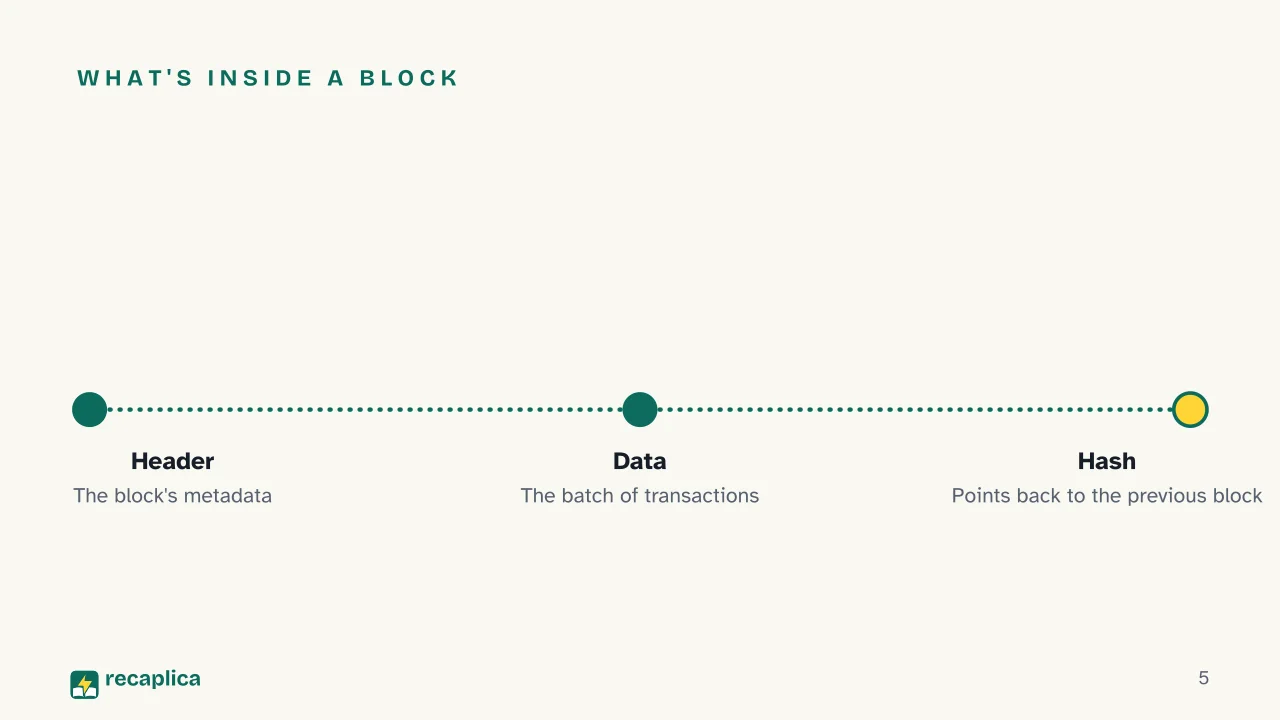 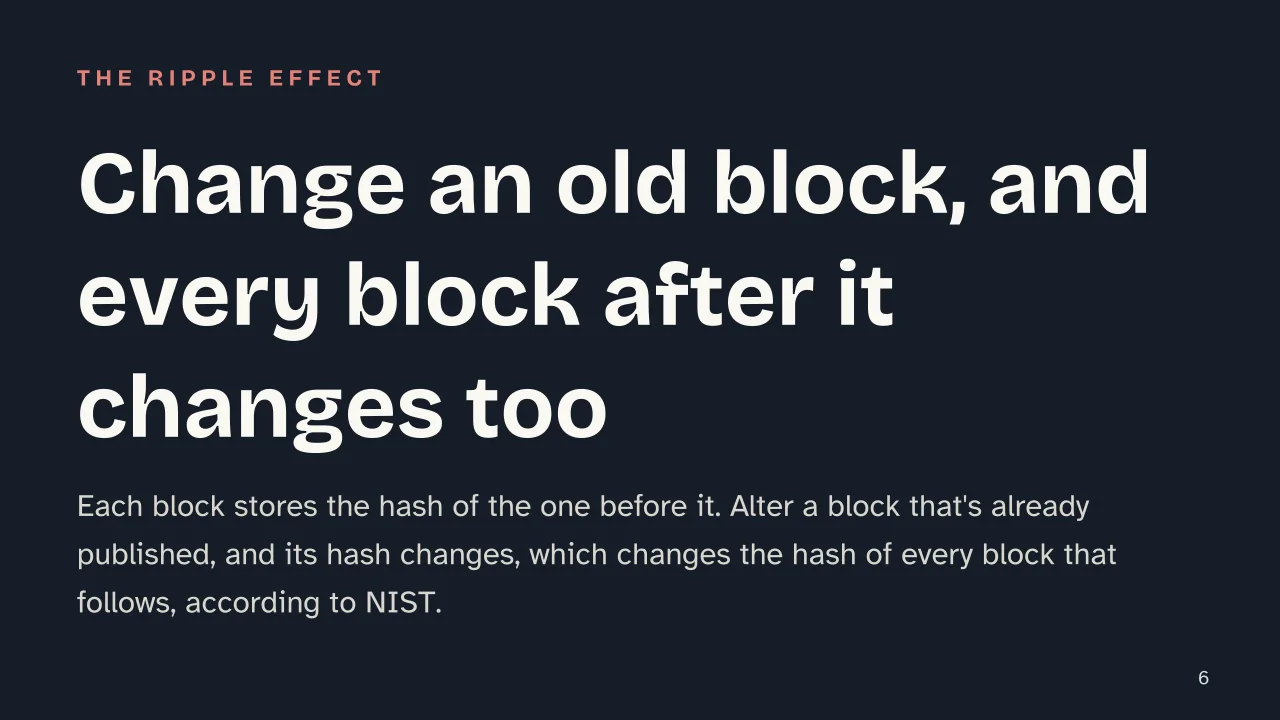  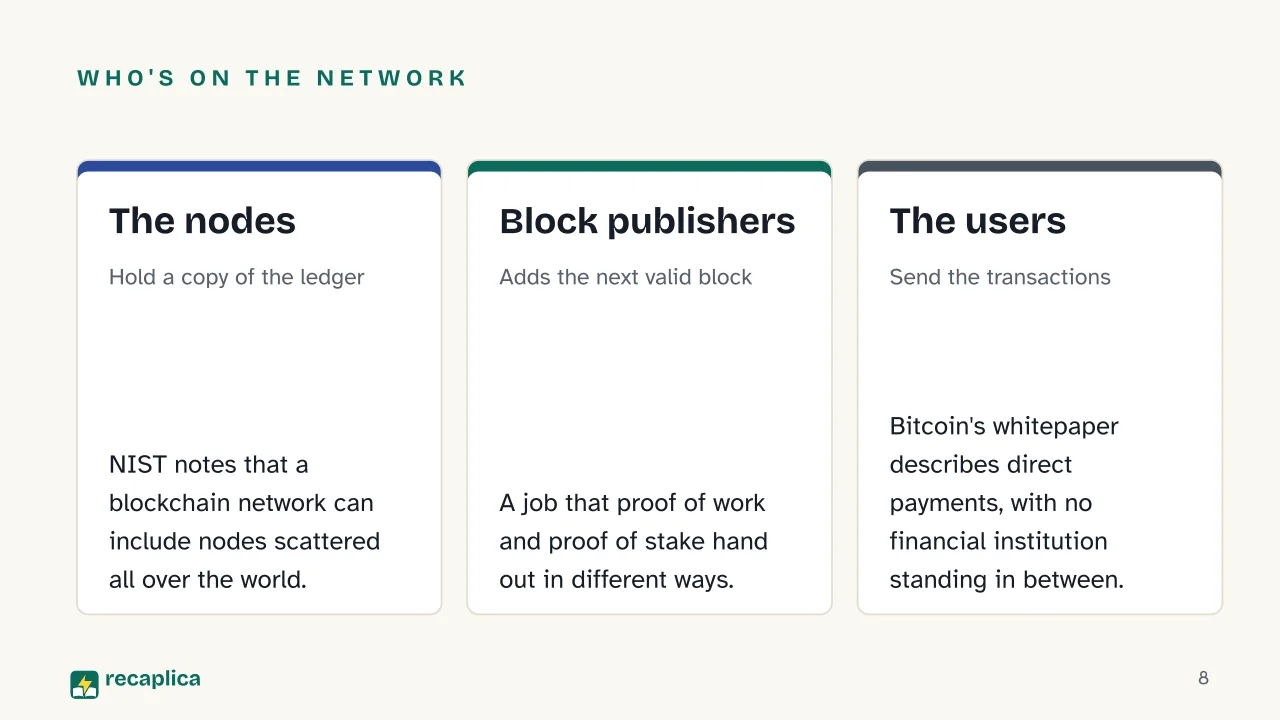  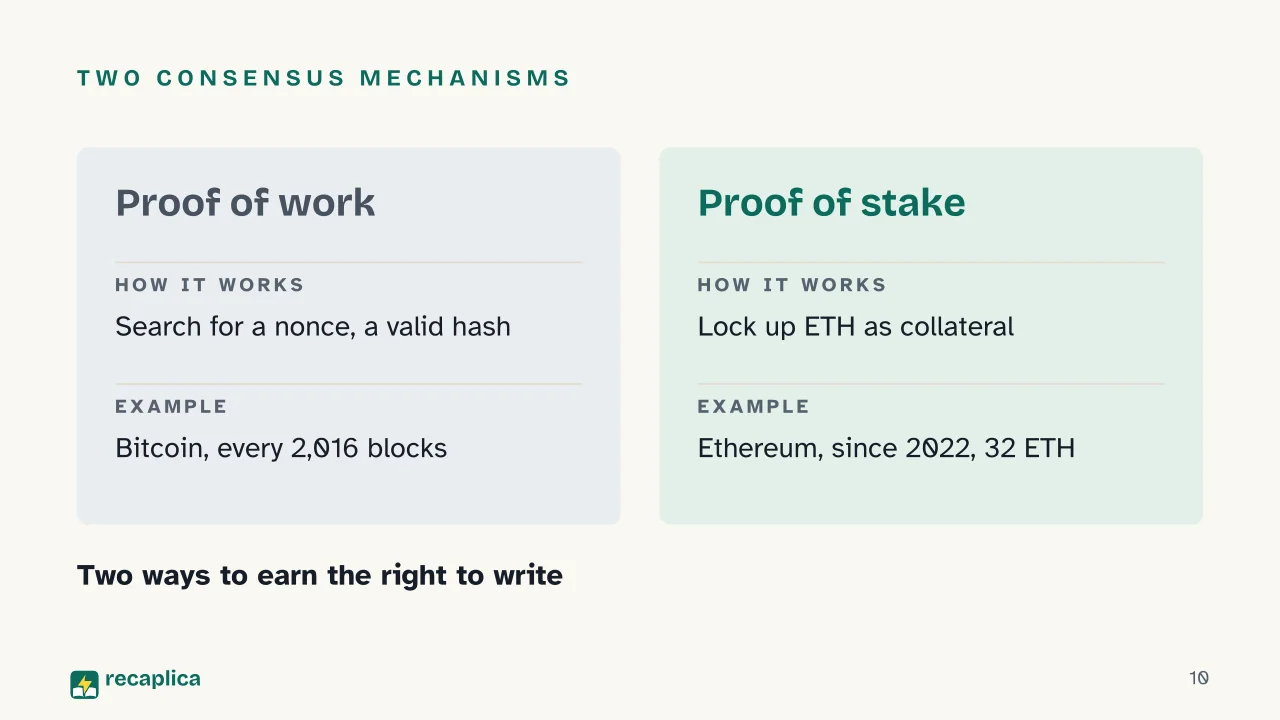 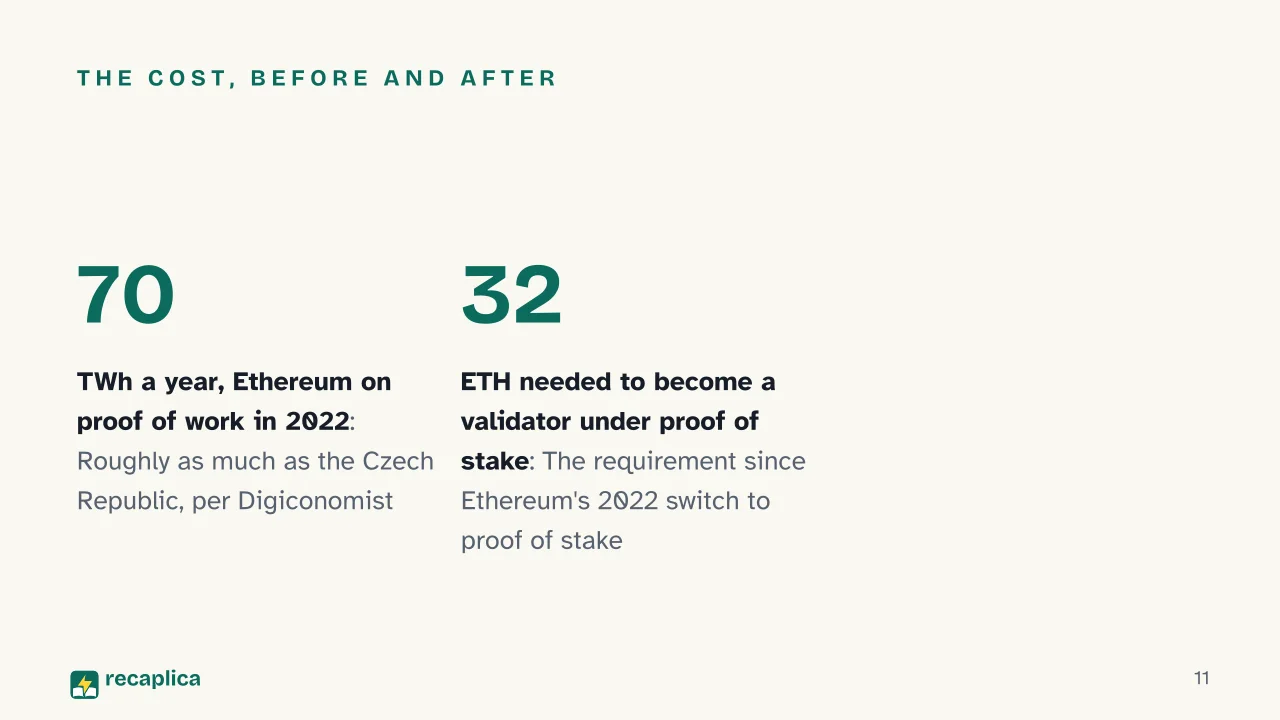  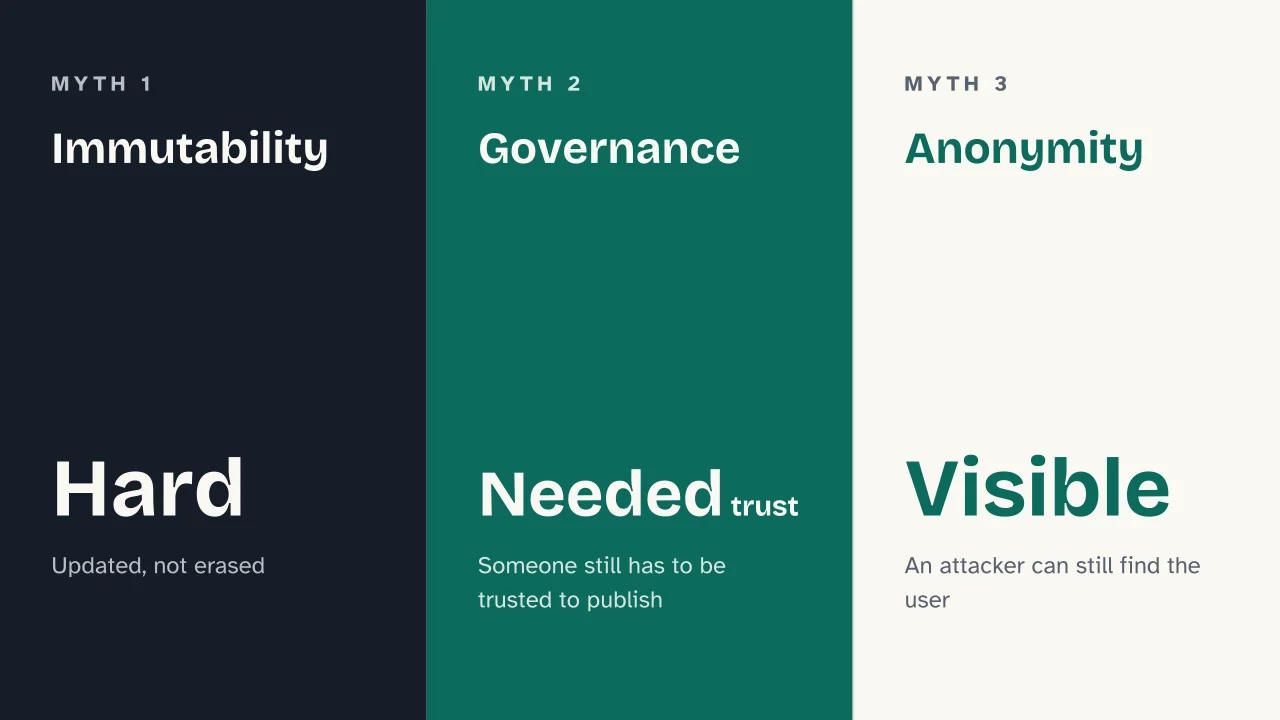 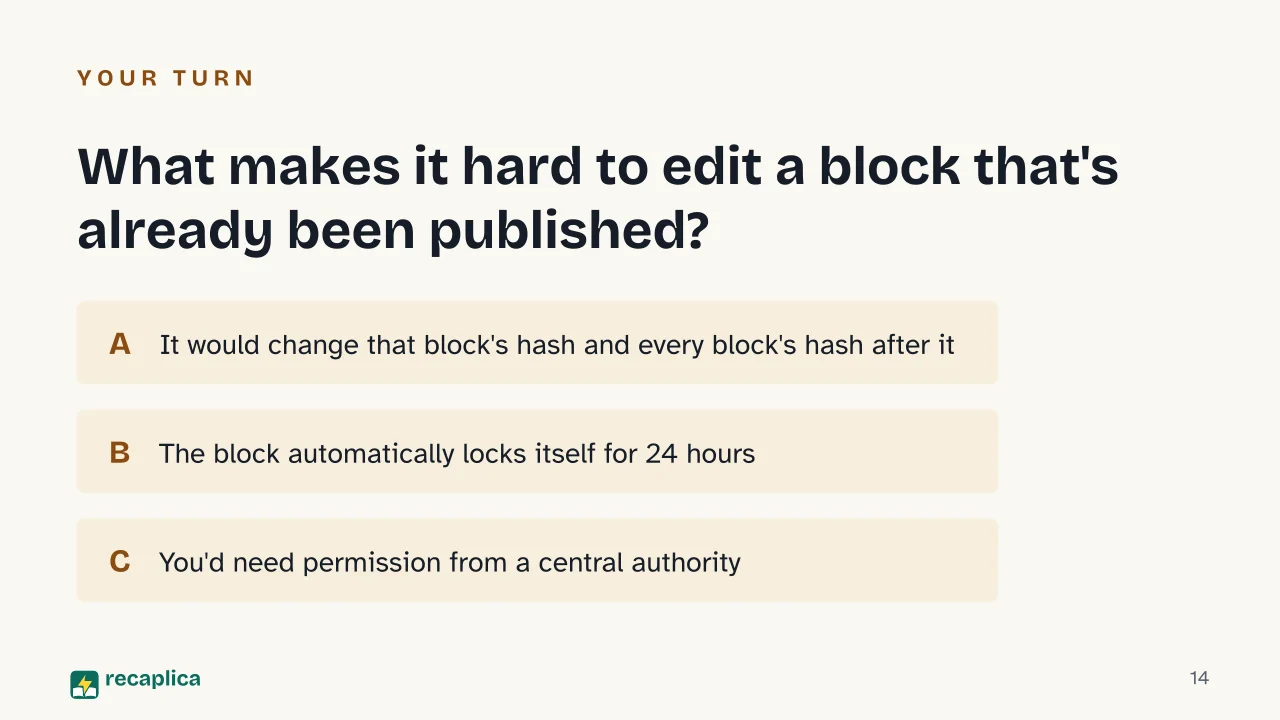  Common myths
Mind mapDrag the background to move around and the nodes to reposition them; use − and + to collapse and expand branches. 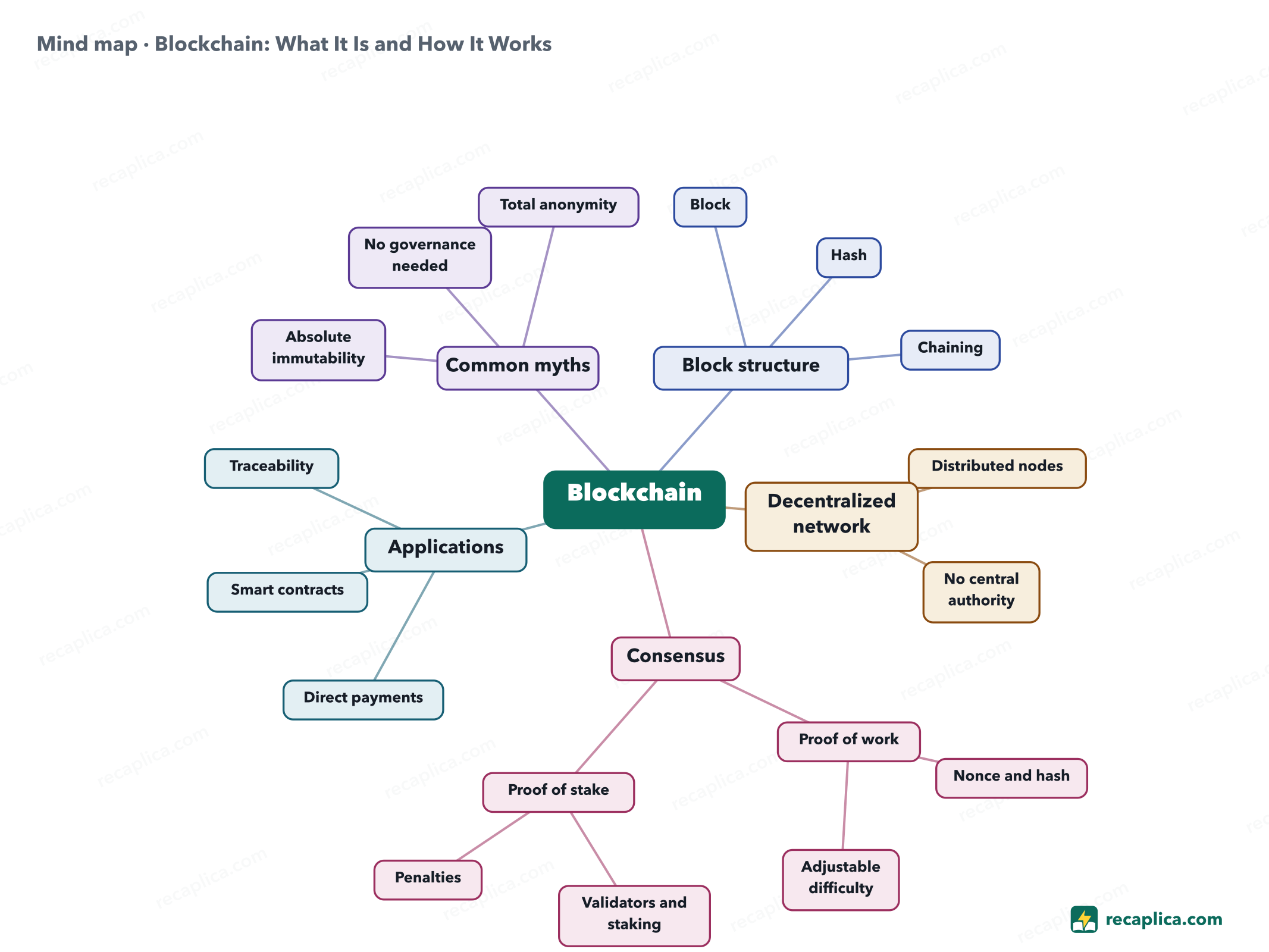
Quiz: test yourselfAnswer the questions to check what you have learned: you get instant feedback and a short explanation. Grade 0/10 0/5
FlashcardsTap the card to flip it and check whether you remember the answer, then move to the next one. 1 / 8 Explain it in your own wordsThe ultimate test: if you can explain it in simple words, you've truly understood it. Write your explanation, then compare it with the Recap. Your explanation is saved only on this device.
Frequently asked questionsAre blockchain and Bitcoin the same thing?No. Bitcoin was the first application built on a blockchain, described in Satoshi Nakamoto's 2008 whitepaper, but the underlying technology, a ledger of chained, hash-linked blocks, also powers things like Ethereum's smart contracts and supply-chain traceability, as NIST's 2018 report lays out. What's the difference between proof of work and proof of stake?Under proof of work, which Bitcoin uses, nodes compete to solve a cryptographic puzzle that burns electricity. Under proof of stake, which Ethereum has run since 2022, validators put up cryptocurrency as collateral instead of computing, and lose it if they misbehave. Who controls the data written to a blockchain?It depends on the network: in Bitcoin and Ethereum, no single entity does, according to NIST, but if one organization controls who can publish blocks, users still have to trust that organization. Can data already written to a blockchain be deleted or changed?Changing it is very hard, because it would alter the hash of that block and every one after it, but NIST is careful to note it isn't impossible in absolute terms: some applications handle corrections by recording a new update on top of the old data, instead of erasing it. How much energy does a proof-of-work blockchain use?It varies a lot by network: in July 2022, Ethereum, while it still ran on proof of work, was using about 70 TWh a year according to Digiconomist, roughly comparable to the Czech Republic's electricity consumption. Every Recap goes through an independent review before publication. |