recaplica
Clear in 30 seconds, yours in 10 minutes.
In 30 seconds quick read
TypeScript is a programming language that adds a syntax for types on top of JavaScript: a typed superset, developed by Microsoft and led by Anders Hejlsberg, previously the lead architect of C#. It was built to handle large-scale JavaScript applications, where the lack of static checks can hide bugs. Developers write optional type annotations, then the tsc compiler checks the types and converts everything into standard JavaScript, runnable anywhere JavaScript runs: the types get stripped out and don't exist at runtime. It debuted publicly on October 1, 2012, and according to the 2025 Stack Overflow Developer Survey, 43.6% of developers use it; by August 2025 it had also become the most used language on GitHub by monthly contributors, overtaking Python.
Key Points
TypeScript is a typed superset of JavaScript, it adds syntax for optional types while staying compatible with every valid JavaScript program (the official typescriptlang.org definition).
Developed by Microsoft and led by Anders Hejlsberg, previously the lead architect of C# and, before that, of Turbo Pascal and Delphi; first public release on October 1, 2012 (version 0.8), followed by TypeScript 1.0 on April 12, 2014.
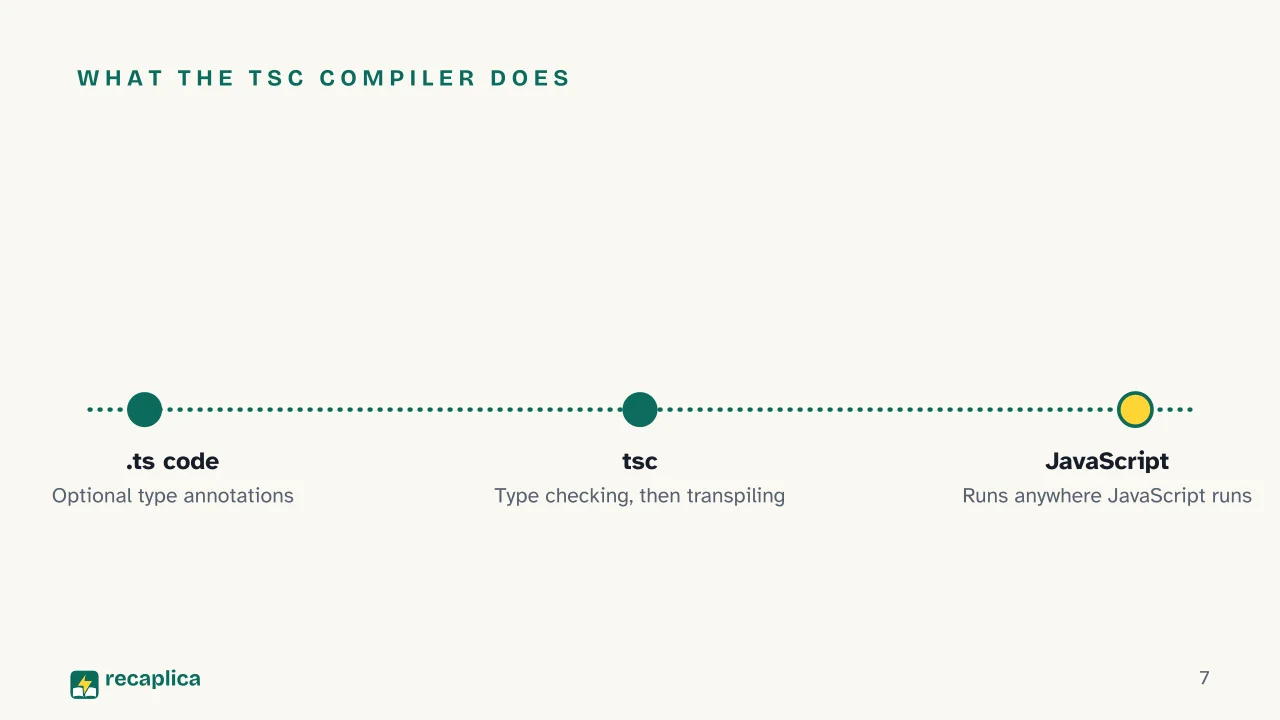
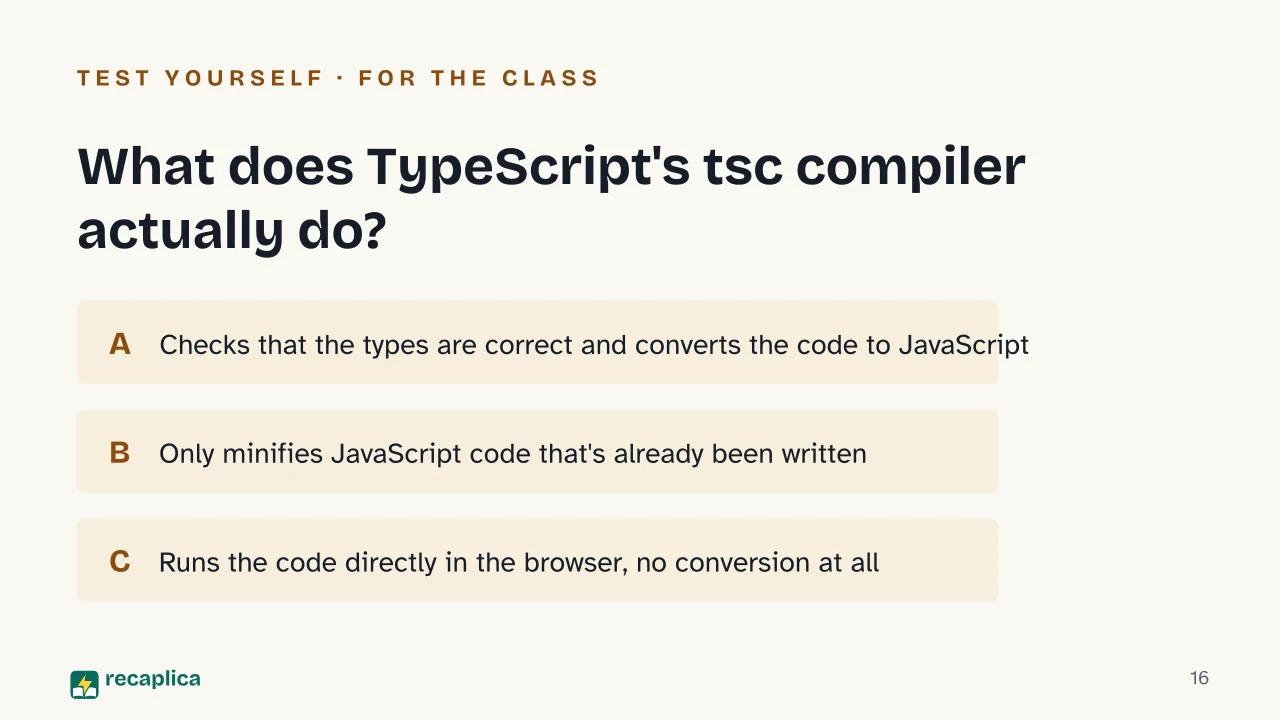
The tsc compiler does two distinct things, it checks the types (type checking) and converts the code into readable, standard JavaScript (transpiling); the types are stripped out and don't exist at runtime.
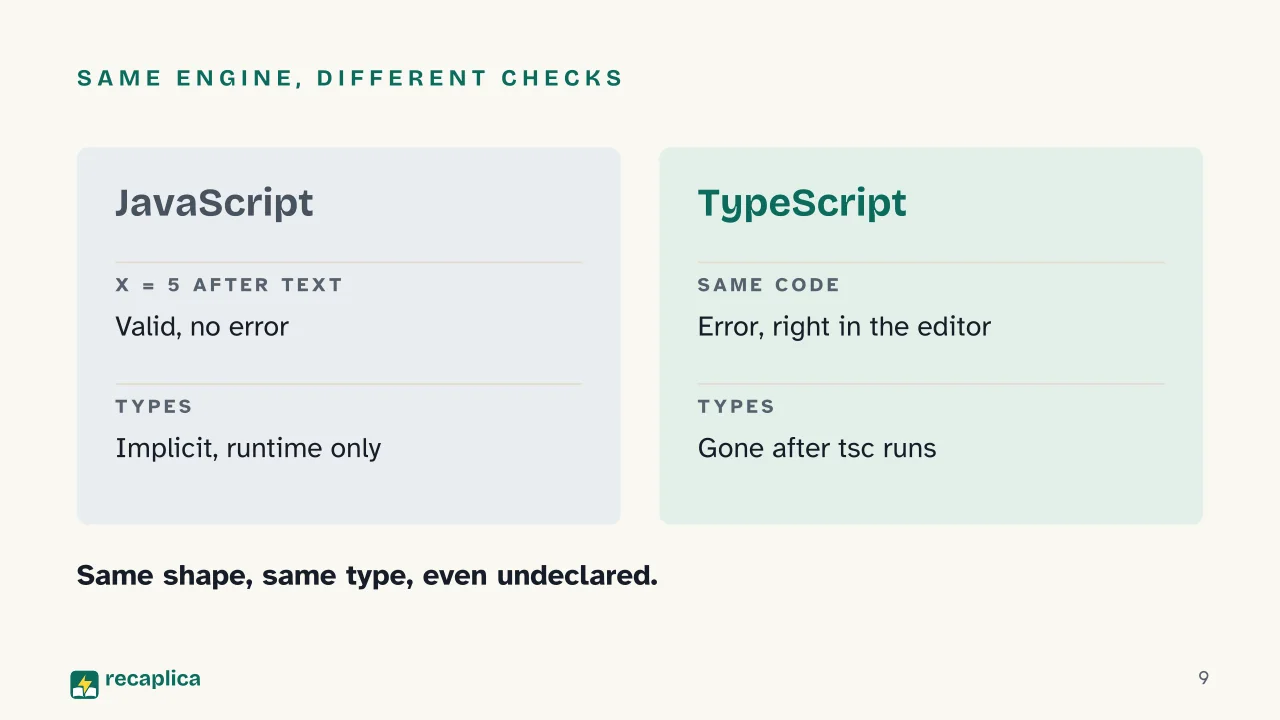
It uses a structural type system, two objects with the same shape count as the same type, no matter what interface or class name they were declared with.
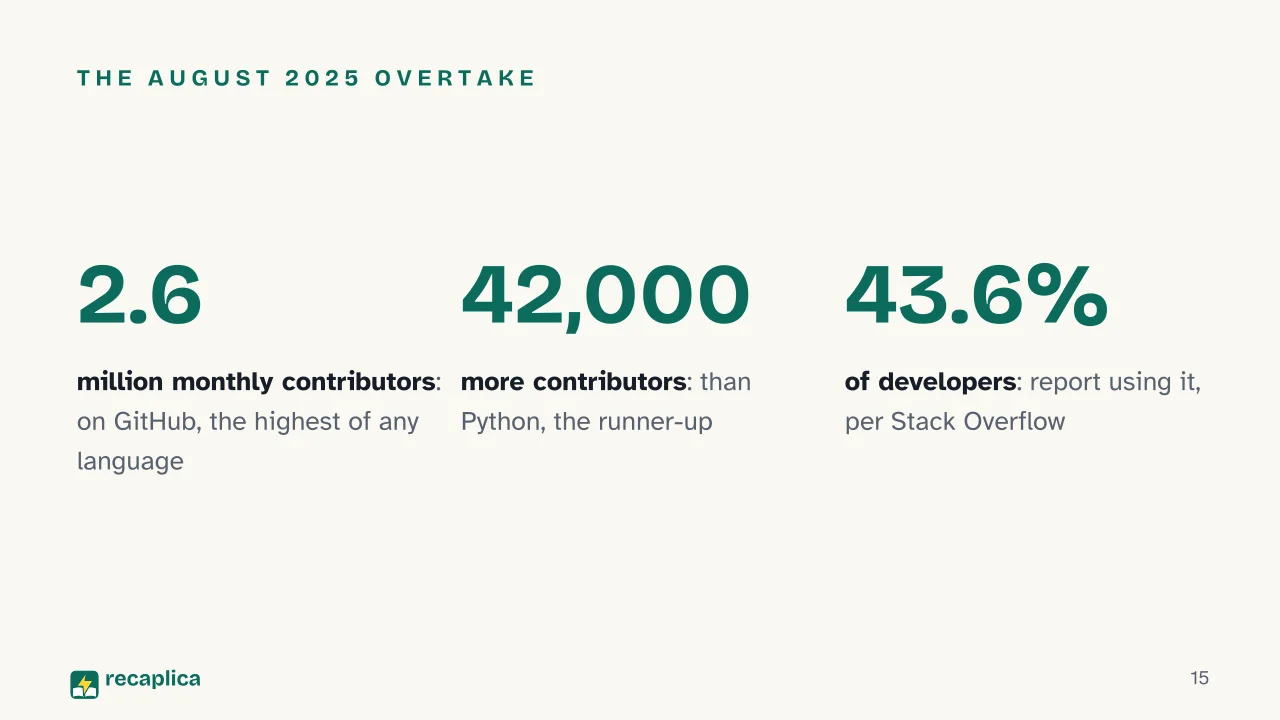
In August 2025 it became, for the first time, the most used language on GitHub by monthly contributors, overtaking Python by about 42,000 (Octoverse 2025 report), while still ranking 6th for self-reported use in the 2025 Stack Overflow survey (43.6%).
It can be adopted incrementally on existing JavaScript projects, even just with JSDoc annotations inside .js files, without rewriting everything from scratch.
Key figures
43.6% the share of developers who report using TypeScript, in the survey Source: Stack Overflow Developer Survey 2025
2,636,006 TypeScript's monthly contributors on GitHub in August 2025, the highest count of any language Source: GitHub Octoverse 2025
October 1, 2012 the date of TypeScript's first public release, version 0.8 Source: Wikipedia — TypeScript
Deep Dive
A superset that adds types to JavaScript
TypeScript is a programming language that adds a syntax for types on top
of JavaScript: a typed superset, developed by
Microsoft, described on its official site as a strongly typed language that
builds on JavaScript. Every valid JavaScript program is also a valid
TypeScript program: the difference is that developers can add optional type
annotations, which a compiler checks before the code runs. The main
benefit, per the official site, is catching errors right in the editor,
before you even run the code; the Handbook sums it up by saying the
advantage is highlighting unexpected behavior, lowering the chance of bugs.
Practical example: an interface describes the shape of an object, and
a union type limits the values it can hold.
Try assigning a string to user.id instead of a number, and the compiler
flags the error before the code ever runs: the same kind of check that,
in PHP, only exists if type hints are explicitly
added to functions.
The origins, from Microsoft to Anders Hejlsberg
TypeScript is developed by Microsoft, with Anders Hejlsberg as lead
architect and a contribution from Luke Hoban. Hejlsberg had already been
the lead architect of C# at Microsoft and, before that, of Turbo Pascal and
Delphi. According to Wikipedia, the language was built to address
JavaScript’s shortcomings for large-scale application development, both
inside Microsoft and among its outside customers: managing complex
JavaScript code with no static types called for dedicated tooling that
JavaScript alone didn’t offer.
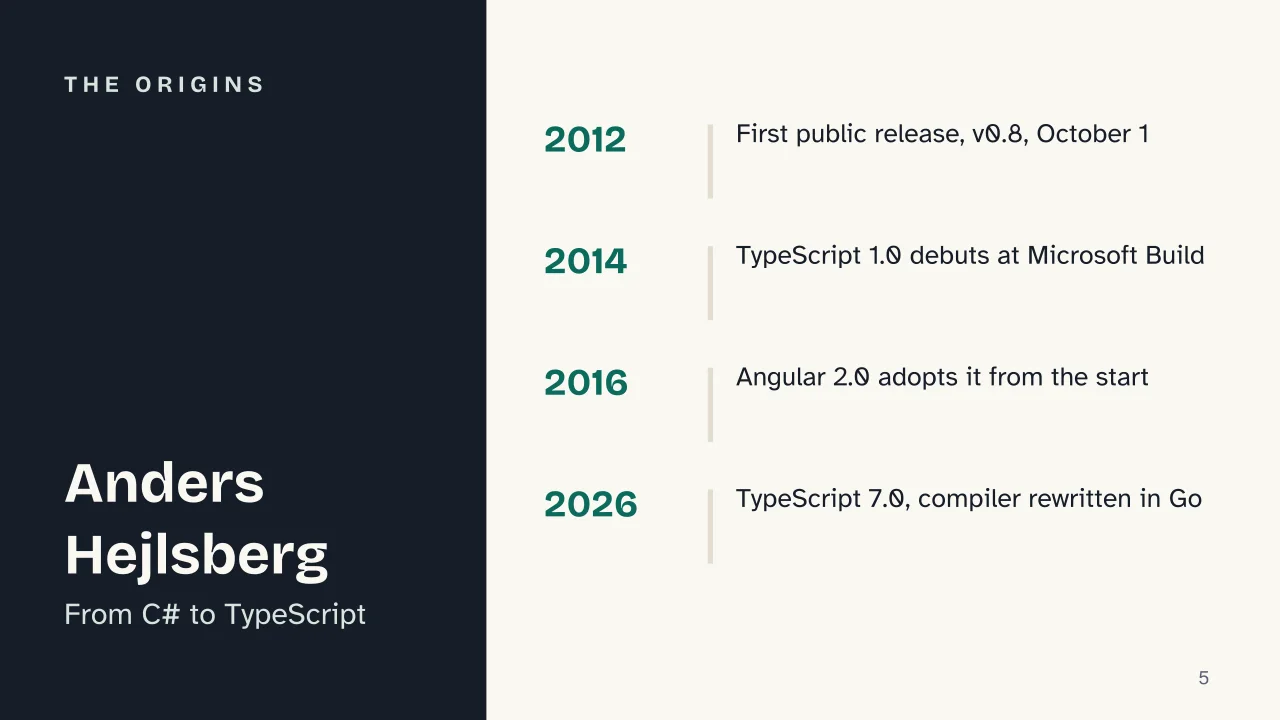
Year
Milestone
2012
First public release, version 0.8, October 1
2014
TypeScript 1.0, announced at Microsoft Build, April 12
2016
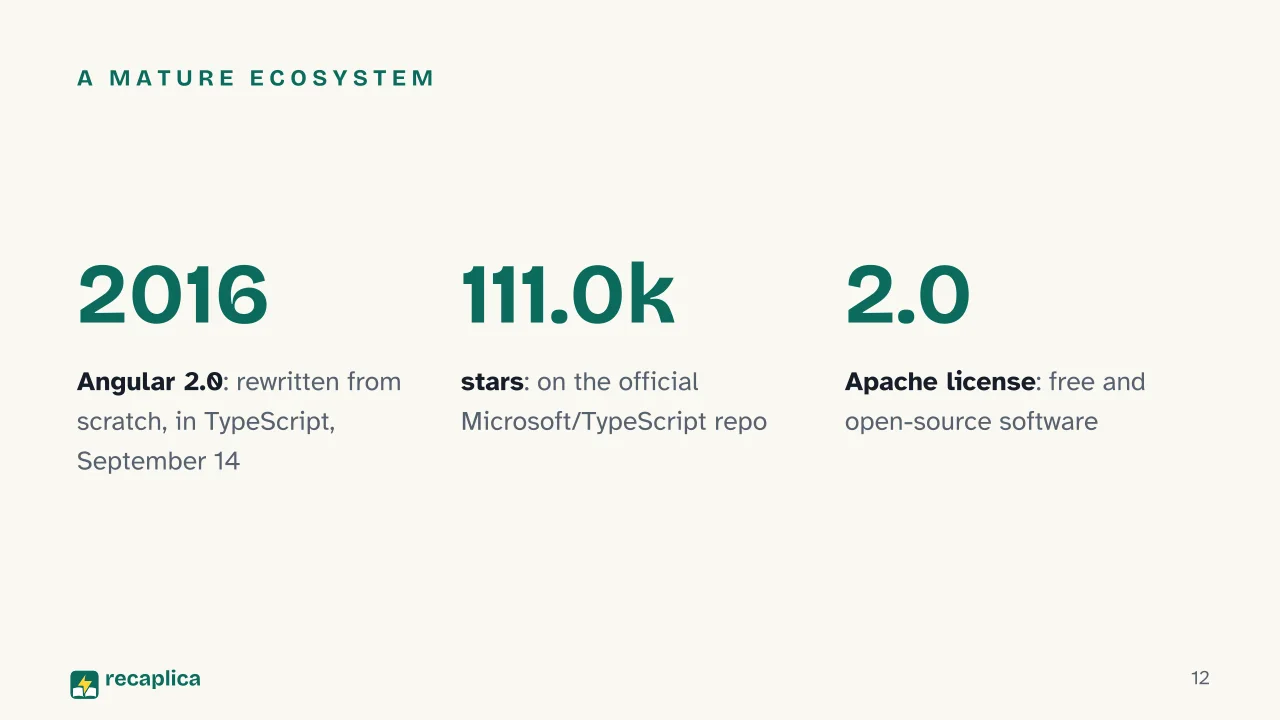
Angular 2.0, rewritten in TypeScript from the start, September 14
2026
TypeScript 7.0, reaches general availability July 8, with the compiler rewritten in Go
The design’s declared influences are C#, F#, Java and JavaScript itself.
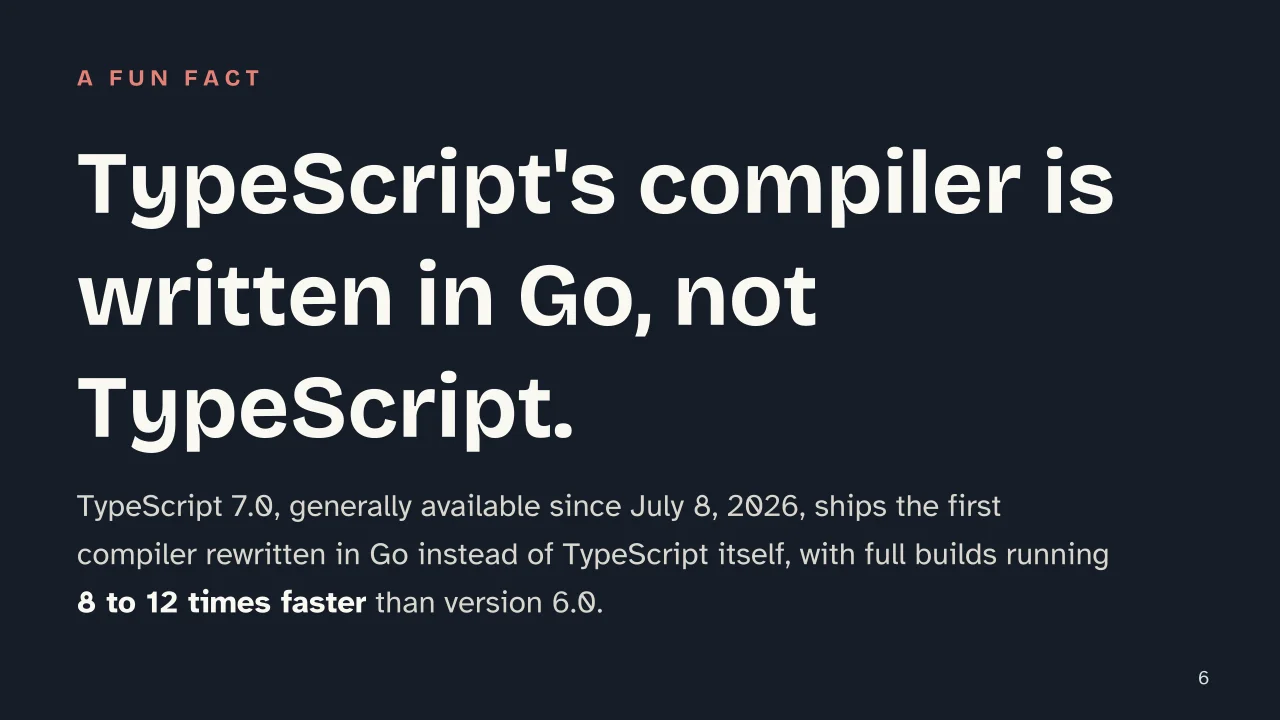
TypeScript 7.0, generally available since July 8, 2026, ships the first
compiler rewritten in Go instead of TypeScript: per the official
announcement, full builds run 8 to 12 times faster than version 6.0, with
one concrete case, the Visual Studio Code project, dropping from 125.7 to
10.6 seconds — a curious technical twist, for a language born specifically
to add types to JavaScript.
What the tsc compiler actually does
The official compiler, tsc, does two distinct things: type checking,
verifying that the types used in the code are consistent, and transpiling
(or emit), converting TypeScript code into standard, readable,
non-obfuscated JavaScript, as the official Microsoft/TypeScript repository
describes it. It installs with npm install -D typescript and runs with
tsc file.ts. Once checked, the types get stripped out: at runtime,
whether in the browser, in Node.js, Deno or Bun, only plain JavaScript
runs, with no trace of the types left.
TypeScript also relies on type inference: writing let helloWorld = "Hello World", the compiler automatically recognizes that helloWorld is
a string, with no explicit annotation needed. The type system is
structural (also known as “duck typing”): two objects with the same
shape, the same fields and the same types, count as the same type,
regardless of the interface name they were declared with. It also supports
narrowing: a check like typeof obj === "string" narrows the type
inside that block of code, updating the analysis as it reads through the
program.
JavaScript
TypeScript
Types
Dynamic, checked only while the program runs
Static and optional, checked by the compiler before it runs
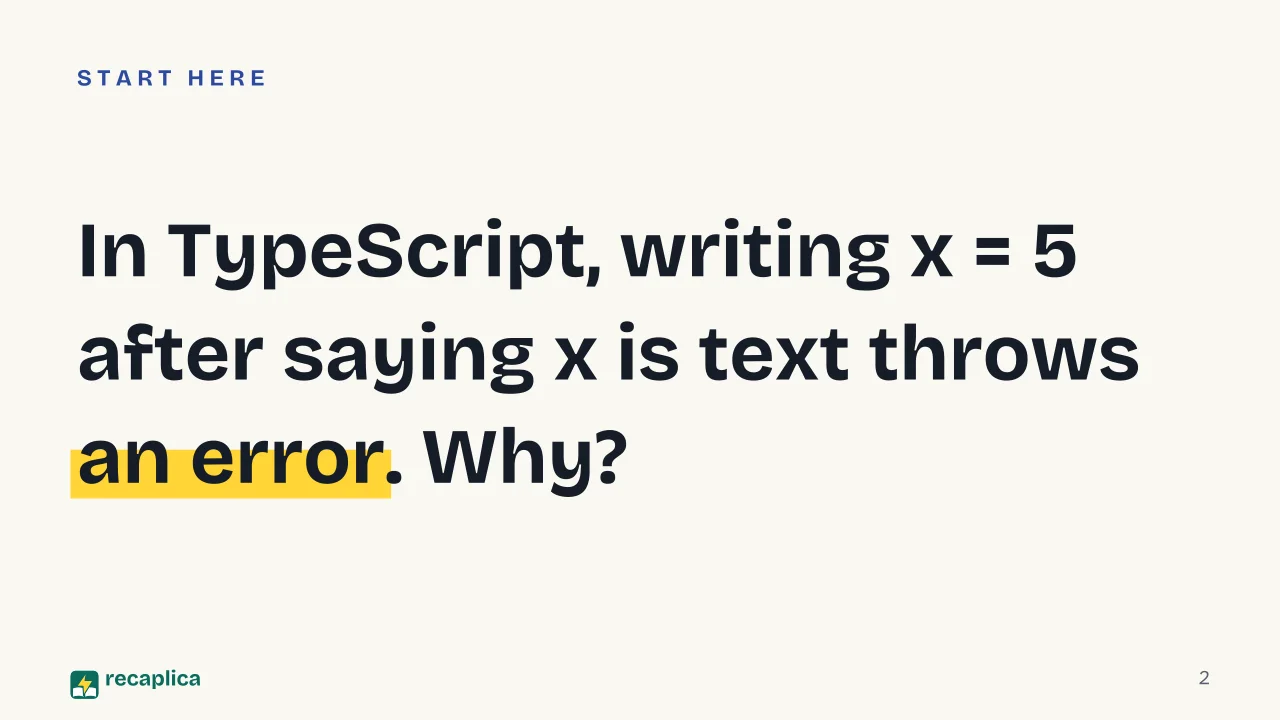
let x = "hi"; x = 5;
Valid, no error
Compile-time error
To use it
Runs natively in every browser
Needs the tsc compiler (npm install -D typescript)
What actually executes
The code you wrote
The JavaScript tsc generated, stripped of types
Why more and more frameworks choose it
GitHub’s Octoverse 2025 report notes that nearly every major frontend
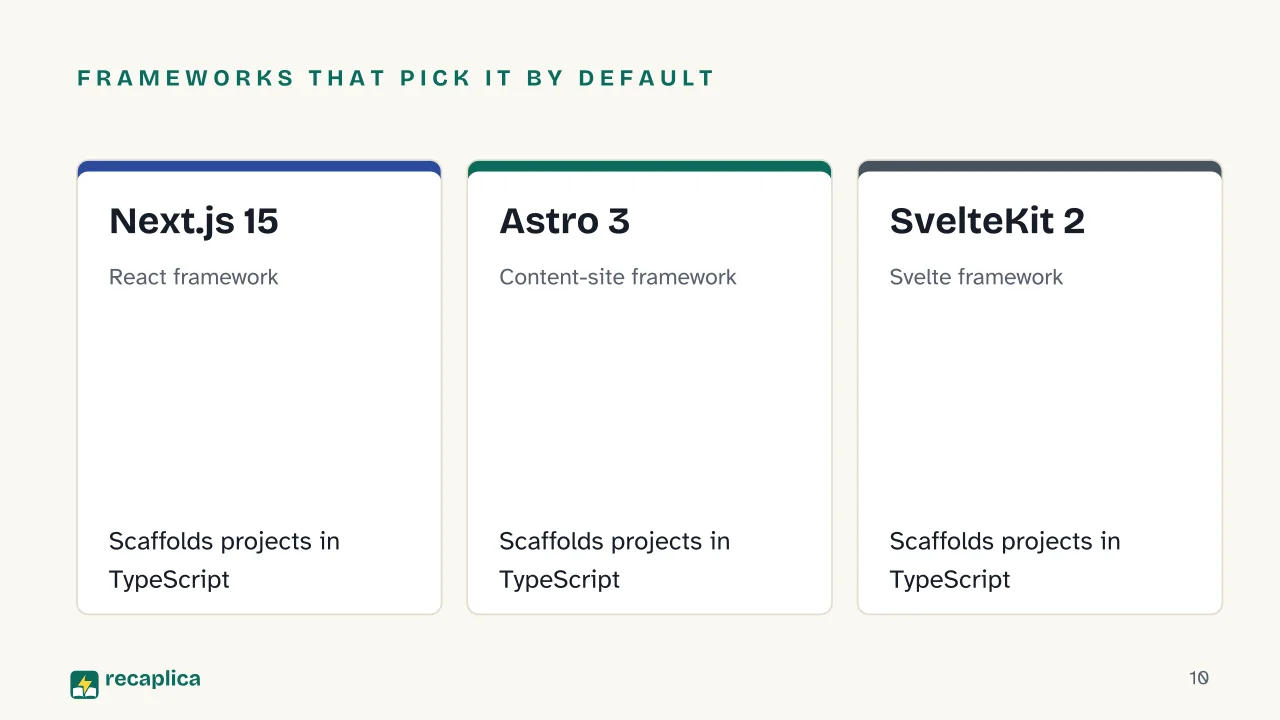
framework scaffolds projects in TypeScript by default, citing Next.js 15,
Astro 3 and SvelteKit 2 as examples. Angular, developed by Google,
explicitly recommends using TypeScript and has used it since the 2.0
rewrite on September 14, 2016: the choice dates back to that framework’s
design, not a later switch, with an ecosystem that counts over 1.7 million
developers.
Among the factors the Octoverse 2025 report points to for TypeScript’s
growth, besides the frameworks that scaffold with it by default, is also
compatibility with artificial
intelligence-assisted workflows:
typed systems reportedly help catch errors in AI-generated code earlier in
the development pipeline, and projects that lean on AI tools benefit from
stricter type contracts. The report also cites tools like Vite, ts-node
and Bun as factors that lower the barrier for people approaching the
language for the first time.
How widely used it is, by the numbers
In August 2025, TypeScript became, for the first time, the most used
language on GitHub by monthly contributors: 2,636,006 in total,
growing 66.63% year over year, overtaking Python by about 42,000
contributors. The Octoverse 2025 report calls this overtake “the most
significant language shift in more than a decade.”
In the 2025 Stack Overflow Developer Survey, the metric looks
different: 43.6% of developers report using it, 6th place overall, behind
JavaScript, HTML/CSS, SQL, Python and Bash/Shell. Among professional
developers who use AI tools, that share climbs to 51.4%, the highest of
any subgroup the survey measured: a sign of correlation between static
typing and AI-assisted workflows, more than a single cause the survey
itself claims to establish.
Not all smooth sailing, the learning curve
The critiques exist too. On freeCodeCamp, an article aimed at developers
weighing whether to learn TypeScript notes that using it “isn’t as simple
as opening the browser console and writing code”: it takes a compiler, a
build system and a configuration file, tsconfig.json, which can produce
confusing setup errors for beginners. Coming from JavaScript, the same
article notes, writing type annotations can feel like “extra code” that
takes extra time, and the initial phase slows development down. Once the
project is set up, though, the same account describes a workflow that goes
back to feeling smooth: the cost sits mostly in the initial adoption, not
in day-to-day use once things are running. Anyone curious about the kind
of step-by-step reasoning that goes into writing a correct program, types
included, can compare it with the logic of any
algorithm: that, too, comes down to defining
precise rules in advance so the result stays predictable.
Slide deck
Slides ready to download and make your own in PowerPoint or Google Slides, with speaker notes. Pick the Flash cut or the Full one.
✗ Myth TypeScript is a completely different language from JavaScript, meant to replace it.
✓ Reality It's a superset, every valid JavaScript program is also valid TypeScript. On top of that, TypeScript code compiles into standard, readable JavaScript, not obfuscated code, as the official Microsoft/TypeScript repository on GitHub describes it, so what actually runs in the end, in the browser or in Node.js, stays JavaScript.
✗ Myth TypeScript's types still exist at runtime, for example inside the browser.
✓ Reality They're stripped out during compilation. Once the program runs, whether in the browser, in Node.js or elsewhere, only plain JavaScript remains, with no trace of the types, as the official typescriptlang.org site makes clear.
✗ Myth TypeScript is a niche language, barely used by developers.
✓ Reality In August 2025 it became, for the first time, the most used language on GitHub by monthly contributors, with 2,636,006 contributors and an overtake of Python by about 42,000 people, the most significant shift in the language rankings in more than a decade according to the Octoverse 2025 report. It still ranks 6th, though, for the share of developers who report using it in the 2025 Stack Overflow survey (43.6%), two different metrics, both measured with precise numbers.
Mind map
Drag the background to move around and the nodes to reposition them; use − and + to collapse and expand branches.
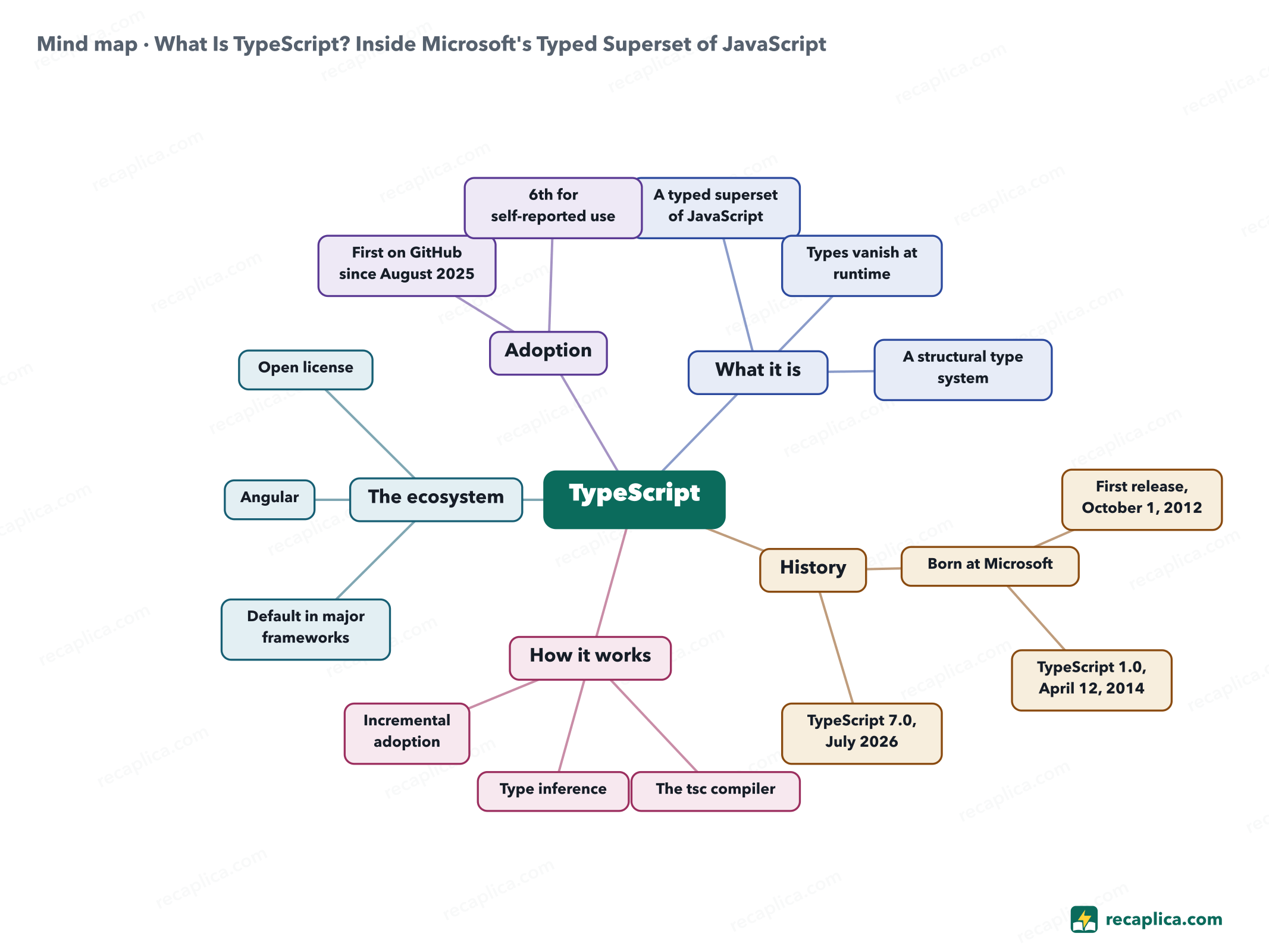
A typed superset of JavaScriptAdds optional types, stays compatible with every valid JavaScript program
Types vanish at runtimeStripped out during compilation
A structural type systemSame shape, same type, regardless of the name
History
Born at MicrosoftLed by Anders Hejlsberg, previously C#'s architect
First release, October 1, 2012Version 0.8
TypeScript 1.0, April 12, 2014Announced at Microsoft Build
TypeScript 7.0, July 2026Compiler rewritten in Go, 8 to 12 times faster on full builds
How it works
The tsc compilerType checking, then transpiling into JavaScript
Type inferenceSuggests types without needing them written out
Incremental adoptionEven just with JSDoc annotations in .js files
The ecosystem
Default in major frameworksNext.js, Astro and SvelteKit scaffold in TypeScript
AngularWritten in TypeScript since the 2016 rewrite
Open licenseApache License 2.0, on the Microsoft/TypeScript repo
Adoption
First on GitHub since August 2025By monthly contributors, overtaking Python
6th for self-reported use43.6% in the 2025 Stack Overflow survey
Quiz: test yourself
Answer the questions to check what you have learned: you get instant feedback and a short explanation.
Grade0/100/5
Answers: 1-A · 2-B · 3-A · 4-A · 5-A
Flashcards
Tap the card to flip it and check whether you remember the answer, then move to the next one.
1 / 8
Explain it in your own words
The ultimate test: if you can explain it in simple words, you've truly understood it. Write your explanation, then compare it with the Recap.
Your explanation is saved only on this device.
TypeScript is a programming language that adds a syntax for types on top of JavaScript: a typed superset, developed by Microsoft and led by Anders Hejlsberg, previously the lead architect of C#. It was built to handle large-scale JavaScript applications, where the lack of static checks can hide bugs. Developers write optional type annotations, then the tsc compiler checks the types and converts everything into standard JavaScript, runnable anywhere JavaScript runs: the types get stripped out and don't exist at runtime. It debuted publicly on October 1, 2012, and according to the 2025 Stack Overflow Developer Survey, 43.6% of developers use it; by August 2025 it had also become the most used language on GitHub by monthly contributors, overtaking Python.
Frequently asked questions
Are TypeScript and JavaScript the same language?
No, but they're closely tied. TypeScript is a superset of JavaScript, every valid JavaScript program is also valid TypeScript, with an added syntax for declaring types. TypeScript code doesn't run on its own, a compiler turns it into standard JavaScript before it executes.
What's the point of types in TypeScript, if they disappear once compiled?
They matter while the code is being written, not while it runs. The compiler uses the types to flag errors right inside the editor, before the program ever runs, and to offer more precise autocompletion and suggestions thanks to type inference.
Can TypeScript be used in an existing JavaScript project?
Yes. The official site presents it as adoptable incrementally, a project can be converted one file at a time, or it can stay plain JavaScript and simply gain JSDoc annotations to get some of the type checking without changing the file extensions.
Who created TypeScript, and why?
Microsoft develops it, with Anders Hejlsberg as lead architect and a contribution from Luke Hoban; according to Wikipedia, it was built to address JavaScript's shortcomings for large-scale application development, both inside Microsoft and among its outside customers.
Is TypeScript hard to learn, coming from JavaScript?
Developers who've written about the switch, for instance on freeCodeCamp, describe a slower start, with a compiler and a configuration file (tsconfig.json) to learn, something plain JavaScript doesn't require. Once the project is set up, though, the same account describes a workflow that goes back to feeling smooth.
Every Recap goes through an independent review before publication.
Statistics, only if you say so
To learn which Recaps help most we would use Google Analytics, with aggregate, anonymous data. It starts only with your OK, and you can change your mind anytime. Privacy policy