Skip to content
recaplica

    One moment: security check

    Cloudflare wants to make sure you're not a robot. Tick the box below and your search will continue on its own.

    IT
    recaplica Robot vacuum cleaners: how they work and navigate your home
    © 2026 Recaplica · recaplica.com — All rights reserved
    Home › Technology

    Robot vacuum cleaners: how they work and navigate your home

    By Recaplica Newsroom · Updated on September 1, 2026

    What to print

    Page numbers appear when printing with default margins.

    Slides

    Choose a cut

    Flash10 slidesThe essential thread, to present in classFull18 slidesEvery chapter and the deeper detail

    Both come with speaker notes.

    Telegram channel
    recaplica Clear in 30 seconds, yours in 10 minutes.
    In 30 seconds Key points Figures Deep dive Slides Myths Mind map Quiz Flashcards FAQ

    In 30 seconds quick read

    A robot vacuum is a small autonomous appliance that cleans your floors without being pushed by hand, finding its way around with sensors and returning to its dock on its own to recharge. The first commercially successful model, iRobot's Roomba, arrived in 2002, but it wasn't the first ever: the Electrolux Trilobite beat it to market back in 2001, after Electrolux had shown off a prototype on TV in 1996. Since then, navigation technology has changed radically, from the random movements of early models to real maps of the home built with lasers (LiDAR) or cameras (vSLAM). The industry is no longer dominated by one brand either: China has become the world's largest market, while iRobot itself went through a deep crisis that ended in bankruptcy in late 2025.

    Key Points

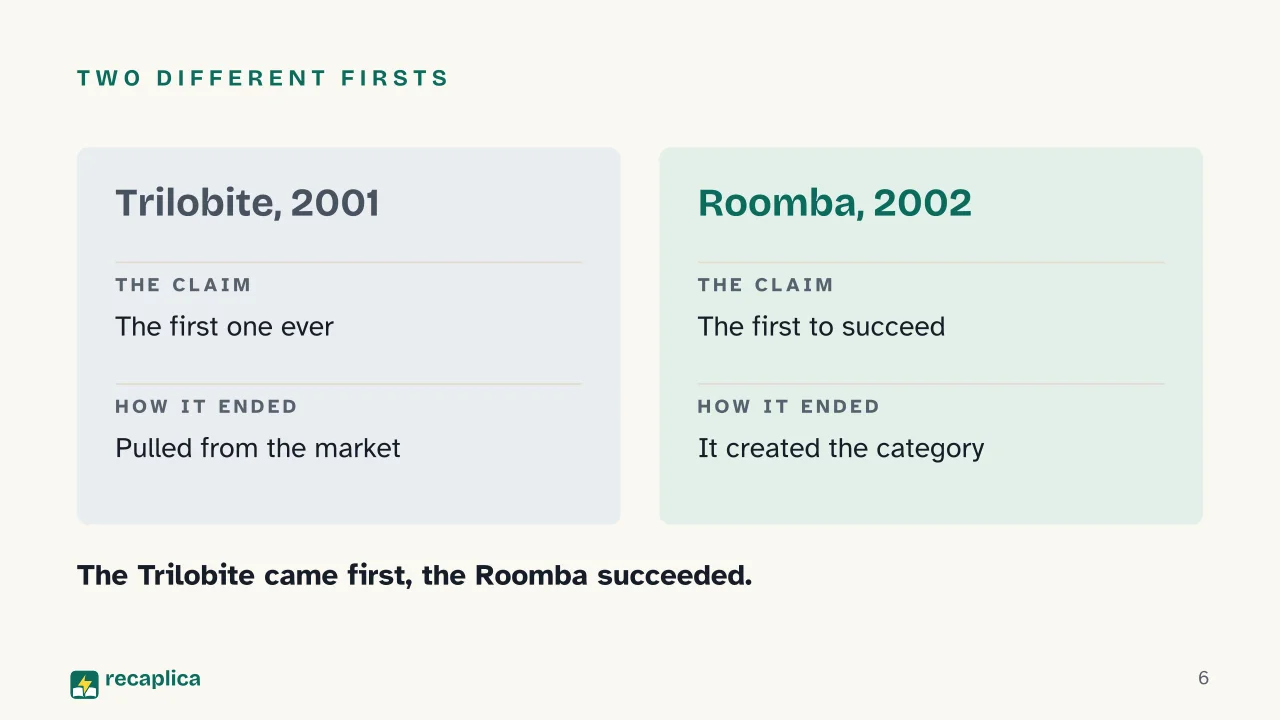
    • The first commercially successful robot vacuum was iRobot's Roomba, launched in 2002; the first robot vacuum ever was Electrolux's Trilobite, launched commercially in 2001 after a TV prototype demo in 1996, but it had serious navigation problems and was pulled from the market.
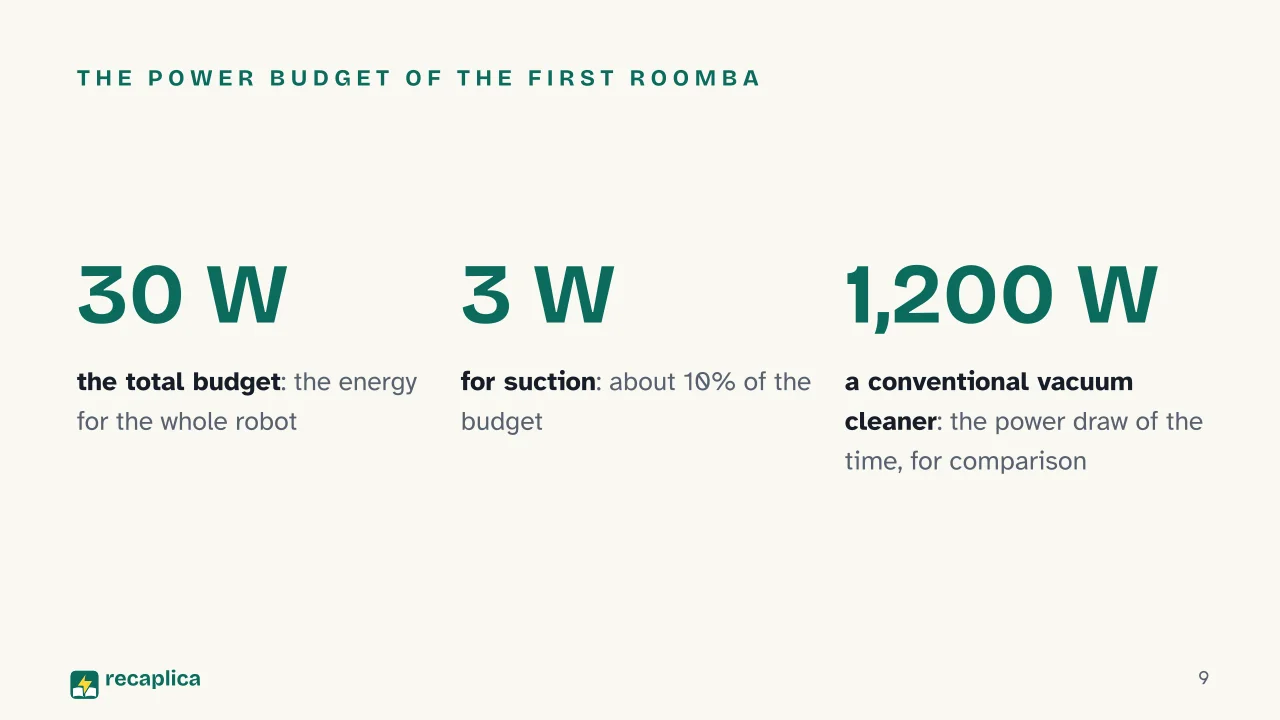
    • Suction was born from an energy trade-off: the original Roomba devoted only about 3 W (10% of a 30 W power budget) to its vacuum motor, versus roughly 1,200 W for a conventional vacuum cleaner, compensating with a mechanical squeegee-style design.
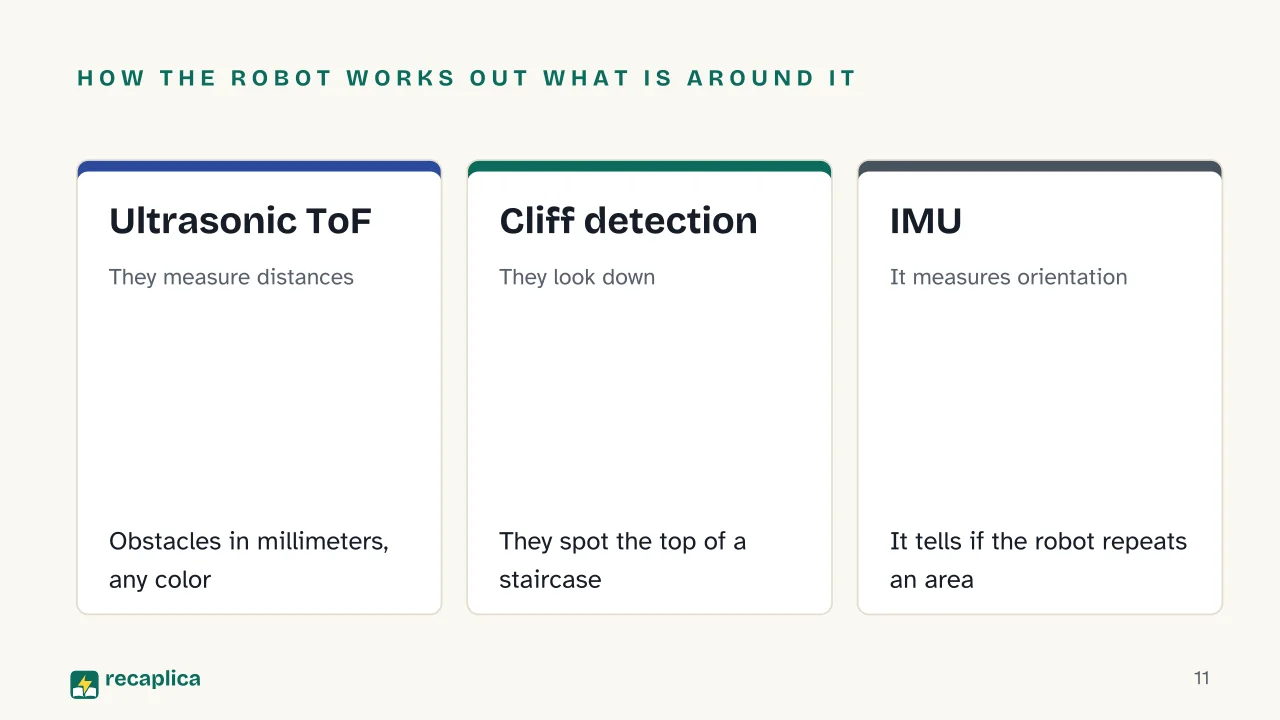
    • Ultrasonic time-of-flight sensors, cliff detection, and an inertial measurement unit (IMU) let the robot avoid obstacles, stay off the stairs, and tell whether it's covering the same patch of floor twice.
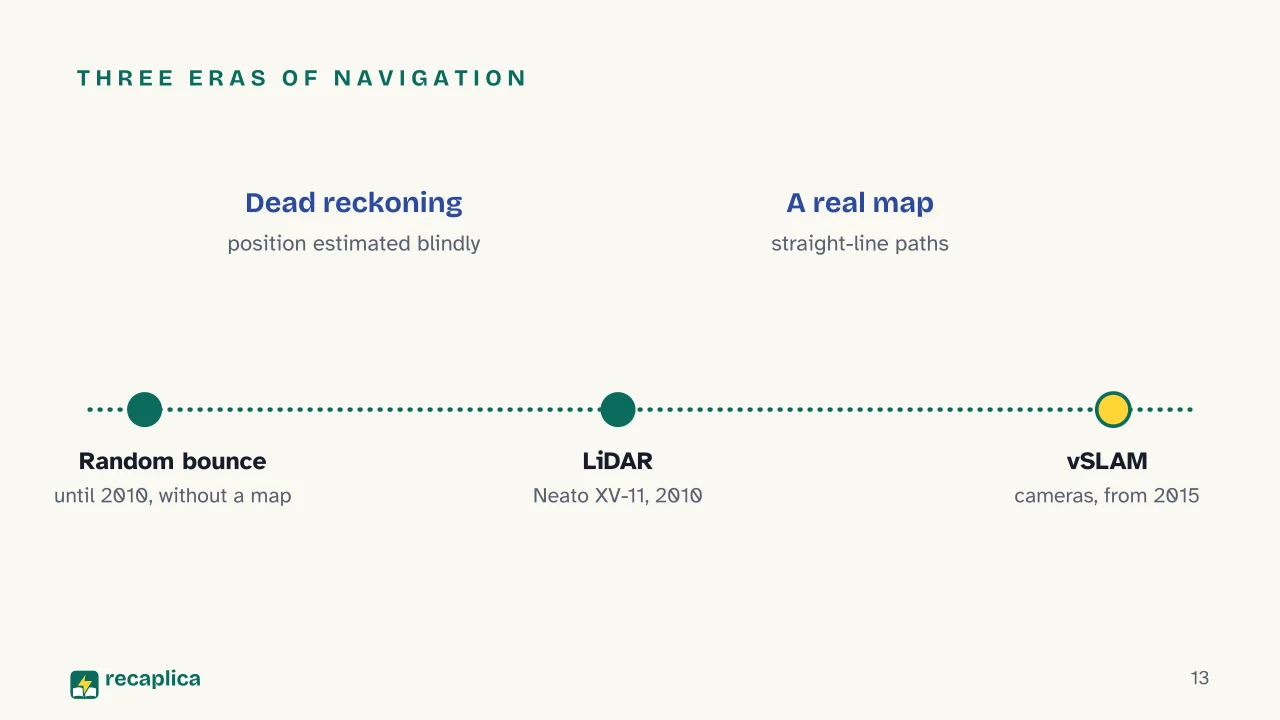
    • Until 2010 most robots navigated by random movement (random bounce); since then, laser mapping (LiDAR, starting with the Neato XV-11) and camera-based mapping (vSLAM, from 2015) have taken over, enabling systematic cleaning paths.
    • The market is no longer dominated by iRobot alone: the company filed for bankruptcy in December 2025 and was acquired by a Chinese partner, while China has been the world's largest market for these robots since 2020.
    • Physical limits remain regardless of the navigation technology: thick rugs, spaces under low furniture, and hair or elastic bands tangled in the brushes can overheat the motors.

    Key figures

    • 2002 the year iRobot launched the first production version of the Roomba, the first commercially successful robot vacuum Source: IEEE Spectrum, How Roomba Got Its Vacuum
    • Over 40 million robots sold worldwide by iRobot, according to the company's official figure released on May 31, 2022 Source: iRobot, official press release, 2022
    • 3 W out of 1,200 W the power devoted to suction in the original Roomba (about 10% of a 30 W total power budget), versus the power draw of a conventional vacuum cleaner of the time Source: IEEE Spectrum, How Roomba Got Its Vacuum

    Deep Dive

    An idea older than the first working prototype

    The idea of a vacuum cleaner that works on its own didn’t start in a lab; it started in a novel. In 1956, science fiction writer Robert Heinlein described a device in The Door into Summer that roamed the house all day “looking for dirt.” A year later, in the real world, engineer Donald Moore patented several robotic home appliances, including an automatic sweeper: Whirlpool considered the idea but decided against building it after a 1959 demonstration.

    It would take until 1985 for a product to actually reach the market: Tomy’s Dustbot, described as the first robot with built-in suction. Electrolux showed off a prototype of its Trilobite on TV as early as 1996, but the actual commercial launch didn’t come until 2001, making it the first true commercial robotic vacuum cleaner in history. The Trilobite, though, suffered from serious navigation problems and was pulled from the market, an unlucky pioneer that arrived before the technology could really make it work.

    Meanwhile, at MIT, an engineer named Joe Jones had already been working on the idea since 1989, pitching early prototypes to two different companies without finding any commercial interest. Only in 1999, inside the fledgling iRobot, did the project take real shape: “Scamp,” the oldest documented prototype, was born, and S.C. Johnson funded its development before eventually stepping away.

    The focus group that changed the product

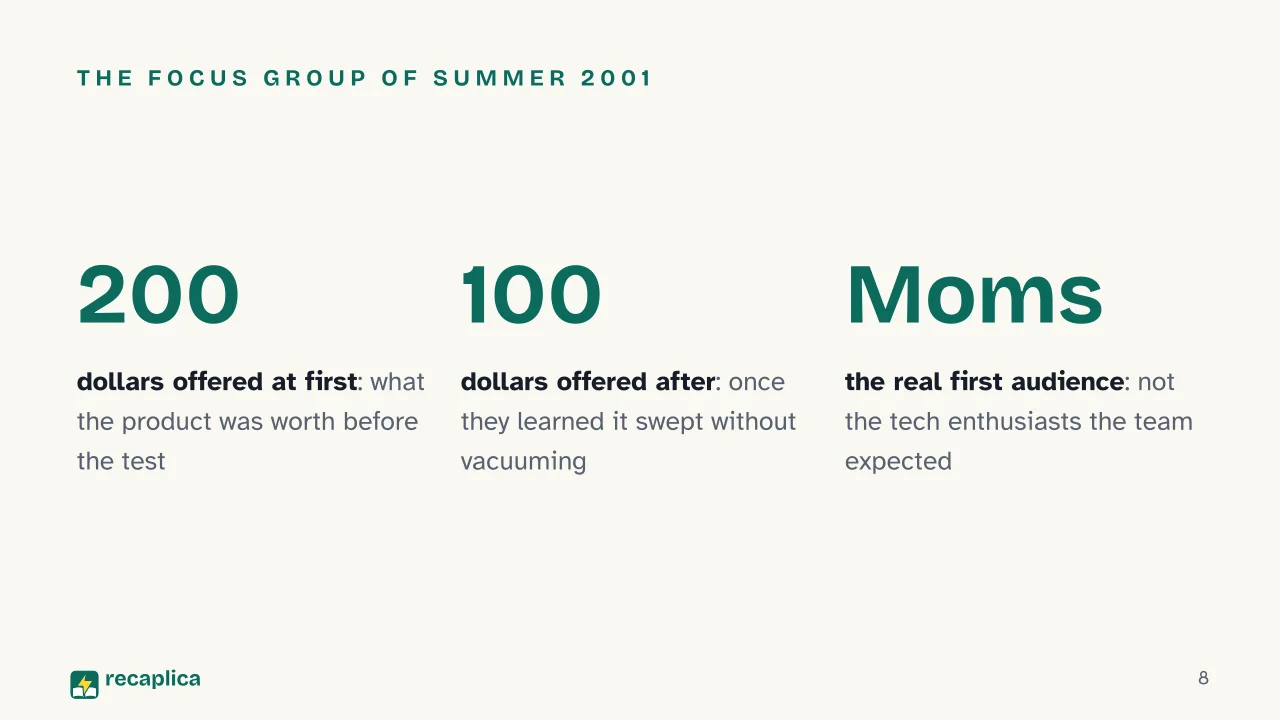
    The turning point came in the summer of 2001, and it didn’t come from a lab but from a group of ordinary consumers. The original design of what would become the Roomba was, in practice, a motorized carpet sweeper: it didn’t actually vacuum. When focus group participants found that out, their willingness to pay for it collapsed: people who’d first said $200 now offered $100. That same session also revealed who the product’s first real audience would be, not the tech enthusiasts the team had expected, but busy moms managing a household, a very different market segment from the one they’d designed for.

    From there, the team went back to the drawing board to add real suction, and in September 2002 iRobot put the first production version of the Roomba on sale.

    Practical example: the most concrete constraint the team had to solve was energy. The robot had a total power budget of 30 W, and could only afford to devote about 10% of it, roughly 3 W, to actual suction, versus about 1,200 W for a conventional vacuum cleaner of the time. The fix wasn’t a stronger pump, impossible on that little power, but a suction opening only a couple of millimeters wide, sealed by two rubber vanes that work like a squeegee on hard floors.

    The sensors: how a robot “sees” without eyes

    A robot vacuum doesn’t have vision the way we think of it, but it adds up data from several sensors to figure out where it is and what’s around it.

    SensorWhat it does
    Ultrasonic time-of-flight (ToF)Measures distance to obstacles in millimeters, regardless of surface color; detects pets or toys to avoid collisions
    Short-range ToFTells floor types apart based on the reflected signal, slowing the robot down when moving from carpet to hardwood
    Cliff detectionSpots drop-offs, like the top of a staircase, to prevent falls
    Inertial measurement unit (IMU)Measures roll, pitch, and yaw of the robot’s movements, helping it tell whether it’s covering the same area twice
    Pressure sensorsEstimate how full the dustbin is based on a drop in airflow
    ThermistorsMonitor the temperature of the motherboard, motors, and brushes, pausing the robot if it detects overheating

    In newer, higher-end models, manufacturers add dedicated sensors to recognize specific objects: iRobot’s PrecisionVision technology, for instance, is built to spot and avoid power cords, shoes, and other typical household obstacles. Recognizing and classifying an object on the fly like that, rather than just measuring its distance, is a classic machine learning task: the system is trained on huge numbers of real-world examples before it’s ever set loose in someone’s home.

    Random bounce, LiDAR, vSLAM: three eras of navigation

    This is where the difference between a budget robot and a high-end one becomes most visible, and it’s also the point where most misconceptions come from.

    The earliest robots, including the first generations of the Roomba, navigate using what’s called random bounce: a set of fairly simple algorithms — spiral, follow the walls, change angle after hitting something — combined with wheel rotation and IMU data to blindly estimate where the robot is, a technique known as dead reckoning. It works, in the sense that the floor ends up mostly covered, but without a real map of the room.

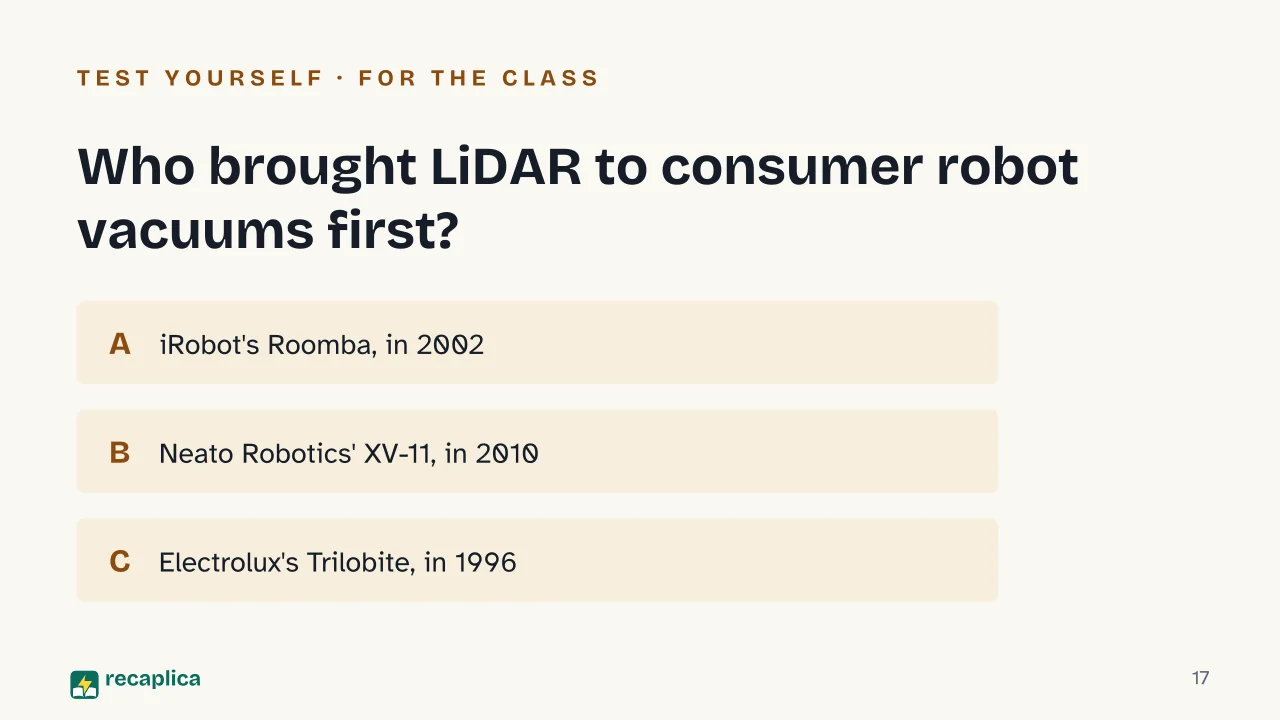
    The shift came in 2010, when Neato Robotics launched the XV-11, the first consumer model to use LiDAR navigation: a laser that measures distances and lets the robot build an actual map of the space, cleaning it with systematic, straight-line paths instead of random ones. In 2015 came a second route to the same goal, camera-based mapping, or vSLAM (visual simultaneous localization and mapping), adopted by both Dyson and iRobot in that year’s flagship models. Processing camera images in real time to figure out “where am I and what’s around me” is the same kind of problem that neural networks tackle in plenty of other computer vision applications.

    Both technologies, LiDAR and vSLAM, share the same weak spot: they struggle in dimly lit spaces, and under a low table or sofa they lose effectiveness for lack of a clear line of sight or a good signal reflection.

    Who makes robot vacuums today

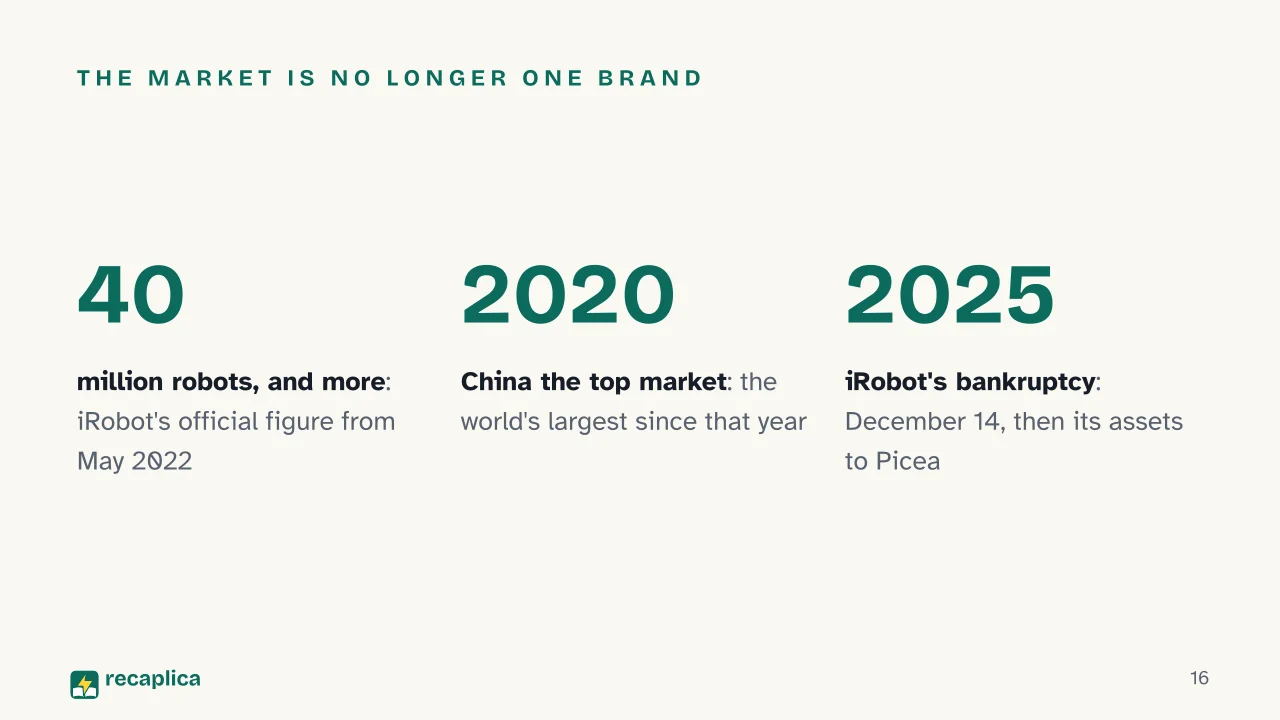
    For years, “robot vacuum” and “Roomba” were nearly synonymous: iRobot created the category in 2002 and, by May 2022, was reporting more than 40 million robots sold worldwide. The picture today looks very different.

    In August 2022, Amazon announced it would acquire iRobot for $1.7 billion, but the deal was blocked by US and European regulators concerned that Amazon could use its e-commerce weight to limit competition. After the deal collapsed, in January 2024, iRobot laid off a third of its staff and suspended research and development; co-founder and longtime CEO Colin Angle left the company. On December 14, 2025, iRobot filed for bankruptcy, and its assets were taken over by Picea, the Chinese partner that had already been manufacturing its products.

    Behind this story lies a bigger shift: China has been the world’s largest market for robot vacuums since 2020, with local companies that, according to IEEE Spectrum, invested two to three times more than iRobot did in research and development. It’s no coincidence that iRobot’s European market share has fallen to 12%, and is still declining. The robot vacuum remains a growing category, in short, but today several manufacturers and several navigation technologies compete for it, not a single pioneering brand.

    Practical limits and maintenance

    Even the most advanced model remains a device with physical limits that have nothing to do with how sophisticated its navigation is.

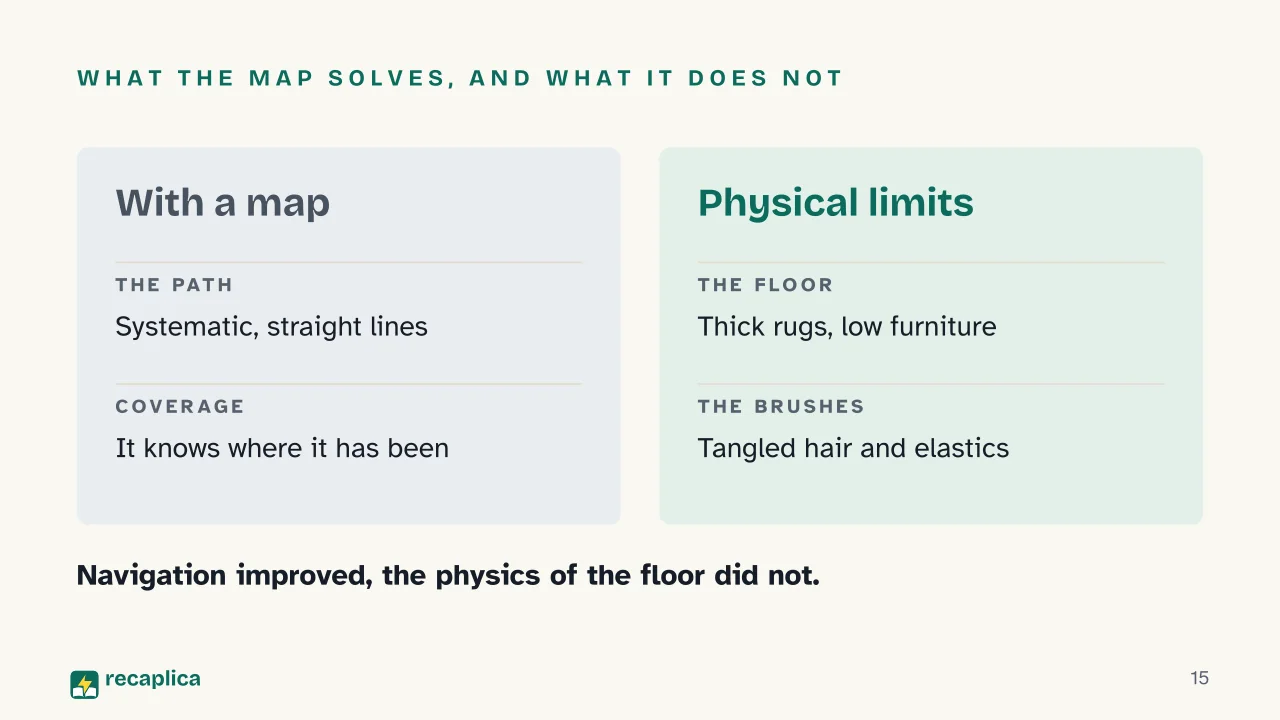
    Thick rugs are still a real obstacle: robots struggle to cross them and often cut power to manage it. Areas under low furniture remain a blind spot even for LiDAR and vSLAM, which lose effectiveness there. If someone physically picks up and moves the robot while it’s working, it loses track of its position and has to head off in a random direction to reorient itself, not unlike having to start over after losing GPS signal in a car. And hair or elastic bands tangled in the brushes can overload and overheat the motors, which means periodic manual cleaning is unavoidable.

    Even the most reliable sensors have their own odd practical limits. In 2016, a wave of reports, later picked up by the international press, described robots rolling over pet accidents left on the floor and spreading them across the room during a cleaning cycle, a concrete reminder that systematic floor coverage, however orderly it looks on paper, isn’t enough on its own to guarantee a clean result in every circumstance.

    Slide deck

    Slides ready to download and make your own in PowerPoint or Google Slides, with speaker notes. Pick the Flash cut or the Full one.
    Slide 1 of the presentation on Robot vacuum cleaners: The robot vacuumSlide 2 of the presentation on Robot vacuum cleaners: How can a robot clean a home it cannot see?Slide 3 of the presentation on Robot vacuum cleaners: How we proceedSlide 4 of the presentation on Robot vacuum cleaners: Chapter 01: Before the RoombaSlide 5 of the presentation on Robot vacuum cleaners: OriginsSlide 6 of the presentation on Robot vacuum cleaners: Two different firstsSlide 7 of the presentation on Robot vacuum cleaners: Chapter 02: Three watts of suctionSlide 8 of the presentation on Robot vacuum cleaners: The focus group of summer 2001Slide 9 of the presentation on Robot vacuum cleaners: The power budget of the first RoombaSlide 10 of the presentation on Robot vacuum cleaners: Chapter 03: Seeing without eyesSlide 11 of the presentation on Robot vacuum cleaners: How the robot works out what is around it: Ultrasonic ToF, Cliff detection, IMUSlide 12 of the presentation on Robot vacuum cleaners: Chapter 04: From random to a mapSlide 13 of the presentation on Robot vacuum cleaners: Three eras of navigationSlide 14 of the presentation on Robot vacuum cleaners: Not every robot moves at random.Slide 15 of the presentation on Robot vacuum cleaners: What the map solves, and what it does notSlide 16 of the presentation on Robot vacuum cleaners: The market is no longer one brandSlide 17 of the presentation on Robot vacuum cleaners: Who brought LiDAR to consumer robot vacuums first?Slide 18 of the presentation on Robot vacuum cleaners: And now, the review
    Flash10 slidesThe essential thread, to present in classFull18 slidesEvery chapter and the deeper detail

    Common myths

    • ✗ Myth Robot vacuums just move around at random, bump into furniture, and hope for the best.

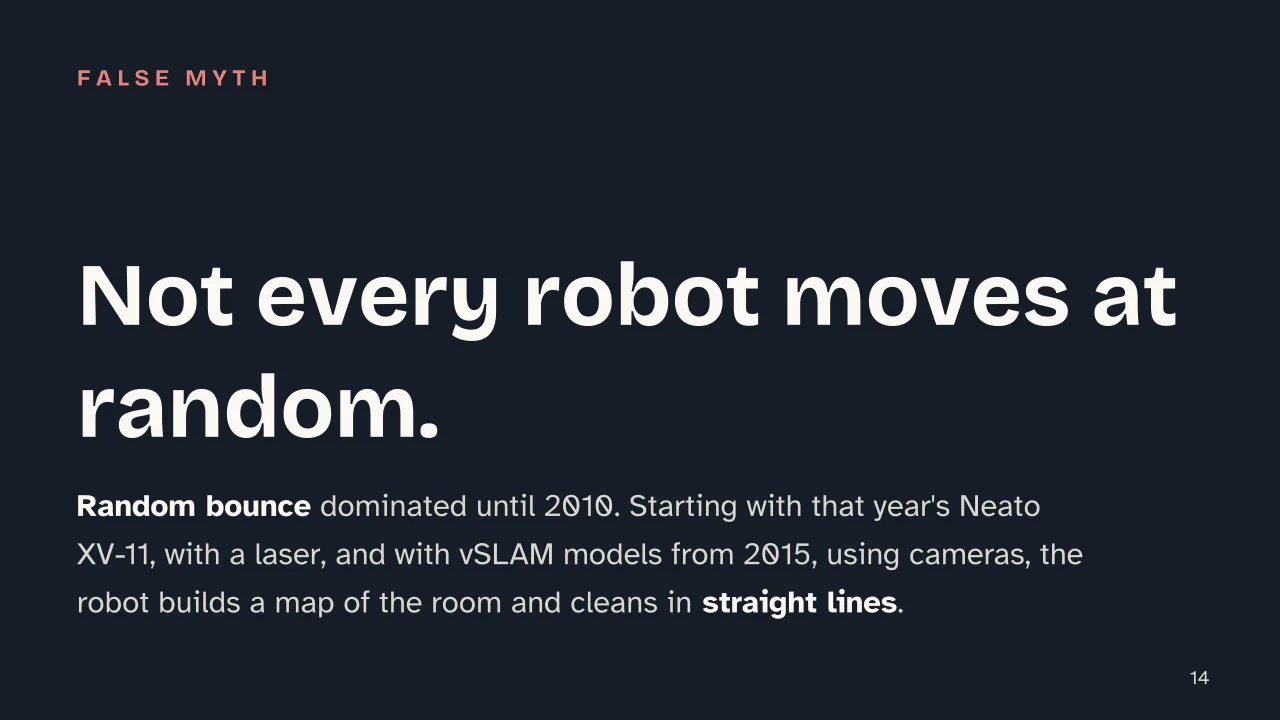
      ✓ Reality That's only true of the simplest models, the ones without mapping. Until 2010, the dominant pattern was so-called random bounce: the robot spirals, follows walls, and changes direction after every bump, with no idea where it actually is. Starting with the Neato XV-11 (2010, laser navigation) and later with vSLAM models (from 2015, cameras), robots began building a real map of the room instead and cleaning it with systematic, straight-line paths.

    • ✗ Myth The Roomba was the first robot vacuum in history.

      ✓ Reality No: a year earlier, in 2001, Electrolux had already launched the Trilobite commercially (after showing off a prototype on TV back in 1996), the first commercial robotic vacuum cleaner ever. It suffered from serious navigation problems, though, and ended up pulled from the market. The Roomba, which arrived in 2002, is more accurately described as the first commercially successful robot vacuum, not the first one overall.

    • ✗ Myth iRobot, the company that invented the Roomba, is still the undisputed leader of the industry today.

      ✓ Reality Not anymore. iRobot filed for bankruptcy on December 14, 2025, and was acquired by its Chinese manufacturing partner, Picea, after years of trouble following Amazon's failed attempt to buy the company. In the meantime, China has been the world's largest market for robot vacuums since 2020, and iRobot's European market share had fallen to 12%.

    Mind map

    Drag the background to move around and the nodes to reposition them; use − and + to collapse and expand branches.
    Customize
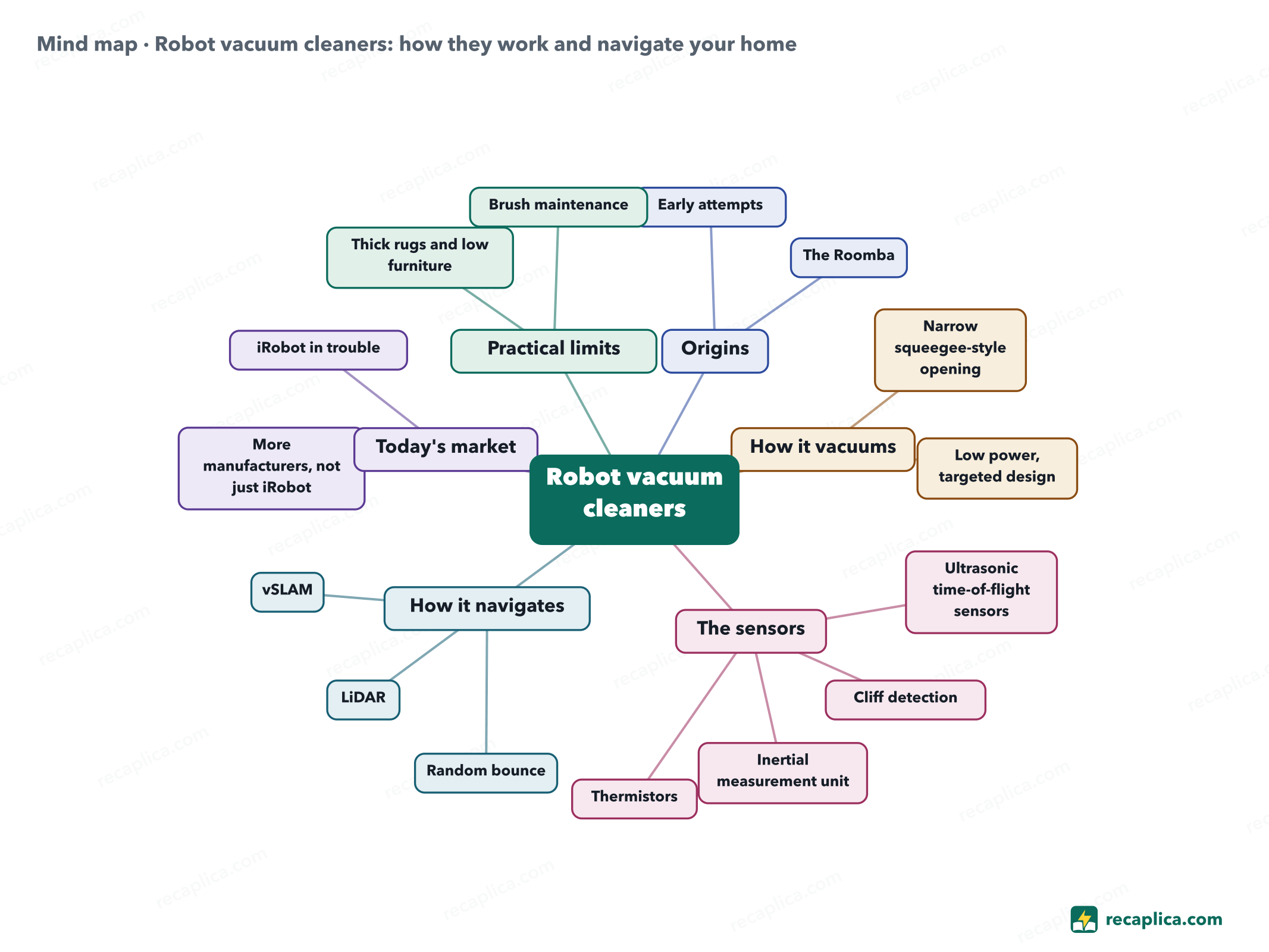
    Mind map: Robot vacuum cleaners: how they work and navigate your home
    • Robot vacuum cleaners
      • Origins
        • Early attempts From Tomy's Dustbot (1985) to Electrolux's Trilobite (2001).
        • The Roomba iRobot, 2002, the category's first commercial success.
      • How it vacuums
        • Narrow squeegee-style opening Just a few millimeters wide, with two rubber vanes.
        • Low power, targeted design About 3 W versus 1,200 W for a conventional vacuum.
      • The sensors
        • Ultrasonic time-of-flight sensors Detect obstacles in millimeters.
        • Cliff detection Avoid falls from drop-offs.
        • Inertial measurement unit Measure the robot's orientation.
        • Thermistors Monitor the motors for overheating.
      • How it navigates
        • Random bounce Random movement, no map, typical of pre-2010 models.
        • LiDAR Laser mapping, introduced in 2010.
        • vSLAM Camera-based mapping, widespread since 2015.
      • Today's market
        • More manufacturers, not just iRobot China has been the largest market since 2020.
        • iRobot in trouble Bankruptcy in December 2025, acquired by Picea.
      • Practical limits
        • Thick rugs and low furniture
        • Brush maintenance Tangled hair and elastic bands can overheat the motors.

    Quiz: test yourself

    Answer the questions to check what you have learned: you get instant feedback and a short explanation.

    Grade 0/10 0/5
    1 What's the main difference between 'random bounce' navigation and LiDAR or vSLAM navigation?

    Random bounce models, the pattern used by robots without mapping, spiral, follow walls, and change direction after every bump. LiDAR (laser, since 2010) and vSLAM (cameras, since 2015) instead build a real map of the room and enable systematic, straight-line cleaning paths.

    2 True or false: the Roomba, launched in 2002, was the first commercial robot vacuum in history.

    False. The Electrolux Trilobite arrived on the market in 2001, a year earlier, but had navigation problems and was pulled from the market. The Roomba is more accurately described as the first commercially successful robot vacuum.

    3 How much power did the original Roomba devote to suction, compared with a conventional vacuum cleaner of the time?

    The design team had a total power budget of 30 W and devoted about 10% of it (3 W) to suction, versus roughly 1,200 W for a conventional vacuum cleaner. The gap was closed with a specific mechanical design, a narrow squeegee-style suction opening, not with raw power.

    4 Which product first introduced laser (LiDAR) navigation in consumer robot vacuums, and when?

    The Neato XV-11, launched in 2010, introduced laser mapping, enabling systematic, straight-line navigation in contrast with the random movement (random bounce) of earlier models.

    5 What happened to iRobot, the company that created the Roomba, at the end of 2025?

    iRobot filed for bankruptcy on December 14, 2025, after years of trouble that followed the regulatory block of Amazon's attempted acquisition (announced in 2022). The company's assets were acquired by Picea, its Chinese manufacturing partner.

    Answers: 1-B · 2-B · 3-A · 4-B · 5-B

    Flashcards

    Tap the card to flip it and check whether you remember the answer, then move to the next one.

    1 / 8

    Explain it in your own words

    The ultimate test: if you can explain it in simple words, you've truly understood it. Write your explanation, then compare it with the Recap.

    Your explanation is saved only on this device.

    A robot vacuum is a small autonomous appliance that cleans your floors without being pushed by hand, finding its way around with sensors and returning to its dock on its own to recharge. The first commercially successful model, iRobot's Roomba, arrived in 2002, but it wasn't the first ever: the Electrolux Trilobite beat it to market back in 2001, after Electrolux had shown off a prototype on TV in 1996. Since then, navigation technology has changed radically, from the random movements of early models to real maps of the home built with lasers (LiDAR) or cameras (vSLAM). The industry is no longer dominated by one brand either: China has become the world's largest market, while iRobot itself went through a deep crisis that ended in bankruptcy in late 2025.

    Frequently asked questions

    How does a robot vacuum avoid falling down the stairs?

    Through cliff detection, sensors on the underside of the robot that detect when it's at the edge of a drop, like the top of a staircase, and make it change direction before it falls. It's one of the oldest safety features in the category, present since the earliest models.

    Why do some robot vacuums move in an orderly pattern while others seem to wander at random?

    It comes down to navigation technology, which is often tied to price. Cheaper models still use random bounce, movement without a map. Higher-end models use LiDAR (laser mapping, since 2010) or vSLAM (camera-based mapping, since 2015) to build a real map of the home and clean it with systematic paths.

    Does a robot vacuum clean as well as a conventional vacuum cleaner?

    Not by raw power: the original Roomba devoted only about 3 W to suction, versus roughly 1,200 W for a conventional vacuum cleaner of the time. The practical result comes from a targeted mechanical design, a narrow squeegee-style opening, not from matching the wattage.

    Who makes the most common robot vacuums today?

    The market is no longer tied to a single brand. iRobot, the pioneer of the category with the Roomba, went through a deep crisis that ended in bankruptcy in December 2025, after Amazon's failed attempt to acquire it. Meanwhile, China has been the world's largest market for these robots since 2020, with local companies investing heavily in research and development.

    Are the 'dirt pickup' percentages that manufacturers advertise comparable between different brands?

    In theory, yes: there's a dedicated international technical standard, IEC/ASTM 62885-7, that defines standardized methods for measuring the cleaning performance of household robot vacuums. The standard doesn't set minimum performance or safety requirements; it only makes the measurements comparable across different models, provided manufacturers actually follow it.

    Sources

    • IEEE Spectrum — How Roomba Got Its Vacuum
    • The Robot Report — Sensor breakdown: how robot vacuums navigate and clean
    • iRobot — iRobot Unveils iRobot OS (official press release, May 31, 2022)
    • iRobot — official Roomba j7+ product page
    • IEEE Spectrum — iRobot's bankruptcy, Colin Angle, and Amazon's role
    • Wikipedia (EN) — Robotic vacuum cleaner
    • Wikipedia (EN) — Roomba
    • IEC/ASTM 62885-7:2020 — Surface cleaning appliances, dry cleaning robots, methods for measuring the performance

    Every Recap goes through an independent review before publication.

    Every evening, the day's new Recaps on our Telegram channel. Join the channel →

    Keep learning

    • Technology AI Pop Culture: When Synthetic Content Rewrites History According to Lead Stories, a World War Two photo held by the Imperial War Museums circulated in 2026 in an AI-colorized version that a detector rated 99% likely to be artificially generated, even though the original shot was genuine. Cases like this also touch pop culture and current events: text, image and video models produce content that looks historical or iconic without actually being so, or alter real content in details that are hard to spot at a glance. Some tools leave technical clues, such as digital watermarks or video length limits, but no single clue covers every generator on the market. The Reuters Institute reports that in 2026 trust in AI chatbot answers about the news stays low, at 20% against 37% for news overall. Checking whether an image or video is authentic still means comparing it against the original archive that holds it. Read the Recap →
    • Technology Echo Chamber: How Recommendation Algorithms Shape What You See An echo chamber is an environment, online or offline, where a person mostly encounters opinions that confirm their own. Recommendation algorithms can build a narrower version of this, often called a filter bubble, by quietly deciding what to show someone based on what they've clicked and watched before. The two ideas get mixed up constantly, but they aren't the same phenomenon, and the strongest research available paints a more mixed picture than the popular narrative: algorithms have a measurable but modest effect, and people's own choices matter more. Whether algorithms actually drive political polarization is not something the most rigorous experiments have settled. Read the Recap →
    • Technology Virtual influencers: the AI-made creators behind the profiles Virtual influencers are digital characters built by an agency or studio, complete with a face, a voice and a biography, who post on social media the way a real creator would. The phenomenon predates the generative-AI boom: Lil Miquela's account has been live since April 23, 2016, and Shudu Gram first appeared on April 22, 2017. Some of these profiles work with major brands: Miquela has partnered with Calvin Klein and Prada, while the Spanish agency The Clueless built Aitana López after finding human models and influencers too unreliable to manage. In the United States, the Federal Trade Commission updated its advertising rules in 2023 to explicitly cover virtual influencers among the content that must be disclosed as sponsored. Read the Recap →

    recaplica

    Clear in 30 seconds, yours in 10 minutes.

    Recaps Mind maps Request a Recap Telegram channel Mind map maker Our method About Privacy & cookies Legal notes & terms of use

    © 2026 Recaplica · A project by Curi S.r.l. — VAT IT05472000750

    Statistics, only if you say so

    To learn which Recaps help most we would use Google Analytics, with aggregate, anonymous data. It starts only with your OK, and you can change your mind anytime. Privacy policy