Skip to content
recaplica

    One moment: security check

    Cloudflare wants to make sure you're not a robot. Tick the box below and your search will continue on its own.

    IT
    recaplica Summer: Why It Happens, When It Starts and How Heat Affects the Body
    © 2026 Recaplica · recaplica.com — All rights reserved
    Home › Science

    Summer: Why It Happens, When It Starts and How Heat Affects the Body

    By Recaplica Newsroom · Updated on September 11, 2026

    What to print

    Page numbers appear when printing with default margins.

    Slides

    Choose a cut

    Flash10 slidesThe essential thread, to present in classFull19 slidesEvery chapter and the deeper detail

    Both come with speaker notes.

    Telegram channel
    recaplica Clear in 30 seconds, yours in 10 minutes.
    In 30 seconds Key points Figures Deep dive Slides Myths Mind map Quiz Flashcards FAQ

    In 30 seconds quick read

    Summer is the hottest season of the year, falling between spring and autumn, and it exists because of the tilt of Earth's axis, not because the planet moves closer to the Sun: during the Northern Hemisphere's summer, Earth is actually at the farthest point in its orbit from the Sun. Its astronomical marker is the summer solstice, the day with the most hours of daylight and the shortest night of the year, which falls around June 21 in the Northern Hemisphere and about six months later in the Southern Hemisphere. Heat fuels thunderstorms and heat waves, phenomena that cities make worse through the urban heat island effect. Intense heat puts the most strain on the human body's cardiovascular system, and the resulting mortality risk falls disproportionately on older adults, young children and people with chronic conditions.

    Key Points

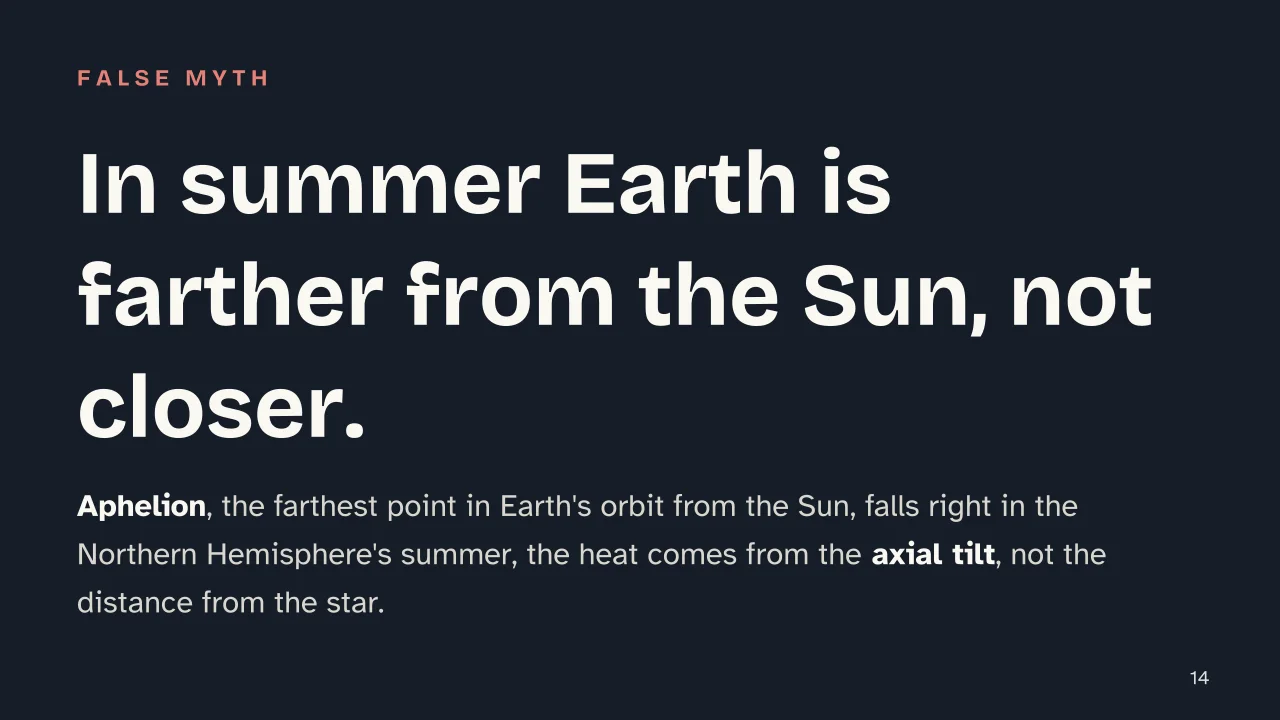
    • Summer exists because Earth's axis is tilted by 23.5 degrees, which makes sunlight hit one hemisphere more directly: it has nothing to do with distance from the Sun, if anything Earth is at the farthest point in its orbit, aphelion, during the Northern Hemisphere's summer.
    • The summer solstice is the day with the most hours of daylight and the shortest night of the year; it falls around June 21 in the Northern Hemisphere, when the North Pole gets 24 hours of continuous daylight and the South Pole stays dark.
    • Astronomical summer and meteorological summer don't line up, the first follows Earth's position relative to the Sun, the second uses the fixed June-July-August block to compare climate data.
    • Summer heat fuels thunderstorms and heat waves, spells of unusually hot weather that last for days when a high-pressure system blocks air from circulating.
    • In cities, the urban heat island effect can push temperatures up to 3°C higher than in the surrounding countryside, making extreme heat episodes worse.
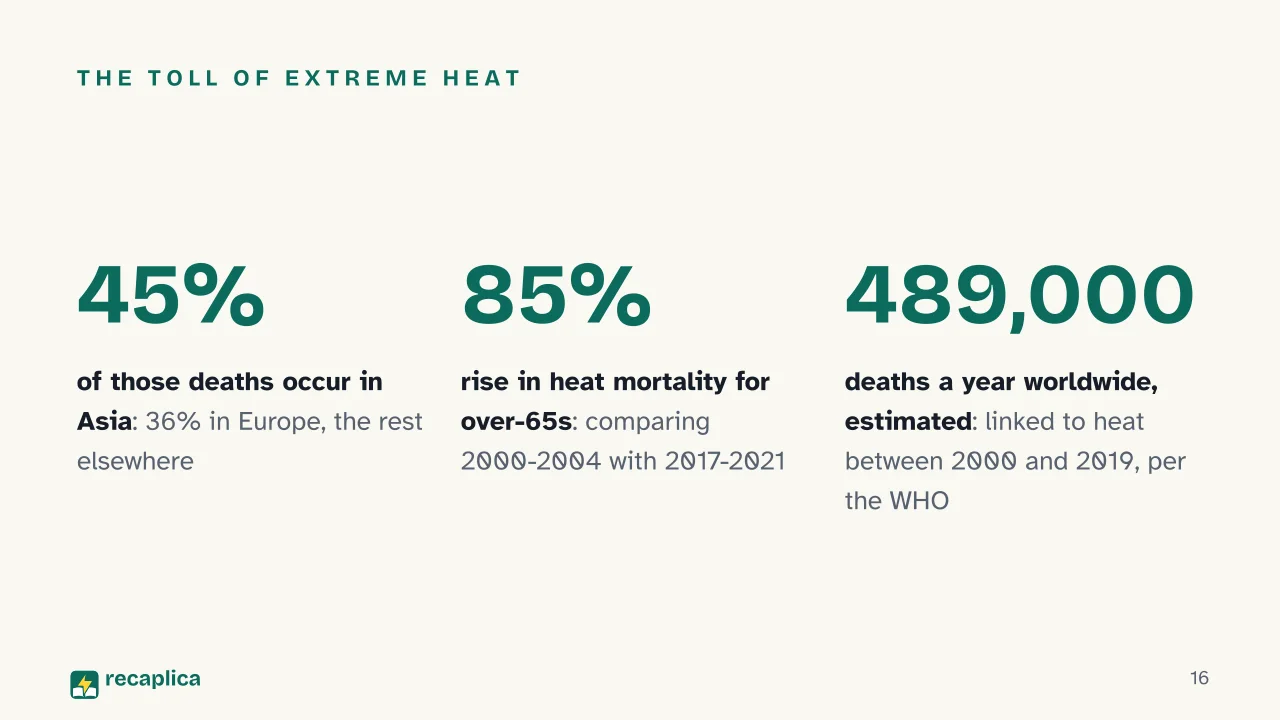
    • Intense heat puts the cardiovascular system under stress and, according to the WHO, caused an estimated 489,000 deaths a year worldwide between 2000 and 2019, hitting older adults, children and the chronically ill hardest.

    Key figures

    • 94.5 million miles aphelion, the farthest point in Earth's orbit from the Sun, reached during the Northern Hemisphere's summer Source: NASA Space Place
    • 489,000 the heat-related deaths estimated worldwide each year between 2000 and 2019 Source: World Health Organization (WHO)
    • up to 3°C the temperature difference between urban centers and the surrounding rural areas caused by the urban heat island effect Source: ISPRA

    Deep Dive

    Why summer happens, and why Earth isn’t actually closer to the Sun

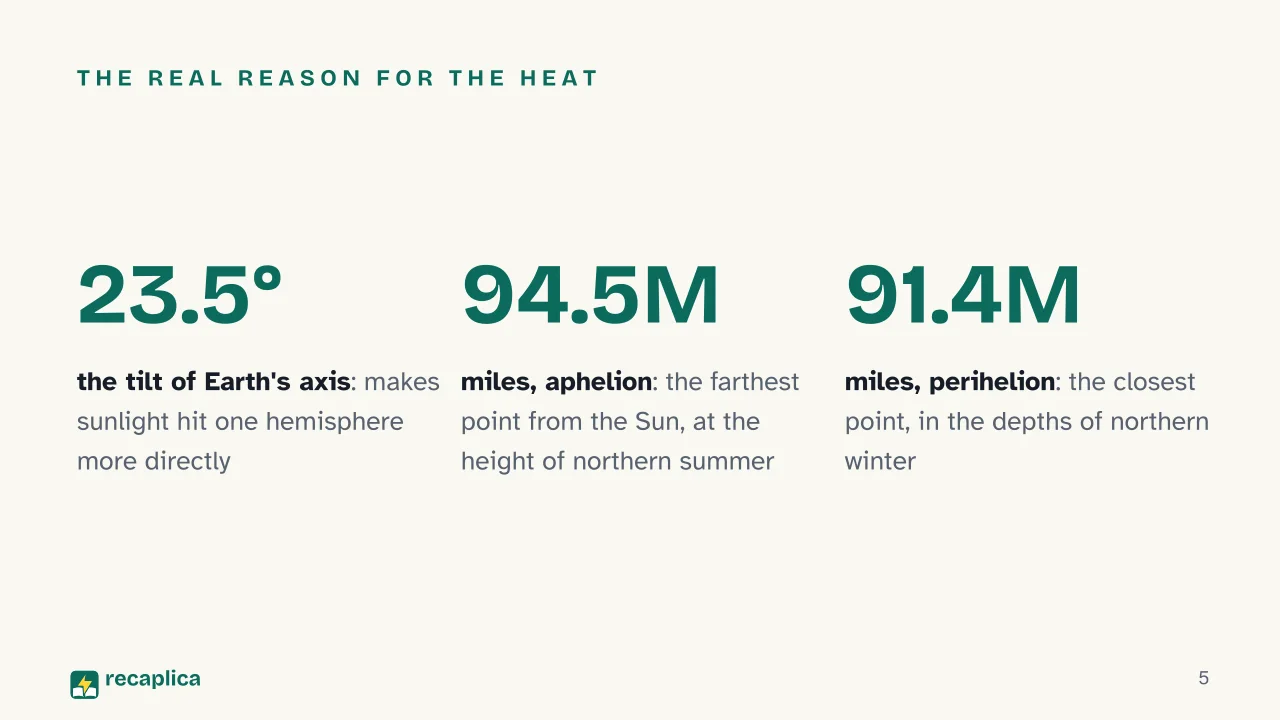
    Summer is not caused by Earth moving closer to the Sun: it is caused by the tilt of Earth’s axis, an angle of about 23.5 degrees relative to the plane of its orbit. As the planet makes its yearly circuit around the Sun, that tilt means each hemisphere receives sunlight more or less directly depending on the time of year: when a hemisphere is tilted toward the Sun, its rays arrive close to perpendicular and concentrate more energy over the same patch of ground, producing summer; when the same hemisphere tilts away from the Sun, the opposite happens, and it’s winter.

    The fact that undercuts the most common assumption is, fittingly, an orbital one. According to NASA, Earth traces a slightly elliptical path around the Sun: at its closest point, perihelion, it sits about 91.4 million miles from the star, while at its farthest point, aphelion, the distance climbs to about 94.5 million miles. The Northern Hemisphere passes through aphelion during its own summer, and through perihelion during its own winter: if heat depended on distance from the Sun, those months should bring the opposite result. The gap between the two distances, roughly 3 million miles, is still small next to the average Earth-Sun distance, and it is not what drives the seasons. Cross-checking several astronomical sources places the 2026 aphelion on July 6, at 17:30 UTC, at a distance of 152,087,774 kilometers from the Sun.

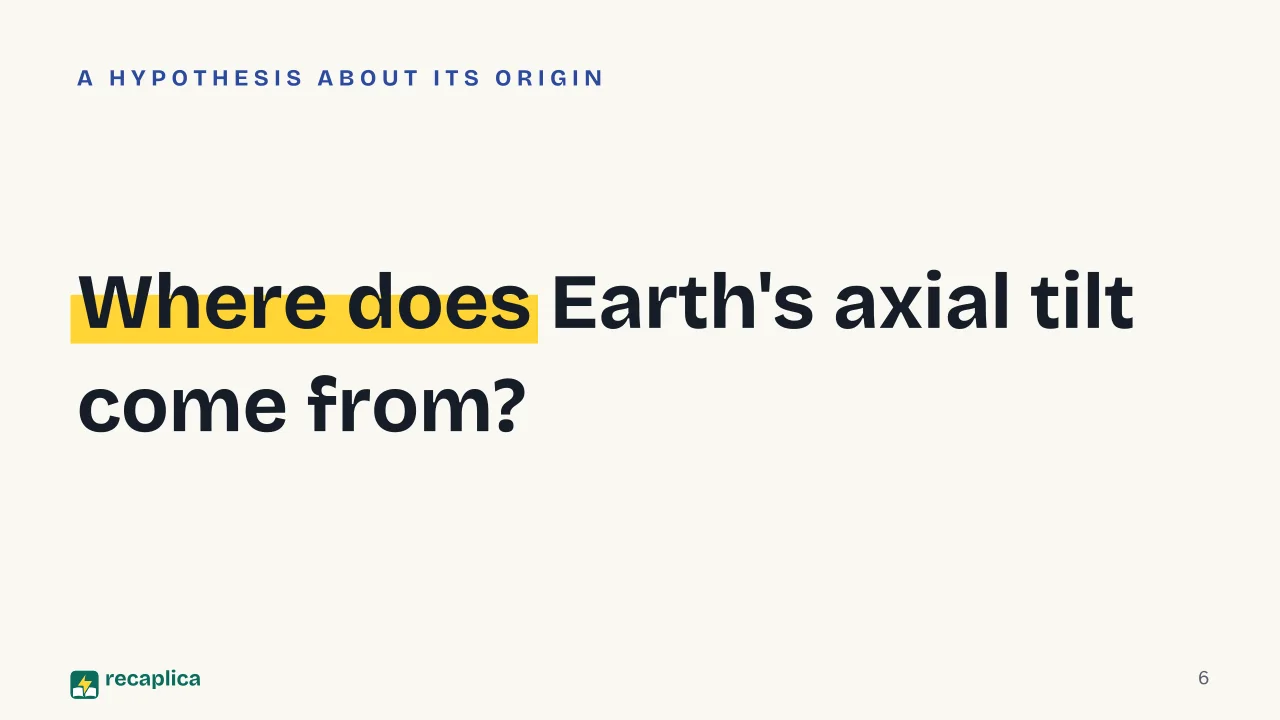
    So where does that 23.5-degree tilt come from? Here the science offers a hypothesis rather than a settled fact: one of the most widely accepted explanations, as reconstructed by NASA, points to the early Solar System, when a large celestial body is thought to have struck Earth while it was still young, knocking its axis out of its original alignment — the same event often credited with forming the Moon. For that same orbital reason, the two hemispheres always experience opposite seasons at the same time: when the North Pole is tilted toward the Sun, it’s summer in the Northern Hemisphere and, at that very moment, winter in the Southern Hemisphere.

    The summer solstice, in both hemispheres

    The astronomical marker of summer is the solstice. At the two moments of the year called equinoxes, Earth’s axis is tilted neither toward nor away from the Sun, and daylight and darkness are spread almost evenly across every latitude; in the months between one equinox and the next, the tilt toward the Sun instead builds to a maximum, which is the solstice itself. According to NOAA, the summer solstice marks, for the hemisphere in question, the day with the most hours of daylight and the shortest night of the year: in 2022, for instance, the Northern Hemisphere’s summer solstice fell on June 21 at 5:14 a.m. (U.S. East Coast time); the exact date shifts slightly from year to year because the civil calendar and the solar year don’t line up perfectly.

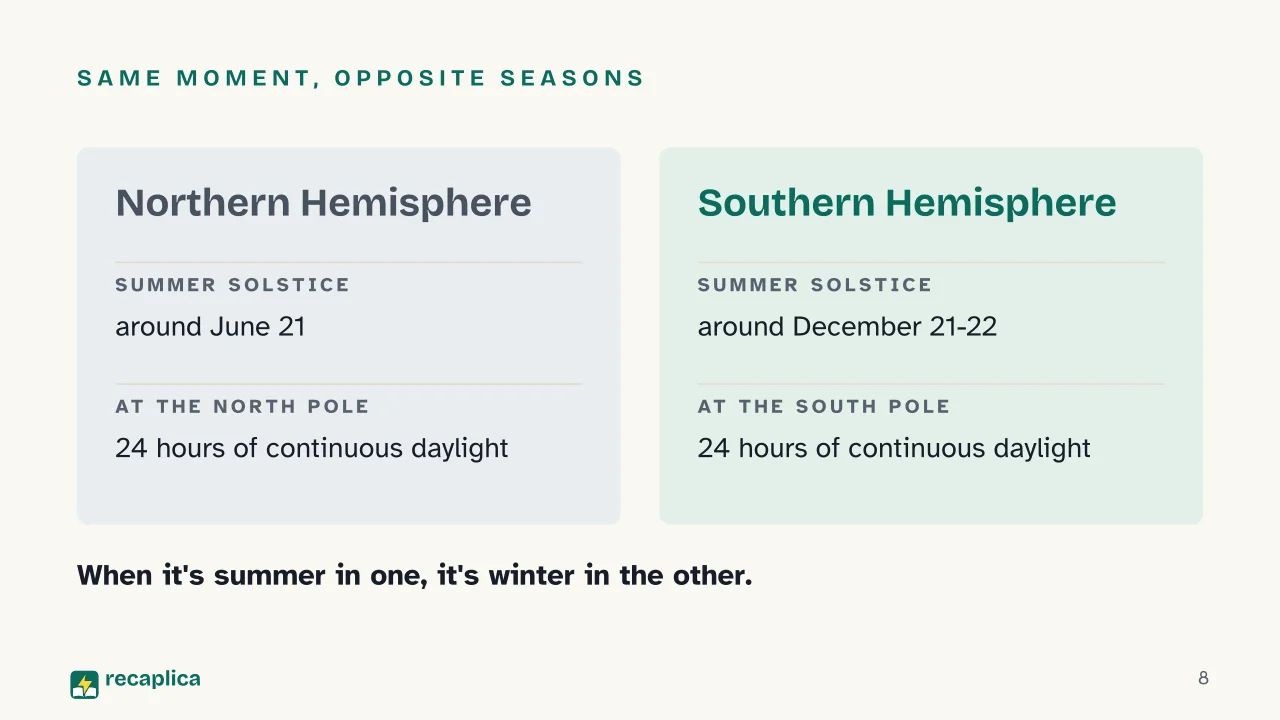
    An even sharper effect shows up at the poles. On the days around the Northern Hemisphere’s summer solstice, the North Pole gets 24 hours of continuous daylight while the South Pole stays in darkness; the situation flips at the December solstice, when it’s the Southern Hemisphere’s turn to have summer. By that same logic, reversed, the Southern Hemisphere’s summer solstice falls around December 21-22, while the Northern Hemisphere is deep in winter: it’s the same phenomenon described in the article on winter, simply viewed from the opposite side of the planet.

    Northern HemisphereSouthern Hemisphere
    Summer solsticearound June 21around December 21-22
    Hours of daylight at the pole in question24 continuous hours at the North Pole24 continuous hours at the South Pole
    When it’s summer thereit’s winter in the other hemisphereit’s winter in the other hemisphere

    Practical example: at the North Pole, on the days around the Northern Hemisphere’s summer solstice, the Sun stays visible for a full twenty-four hours, while at that same moment the South Pole sits in darkness. Six months later, around the December solstice, the situation reverses exactly, and it’s the South Pole that stays lit around the clock, with the North Pole in darkness.

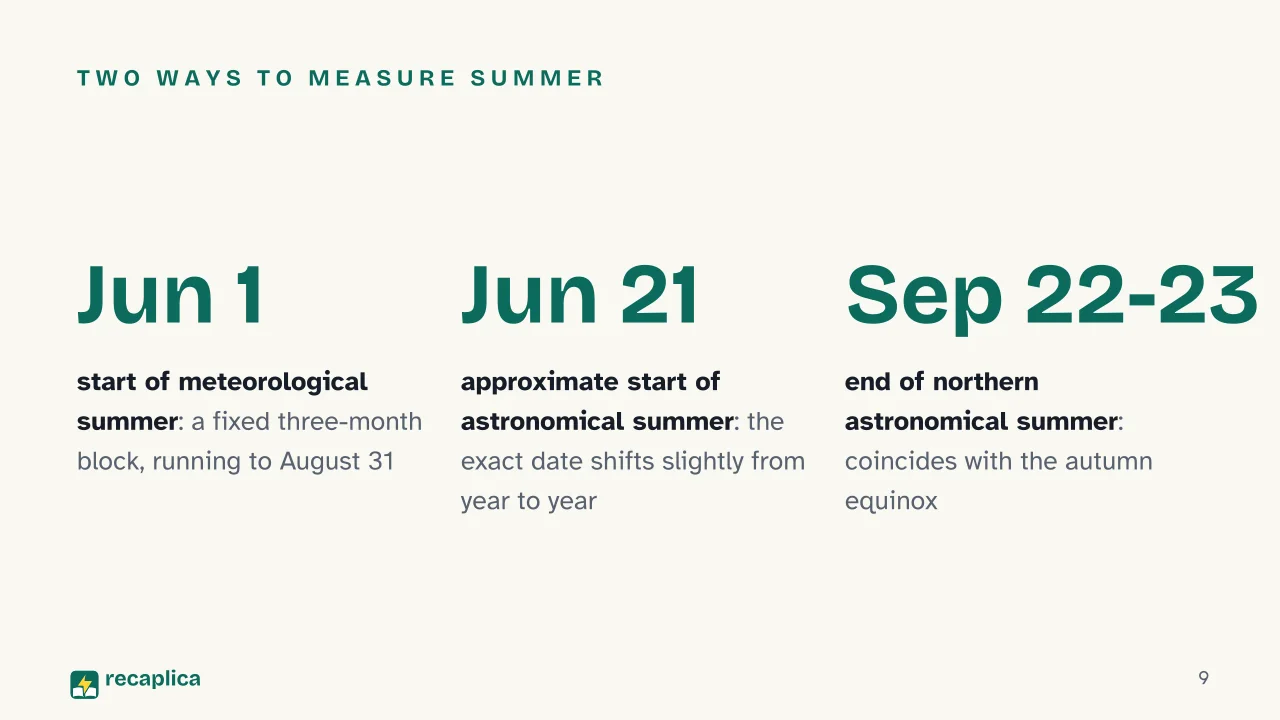
    Not everyone measures summer the same way. According to the Met Office, meteorologists prefer a fixed three-month block, June, July and August in the Northern Hemisphere (December, January and February in the Southern), because it makes climate data easier to compare from year to year; it’s the definition behind official climate statistics, such as monthly temperature rankings. Astronomers, by contrast, measure summer starting from the solstice, around June 21 in the Northern Hemisphere, through the autumn equinox, which falls roughly between September 22 and 23, a window that, as noted above, drifts slightly year to year.

    Thunderstorms, heat waves and the urban heat island effect

    Summer heat drives a handful of characteristic weather phenomena. According to the Met Office, summer is the most thunder-prone season, because the heat and moisture that build up at ground level during the longer days create ideal conditions for storms to form: it’s one of many expressions of the water cycle, the same evaporation-and-condensation mechanism that governs rainfall throughout the year.

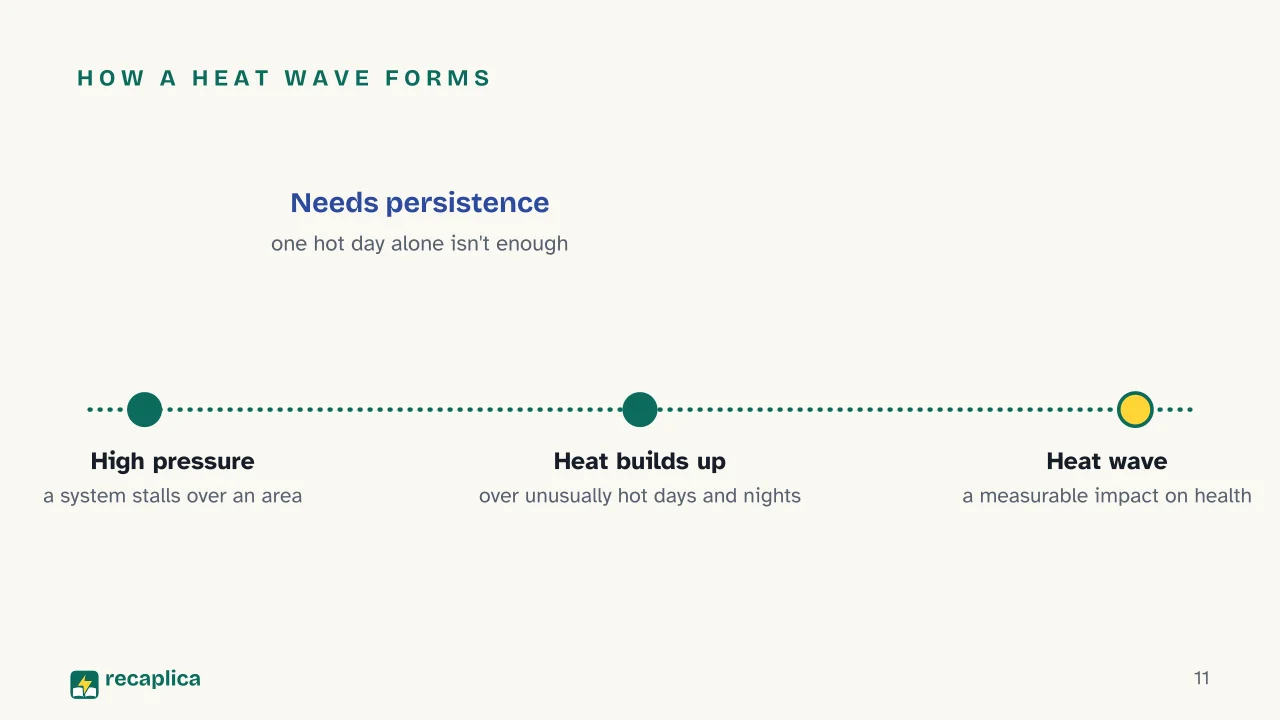
    The phenomenon that matters most for health, though, is the heat wave. The World Health Organization defines it as a period when heat builds up locally over a sequence of unusually hot days and nights, with an onset and end that are often not sharply defined, but a minimum duration of two or three days and a measurable impact on human activity. The Met Office ties the persistence of heat waves to areas of high pressure, anticyclones, that block air circulation for several days in a row and let heat accumulate instead of dispersing.

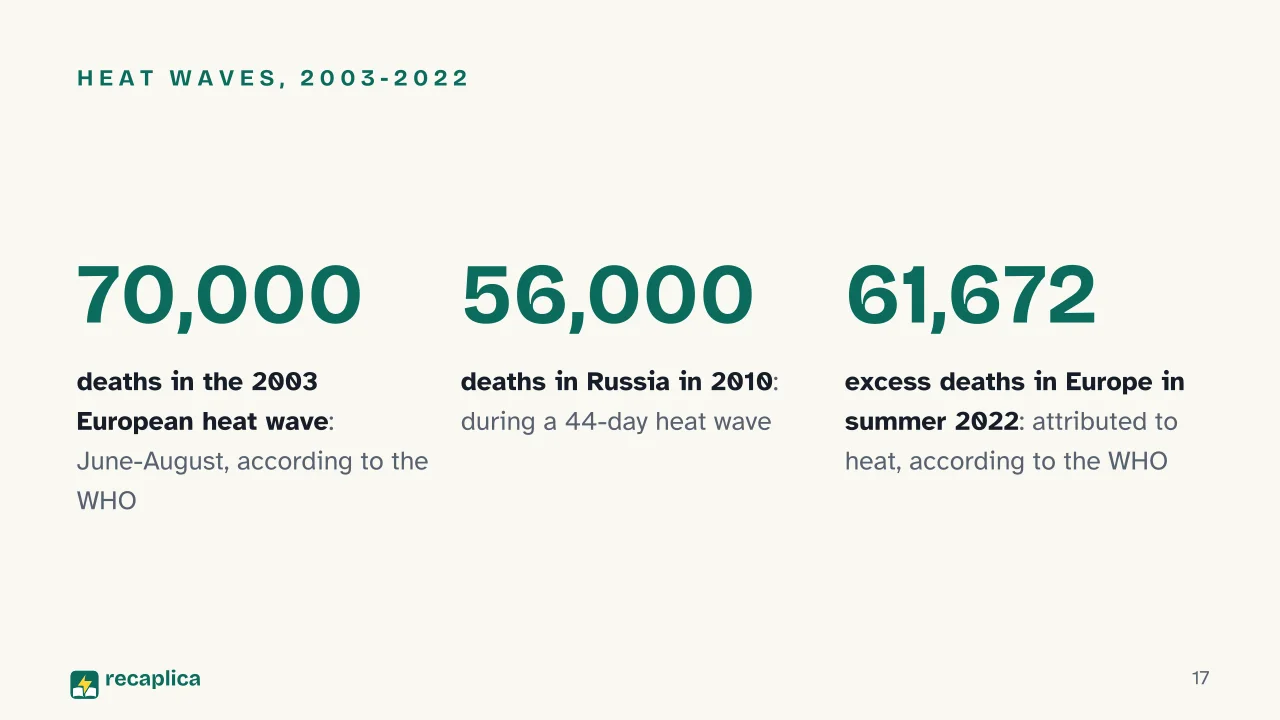
    Practical example: a single day of intense heat isn’t enough to make a heat wave, because persistence is what counts. The two most severe heat waves of recent decades make the point well, the 2003 European one, which ran from June through August, and the 2010 Russian one, which lasted 44 consecutive days: both had a far greater impact on mortality than any single hot day could produce on its own.

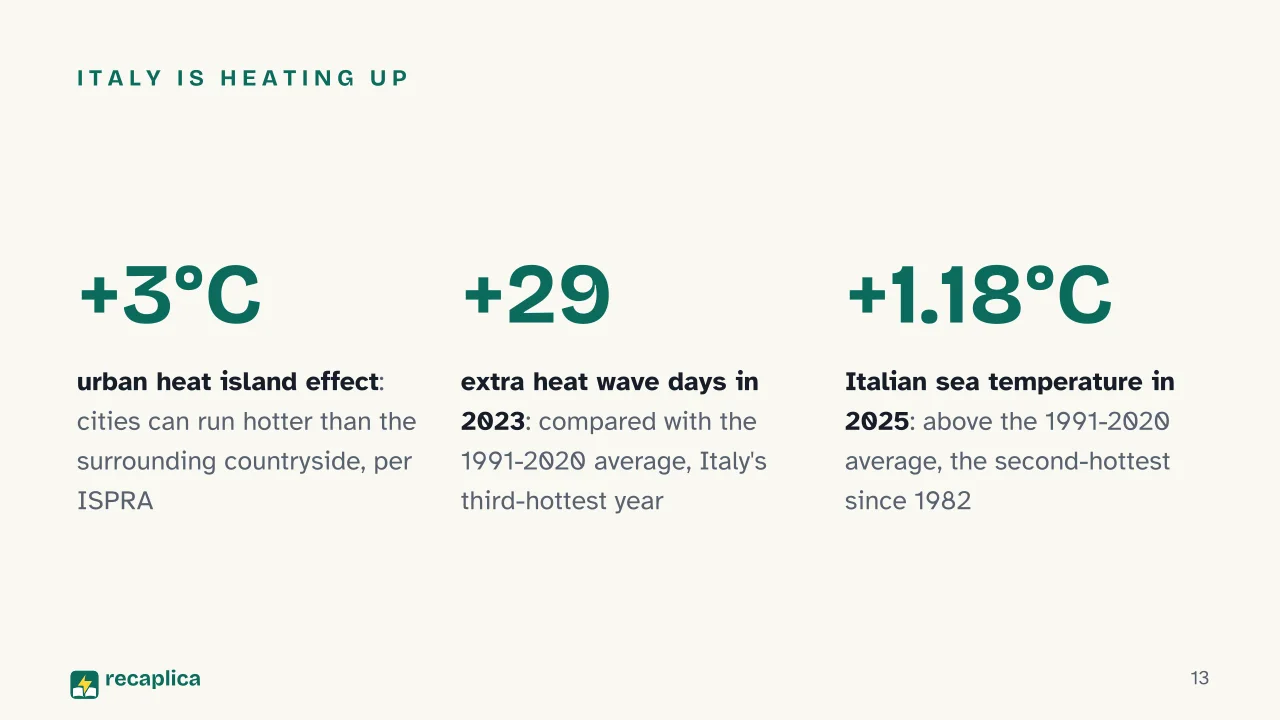
    In Italy, according to ISPRA, these phenomena are tracked using climate indices such as the WSDI, the Warm Spell Duration Index, and the trend over the last fifty years has been a structural, not occasional, increase in both the number of summer days and the frequency of tropical nights and the length of heat waves, a trend that fits into the same underlying mechanism described in the article on the greenhouse effect. The year 2023, with roughly 29 more heat wave days than the 1991-2020 average, ranked as the third-hottest year in Italy’s historical record; 2025 saw the average Italian sea temperature come in 1.18°C above that same baseline, the second-hottest year for Italy’s seas since 1982, with average temperatures around 20°C and peaks above 26°C in July and August.

    In cities, heat compounds with another effect: the urban heat island. According to ISPRA, temperatures in urban centers can run up to 3°C higher than in the surrounding countryside, a gap that intensifies episodes of extreme heat exactly where most of the population lives. The mechanisms and risk thresholds of heat waves are covered in more depth in the dedicated article.

    Effects on people: health and tourism

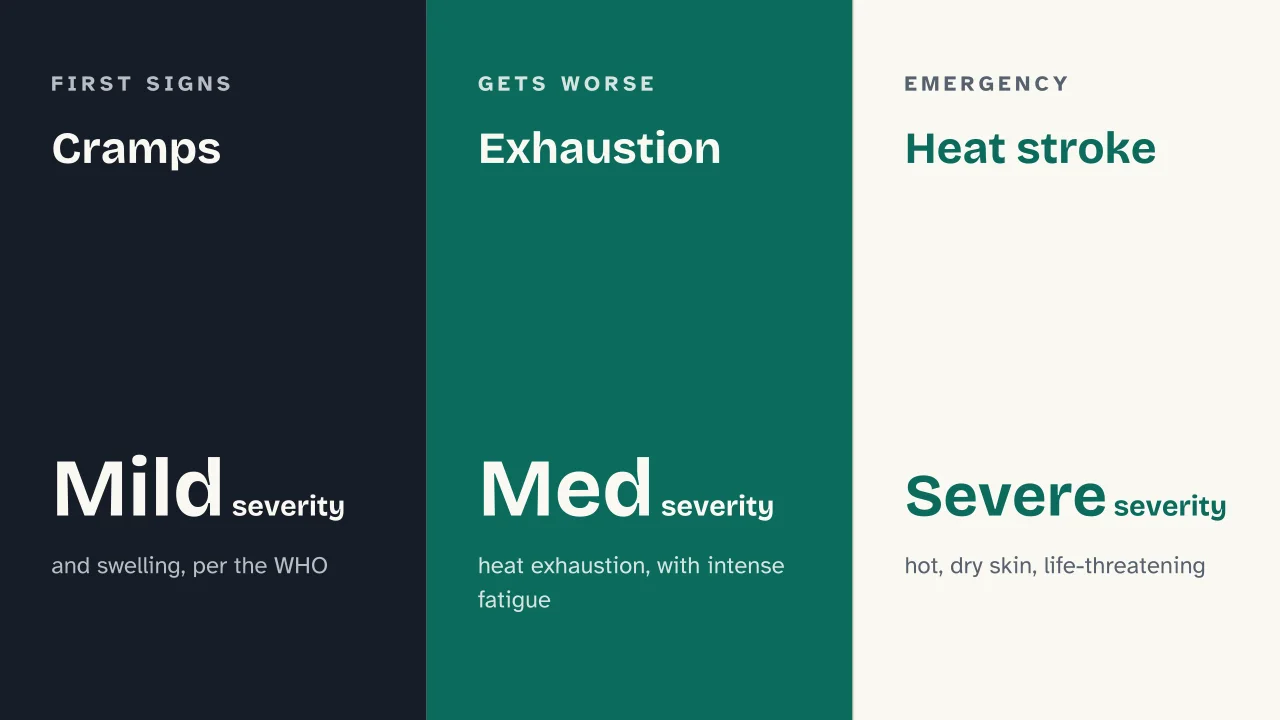
    Intense heat puts the cardiovascular system under stress. According to the WHO, heat stress can raise heart rate and left-ventricular contractility while reducing central blood volume, ventricular filling pressures and cerebral perfusion. Symptoms from heat exposure range from swelling and cramps to heat exhaustion and, in the most severe cases, heat stroke, which the WHO describes as involving fainting and hot, dry skin, because the body loses the ability to regulate high temperatures; heat can also worsen existing chronic conditions, including cardiovascular disease, asthma, diabetes and mental health disorders, and it raises the risk of acute kidney injury and accidents.

    The numbers help put the scale of the problem in context. Still according to the WHO, an estimated 489,000 heat-related deaths occurred worldwide each year between 2000 and 2019, 45% of them in Asia and 36% in Europe; in the summer of 2022 alone, an estimated 61,672 excess deaths in Europe were attributed to heat, while the European heat wave of June-August 2003 is thought to have caused around 70,000 deaths and the 2010 Russian one, lasting 44 days, around 56,000. The trend is rising: comparing 2000-2004 with 2017-2021, heat-related mortality among people over 65 increased by 85%, and the WHO expects the frequency, duration and intensity of heat waves to keep increasing throughout the twenty-first century because of climate change.

    The most vulnerable populations, according to the WHO, include infants and young children, older adults, people with disabilities, people already under medical care, those taking medication or using alcohol, outdoor workers, and people living in poverty or informal settlements, in both urban and rural areas; even heat waves of low or moderate intensity can affect these groups.

    A curiosity collected by the Met Office ties heat to the animal world too: you can roughly estimate the temperature in degrees Celsius by counting a cricket’s chirps over 25 seconds, dividing by 3 and adding 4. It’s an anecdotal method, not a scientifically validated measuring tool, but it shows how the activity of some insects tracks air temperature.

    Summer heat is also an economic season. According to Eurostat, in the 2018 summer season, the latest detailed reading published in this data series and not a figure for the current year, nights spent in hotels and similar establishments across the European Union rose by 7.5 million, or +0.8% compared with the previous year, with two-thirds of hotel stays concentrated in five countries, Spain, Italy, Germany, France and the United Kingdom; August recorded the highest occupancy rates in most member states, while in a few, including Bulgaria, Denmark, Estonia, Cyprus, Finland and Sweden, the peak shifted to July.

    Slide deck

    Slides ready to download and make your own in PowerPoint or Google Slides, with speaker notes. Pick the Flash cut or the Full one.
    Slide 1 of the presentation on Summer: SummerSlide 2 of the presentation on Summer: Farther from the Sun, yet hotter, why?Slide 3 of the presentation on Summer: Where we're headedSlide 4 of the presentation on Summer: Chapter 01: A tilted planetSlide 5 of the presentation on Summer: The real reason for the heatSlide 6 of the presentation on Summer: Where does Earth's axial tilt come from?Slide 7 of the presentation on Summer: Chapter 02: The longest day of the yearSlide 8 of the presentation on Summer: Same moment, opposite seasonsSlide 9 of the presentation on Summer: Two ways to measure summerSlide 10 of the presentation on Summer: Chapter 03: Heat wavesSlide 11 of the presentation on Summer: How a heat wave formsSlide 12 of the presentation on Summer: Cramps · Exhaustion · Heat strokeSlide 13 of the presentation on Summer: Italy is heating upSlide 14 of the presentation on Summer: In summer Earth is farther from the Sun, not closer.Slide 15 of the presentation on Summer: Chapter 04: What happens to the bodySlide 16 of the presentation on Summer: The toll of extreme heatSlide 17 of the presentation on Summer: Heat waves, 2003-2022Slide 18 of the presentation on Summer: Why does summer happen, astronomically speaking?Slide 19 of the presentation on Summer: Now, for review
    Flash10 slidesThe essential thread, to present in classFull19 slidesEvery chapter and the deeper detail

    Common myths

    • ✗ Myth It's hot in summer because Earth is closer to the Sun.

      ✓ Reality It's actually the opposite: according to NASA, during the Northern Hemisphere's summer Earth sits at the farthest point in its orbit from the Sun, aphelion, at about 94.5 million miles, while in winter it is at the closest point, perihelion, at about 91.4 million miles. The heat depends on the 23.5-degree tilt of Earth's axis, which makes sunlight hit that hemisphere more directly, not on distance from the star.

    • ✗ Myth A heat wave is simply one very hot day.

      ✓ Reality According to the World Health Organization, a heat wave is a period in which heat builds up over a sequence of unusually hot days and nights, lasting at least two or three days: a single day of intense heat, however uncomfortable, does not produce the same health effects as heat that persists, as in the 2010 Russian heat wave, which lasted 44 days.

    • ✗ Myth The risk from extreme heat mainly concerns people working or exercising outdoors.

      ✓ Reality According to the WHO, the most exposed groups also include people who mostly stay indoors, such as infants, older adults and people with chronic conditions, because heat stress can worsen existing cardiovascular, respiratory or kidney conditions, regardless of physical activity.

    Mind map

    Drag the background to move around and the nodes to reposition them; use − and + to collapse and expand branches.
    Customize
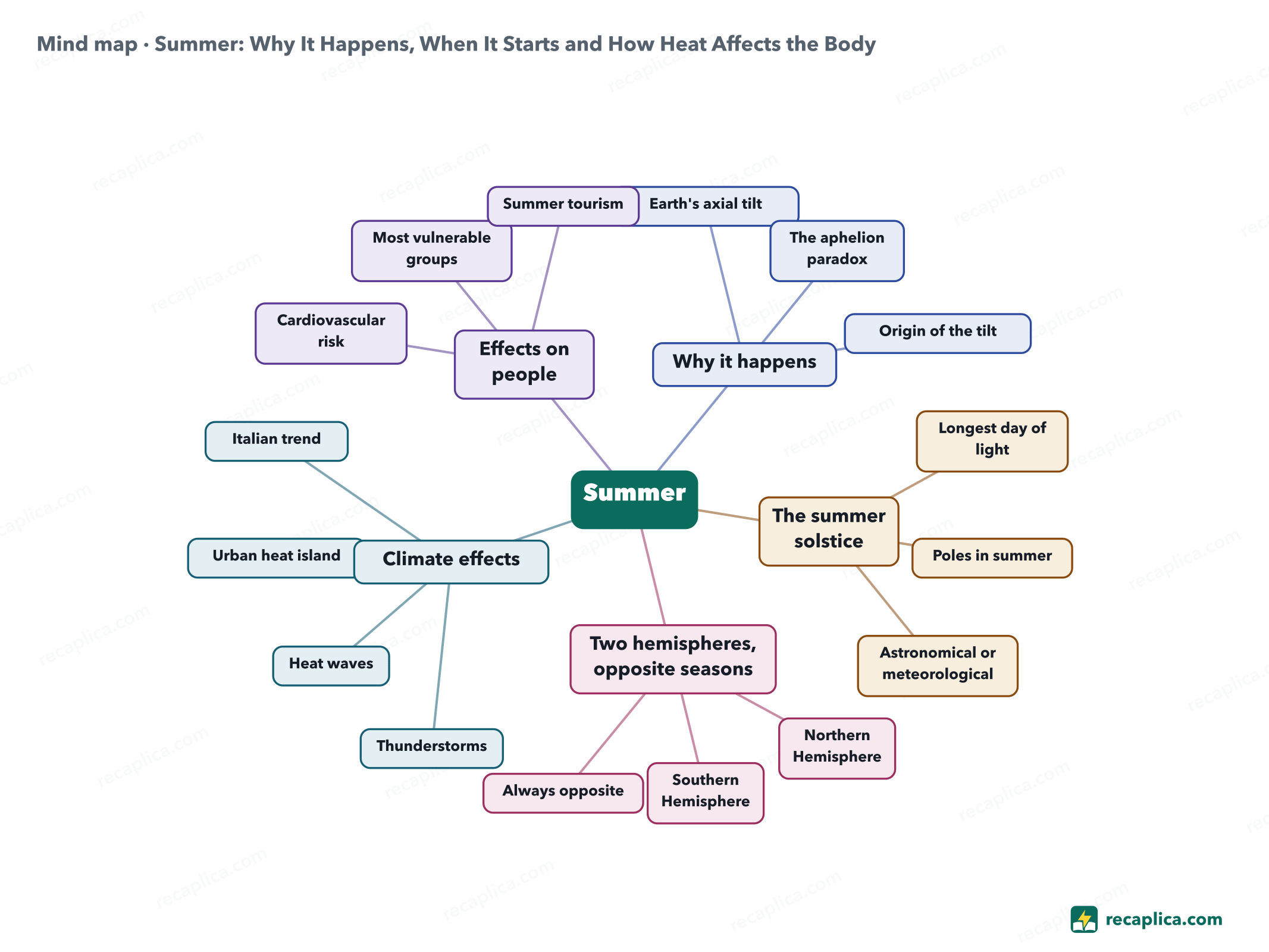
    Mind map: Summer: Why It Happens, When It Starts and How Heat Affects the Body
    • Summer
      • Why it happens
        • Earth's axial tilt 23.5 degrees, not distance from the Sun
        • The aphelion paradox Earth is farthest from the Sun right during northern summer
        • Origin of the tilt A hypothesis about an early cosmic impact
      • The summer solstice
        • Longest day of light The shortest night of the year
        • Poles in summer 24 hours of continuous daylight at the pole in question
        • Astronomical or meteorological Two different definitions, different dates
      • Two hemispheres, opposite seasons
        • Northern Hemisphere Summer from around June 21
        • Southern Hemisphere Summer from around December 21-22
        • Always opposite When it's summer in one, it's winter in the other
      • Climate effects
        • Thunderstorms Heat and moisture building up at ground level
        • Heat waves A high-pressure system blocks air circulation for days
        • Urban heat island Up to 3°C hotter in cities
        • Italian trend A structural rise over the last fifty years
      • Effects on people
        • Cardiovascular risk Heat stress on the heart and blood pressure
        • Most vulnerable groups Older adults, young children, people with chronic conditions
        • Summer tourism Europe's seasonal peak in overnight stays

    Quiz: test yourself

    Answer the questions to check what you have learned: you get instant feedback and a short explanation.

    Grade 0/10 0/5
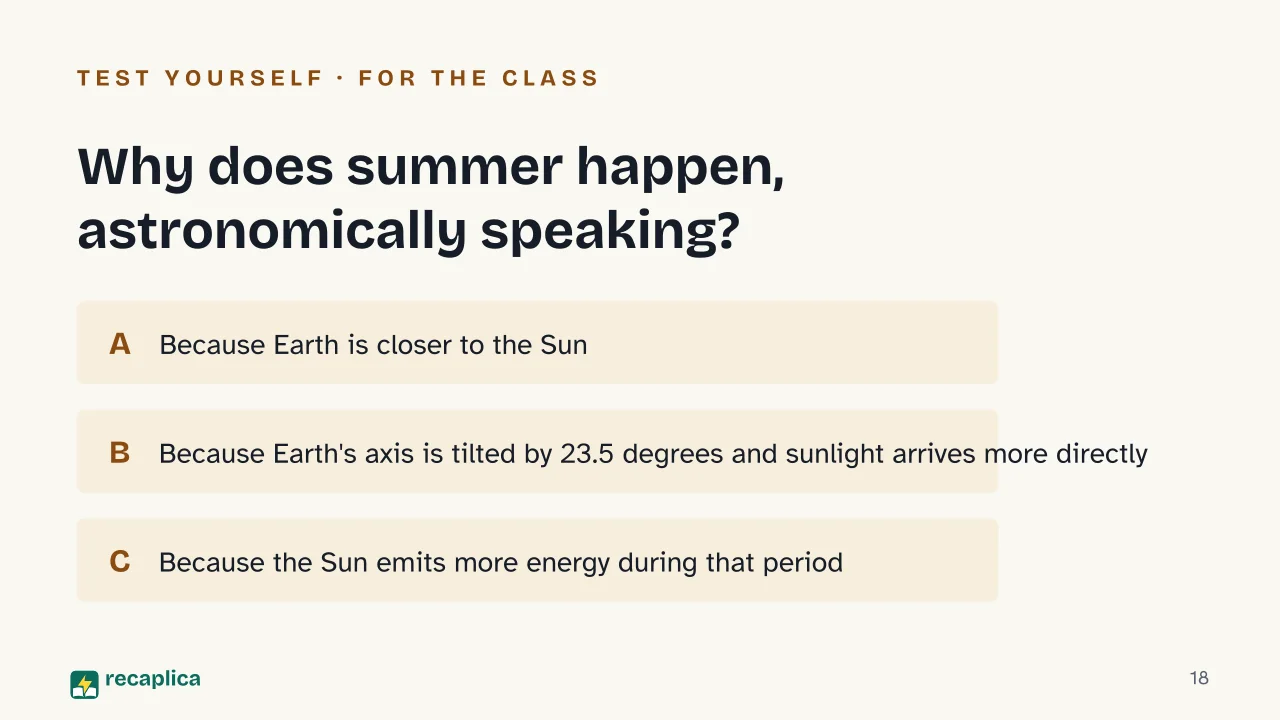
    1 Why does summer happen, astronomically speaking?

    The tilt of Earth's axis means that, at certain times of the year, one hemisphere receives the Sun's rays more directly than the other: according to NASA, that is what produces the seasons, not the distance from the Sun.

    2 True or false: during the Northern Hemisphere's summer, Earth is at the farthest point in its orbit from the Sun.

    True. According to NASA, aphelion, the farthest point in Earth's orbit from the Sun (about 94.5 million miles), falls right during the Northern Hemisphere's summer: proof that distance from the Sun does not explain summer heat.

    3 What distinguishes astronomical summer from meteorological summer?

    According to the UK Met Office, meteorologists use a fixed three-month block (June-July-August in the Northern Hemisphere) to make climate data easier to compare, while astronomers follow Earth's position relative to the Sun, which shifts slightly from year to year.

    4 What is a heat wave, according to the World Health Organization?

    The WHO defines a heat wave as a period of at least two or three days in which local heat builds up over a sequence of unusually hot days and nights, with a measurable impact on human activity.

    5 What is the urban heat island effect?

    According to ISPRA, temperatures in urban centers can run up to 3°C higher than in the surrounding rural areas, a gap that intensifies episodes of extreme heat in cities.

    Answers: 1-B · 2-A · 3-B · 4-B · 5-B

    Flashcards

    Tap the card to flip it and check whether you remember the answer, then move to the next one.

    1 / 8

    Explain it in your own words

    The ultimate test: if you can explain it in simple words, you've truly understood it. Write your explanation, then compare it with the Recap.

    Your explanation is saved only on this device.

    Summer is the hottest season of the year, falling between spring and autumn, and it exists because of the tilt of Earth's axis, not because the planet moves closer to the Sun: during the Northern Hemisphere's summer, Earth is actually at the farthest point in its orbit from the Sun. Its astronomical marker is the summer solstice, the day with the most hours of daylight and the shortest night of the year, which falls around June 21 in the Northern Hemisphere and about six months later in the Southern Hemisphere. Heat fuels thunderstorms and heat waves, phenomena that cities make worse through the urban heat island effect. Intense heat puts the most strain on the human body's cardiovascular system, and the resulting mortality risk falls disproportionately on older adults, young children and people with chronic conditions.

    Frequently asked questions

    Why is Earth farther from the Sun in summer, yet it's hotter?

    Because heat doesn't depend on distance from the Sun, but on the 23.5-degree tilt of Earth's axis: during a hemisphere's summer, that hemisphere receives sunlight more directly, regardless of whether the whole planet happens to be closer to or farther from the Sun at that moment. If anything, according to NASA, the Northern Hemisphere passes through aphelion, the farthest point in its orbit from the Sun, during its own summer.

    When does summer start, according to astronomers and meteorologists?

    For meteorologists, according to the Met Office, the Northern Hemisphere's summer always starts on June 1 and ends on August 31, a fixed three-month block used to compare climate data; for astronomers it starts with the solstice, around June 21, and ends with the autumn equinox, falling roughly between September 22 and 23, a window that shifts slightly from year to year.

    What is the summer solstice?

    According to NOAA, the summer solstice is the day with the most hours of daylight and the shortest night of the year for the hemisphere in question: in the Northern Hemisphere it falls around June 21, in the Southern Hemisphere around December 21-22, when it's the other hemisphere's turn to have winter.

    What is a heat wave and when does it become dangerous?

    The WHO defines it as a period of at least two or three days in which local heat builds up over a sequence of unusually hot days and nights; it becomes dangerous because it puts the cardiovascular system under stress and can worsen existing chronic conditions, with a mortality impact that, between 2000 and 2019, the WHO estimates at around 489,000 deaths a year worldwide.

    What is the urban heat island effect?

    It's the phenomenon by which, according to ISPRA, temperatures in urban centers can run up to 3°C higher than in the surrounding rural areas, a gap that worsens episodes of extreme heat exactly where most of the population lives.

    Sources

    • NOAA NESDIS — Earth from Orbit, Summer Solstice
    • Met Office (UK) — Summer: the warmest season
    • World Health Organization — Climate change, heat and health
    • ISPRA — Climate change: heat waves
    • NASA Space Place — What Causes the Seasons?
    • Eurostat — Tourism statistics, summer season occupancy

    Every Recap goes through an independent review before publication.

    Every evening, the day's new Recaps on our Telegram channel. Join the channel →

    Keep learning

    • Science Weather Forecasting: How It Works, From Data to Models to Forecasters A weather forecast starts with thousands of measurements collected every day by ground stations, radar, satellites and radiosondes carried aloft by balloons. A numerical model takes that data as a starting snapshot and uses the equations of physics to calculate how the atmosphere will change hour by hour. The further out the forecast reaches, the more a tiny error in the starting data grows, which is why detailed forecasts hold up for roughly a week, while beyond 15 days large models such as the ECMWF's work only in probabilities. In the end it's still a forecaster who settles on what to communicate to the public, uncertainty included. Read the Recap →
    • Science How Thunderstorms Form: From Warm Air to Lightning A thunderstorm forms when warm, moist air near the ground gets pushed upward, meets unstable air, and keeps rising until it builds a towering cloud, the cumulonimbus. It goes through three stages: developing, then mature, and finally dissipating. A single storm cell typically lasts 30 to 60 minutes, while the whole process takes about an hour. The mature stage is also the most dangerous: updrafts and downdrafts coexist and bring heavy rain, hail, strong wind, and lightning; if the updraft starts rotating because of winds that shift with height, a supercell forms, the longest-lived storm type, and the one most associated with the most violent tornadoes. Some storms, instead of fading away, keep regenerating over the same spot for hours, dumping persistent rain. Read the Recap →
    • Science How Tornadoes Form: From Thunderstorm to Funnel A tornado is a violently rotating column of air that touches both the ground and the cloud it hangs from at the same time. The most violent and destructive tornadoes almost always form inside a supercell, a thunderstorm that rotates internally thanks to a circulation called a mesocyclone. The usual ingredients are moisture, atmospheric instability, a lifting mechanism and wind shear, meaning a change in wind direction and speed with height: together they generally raise the odds of a vortex forming, but they never guarantee one. The funnel does not descend from the cloud like a stretching limb; it forms near the ground and builds upward, and even after decades of research scientists still don't have a complete picture of exactly what turns a mesocyclone into a tornado. Read the Recap →

    recaplica

    Clear in 30 seconds, yours in 10 minutes.

    Recaps Mind maps Request a Recap Telegram channel Mind map maker Our method About Privacy & cookies Legal notes & terms of use

    © 2026 Recaplica · A project by Curi S.r.l. — VAT IT05472000750

    Statistics, only if you say so

    To learn which Recaps help most we would use Google Analytics, with aggregate, anonymous data. It starts only with your OK, and you can change your mind anytime. Privacy policy