Skip to content
recaplica

    One moment: security check

    Cloudflare wants to make sure you're not a robot. Tick the box below and your search will continue on its own.

    IT
    recaplica Solid of Revolution: What It Is and the Volume Formula
    © 2026 Recaplica · recaplica.com — All rights reserved
    Home › Science

    Solid of Revolution: What It Is and the Volume Formula

    By Recaplica Newsroom · Updated on September 22, 2026

    What to print

    Page numbers appear when printing with default margins.

    Slides

    Choose a cut

    Flash10 slidesThe essential thread, to present in classFull15 slidesEvery chapter and the deeper detail

    Both come with speaker notes.

    Telegram channel
    recaplica Clear in 30 seconds, yours in 10 minutes.
    In 30 seconds Key points Figures Deep dive Slides Myths Mind map Quiz Flashcards FAQ

    In 30 seconds quick read

    A solid of revolution is the three-dimensional shape you get by spinning a flat region around a line, the axis of revolution. Cylinders, cones and spheres are the most familiar examples, but the same idea works for any curve. The volume comes from slicing the solid into thin cross-sections and adding them up with an integral: solid disks when the shape touches the axis, hollow washers when it leaves a gap in the middle. This Recap walks through both formulas, two worked examples, and where the underlying calculus actually came from.

    Key Points

    • A solid of revolution is what you get when a flat region is spun around a line that lies in the same plane, the axis of revolution.
    • The disk method treats the volume as a stack of solid circular slices; it applies when the rotated region touches the axis.
    • The washer method applies when the region is offset from the axis: each slice is a ring, so the calculation needs both an outer and an inner radius.
    • A cone, a sphere and a cylinder are all solids of revolution in disguise, and their known volume formulas can be checked against these same methods.
    • The calculus behind both methods took shape in the 1600s, with Newton and Leibniz building on groundwork Cavalieri had laid decades earlier.

    Key figures

    • 1635 The year Bonaventura Cavalieri published his treatise on the method of indivisibles, the conceptual ancestor of slicing a solid into thin layers. Source: Wikipedia, History of calculus
    • 1664-1666 The years in which Newton worked out his version of calculus, the mathematical foundation the disk method eventually rests on. Source: Wikipedia, History of calculus
    • 1684 The year Leibniz, who had been recording his own discoveries in manuscripts since 1675, published his first paper on differential calculus in Acta Eruditorum. Source: Wikipedia, History of calculus

    Deep Dive

    Solids of revolution are part of solid geometry: they’re the bridge between flat-shape geometry and the volume of genuinely complicated objects, which is why the topic shows up in calculus courses, once integration enters the picture.

    What solids of revolution are

    MathWorld’s definition, echoed by Wikipedia, describes a solid of revolution as a three-dimensional shape enclosing the surface produced when a curve, a line, or a flat region is rotated around an axis. That axis has to sit in the same plane as the original shape — it’s the line everything spins around.

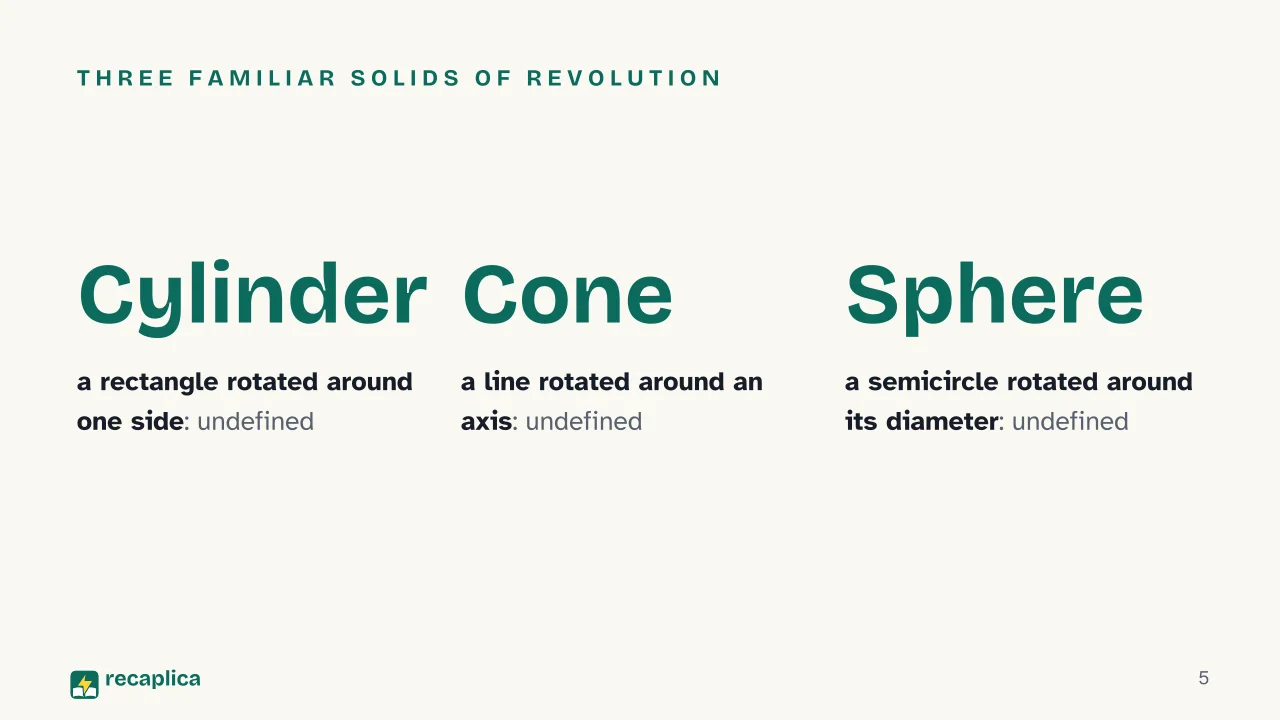
    The most familiar examples come straight out of classical Euclidean geometry. Rotate a rectangle around one of its sides and you get a cylinder. Rotate a right triangle, or just a line, around one leg and you get a cone. Rotate a semicircle around its own diameter and you get a sphere. A slice cut from a solid of revolution by a plane set at an angle to its base is called an “ungula,” in the terminology MathWorld uses.

    Once the starting shape is more complicated than a rectangle or a triangle, the resulting solid no longer has a simple volume formula — that’s where calculus, and specifically the disk and washer method, takes over.

    The disk method

    The disk method applies when the rotated region touches the axis all along the interval in question. Picture slicing the solid with planes perpendicular to the axis: each slice is a solid disk, and its radius is the distance from the curve to the axis at that point. For a function f(x) defined on an interval from a to b and rotated around the x-axis, each disk’s area is pi times f(x) squared; stacking infinitely many infinitely thin disks with an integral gives the total volume, V equals pi times the integral from a to b of f(x) squared. The same idea carries over when rotating around the y-axis, simply swapping the roles of x and y in the formula.

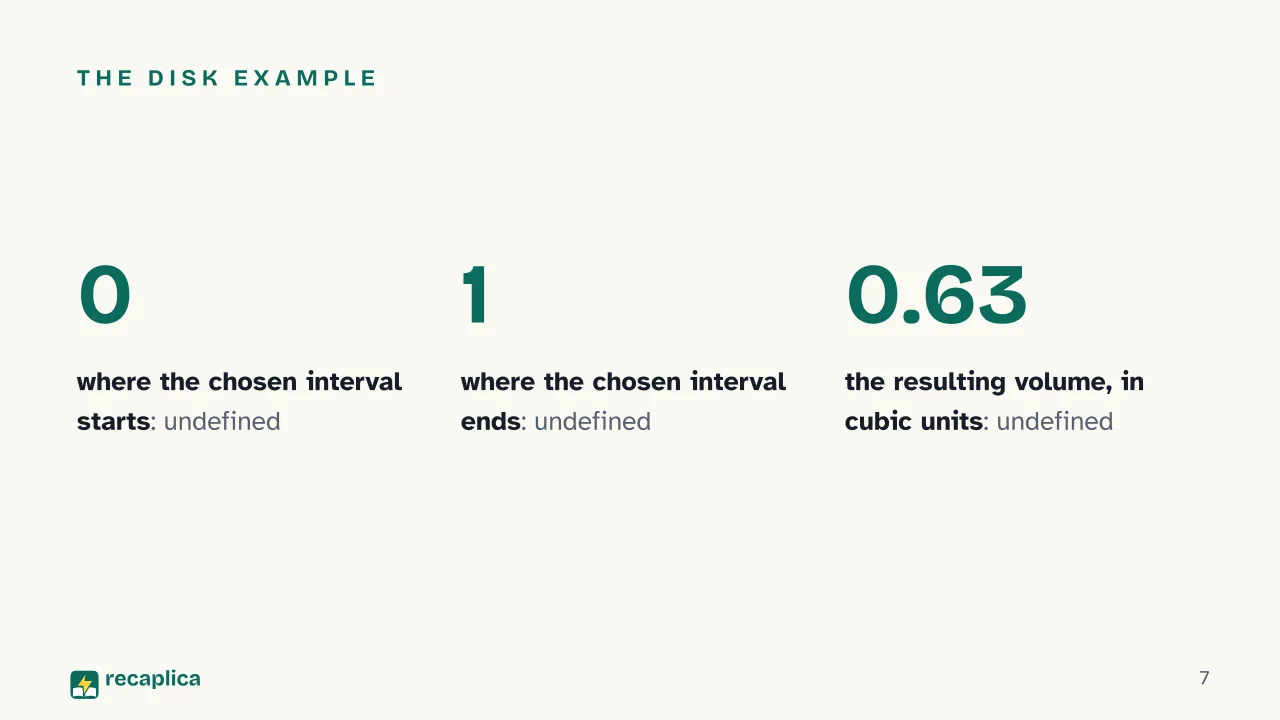
    Practical example: rotate the curve f(x) = x squared around the x-axis, over the interval from x=0 to x=1. Each cross-section is a disk of radius x squared, so its area is pi times x to the fourth power. Integrating from 0 to 1 gives a volume of one-fifth pi, about 0.63 cubic units.

    The washer method

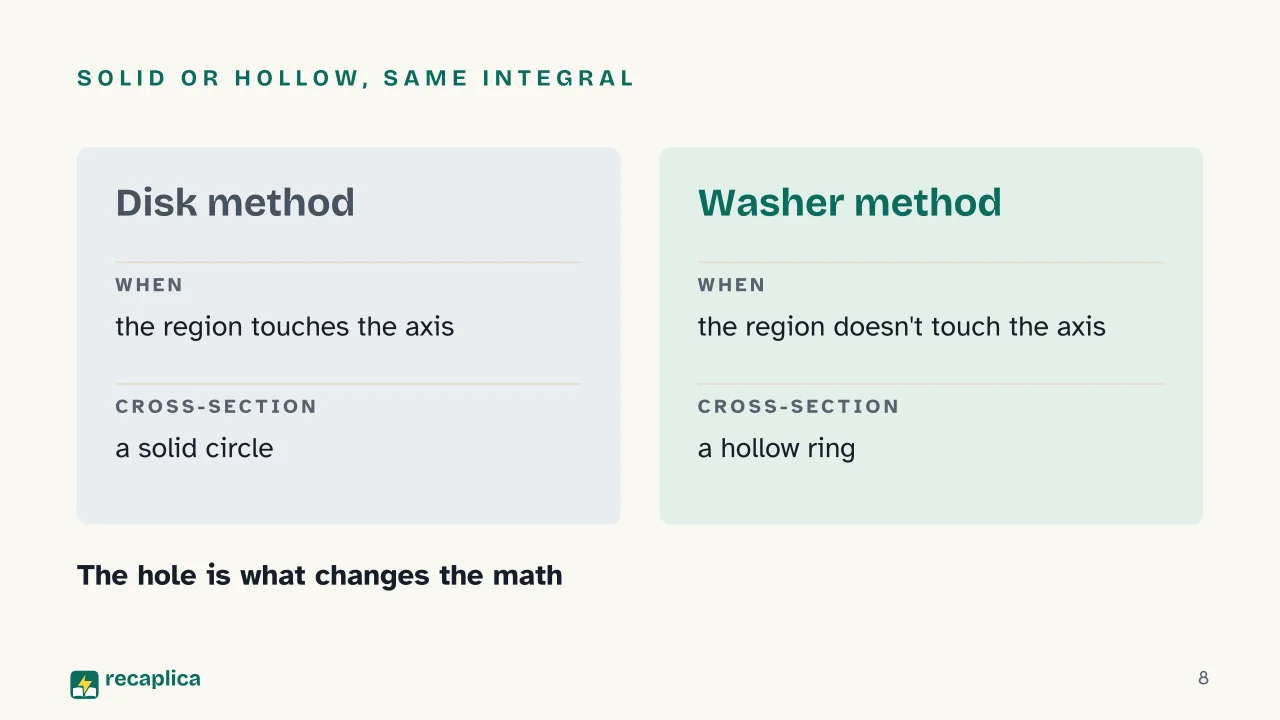
    When the rotated region doesn’t touch the axis — because it’s bounded by two curves, one closer and one farther away — the resulting solid has a hole through the middle, like a ring. Every cross-section is no longer a solid disk but a washer, bounded by an outer radius and an inner radius. The volume comes from subtracting the inner circle’s area from the outer circle’s area and integrating along the interval: V equals pi times the integral from a to b of the outer radius squared minus the inner radius squared.

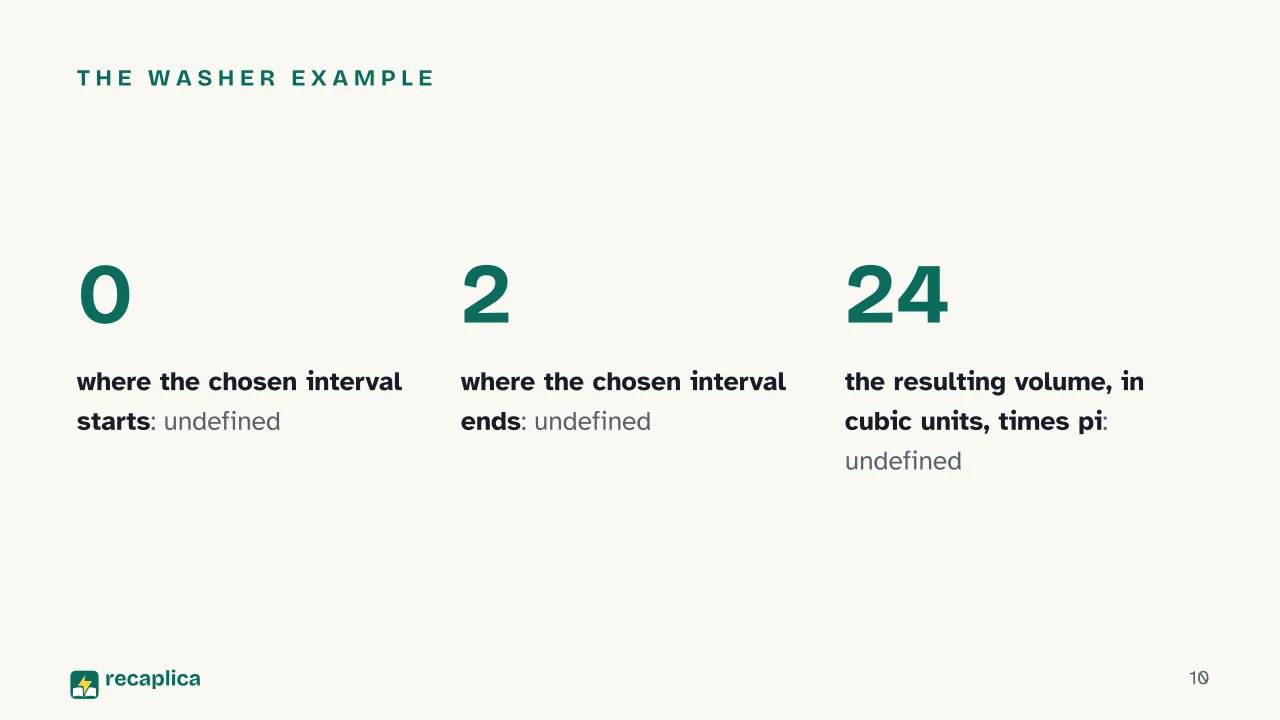
    Practical example: take the region between the outer line f(x) = x+3 and the inner line g(x) = x+1, over the interval from x=0 to x=2, rotated around the x-axis. The result is a hollow, ring-shaped solid, something like a stretched-out donut: each cross-section’s area is pi times the difference between (x+3) squared and (x+1) squared, which simplifies to pi times (4x+8). Integrating from 0 to 2 gives a volume of 24 times pi cubic units.

    An MIT exercise describes this exact situation with a donut-shaped solid, produced by rotating a region around a line that doesn’t touch it: it’s the case where the disk method alone isn’t enough, and the washer method takes over.

    Comparing the two methods

    AspectDisk methodWasher method
    When it appliesthe region touches the axis of rotationthe region is offset from the axis (a hole in the middle)
    What gets added upsolid disksrings, or washers
    Data neededa single radius, f(x)an outer radius and an inner radius
    Cross-sectiona circlea ring

    Special cases: cone, sphere, cylinder

    Both methods aren’t just for awkward curves — applied to simple shapes, they hand back the volume formulas already familiar from geometry class. Rotating the line y = kx, between x=0 and x=h, around the x-axis produces a cone with base radius R = kh and height h; the volume that comes out of the integration matches the standard formula, one-third pi times R squared times h. The same logic recovers the sphere’s formula from a rotated semicircle, and the cylinder’s from a rotated rectangle.

    SolidVolume
    Coneone-third pi times the radius squared times the height
    Spherefour-thirds pi times the radius cubed
    Cylinderpi times the radius squared times the height

    MathWorld lists this same table as a reference check: if applying the disk method to a cone doesn’t return this result, there’s an error somewhere in the integral.

    Where the two methods came from, carefully stated

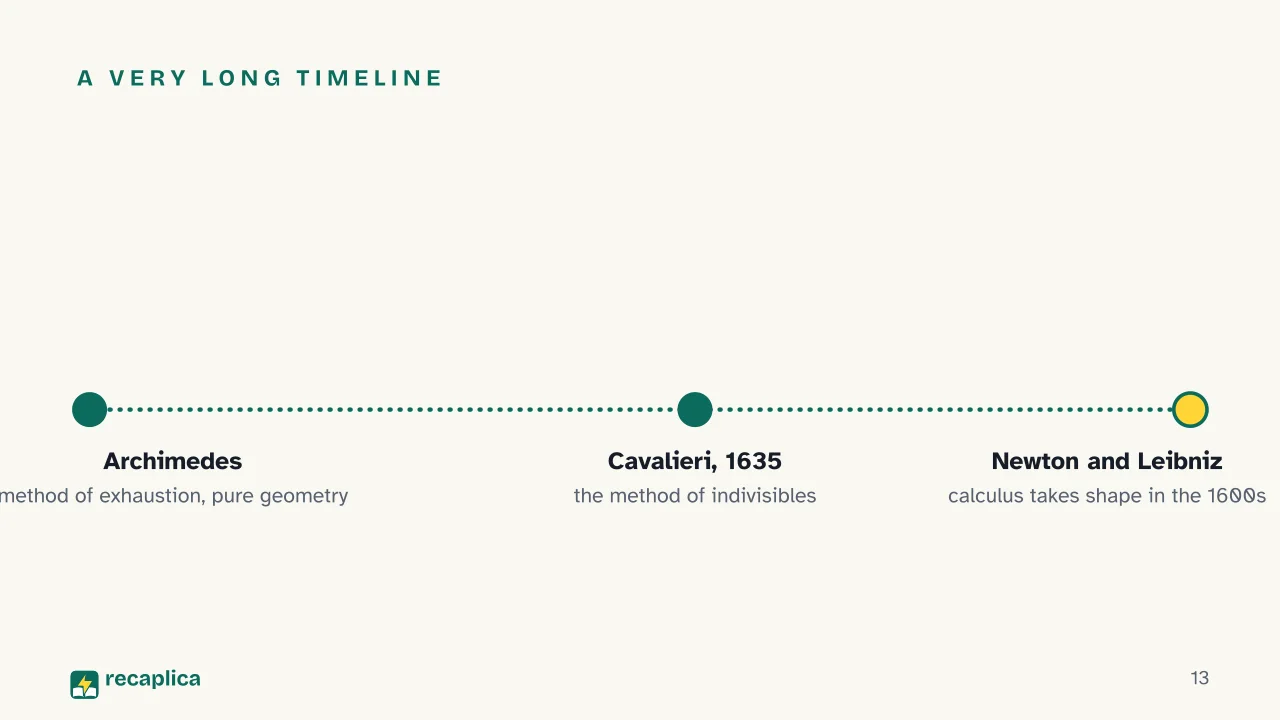
    The calculus underneath the disk and washer methods didn’t arrive on a single day. According to Wikipedia, Bonaventura Cavalieri published a treatise on the method of indivisibles in 1635, inspired by Kepler’s work — the direct conceptual ancestor of slicing a solid into extremely thin layers. Newton worked out his own calculus between 1664 and 1666, with a manuscript dated May 20, 1665 already showing substantial progress. Leibniz, working independently, recorded his discoveries in manuscripts starting in the autumn of 1675 and published the first paper on differential calculus in 1684, in the journal Acta Eruditorum in Leipzig.

    None of these sources, though, pins down a precise date for the disk or washer method itself as a teaching technique: that’s a later systematization, built into calculus textbooks on the foundations Cavalieri, Newton and Leibniz had laid. And well before any of them, Archimedes of Syracuse, working around 287-212 BCE, had already reached the volume of a sphere using the method of exhaustion, a purely geometric procedure with no limits and no algebraic notation: the historical sources consulted here describe it as the result he valued most in his entire body of work.

    Common mistakes

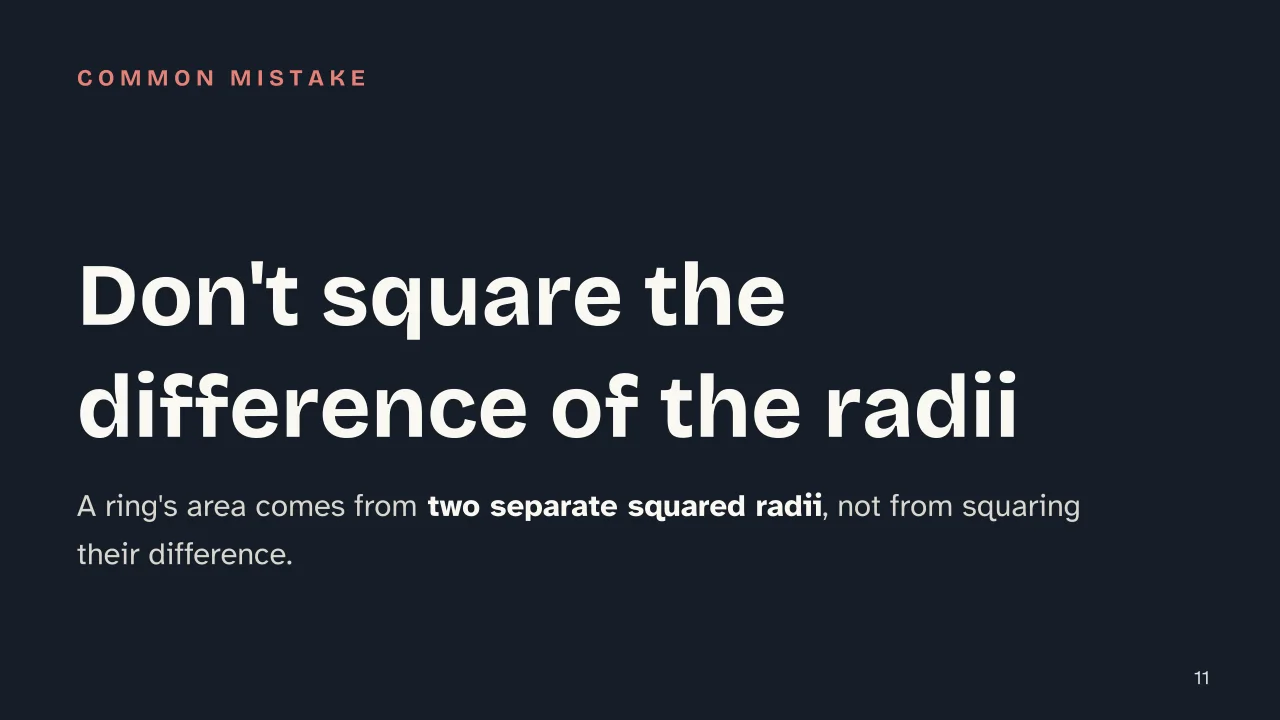
    The most frequently flagged error involves the washer method specifically: mixing up the square of a difference with the difference of two squares. One source (LibreTexts, adapted from OpenStax Calculus) calls this out explicitly as “a prevalent mistake” among students, and recommends deriving the formula from scratch every time rather than memorizing it — a practical habit more than a theoretical nicety, since the final number changes depending on which version you use.

    Anyone who has already worked with equations for lines and curves will recognize the same principle here: the exact shape of the function, not just its general type, is what determines the volume of the solid it sweeps out.

    Slide deck

    Slides ready to download and make your own in PowerPoint or Google Slides, with speaker notes. Pick the Flash cut or the Full one.

    Slide 1 of the presentation on Solid of Revolution: Solid of RevolutionSlide 2 of the presentation on Solid of Revolution: Why does a donut-shaped solid need two radii instead of one?Slide 3 of the presentation on Solid of Revolution: In this RecapSlide 4 of the presentation on Solid of Revolution: Chapter 01: What solids of revolution areSlide 5 of the presentation on Solid of Revolution: Three familiar solids of revolutionSlide 6 of the presentation on Solid of Revolution: Chapter 02: The disk methodSlide 7 of the presentation on Solid of Revolution: The disk exampleSlide 8 of the presentation on Solid of Revolution: Solid or hollow, same integralSlide 9 of the presentation on Solid of Revolution: Chapter 03: The washer methodSlide 10 of the presentation on Solid of Revolution: The washer exampleSlide 11 of the presentation on Solid of Revolution: Don't square the difference of the radiiSlide 12 of the presentation on Solid of Revolution: Chapter 04: Where the two methods came fromSlide 13 of the presentation on Solid of Revolution: A very long timelineSlide 14 of the presentation on Solid of Revolution: Which method applies when the rotated region doesn't touch the axis?Slide 15 of the presentation on Solid of Revolution: The Recap continues online
    Flash10 slidesThe essential thread, to present in classFull15 slidesEvery chapter and the deeper detail

    Common myths

    • ✗ Myth You find the volume of a washer by squaring the difference between the outer and inner radius.

      ✓ Reality A ring's area is the big circle's area minus the small circle's area — two separate squared numbers subtracted from each other, not the square of a subtraction. A university-level calculus source flags this exact swap as the most common error students make with the method, and recommends deriving the formula from scratch each time rather than memorizing a shortcut that's easy to misremember.

    • ✗ Myth Nobody could work out the volume of a curved solid like a sphere before calculus existed.

      ✓ Reality Archimedes of Syracuse, working around 287-212 BCE, got there with the method of exhaustion — pure geometry, no limits, no integrals. He proved that a sphere's volume is two-thirds that of the cylinder that just contains it, a result he reportedly valued above anything else he produced, roughly 1,800 years before Newton and Leibniz formalized calculus.

    • ✗ Myth The disk method was invented by Newton or Leibniz in the 1600s.

      ✓ Reality Newton and Leibniz gave the world the integral that the disk method relies on — Newton between 1664 and 1666, Leibniz in manuscripts from 1675 published in 1684 — but neither history source pins down a precise moment when the disk method itself, as it's taught in calculus courses, was assembled into a named technique. It's a later textbook systematization built on foundations Cavalieri had already sketched out in 1635 with his method of indivisibles.

    Mind map

    Drag the background to move around and the nodes to reposition them; use − and + to collapse and expand branches.
    Customize
    Mind map: Solid of Revolution: What It Is and the Volume Formula
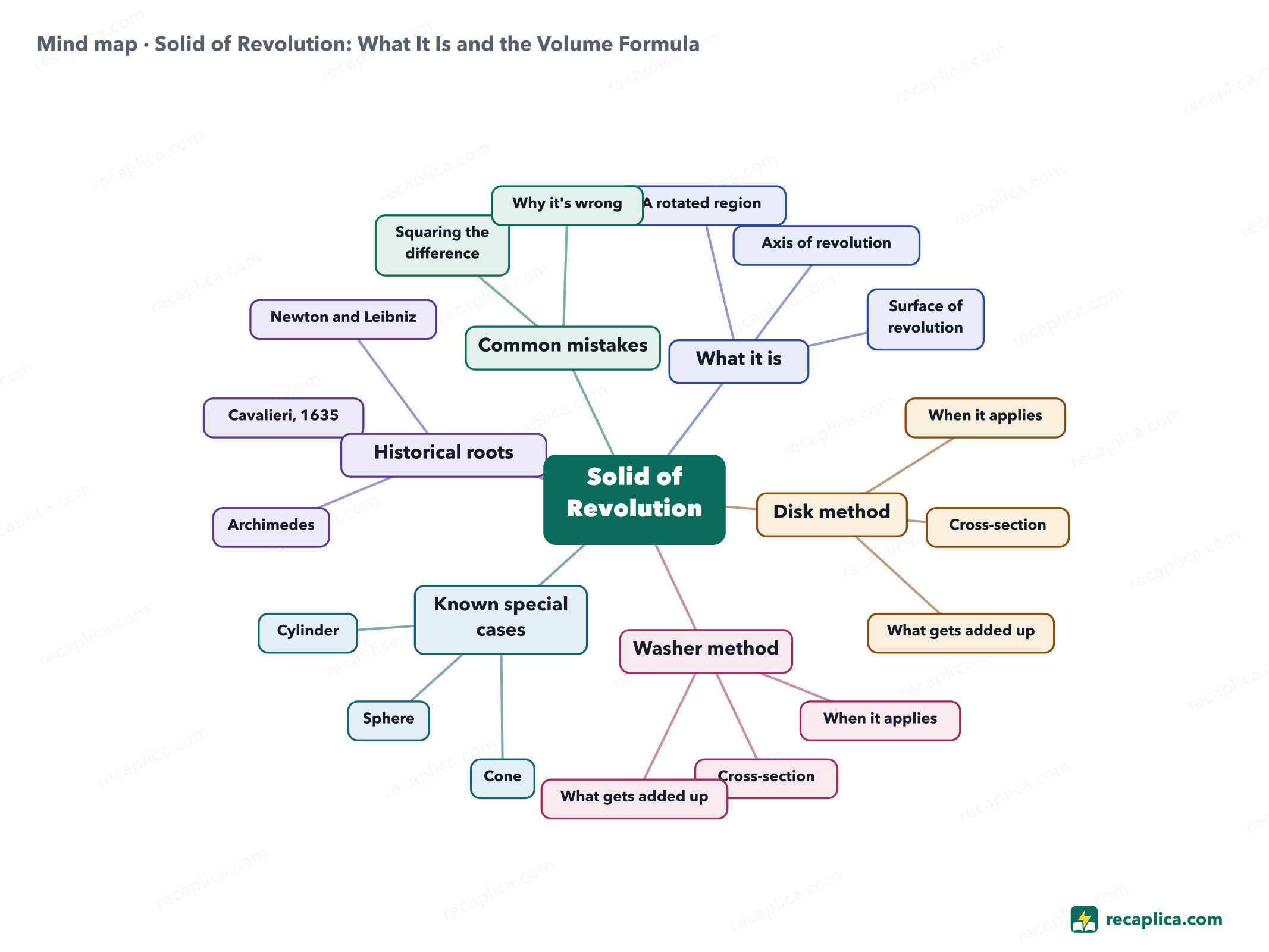
    • Solid of Revolution
      • What it is
        • A rotated region a flat shape or curve in a plane
        • Axis of revolution the line in that same plane it spins around
        • Surface of revolution the outer boundary of the resulting solid
      • Disk method
        • When it applies the rotated region touches the axis
        • Cross-section a solid circle
        • What gets added up a stack of thin disks
      • Washer method
        • When it applies the rotated region is offset from the axis
        • Cross-section a ring
        • What gets added up a stack of thin rings
      • Known special cases
        • Cone a line rotated around an axis
        • Sphere a semicircle rotated around its diameter
        • Cylinder a rectangle rotated around one side
      • Historical roots
        • Archimedes method of exhaustion, pure geometry
        • Cavalieri, 1635 the method of indivisibles
        • Newton and Leibniz calculus takes shape in the 1600s
      • Common mistakes
        • Squaring the difference the most reported error among students
        • Why it's wrong the area is a difference of two squares

    Quiz: test yourself

    Answer the questions to check what you have learned: you get instant feedback and a short explanation.

    Grade 0/10 0/5
    1 By definition, what is a solid of revolution?

    MathWorld and Wikipedia both describe it this way: a solid enclosing the surface obtained by rotating a curve or a flat region about an axis lying in the same plane.

    2 Which formula matches the disk method for a function f(x) on the interval from a to b, rotated around the x-axis?

    The disk method stacks thin circular slices of radius f(x); each disk has area pi times f(x) squared, and adding them up over the interval with an integral gives the total volume.

    3 True or false: with the washer method, you find the volume by squaring the difference between the outer and inner radius.

    A ring's area is the outer circle's area minus the inner circle's area: you calculate the two squared radii separately, then subtract them.

    4 Which ancient mathematician worked out a sphere's volume using pure geometry, with no calculus involved?

    Archimedes used the method of exhaustion to show that a sphere's volume is two-thirds that of the cylinder that circumscribes it, roughly 1,800 years before Newton and Leibniz formalized calculus.

    5 Rotating which shape around the x-axis produces a cone?

    Rotating the line y=kx between 0 and h around the x-axis produces a cone with base radius R=kh and height h, whose volume works out to one-third pi times R squared times h — the standard cone formula.

    Answers: 1-A · 2-A · 3-B · 4-A · 5-A

    Flashcards

    Tap the card to flip it and check whether you remember the answer, then move to the next one.

    1 / 8

    Explain it in your own words

    The ultimate test: if you can explain it in simple words, you've truly understood it. Write your explanation, then compare it with the Recap.

    Your explanation is saved only on this device.

    A solid of revolution is the three-dimensional shape you get by spinning a flat region around a line, the axis of revolution. Cylinders, cones and spheres are the most familiar examples, but the same idea works for any curve. The volume comes from slicing the solid into thin cross-sections and adding them up with an integral: solid disks when the shape touches the axis, hollow washers when it leaves a gap in the middle. This Recap walks through both formulas, two worked examples, and where the underlying calculus actually came from.

    Frequently asked questions

    What is a solid of revolution?

    It's a three-dimensional shape produced by rotating a flat region, or even just a curve, around a line in the same plane called the axis of revolution. Its outer boundary is called the surface of revolution.

    What is the disk and washer method used for?

    It's the standard technique for finding the volume of a solid of revolution with calculus. The disk method slices the solid into solid circles when the region touches the axis; the washer method slices it into rings when the region is offset from the axis, leaving a hole down the middle.

    What is the disk method formula?

    For a function f(x) on an interval from a to b, rotated around the x-axis, the volume equals pi times the integral from a to b of f(x) squared. Each thin slice is a disk with radius f(x), and stacking infinitely many of them with an integral gives the total volume.

    How is the washers method different from the disk method?

    The washers method is used when the rotated region does not touch the axis, so every cross-section is a ring rather than a solid circle. The volume formula subtracts the squared inner radius from the squared outer radius before integrating — a common mix-up is squaring the difference of the radii instead, which gives the wrong number.

    How can I practice finding the volume of a solid of revolution?

    Start with a simple function on a defined interval, decide whether the region touches the axis (disk) or sits away from it (washer), write out the matching integral, and solve it step by step. Checking the result against the known volumes of a cone, sphere or cylinder is a quick way to catch a mistake.

    Sources

    • Wolfram MathWorld, Solid of Revolution
    • MIT OpenCourseWare, 18.01SC Single Variable Calculus, Session 57b — Volumes by Disks and Shells
    • Mathematics LibreTexts (CCSF Calculus), Volumes of Revolution - The Disk and Washer Methods
    • Wikipedia, Solid of revolution
    • Wikipedia, History of calculus

    Every Recap goes through an independent review before publication.

    Every evening, the day's new Recaps on our Telegram channel. Join the channel →

    Keep learning

    • Science Cognitive Load Theory: The Definition Behind Sweller's Research Cognitive load is the amount of working memory a task uses up while you learn something new. Psychologist John Sweller first described it in 1988, starting from research on problem solving: a strategy that is too demanding leaves little room to build stable mental structures. Later research distinguishes three types of load, intrinsic, extraneous, and germane, though part of the field treats the third as indistinguishable from the first. Cutting extraneous load, with worked examples or less cluttered materials, frees up mental room for actual learning. Read the Recap →
    • Science Cognitivism: how the mind processes information Cognitivism is the psychological paradigm that treats the mind as a system for processing information, spanning perception, memory, reasoning and language. The shift began around 1956, while behaviorism, championed by Watson and Skinner, still ruled academic psychology and reduced the field to observable stimuli and responses. That same year, George Miller exposed the limits of short-term memory, and Chomsky joined McCarthy, Minsky, Newell and Simon in laying the groundwork for cognitive science. Donald Broadbent's attention model in 1958 and Ulric Neisser's 1967 book, which put the name cognitive psychology into common use, complete the roster of its founding figures. Read the Recap →
    • Science Behaviorism: What It Is and Where It Came From Behaviorism is the school of psychology that studies only observable behavior, leaving aside the thoughts and feelings that stay hidden inside the mind. It began in 1913, when the American psychologist John B. Watson published an essay calling for psychology to become an experimental science, without relying on introspection. After him, Ivan Pavlov studied conditioned reflexes and Edward Thorndike studied trial-and-error learning; Burrhus Skinner pushed the ideas to their most extreme form with radical behaviorism. The thread running through all of it is the stimulus-response model: a behavior is explained by what comes before it and what follows it, not by guessing what happens inside the head of the person doing it. Read the Recap →

    recaplica

    Clear in 30 seconds, yours in 10 minutes.

    Recaps Mind maps Request a Recap Telegram channel Mind map maker Our method About Privacy & cookies Legal notes & terms of use

    © 2026 Recaplica · A project by Curi S.r.l. — VAT IT05472000750

    Statistics, only if you say so

    To learn which Recaps help most we would use Google Analytics, with aggregate, anonymous data. It starts only with your OK, and you can change your mind anytime. Privacy policy