Skip to content
recaplica

    One moment: security check

    Cloudflare wants to make sure you're not a robot. Tick the box below and your search will continue on its own.

    IT
    recaplica Rectangular Prism Volume: The Formula and a Worked Example
    © 2026 Recaplica · recaplica.com — All rights reserved
    Home › Science

    Rectangular Prism Volume: The Formula and a Worked Example

    By Recaplica Newsroom · Updated on September 22, 2026

    What to print

    Page numbers appear when printing with default margins.

    Telegram channel
    recaplica Clear in 30 seconds, yours in 10 minutes.
    In 30 seconds Key points Deep dive Myths Mind map Quiz Flashcards FAQ

    In 30 seconds quick read

    A rectangular prism is a solid with six faces, all of them rectangles, sometimes called a quadrangular rectangular prism or a rectangular-based parallelepiped. Its volume comes from multiplying the three dimensions — length, width and height — with the formula V = l × w × h. When all three dimensions match, the same solid becomes a cube. It's the simplest kind of prism: unlike a triangular-based prism, there's no triangle-area formula to work out first.

    Key Points

    • A rectangular prism has six faces, all rectangles, opposite pairs congruent.
    • It is also called a quadrangular rectangular prism or a rectangular-based parallelepiped: different names for the same solid.
    • Volume equals length × width × height (V = l × w × h).
    • When all three dimensions are equal, a rectangular prism becomes a cube.
    • Total surface area uses a different formula from volume: the two are not interchangeable.
    • The calculation matches base area × height, the same logic behind every prism.

    Deep Dive

    Right Rectangular Prism: Definition

    Wolfram MathWorld defines a cuboid — also called a rectangular parallelepiped — as “a closed box composed of three pairs of rectangular faces placed opposite each other and joined at right angles to each other.” Math Is Fun describes the same shape more plainly: a box-shaped object with six flat faces, all of them rectangles, where every angle is a right angle. That right-angle property is why the shape is also called a right rectangular prism: its side faces meet the base square on, not at a slant.

    The Enciclopedia della Matematica Treccani places it inside the broader family of parallelepipeds — solids with six faces, opposite pairs parallel and congruent — and calls one “rectangular” only when every face is a rectangle. Two other names turn up for the exact same solid in textbooks: quadrangular rectangular prism and rectangular-based parallelepiped.

    The Rectangular Prism Formula for Volume

    Every source above gives the same rectangular prism formula, just with different letters. Treccani and Wolfram MathWorld write it as V = abc, where a, b and c are the three edges; Math Is Fun and Cuemath write it as V = lwh, length times width times height. Same multiplication, different notation:

    V = length × width × height

    The three dimensions meet at each corner of the solid at right angles to one another. The result comes out in cubic units: if length, width and height are measured in centimeters, the volume is in cubic centimeters.

    The same formula also reads as “base area × height,” the rule behind the triangular-prism case too — there, though, finding the base area takes the triangle-area formula first, since a plain product of two sides isn’t enough. In a rectangular prism the base is itself a rectangle, so its area is already length × width, and multiplying that by the height lands on the same number as V = l × w × h.

    How to Find the Volume of a Rectangular Prism: Worked Example

    Practical example: Cuemath works through a box measuring 8 inches long, 5 inches wide and 16 inches tall. First, the base area: 8 × 5 = 40 square inches. Then multiply by the height: 40 × 16 = 640 cubic inches. Multiplying all three numbers in one go, 8 × 5 × 16, gives the same 640.

    The Cube: A Special Case

    Treccani and Wolfram MathWorld both mark the same boundary: once the three dimensions match (a = b = c), a rectangular prism turns into a cube. A cube, then, is simply the special case where length, width and height happen to be equal, so the volume formula stays exactly the same, just with three matching factors (5 × 5 × 5, for instance).

    Total Surface Area, So It Doesn’t Get Mixed Up with Volume

    The same sources also give the formula for total surface area, the combined area of all six faces, mostly so it doesn’t get confused with volume: A = 2(lw + lh + wh), using the same three dimensions. That’s a different formula from the one above, and the result comes out in square units: for a solid measuring 4, 5 and 10, the volume is 200 cubic units, while the total surface area is 220 square units. The algebra behind these formulas is covered in algebra: what it is and how symbolic notation works. Both formulas rest on the same theorems as Euclidean geometry: what it is and how Euclid’s postulates work, and the broader framework for combining variables and matrices is linear algebra: what it is and how vectors and matrices work.

    Common myths

    • ✗ Myth Multiplying any two measurements of the solid gives its volume.

      ✓ Reality A rectangular prism's volume depends on three dimensions: length, width and height. Multiplying just two of them gives the area of one face, a surface measured in square units. The solid's volume comes out in cubic units, and calculating it takes all three dimensions.

    • ✗ Myth Total surface area and volume are the same measurement, just with a different name.

      ✓ Reality They are two different measurements, with two different formulas. For a solid with sides 4, 5 and 10, the volume is 4 × 5 × 10 = 200 cubic units, while the total surface area is 2(4×5 + 4×10 + 5×10) = 2(20 + 40 + 50) = 220 square units.

    • ✗ Myth Changing the order in which length, width and height are multiplied changes the result.

      ✓ Reality Multiplication is commutative: 8 × 5 × 16 gives the same result as 16 × 8 × 5 or 5 × 16 × 8. The three numbers stay the same in every version; only their order on the page changes.

    Mind map

    Drag the background to move around and the nodes to reposition them; use − and + to collapse and expand branches.
    Customize
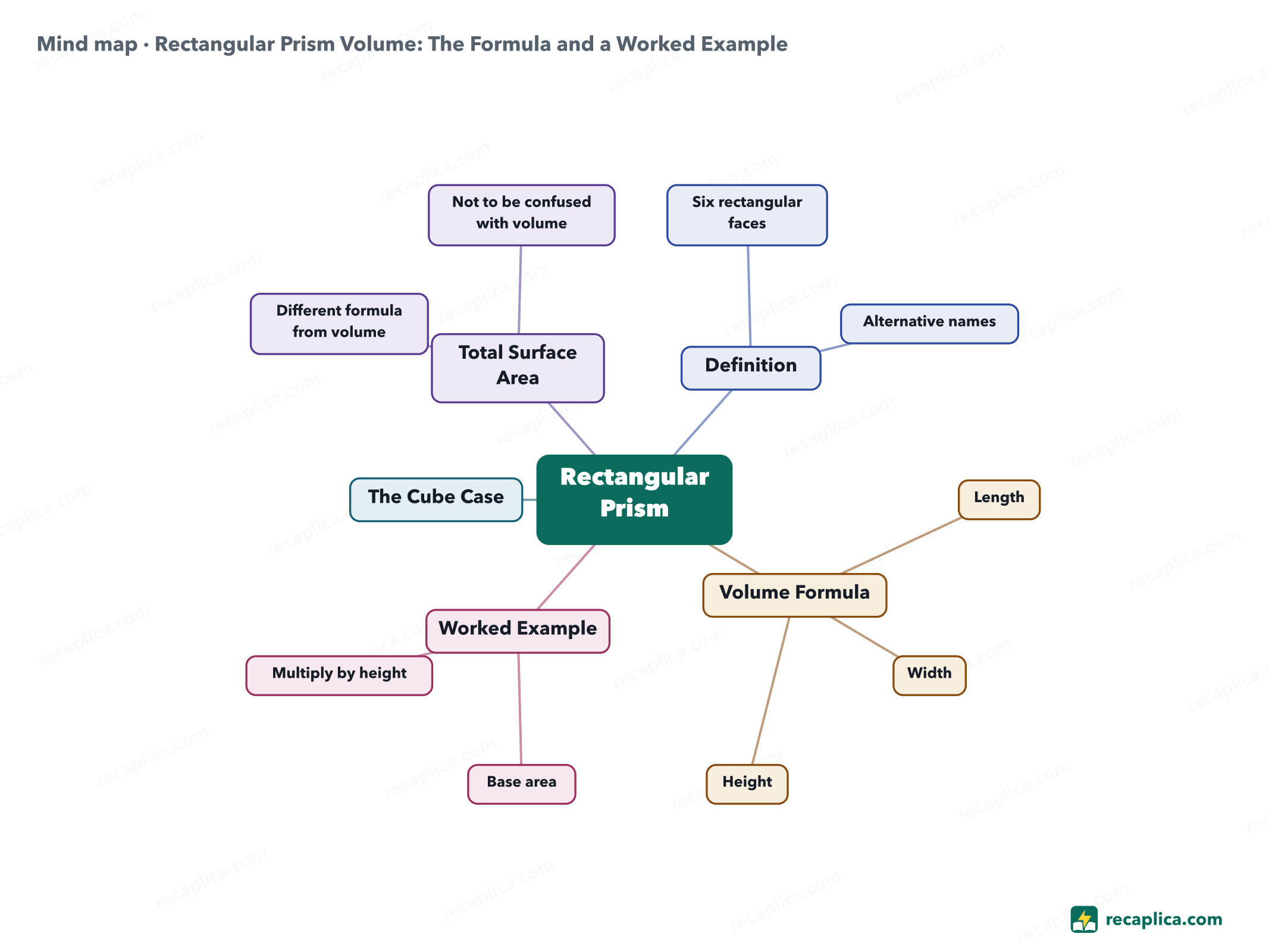
    Mind map: Rectangular Prism Volume: The Formula and a Worked Example
    • Rectangular Prism
      • Definition
        • Six rectangular faces opposite pairs congruent
        • Alternative names quadrangular rectangular prism, rectangular-based parallelepiped
      • Volume Formula
        • Length
        • Width
        • Height
      • Worked Example
        • Base area length times width
        • Multiply by height
      • The Cube Case when length, width and height match
      • Total Surface Area
        • Different formula from volume
        • Not to be confused with volume

    Quiz: test yourself

    Answer the questions to check what you have learned: you get instant feedback and a short explanation.

    Grade 0/10 0/5
    1 What is the formula for the volume of a rectangular prism?

    The volume of a rectangular prism is the product of its three dimensions: length, width and height.

    2 A box measures 8 × 5 × 16. What is its volume?

    Base area first (8 × 5 = 40), then × the height (40 × 16 = 640).

    3 What is a rectangular prism called when all three dimensions are equal?

    When length, width and height match, a rectangular prism becomes a cube: a special case, not a different solid.

    4 "Quadrangular rectangular prism" and "rectangular-based parallelepiped" name two different solids.

    They are two different names geometry uses for the same solid: the rectangular prism.

    5 Why doesn't multiplying just two dimensions give the volume of the solid?

    Multiplying two dimensions gives the area of one rectangular face (square units); volume needs the third dimension and comes out in cubic units.

    Answers: 1-A · 2-A · 3-A · 4-A · 5-A

    Flashcards

    Tap the card to flip it and check whether you remember the answer, then move to the next one.

    1 / 7

    Explain it in your own words

    The ultimate test: if you can explain it in simple words, you've truly understood it. Write your explanation, then compare it with the Recap.

    Your explanation is saved only on this device.

    A rectangular prism is a solid with six faces, all of them rectangles, sometimes called a quadrangular rectangular prism or a rectangular-based parallelepiped. Its volume comes from multiplying the three dimensions — length, width and height — with the formula V = l × w × h. When all three dimensions match, the same solid becomes a cube. It's the simplest kind of prism: unlike a triangular-based prism, there's no triangle-area formula to work out first.

    Frequently asked questions

    What is a right rectangular prism?

    It is the formal name for the same shape most people just call a rectangular prism or a box: six rectangular faces meeting at right angles, with the volume found by multiplying length × width × height.

    What is the rectangular prism formula?

    Volume equals length × width × height (V = l × w × h). Total surface area uses a different formula, 2(lw + lh + wh), and comes out in square units instead of cubic ones.

    How do you find the volume of a rectangular prism?

    Multiply the three dimensions together, or work in two steps: find the base area (length × width), then multiply that by the height. Both routes give the same result.

    Is a cube the same shape as a rectangular prism?

    A cube is a special case of a rectangular prism, the one where length, width and height are all equal. A rectangular prism with three different dimensions doesn't qualify as a cube.

    What's the difference between volume and total surface area?

    Volume is the space the solid takes up, measured in cubic units (V = length × width × height); total surface area is the combined area of all six faces, measured in square units, and uses a different formula.

    Sources

    • Parallelepipedo — Enciclopedia della Matematica, Treccani
    • Cuboid — Wolfram MathWorld
    • Cuboids and Rectangular Prisms — Math Is Fun
    • Volume of Rectangular Prism — Cuemath

    Every Recap goes through an independent review before publication.

    Every evening, the day's new Recaps on our Telegram channel. Join the channel →

    Keep learning

    • Science Cognitive Load Theory: The Definition Behind Sweller's Research Cognitive load is the amount of working memory a task uses up while you learn something new. Psychologist John Sweller first described it in 1988, starting from research on problem solving: a strategy that is too demanding leaves little room to build stable mental structures. Later research distinguishes three types of load, intrinsic, extraneous, and germane, though part of the field treats the third as indistinguishable from the first. Cutting extraneous load, with worked examples or less cluttered materials, frees up mental room for actual learning. Read the Recap →
    • Science Cognitivism: how the mind processes information Cognitivism is the psychological paradigm that treats the mind as a system for processing information, spanning perception, memory, reasoning and language. The shift began around 1956, while behaviorism, championed by Watson and Skinner, still ruled academic psychology and reduced the field to observable stimuli and responses. That same year, George Miller exposed the limits of short-term memory, and Chomsky joined McCarthy, Minsky, Newell and Simon in laying the groundwork for cognitive science. Donald Broadbent's attention model in 1958 and Ulric Neisser's 1967 book, which put the name cognitive psychology into common use, complete the roster of its founding figures. Read the Recap →
    • Science Behaviorism: What It Is and Where It Came From Behaviorism is the school of psychology that studies only observable behavior, leaving aside the thoughts and feelings that stay hidden inside the mind. It began in 1913, when the American psychologist John B. Watson published an essay calling for psychology to become an experimental science, without relying on introspection. After him, Ivan Pavlov studied conditioned reflexes and Edward Thorndike studied trial-and-error learning; Burrhus Skinner pushed the ideas to their most extreme form with radical behaviorism. The thread running through all of it is the stimulus-response model: a behavior is explained by what comes before it and what follows it, not by guessing what happens inside the head of the person doing it. Read the Recap →

    recaplica

    Clear in 30 seconds, yours in 10 minutes.

    Recaps Mind maps Request a Recap Telegram channel Mind map maker Our method About Privacy & cookies Legal notes & terms of use

    © 2026 Recaplica · A project by Curi S.r.l. — VAT IT05472000750

    Statistics, only if you say so

    To learn which Recaps help most we would use Google Analytics, with aggregate, anonymous data. It starts only with your OK, and you can change your mind anytime. Privacy policy