|
recaplica
What Is the Space Economy? Value, Growth and Who Runs It | |||||||||||||||||||||||||||
| © 2026 Recaplica · recaplica.com — All rights reserved | |||||||||||||||||||||||||||
What Is the Space Economy? Value, Growth and Who Runs ItWhat to print Page numbers appear when printing with default margins. SlidesChoose a cut Flash10 slidesThe essential thread, to present in classFull15 slidesEvery chapter and the deeper detailBoth come with speaker notes. In 30 seconds quick readThe space economy covers every economic activity built around space: launches, satellites, telecommunications, Earth observation and, increasingly, lunar resources. In 2025 the global market was worth about $600 billion, according to the OECD, while McKinsey and the World Economic Forum project it could reach $1.8 trillion by 2035. Before 2010, launches were mostly government-run; by 2025, 88% launched privately. Control of the busiest orbits and of the Moon has meanwhile become a contest between two coalitions, the US-led Artemis Accords and the China-Russia International Lunar Research Station. Key Points
Key figures
Deep DiveThe space economy covers everything that generates economic value from space: launches, building and operating satellites, telecommunications, Earth observation and, increasingly, the extraction of resources from the Moon and asteroids. In 2025 the global market was worth about $600 billion, according to the OECD. A market changing scaleThe OECD’s 2025 figure and the McKinsey-World Economic Forum projection for 2035 measure two different things: the first is a snapshot of today’s market, the second is a future scenario in which the market nearly triples from its 2023 level in just over a decade.
The two segments of the McKinsey-WEF projection show where the growth is expected to concentrate: by 2035, “backbone services” (launches, satellites, ground stations) would be worth about $755 billion, while the applications that use that infrastructure — from precision agriculture to navigation — would top $1 trillion. From public to privateThe sector started out public and stays partly so: OECD countries’ civil budgets rose from $40.5 billion to $46.4 billion between 2022 and 2025. But private capital is moving faster, with flows estimated between $11 billion and $13 billion in 2025 alone. The clearest signal is in launches: private operators carried out 23% of them in 2010, and 88% in 2025.
Two coalitions racing for the MoonThe reference legal framework is still the 1967 Outer Space Treaty, which bans any state from appropriating a celestial body “by declaration, use, occupation, or any other means” and defines outer space as “the province of all mankind.” On lunar and asteroid resource extraction, though, the text stays silent: it’s a gap the two coalitions now competing for the Moon have filled in different ways, six decades after Apollo 11 landed on the Moon.
The Artemis Accords explicitly tie the resource question to the 1967 treaty, arguing that extraction “can and should” happen in a way that complies with it. Several countries, including Luxembourg, Japan, China, India and Russia, have meanwhile introduced their own national laws on appropriating space resources. New players outside the two main coalitions are joining the lunar race. India, through the company Skyroot, launched the Vikram-1 rocket on July 18, 2026, becoming the third country in the world with private orbital launch capability, after the United States and China. In Europe, where the Ariane program remains the backbone of independent access to space (with several European Union member states among its backers), Amazon booked six additional launches with Arianespace in September 2026, bringing its total booked launches to 24, to compete with SpaceX’s Starlink constellation. Why orbit is already crowdedNot all orbital competition is about the Moon: much of it plays out much closer to home, in low orbit. According to ESA, about 40,000 objects were tracked in orbit in 2025, of which about 11,000 were active satellites; the estimated number of debris pieces larger than 1 centimeter, big enough to cause serious damage on impact, tops 1.2 million. In low orbit around 550 km altitude, hazardous debris is now roughly the same order of magnitude as operational satellites: it’s the setup behind what experts call the Kessler cascade, the risk that collisions trigger more debris in a chain reaction. Rocket bodies re-enter the atmosphere more than three times a day on average, and in 2024, controlled re-entries outnumbered uncontrolled ones for the first time. About 90% of rocket bodies in low orbit meet the standard of re-entering within 25 years of the end of their mission; 80% also meet the newer, tighter 5-year standard. Part of the push for stricter rules is that, according to the OECD, nearly $200 billion of economic activity was exposed to the risk posed by space debris in 2025. Slide deckSlides ready to download and make your own in PowerPoint or Google Slides, with speaker notes. Pick the Flash cut or the Full one.     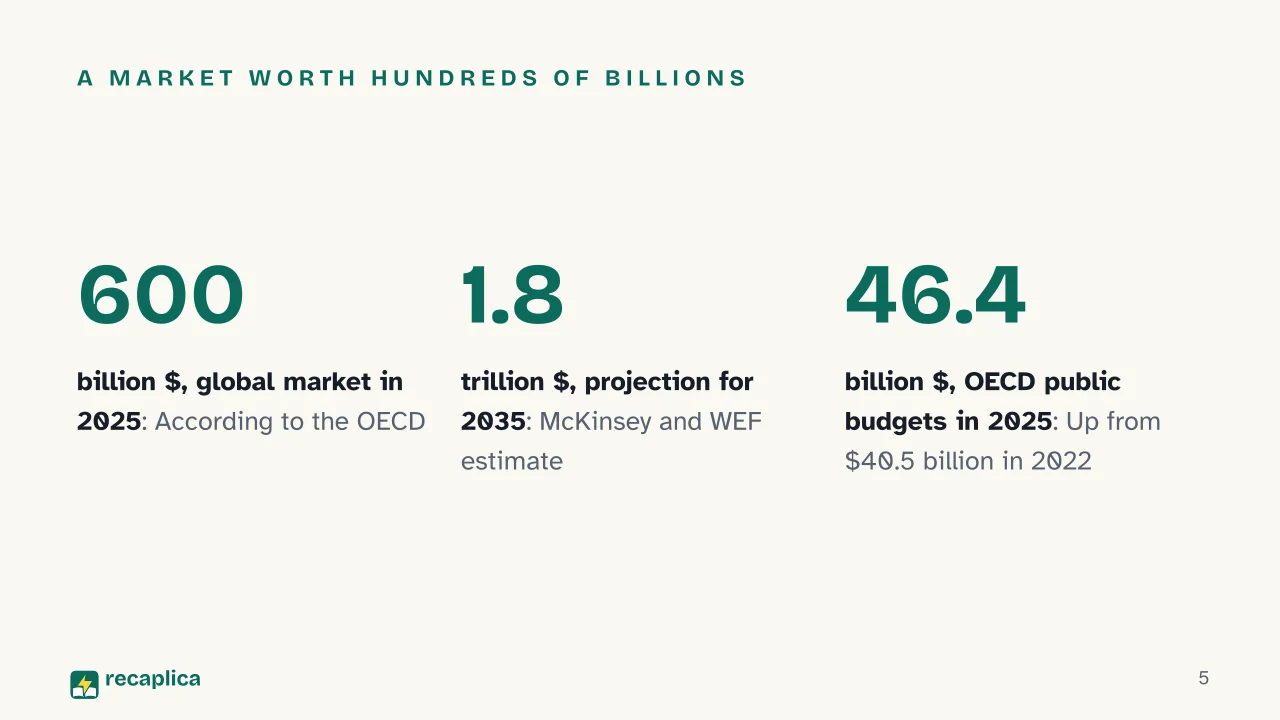  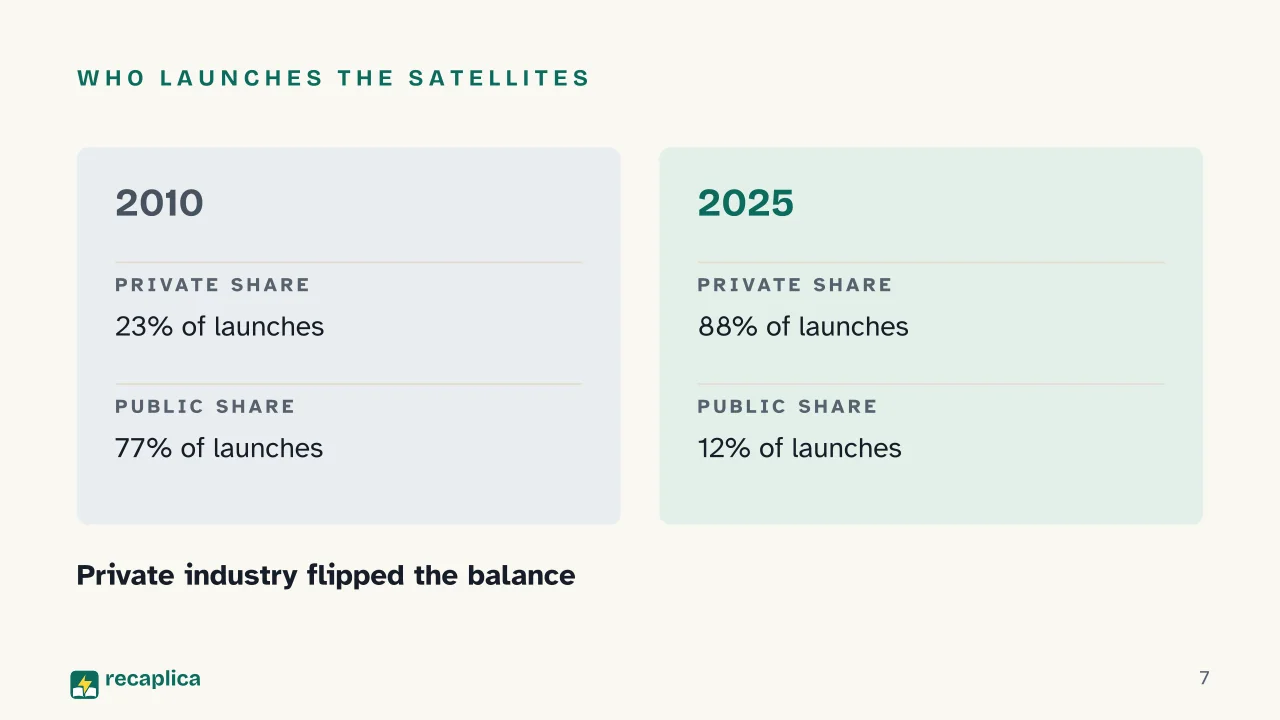 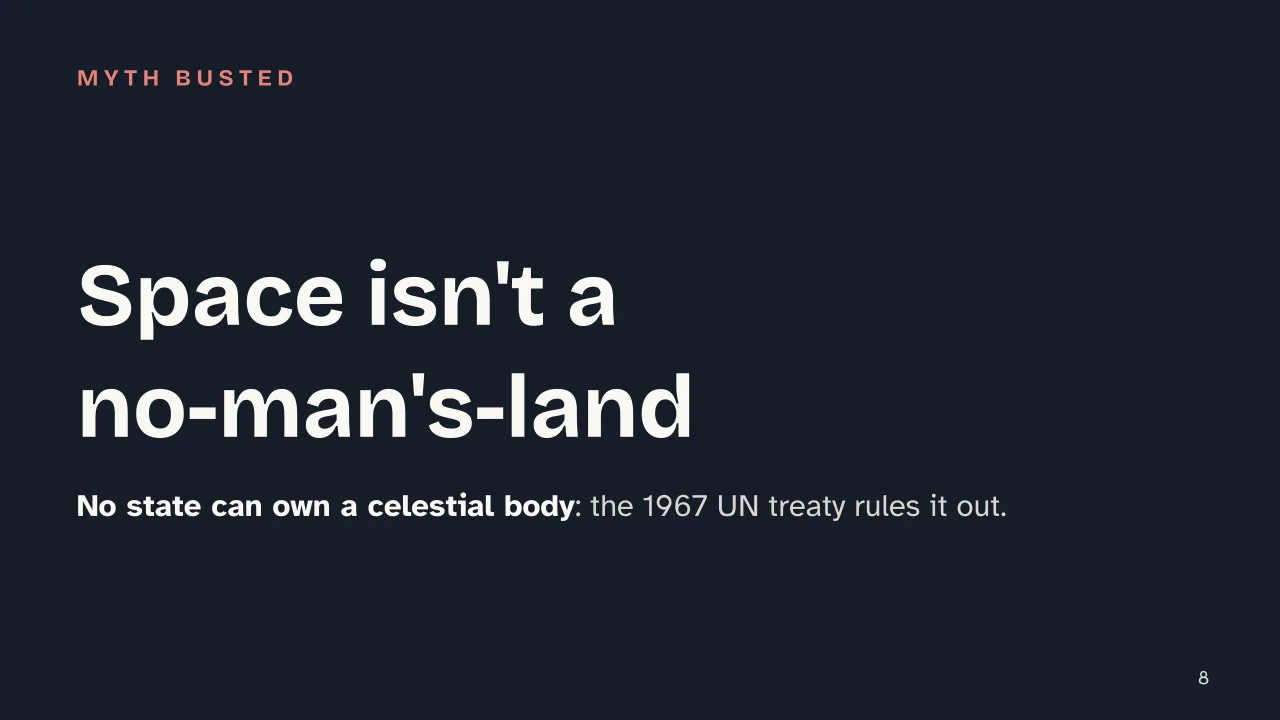  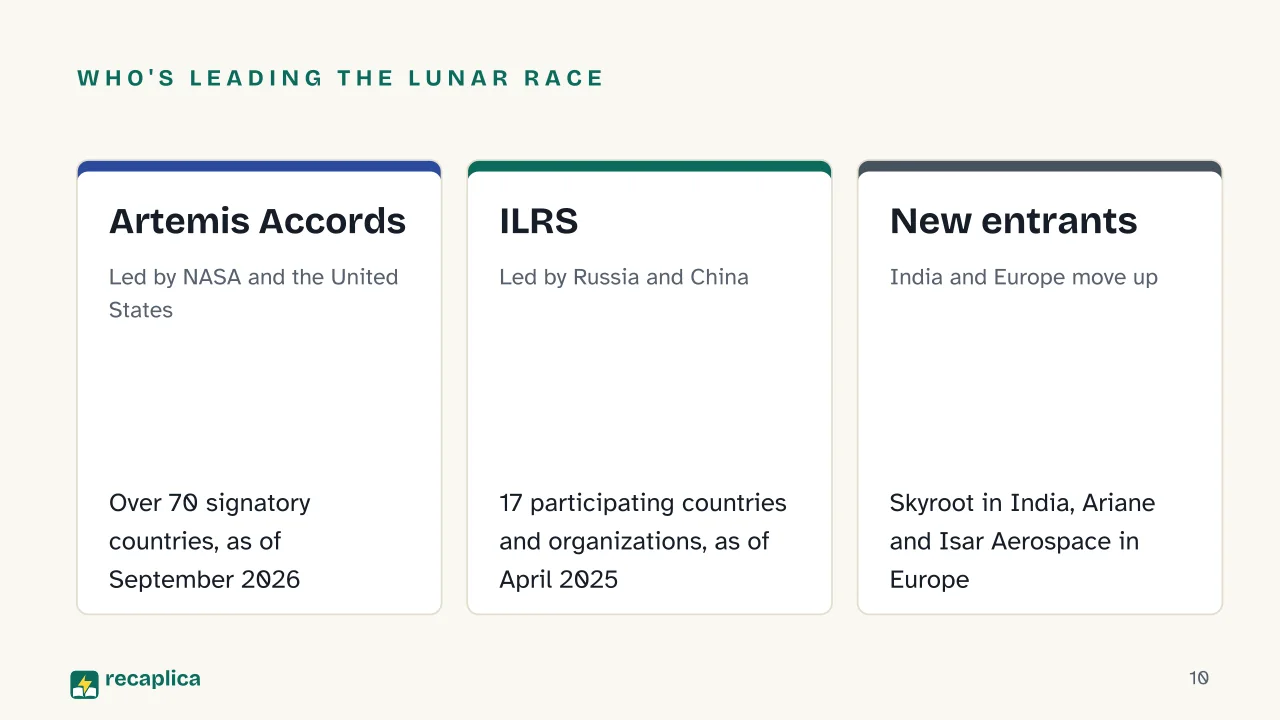 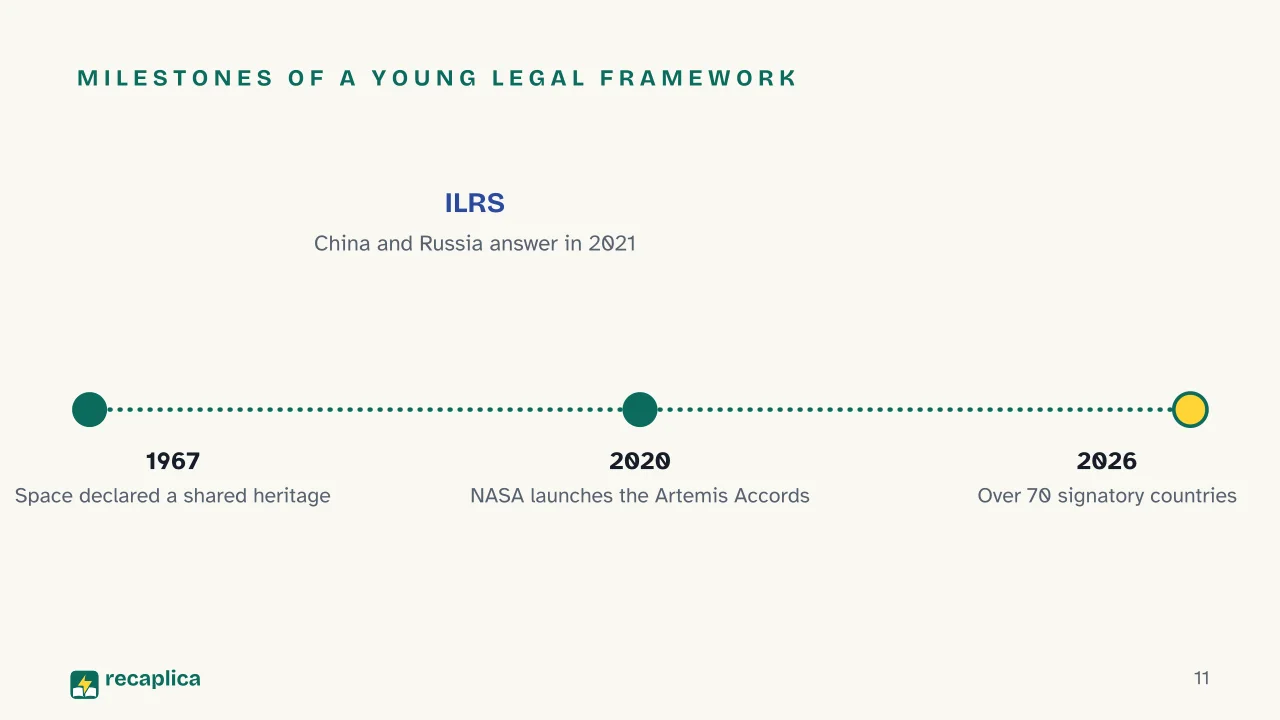  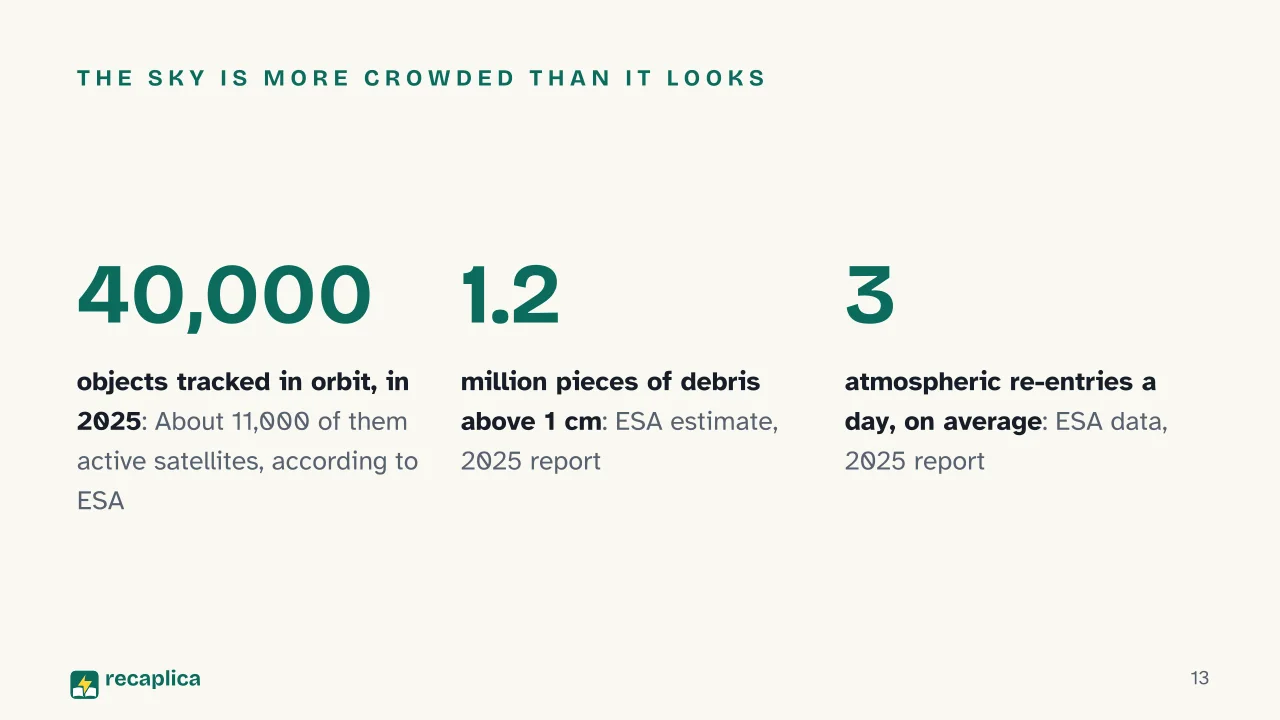 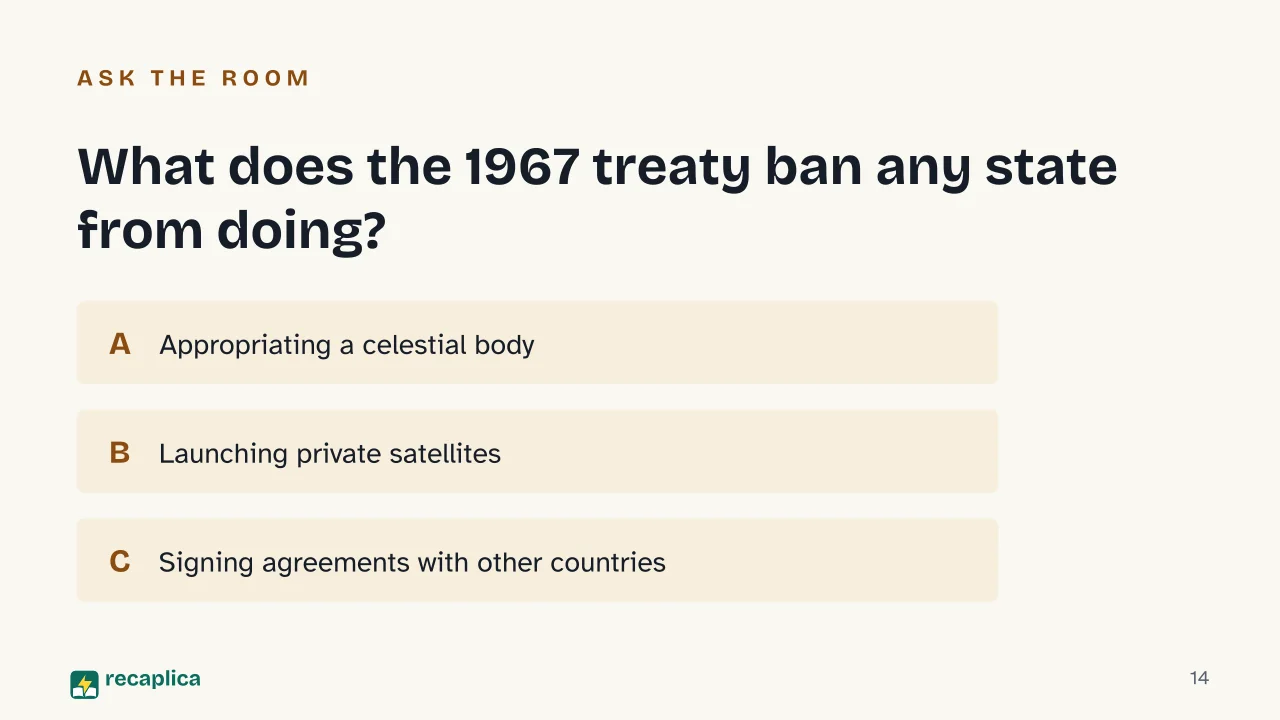  Common myths
Mind mapDrag the background to move around and the nodes to reposition them; use − and + to collapse and expand branches. 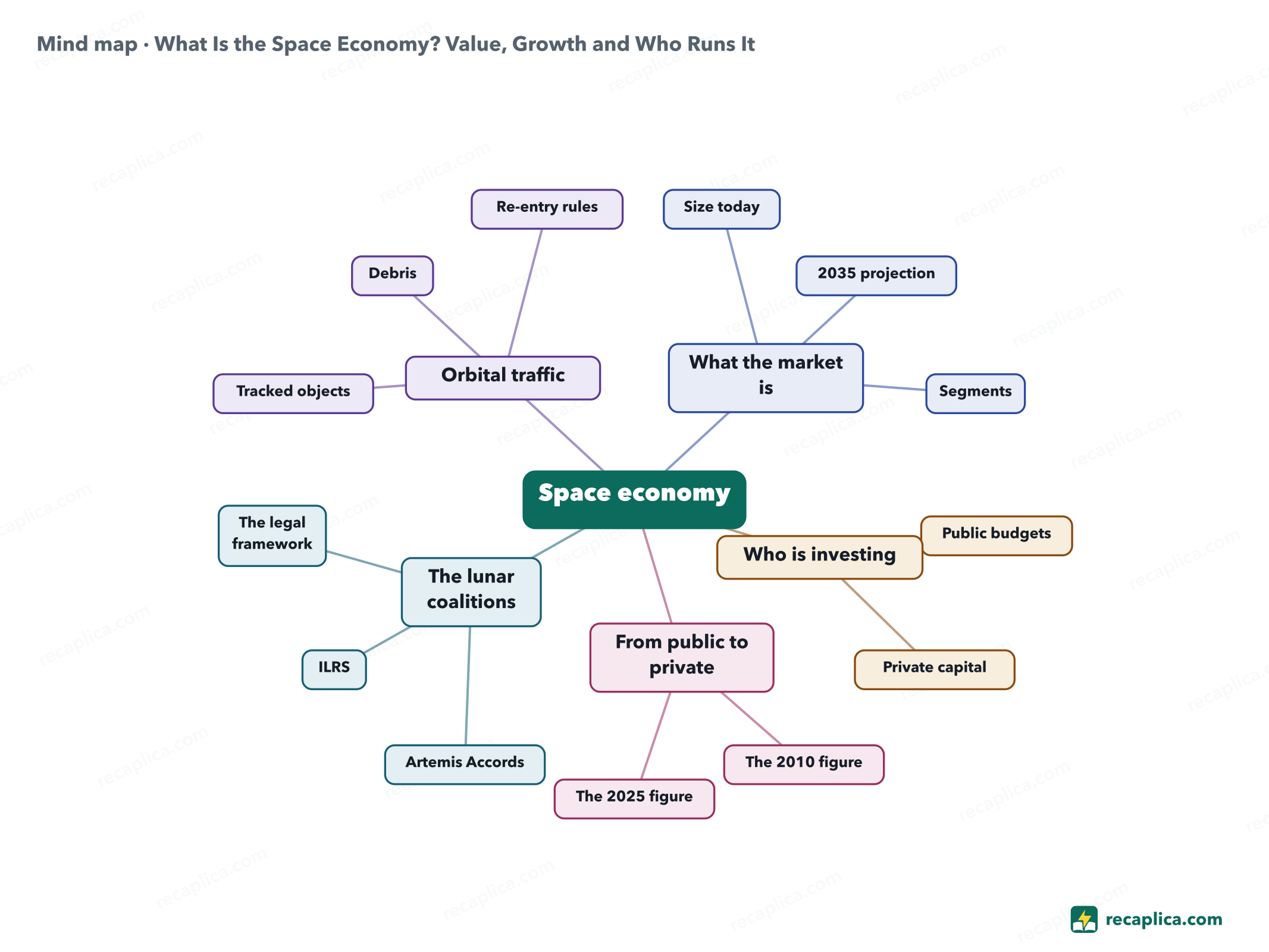
Quiz: test yourselfAnswer the questions to check what you have learned: you get instant feedback and a short explanation. Grade 0/10 0/5
FlashcardsTap the card to flip it and check whether you remember the answer, then move to the next one. 1 / 8 Explain it in your own wordsThe ultimate test: if you can explain it in simple words, you've truly understood it. Write your explanation, then compare it with the Recap. Your explanation is saved only on this device.
Frequently asked questionsWhat is the space economy?It's the sum of economic activities generated by space: rocket launches, building and operating satellites, telecommunications and Earth-observation services, and increasingly the extraction of lunar resources. In 2025 it was worth about $600 billion, according to the OECD. Who's driving today's space race, governments or private companies?Both, but with different roles: OECD governments raised civil space budgets to $46.4 billion in 2025, while private operators already launched 88% of satellites that same year, up from 23% in 2010. Who owns the Moon?No state can claim ownership of it: the 1967 Outer Space Treaty bans national appropriation of a celestial body. The text stays vague on resource extraction, though, which is why the Artemis Accords and a patchwork of national laws emerged. What are the Artemis Accords, and who has signed them?They are a set of principles for civil space exploration, launched by NASA and the US State Department in 2020. As of September 2026 they counted over 70 signatory countries, after Djibouti joined as the 72nd nation on September 14, 2026. Is space debris really a problem?Yes: ESA tracked about 40,000 objects in orbit in 2025 and estimates over 1.2 million pieces of debris larger than 1 centimeter, capable of causing serious damage in a collision. In low orbit around 550 km altitude, hazardous debris is now roughly comparable in number to active satellites. What is the lunar economy, and how does it relate to the space economy?It's the part of the space economy tied specifically to the Moon: mapping and extracting resources such as water ice, building lunar infrastructure, and the competing programs racing to establish a presence there, from the Artemis Accords to the ILRS. Every Recap goes through an independent review before publication. |