|
recaplica
Avogadro's Number: What It Is, the Mole and Molar Mass | |||||||||||||||||||||||||||||||||||||||||||||||||||||||||||||||||||||||||
| © 2026 Recaplica · recaplica.com — All rights reserved | |||||||||||||||||||||||||||||||||||||||||||||||||||||||||||||||||||||||||
Avogadro's Number: What It Is, the Mole and Molar MassWhat to print Page numbers appear when printing with default margins. SlidesChoose a cut Flash10 slidesThe essential thread, to present in classFull16 slidesEvery chapter and the deeper detailBoth come with speaker notes. In 30 seconds quick readChemists count atoms, molecules and ions in a unit called the mole. Since 20 May 2019 one mole holds exactly 6.022 140 76 × 10²³ entities, and that figure is Avogadro's number. To find how many particles a sample contains, you weigh it and divide by its molar mass, the mass of one mole, which comes from the atomic weights of its elements. Before 2019 the mole was tied to 12 grams of carbon-12, and the switch left everyday calculations unchanged. Key Points
Key figures
Deep DiveNobody can count atoms one at a time, so chemistry counts them by weight. You put a sample on a scale, and the mass tells you how many particles it holds. The link between the two is the mole, defined by a number that carries the name of Amedeo Avogadro. What a mole isIn the International System of Units (SI), the mole, symbol mol, is the unit of amount of substance. Since 20 May 2019 its definition has been a count: one mole contains exactly 6.022 140 76 × 10²³ elementary entities. The BIPM, the international bureau that maintains the SI, writes amount of substance as n and uses it to say how many entities of a stated kind a system contains. What gets counted can be any particle, from an electron to an atom, ion or molecule, or a well-defined group of particles. Since 1971, anyone using the mole has had to say what is being counted, and the BIPM suggests doing so with the chemical formula. A mole of O₂ is 6.022 140 76 × 10²³ oxygen molecules, which means twice that many oxygen atoms. In 2018 IUPAC, the international union of chemists, stressed that amount of substance is a count of entities, and a sample’s mass is a different quantity. Peter W. Atkins, the first chair of its committee on chemistry education, said he was puzzled that the mole has a reputation as a hard topic. He welcomed the new definition because it goes straight to what a mole means. Avogadro’s number vs the Avogadro constantThe same value goes by two names. According to the BIPM, the Avogadro constant, symbol NA, is exactly 6.022 140 76 × 10²³ mol⁻¹, read as “per mole”. Take the number 6.022 140 76 × 10²³ on its own, as a pure number, and you have Avogadro’s number. The constant is a proportionality factor between two quantities: amount of substance, in moles, and the number of entities, which is a pure number. As a formula, N = n × NA.
How to calculate molar massGoing from grams to particles takes molar mass, M: the mass of one mole of a substance. The BIPM gives the molar mass of an atom or molecule as the Avogadro constant multiplied by the mass of a single entity. That mass can in turn be written as the relative atomic mass Ar, a pure number, times the atomic mass constant mu, which is one twelfth of the mass of a carbon-12 atom. The dalton (Da) and the unified atomic mass unit (u) are synonyms, both defined as one twelfth of the mass of an unbound carbon-12 atom, at rest and in its ground state. The CODATA 2022 recommended value is 1.660 539 068 92 × 10⁻²⁷ kg, and since it is measured, it comes with an uncertainty. Multiply the two and the bridge appears: 6.022 140 76 × 10²³ mol⁻¹ times 1.660 539 068 92 × 10⁻²⁷ kg gives 1 g/mol, give or take digits far to the right of the decimal point. That is why, in classroom calculations, molar mass in g/mol has the same numerical value as relative atomic mass, and a molecule’s molar mass is the sum of its atoms’ values.
The atomic weights to use are the standard values from CIAAW, the IUPAC commission that maintains atomic weights for the elements of the periodic table. Its abridged table is based on the Atomic Weights 2021 report, and since 2013 the commission has recommended rounding to five figures. The CIAAW page on carbon notes that carbon-12 has anchored the atomic mass unit scale since 1960 and underlies every atomic weight.
The formula n = m/M, with worked examplesNearly every mole exercise turns on one relationship: amount of substance equals mass divided by molar mass, n = m/M, with m in grams and M in g/mol. Rearranging it, as you would any first-degree equation, gives m = n × M and M = m/n. One more multiplication, by the Avogadro constant, takes you to the number of particles.
NIST, the US national metrology institute, uses water to give a sense of scale. Half a mole of oxygen (O₂) and one mole of hydrogen (H₂) make one mole of water, about 18 grams. Those 18 grams hold roughly 600 billion trillion molecules, a number on the order of 6 × 10²³. From Avogadro to Perrin: a history of the numberAmedeo Avogadro lived from 1776 to 1856. He trained as a lawyer before turning to chemistry, where his name became attached to a hypothesis about gases: equal volumes at the same temperature and pressure contain the same number of molecules. That is Avogadro’s law, a separate idea from the number. In his day not everyone accepted that atoms existed, and he spoke of “elementary molecules”. NIST says it took about fifty years, by which time he had died, for others to see the value of his ideas. The name “Avogadro’s number” arrived in the early 20th century as a tribute, for the number of molecules in a gram-molecule of oxygen. The word mole dates from the same period: it appeared around 1900 as the German shortening Mol, from Molekül. Jean Perrin retraced the hunt for that number in his Nobel lecture in physics on 11 December 1926. He defined the gram-molecule against 32 grams of oxygen and called the number of molecules it contains Avogadro’s number, N. Ratios between the weights of atoms and molecules were already known; with N in hand, their absolute masses would follow.
His most careful emulsion measurement gave 68 × 10²², or 6.8 × 10²³. The value fixed in 2019 is 6.022 140 76 × 10²³, the same order of magnitude. In the same lecture Perrin argued that the reality of atoms and molecules, still doubted twenty years earlier, could now be treated as a proven principle. The 2019 definition and the carbon-12 oneThe mole joined the SI in 1971 as the seventh base unit, by decision of the 14th General Conference on Weights and Measures (CGPM), and people began to speak of the Avogadro constant. The 1971 definition counted as many entities as there are atoms in 0.012 kg, or 12 grams, of carbon-12, the most common form of carbon. That made the mole depend on the kilogram, which was then the mass of a platinum-iridium cylinder kept near Paris. IUPAC’s project on a new definition began in 2013, to work out how redefining the kilogram would affect amount of substance. The recommendation, signed by Roberto Marquardt and six co-authors including Jürgen Stohner, appeared in the January 2018 issue of Pure and Applied Chemistry. Its proposed wording is the one later adopted in the SI, and the mole changed along with the kilogram, the ampere and the kelvin. On 16 November 2018, at Versailles, representatives of more than 50 countries voted for the redefinition, which NIST describes as the outcome of about twenty years of international work. The resolution repealed the 1971 definition, and the new one took effect on 20 May 2019, World Metrology Day, the anniversary of the 1875 Metre Convention. One of the methods that led there counts the atoms in a silicon sphere using X-rays. Starting in the early 2000s, silicon was enriched in centrifuges from its natural 92% silicon-28 to 99.995%, and Germany’s metrology institute, PTB, made two one-kilogram spheres from it. From the sphere’s mass and volume, plus the spacing between its atoms and the molar mass of silicon, you can work out how many atoms it holds. The method measures the Avogadro constant, and through the Planck constant it also fed into the new kilogram.
The constant’s value was chosen so that, at the changeover, the molar mass of carbon-12 stayed at 0.012 kg/mol with a relative uncertainty of 4.5 × 10⁻¹⁰. Slide deckSlides ready to download and make your own in PowerPoint or Google Slides, with speaker notes. Pick the Flash cut or the Full one.   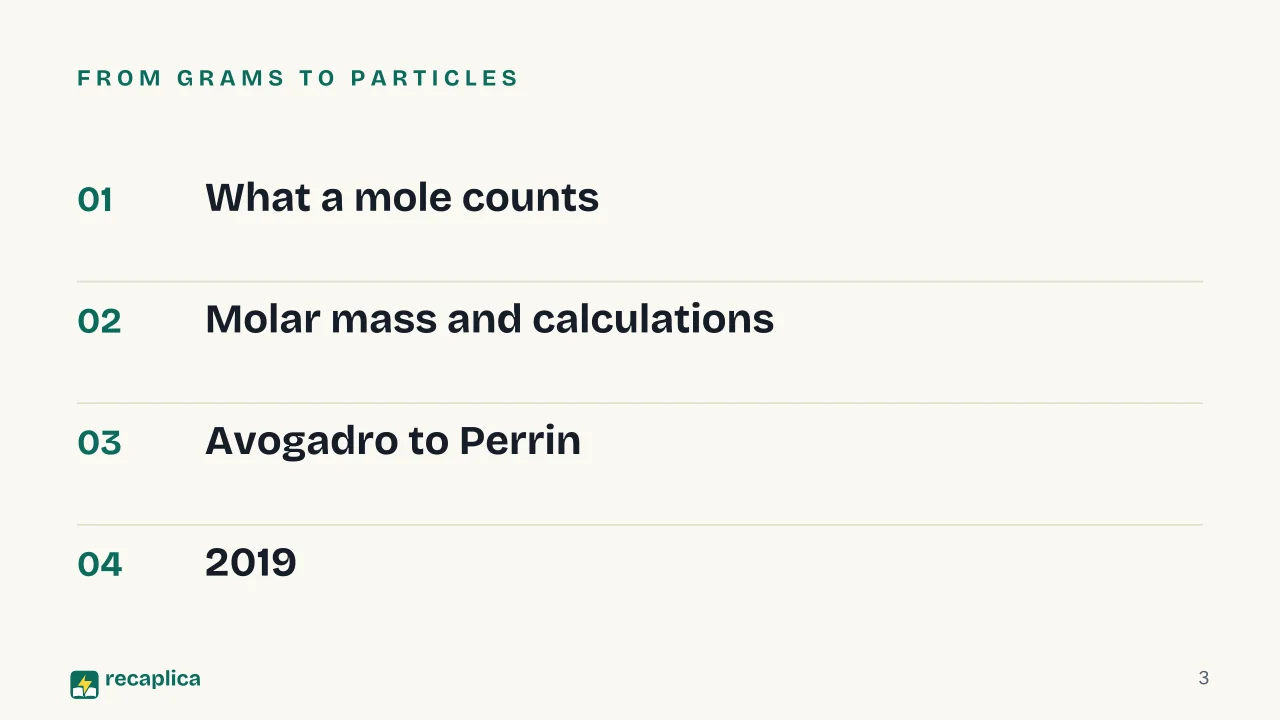  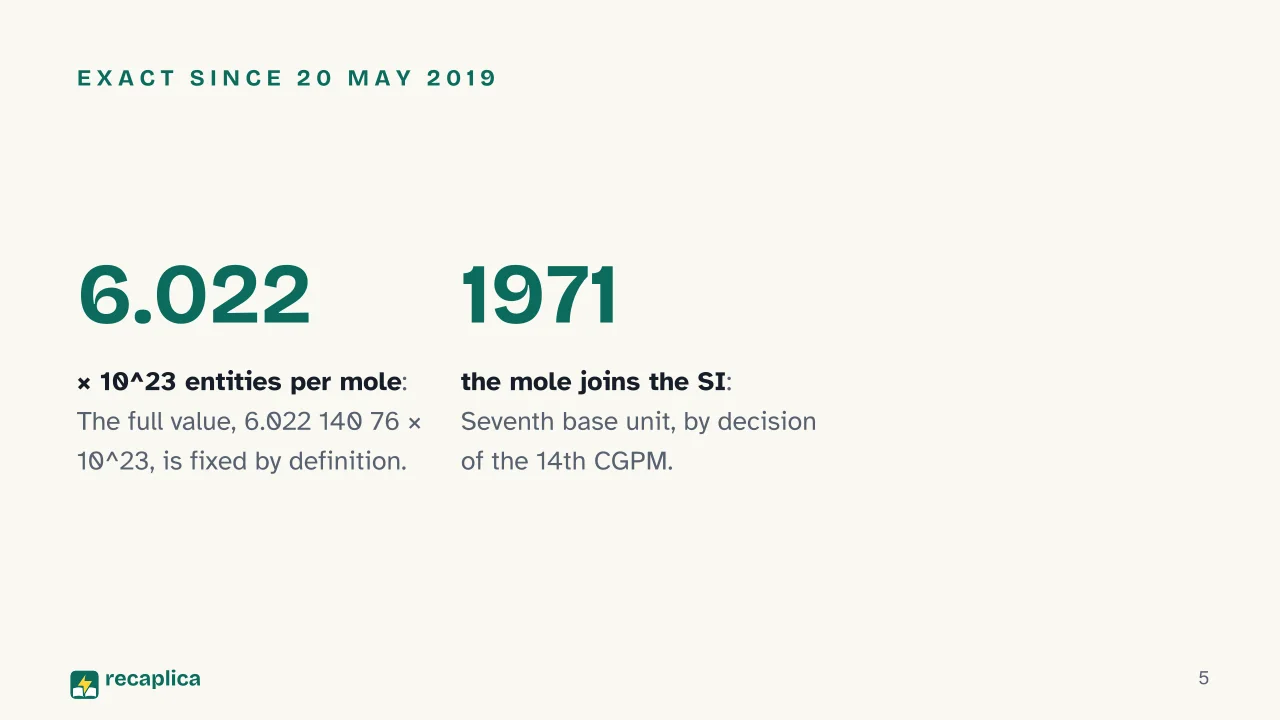 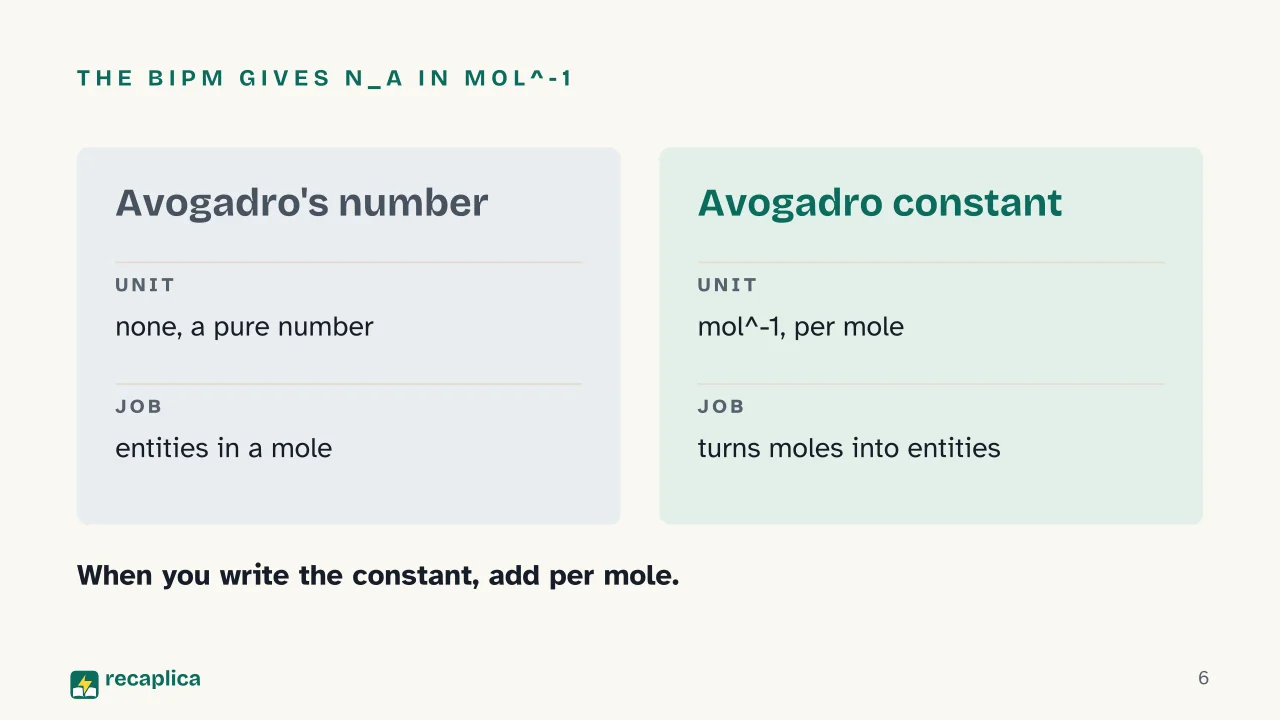  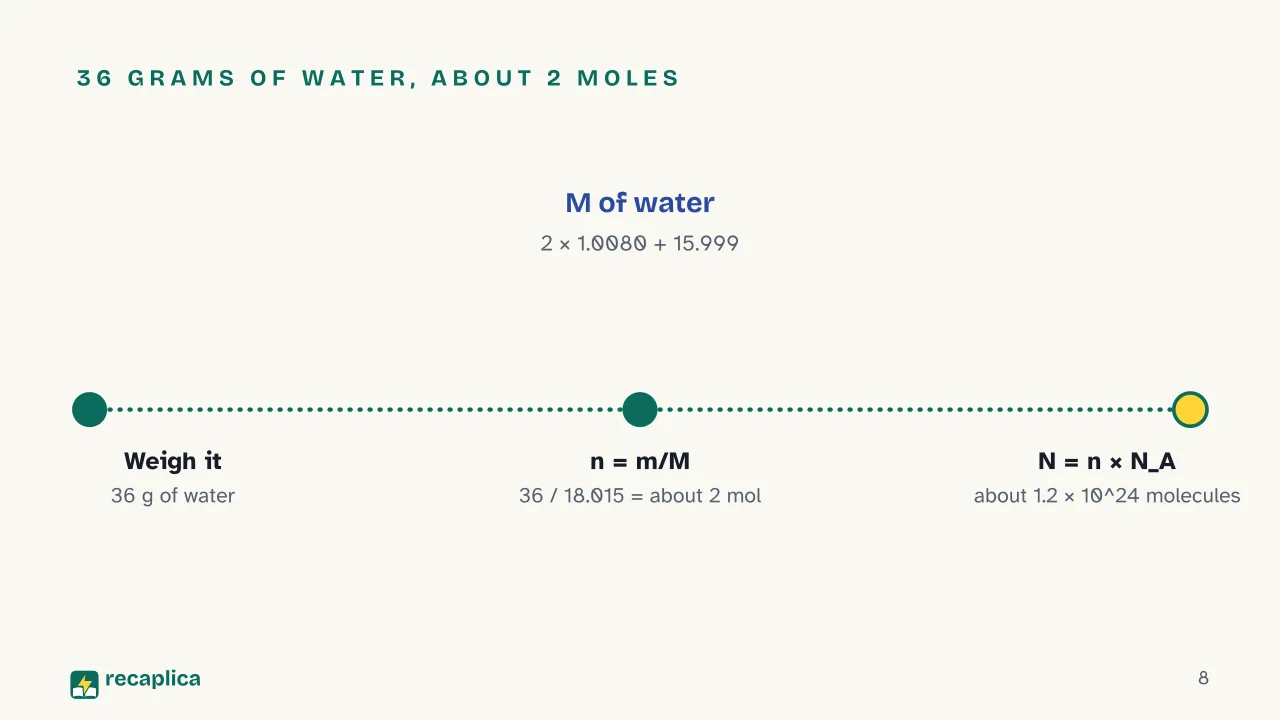  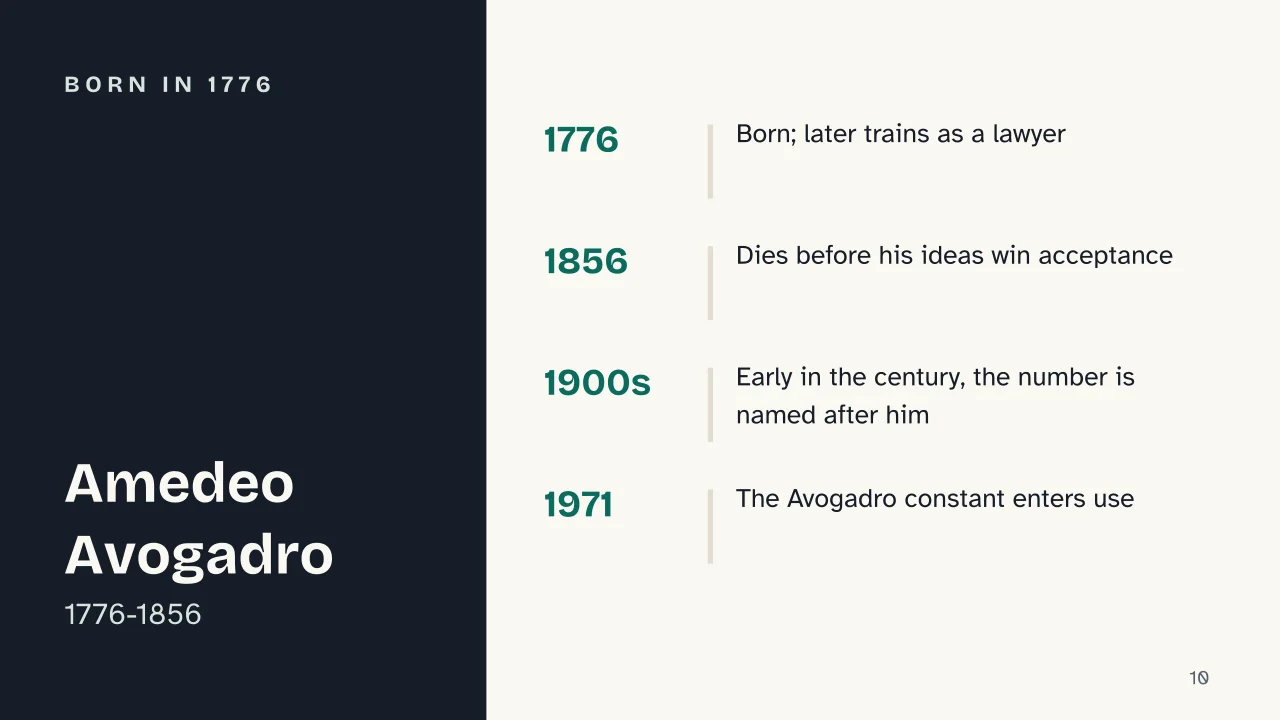 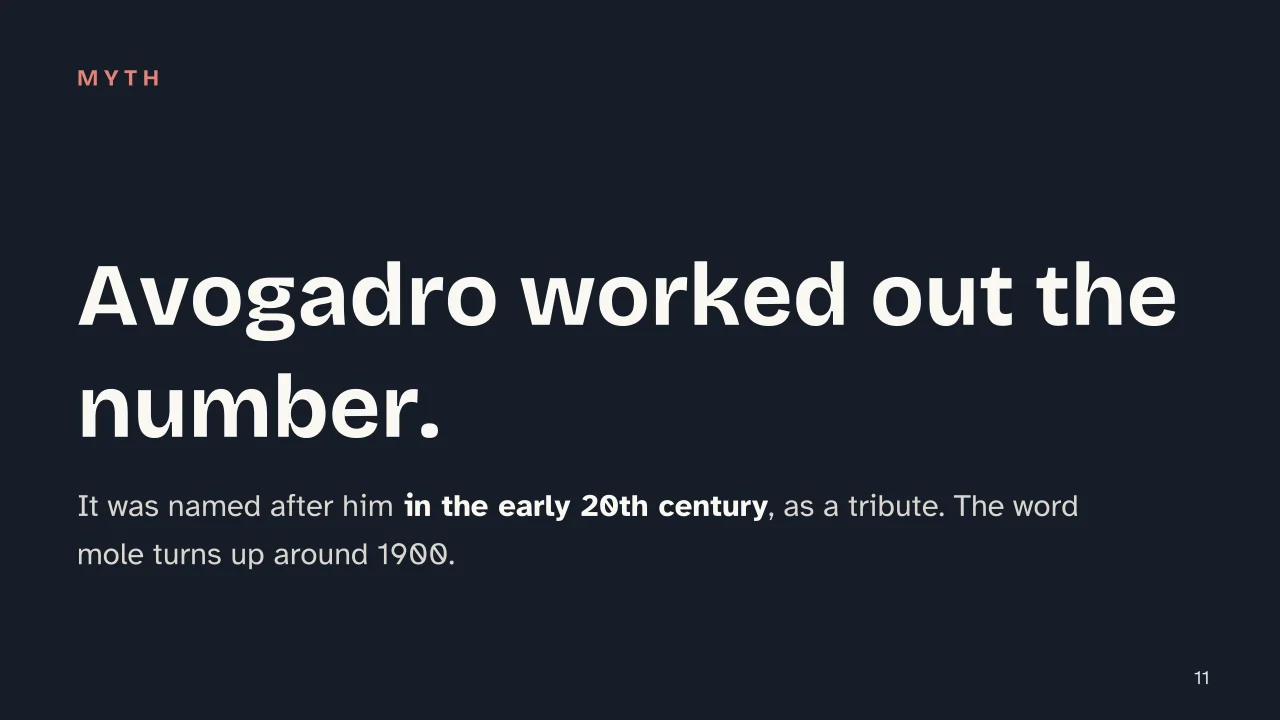 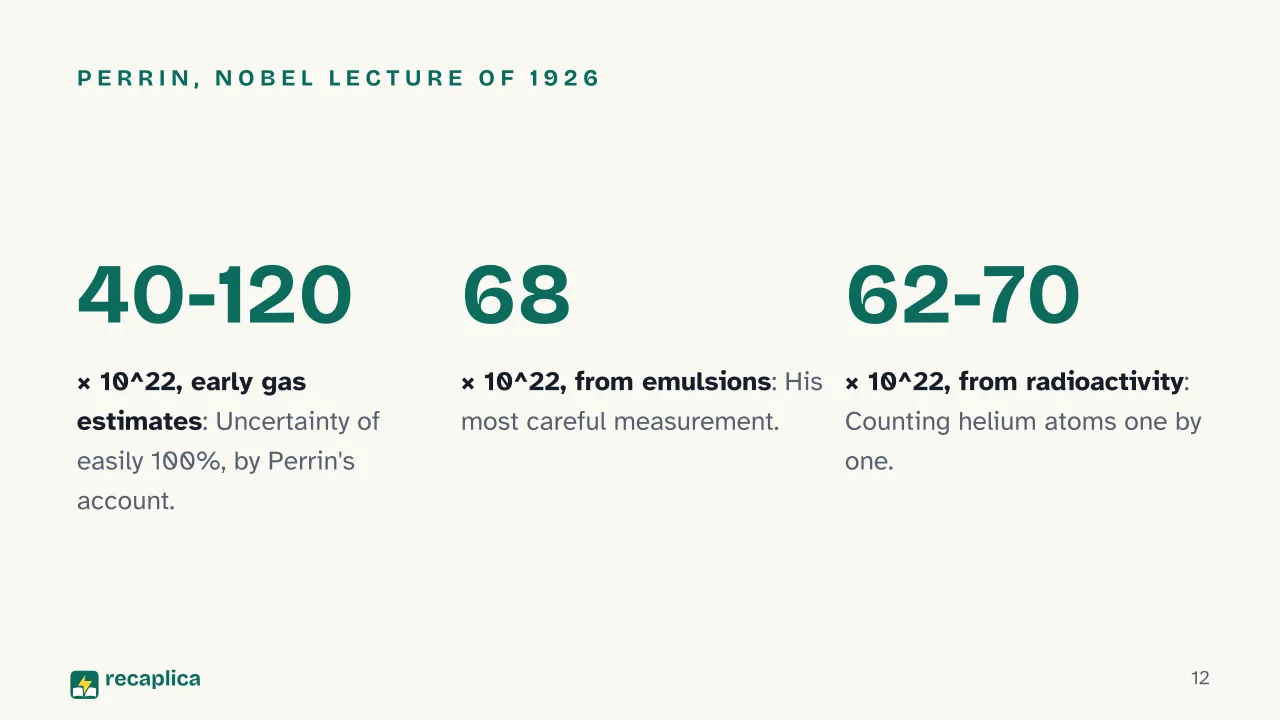  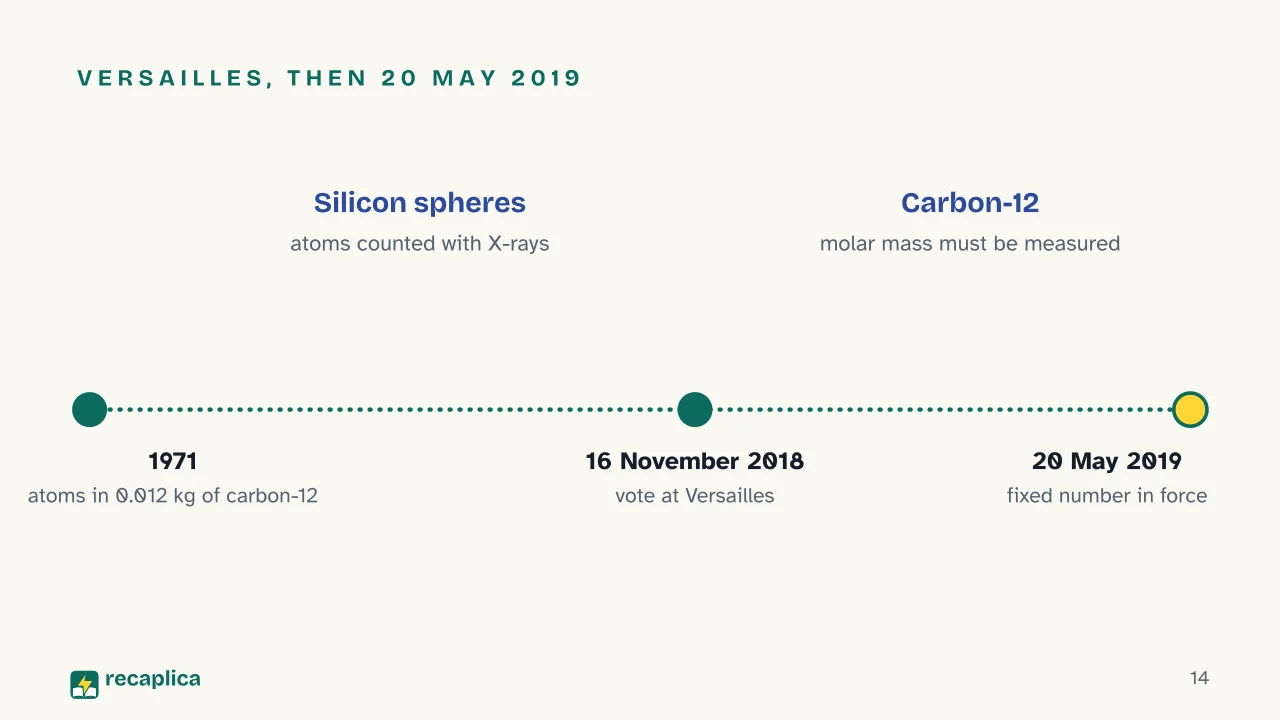 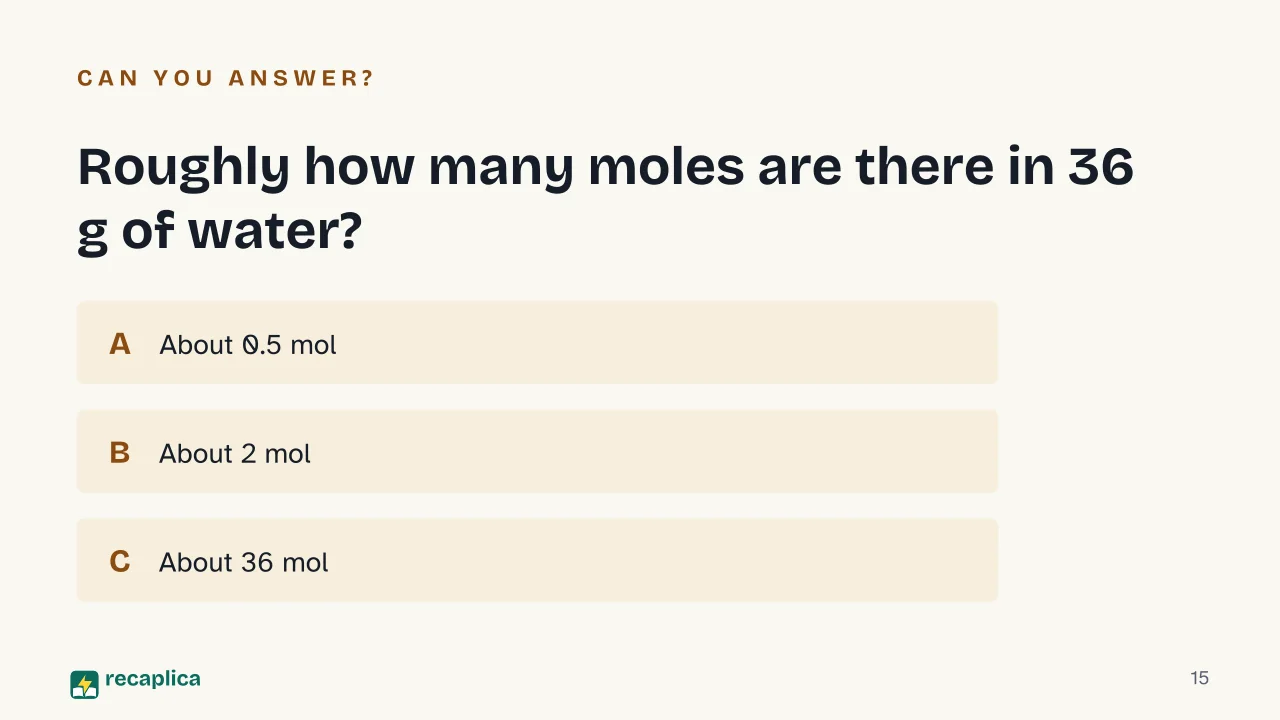  Common myths
Mind mapDrag the background to move around and the nodes to reposition them; use − and + to collapse and expand branches. 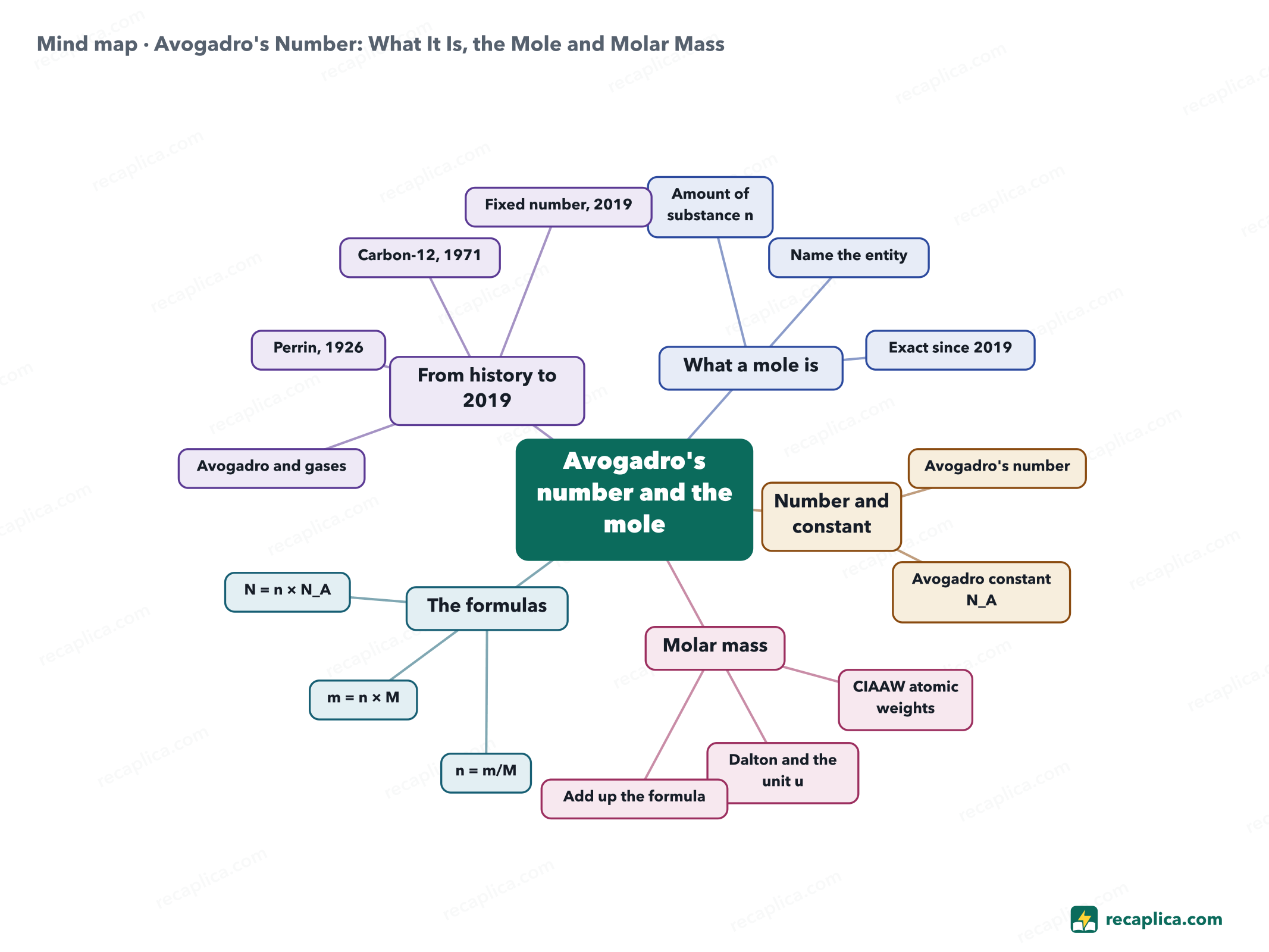
Quiz: test yourselfAnswer the questions to check what you have learned: you get instant feedback and a short explanation. Grade 0/10 0/5
FlashcardsTap the card to flip it and check whether you remember the answer, then move to the next one. 1 / 7 Explain it in your own wordsThe ultimate test: if you can explain it in simple words, you've truly understood it. Write your explanation, then compare it with the Recap. Your explanation is saved only on this device.
Frequently asked questionsWhat does 6.022 x 10^23 mean in chemistry?It is Avogadro's number, the count of entities in one mole, and its full value is exactly 6.022 140 76 × 10²³. The figure has been fixed by definition since 20 May 2019, so it carries no uncertainty. Written with the unit mol⁻¹ it becomes the Avogadro constant, which converts moles into particles. How do you calculate the molar mass of a substance?Add up the atomic weights of the atoms in the formula and attach the unit g/mol. For water, H₂O, with CIAAW values: 2 × 1.0080 + 15.999 = 18.015, so about 18.015 g/mol. For a single element, its atomic weight is enough: carbon is 12.011, giving about 12.011 g/mol. What is the difference between a mole and Avogadro's number?The mole is a unit of measurement, like the metre or the second, used to express amount of substance. Avogadro's number tells you how many entities fit in one mole, 6.022 140 76 × 10²³. You say «2 mol of water» with the mole and use Avogadro's number to turn that into molecules. Who discovered Avogadro's number?Avogadro himself never did. The number was named after him in the early 20th century, decades after he died in 1856. Jean Perrin was one of those who measured it: in his 1926 Nobel lecture he reported values between 60 × 10²² and 68 × 10²² obtained from grains suspended in a liquid. Every Recap goes through an independent review before publication. |