|
recaplica
Literary Criticism: What It Is and Its Main Schools |
| © 2026 Recaplica · recaplica.com — All rights reserved |
Literary Criticism: What It Is and Its Main SchoolsWhat to print Page numbers appear when printing with default margins. SlidesChoose a cut Flash10 slidesThe essential thread, to present in classFull15 slidesEvery chapter and the deeper detailBoth come with speaker notes. In 30 seconds quick readLiterary criticism is the practice of reading an actual work, applying methods that literary theory develops. From the twentieth century onward, several schools took shape, each with its own starting point: the author's biography, the form of the text, the reader who interprets it, the gender of the person who wrote it, the myths a story reworks. Each school brings different questions to the same novel or poem, and none exhausts it on its own. Key Points
Deep DiveAccording to the Internet Encyclopedia of Philosophy, literary theory is the set of ideas and methods a text can be read with, while criticism puts those methods to work on a specific novel, poem, or story. No critic invents a method from scratch each time: they borrow one from a school that took shape over time, each with its own starting point. Biographical Literary CriticismBiographical literary criticism is represented by the French critic Charles-Augustin Sainte-Beuve, who held that a literary work is best explained through the life of the person who wrote it. In this view, a novel or a poem isn’t read as a self-contained object: plot choices, recurring themes, even the tone of a page are traced back to the author’s life, events, and relationships.
This approach carries a limit that the school succeeding it would point out directly: it draws too thin a line between text and author, risking treatment of the work as a biographical record rather than an autonomous piece of language. New Criticism and Close ReadingNew Criticism, a current of critical literary theory also known as American formalism, took shape in American universities in the 1930s and 1940s as a break from earlier critical methods. Its figures include Cleanth Brooks, John Crowe Ransom, Robert Penn Warren, and W. K. Wimsatt. Their method, known as close reading, separates the text from the author’s life and historical context: what matters is the work’s internal form — its imagery, its rhythmic and syntactic structure.
For this school, the text stops serving as biographical evidence and generates meaning entirely through its verbal structure. Reader-Response CriticismReader-response criticism, known in Europe as reception theory, developed within poststructuralism and shifts attention away from the text or the author and toward the reader. Stanley Fish, Jane Tompkins, and Wolfgang Iser are among the names associated with this school. In this view, a work’s meaning takes shape in the encounter between the text and whoever is reading it. This marks a clear departure from literary criticism as described so far, which remains the practice of reading an actual work. Philosophical hermeneutics (what it is and how interpretation works) takes up the same question — what it means to interpret a text — but at a more general level, as a theory of interpretation as such, not tied to any single literary work. Feminist Literary CriticismFeminist literary theory developed shortly after the revival of the feminist movement in the United States and Western Europe, in the 1960s. Simone de Beauvoir, Luce Irigaray, Hélène Cixous, and Julia Kristeva are among the writers associated with this school. According to the Stanford Encyclopedia of Philosophy, one stated goal of feminist criticism has been to give women writers a fair chance at recognition in the arts, and in the 1970s and 1980s a significant part of its work involved rediscovering the writing of past women authors left at the margins of the canon. The same school also examines how gender shapes ideas about art, artists, and aesthetic value, including how the literary canon itself takes shape — which authors make it into school curricula, and which are left out. According to some theorists, including Cixous with her concept of écriture féminine, women’s lived experience can leave a mark on women’s writing through expressive means that depart from standard objective description and linear development.
Archetypal CriticismArchetypal criticism, a branch of archetypal literary theory also called myth-ritual criticism, holds that a literary text’s meaning is shaped by shared cultural and psychological archetypes and myths. It draws on the psychologist Carl Jung’s theory of the collective unconscious, a psyche common to all humans, visible in dreams and myths, holding themes and images everyone inherits; for Jung, mythology is the textbook where these archetypes are expressed. Archetypes appear in literary works as recurring images, symbols, and motifs: the quest, character types such as the hero or the trickster, symbols such as the apple or the serpent. The founding text of this school, applied to literature, is Anatomy of Criticism: Four Essays, published in 1957 by the Canadian critic and literary theorist Northrop Frye, the main figure behind archetypal criticism. In it, he treats myth as the shared origin of all literature, aiming to map how such a criticism — built solely on literature itself — defines its own territory, framework, and working methods.
Each of these five schools puts a distinct question to the text. None replaces the others: the life of the person who wrote the book, the structure of the page, the identity of whoever reads it, the gender of the author, the myth the story reworks are all present at once in any given work, and each school brings one of them into focus. Slide deckSlides ready to download and make your own in PowerPoint or Google Slides, with speaker notes. Pick the Flash cut or the Full one.     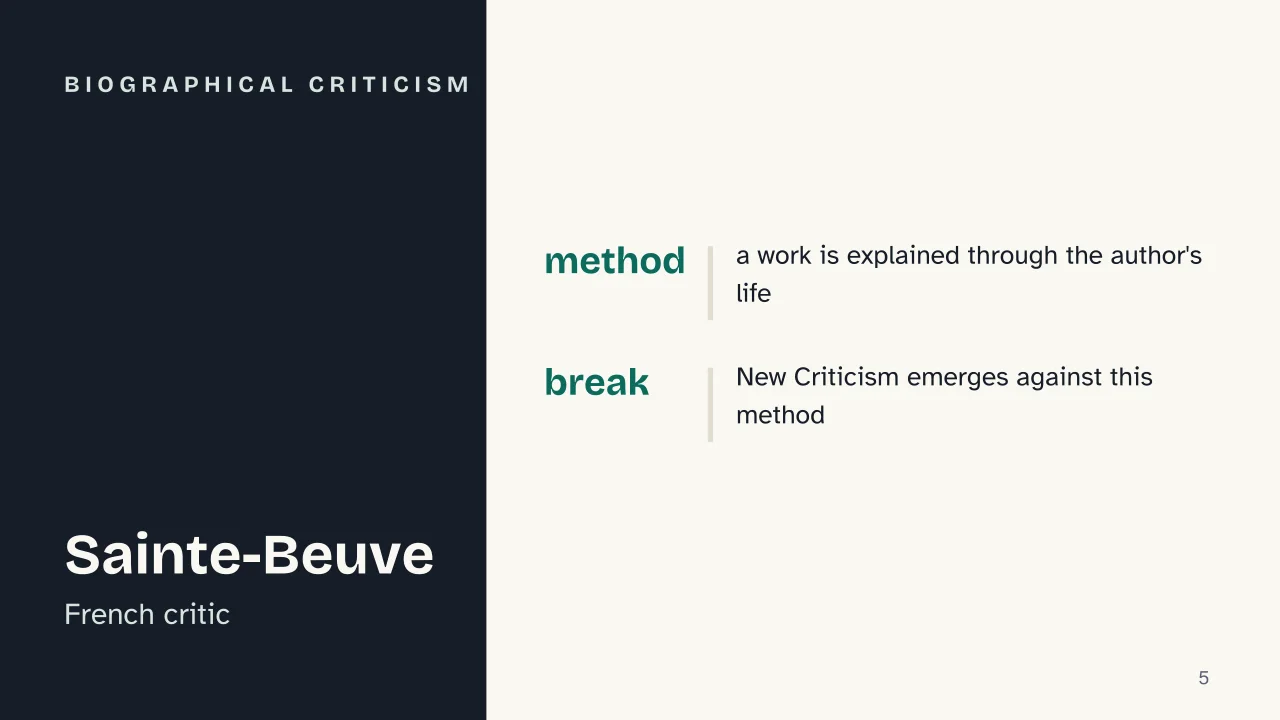  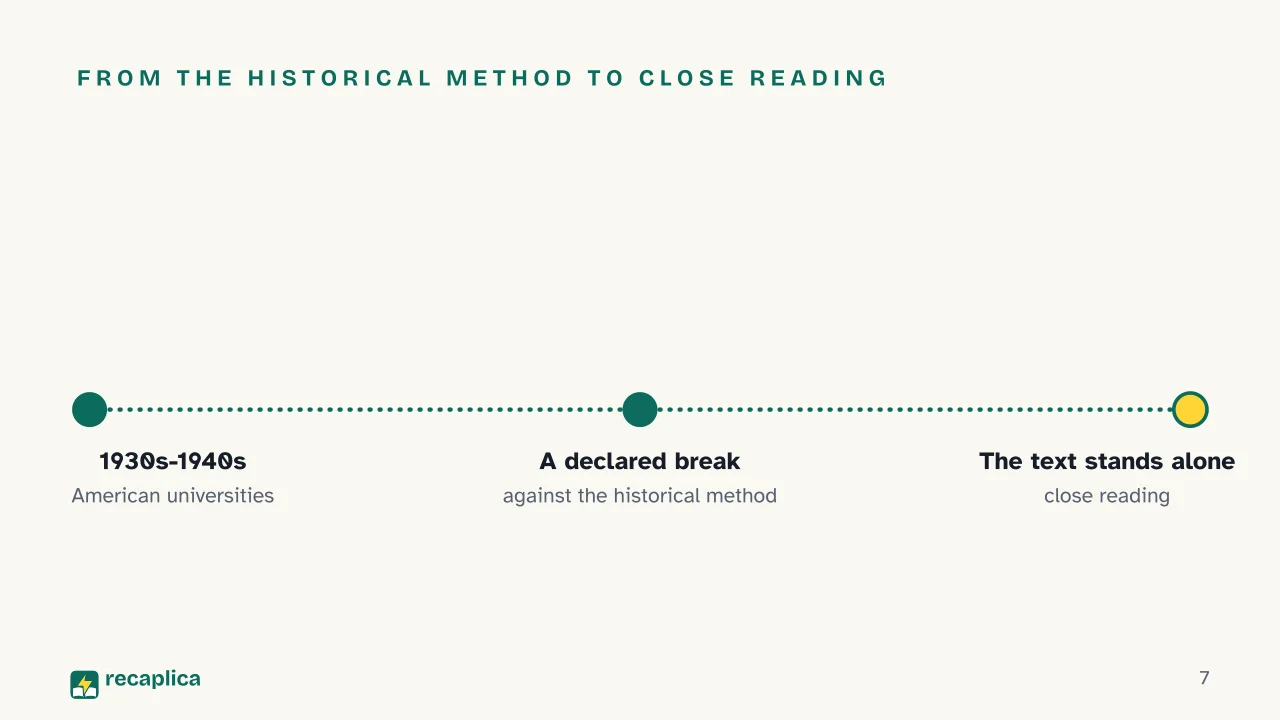  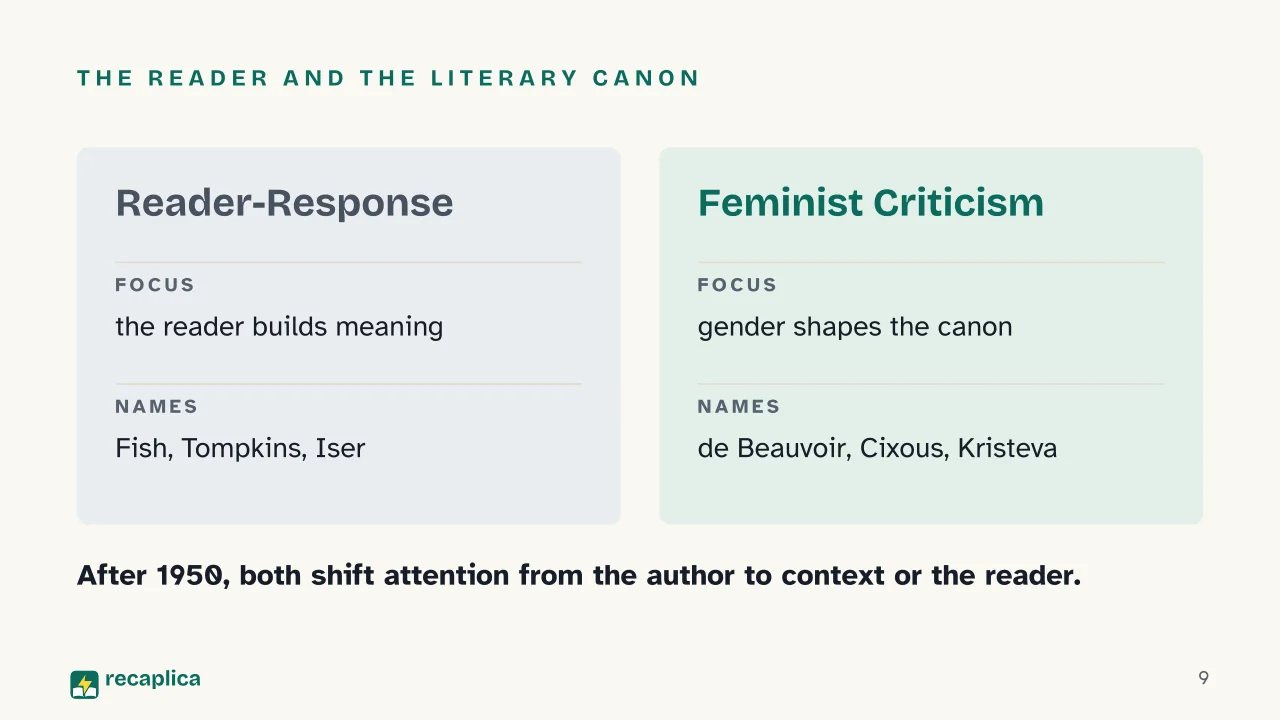 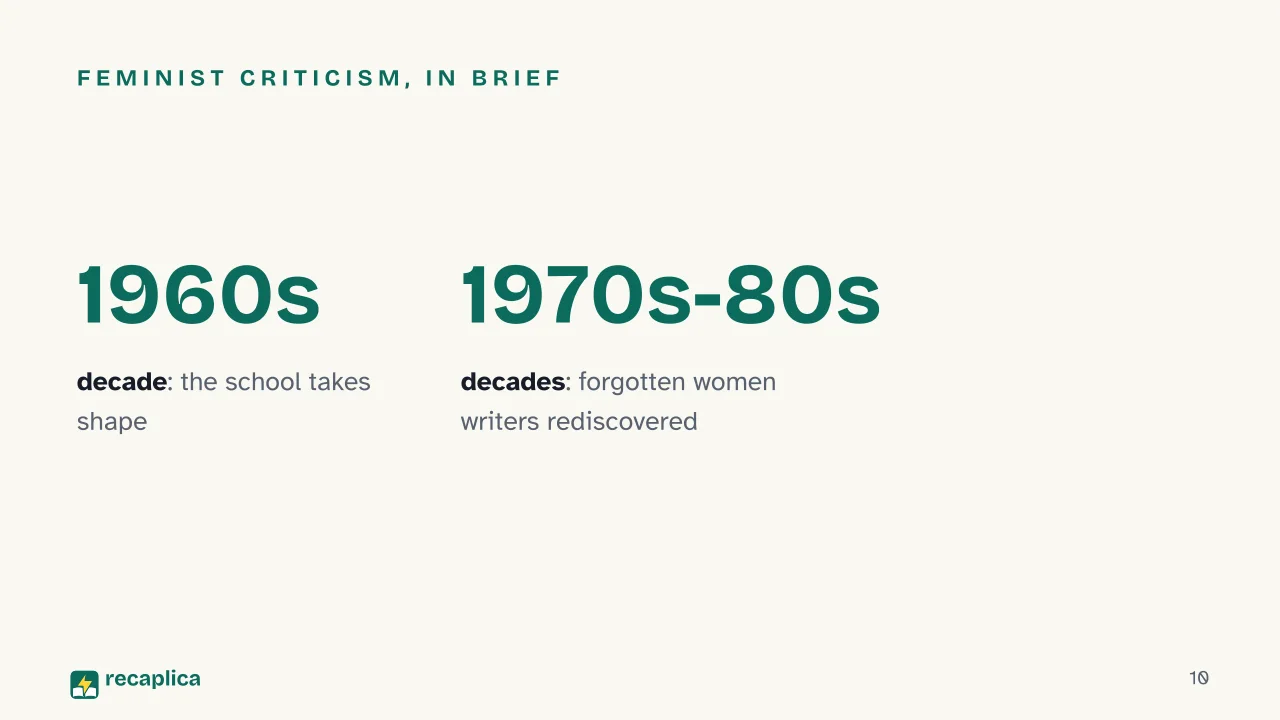  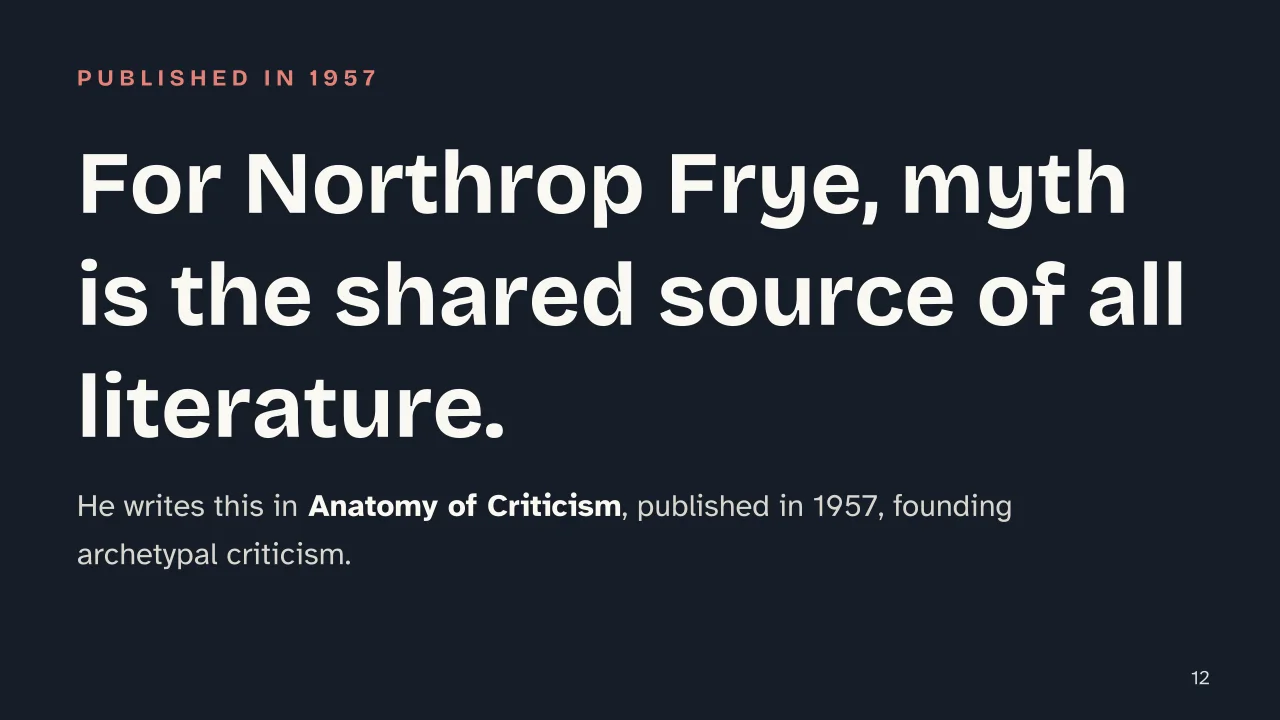  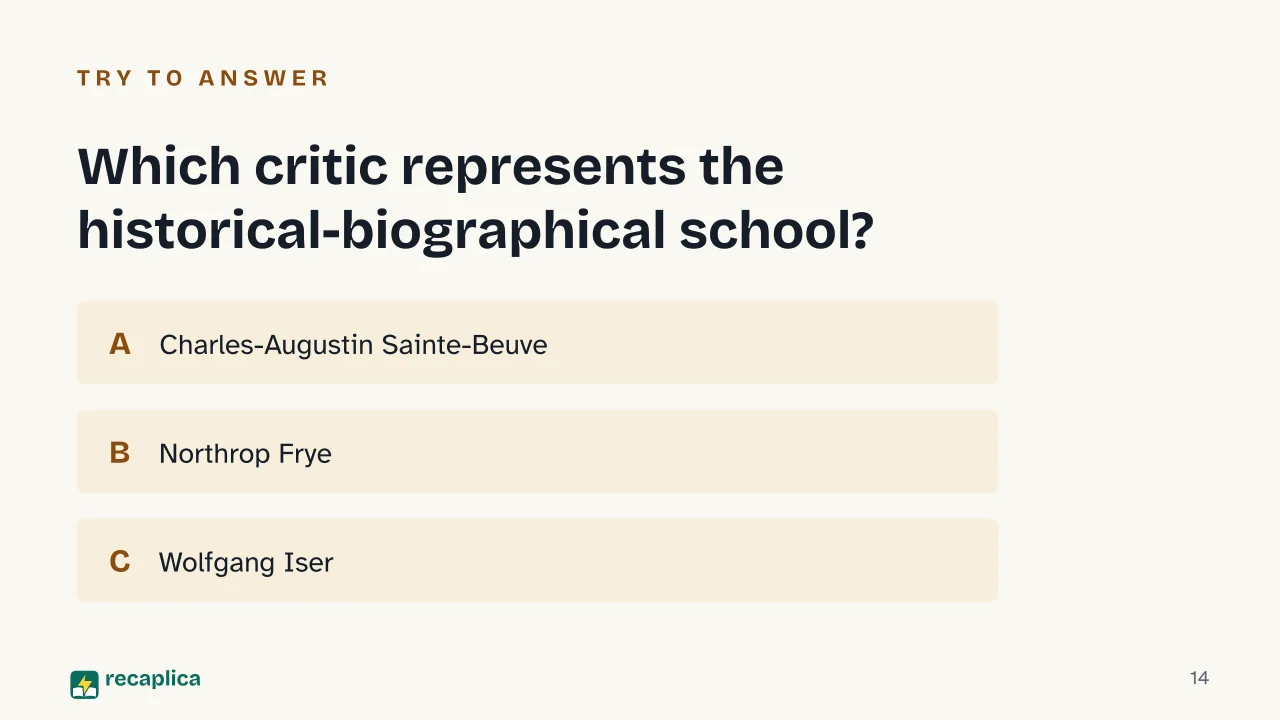  Common myths
Mind mapDrag the background to move around and the nodes to reposition them; use − and + to collapse and expand branches. 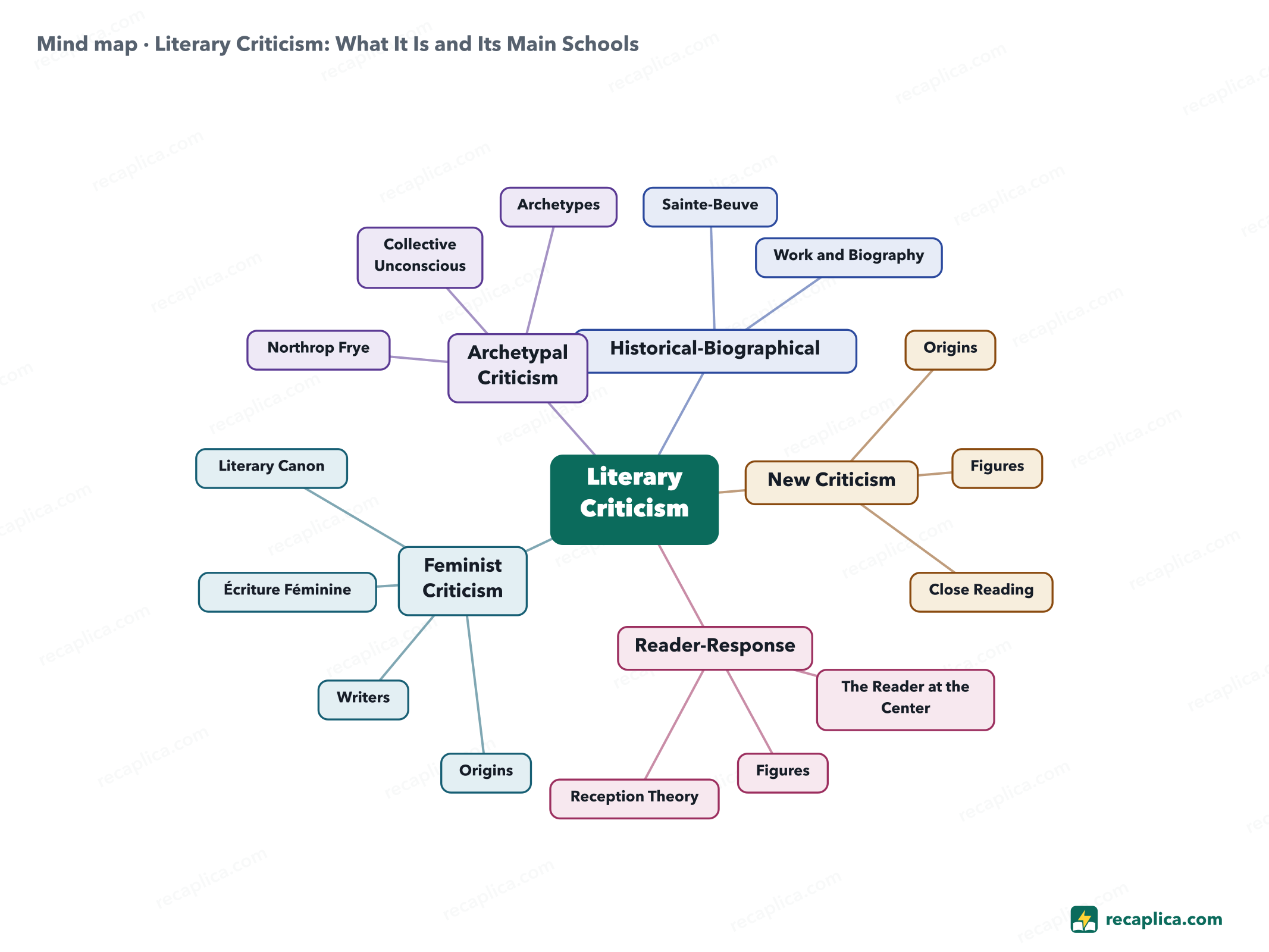
Quiz: test yourselfAnswer the questions to check what you have learned: you get instant feedback and a short explanation. Grade 0/10 0/5
FlashcardsTap the card to flip it and check whether you remember the answer, then move to the next one. 1 / 8 Explain it in your own wordsThe ultimate test: if you can explain it in simple words, you've truly understood it. Write your explanation, then compare it with the Recap. Your explanation is saved only on this device.
Frequently asked questionsWhat is literary criticism?It's the practice of reading and interpreting a literary work in concrete terms, applying methods developed by literary theory: each school starts from a different point, from the author's biography to the reader who builds the text's meaning. What is the difference between literary criticism and literary theory?According to the Internet Encyclopedia of Philosophy, theory develops the methods a work can be read with, while criticism applies them to one particular novel, poem, or story. What are the main schools of literary criticism?Among the main ones are the historical-biographical school, New Criticism (American formalism), reader-response criticism, feminist literary criticism, and archetypal (or myth-ritual) criticism. What is New Criticism?It's the formalist school that emerged in American universities in the 1930s and 1940s, reading a text through its internal form and breaking with the historical-biographical method; Cleanth Brooks and Robert Penn Warren are among its figures. What does Northrop Frye's archetypal theory argue?It argues that a text's meaning is tied to shared cultural and psychological archetypes and myths; Frye lays this out in Anatomy of Criticism (1957), where literature as a whole finds its common origin in myth. Every Recap goes through an independent review before publication. |