Skip to content
recaplica

    One moment: security check

    Cloudflare wants to make sure you're not a robot. Tick the box below and your search will continue on its own.

    IT
    recaplica Dark Romance: What the Genre Means and Its Main Subgenres
    © 2026 Recaplica · recaplica.com — All rights reserved
    Home › Literature

    Dark Romance: What the Genre Means and Its Main Subgenres

    By Recaplica Newsroom · Updated on October 8, 2026

    What to print

    Page numbers appear when printing with default margins.

    Telegram channel
    recaplica Clear in 30 seconds, yours in 10 minutes.
    In 30 seconds Key points Deep dive Myths Mind map Quiz Flashcards FAQ

    In 30 seconds quick read

    Dark romance is the strand of romance fiction where the bond between the two leads is never balanced: morally gray territory, power split unevenly, and often ground a conventional romance would avoid altogether. The plot keeps returning to the same psychological pull: a fixation on the other person that edges into dependency, while the two leads fight over who actually controls the relationship. Several distinct strands sit under the label, from mafia romance to paranormal romance, from dark academia to horror romance. The genre found its own readership in the 2010s, the same stretch when digital self-publishing opened space for stories a traditional publisher would have turned down.

    Key Points

    • The common thread in dark romance is a couple's relationship marked by moral ambiguity and an uneven split of power.
    • The leads are often figures on the edge of the law or of psychological stability, not straightforward heroes.
    • The genre is driven by an obsession with the other person that often slides into a form of dependency, and by the struggle over who actually controls the relationship.
    • Mafia romance, set inside organized crime, has seen a real boom under the label, with some titles turning into publishing phenomena.
    • The genre overlaps in places with paranormal romance, dark academia and horror romance, while staying distinct from each.
    • It carved out its own market niche in the 2010s, as self-publishing and digital reading lowered the barriers to entry.

    Deep Dive

    What dark romance means

    Dark romance is a romance subgenre. What defines it isn’t the setting but the nature of the relationship at the story’s center: according to Wikipedia, it tells love stories where moral ambiguity, an uneven split of power and taboo or transgressive ground all come into play.

    Penguin Books lands on a similar description, in its own words: it’s the anguished, sometimes forbidden side of love inside a plot, with characters far removed from any idea of a healthy couple and emotional intensity pushed to the extreme.

    Readers who wonder what dark romance means often expect a definition built around how explicit the content is. That criterion misses the mark: explicitness can show up alongside the genre, but what defines it stays the relationship itself, with its imbalances.

    How it differs from a conventional romance

    In traditional romance, the leads’ arc tends toward a shared ideal of healthy love. In dark romance, according to Wikipedia, the leads move away from that ideal: a criminal, an antihero, or a character wrestling with real psychological instability shows up far more often than a conventional hero.

    What drives the plot are psychological pulls that keep recurring in much the same shape: an obsessive bond with the other person, an attachment edging toward dependency, and a tug-of-war over which of the two actually holds control of the relationship. They’re the engine of the story more than a background detail.

    Practical example: in a story that follows the head of a criminal organization and a woman who ends up bound to him against her will, dark romance focuses less on the crime itself and more on how that power imbalance shifts, or stays fixed, inside the relationship between the two characters.

    The main strands

    Several strands with their own traits sit under the dark romance label.

    Mafia romance sets the story inside organized crime. Penguin Books flags a real boom in this strand under the label, with some titles turning into genuine publishing phenomena.

    Paranormal romance adds a fantastical layer: it blends romance with what falls outside scientific explanation, drawing on fantasy, science fiction and horror, per Wikipedia’s definition. Romantic relationships between humans and beings like vampires or shapeshifters are common in this strand.

    Dark academia began as an online aesthetic and subculture: a world built from lecture halls, libraries and a romanticized idea of higher education, with an openly stated taste — Wikipedia notes — for gothic atmosphere and beauty found in the somber. When its school or university settings cross paths with dark romance’s typical dynamics, Penguin Books observes an overlap between the two worlds.

    When fear in the literal sense becomes the dominant element instead, the story moves into horror romance territory, the subgenre that weaves romance together with horror’s own tools — a close relative of dark romance, but with a different center of gravity. Readers tracing that fear back to its roots can also look at how the horror genre took shape in fiction, or at how the brooding atmosphere of gothic literature formed, the wellspring many of these labels draw from.

    StrandDefining element
    Mafia romanceWorld of organized crime
    Paranormal romanceFantastical or otherworldly beings (vampires, shapeshifters, ghosts)
    Dark academiaSchool or university settings, gothic aesthetic
    Horror romanceHorror elements as the narrative engine

    For concrete titles across these strands, a reading list is at best dark romance books.

    Why it became a recognizable genre

    According to Wikipedia, dark romance became a recognizable commercial label in the 2010s, the same stretch when self-publishing and digital reading opened a new channel: stories with more extreme themes could reach readers without going through a traditional publisher’s criteria.

    BookTok’s spread sped up that path. Publishers Weekly links the platform to the comeback of print books and to new adult fiction regaining ground it had lost since its early-2010s heyday; the same outlet notes a growing reader demand for spicier romance, enough to give rise to the informal label “SpicyTok” for those seeking it out openly. Among the factors behind this shift, according to the source, is also a reversal of roles: publishers no longer set romance trends — readers themselves now do.

    Writers wondering how to navigate romance’s many labels can start from the guide on how to choose a literary genre before deciding whether dark romance is the right shape for their story, or check the general overview of literary genres.

    Common myths

    • ✗ Myth Dark romance is just erotica with no plot.

      ✓ Reality In reality the genre is defined by morally ambiguous dynamics and a power imbalance between the leads, not by how explicit the content is: Wikipedia points to exactly those elements, not sexual content, as the subgenre's defining trait.

    • ✗ Myth Dark romance and horror romance are the same label.

      ✓ Reality In reality they start from different premises: one puts fear at the center as a genre element, the other the morally ambiguous relationship between the two characters. The labels sit close together and sometimes overlap, but they remain distinct subgenres.

    • ✗ Myth Dark romance always means a fantasy or paranormal setting.

      ✓ Reality In reality those are only some of its possible strands, alongside mafia romance and dark academia: according to Penguin Books, the core of the genre is the intense, taboo relationship, not a required setting.

    Mind map

    Drag the background to move around and the nodes to reposition them; use − and + to collapse and expand branches.
    Customize
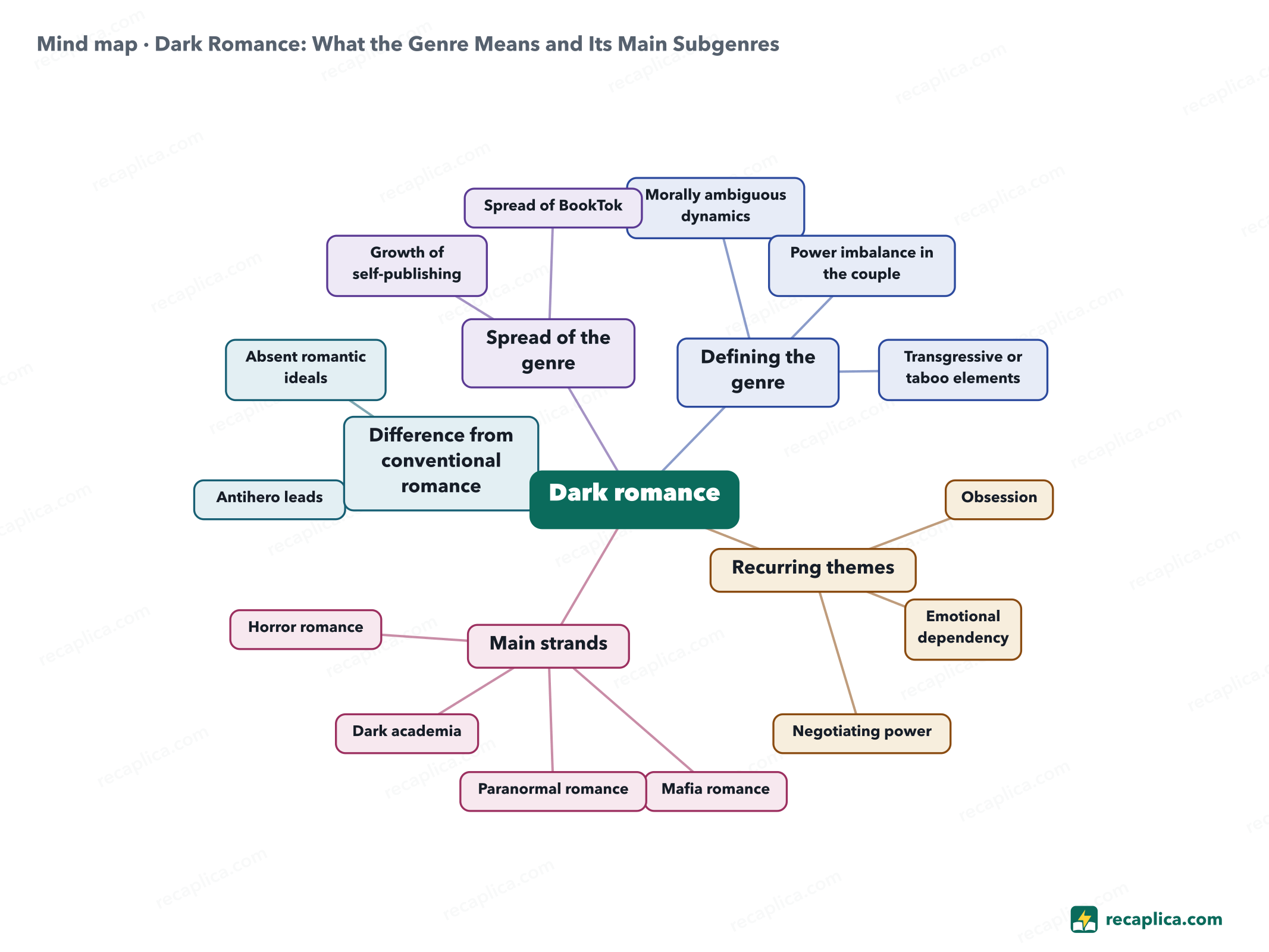
    Mind map: Dark Romance: What the Genre Means and Its Main Subgenres
    • Dark romance
      • Defining the genre
        • Morally ambiguous dynamics
        • Power imbalance in the couple
        • Transgressive or taboo elements
      • Recurring themes
        • Obsession
        • Emotional dependency
        • Negotiating power
      • Main strands
        • Mafia romance organized crime
        • Paranormal romance fantastical or otherworldly beings
        • Dark academia school or university settings
        • Horror romance horror elements as the narrative engine
      • Difference from conventional romance
        • Antihero leads
        • Absent romantic ideals
      • Spread of the genre
        • Growth of self-publishing
        • Spread of BookTok

    Quiz: test yourself

    Answer the questions to check what you have learned: you get instant feedback and a short explanation.

    Grade 0/10 0/5
    1 What mainly defines dark romance as a genre?

    According to Wikipedia, the defining trait of dark romance is morally ambiguous dynamics and power imbalances in the relationship, not how explicit the content is.

    2 What traits do dark romance leads often share?

    Wikipedia notes that dark romance leads move away from conventional romantic ideals: they're often criminals, antiheroes or psychologically unstable characters.

    3 What is mafia romance?

    According to Penguin Books, mafia romance belongs to dark romance and lives inside organized crime, where it has seen a real boom under this label.

    4 Dark romance and horror romance are exactly the same genre.

    They touch, but start from different points: one leans mainly on fear, the other on the morally ambiguous relationship between the characters.

    5 What role did BookTok play, according to Publishers Weekly, in the spread of more explicit romance?

    Publishers Weekly notes that the platform brought readers back to print books and put new adult fiction back in play, with readers growing more explicit in what they ask for.

    Answers: 1-B · 2-B · 3-A · 4-B · 5-A

    Flashcards

    Tap the card to flip it and check whether you remember the answer, then move to the next one.

    1 / 8

    Explain it in your own words

    The ultimate test: if you can explain it in simple words, you've truly understood it. Write your explanation, then compare it with the Recap.

    Your explanation is saved only on this device.

    Dark romance is the strand of romance fiction where the bond between the two leads is never balanced: morally gray territory, power split unevenly, and often ground a conventional romance would avoid altogether. The plot keeps returning to the same psychological pull: a fixation on the other person that edges into dependency, while the two leads fight over who actually controls the relationship. Several distinct strands sit under the label, from mafia romance to paranormal romance, from dark academia to horror romance. The genre found its own readership in the 2010s, the same stretch when digital self-publishing opened space for stories a traditional publisher would have turned down.

    Frequently asked questions

    What does dark romance mean?

    Literally, "dark romance": it's the label for love stories where the bond between the leads is never balanced, with power split unevenly and, often, themes a conventional romance leaves aside.

    How does dark romance differ from a conventional romance?

    In a conventional romance the couple works toward a healthy balance; in dark romance the leads are often outside the law or psychologically unstable, and the plot turns on the obsessive bond with the other person, the dependency that follows, and the tug-of-war over who, in the end, is in control.

    What is mafia romance?

    The dark romance strand set inside organized crime. Penguin Books flags a real boom in this strand, with stories that became publishing phenomena.

    Are dark romance and horror romance the same genre?

    No, even though they touch: horror romance leans on fear in the literal sense, while in dark romance it's the ambiguous relationship between the characters that drives the plot. For the full distinction, see the page on horror romance.

    What is dark academia and how does it connect to dark romance?

    It's an online subculture built around a romanticized take on academic life, drawn to gothic settings and moods. Some dark romance novels are set in schools or universities and share this aesthetic.

    Sources

    • Wikipedia, "Dark romance"
    • Penguin Books UK, "What is dark romance? A beginner's guide to the genre"
    • Wikipedia, "Paranormal romance"
    • Wikipedia, "Dark academia"
    • Publishers Weekly, "How TikTok Has Transformed Romance Publishing"

    Every Recap goes through an independent review before publication.

    Every evening, the day's new Recaps on our Telegram channel. Join the channel →

    Keep learning

    • Literature Best Dark Romance Books: A List for Every Subgenre A selection of dark romance books sorted by subgenre, for readers who already know what the genre is and just want a place to start. Dark mafia romance books cover forced marriages and warring crime families, as in Ruthless People and Killing Sarai. Dark fantasy romance books and paranormal romance move the same pull between desire and threat into worlds with gods, vampires and power struggles. Dark academia romance sets it among visions and fairy tales, while spicy dark romance books and stalker romance push the premise to the edge of real obsession. Read the Recap →
    • Literature Best Stephen King Books: 10 Novels and the Case for Each One Stephen King has written novels across several genres, from Carrie in 1974 to The Institute in 2019, and Wikipedia credits his books with more than 400 million copies sold overall. This list lines up ten titles that come up often in recommendations, with a reason for each pick, from horror staples like It and The Shining to novels that step outside the genre, such as 11/22/63 and The Green Mile. Every book comes with its publication year, its publisher and, where one exists, the award it won or was nominated for. There's no single agreed ranking: Hans-Åke Lilja, interviewed by Five Books as someone who has followed King's career for over 40 years, leaves well-known titles such as Carrie and The Shining out of his own personal picks. Read the Recap →
    • Literature Horror Story Ideas: Everyday Details, Old Fears and a Twist That Lands Writing a horror story often starts with a blank page more uncomfortable than the story itself. This Recap collects starting situations, recurring fears and ways to build a twist, with concrete examples to work from. It doesn't cover the techniques that build tension on the page — those live in the parent Recap on how to write a horror story. The sturdiest ideas tend to start with an everyday detail that stops behaving the way it should, or an old fear dressed in a setting readers recognize. Read the Recap →

    recaplica

    Clear in 30 seconds, yours in 10 minutes.

    Recaps Mind maps Request a Recap Telegram channel Mind map maker Our method About Privacy & cookies Legal notes & terms of use

    © 2026 Recaplica · A project by Curi S.r.l. — VAT IT05472000750

    Statistics, only if you say so

    To learn which Recaps help most we would use Google Analytics, with aggregate, anonymous data. It starts only with your OK, and you can change your mind anytime. Privacy policy