Skip to content
recaplica

    One moment: security check

    Cloudflare wants to make sure you're not a robot. Tick the box below and your search will continue on its own.

    IT
    recaplica Trasformismo: What It Is and How Agostino Depretis Invented It
    © 2026 Recaplica · recaplica.com — All rights reserved
    Home › History

    Trasformismo: What It Is and How Agostino Depretis Invented It

    By Recaplica Newsroom · Updated on September 27, 2026

    What to print

    Page numbers appear when printing with default margins.

    Slides

    Choose a cut

    Flash10 slidesThe essential thread, to present in classFull15 slidesEvery chapter and the deeper detail

    Both come with speaker notes.

    Telegram channel
    recaplica Clear in 30 seconds, yours in 10 minutes.
    In 30 seconds Key points Figures Deep dive Slides Myths Mind map Quiz Flashcards FAQ

    In 30 seconds quick read

    Trasformismo is the political practice, born in Italy between late 1882 and early 1883, of building parliamentary majorities around individual politicians and short-term programs rather than along the line dividing right and left. Agostino Depretis started it: he had led the Historical Left since 1876, and in May 1883 he assembled a new majority out of the more moderate wings of both camps. The name comes from a line he delivered in Stradella on October 8, 1882, offering a place in his ranks to anyone willing to "transform" politically. The word has carried a critical edge in Italian politics ever since, and historians still argue over how to weigh it: some read it as a conservative retreat, others as a flawed but real answer to the fragility of a state that had only just been unified.

    Key Points

    • Trasformismo describes parliamentary majorities built around individual politicians and short-term programs, no longer along a strict right-left line.
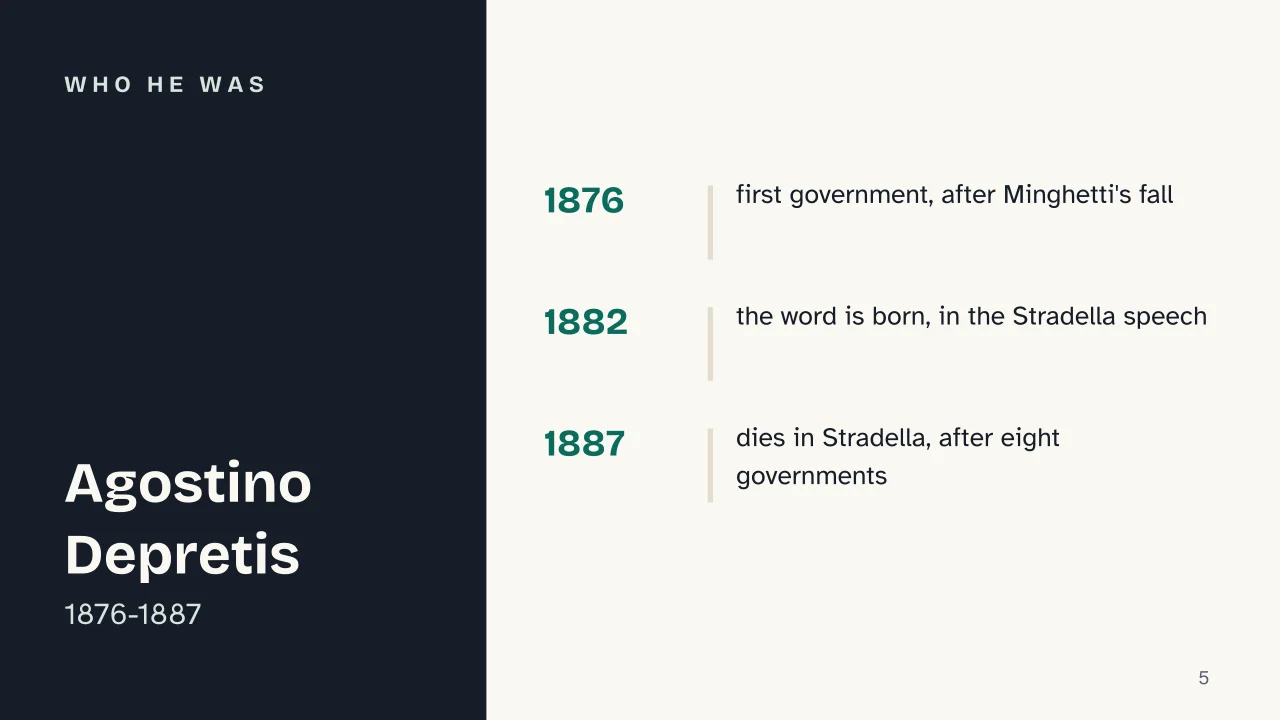
    • Agostino Depretis started the practice, having led the Historical Left since the Minghetti government fell in March 1876.
    • The name comes from a speech in Stradella on October 8, 1882 — a different occasion from an earlier Depretis speech in the same town back in 1876.
    • The trasformista majority became official in May 1883, when Depretis formed his fifth government with backing from parts of the old Right.
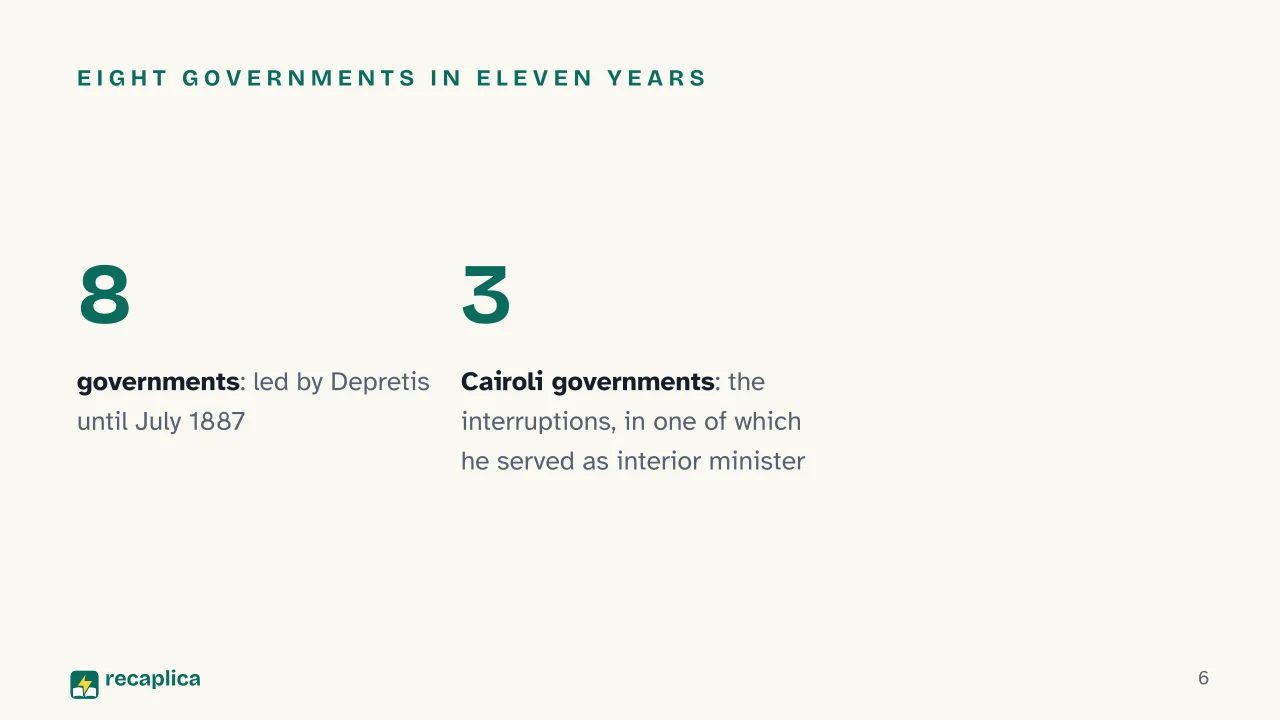
    • Depretis headed eight governments in total until July 1887, with three interruptions caused by the Cairoli governments.
    • Historians remain split: Carocci, Vivarelli and Candeloro stress its conservative, stalling traits, while Sabbatucci ties it to a structural weakness in the young Italian state.

    Key figures

    • 8 the governments Agostino Depretis headed between 1876 and July 1887, interrupted three times by governments led by Benedetto Cairoli Source: Treccani, Enciclopedia — L'Unificazione, entry Deprètis, Agostino

    Deep Dive

    What we mean by trasformismo

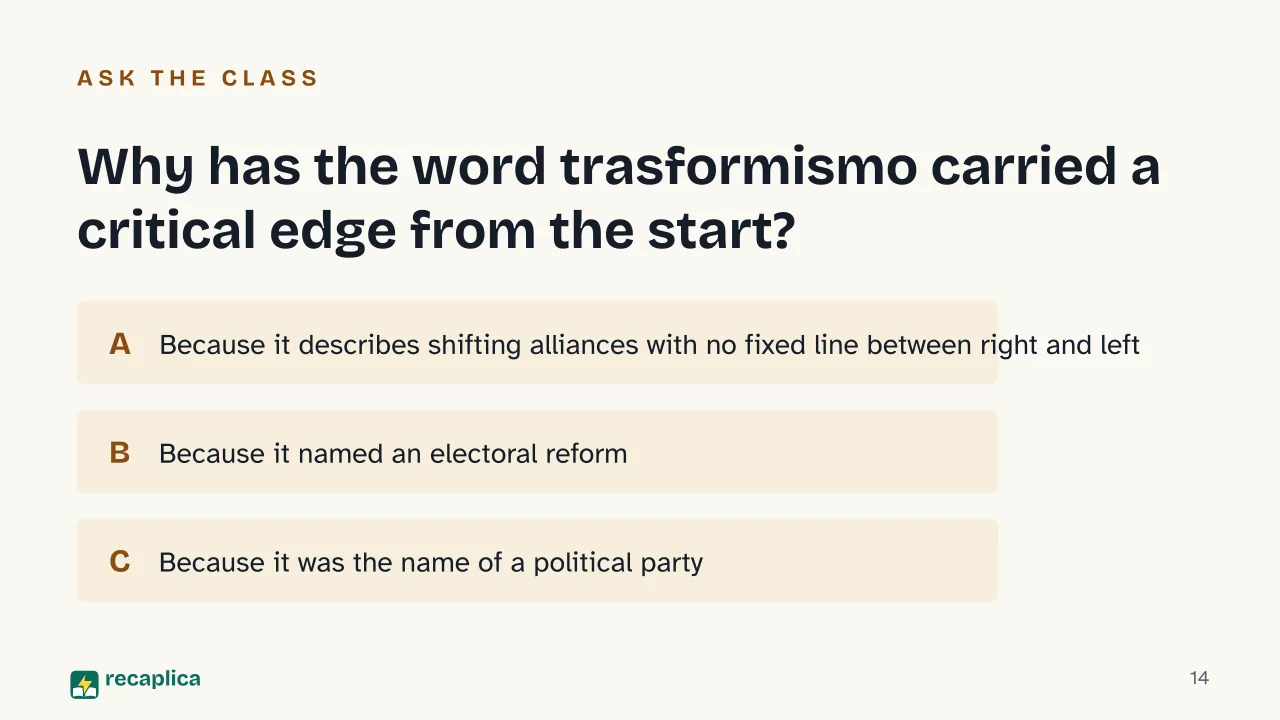
    Trasformismo is the name Italian political commentary gave, between late 1882 and early 1883, to a specific practice: building parliamentary majorities around individual politicians and programs that suited the moment, rather than along the line separating right and left. Agostino Depretis started it, as the central figure of the political season that followed the unification of Italy by only a few years. In everyday use the word has come to carry an almost constant critical or dismissive tone, tied to practices such as favors traded with local cliques in exchange for parliamentary support, backroom maneuvering, and compromises held together more by convenience than by any ideological consistency.

    From the fall of the Right to the Depretis government

    The road to the first Left-wing government opened in March 1876, when the government led by Marco Minghetti — the last of the so-called Historical Right — fell. In the election that followed, the Left won a majority described in sources of the time as not merely solid but sweeping: a very different starting point from the fragmented parliament in which trasformismo would later take hold. In a system where governing power sat firmly with parliament and the constitutional bodies of the state, whether a majority held together depended almost entirely on the balance of forces inside the chamber, far more than on any direct check from voters between elections.

    From that point on, Depretis stayed at the center of Italian political life for more than a decade. He headed eight governments in total until July 1887, the year he died — a run interrupted three times by governments led by Benedetto Cairoli, in one of which Depretis himself served as interior minister, between 1879 and 1881.

    The Stradella speech and the birth of the word

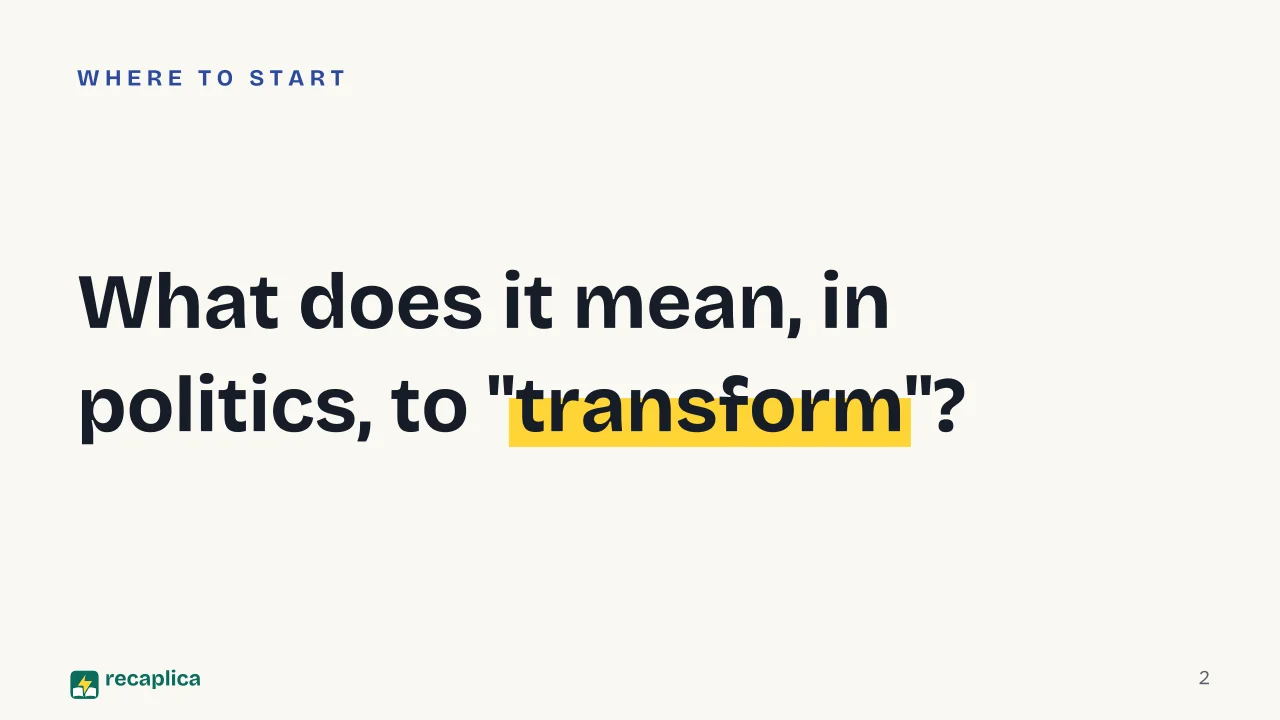
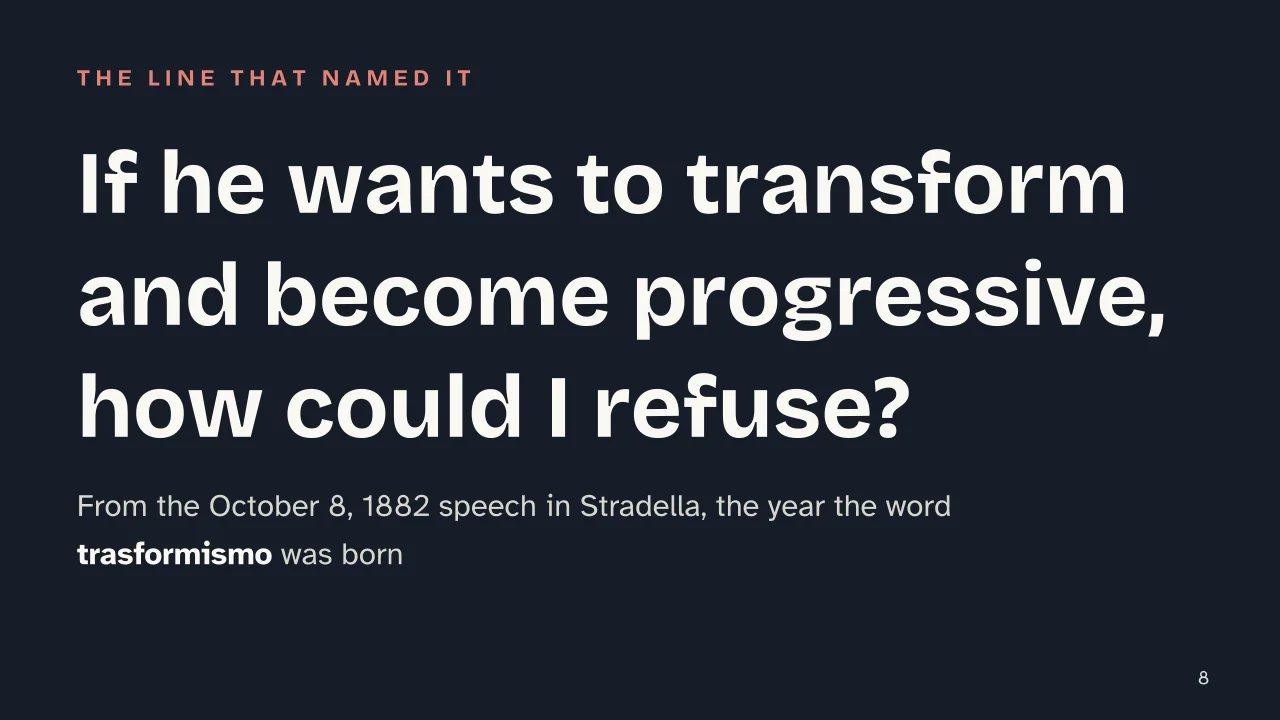
    The name of the phenomenon comes from one specific moment. On October 8, 1882, in a speech delivered in Stradella, Depretis said he was ready to welcome anyone who shared his program, in a line that would go down in Italian political history: he declared himself open to anyone willing to “transform and become progressive.” It was this line — delivered just as the old boundary between political camps had all but disappeared, and as new political and social tensions, both radical-republican and socialist, were becoming more visible — that gave the word trasformismo its place in Italian political language.

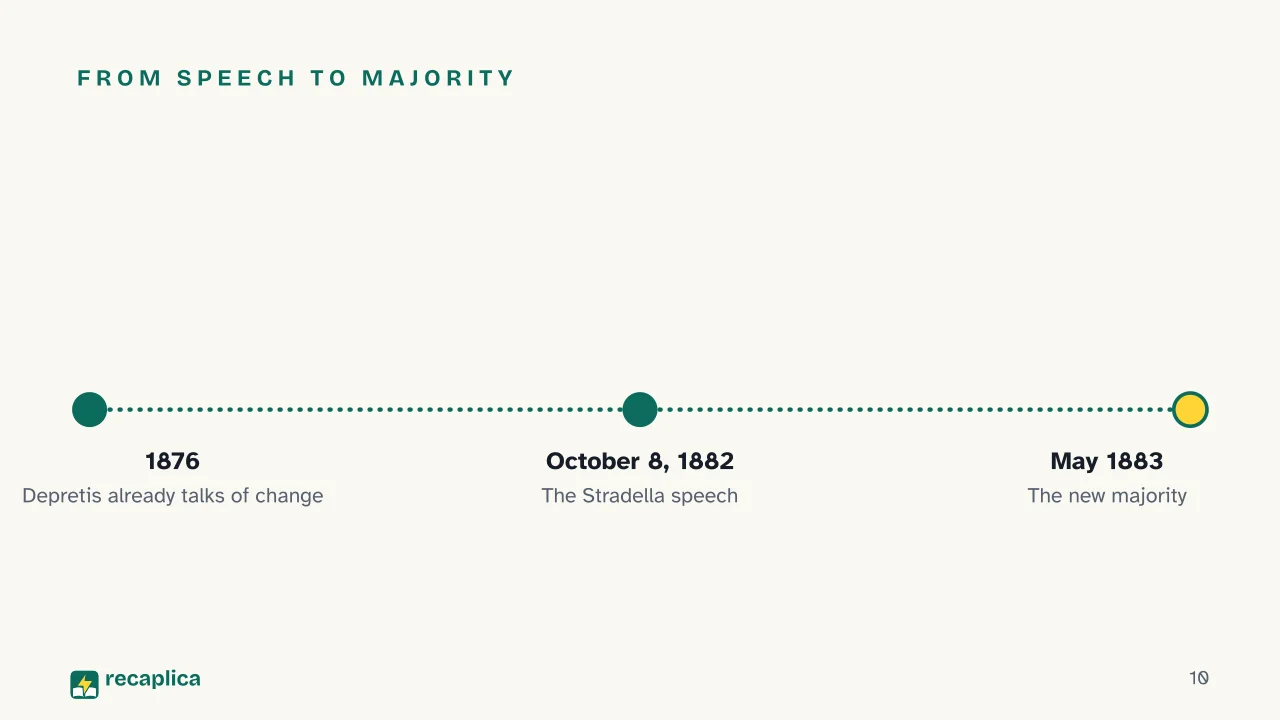
    It needs to be kept separate from another speech, also delivered in Stradella but six years earlier, on October 8, 1876: on that occasion Depretis had already spoken of concord and of a “fruitful transformation of the parties,” but without the phrase yet naming a recognized method of governing. The two speeches share a calendar date and a town, not the historical moment or the weight they carried.

    Practical example: if an opposition party today decided to back a single government bill in parliament, without formally joining it or declaring a lasting alliance, commentators would likely reach for the word trasformismo to describe that choice: it is exactly the kind of move, built on short-term convenience rather than a shared program, the term has referred to since it was coined.

    The May 1883 majority

    The Stradella turn found concrete political form in May 1883, when Depretis put together a new majority by drawing in the more moderate wings of both the Left and the old Right. The formation of his fifth government, officially backed by a substantial part of his former opponents, marked what sources call the official sealing of trasformismo as a method of government: a tool with which Depretis meant to strengthen his parliamentary majority by reducing the weight of the more extreme wings on both sides.

    One method, different readings

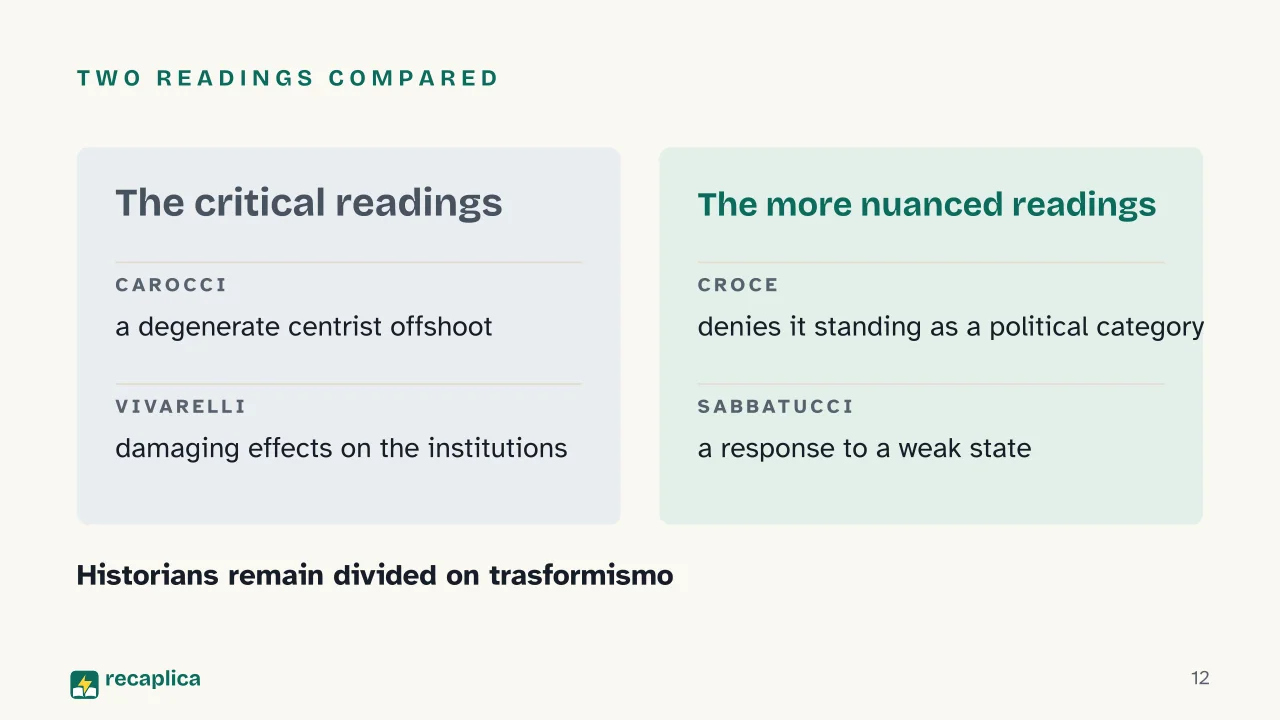
    Historians have never reached a shared verdict on trasformismo, and textbook summaries that dispose of it in a single line risk flattening a debate that has stayed open for more than a century.

    HistorianJudgment on trasformismo
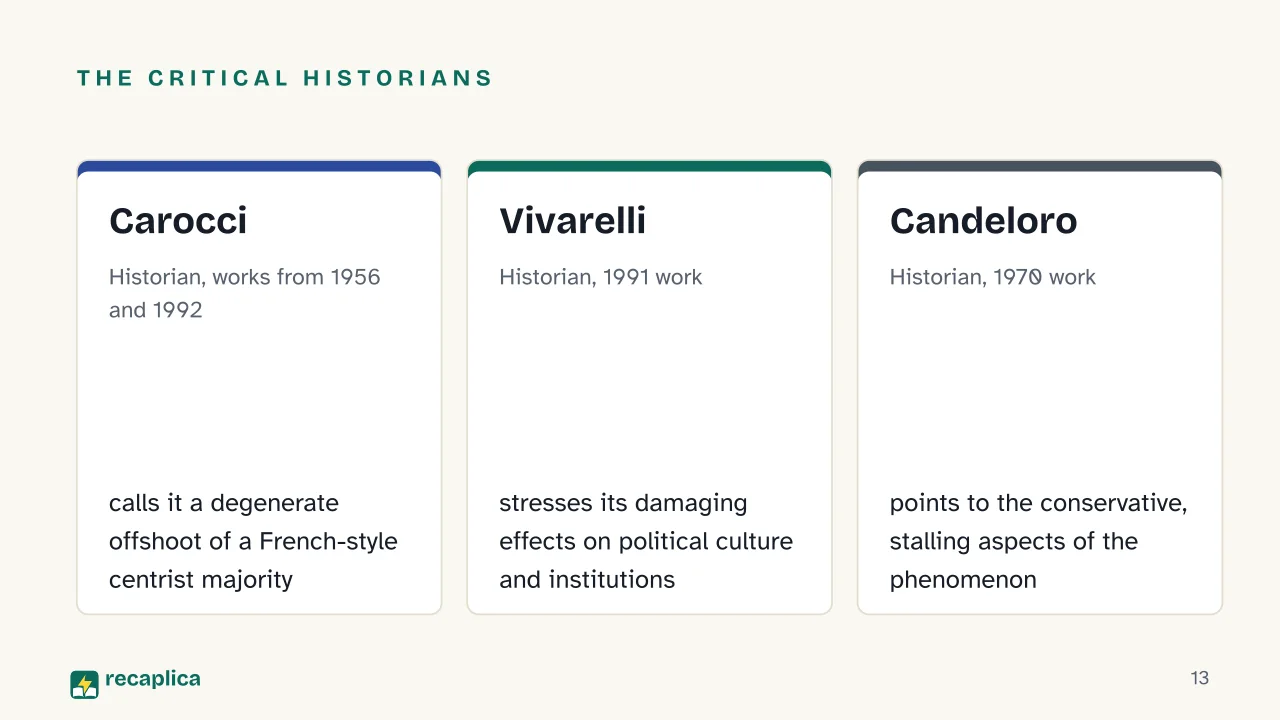
    Caroccia degenerate offshoot of a French-style centrist majority, conservative and stalling in nature
    Vivarellidamaging effects on political culture and the functioning of institutions
    Candelorothe conservative, stalling aspects of the phenomenon
    Crocedenies the concept any standing as a political category, a verdict described as exculpatory
    Sabbatuccinot born from an Italian inclination to compromise, but from the original weakness of the unified state: a response, perhaps a mistaken one, to a real problem

    Carocci, Vivarelli and Candeloro land on a harsh judgment, reading trasformismo as a retreat and a brake on the evolution of the political system. Croce, from the opposite direction, goes as far as denying it any standing as an autonomous political category. Sabbatucci offers a third path, different from both: not a character flaw of the Italian political class, but a systemic choice, born from the fragility of a still-young unified state that lacked structured parties able to sustain a direct contest between a majority and an opposition — a question that touches directly on how different forms of government are distinguished from one another, and on the relationship between parliamentary representation and popular sovereignty.

    Slide deck

    Slides ready to download and make your own in PowerPoint or Google Slides, with speaker notes. Pick the Flash cut or the Full one.
    Slide 1 of the presentation on Trasformismo: TrasformismoSlide 2 of the presentation on Trasformismo: What does it mean, in politics, to "transform"?Slide 3 of the presentation on Trasformismo: Four stopsSlide 4 of the presentation on Trasformismo: Chapter 01: The Left takes powerSlide 5 of the presentation on Trasformismo: Who he wasSlide 6 of the presentation on Trasformismo: Eight governments in eleven yearsSlide 7 of the presentation on Trasformismo: Chapter 02: The Stradella speechSlide 8 of the presentation on Trasformismo: If he wants to transform and become progressive, how could I refuse?Slide 9 of the presentation on Trasformismo: Chapter 03: The 1883 majoritySlide 10 of the presentation on Trasformismo: From speech to majoritySlide 11 of the presentation on Trasformismo: Chapter 04: What historians saySlide 12 of the presentation on Trasformismo: Two readings comparedSlide 13 of the presentation on Trasformismo: The critical historians: Carocci, Vivarelli, CandeloroSlide 14 of the presentation on Trasformismo: Why has the word trasformismo carried a critical edge from the start?Slide 15 of the presentation on Trasformismo: Read more
    Flash10 slidesThe essential thread, to present in classFull15 slidesEvery chapter and the deeper detail

    Common myths

    • ✗ Myth Trasformismo was a sudden invention by Depretis in 1883.

      ✓ Reality Depretis had already talked about concord and about transforming the parties in a speech back in 1876; the word itself only spread between late 1882 and early 1883, once that political line took the shape of an official majority.

    • ✗ Myth Trasformismo simply means a politician switching parties.

      ✓ Reality It describes a method of governing — building majorities around individual figures and short-term programs — not a single episode of party-switching.

    • ✗ Myth Historians all agree that trasformismo was a failure.

      ✓ Reality The verdict is split. Carocci, Vivarelli and Candeloro highlight its conservative, stalling traits; Croce went as far as denying it any standing as a political category; Sabbatucci instead treats it as a response, "perhaps a mistaken one," to a real problem rooted in the weakness of the unified state.

    Mind map

    Drag the background to move around and the nodes to reposition them; use − and + to collapse and expand branches.
    Customize
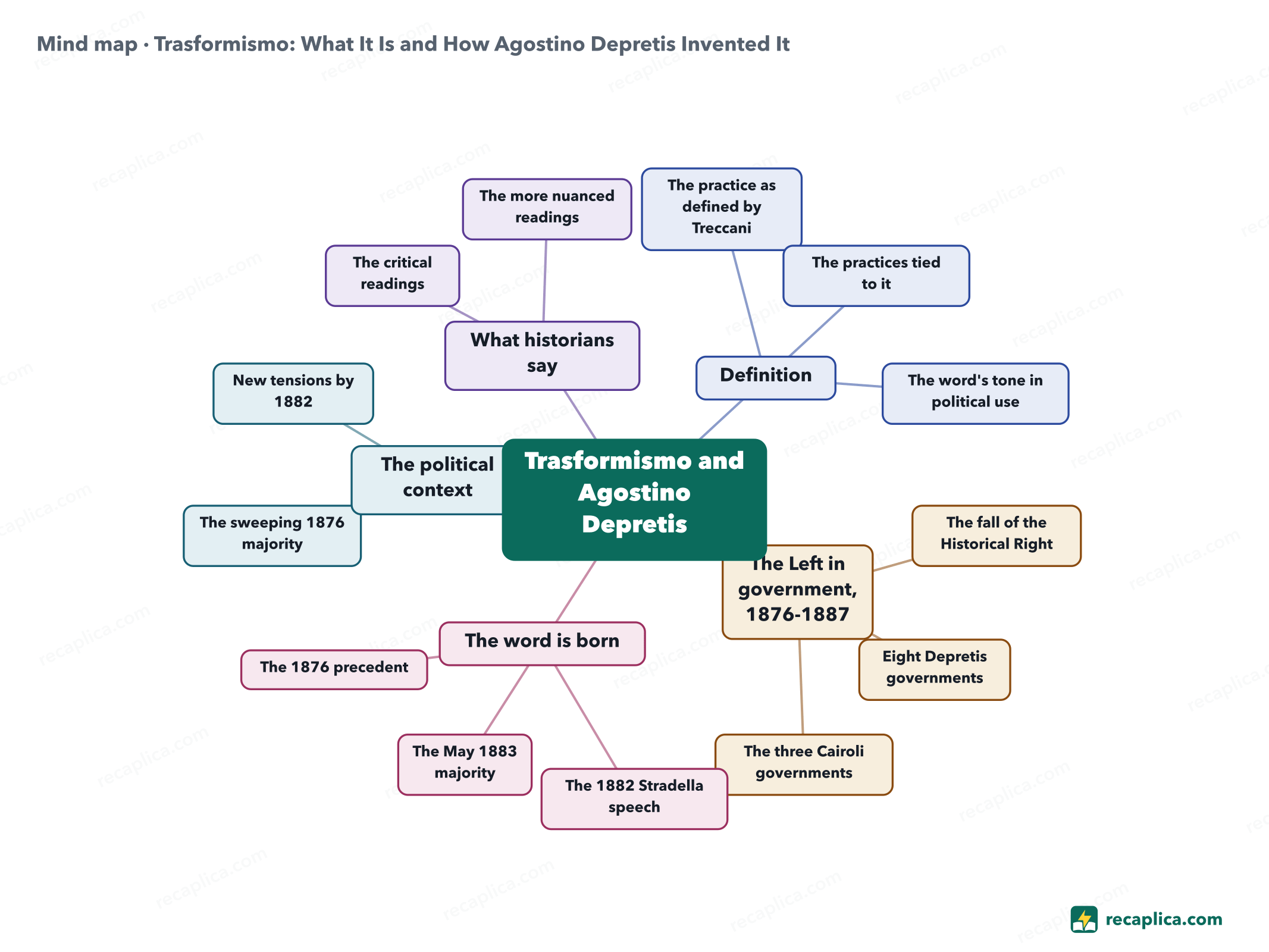
    Mind map: Trasformismo: What It Is and How Agostino Depretis Invented It
    • Trasformismo and Agostino Depretis
      • Definition
        • The practice as defined by Treccani majorities built around individual politicians and short-term programs
        • The practices tied to it favors to local cliques, backroom deals, patronage
        • The word's tone in political use almost always with a critical or dismissive tone
      • The Left in government, 1876-1887
        • The fall of the Historical Right March 1876, the Minghetti government falls
        • Eight Depretis governments running until July 1887
        • The three Cairoli governments interruptions, one of which saw Depretis as interior minister
      • The word is born
        • The 1882 Stradella speech October 8, the line about "transforming"
        • The May 1883 majority Depretis's fifth government
        • The 1876 precedent an earlier speech, the same idea of transforming the parties
      • The political context
        • The sweeping 1876 majority the Left wins the election by a wide margin
        • New tensions by 1882 radical and socialist dissent on the rise
      • What historians say
        • The critical readings Carocci, Vivarelli, Candeloro
        • The more nuanced readings Croce and Sabbatucci, for different reasons

    Quiz: test yourself

    Answer the questions to check what you have learned: you get instant feedback and a short explanation.

    Grade 0/10 0/5
    1 What does the term "trasformismo," coined in late-19th-century Italy, describe?

    This is the definition Treccani attributes to the political commentary of the era, describing the practice Depretis started.

    2 In what year did the Minghetti government fall, opening the way to the first Depretis-led government?

    The Minghetti government fell in March 1876, and from there the first Left-led government, headed by Depretis, took shape.

    3 When did Depretis deliver the Stradella speech with the line about "transforming and becoming progressive"?

    Don't confuse this speech with an earlier one, also in Stradella, that Depretis gave in 1876: the line that gave the phenomenon its name dates to 1882.

    4 How many governments did Agostino Depretis head in total, up to July 1887?

    Eight, interrupted three times by governments led by Benedetto Cairoli.

    5 According to historian Sabbatucci, what gave rise to trasformismo?

    Sabbatucci ties it to the original fragility of the newly unified state, which still lacked parties structured enough to sustain a direct contest between a majority and an opposition.

    Answers: 1-A · 2-B · 3-B · 4-C · 5-B

    Flashcards

    Tap the card to flip it and check whether you remember the answer, then move to the next one.

    1 / 8

    Explain it in your own words

    The ultimate test: if you can explain it in simple words, you've truly understood it. Write your explanation, then compare it with the Recap.

    Your explanation is saved only on this device.

    Trasformismo is the political practice, born in Italy between late 1882 and early 1883, of building parliamentary majorities around individual politicians and short-term programs rather than along the line dividing right and left. Agostino Depretis started it: he had led the Historical Left since 1876, and in May 1883 he assembled a new majority out of the more moderate wings of both camps. The name comes from a line he delivered in Stradella on October 8, 1882, offering a place in his ranks to anyone willing to "transform" politically. The word has carried a critical edge in Italian politics ever since, and historians still argue over how to weigh it: some read it as a conservative retreat, others as a flawed but real answer to the fragility of a state that had only just been unified.

    Frequently asked questions

    What is trasformismo in politics?

    It is the practice of building parliamentary majorities around individual politicians and short-term programs, rather than along the line dividing right and left. Agostino Depretis started it in the early 1880s.

    Why is it called "trasformismo"?

    From the verb Depretis used in a speech in Stradella on October 8, 1882, where he said he was ready to welcome anyone willing to "transform and become progressive."

    Who was Agostino Depretis?

    The politician who led the Historical Left from 1876, heading eight governments in total until July 1887, the year he died in Stradella.

    Did trasformismo only exist in 19th-century Italy?

    The phenomenon began with Depretis, but the word has stayed in Italian political language, almost always used critically to describe similar practices in later eras.

    Was trasformismo good or bad for Italian politics?

    Historians are split. Carocci, Vivarelli and Candeloro point to its conservative, stalling traits; Croce judged it devoid of conceptual standing; Sabbatucci instead ties it to the fragility of the newly unified state.

    Sources

    • Treccani, Enciclopedia — entry Trasformismo
    • Treccani, Enciclopedia — L'Unificazione, entry Deprètis, Agostino
    • Treccani, Enciclopedia delle scienze sociali, entry Trasformismo
    • Treccani, Dizionario Biografico degli Italiani, entry Depretis, Agostino (Raffaele Romanelli, 1991)

    Every Recap goes through an independent review before publication.

    Every evening, the day's new Recaps on our Telegram channel. Join the channel →

    Keep learning

    • History Italian City-State: What It Was, How It Began, and How It Changed The Italian city-state was the form of self-government with which, starting in the late 11th century, many cities in northern and central Italy ran their own affairs, pulling free of direct control by bishops and feudal lords. It began as a government of consuls elected by an assembly of heads of household, then shifted to a foreign official called the podestà, and from the mid-13th century saw the institutions of the popolo take shape alongside it, organized by guild and led by the captain of the people. Through the 13th and 14th centuries, conflict between leading families and the popolo wore this balance down and opened the way to city lordships, the signorie. Venice followed a different path from the start, with an elected doge and its own system of councils. Read the Recap →
    • History The Renaissance: What It Was, When It Began, and Why It Changed Europe The Renaissance is the period of European history in which, starting from Florence and the other Italian city-states, scholars rediscovered the texts and ideals of ancient Greece and Rome and developed new approaches to art, science and politics. It begins around the middle of the fourteenth century and runs through the fifteenth and sixteenth, with exact boundaries still debated among historians. It grew out of the work of chancellors, philosophers and artists in Italian courts and republics, then spread across Europe helped along by the printing press. Its most lasting legacy is the method of observation and verification that would feed into the scientific revolution. Read the Recap →
    • History The Roman Empire: rise, peak and fall The Roman Empire begins in 27 BC, when Octavian takes the name Augustus and becomes the first emperor. Over the following two centuries the Pax Romana holds together a territory that by around AD 100 contains, on the highest estimates, up to 100 million people, across land that today belongs to some fifty countries. The high point is Trajan's reign, which in AD 117 pushes the borders from northern Britain to the Caspian Sea. Then come the long third-century crisis, the administrative split, and in 476 the deposition of the last western emperor. The eastern half, however, does not fall at all: it keeps calling itself the Roman Empire until 1453. Read the Recap →

    recaplica

    Clear in 30 seconds, yours in 10 minutes.

    Recaps Mind maps Request a Recap Telegram channel Mind map maker Our method About Privacy & cookies Legal notes & terms of use

    © 2026 Recaplica · A project by Curi S.r.l. — VAT IT05472000750

    Statistics, only if you say so

    To learn which Recaps help most we would use Google Analytics, with aggregate, anonymous data. It starts only with your OK, and you can change your mind anytime. Privacy policy