Skip to content
recaplica

    One moment: security check

    Cloudflare wants to make sure you're not a robot. Tick the box below and your search will continue on its own.

    IT
    recaplica Parerga and Paralipomena: Schopenhauer's Essays on the Wisdom of Life
    © 2026 Recaplica · recaplica.com — All rights reserved
    Home › History

    Parerga and Paralipomena: Schopenhauer's Essays on the Wisdom of Life

    By Recaplica Newsroom · Updated on October 14, 2026

    What to print

    Page numbers appear when printing with default margins.

    Slides

    Choose a cut

    Flash10 slidesThe essential thread, to present in classFull16 slidesEvery chapter and the deeper detail

    Both come with speaker notes.

    Telegram channel
    recaplica Clear in 30 seconds, yours in 10 minutes.
    In 30 seconds Key points Figures Deep dive Slides Myths Mind map Quiz Flashcards FAQ

    In 30 seconds quick read

    Parerga and Paralipomena is Arthur Schopenhauer's last work, published in 1851: a collection of essays and aphorisms written for general readers, not specialists. In his own eyes it was the slightest of his books, yet a chance review turned it into the one that finally made him known. Its best-known section, the Aphorisms on the Wisdom of Life, ranks a person's inner qualities above wealth and reputation, and credits health alone with nine tenths of happiness. Schopenhauer died in 1860, having finally enjoyed the fame that arrived after decades of neglect.

    Key Points

    • Parerga and Paralipomena, published in 1851, is Schopenhauer's last work: essays and short notes meant for a broad readership.
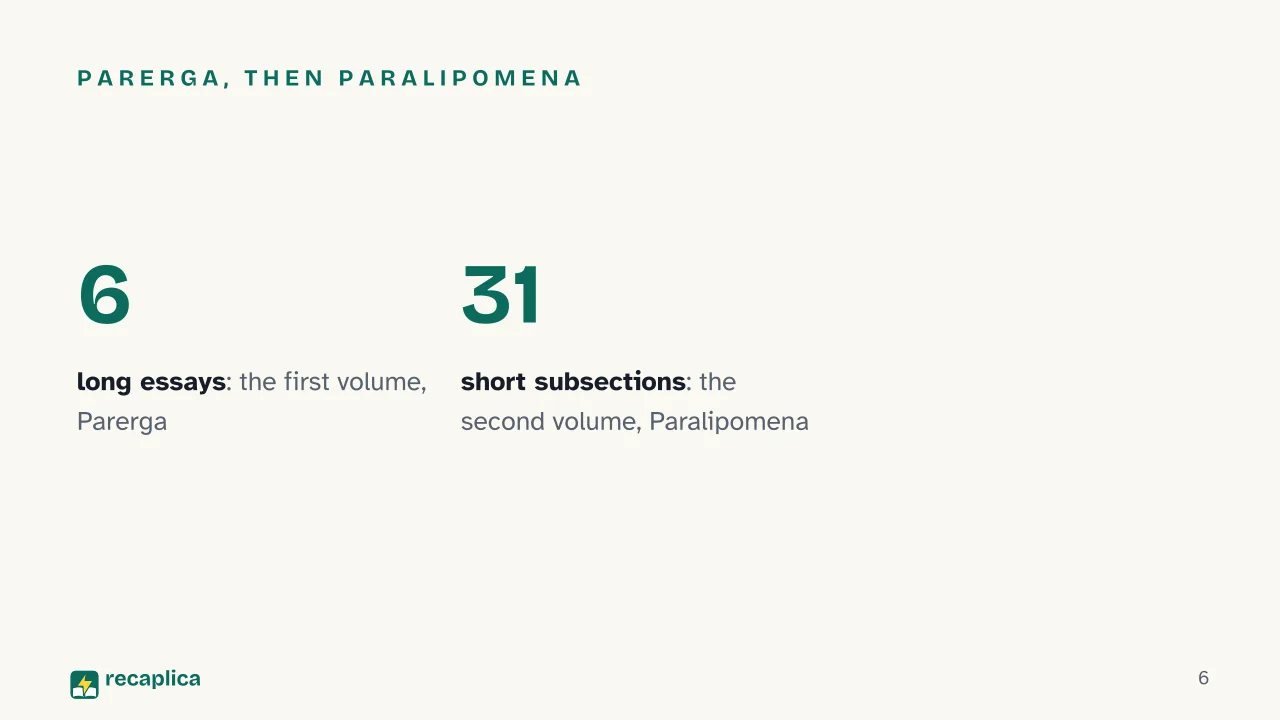
    • It comes in two volumes: Parerga, six longer essays, and Paralipomena, shorter notes grouped into 31 subsections.
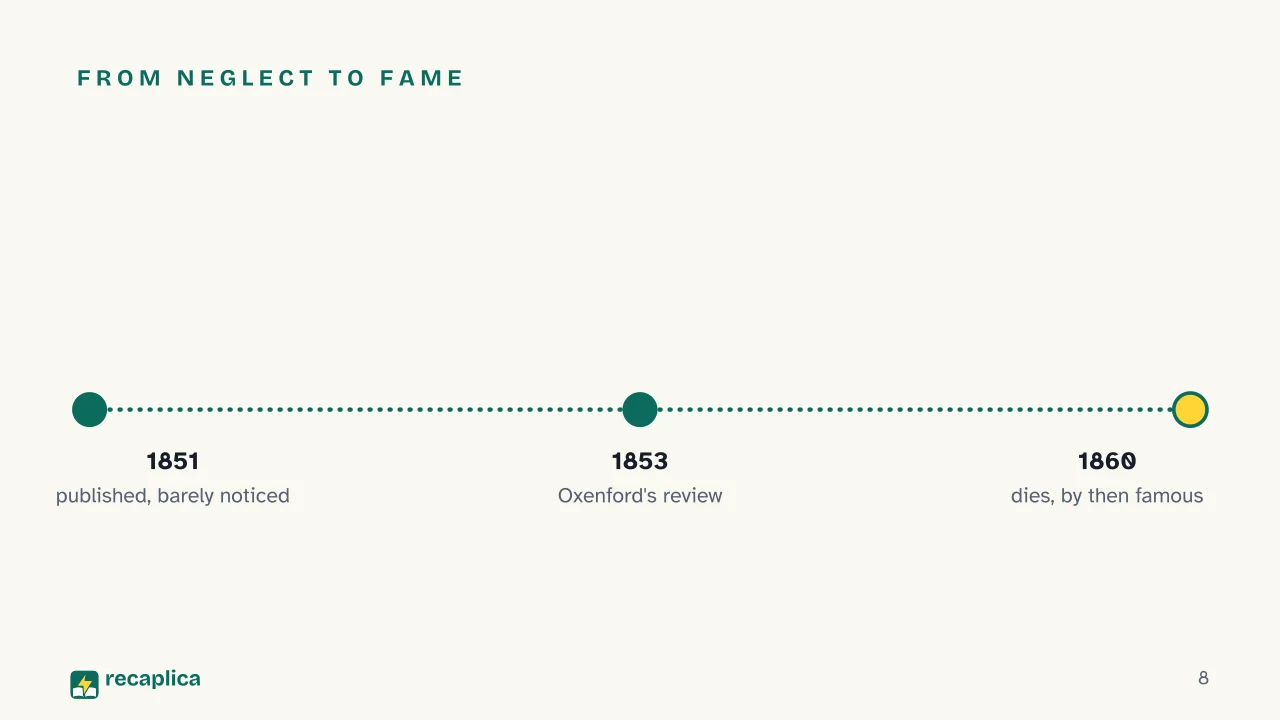
    • A review by the English critic John Oxenford, translated into German, made Schopenhauer famous almost overnight.
    • The Aphorisms on the Wisdom of Life sort human goods into three kinds, from personality and health to possessions and reputation.
    • Schopenhauer credits health alone with nine tenths of human happiness.
    • For Schopenhauer, human life swings between two negative poles: the pain of an unmet desire and the boredom of a desire already satisfied.

    Key figures

    • 1851 Year Parerga and Paralipomena, Schopenhauer's last work, was published. Source: Internet Encyclopedia of Philosophy
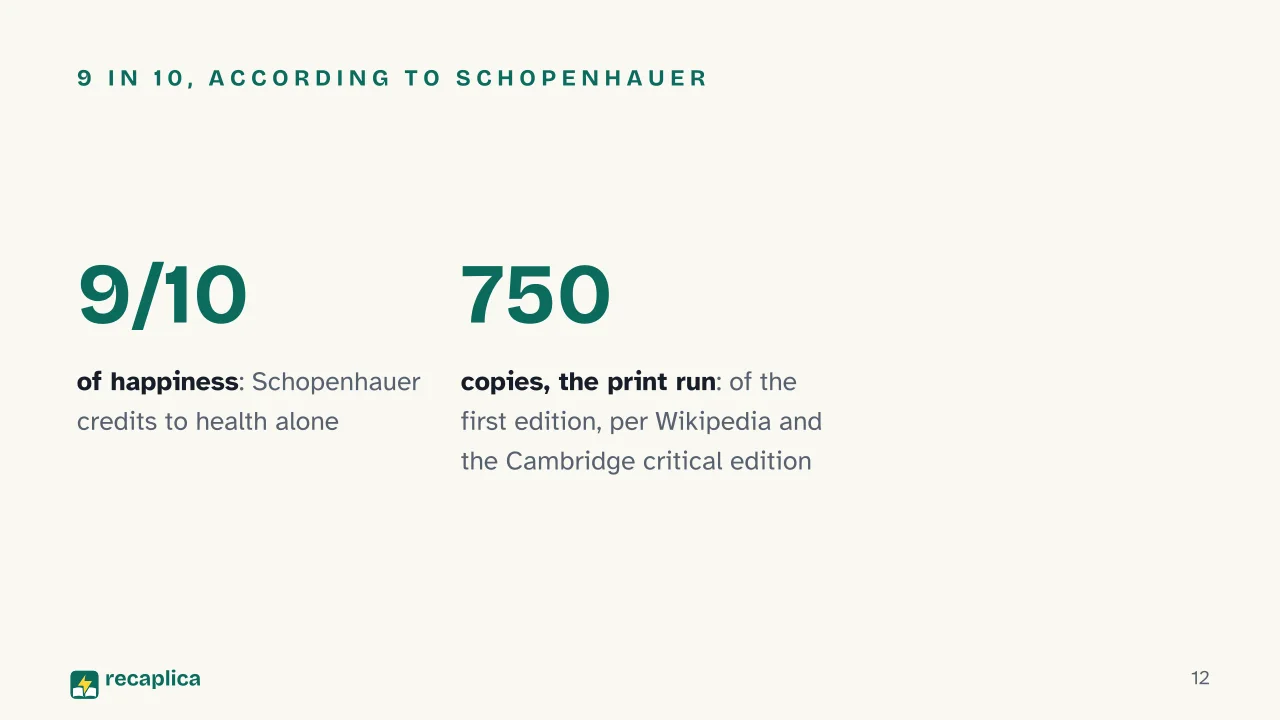
    • 750 copies Print run of the first edition according to Wikipedia, also confirmed by the Cambridge critical edition of the work. Source: Wikipedia (tertiary source)

    Deep Dive

    A book meant as an appendix

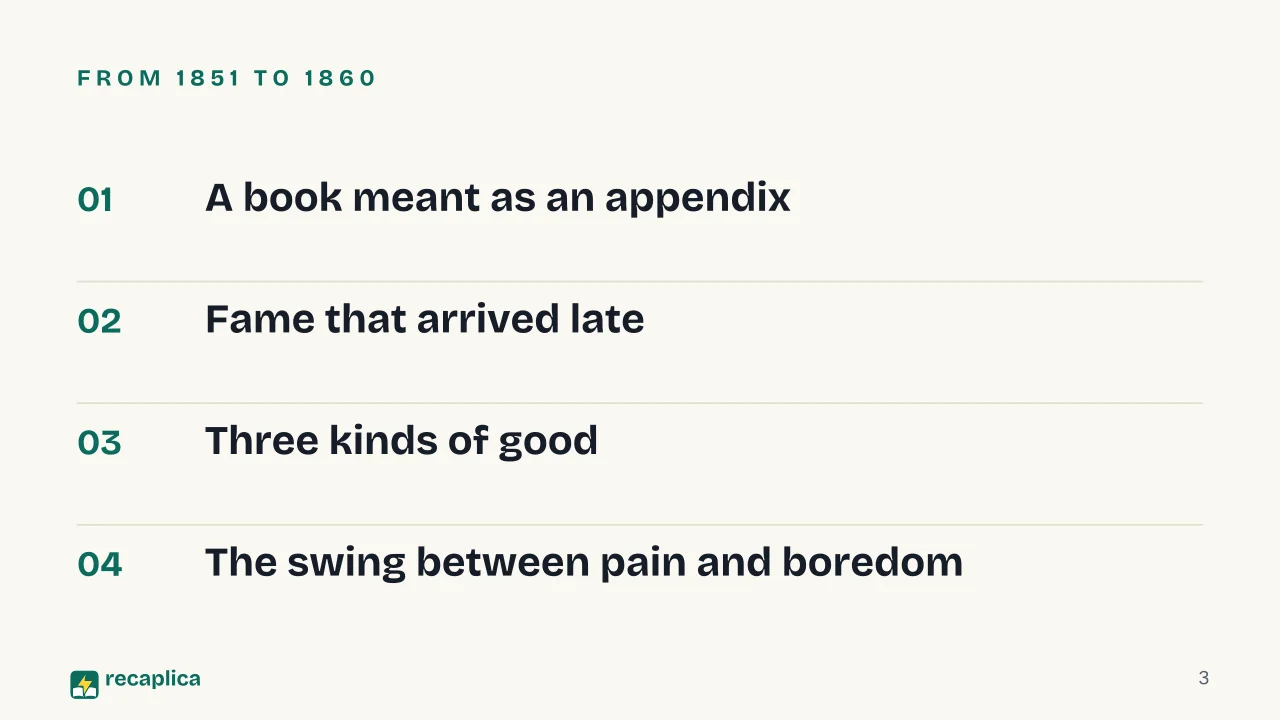
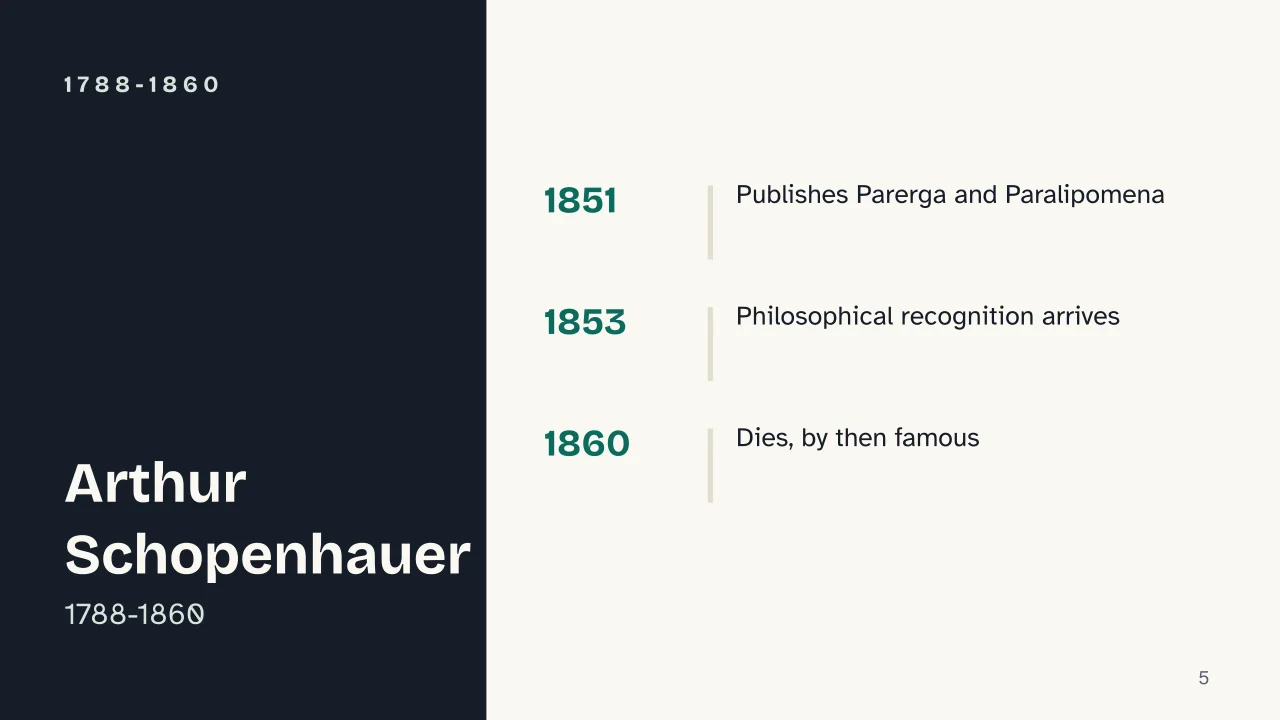
    In 1851 Arthur Schopenhauer published Parerga and Paralipomena, his last work. The Greek title literally means secondary works and things left over: an almost self-deprecating name, chosen for a book its author considered a mere accompaniment to The World as Will and Representation, his major systematic work.

    The first volume, Parerga, collects six extended essays meant as supplements to his thought; the second, Paralipomena, gathers shorter pieces across 31 subsections. According to Wikipedia, the work wasn’t conceived as a summary of or introduction to Schopenhauer’s philosophical system: it was meant as supplementary reading for those who already knew it, while still aiming, in the author’s own intention, to stay understandable to readers encountering him for the first time.

    Fame that arrived late, from a minor work

    The Berlin publisher Hayn agreed to print the book, in two volumes, only after persuasion from Julius Frauenstädt, Schopenhauer’s disciple. The print run was just 750 copies, a figure that both Wikipedia and Christopher Janaway’s Cambridge edition agree on.

    Within a couple of years, around 1853, things changed. The English critic John Oxenford wrote a review, “Iconoclasm in German Philosophy”, later translated into German: German readers met it with great interest, and before long the philosopher, until then almost ignored, began receiving the recognition he had waited decades for. The same review appeared in the Westminster Review. Schopenhauer spent his remaining years, until his death in 1860, enjoying a notoriety that had come late and only after a long wait.

    Three kinds of good, and the wisdom of living

    Within Parerga and Paralipomena, the best-known section is the Aphorisms on the Wisdom of Life: it gathers Schopenhauer’s reflections on the goods of life, arranged in subchapters that run through Counsels and Maxims to a chapter on the different ages of life.

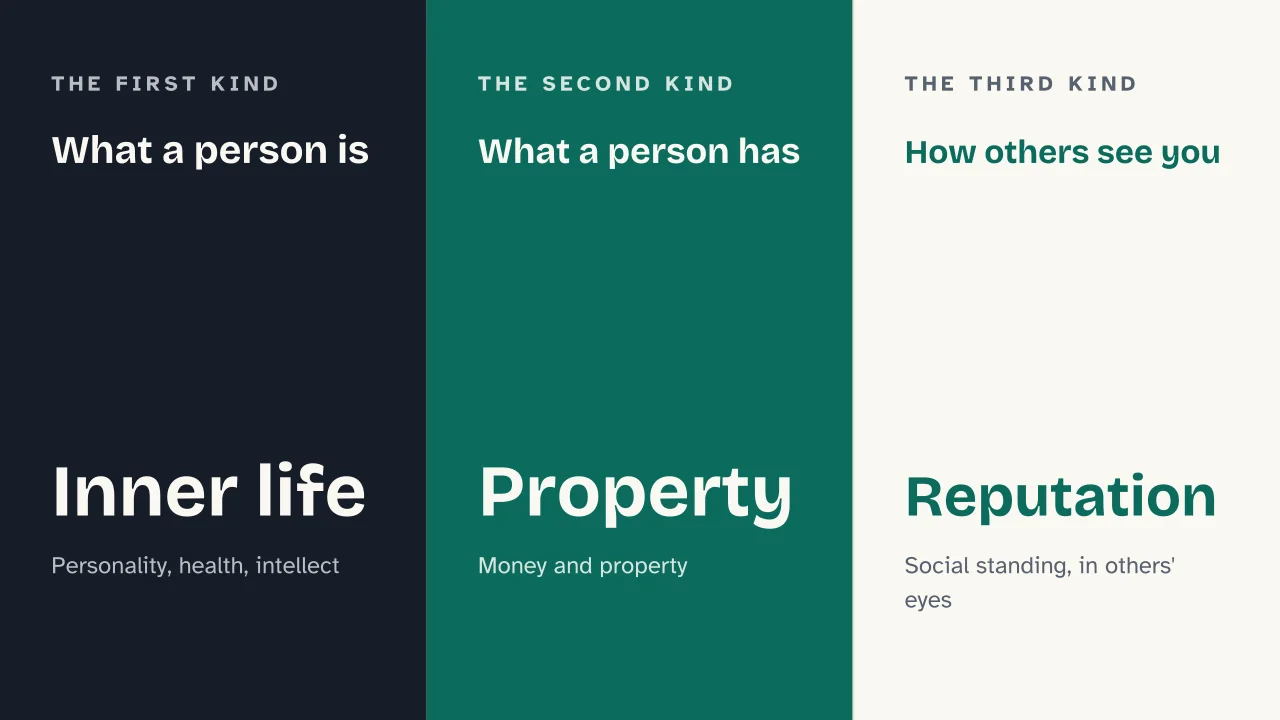
    Schopenhauer opens the text by distinguishing three kinds of good: what a person is, what a person has, and what a person represents in the eyes of others. The table below sums them up.

    CategoryWhat it covers
    What a person isPersonality, health, intellect
    What a person hasPossessions
    How a person is seenReputation, social standing

    For Schopenhauer, the first category outweighs the other two in shaping happiness. The same aphoristic approach, turned toward a different field, resurfaces in The Art of Being Right: there too, the quality of an argument depends on who is making it, not on the circumstances surrounding it.

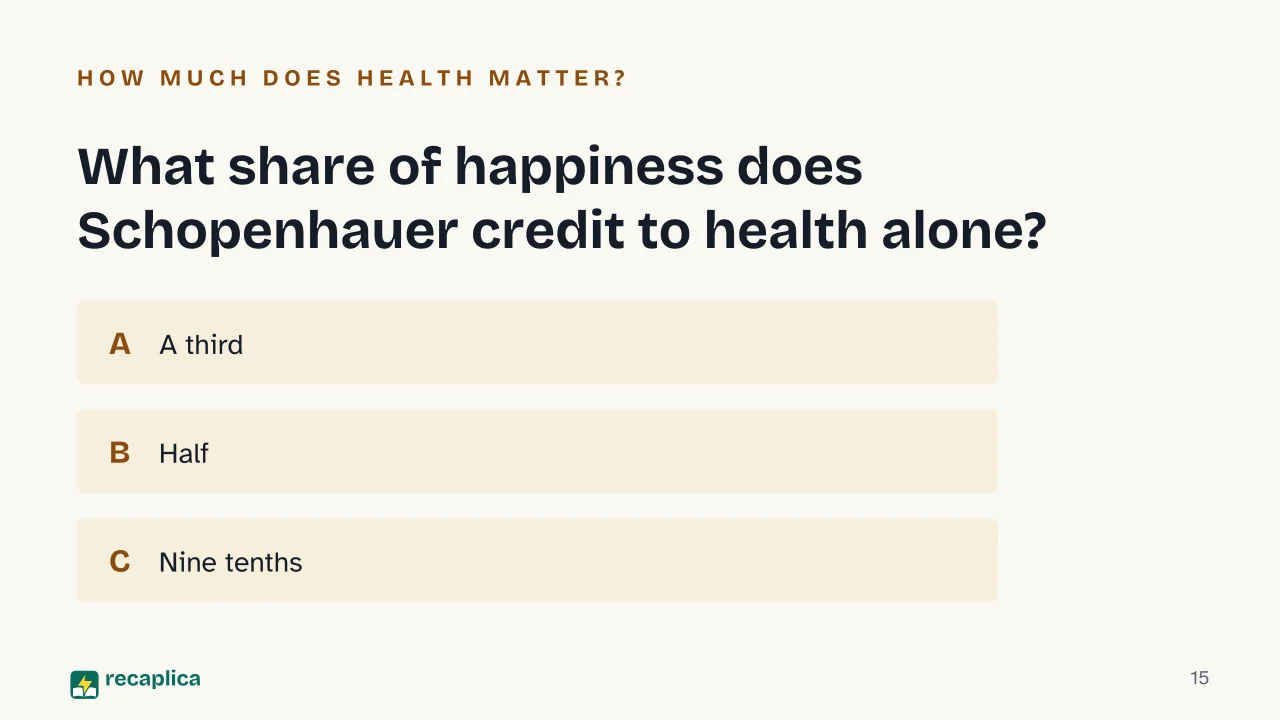
    To health in particular, Schopenhauer credits nine tenths of human happiness: sacrificing it for any other kind of happiness, money, career or pleasure, is for him the greatest of follies.

    Practical example: two people spend the same quiet weekend alone, with nothing planned. Someone with a rich intellectual life, Schopenhauer writes, still finds excellent company in their own thoughts; someone without that inner resource grows bored in the very same solitude.

    The swing between pain and boredom

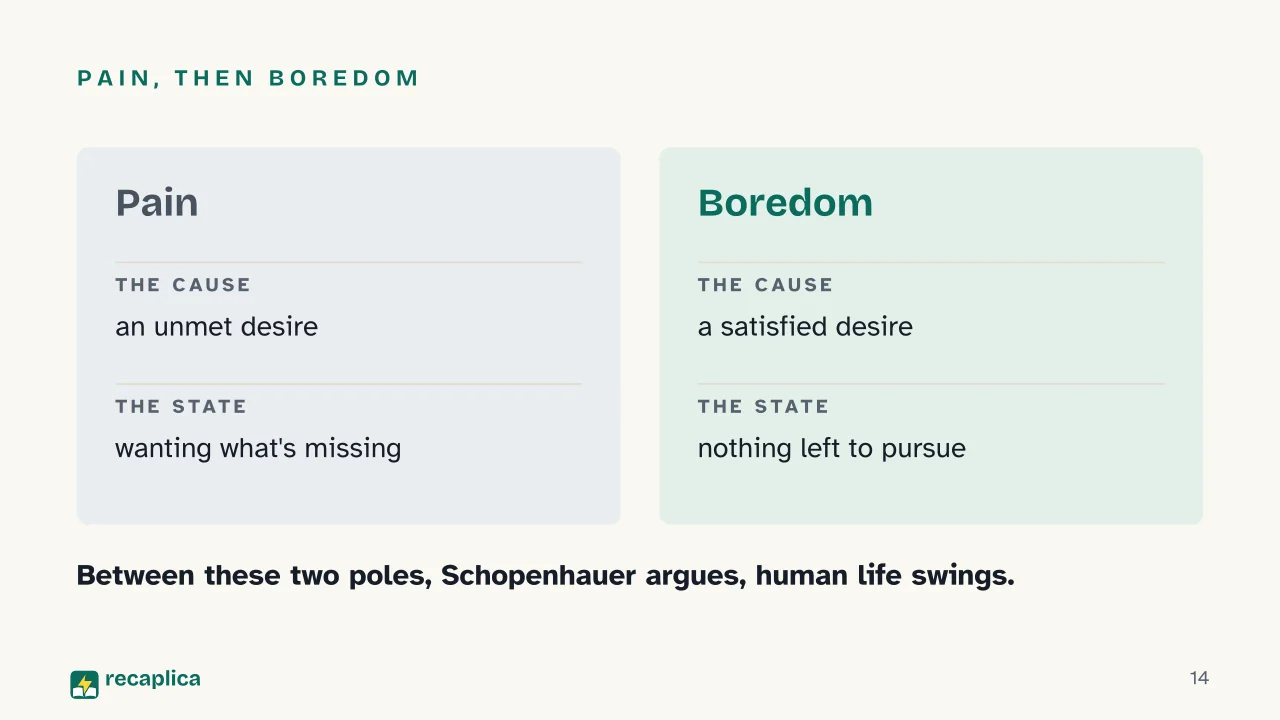
    Schopenhauer describes human life as a more or less violent oscillation between two negative poles. Pain arrives when a desire goes unmet; boredom, when the desire is already satisfied and nothing is left to pursue.

    English translator T. B. Saunders sums up a rule Schopenhauer never tires of repeating: how much enjoyment a person gets out of anything external hinges on their own character, not on the thing itself. Health, inner resources, a mind that keeps itself company: this is what the book keeps coming back to, through the ranking of goods and the warning about health alike.

    Slide deck

    Slides ready to download and make your own in PowerPoint or Google Slides, with speaker notes. Pick the Flash cut or the Full one.
    Slide 1 of the presentation on Parerga and Paralipomena: Parerga and ParalipomenaSlide 2 of the presentation on Parerga and Paralipomena: How a minor work made Schopenhauer famousSlide 3 of the presentation on Parerga and Paralipomena: From 1851 to 1860Slide 4 of the presentation on Parerga and Paralipomena: Chapter 01: A book meant as an appendixSlide 5 of the presentation on Parerga and Paralipomena: 1788-1860Slide 6 of the presentation on Parerga and Paralipomena: Parerga, then ParalipomenaSlide 7 of the presentation on Parerga and Paralipomena: Chapter 02: Fame that arrived lateSlide 8 of the presentation on Parerga and Paralipomena: From neglect to fameSlide 9 of the presentation on Parerga and Paralipomena: His most marginal book made him famousSlide 10 of the presentation on Parerga and Paralipomena: Chapter 03: Three kinds of goodSlide 11 of the presentation on Parerga and Paralipomena: What a person is · What a person has · How others see youSlide 12 of the presentation on Parerga and Paralipomena: 9 in 10, according to SchopenhauerSlide 13 of the presentation on Parerga and Paralipomena: Chapter 04: Between pain and boredomSlide 14 of the presentation on Parerga and Paralipomena: Pain, then boredomSlide 15 of the presentation on Parerga and Paralipomena: What share of happiness does Schopenhauer credit to health alone?Slide 16 of the presentation on Parerga and Paralipomena: Now, the review
    Flash10 slidesThe essential thread, to present in classFull16 slidesEvery chapter and the deeper detail

    Common myths

    • ✗ Myth Parerga and Paralipomena is a summary or an introduction meant for readers who don't yet know Schopenhauer.

      ✓ Reality The work, Wikipedia explains, was written as supplementary reading for those who already knew Schopenhauer's thought: an accompaniment to the system, more than a digest of it, even though meant to stay understandable to newcomers too.

    • ✗ Myth Schopenhauer became famous mainly through his systematic philosophical work.

      ✓ Reality It was instead Parerga and Paralipomena, the book he himself saw as peripheral, that brought him his first public recognition, thanks to John Oxenford's review once it was translated into German.

    • ✗ Myth The Aphorisms on the Wisdom of Life put money or social success at the center of happiness.

      ✓ Reality Schopenhauer instead places personality at the top of human goods, ahead of possessions and social standing.

    Mind map

    Drag the background to move around and the nodes to reposition them; use − and + to collapse and expand branches.
    Customize
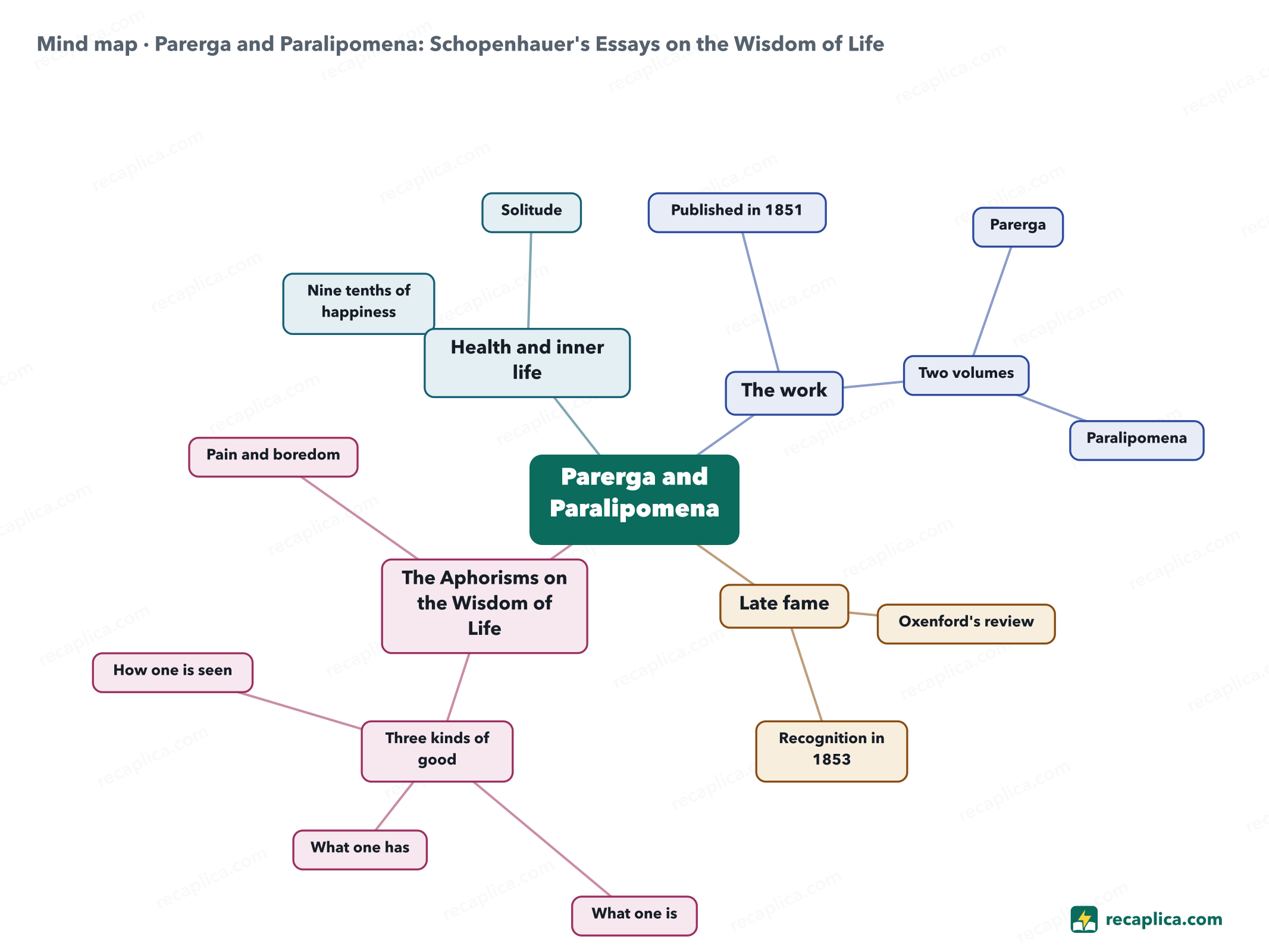
    Mind map: Parerga and Paralipomena: Schopenhauer's Essays on the Wisdom of Life
    • Parerga and Paralipomena
      • The work
        • Published in 1851 Schopenhauer's last work, written for general readers
        • Two volumes
          • Parerga six long essays
          • Paralipomena 31 shorter subsections
      • Late fame
        • Oxenford's review translated into German, makes Schopenhauer famous almost overnight
        • Recognition in 1853 follows the review in the Westminster Review
      • The Aphorisms on the Wisdom of Life
        • Three kinds of good
          • What one is
          • What one has
          • How one is seen
        • Pain and boredom the two poles between which human life swings
      • Health and inner life
        • Nine tenths of happiness credited by Schopenhauer to health alone
        • Solitude a rich inner life keeps good company with its own thoughts

    Quiz: test yourself

    Answer the questions to check what you have learned: you get instant feedback and a short explanation.

    Grade 0/10 0/5
    1 In what year was Parerga and Paralipomena published?

    Schopenhauer published Parerga and Paralipomena in 1851, his last work.

    2 What does the Greek title Parerga and Paralipomena literally mean?

    That is exactly what the Greek title translates to: a modest name for the book that made Schopenhauer famous.

    3 Who wrote the review that made Schopenhauer famous almost overnight?

    It was the English critic John Oxenford, with his review "Iconoclasm in German Philosophy", later translated into German.

    4 According to Schopenhauer, what share of human happiness depends on health alone?

    That is the figure Schopenhauer gives for health on its own: trading it away for money, career or pleasure counts, in his view, as the worst mistake a person can make.

    5 True or false: according to Schopenhauer, someone with a rich intellectual life finds good entertainment in their own thoughts even in complete solitude.

    True: for Schopenhauer, a person with inner resources can keep themselves good company even in complete solitude, unlike someone without them.

    Answers: 1-B · 2-A · 3-B · 4-C · 5-A

    Flashcards

    Tap the card to flip it and check whether you remember the answer, then move to the next one.

    1 / 8

    Explain it in your own words

    The ultimate test: if you can explain it in simple words, you've truly understood it. Write your explanation, then compare it with the Recap.

    Your explanation is saved only on this device.

    Parerga and Paralipomena is Arthur Schopenhauer's last work, published in 1851: a collection of essays and aphorisms written for general readers, not specialists. In his own eyes it was the slightest of his books, yet a chance review turned it into the one that finally made him known. Its best-known section, the Aphorisms on the Wisdom of Life, ranks a person's inner qualities above wealth and reputation, and credits health alone with nine tenths of happiness. Schopenhauer died in 1860, having finally enjoyed the fame that arrived after decades of neglect.

    Frequently asked questions

    What is Parerga and Paralipomena?

    It is Arthur Schopenhauer's last work, published in 1851: it combines longer essays with scattered notes, meant for readers who want to approach his thinking without tackling his major systematic work.

    What are Schopenhauer's aphorisms on the wisdom of life?

    They form the best-known section of Parerga and Paralipomena: they cover personality, health, possessions and reputation, plus a chapter of Counsels and Maxims and one on the different ages of life.

    Why did Parerga and Paralipomena make Schopenhauer famous?

    John Oxenford's review, translated into German, was met with great interest by German readers, and within a few years changed the fortunes of an author who had long sat on the margins of philosophical debate.

    What are the three categories of human goods according to Schopenhauer?

    They are what a person is in themselves, meaning personality, health and intellect; what a person has, meaning possessions; and how a person is regarded by others, meaning reputation and social standing. For Schopenhauer, the first weighs most heavily on happiness.

    How does Parerga and Paralipomena differ from The World as Will and Representation?

    [The World as Will and Representation](/en/history/schopenhauer-world-as-will-and-representation/) is Schopenhauer's major systematic work; Parerga and Paralipomena, according to Wikipedia, wasn't meant as a summary of it or an introduction to it, but as supplementary reading for those who already knew that system, even if a newcomer could, in theory, follow it too.

    Sources

    • Schopenhauer, Arthur (Internet Encyclopedia of Philosophy)
    • Arthur Schopenhauer (Stanford Encyclopedia of Philosophy)
    • Parerga and Paralipomena (Wikipedia)
    • The Wisdom of Life, trans. T. Bailey Saunders, 1897 (Project Gutenberg)
    • Schopenhauer: Parerga and Paralipomena, ed. Christopher Janaway (Cambridge University Press)

    Every Recap goes through an independent review before publication.

    Every evening, the day's new Recaps on our Telegram channel. Join the channel →

    Keep learning

    • History What Is Existentialism? Heidegger, Being and Time, and Dasein Existentialism is a current of twentieth-century philosophy centered on human existence, freedom and the search for meaning. According to the Stanford Encyclopedia of Philosophy, the German philosopher Martin Heidegger (1889-1976) shaped that current more than almost anyone else, even though he never accepted the label. In 1927 he published Being and Time, his major work, where he introduced the concept of Dasein: the human being as the one entity that questions its own existence. That book influenced Jean-Paul Sartre's existentialism, but in 1946, in the Letter on Humanism, Heidegger openly broke with Sartre and refused to be called an existentialist. In 1933 he was elected rector of the University of Freiburg and became a Nazi party member, keeping that membership until the regime fell - an episode Heidegger himself later denied or played down more than once. Read the Recap →
    • History What Is Phenomenology? Husserl's Philosophy Explained Edmund Husserl founded phenomenology as a philosophical discipline around 1900-1901, with his Logical Investigations. His method starts from the epoché, a suspension of our everyday, unquestioning stance toward the world, and moves toward phenomenological reduction: studying how things appear to consciousness rather than what they are in themselves. At the center sits intentionality, the idea that every experience is always an experience of something specific, whether hoping, perceiving, or desiring. The method Husserl built carried into the 20th century through Heidegger, Sartre, and Merleau-Ponty, moving from German philosophy into French philosophy along the way. Read the Recap →
    • History Legal Positivism: What It Is, from Austin to Kelsen and Hart According to the Stanford Encyclopedia of Philosophy, legal positivism measures legal validity against observable social facts, keeping moral judgment on a separate track. Its roots lie in Hobbes and Hume. Jeremy Bentham produced the theory's first full account, which John Austin later took up and spread: for Austin, a rule is law only when a sovereign commands it under threat of punishment. In the twentieth century, Hans Kelsen grounded legal validity in a hierarchy that traces back to a presupposed basic norm, while Herbert Hart located it instead in a rule of recognition actually followed by judges and officials. Natural law theory takes the opposite view: an unjust law is not really a law. Legal positivism disagrees — a law stays valid even when it is morally unjust, as long as it was made the way the system requires. Read the Recap →

    recaplica

    Clear in 30 seconds, yours in 10 minutes.

    Recaps Mind maps Request a Recap Telegram channel Mind map maker Our method About Privacy & cookies Legal notes & terms of use

    © 2026 Recaplica · A project by Curi S.r.l. — VAT IT05472000750

    Statistics, only if you say so

    To learn which Recaps help most we would use Google Analytics, with aggregate, anonymous data. It starts only with your OK, and you can change your mind anytime. Privacy policy