|
recaplica
Clifford Geertz: who he was and what interpretive anthropology is |
| © 2026 Recaplica · recaplica.com — All rights reserved |
Clifford Geertz: who he was and what interpretive anthropology isWhat to print Page numbers appear when printing with default margins. SlidesChoose a cut Flash10 slidesThe essential thread, to present in classFull15 slidesEvery chapter and the deeper detailBoth come with speaker notes. In 30 seconds quick readClifford Geertz (1926-2006) is the anthropologist who proposed studying a culture the way one studies a text. In 1973 he described culture as a body of meanings handed down through history and carried in symbols: to understand it you interpret those symbols, rather than hunt for general laws. His working tool is thick description, an account detailed enough to show which meanings hold the observed facts together. “The Interpretation of Cultures”, regarded as his most influential book, appeared in 1973. Key Points
Key figures
Deep DiveWho Clifford Geertz wasClifford Geertz was born in San Francisco on 23 August 1926. The American Historical Association recalls that he arrived at Antioch College drawn to English literature and moved from there towards philosophy; sociology and anthropology came afterwards, at Harvard. The Antioch degree is from 1950, the Harvard doctorate from 1956. His first long stretch of fieldwork was in Java, in Indonesia, together with his wife Hildred Geertz, an anthropologist as well. In Indonesia he also worked in Bali and in Sumatra. Later he moved his research to Morocco, taking in oral poetry, olive growing, the mosques and the bazaars. Two of his best-known case studies come from this fieldwork: the cockfights he watched in Bali, and the religious rituals he observed in Morocco. From 1970 he was professor of social science at the Institute for Advanced Study in Princeton, where he stayed until his death. He died in Philadelphia on 30 October 2006, of complications from heart surgery. Culture read as a textIn 1973 Geertz described culture as an inheritance of meanings that history hands down and that people put into symbolic form: a system of ideas passed on in symbols, which people draw on to communicate and to build up what they know and feel about living. A definition like that carries a way of working with it. If a culture is a stock of meanings, it can be read like a text: you interpret it by looking at the symbols it is built from, rather than accounting for it with laws good for every society. The move is the one hermeneutics had been making on written pages for centuries, now applied to a market day or a ceremony: in place of the page there are people acting, and what they do has to be understood in its sense before it is filed anywhere. The opposite project, a secure method that leads to certain knowledge, is the subject of the Recap on Descartes and the problem of method. What thick description meansThick description is the tool that holds this approach together. The Stanford Encyclopedia of Philosophy takes it to mean describing cultural practice in such detail that the links of sense between the observed events can be put back together. It is not an invitation to write more pages; it is a rule about what has to end up in the notebook.
The Interpretation of Cultures, 1973“The Interpretation of Cultures” came out in 1973 and is regarded as the most influential of Geertz’s works. It was not conceived as a single treatise: it collects essays he had already published through the 1960s. The criticisms, and the author’s own doubtsThe anthropologist Talal Asad faulted Geertz’s theory for a dualism in the way it handles culture and social reality, pointing to a gap between “cultural system” and “social reality”. The discussion stays inside the academic debate, and bears on the frame of the theory. Geertz himself, after all, doubted that the study of cultures could be fully objective. How much we can really know of what we observe is a question modern philosophy had been turning over long before anthropology arrived, as in the Recap on David Hume’s empiricism. The American Historical Association also remembers a sharp-penned Geertz: his notices of other scholars’ work were witty and cutting, and now and then they drew indignant reactions. Slide deckSlides ready to download and make your own in PowerPoint or Google Slides, with speaker notes. Pick the Flash cut or the Full one.   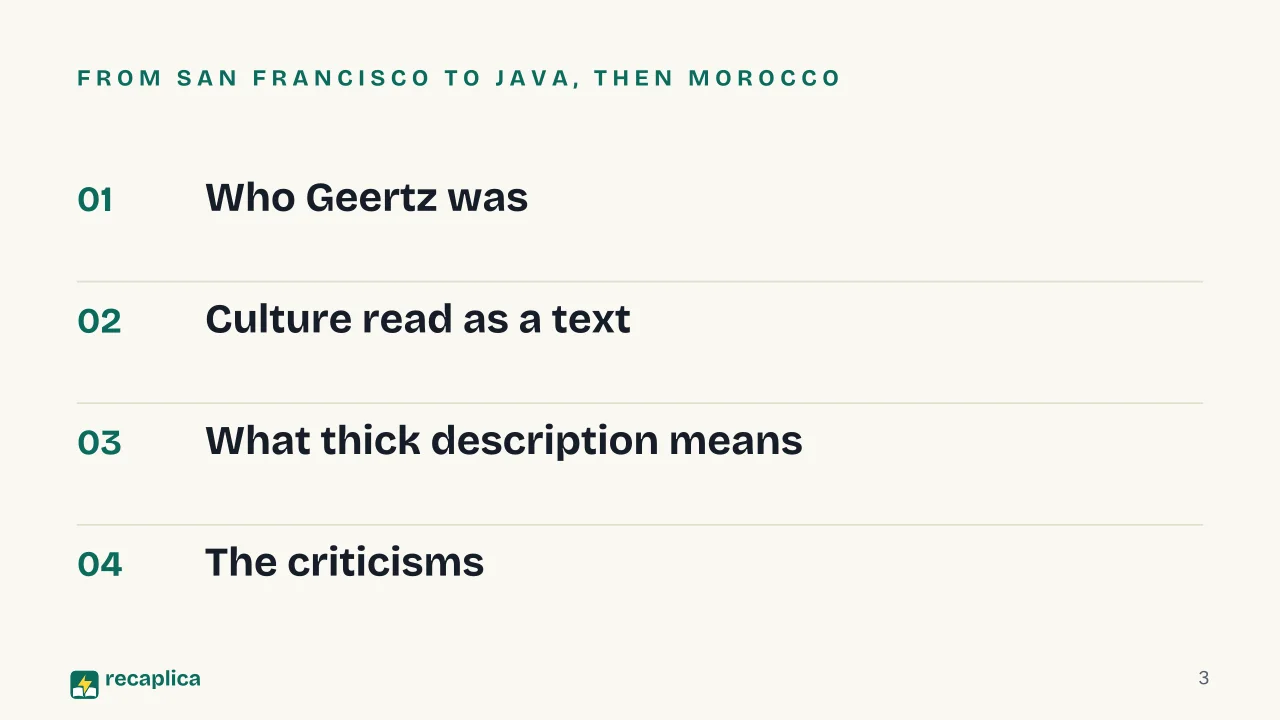  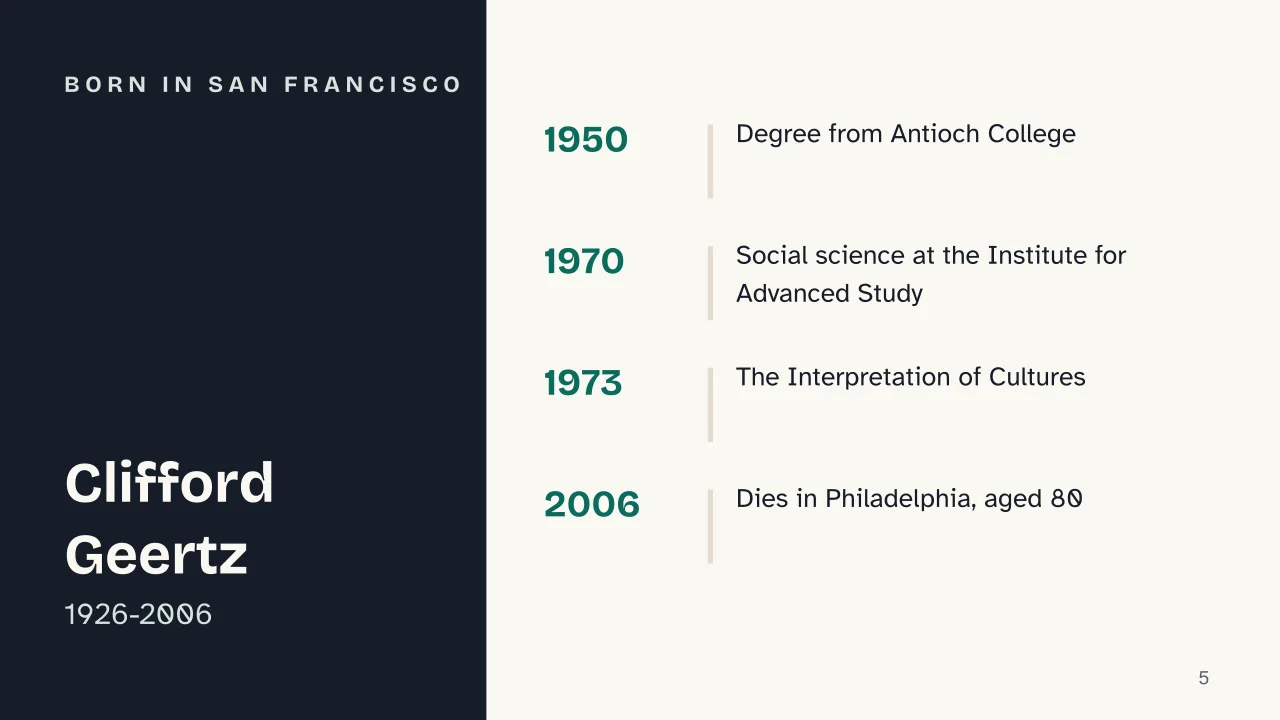  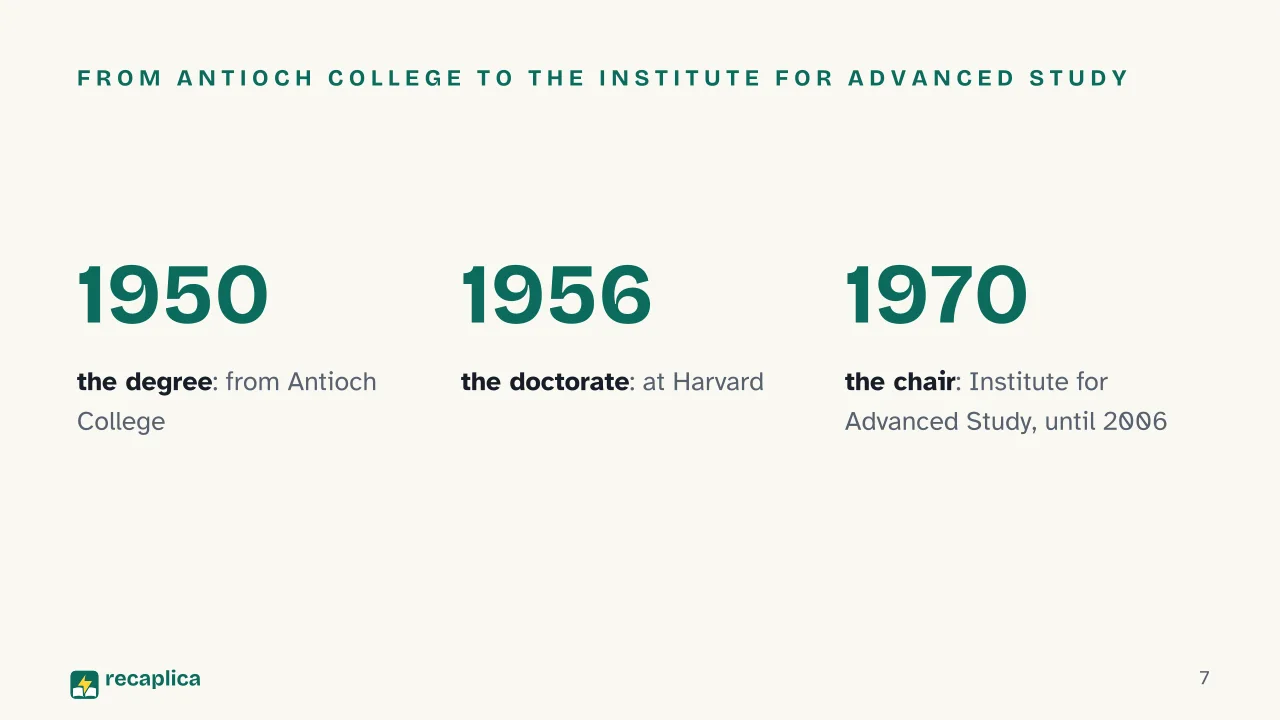  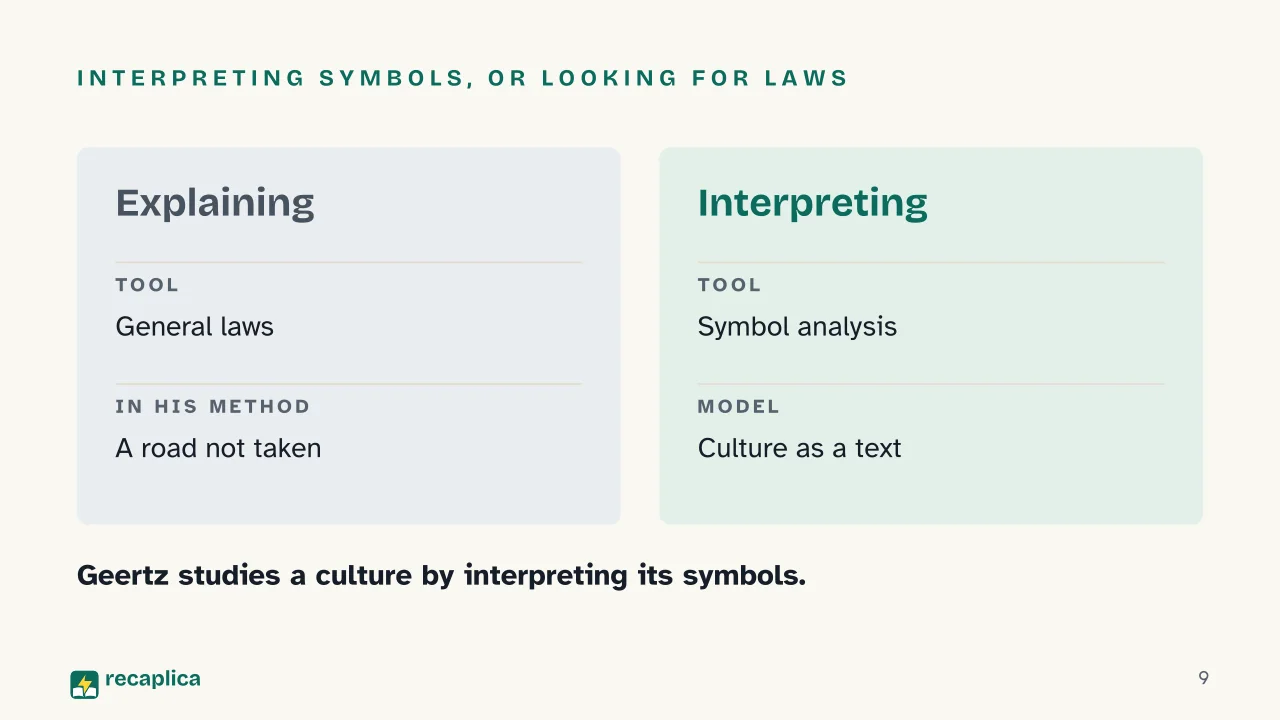     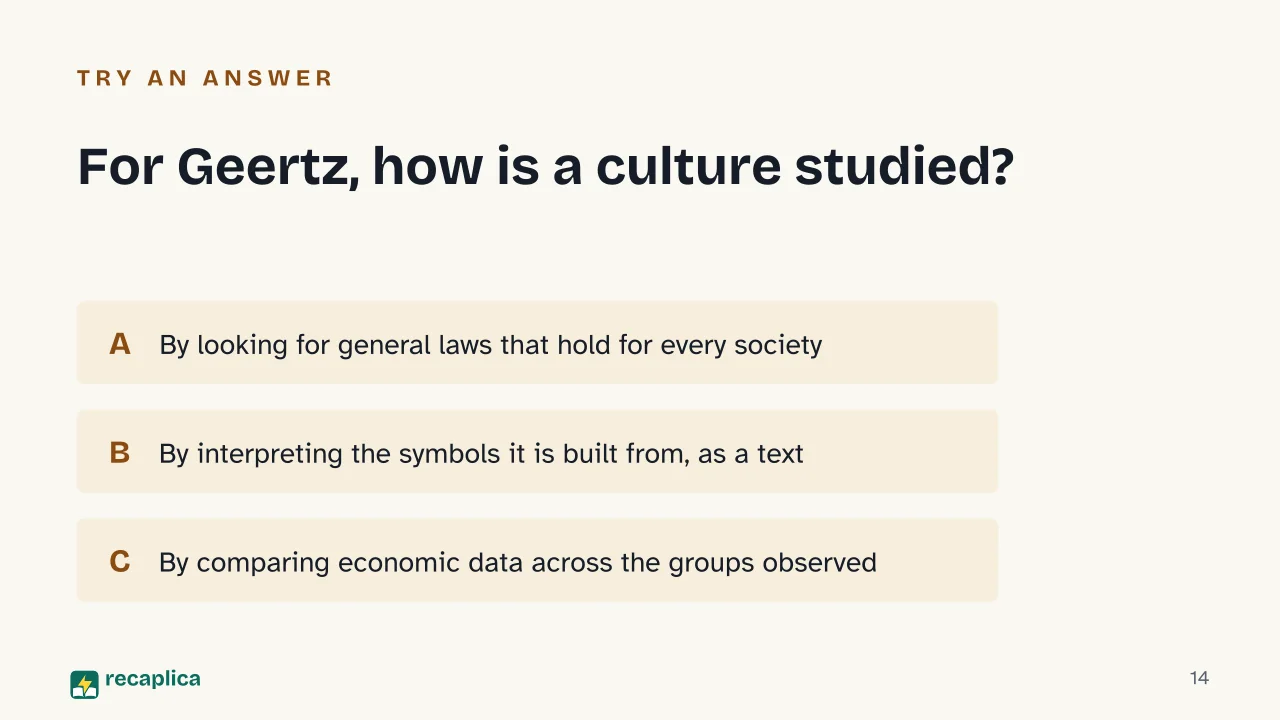  Common myths
Mind mapDrag the background to move around and the nodes to reposition them; use − and + to collapse and expand branches. 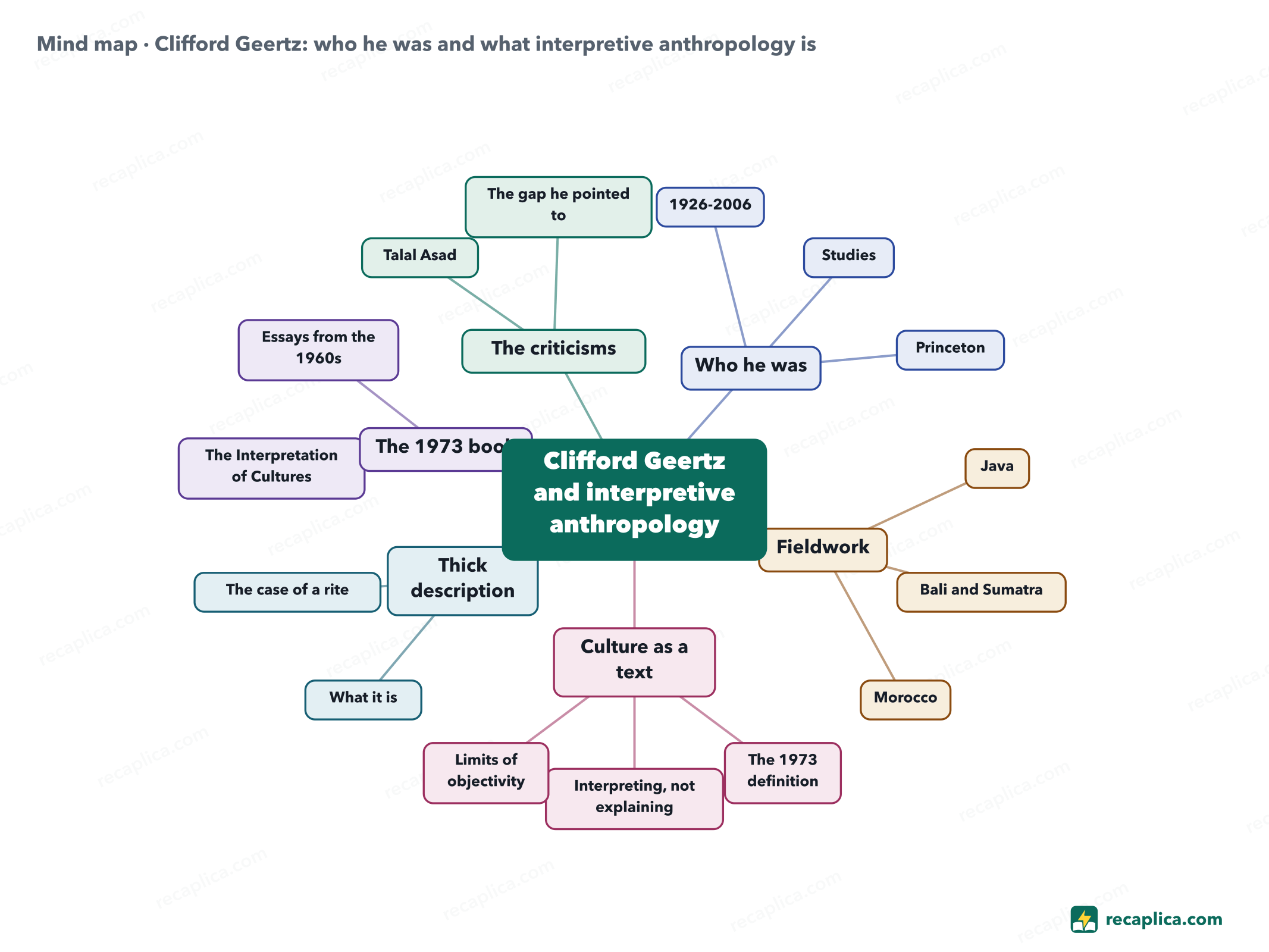
Quiz: test yourselfAnswer the questions to check what you have learned: you get instant feedback and a short explanation. Grade 0/10 0/5
FlashcardsTap the card to flip it and check whether you remember the answer, then move to the next one. 1 / 7 Explain it in your own wordsThe ultimate test: if you can explain it in simple words, you've truly understood it. Write your explanation, then compare it with the Recap. Your explanation is saved only on this device.
Frequently asked questionsWho was Clifford Geertz?An American anthropologist, born in San Francisco on 23 August 1926, who died in Philadelphia on 30 October 2006. He graduated from Antioch College in 1950 and took his doctorate at Harvard in 1956; from 1970 he was a professor of social science at the Institute for Advanced Study in Princeton. His name is tied to interpretive anthropology. What is interpretive anthropology?It is the approach on which a culture has to be read like a text: you interpret the symbols people use to communicate and to pass meanings on. Geertz set it out in 1973, when he described a culture as made of meanings that reach us through history and are put into symbolic form. What does thick description mean?It means describing a cultural practice up to the point where you can see what holds the various moments of it together. The measure is how far that account lets you grasp what a gesture does in that group. What book did Clifford Geertz write?His best-known title is “The Interpretation of Cultures”, published in 1973 and regarded as the most influential of his works. It collects essays that had come out through the 1960s. What criticisms did Geertz's theory receive?The anthropologist Talal Asad objected that the theory rests on a dualism, with a gap between “cultural system” and “social reality”. Geertz, for his part, did not think a fully objective study of cultures was possible. Every Recap goes through an independent review before publication. |