Skip to content
recaplica

    One moment: security check

    Cloudflare wants to make sure you're not a robot. Tick the box below and your search will continue on its own.

    IT
    recaplica What Is Social Commerce? How It Works and Examples
    © 2026 Recaplica · recaplica.com — All rights reserved
    Home › Economics

    What Is Social Commerce? How It Works and Examples

    By Recaplica Newsroom · Updated on September 19, 2026

    What to print

    Page numbers appear when printing with default margins.

    Slides

    Choose a cut

    Flash10 slidesThe essential thread, to present in classFull15 slidesEvery chapter and the deeper detail

    Both come with speaker notes.

    Telegram channel
    recaplica Clear in 30 seconds, yours in 10 minutes.
    In 30 seconds Key points Figures Deep dive Slides Myths Mind map Quiz Flashcards FAQ

    In 30 seconds quick read

    Social commerce is selling that starts inside a social network: not an ad that sends people to a website, but a product tagged in a post, a livestream, or a video, where discovery and purchase happen without ever opening a search engine. Instagram, Facebook, and TikTok all offer it, but they part ways on the detail that matters most, where the payment actually happens: since 2025, Instagram and Facebook send buyers to a merchant's own website to finish checkout, while TikTok Shop keeps the whole purchase inside the app. Statista puts the market at roughly $586 billion worldwide in 2026, about 15% of all e-commerce.

    Key Points

    • Social commerce starts with impulse discovery inside a feed, not an active search on a site or search engine: someone spots a product while scrolling, and that's what triggers the purchase.
    • The three platforms usually named are Instagram Shopping, Facebook Shops, and TikTok Shop, and they don't all handle the part that matters most, payment, the same way.
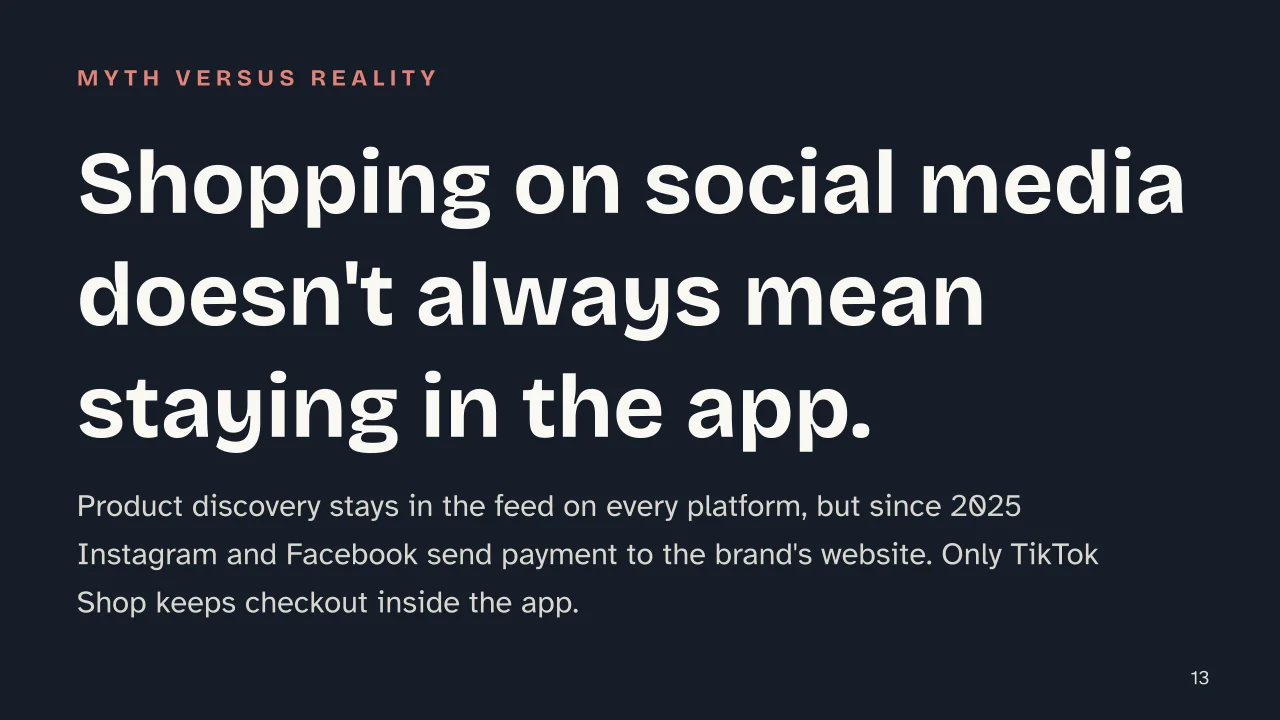
    • Since 2025, Meta has phased out native checkout on most Facebook and Instagram Shops: discovery still happens in the feed, but payment finishes on the merchant's own website.
    • TikTok Shop, which launched in the United States in September 2023, keeps checkout inside the app instead, using third-party payment providers plugged directly into the purchase flow.
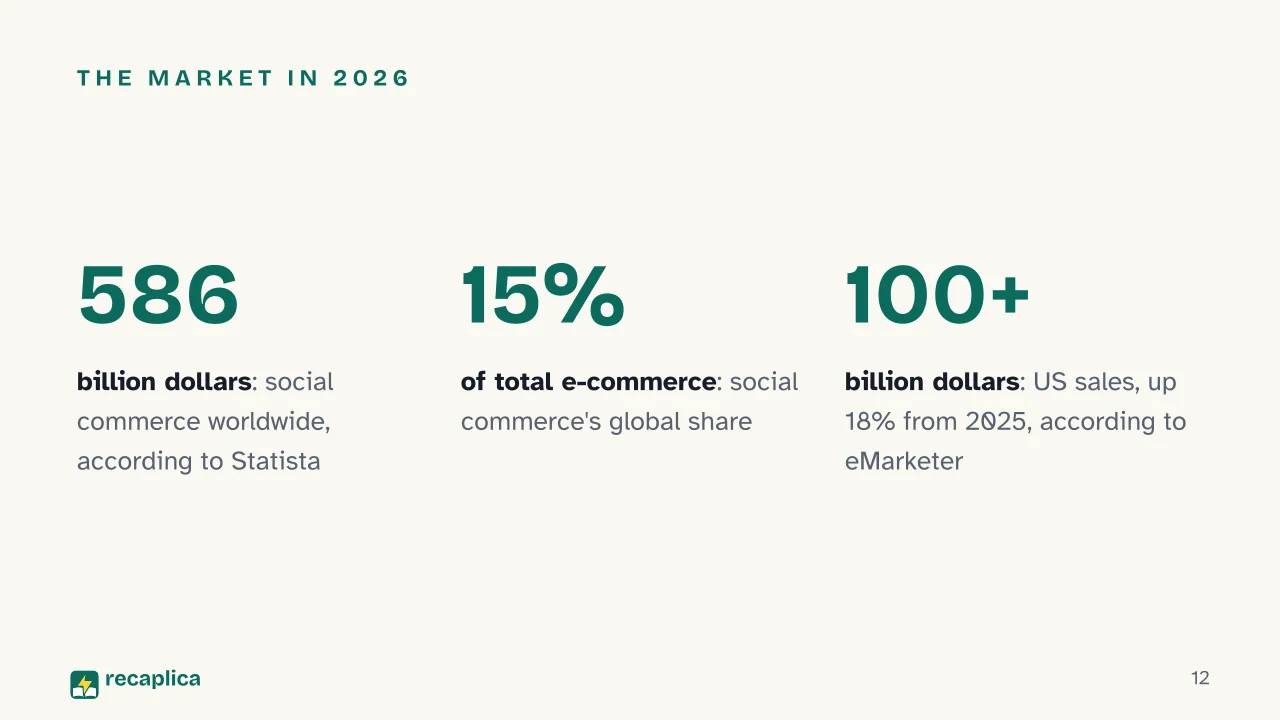
    • Statista estimates the global social commerce market at about $586 billion in 2026, 15% of total e-commerce; in the United States, eMarketer projects it will pass $100 billion for the first time, up 18% from the year before.
    • The European Commission lists interfaces that push impulse buying, the kind built into feeds and livestreams, among the practices its Digital Fairness Act is meant to address, alongside influencer marketing.

    Key figures

    • $586 billion the estimated global value of social commerce in 2026 Source: Statista
    • 15% social commerce's share of total worldwide e-commerce in 2026 Source: Statista
    • $100+ billion estimated US social commerce sales in 2026, up 18% from 2025 Source: eMarketer

    Deep Dive

    What social commerce actually means

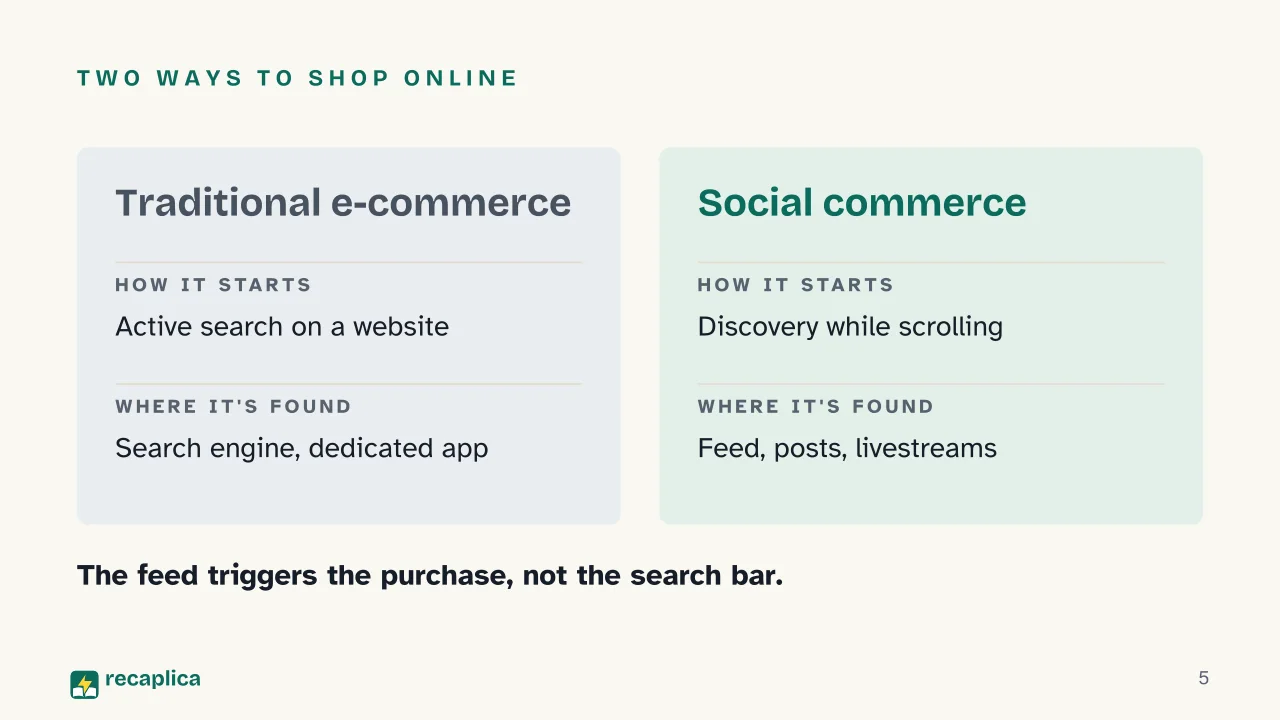
    An ad that links out to a website doesn’t count as social commerce. According to Statista, the term describes the integration of e-commerce and social media: a product tagged in a post, a video, or a livestream, where the purchase starts while someone is scrolling a feed, without ever searching for it on purpose. That’s the split from the older e-commerce model built around sites and search engines, where the shopper already arrives with an intent to buy; here, the product finds the shopper while their mind is on something else entirely.

    Practical example: you’re watching a friend’s Instagram videos, and between two clips a reel shows up with a pair of shoes. You tap the product tag, see the price and sizes without leaving the app, and that’s how the purchase starts, no search, no website typed in by hand, just a feed showing something while you scroll.

    How it works across social commerce platforms

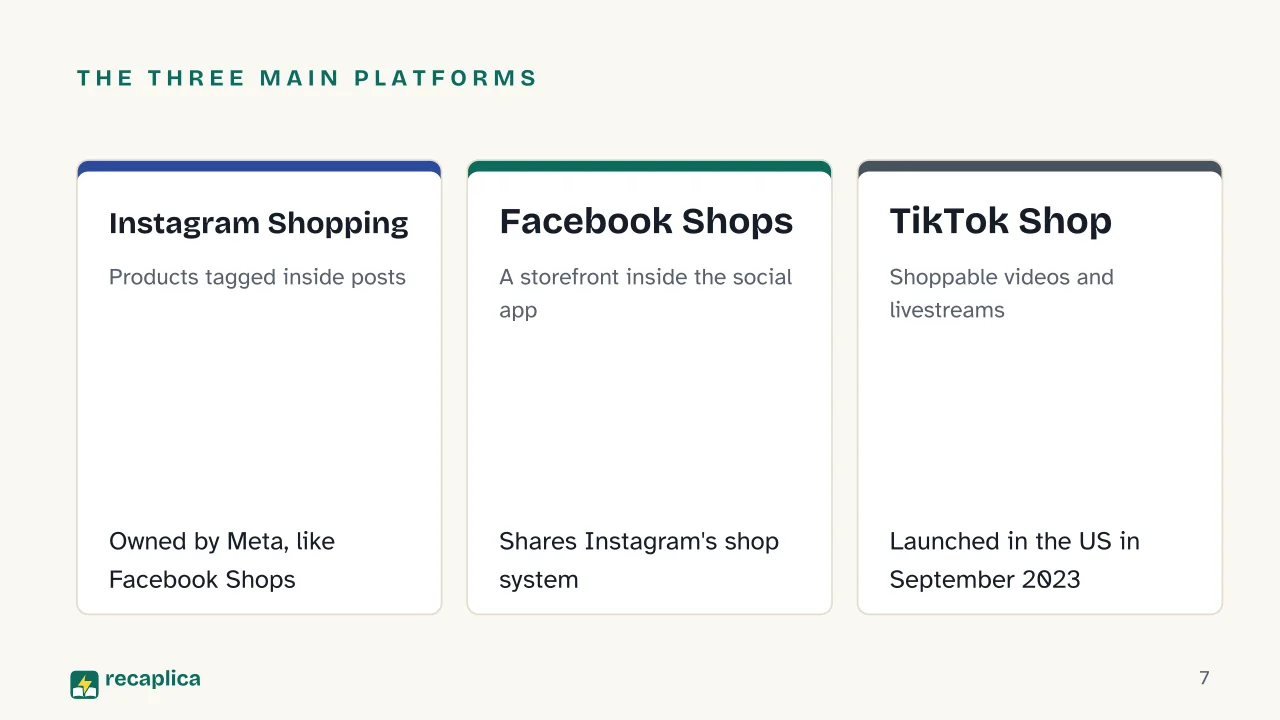
    Instagram Shopping and Facebook Shops, both owned by Meta, run on the same storefront system: brands upload a catalog, products get tagged in posts and stories, and anyone watching can open a product page without switching apps. TikTok Shop works differently. According to TikTok Newsroom’s own announcement, the platform brings «shoppable videos and LIVE streams directly to For You feeds across the country», letting sellers tag products inside videos and livestreams or let shoppers browse a favorite brand’s storefront directly. TikTok Shop launched in the United States in September 2023, years after Instagram and Facebook already had their shopping features running.

    All three platforms also share something on the creator side: TikTok built a commission-based affiliate program that connects sellers and creators inside the app, a different mechanism but a relative of the one that keeps virtual influencers in business, where an AI-made character does the promoting inside the feed instead of a human creator.

    The 2025 shift: where the payment really lands

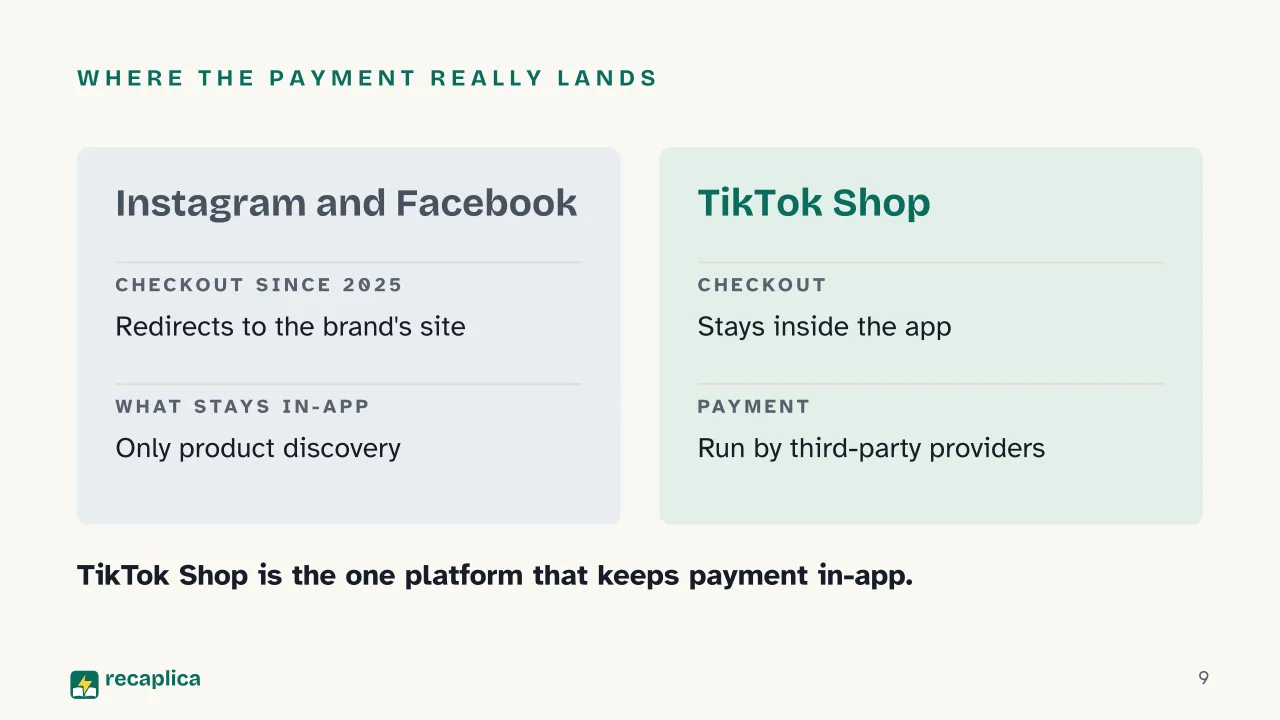
    According to Meta’s own communication, picked up by trade press, customers have stopped completing purchases directly inside Facebook or Instagram since 2025: at checkout, they’re redirected to the merchant’s website to finish the transaction. The change was announced in June 2025, and most shops finished the transition by August 2025; the exception is shops connected to third-party order management systems, such as Magento and Adobe Commerce Cloud, which were updated later. Meta frames the move as giving merchants more control over the checkout experience, payment processing, and the customer relationship after the sale. An independent industry source also describes the workaround many brands have used since 2025 in place of native Instagram checkout: someone watching a livestream comments a keyword, an automation sends them the product link by direct message, and the purchase finishes outside the app, on the seller’s own site.

    TikTok Shop runs on the opposite logic. According to TikTok Newsroom, the platform works with trusted third-party payment providers to keep checkout «quick, smooth, and secure» without ever leaving the app: the product gets discovered inside a video or livestream and paid for in the same place. That’s the difference that matters most between the two platform families. Discovery, by contrast, stays the same everywhere, inside the feed.

    Instagram and Facebook (since 2025)TikTok Shop
    Product discoveryIn the feed, via product tagsIn the feed, via videos and livestreams
    CheckoutRedirects to the brand’s siteStays inside the app
    PaymentHandled by the merchant’s siteThird-party payment providers, built in

    How big is social commerce

    The numbers describe a market that’s already large. Statista estimates that in 2026 social commerce is worth about $586 billion worldwide, 15% of all e-commerce globally: a sizable share, but still a minority next to the rest of online retail, where broader supply-and-demand dynamics studied by economists also come into play. In the United States, eMarketer projects the market will pass $100 billion for the first time in 2026, up 18% from 2025 (about $87 billion) and heading toward nearly $119 billion in 2027. In that same market, eMarketer figures show TikTok Shop already made up nearly a fifth of US social commerce sales in 2025, with 2026 estimates topping $20 billion and a forecast share of nearly a quarter of the US market by 2027.

    Social commerce’s growth is also large enough to register in a country’s broader retail spending, the kind of figures that eventually feed into GDP. One slice of the market is growing faster than the rest: US livestream ecommerce sales rose nearly 50% in 2025, reaching $14.64 billion, according to a trade source that tracks live shopping specifically. That’s still a smaller piece of social commerce overall, but at a pace that outruns the market as a whole.

    Risks and the rules coming for social commerce

    Social commerce’s growth hasn’t gone unnoticed by regulators. The European Commission, in its 2025-2030 Consumer Agenda adopted on November 19, 2025, lists «manipulative interfaces, addictive design, unfair personalisation and influencer marketing» among the practices that need a dedicated tool: the Digital Fairness Act, backed up by enforcement under the Digital Services Act against online fraud and misleading commercial tactics. The document doesn’t single out social commerce as its own category, but scrollable feeds and livestreams that push impulse buying fit squarely into that kind of interface.

    Slide deck

    Slides ready to download and make your own in PowerPoint or Google Slides, with speaker notes. Pick the Flash cut or the Full one.
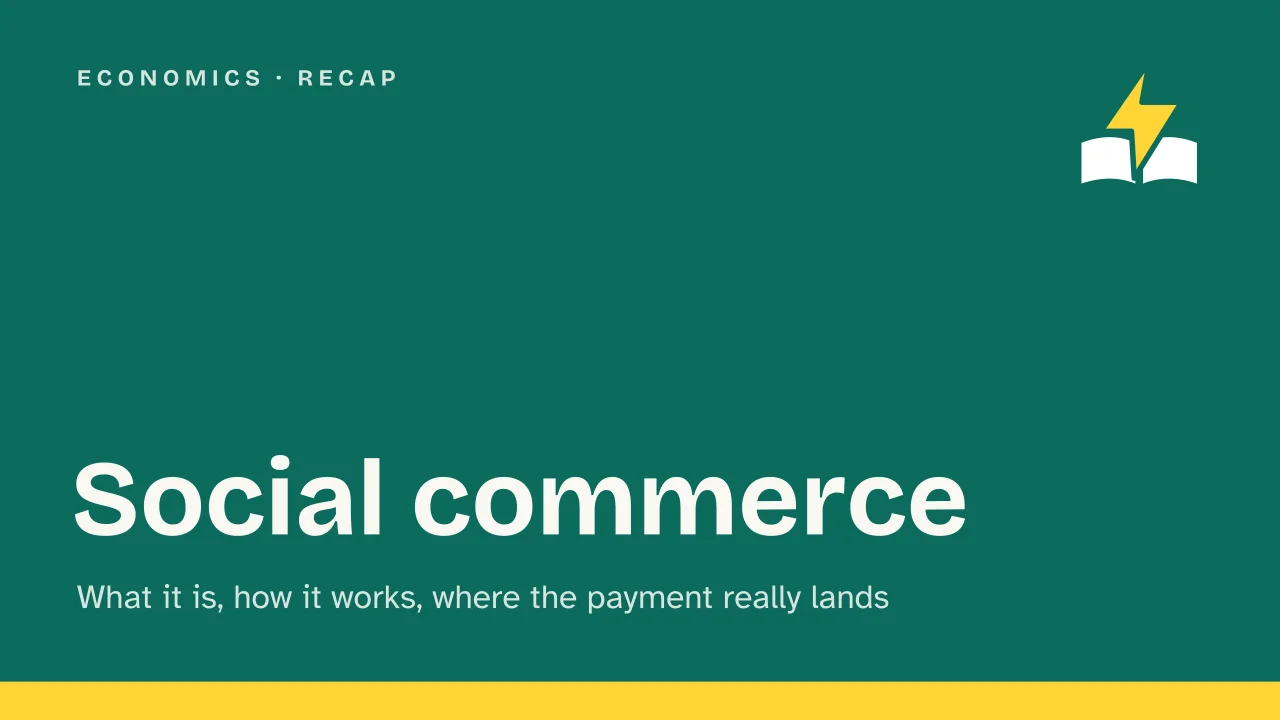
    Slide 1 of the presentation on What Is Social Commerce? How It Works and Examples: Social commerceSlide 2 of the presentation on What Is Social Commerce? How It Works and Examples: Does buying on Instagram mean you never leave the app?Slide 3 of the presentation on What Is Social Commerce? How It Works and Examples: What we'll coverSlide 4 of the presentation on What Is Social Commerce? How It Works and Examples: Chapter 01: What social commerce isSlide 5 of the presentation on What Is Social Commerce? How It Works and Examples: Two ways to shop onlineSlide 6 of the presentation on What Is Social Commerce? How It Works and Examples: Chapter 02: The platforms that offer itSlide 7 of the presentation on What Is Social Commerce? How It Works and Examples: The three main platforms: Instagram Shopping, Facebook Shops, TikTok ShopSlide 8 of the presentation on What Is Social Commerce? How It Works and Examples: Chapter 03: The 2025 shift on paymentSlide 9 of the presentation on What Is Social Commerce? How It Works and Examples: Where the payment really landsSlide 10 of the presentation on What Is Social Commerce? How It Works and Examples: Why does Meta send payment outside the app?Slide 11 of the presentation on What Is Social Commerce? How It Works and Examples: Chapter 04: How big it is, and the risksSlide 12 of the presentation on What Is Social Commerce? How It Works and Examples: The market in 2026Slide 13 of the presentation on What Is Social Commerce? How It Works and Examples: Shopping on social media doesn't always mean staying in the app.Slide 14 of the presentation on What Is Social Commerce? How It Works and Examples: True or false: since 2025, you can still buy on Instagram without leaving the app.Slide 15 of the presentation on What Is Social Commerce? How It Works and Examples: Now, the recap
    Flash10 slidesThe essential thread, to present in classFull15 slidesEvery chapter and the deeper detail

    Common myths

    • ✗ Myth Social commerce means you never leave the app to buy anything, on any platform.

      ✓ Reality Not anymore, everywhere: since 2025 Meta has phased out native checkout on most Facebook and Instagram Shops, and payment now finishes on the merchant's website. TikTok Shop, on the other hand, still keeps checkout inside the app. Product discovery stays in the feed either way; payment doesn't.

    • ✗ Myth Social commerce is something TikTok invented.

      ✓ Reality Instagram and Facebook already had shopping features running before TikTok entered the space: TikTok Shop only launched in the United States in September 2023, by which point Meta's storefronts had existed for years. TikTok added a newer piece to the picture, not the concept itself.

    • ✗ Myth Live shopping is a minor sideshow next to the rest of social commerce.

      ✓ Reality The numbers tell a different story: US livestream ecommerce sales grew nearly 50% in 2025, reaching $14.64 billion. That's still a smaller slice of the wider market, but one growing faster than social commerce as a whole.

    Mind map

    Drag the background to move around and the nodes to reposition them; use − and + to collapse and expand branches.
    Customize
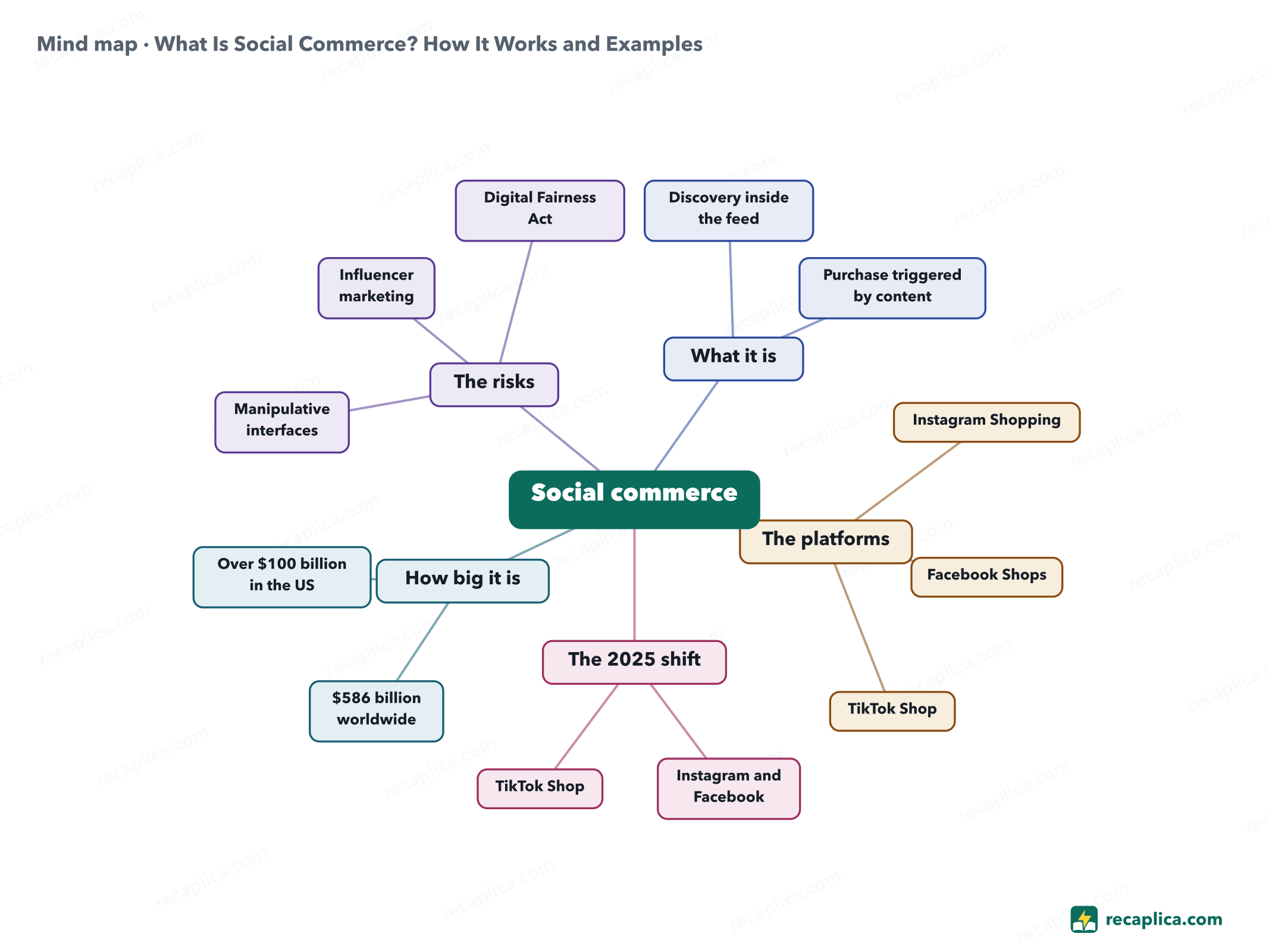
    Mind map: What Is Social Commerce? How It Works and Examples
    • Social commerce
      • What it is
        • Discovery inside the feed The product shows up while scrolling, nobody searches for it
        • Purchase triggered by content A post, video, or livestream with a tagged product
      • The platforms
        • Instagram Shopping
        • Facebook Shops
        • TikTok Shop Launched in the United States in September 2023
      • The 2025 shift
        • Instagram and Facebook Checkout redirects to the brand's website
        • TikTok Shop Checkout stays inside the app
      • How big it is
        • $586 billion worldwide In 2026, 15% of total e-commerce, Statista
        • Over $100 billion in the US In 2026, up 18% from 2025, eMarketer
      • The risks
        • Manipulative interfaces Flagged by the European Commission
        • Influencer marketing
        • Digital Fairness Act The regulatory tool coming since 2025

    Quiz: test yourself

    Answer the questions to check what you have learned: you get instant feedback and a short explanation.

    Grade 0/10 0/5
    1 What sets social commerce apart from traditional e-commerce?

    In traditional e-commerce, the shopper actively looks for a product on a site or search engine. In social commerce, the product shows up while someone scrolls a feed, tagged in a post, a video, or a livestream, and that chance encounter is what starts the purchase.

    2 True or false: on Instagram and Facebook, since 2025, you can still finish a purchase without ever leaving the app.

    False. According to Meta's own communication, native checkout on Facebook and Instagram Shops has been phased out for most markets since 2025: buyers are sent to the merchant's website to complete the transaction.

    3 What happens instead on TikTok Shop?

    TikTok, according to its own launch announcement, built Shop to keep the entire journey inside the app, from tagged videos and livestreams to a checkout handled by third-party payment partners without ever leaving TikTok.

    4 How large does Statista estimate social commerce to be worldwide in 2026?

    Statista puts global social commerce at roughly $586 billion in 2026, equal to 15% of all e-commerce worldwide: a sizable slice, but still a minority of online sales overall.

    5 Why is the European Commission paying attention to social commerce interfaces?

    The European Commission's 2025-2030 Consumer Agenda names manipulative interfaces, addictive design, and influencer marketing among the practices its new Digital Fairness Act is meant to tackle.

    Answers: 1-A · 2-B · 3-A · 4-A · 5-A

    Flashcards

    Tap the card to flip it and check whether you remember the answer, then move to the next one.

    1 / 8

    Explain it in your own words

    The ultimate test: if you can explain it in simple words, you've truly understood it. Write your explanation, then compare it with the Recap.

    Your explanation is saved only on this device.

    Social commerce is selling that starts inside a social network: not an ad that sends people to a website, but a product tagged in a post, a livestream, or a video, where discovery and purchase happen without ever opening a search engine. Instagram, Facebook, and TikTok all offer it, but they part ways on the detail that matters most, where the payment actually happens: since 2025, Instagram and Facebook send buyers to a merchant's own website to finish checkout, while TikTok Shop keeps the whole purchase inside the app. Statista puts the market at roughly $586 billion worldwide in 2026, about 15% of all e-commerce.

    Frequently asked questions

    What is social commerce?

    It's selling that starts inside a social network: a product tagged in a post, a video, or a livestream lets someone discover it and start buying without leaving the feed they're scrolling, at least until the payment step.

    Which platforms offer social commerce?

    The three most cited are Instagram Shopping, Facebook Shops, and TikTok Shop. Instagram and Facebook belong to Meta and share the same shop system; TikTok Shop, which launched in the United States in September 2023, runs its own logistics and payment setup.

    Can you still buy something without ever leaving Instagram or Facebook?

    Discovering the product, yes, that still happens in the app. Paying for it, no: since 2025 Meta redirects buyers to the merchant's website to complete most purchases, except for shops connected to third-party order management systems such as Magento or Adobe Commerce Cloud, which were updated later.

    How does social commerce differ from traditional e-commerce?

    In traditional e-commerce, a customer arrives on a site or dedicated app already looking for a product. In social commerce, the product turns up by chance while someone scrolls a feed or watches a livestream, and that discovery is what starts the purchase.

    How big is the social commerce market worldwide?

    Statista estimates it at about $586 billion in 2026, 15% of all e-commerce globally. In the United States, eMarketer projects the market will pass $100 billion for the first time in 2026, up 18% from 2025.

    Sources

    • Statista — Social commerce, statistics & facts
    • eMarketer, via Yahoo Finance — TikTok Shop Driving Social Commerce
    • TikTok Newsroom — Introducing TikTok Shop
    • ppc.land — Meta Phases Out Facebook and Instagram Shops Checkout by August 2025
    • ecommerce-europe.eu — European Commission adopts 2025-2030 Consumer Agenda

    Every Recap goes through an independent review before publication.

    Every evening, the day's new Recaps on our Telegram channel. Join the channel →

    Keep learning

    • Economics Labor Market: How Supply, Demand and Unemployment Work The labor market is where businesses that need workers to produce goods and services meet the people willing to work for them. In the textbook model, that meeting sets wages and employment levels the way any other market would, but imperfect information, bargaining power and legal rules push the real market away from pure competition. Those gaps are where unemployment comes from, and economists split it into frictional, structural, cyclical and technological types depending on the cause. Official statistics, such as Italy's ISTAT, measure it against the labor force — people employed plus people actively looking for work — not the whole population. As of July 2026, Italy's unemployment rate stood at 5.8%, provisional, against 6.4% for the euro area. Read the Recap →
    • Economics Mercantilism: History, Examples, and Definition Mercantilism was the dominant economic doctrine in Western Europe from the 16th to the 18th century: a state grew powerful by selling more abroad than it bought, building up reserves of gold and silver. Britannica Money describes it as "an economic practice by which governments used their economies to augment state power at the expense of other countries." Colonies had one job under this system: supply raw materials to the mother country and buy finished goods back from it, while at home tariffs and monopolies shielded domestic industry. The name itself came later, from the doctrine's most famous critic: Adam Smith made it current in The Wealth of Nations, published in 1776. Read the Recap →
    • Economics Keynesianism explained: the theory born from the Great Depression Keynesianism is the body of economic thinking named after John Maynard Keynes, the British economist who in the 1930s offered a different way of reading a slump. The IMF notes that when the Great Depression hit, the economic theory of the day could neither explain the collapse nor say how to restart production and employment. Keynes put aggregate demand at the centre — the total spending of households, businesses and government — and argued that full employment is a special case rather than something markets deliver on their own. That is where the idea comes from that public spending can step in when private demand stalls. Keynesianism guided economic policy from the end of the Second World War until the 1970s, then lost ground. Read the Recap →

    recaplica

    Clear in 30 seconds, yours in 10 minutes.

    Recaps Mind maps Request a Recap Telegram channel Mind map maker Our method About Privacy & cookies Legal notes & terms of use

    © 2026 Recaplica · A project by Curi S.r.l. — VAT IT05472000750

    Statistics, only if you say so

    To learn which Recaps help most we would use Google Analytics, with aggregate, anonymous data. It starts only with your OK, and you can change your mind anytime. Privacy policy