Skip to content
recaplica

    One moment: security check

    Cloudflare wants to make sure you're not a robot. Tick the box below and your search will continue on its own.

    IT
    recaplica Quiet Quitting: What It Is and Where the Term Comes From
    © 2026 Recaplica · recaplica.com — All rights reserved
    Home › Economics

    Quiet Quitting: What It Is and Where the Term Comes From

    By Recaplica Newsroom · Updated on September 20, 2026

    What to print

    Page numbers appear when printing with default margins.

    Slides

    Choose a cut

    Flash10 slidesThe essential thread, to present in classFull15 slidesEvery chapter and the deeper detail

    Both come with speaker notes.

    Telegram channel
    recaplica Clear in 30 seconds, yours in 10 minutes.
    In 30 seconds Key points Figures Deep dive Slides Myths Mind map Quiz Flashcards FAQ

    In 30 seconds quick read

    Quiet quitting means doing exactly what a job description asks for, and nothing beyond it: no unpaid extra hours, no volunteering for tasks nobody assigned. The phrase went viral after a 17-second TikTok video posted by Zaid Khan in July 2022, but Gallup also uses it as a technical label for a measurement category it tracks every year. In 2022 Gallup put 59% of workers worldwide in that category, against 23% classified as "engaged" and 18% openly disengaged. Academic research frames it as a deliberate choice about where to draw a line, not as burnout or laziness.

    Key Points

    • Quiet quitting is not walking off the job: it's sticking to the tasks a role actually requires, without going further.
    • The term took off after Zaid Khan posted a 17-second TikTok video in July 2022.
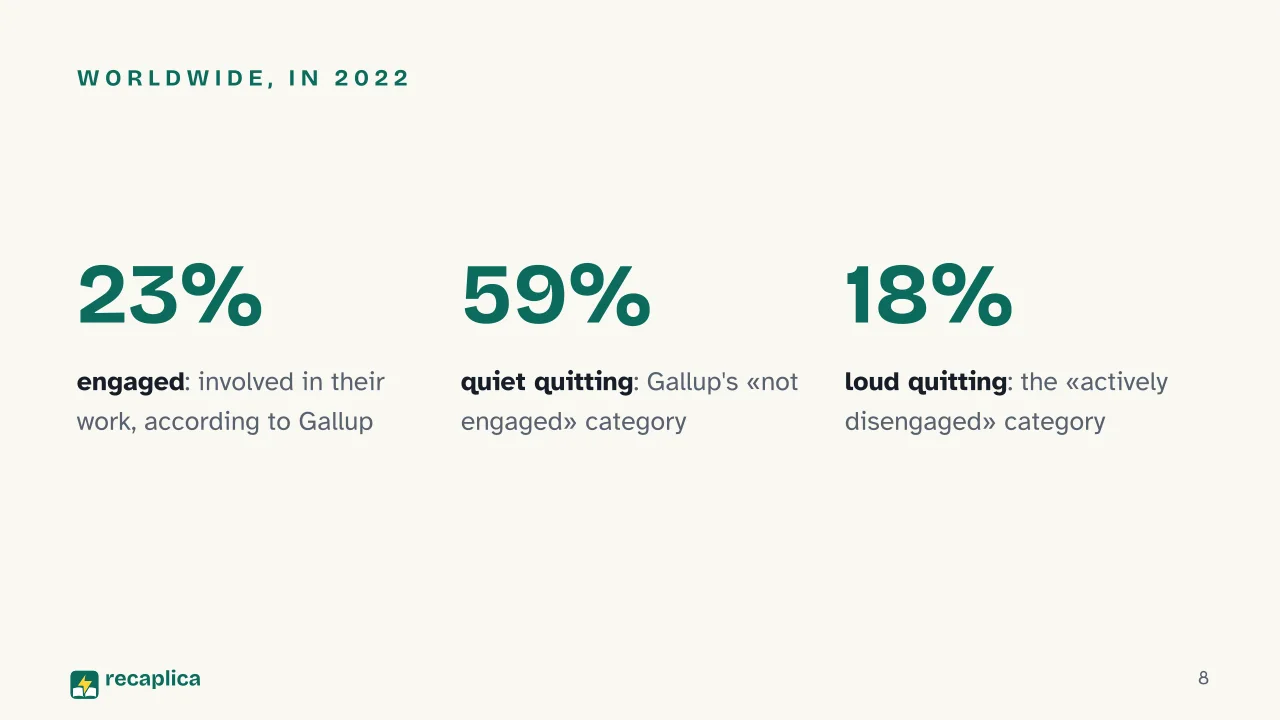
    • Gallup also uses it as a measurement category: in 2022, 59% of workers worldwide were «not engaged», and 18% fell into «loud quitting».
    • Academic research describes it as an intentional, self-regulated act of boundary-setting, separate from involuntary withdrawal.
    • Engagement in Europe and Italy stayed low in 2025, but the published figures don't allow a quiet-quitting percentage to be calculated by subtraction.

    Key figures

    • 59% of workers worldwide were classified as «not engaged» in 2022, the category Gallup treats as equivalent to quiet quitting Source: Gallup, State of the Global Workplace 2023
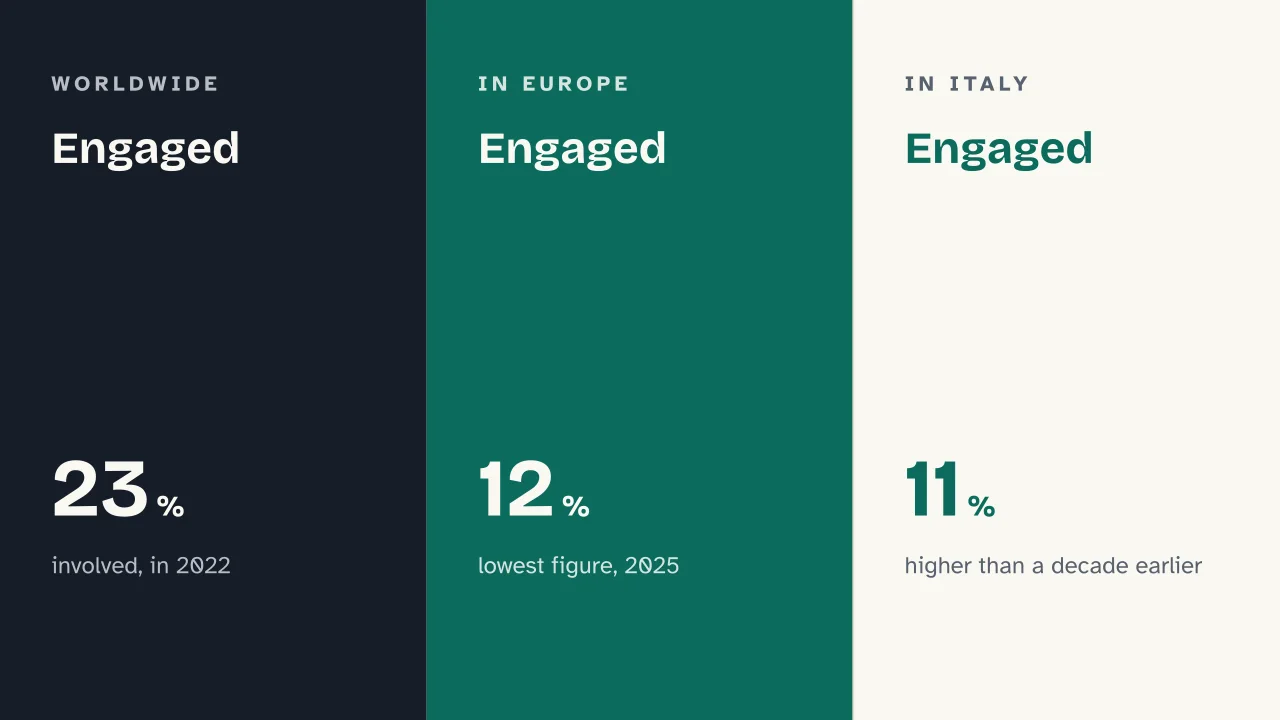
    • 12% of European workers were «engaged» in 2025, the lowest share of any world region for the sixth year running Source: Gallup, State of the Global Workplace, 2026 report
    • 11% of Italian workers were «engaged» in 2025, the highest level in a decade but still low by regional and global standards — not a quiet-quitting figure Source: Gallup, State of the Global Workplace, 2026 report

    Deep Dive

    What it means in practice

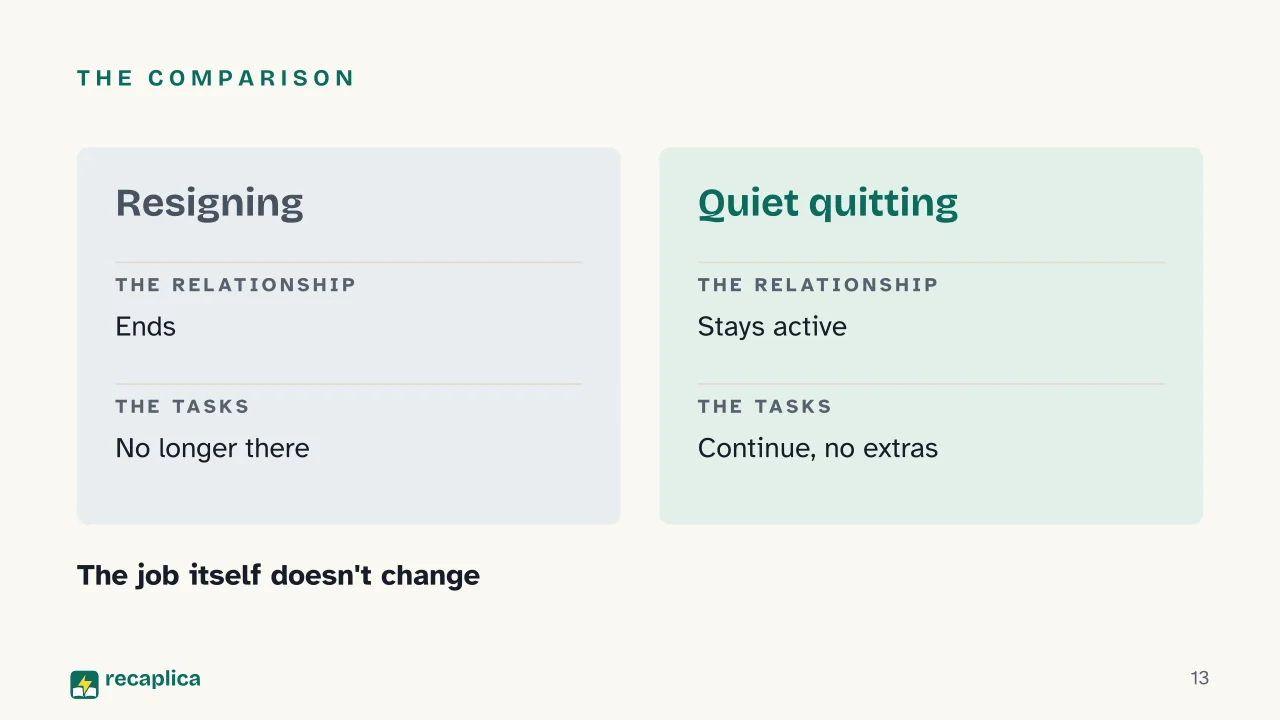
    Quiet quitting is doing exactly what a role requires, and nothing more: keeping to your hours, finishing assigned tasks, and not volunteering for unpaid overtime or requests that fall outside the job description. It isn’t a change of contract or a public announcement — it’s a way of staying inside the job you already have.

    Real-world example: instead of answering work emails at night or applying for every unpaid extra project, someone shuts their laptop at the scheduled time and limits their contribution to what the job description actually says. The work gets done, but nothing beyond it.

    Where the term came from

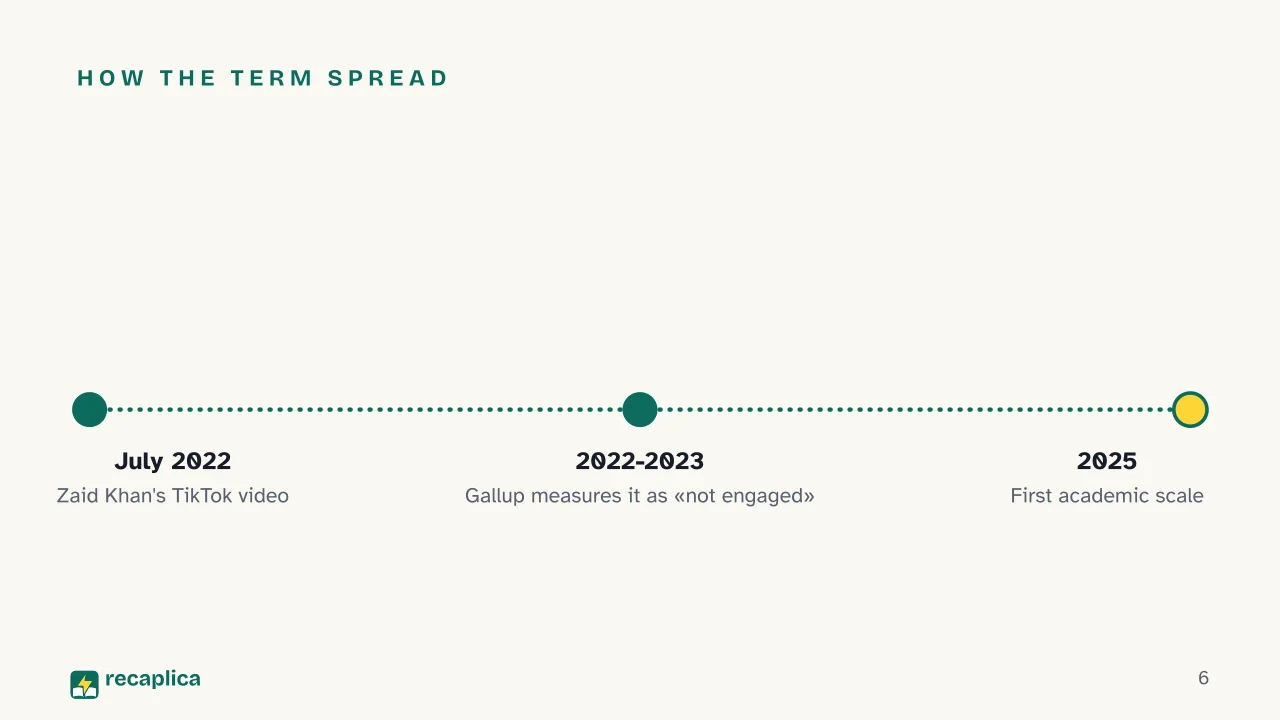
    The phrase went viral in July 2022, when Zaid Khan posted a 17-second TikTok video describing the idea of “quitting the idea of going above and beyond.” In his own words, the concept has nothing to do with leaving a job: “You’re still performing your duties, but you’re no longer subscribing to the hustle-culture mentality that work has to be your life. The reality is it’s not. And your worth as a person is not defined by your labor.”

    How Gallup measures it

    Gallup, the research firm behind the annual State of the Global Workplace report, also uses “quiet quitting” as a technical stand-in for a category it has tracked for years under the name “not engaged”: workers who carry out their duties without active involvement. In 2022 that category covered 59% of workers worldwide. Alongside it, Gallup counted 23% of workers as “engaged” and 18% in “loud quitting,” the category for open, active disengagement. Gallup’s global engagement tracking began in 2009, when the engaged share stood at 12%: the 23% recorded in 2022 marks an 11-point gain over thirteen years, with a temporary dip in 2020.

    In Gallup’s usage, “quiet quitting” is a label applied after the fact to a measurement category, not a name workers give to their own choice. It’s a technical use of the term, distinct from the colloquial one born on TikTok, even though it points at the same underlying behavior — doing the minimum required, with no extra emotional investment.

    What academic research says

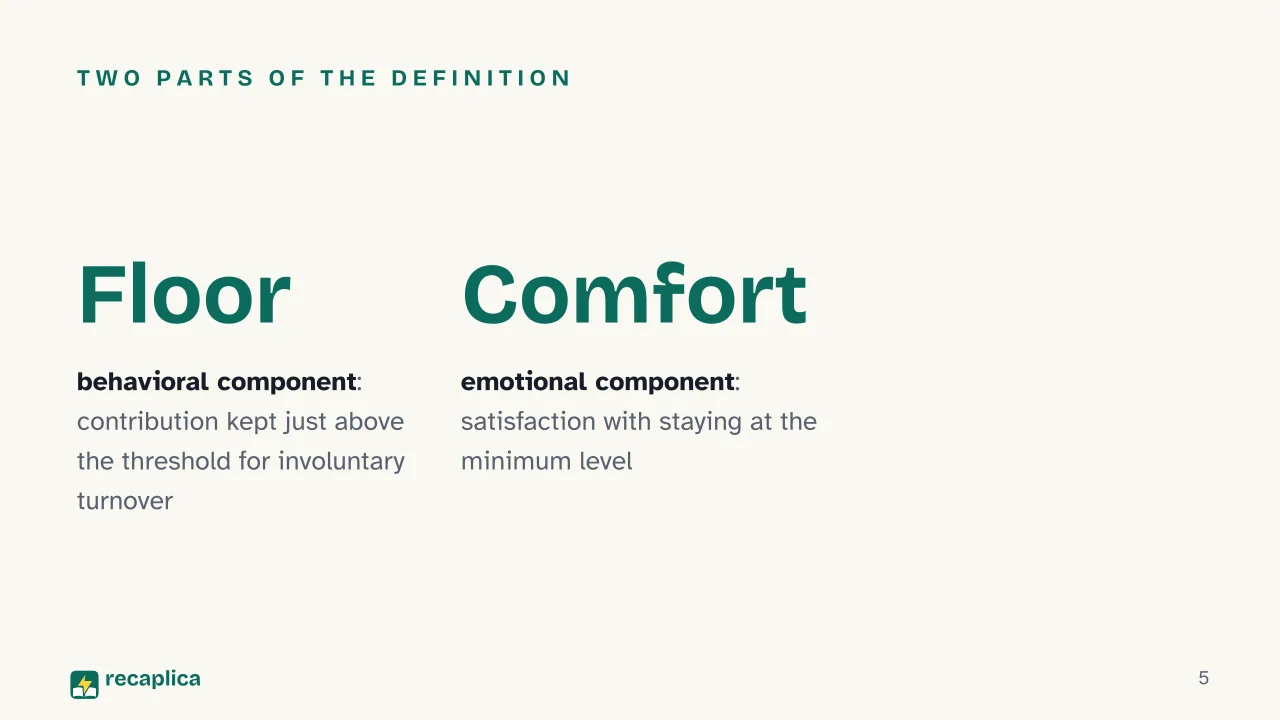
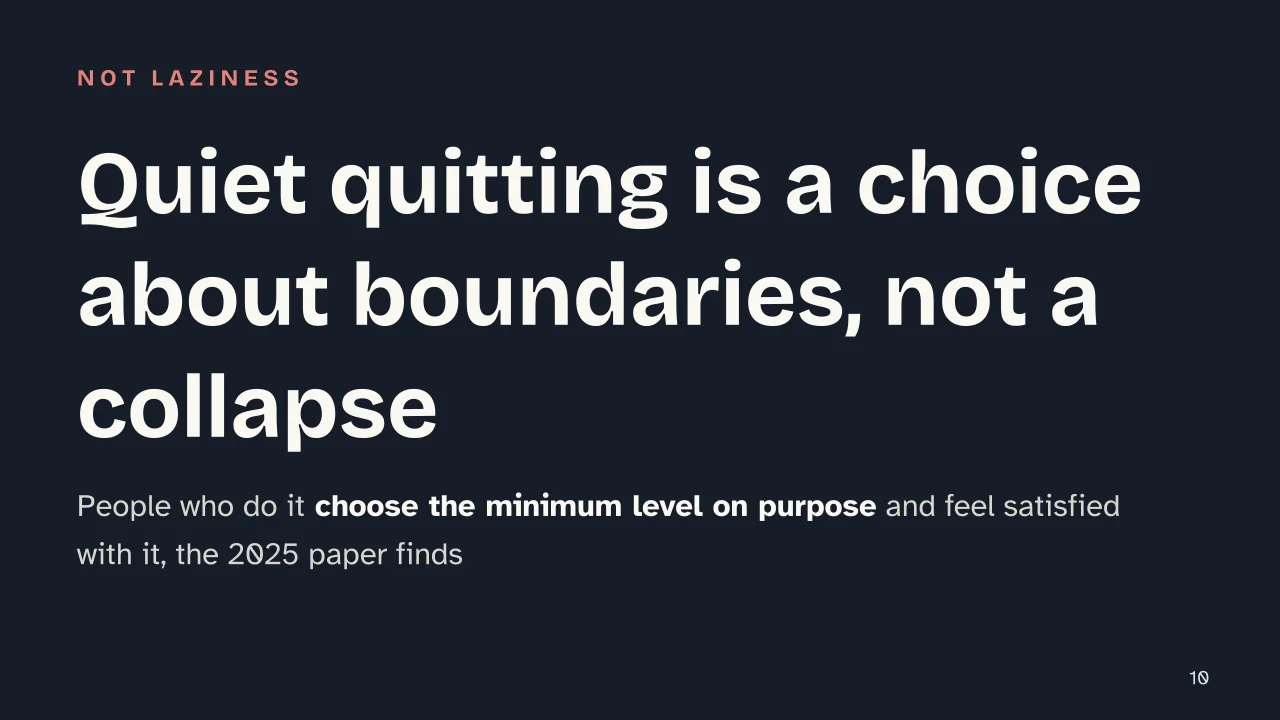
    A paper published in PLoS One in 2025 offers a more precise definition, useful for separating quiet quitting both from plain “slacking off” and from the total disengagement Gallup calls loud quitting. The authors describe it as “the execution of work-related tasks at a minimum level of compliance, coupled with feelings of comfort — even a principled right — to engage at work with this minimal level of contribution.” Their model has two dimensions: a behavioral component, the actual contribution kept just above the threshold that would trigger dismissal; and an emotional component, the satisfaction felt at staying at that level, paired with a negative reaction to doing more.

    The academic definition treats quiet quitting as an intentional, self-regulated behavior — a choice about where to draw a line — not an involuntary withdrawal caused by low motivation or inability.

    Europe and Italy, with a caveat

    In Gallup’s most recent report (State of the Global Workplace, published in April 2026 on 2025 data), Europe comes out as the least engaged world region for the sixth year running: only 12% of European workers were classified as “engaged,” one point down from the year before. For Italy, the same report puts engagement at 11% in 2025, the highest level in a decade but still low by regional and global standards. The same report shows global engagement also slipping, to 20% in 2025 — its lowest level since 2020 — with 64% of workers in the “not engaged” category (the same one the 2023 report labeled “quiet quitting”) and 16% “actively disengaged”: a decline from the 23%/59%/18% split in 2022 cited above.

    Italy’s 11% only measures the “engaged” share: it isn’t the complement of a quiet-quitting figure, because Gallup distinguishes three categories — engaged, not engaged and actively disengaged — and the Italy release reports only the first. Claiming “89% of Italians are quiet quitting” by subtracting 11% from 100% would collapse two different categories (not engaged and actively disengaged) into one — an error the available data can’t correct, since the full breakdown for Italy hasn’t been published.

    A single worker’s decision to limit their effort is a matter between them and their employer. The aggregate trend in engagement across an entire country belongs instead to macroeconomics, the branch that looks at economic phenomena at national scale. Gallup’s 2023 report estimated that disengaged workers worldwide represent an $8.8 trillion untapped productivity opportunity in 2022, a figure of the same order of magnitude as the GDP of major economies.

    Slide deck

    Slides ready to download and make your own in PowerPoint or Google Slides, with speaker notes. Pick the Flash cut or the Full one.
    Slide 1 of the presentation on Quiet Quitting: Quiet QuittingSlide 2 of the presentation on Quiet Quitting: Is someone who does exactly their job on strike?Slide 3 of the presentation on Quiet Quitting: In this RecapSlide 4 of the presentation on Quiet Quitting: Chapter 01: What quiet quitting isSlide 5 of the presentation on Quiet Quitting: Two parts of the definitionSlide 6 of the presentation on Quiet Quitting: How the term spreadSlide 7 of the presentation on Quiet Quitting: Chapter 02: What Gallup measuresSlide 8 of the presentation on Quiet Quitting: Worldwide, in 2022Slide 9 of the presentation on Quiet Quitting: Chapter 03: What academic research saysSlide 10 of the presentation on Quiet Quitting: Quiet quitting is a choice about boundaries, not a collapseSlide 11 of the presentation on Quiet Quitting: Chapter 04: Europe and ItalySlide 12 of the presentation on Quiet Quitting: Engaged · Engaged · EngagedSlide 13 of the presentation on Quiet Quitting: The comparisonSlide 14 of the presentation on Quiet Quitting: What share of workers worldwide were «not engaged» in 2022?Slide 15 of the presentation on Quiet Quitting: The Recap continues
    Flash10 slidesThe essential thread, to present in classFull15 slidesEvery chapter and the deeper detail

    Common myths

    • ✗ Myth Quiet quitting is laziness, doing as little as possible because you don't feel like working.

      ✓ Reality Academic research treats it as an intentional, self-regulated act of setting boundaries, not an involuntary withdrawal: people who practice it choose the minimum level deliberately and feel comfortable with it, rather than being pushed into it by low motivation.

    • ✗ Myth Quiet quitting means resigning quietly, leaving a job without telling anyone.

      ✓ Reality Zaid Khan, whose video popularized the term, described the opposite: you keep doing your job, you just stop buying into the idea that work has to take over your whole life.

    • ✗ Myth In Italy, quiet quitting affects 89% of workers, calculated as the gap left by the 11% who are «engaged».

      ✓ Reality Gallup measures three separate categories — engaged, not engaged and actively disengaged — and the Italy release only reports the first one; without the full three-way breakdown, subtracting engaged from 100% doesn't produce a valid quiet-quitting figure.

    Mind map

    Drag the background to move around and the nodes to reposition them; use − and + to collapse and expand branches.
    Customize
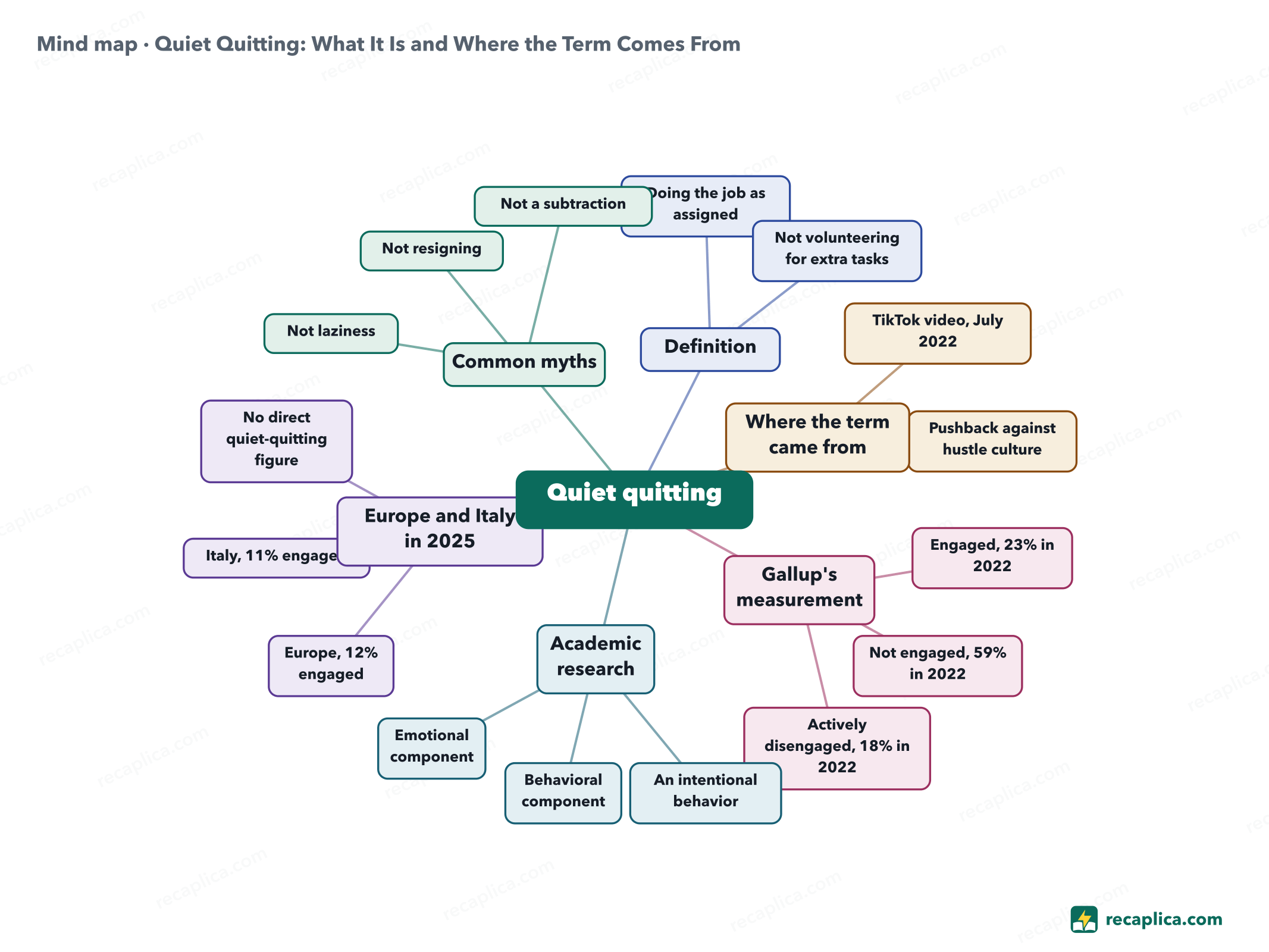
    Mind map: Quiet Quitting: What It Is and Where the Term Comes From
    • Quiet quitting
      • Definition
        • Doing the job as assigned
        • Not volunteering for extra tasks
      • Where the term came from
        • TikTok video, July 2022 Zaid Khan, 17 seconds
        • Pushback against hustle culture
      • Gallup's measurement
        • Engaged, 23% in 2022
        • Not engaged, 59% in 2022
        • Actively disengaged, 18% in 2022
      • Academic research
        • An intentional behavior
        • Behavioral component contribution kept just above the threshold for involuntary turnover
        • Emotional component comfort with the minimum level
      • Europe and Italy in 2025
        • Europe, 12% engaged
        • Italy, 11% engaged
        • No direct quiet-quitting figure
      • Common myths
        • Not laziness
        • Not resigning
        • Not a subtraction

    Quiz: test yourself

    Answer the questions to check what you have learned: you get instant feedback and a short explanation.

    Grade 0/10 0/5
    1 What does quiet quitting refer to, strictly speaking?

    The term describes sticking closely to the tasks a job requires, not abandoning it or negotiating a contract.

    2 Who popularized the term with a video on social media?

    Zaid Khan's 17-second TikTok video, posted in July 2022, is where the term's popularity began.

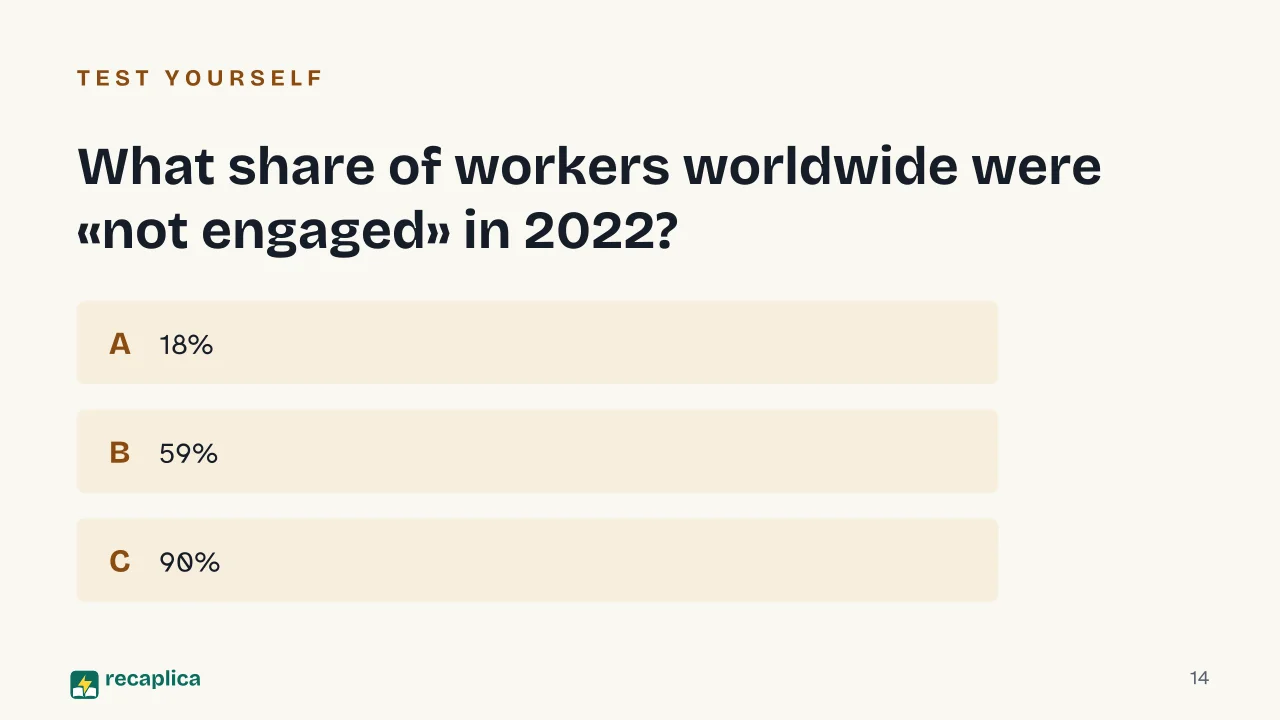
    3 According to Gallup, what share of workers worldwide were «not engaged» in 2022?

    Gallup classified 59% of workers worldwide as «not engaged» in 2022, against 23% «engaged» and 18% in «loud quitting».

    4 True or false: academic research describes quiet quitting as involuntary, caused by low motivation.

    The literature defines it as intentional and self-regulated, with people reporting comfort and satisfaction at the minimum level — the opposite of an involuntary lapse.

    5 Why can't we say that 89% of Italian workers are quiet quitting?

    Engaged, not engaged and actively disengaged are three distinct categories: without all three, there's no way to derive an Italian quiet-quitting figure.

    Answers: 1-B · 2-A · 3-C · 4-B · 5-B

    Flashcards

    Tap the card to flip it and check whether you remember the answer, then move to the next one.

    1 / 8

    Explain it in your own words

    The ultimate test: if you can explain it in simple words, you've truly understood it. Write your explanation, then compare it with the Recap.

    Your explanation is saved only on this device.

    Quiet quitting means doing exactly what a job description asks for, and nothing beyond it: no unpaid extra hours, no volunteering for tasks nobody assigned. The phrase went viral after a 17-second TikTok video posted by Zaid Khan in July 2022, but Gallup also uses it as a technical label for a measurement category it tracks every year. In 2022 Gallup put 59% of workers worldwide in that category, against 23% classified as "engaged" and 18% openly disengaged. Academic research frames it as a deliberate choice about where to draw a line, not as burnout or laziness.

    Frequently asked questions

    What does quiet quitting mean?

    It means doing exactly the tasks a role requires, without volunteering for extra work nobody asked for: not leaving a job, but no longer going beyond what's assigned.

    Since when has the term quiet quitting been used?

    It took off after Zaid Khan posted a TikTok video in July 2022 describing his rejection of hustle culture.

    Is quiet quitting the same as resigning?

    No: someone who quiet quits stays in their role and keeps doing the tasks their contract requires, without leaving the job.

    How many workers quiet quit worldwide?

    According to Gallup, 59% of workers worldwide fell into the «not engaged» category in 2022, the one the institute treats as equivalent to quiet quitting.

    Is there an official quiet-quitting figure for Italy?

    Not directly: Gallup only reports 11% of Italian workers as «engaged» in 2025, a figure that on its own isn't enough to calculate a quiet-quitting share.

    Sources

    • Gallup, Globally, Employees Are More Engaged — and More Stressed (State of the Global Workplace 2023)
    • Gallup / PR Newswire, European Workers Remain the Least Engaged Regional Workforce (State of the Global Workplace 2024)
    • Fortune, Zaid Khan quiet quitting gen Z quits job
    • Patel, Guedes, Bachrach, Cho, A multidimensional quiet quitting scale: Development and test of a measure of quiet quitting, PLoS One
    • Gallup / PR Newswire, Global Employee Engagement Falls as Europe Remains Least Engaged Region for Sixth Consecutive Year (State of the Global Workplace, 2026 report)

    Every Recap goes through an independent review before publication.

    Every evening, the day's new Recaps on our Telegram channel. Join the channel →

    Keep learning

    • Economics Labor Market: How Supply, Demand and Unemployment Work The labor market is where businesses that need workers to produce goods and services meet the people willing to work for them. In the textbook model, that meeting sets wages and employment levels the way any other market would, but imperfect information, bargaining power and legal rules push the real market away from pure competition. Those gaps are where unemployment comes from, and economists split it into frictional, structural, cyclical and technological types depending on the cause. Official statistics, such as Italy's ISTAT, measure it against the labor force — people employed plus people actively looking for work — not the whole population. As of July 2026, Italy's unemployment rate stood at 5.8%, provisional, against 6.4% for the euro area. Read the Recap →
    • Economics Mercantilism: History, Examples, and Definition Mercantilism was the dominant economic doctrine in Western Europe from the 16th to the 18th century: a state grew powerful by selling more abroad than it bought, building up reserves of gold and silver. Britannica Money describes it as "an economic practice by which governments used their economies to augment state power at the expense of other countries." Colonies had one job under this system: supply raw materials to the mother country and buy finished goods back from it, while at home tariffs and monopolies shielded domestic industry. The name itself came later, from the doctrine's most famous critic: Adam Smith made it current in The Wealth of Nations, published in 1776. Read the Recap →
    • Economics Keynesianism explained: the theory born from the Great Depression Keynesianism is the body of economic thinking named after John Maynard Keynes, the British economist who in the 1930s offered a different way of reading a slump. The IMF notes that when the Great Depression hit, the economic theory of the day could neither explain the collapse nor say how to restart production and employment. Keynes put aggregate demand at the centre — the total spending of households, businesses and government — and argued that full employment is a special case rather than something markets deliver on their own. That is where the idea comes from that public spending can step in when private demand stalls. Keynesianism guided economic policy from the end of the Second World War until the 1970s, then lost ground. Read the Recap →

    recaplica

    Clear in 30 seconds, yours in 10 minutes.

    Recaps Mind maps Request a Recap Telegram channel Mind map maker Our method About Privacy & cookies Legal notes & terms of use

    © 2026 Recaplica · A project by Curi S.r.l. — VAT IT05472000750

    Statistics, only if you say so

    To learn which Recaps help most we would use Google Analytics, with aggregate, anonymous data. It starts only with your OK, and you can change your mind anytime. Privacy policy