recaplica
Clear in 30 seconds, yours in 10 minutes.
In 30 seconds quick read
Lewin's change model describes, in three stages, the passage of an organization from a settled way of working to a new one, and how it avoids sliding back into old habits. In the unfreeze stage, the organization recognizes the need for change and prepares the ground; in the change stage, new processes and behaviors are introduced; in the refreeze stage, the new setup is locked in so it does not slip back to where it started. The model grows out of Kurt Lewin's work on group dynamics in the 1940s, but the three-stage version used in change management is largely a later reconstruction. It remains the most cited reference point in organizational change management, criticism included.
Key Points
Lewin's change model breaks organizational change into three stages: unfreeze, change and refreeze.
In the unfreeze stage, the organization communicates why change is needed and prepares people to accept it.
In the change stage, new processes, systems or behaviors are actually introduced.
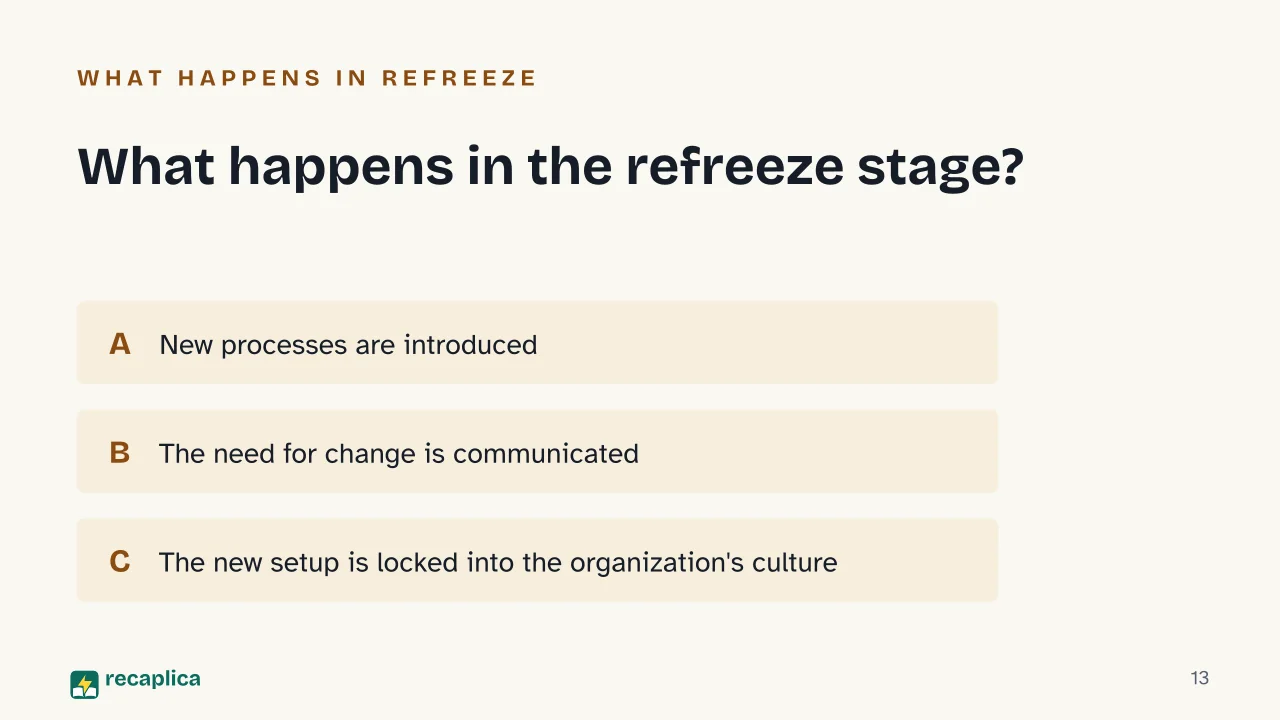
In the refreeze stage, the new behaviors are stabilized so they become the everyday norm.
The word 'refreezing' does not appear in Lewin's own writing: according to a 2016 historical account, it was introduced in 1950 by Leon Festinger and only became a standard part of the field from the 1980s.
The most common criticisms target the model's linearity and its weak fit with radical or continuous change.
Deep Dive
What is Lewin’s change model
Lewin’s change model is a three-stage framework that describes how an
organization moves from an established way of working to a new one:
unfreeze, change, refreeze. Lewin arrives at these ideas as part of
broader research into group dynamics,
the same line of work that produced his concept of psychological field.
The angle here is different: not the psychology of groups, but how that
model gets used to design organizational change management.
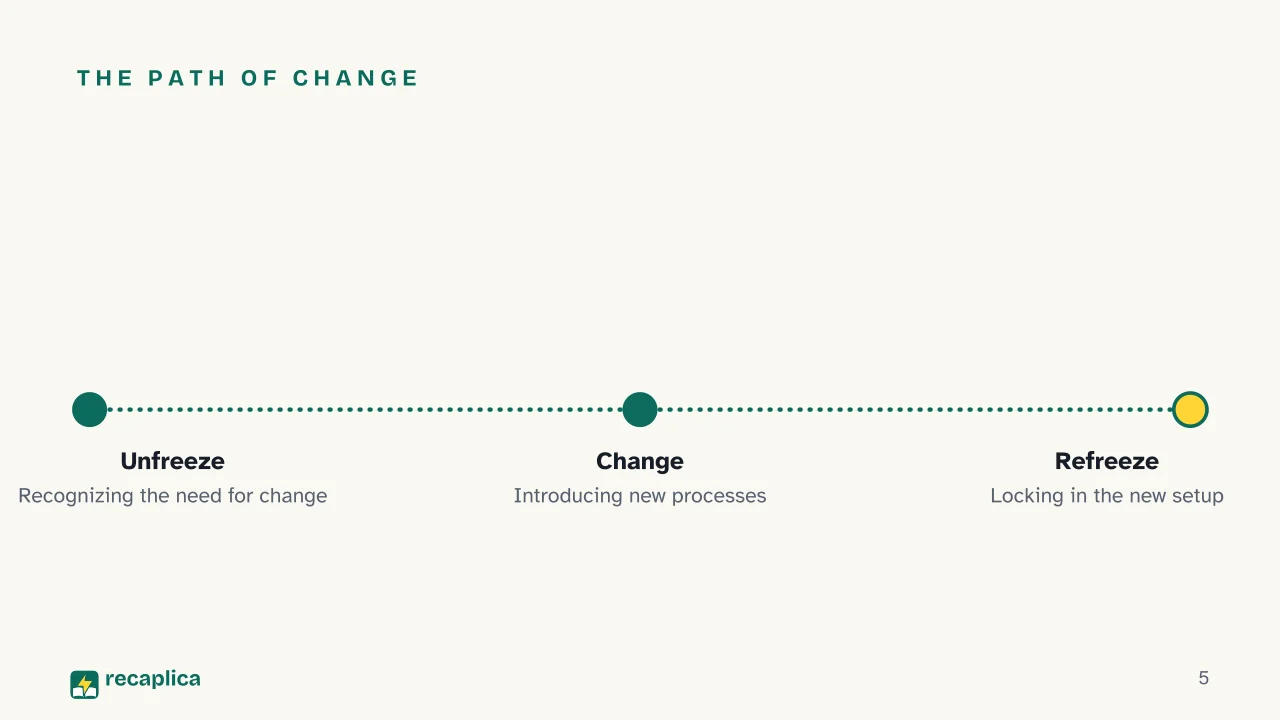
The three stages, one by one
Stage
What happens
Unfreeze
The organization recognizes that change is needed, communicates why, and prepares people to let go of old habits.
Change
New processes, systems or behaviors are introduced; people start working through the uncertainty and looking for new ways to do things.
Refreeze
The new setup gets locked in, so it holds over time.
A widely used explanation in management training, from MindTools,
compares the process to a block of ice: it first has to melt so it can
be reshaped (unfreeze), then be molded into the form that is needed
(change), and finally solidify again (refreeze). It is a useful image
because it makes the trickiest part of the model visible: skip the last
stage, and the new shape risks melting again as soon as the push for
change lets up.
A real case: the Nissan restructuring
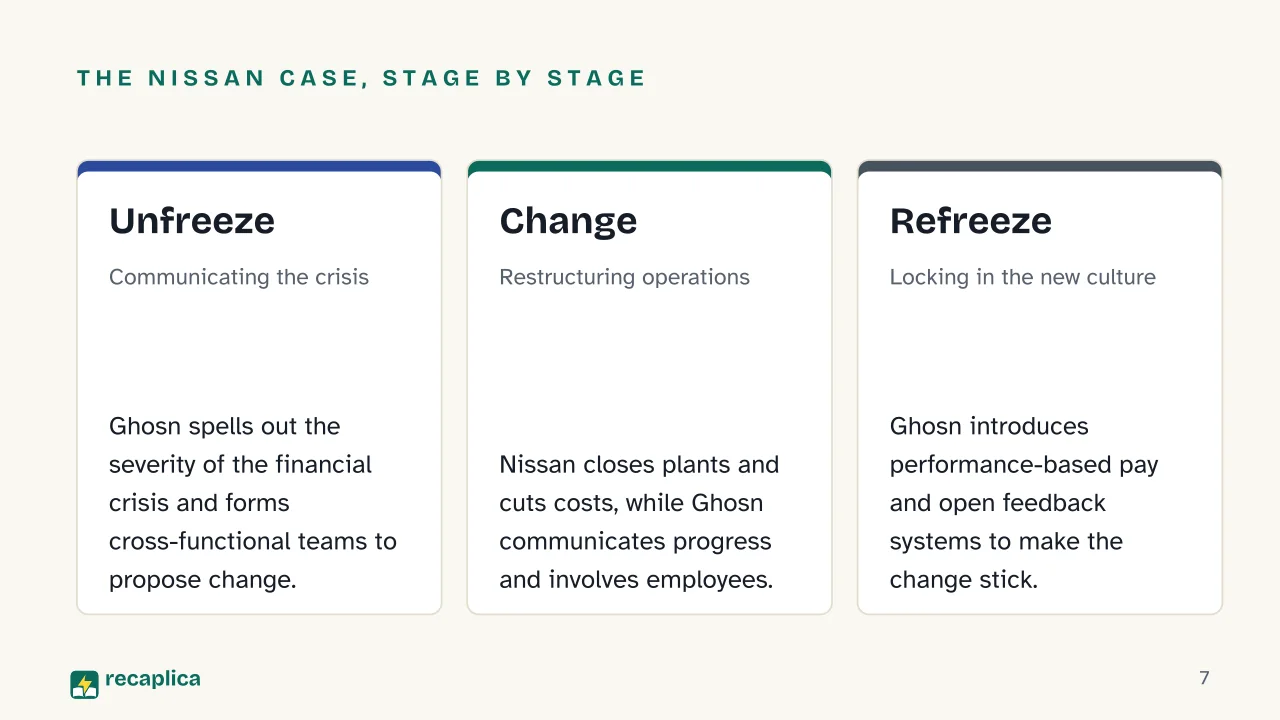
Practical example: during the restructuring of Nissan Motor
Company under Carlos Ghosn, the three stages of the model show up
clearly. In the unfreeze stage, Ghosn tells employees how serious the
company’s financial crisis is and sets up cross-functional teams
tasked with proposing solutions. In the change stage, Nissan
restructures its operations, closes plants and cuts costs, while
leadership communicates progress and involves staff. In the refreeze
stage, Ghosn introduces performance-based pay and open feedback
systems, to make the new culture stick instead of letting it fade
over time.
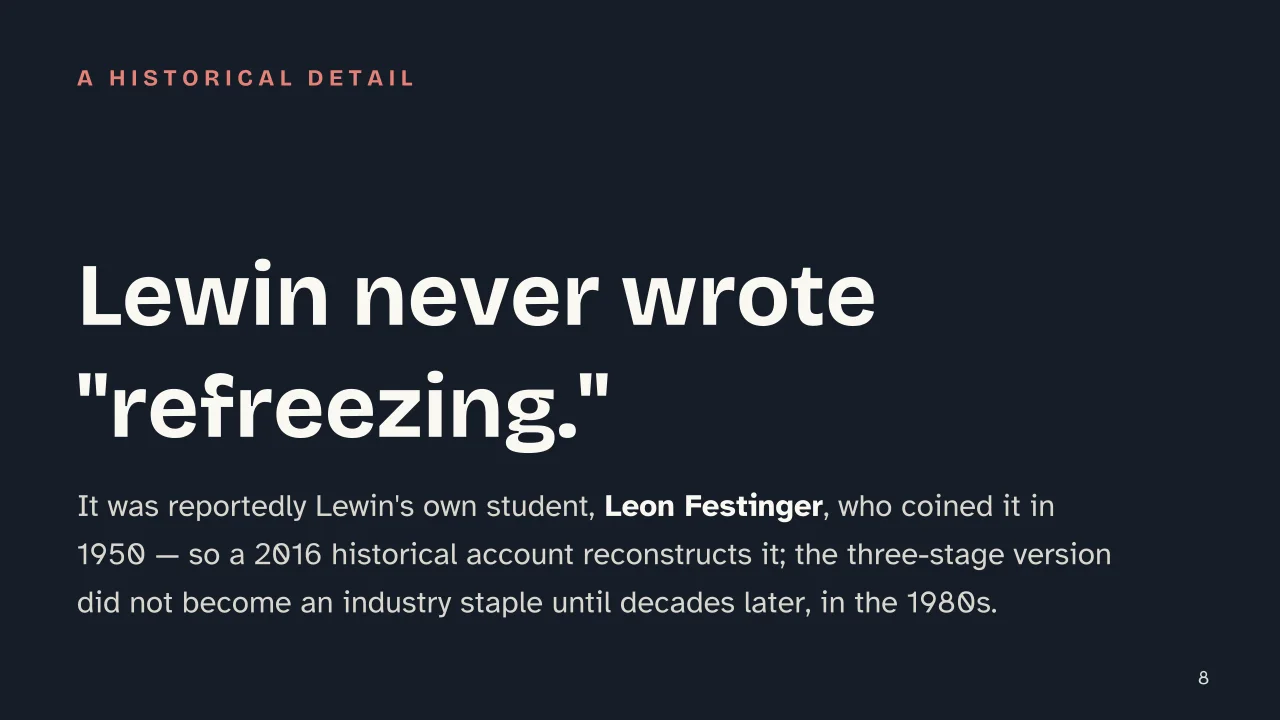
“Refreezing” is not Lewin’s word
One detail worth knowing before treating the model as something Lewin
wrote word for word: in his 1947 article, the subtitle refers to
“unfreezing, moving and freezing” group standards, not “refreezing.”
The word “refreezing” only appeared in 1950, in a conference paper by
Leon Festinger, a former student of his, who also changed “moving” to
“stabilizing.” According to a 2016 historical account (Cummings,
Bridgman and Brown, cited here through a blog that reports its
findings, since the original academic paper could not be accessed
directly), the three-stage version now attributed to Lewin was little
known before the early 1980s and only became the field’s standard in
that decade. That is not a reason to dismiss the model, but it is a
good reason to attribute it carefully: it is more accurate to call it a
model “associated with Lewin” or “credited to Lewin” than a formula
Lewin himself put on paper.
Criticism and limits of the model
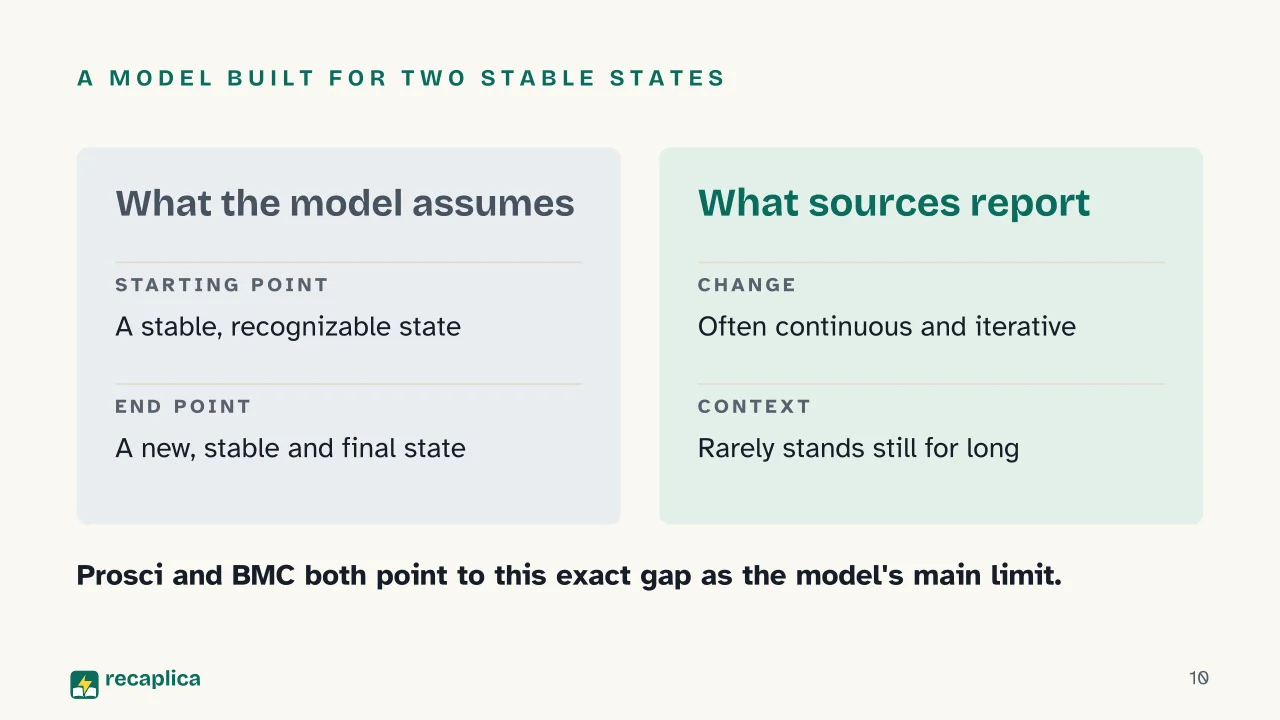
Several independent industry sources converge on the same limits.
Prosci and BMC both flag the model’s linear, sequential nature: it
describes a fixed three-stop path, while many organizations deal
with ongoing, overlapping change that does not fit neatly into a
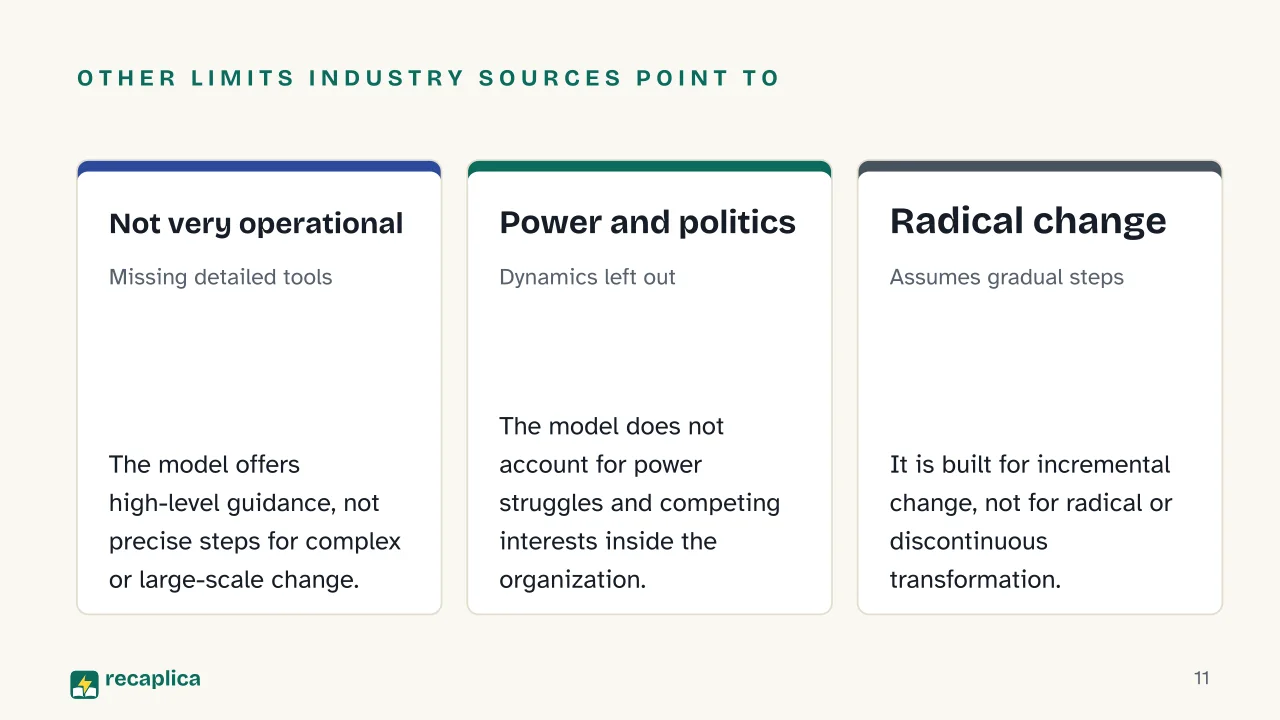
framework ending in a “freeze.” Prosci adds that the model offers
high-level guidance without detailed operational tools for managing
complex or large-scale transformations. Management Study Guide lists
further limits: the model assumes incremental change and struggles
with radical transformation, and it does not account for power
dynamics and competing interests inside an organization.
Applying the model in practice
In practice, the model still earns its keep mainly as a frame for
ordering the questions of a reorganization: the need for change gets
communicated, the change itself gets introduced, and then it gets made
to last. That logic applies as much to an internal reorganization
as to broader shifts in the labor market,
where companies and workers adjust together to new ways of working. One
sign that the unfreeze stage was not done well, for instance, is
employees growing disengaged from an announced change — a pattern often
described with the label quiet
quitting, doing the bare minimum
instead of buying into a change that was never clearly communicated.
The criticism above is still worth keeping in mind: Lewin’s change
model offers a basic logic, not a ready-made plan for an
organization’s specific context.
Slide deck
Slides ready to download and make your own in PowerPoint or Google Slides, with speaker notes. Pick the Flash cut or the Full one.
✗ Myth Kurt Lewin wrote 'unfreeze, change, refreeze' word for word.
✓ Reality In his 1947 article, Lewin writes about "unfreezing, moving and freezing" group standards; the word "refreezing" is absent. A 2016 historical account traces the rephrasing to 1950, to a paper by his former student Leon Festinger, and places the three-stage version's rise to industry standard only from the 1980s onward: on that reading, the model was built up after the fact and is no faithful quotation.
✗ Myth Once refreeze is reached, the change is finished and the organization goes back to working as before.
✓ Reality Industry sources such as Prosci and BMC point out that organizations usually face several changes in parallel, one after another: refreeze locks in one new state, but it is rarely the final one.
✗ Myth Lewin's change model gives precise instructions for running a complex change project.
✓ Reality Prosci notes that the model offers high-level guidance and leaves out the detailed steps or operational tools for managing large-scale or multifaceted change: it works better as a conceptual frame than as an operating manual.
Mind map
Drag the background to move around and the nodes to reposition them; use − and + to collapse and expand branches.
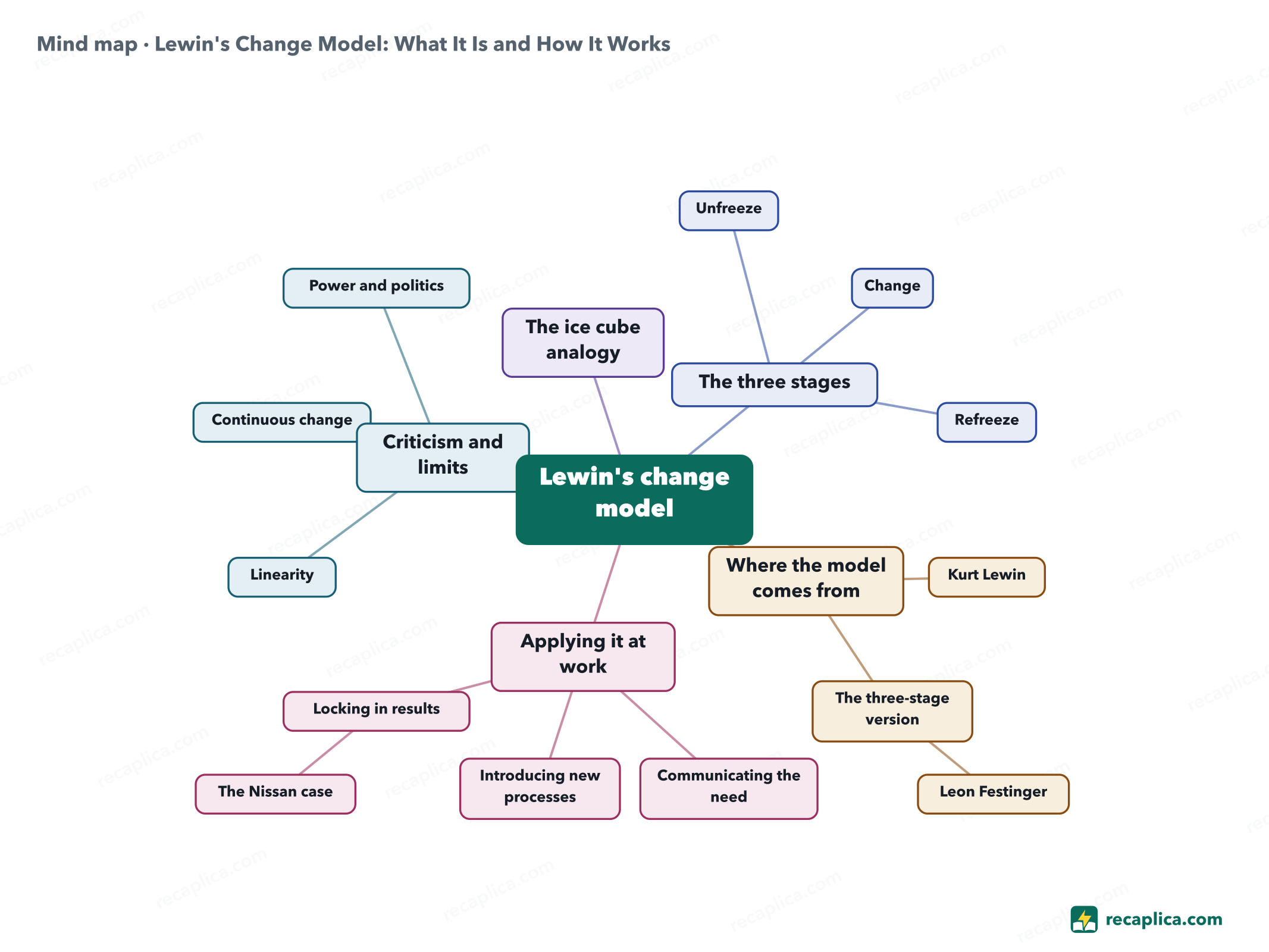
Kurt LewinSocial psychologist, group dynamics research in the 1940s
The three-stage versionA later reconstruction, standard across the field from the 1980s
Leon FestingerIntroduces the term refreezing in 1950
Applying it at work
Communicating the needThe unfreeze stage
Introducing new processesThe change stage
Locking in resultsThe refreeze stage
The Nissan caseGhosn ties pay to performance to make the change stick
Criticism and limits
LinearityA fixed sequence of three stages
Continuous changeA poor fit for iterative transformation
Power and politicsDynamics the model leaves out
The ice cube analogyA common teaching tool in management training
Quiz: test yourself
Answer the questions to check what you have learned: you get instant feedback and a short explanation.
Grade0/100/5
Answers: 1-A · 2-B · 3-B · 4-B · 5-C
Flashcards
Tap the card to flip it and check whether you remember the answer, then move to the next one.
1 / 8
Explain it in your own words
The ultimate test: if you can explain it in simple words, you've truly understood it. Write your explanation, then compare it with the Recap.
Your explanation is saved only on this device.
Lewin's change model describes, in three stages, the passage of an organization from a settled way of working to a new one, and how it avoids sliding back into old habits. In the unfreeze stage, the organization recognizes the need for change and prepares the ground; in the change stage, new processes and behaviors are introduced; in the refreeze stage, the new setup is locked in so it does not slip back to where it started. The model grows out of Kurt Lewin's work on group dynamics in the 1940s, but the three-stage version used in change management is largely a later reconstruction. It remains the most cited reference point in organizational change management, criticism included.
Frequently asked questions
What order do the three stages of Lewin's change model follow?
First unfreeze, when the organization recognizes and communicates the need for change; then change, when new processes or behaviors are introduced; finally refreeze, when the new setup is embedded into the organization's culture.
Is Lewin's change model the same as Lewin's change theory?
Yes, "Lewin's change theory," "Lewin's change management model" and "Lewin's 3 stage model" all refer to the same unfreeze-change-refreeze framework: several names in circulation for a single model.
What are the main criticisms of Lewin's change model?
Industry sources mostly challenge its linearity, its weak fit with radical or continuous change, and the lack of detailed operational guidance; Management Study Guide adds that the model leaves out power dynamics inside the organization.
Is Lewin's change model still used in change management?
Yes, it remains one of the most cited reference points for explaining the basic logic of organizational change, though several management sources treat it as a starting point to combine with approaches built for continuous-change settings.
Did Lewin himself come up with the unfreeze-change-refreeze model?
Lewin laid the theoretical groundwork in the 1940s through his research on group dynamics, but the three-stage version built around the word "refreeze" is a later reconstruction, credited mainly to Leon Festinger in 1950, that only became the field's canon from the 1980s onward.
Every Recap goes through an independent review before publication.
Statistics, only if you say so
To learn which Recaps help most we would use Google Analytics, with aggregate, anonymous data. It starts only with your OK, and you can change your mind anytime. Privacy policy