|
recaplica
IMAT Exam: What It Is and How Italy's English-Language Medical Test Works | ||||||||||||
| © 2026 Recaplica · recaplica.com — All rights reserved | ||||||||||||
IMAT Exam: What It Is and How Italy's English-Language Medical Test WorksWhat to print Page numbers appear when printing with default margins. SlidesChoose a cut Flash10 slidesThe essential thread, to present in classFull14 slidesEvery chapter and the deeper detailBoth come with speaker notes. In 30 seconds quick readThe IMAT (International Medical Admissions Test) is the admission exam for international students who want to study Medicine and Surgery in English at an Italian university. It is a pen-and-paper, multiple-choice test: according to the University of Pavia's admissions page, 60 questions, a maximum score of 90, and 100 minutes on the clock, with extra time for candidates who hold a certified learning disorder or serious illness. Registration runs through the same national portal, Universitaly.it, that Italian-language applicants use for a completely different route into Medicine: since a 2025 reform, they no longer sit an entrance test at all, but follow a semester of university coursework instead. Key Points
Key figures
Deep DiveWhat the IMAT is, and who takes itItaly has two separate front doors into a Medicine degree, and they lead different applicants to different exams. The IMAT — International Medical Admissions Test — is the one built for international students: it’s the admission test for the Medicine and Surgery degree programmes that a number of Italian universities teach entirely in English, aimed at candidates who want to study medicine in Italy without first learning Italian. According to the admissions page for the “Medicine and Surgery Harvey” programme at the University of Pavia, the IMAT is a pen-and-paper test, marked by hand rather than on a computer: a written exam in the fullest sense, taken on a single day. Registration for the IMAT goes through Universitaly.it, the same national portal Italy uses for every other route into a public university — including, as the last section of this Recap covers, the different path that Italian-language applicants have followed since a 2025 reform. Format and scoringThe University of Pavia’s admissions page describes the IMAT as a multiple-choice test of 60 questions in total, each offering five possible answers with only one correct. There is no partial credit for a near-miss: a candidate either identifies the single correct option among the five, or doesn’t. The maximum score achievable across all 60 questions is 90 points.
What the exam covers, subject by subjectThe 60 questions aren’t spread evenly across subjects. Per the University of Messina’s IMAT information page, for the 2026/2027 intake the exam is organised into five thematic areas:
Biology carries the single largest share of the paper, well over a third of all questions, with chemistry a distant second; physics and mathematics, logical reasoning, and reading skills and general knowledge round out the rest with far fewer questions each. A candidate weighing how to divide study time across subjects is, in effect, looking at this same table. Timing, and who can get more of itCandidates have 100 minutes to complete the IMAT. The University of Pavia’s admissions page notes one accommodation: anyone diagnosed with a learning disorder, or living with a serious illness, can submit a medical certificate to the university’s dedicated office (SAISD) and receive 30% extra time — pushing the standard 100 minutes up for that candidate alone, rather than changing the clock for everyone. Registering for the IMATRegistration for the IMAT is handled centrally, through Universitaly.it — the same portal that manages admissions for every publicly funded university course in Italy, whatever the language of instruction. An international applicant doesn’t register directly with a single university’s admissions office; the process runs through this shared national system, much like the requirements a foreign national needs to check before ever sitting the exam, starting with the visa formalities that the Italian Ministry of Foreign Affairs sets out for study abroad. Why so few seats, and why the process is centralisedThe IMAT exists because the number of English-language Medicine places in Italy is fixed and limited well below the number of applicants who want one — a mismatch between a scarce supply and a large demand that isn’t unlike the trade-offs studied in microeconomics and macroeconomics, where a capped supply meeting high demand is precisely what turns a place into something worth competing for through a ranked exam rather than first-come, first-served registration. Italy’s other route: the open semesterThe IMAT is not the only door into Medicine in Italy, and it isn’t the one Italian-language applicants use. Since a 2025 reform, students applying to Medicine and Surgery, Dentistry, or Veterinary Medicine in Italian no longer sit an entrance test at all. Instead, they register on Universitaly.it for what Italy’s Ministry of University and Research calls the “open semester”: a run of actual university coursework in chemistry, physics and biology, closed by three separate subject exams rather than a single multiple-choice paper. The academic calendar for that pathway runs from September to November, a window comparable to how term dates vary across the continent, as this Recap on school start dates in Europe sets out for other countries. In the 2025-2026 academic year, the first under the new rules, the Ministry reported 64,825 students enrolled in the open semester across the three degree tracks; 54,313 of them, the large majority, chose Medicine and Surgery. None of those students sat the IMAT: it remains a separate exam, reserved for the English-language track, and the reform that created the open semester left it untouched. The change itself followed the ordinary sequence for turning a law into a working procedure: a bill, a law, then an implementing decree with the operational detail, the same layered process explained in this Recap on how a legal norm moves from principle to practice. Slide deckSlides ready to download and make your own in PowerPoint or Google Slides, with speaker notes. Pick the Flash cut or the Full one.     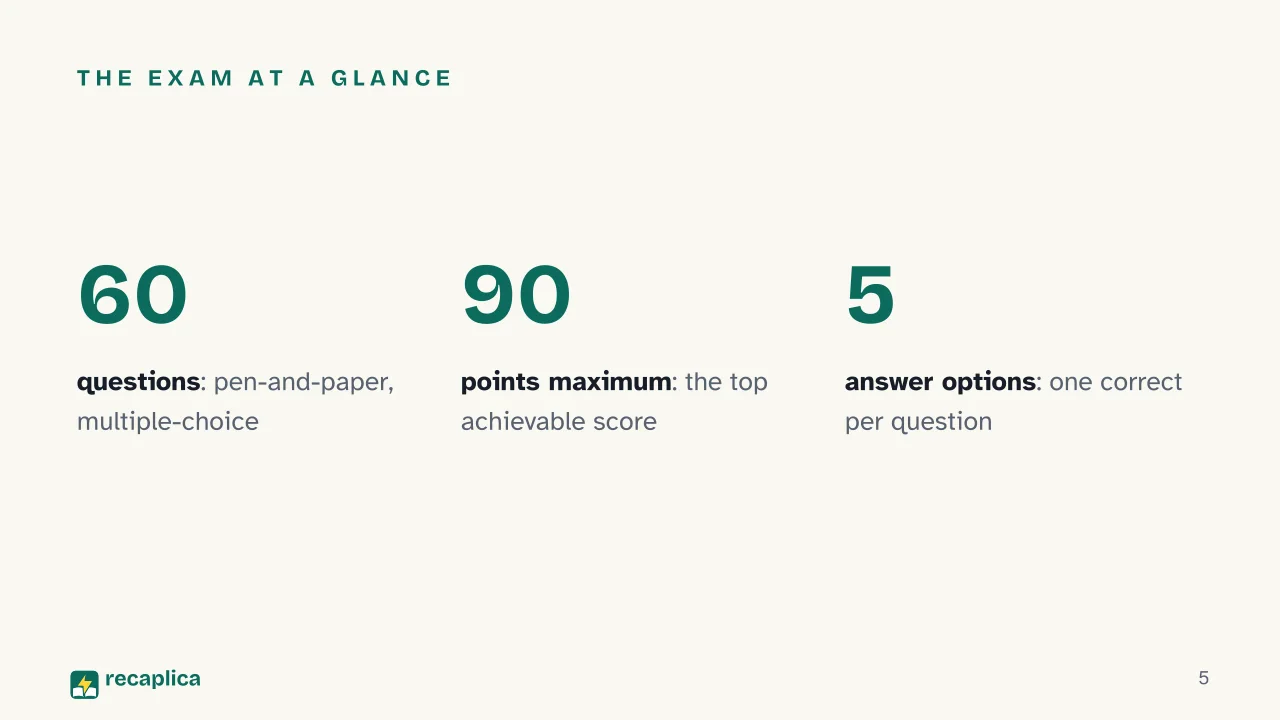  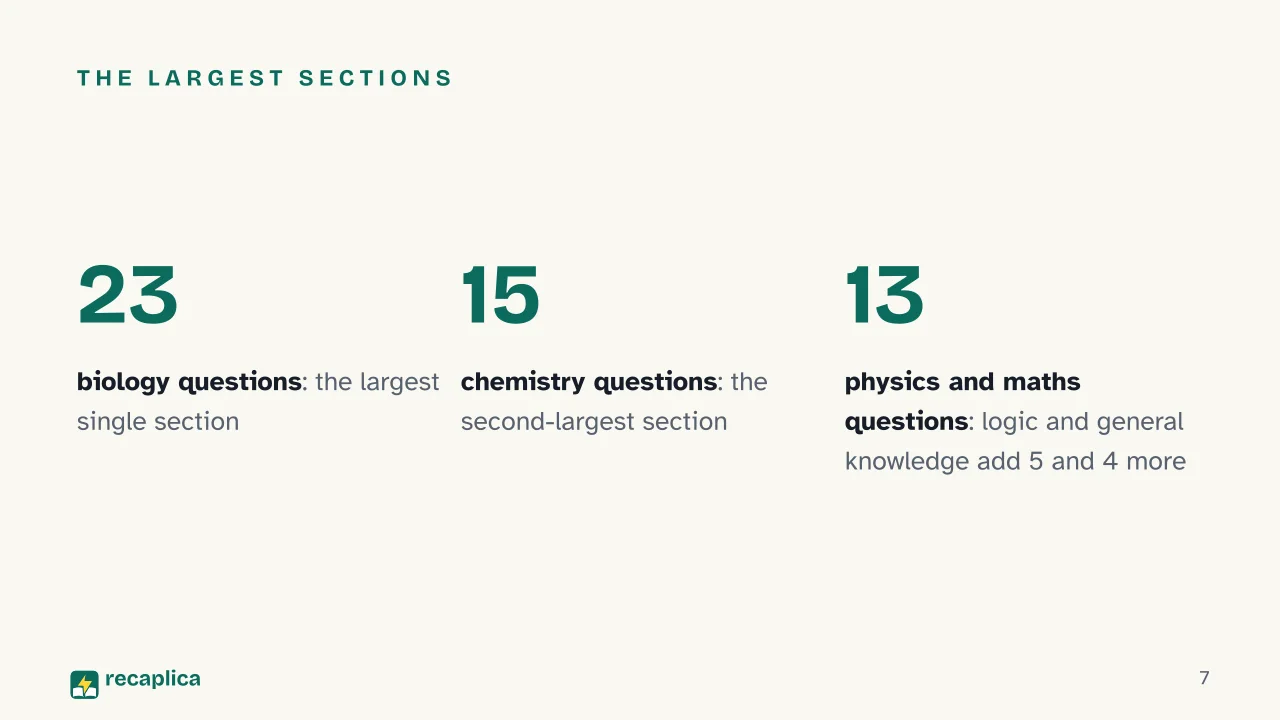  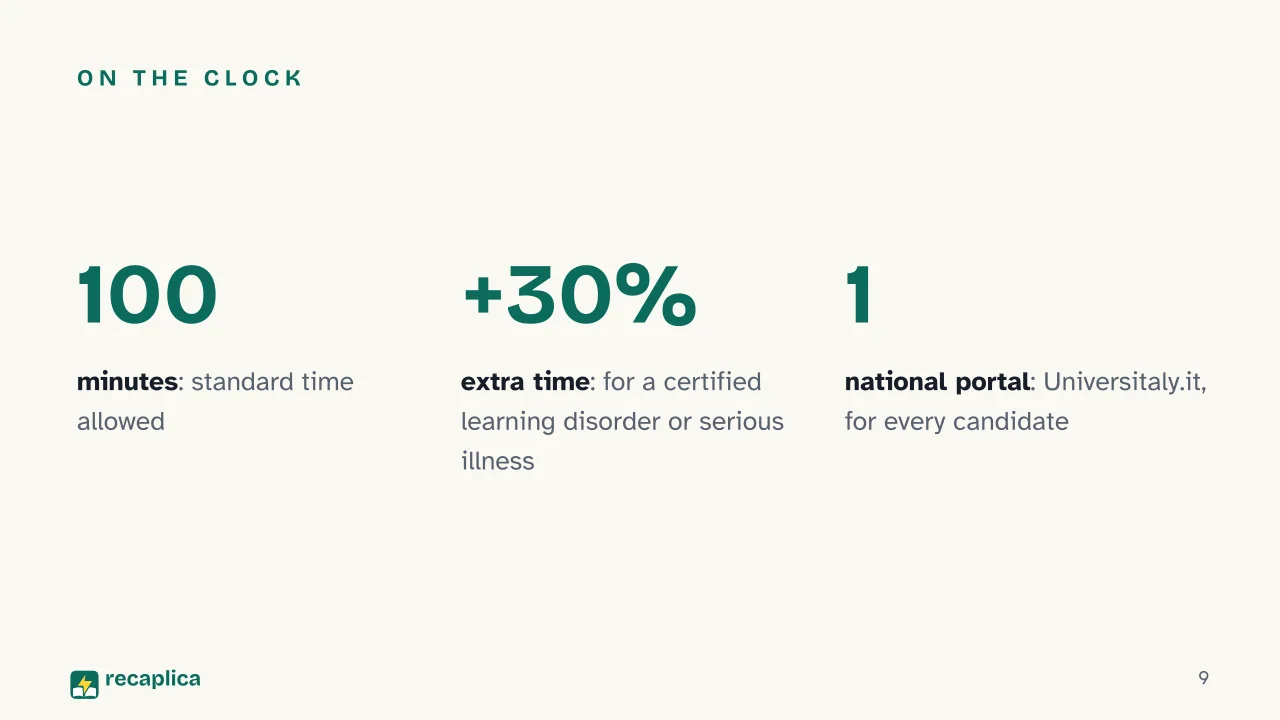 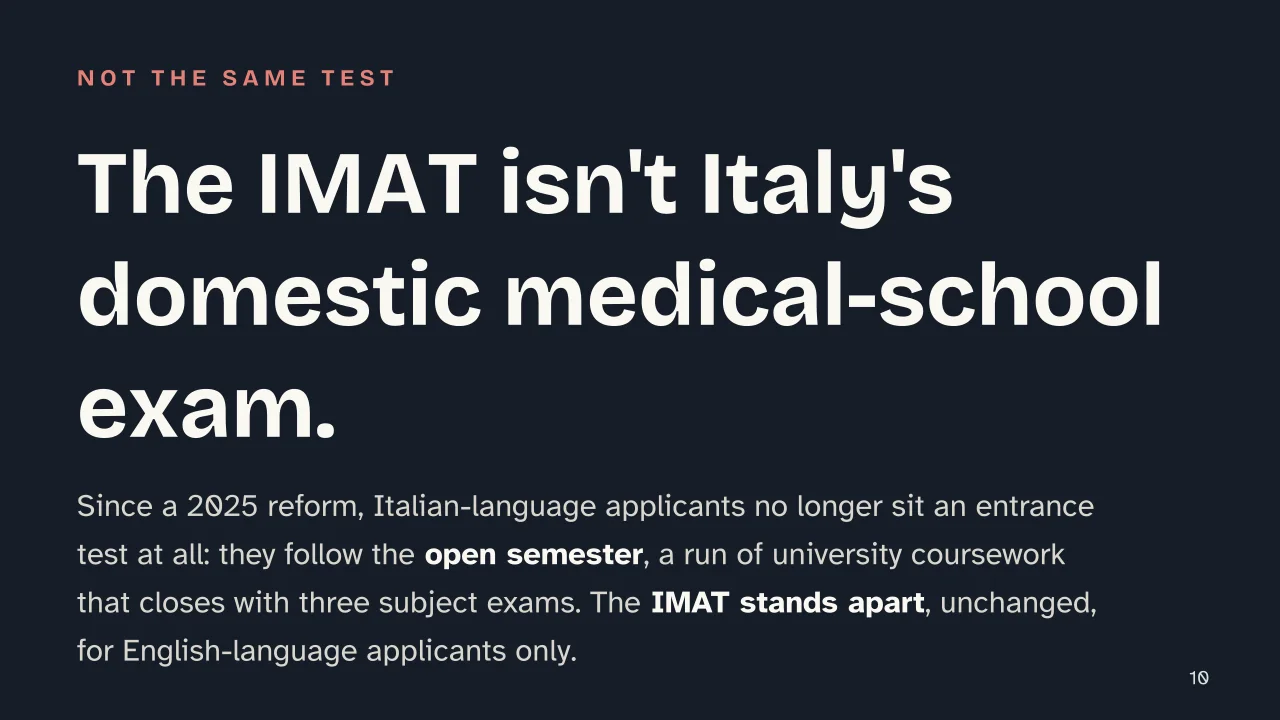  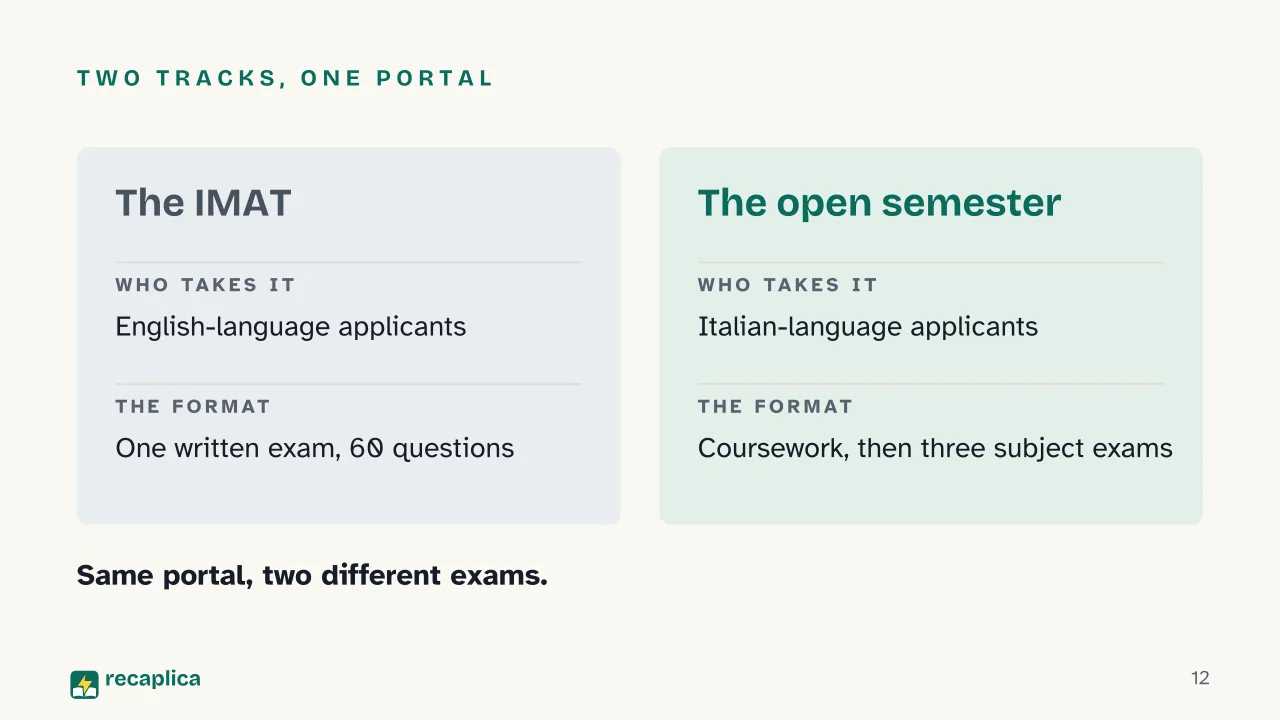 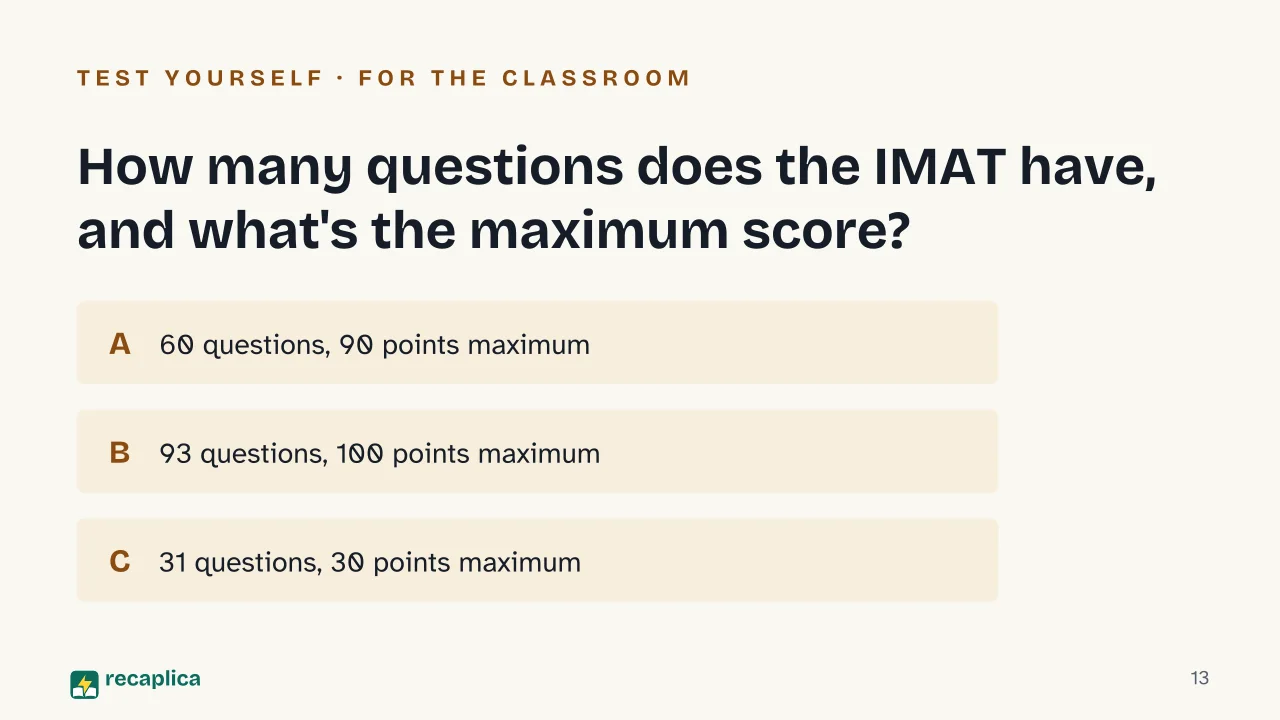  Common myths
Mind mapDrag the background to move around and the nodes to reposition them; use − and + to collapse and expand branches. 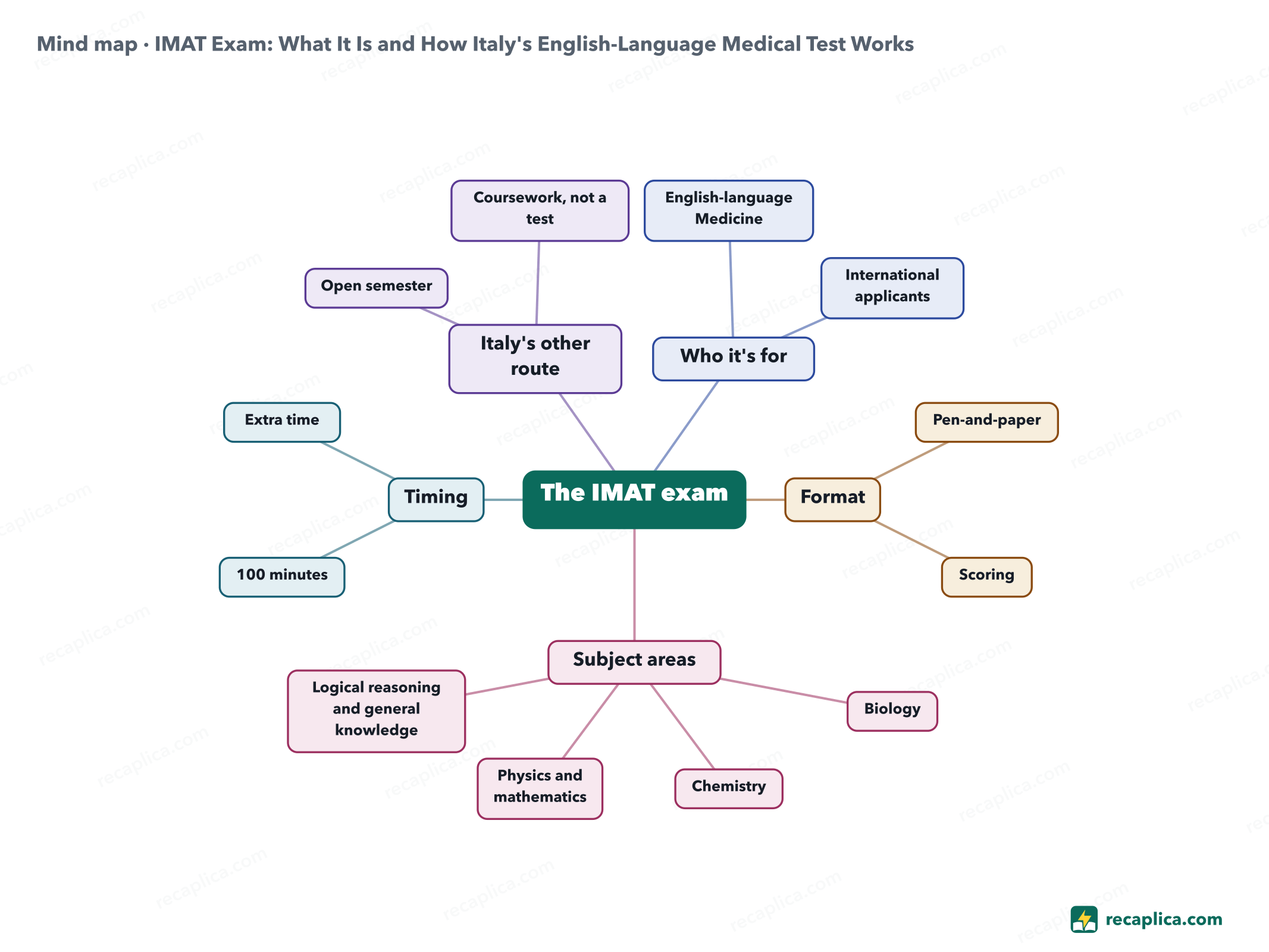
Quiz: test yourselfAnswer the questions to check what you have learned: you get instant feedback and a short explanation. Grade 0/10 0/5
FlashcardsTap the card to flip it and check whether you remember the answer, then move to the next one. 1 / 7 Explain it in your own wordsThe ultimate test: if you can explain it in simple words, you've truly understood it. Write your explanation, then compare it with the Recap. Your explanation is saved only on this device.
Frequently asked questionsWhat is the IMAT exam?The IMAT (International Medical Admissions Test) is the written admission exam for international students applying to Medicine and Surgery degree programmes taught in English at Italian universities. According to the University of Pavia's admissions page, it is a pen-and-paper test designed for candidates who want to study medicine in Italy without first learning Italian. What subjects does the IMAT cover?The University of Messina's IMAT information page, for the 2026/2027 intake, lists five areas across the 60 questions — 4 on reading skills and general knowledge, 5 on logical reasoning, 23 on biology, 15 on chemistry, and 13 on physics and mathematics — each question offering five answer options with a single correct one. How long is the IMAT, and is extra time available?Candidates have 100 minutes to complete the test. Anyone who submits a medical certificate for a learning disorder or a serious illness to the university's dedicated office can receive 30% extra time. How do you register for the IMAT?Registration runs through Universitaly.it, Italy's national portal for university admissions — the same platform used for every other route into an Italian university, including the domestic pathway into Medicine. Is the IMAT the same test Italian students take for Medicine?No. The IMAT is only for applicants to English-language Medicine and Surgery programmes. Since a 2025 reform, Italian-language applicants no longer sit an entrance test at all: they follow the open semester, a period of university coursework in chemistry, physics and biology that ends in three subject exams, with a national ranking built from the results. Every Recap goes through an independent review before publication. |