Skip to content
recaplica

    One moment: security check

    Cloudflare wants to make sure you're not a robot. Tick the box below and your search will continue on its own.

    IT
    recaplica School Start Dates in Europe 2026/2027: Country by Country
    © 2026 Recaplica · recaplica.com — All rights reserved
    Home › Civics

    School Start Dates in Europe 2026/2027: Country by Country

    By Recaplica Newsroom · Updated on September 8, 2026

    What to print

    Page numbers appear when printing with default margins.

    Slides

    Choose a cut

    Flash10 slidesThe essential thread, to present in classFull17 slidesEvery chapter and the deeper detail

    Both come with speaker notes.

    Telegram channel
    recaplica Clear in 30 seconds, yours in 10 minutes.
    In 30 seconds Key points Figures Deep dive Slides Myths Mind map Quiz Flashcards FAQ

    In 30 seconds quick read

    There's no single date when school starts across Europe: according to Eurydice, the European education network, different countries follow different systems of who decides. In France, Poland and Greece a nationally set date applies to (almost) the whole country; in Germany, Spain and the United Kingdom the decision instead falls to states, autonomous regions and local authorities; in the Netherlands and Sweden the central level only sets guide dates, and the final call belongs to schools or municipalities. Italy is a hybrid case, with a fixed national framework (from September 1 to August 31) inside which each region sets the detailed calendar. The specific dates in this Recap are for the 2026/2027 school year: they change every year, even though the underlying rule for choosing them stays the same.

    Key Points

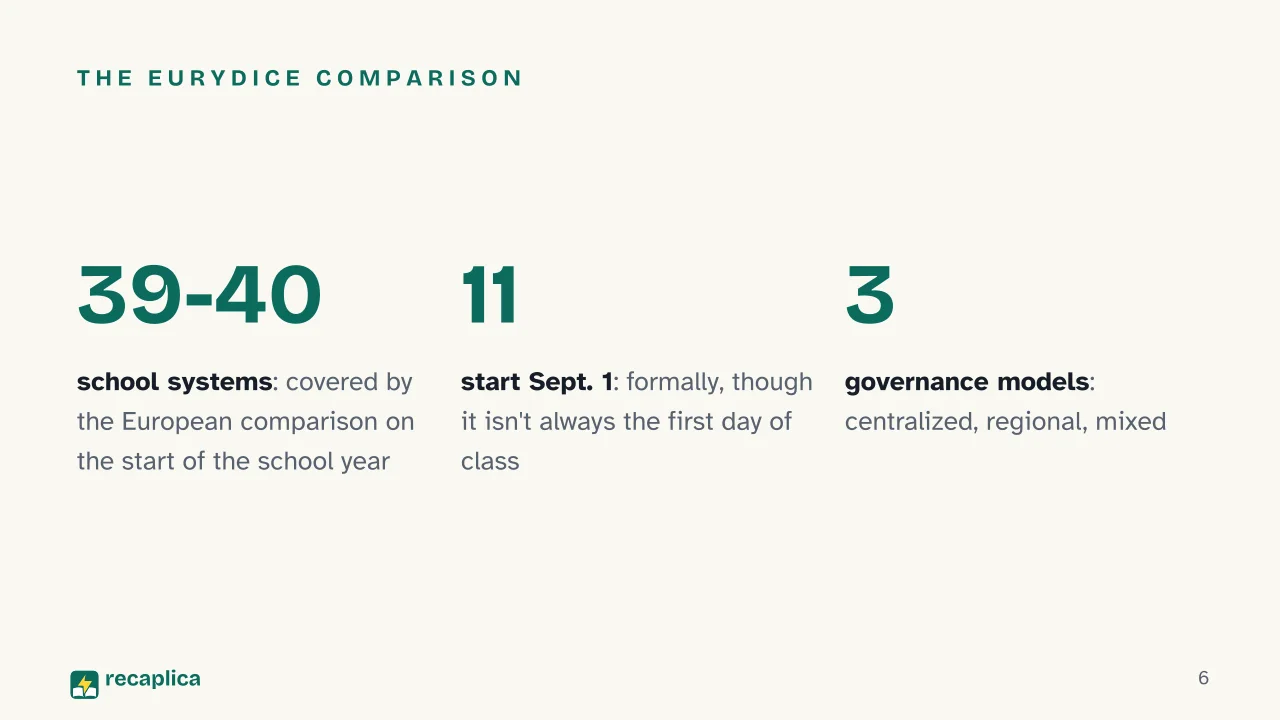
    • There's no single school start date across Europe: Eurydice identifies three governance models, a centralized decision, a regional or local one, and mixed or guided systems.
    • In France, Poland and Greece a central ministry sets one date for (almost) the whole country: for the 2026/2027 school year, mainland France went back to school on September 1, 2026.
    • In Germany the 16 federal states (Länder) decide, coordinated by the Kultusministerkonferenz (KMK) through a five-group rotation in place since 1964, to keep summer holidays from overlapping everywhere at once.
    • In Italy, school operates inside a national framework, from September 1 to August 31, but each region sets the detailed teaching calendar.
    • In the Netherlands and Sweden, the central level only gives guidance (advisory dates, or an August-to-June framework): the final decision belongs to schools or municipalities.
    • The dates in this Recap are for the 2026/2027 school year and change annually: what stays stable over time is the rule for who decides, not the date itself.

    Key figures

    • 1964 the year of the Hamburg Agreement, when Germany introduced the five-group rotation among states to stagger summer holidays Source: Kultusministerkonferenz (KMK)
    • 11 of 39-40 European school systems where the academic year formally starts on September 1, according to Eurydice's comparison (the formal date doesn't always match the first day of class) Source: Eurydice, Start of the academic year in Europe
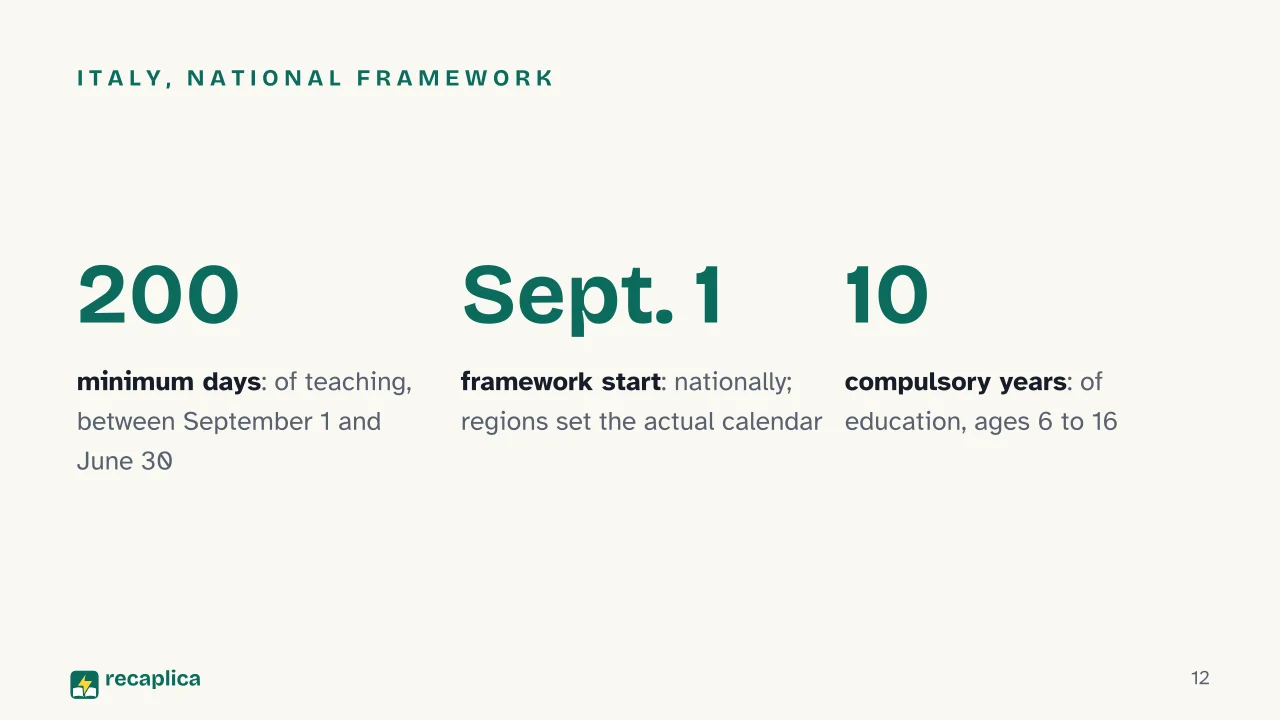
    • 200 days minimum amount of teaching activity in Italy, between September 1 and June 30, inside the national September 1-August 31 framework Source: Eurydice, Organisation of primary education (Italy)

    Deep Dive

    No single date, three ways to decide it

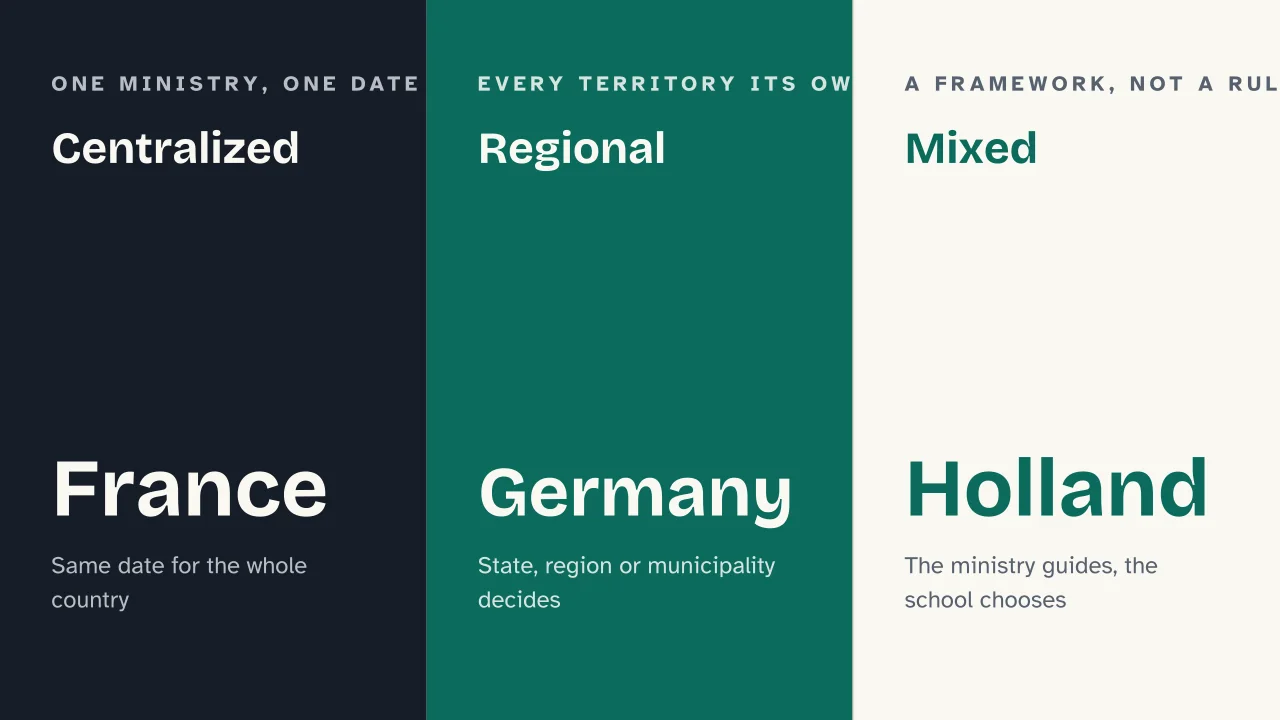
    Anyone expecting a shared European calendar will be disappointed: there’s no school start date that applies to every country. Eurydice, the European comparison tool covering 39-40 school systems, does find three recurring ways of deciding that date. In the first, a central authority picks a single date for the entire country. In the second, the decision is decentralized, handled by regions, local authorities or individual schools, inside national guidelines on the number of teaching days or hours. In the third, several authorities share the job, with a central government setting a framework that gets adapted locally.

    There’s also a less obvious but useful distinction: in some countries the official “start of the school year” date matches the first day of class; in others it’s only the start of an administrative period, and actual lessons begin a few days later. That’s the case in Greece, where the official opening (the agiasmos, a blessing ceremony) and the first day of regular classes can fall on different dates.

    Who decides, country by country (2026/2027)

    CountryIndicative date, 2026/2027Who decides
    FranceSeptember 1, 2026 (mainland France)Ministry of National Education
    PolandSeptember 1, 2026Ministry of National Education
    Greeceopening around September 11, regular classes September 14, 2026Central Ministry of Education
    Germanybetween late July/early August and mid-September 2026, depending on the stateThe 16 Länder, coordinated by the KMK
    SpainSeptember 7-10, 2026, depending on the autonomous communityThe autonomous communities
    United Kingdommid-August (Scotland) to early September 2026 (England, Wales)Local authorities and devolved nations
    Netherlandslate August to early September, three regionsMinistry (guide dates), final call by the school
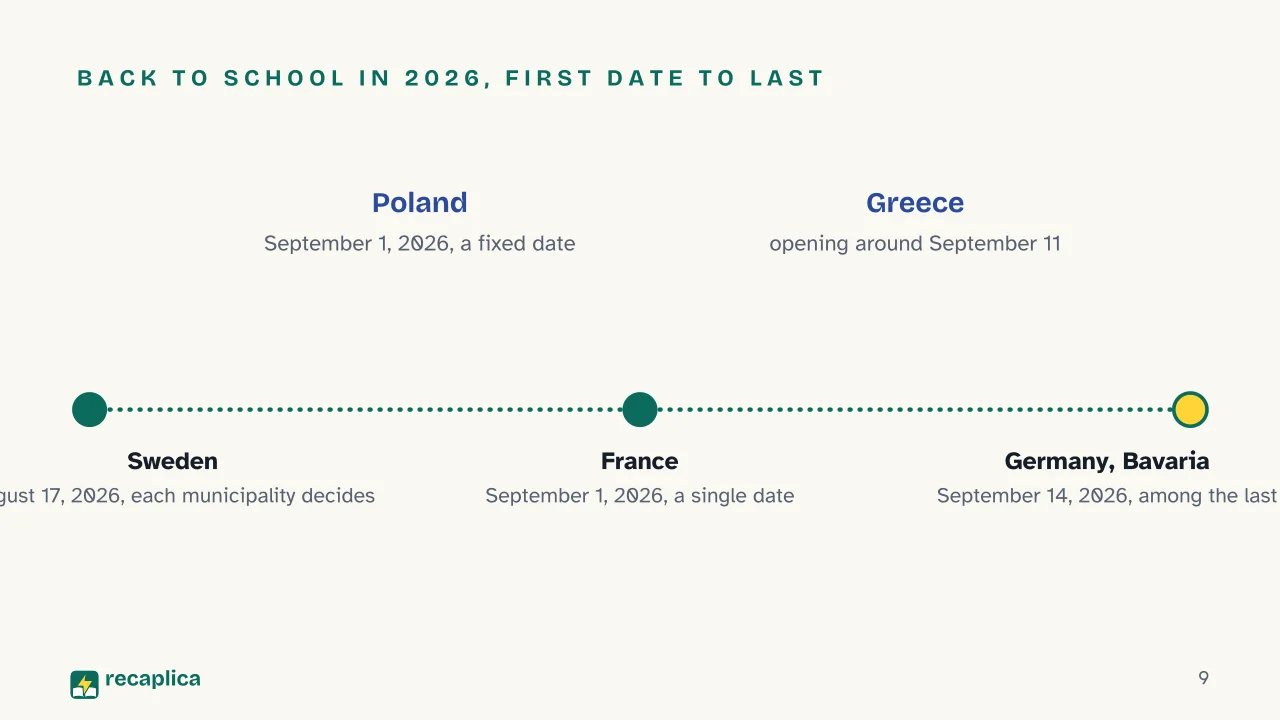
    SwedenAugust 17-19, 2026, depending on the municipalityThe municipality (huvudman), inside the Skolverket framework
    ItalySeptember 1-August 31 framework, class start date set by the regionThe regions, inside the national framework

    The dates in the table hold only for the 2026/2027 school year: they change every year (more on why below), while the criterion behind them, who decides, stays stable.

    Practical example: a family moving from Munich to Milan in late August finds two different systems. In Bavaria, the return date depends on the turn assigned by Germany’s five-group state rotation: for the 2026/2027 school year, Bavarian classes resumed among the last in Germany. In Italy, it’s the region that decides instead, inside the national framework running from September 1 to August 31.

    The centralized model: one ministry, one date

    In France, the 2026 rentrée scolaire was set by the Ministry of National Education at September 1, 2026 for mainland France, across all three of the country’s holiday zones (zones that stagger mid-year breaks, not the September rentrée itself, which stays the same for the mainland). Corsica has its own rentrée a few days later, and the overseas territories follow independent calendars. This strong national framework doesn’t come from nowhere: France has a tradition of administrative centralization rooted in a history covered in the Recap on the French Revolution, when the state rewrote the rules of political life on a national scale.

    In Poland, the Ministry of National Education decides in the same way: for the 2026/2027 school year, teaching began on September 1, 2026 across the whole country, with only winter break staggered across three regional turns. In Greece, the central Ministry of Education sets an official opening traditionally close to September 11 (the date shifts if it falls on a Saturday or Sunday): for 2026/2027 it fell on Friday, September 11, 2026, with regular classes starting the following Monday, September 14, 2026.

    The regional model: every territory its own

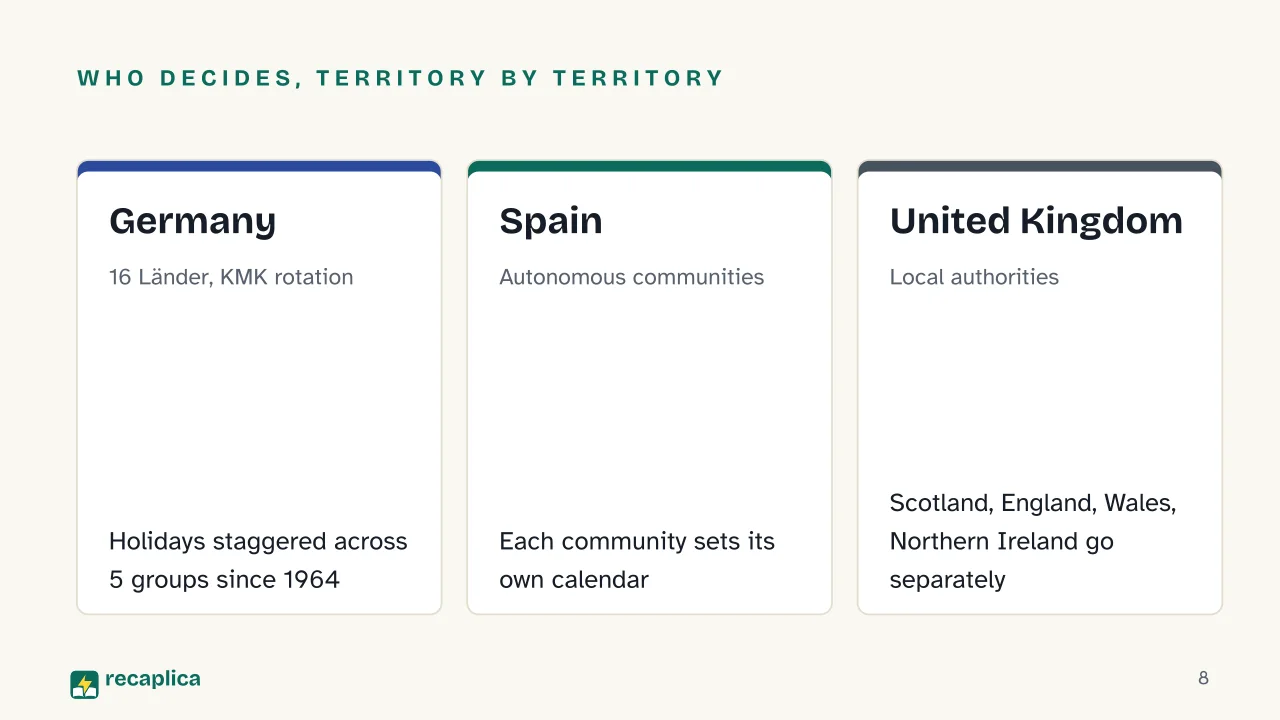
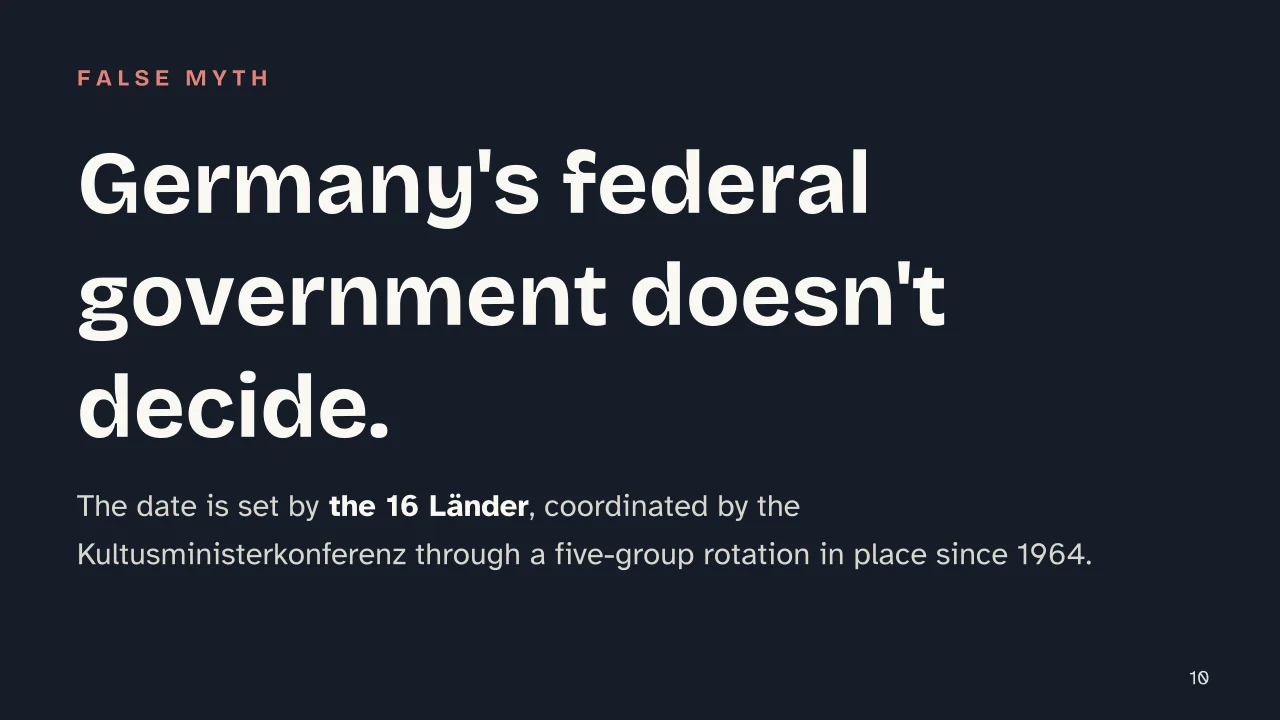
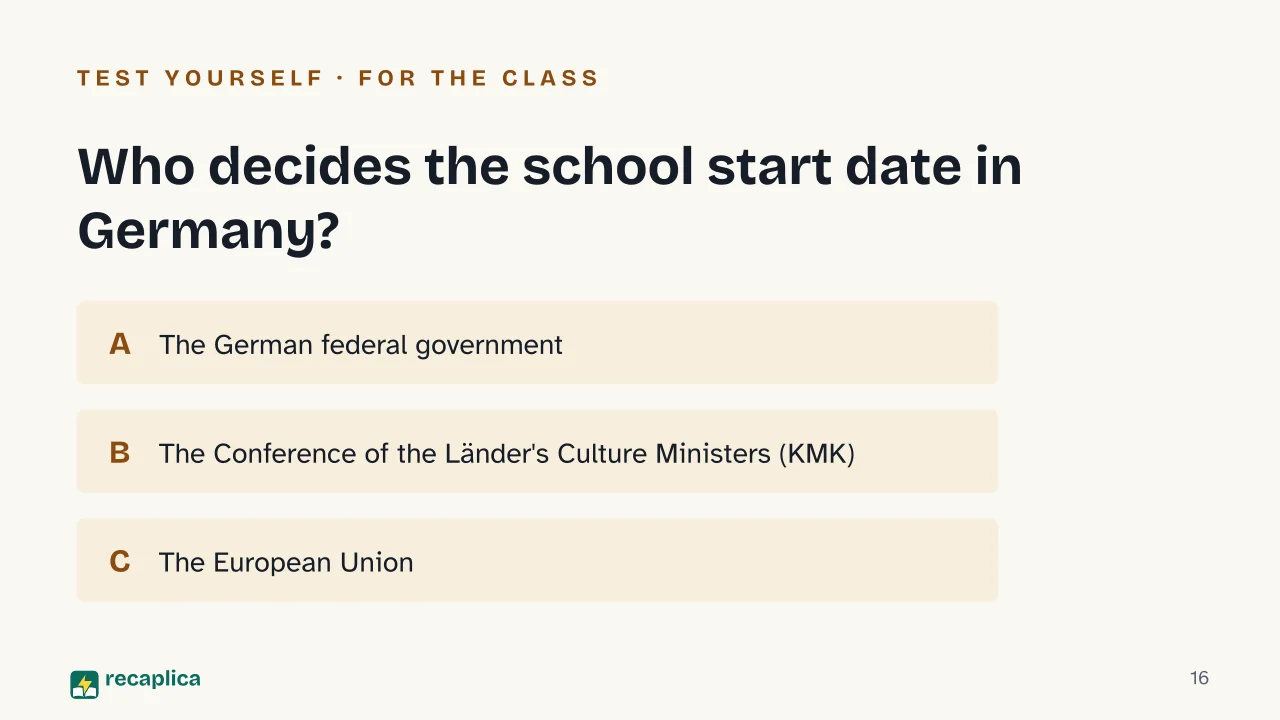
    In Germany, education is a responsibility of the 16 Länder, not the federal government: summer holiday dates are set long-term by the Kultusministerkonferenz (KMK), the conference of the Länder’s culture ministers, through a five-group rotation introduced in 1964 (the Hamburg Agreement) to keep German families from all going on holiday at the same time. Summer holidays last at least six weeks and can start anywhere between June 20 and September 15 depending on the state; Bavaria and Baden-Württemberg are traditionally among the last to break for summer, for a historical reason tied to the 1964 harvest season.

    In Spain, the constitution gives the autonomous communities full authority over the calendar for non-university schools: for 2026/2027 the return to class fell between September 7 and 10, 2026 depending on the community, with differences between school levels too (in Catalonia, for example, September 8 for most stages but September 14 for vocational training). In the United Kingdom, the official government portal says so without mincing words: dates vary across the country, and finding them means checking with the relevant local authority. In England, local authorities decide (with extra autonomy for academies); in Wales, the Welsh government decides centrally; in Scotland, 32 local councils each choose their own dates, typically in mid-August, notably earlier than the rest of the UK; in Northern Ireland, the Education Authority publishes recommended dates that most schools follow.

    The mixed model: a framework, the final call elsewhere

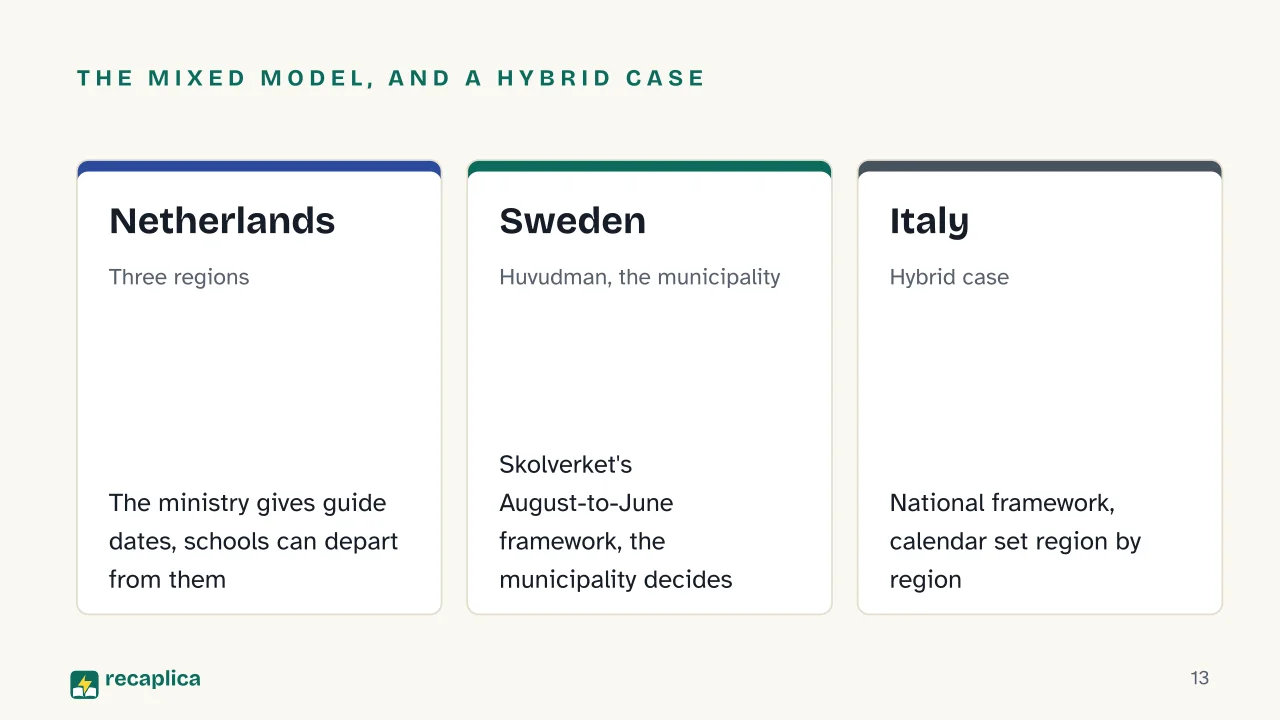
    In the Netherlands, the Ministry of Education (OCW) publishes “guide dates” for three regions, but individual schools can depart from them without asking the ministry’s permission. In Sweden, the national agency Skolverket only sets a framework, the school year must start in August and end in June, while the exact start and end date of each term is decided by the “huvudman,” the school’s operator, which in most cases is the municipality: in autumn 2026, for example, Stockholm, Gothenburg and Malmö went back to class on August 17, while Örebro opened on the 19th.

    Italy: a national framework, a calendar set by region

    Italy is a hybrid case between the two extremes. Nationally, the school year runs from September 1 to August 31, with a minimum of 200 days of teaching activity between September 1 and June 30. Inside that framework, it’s the regions that set the detailed school calendar, the start date of classes, the length of the Christmas break (typically two weeks) and the Easter break (typically one week), adapting the calendar to local needs. Italy’s twenty regions administer a territory unified as a single state in the nineteenth century: the story of that process is told in the Recap on Italian unification.

    Why the dates change every year

    None of the criteria described above produces a date that stays fixed over time. In France, each school year’s calendar is set by its own ministerial decree; in Greece, the “around September 11” opening shifts if that date falls on a Saturday or Sunday; in the Netherlands and Sweden, guide dates or municipal dates are redefined year by year. That’s why the figures in this Recap are explicitly anchored to the 2026/2027 school year: they’re a concrete example of how each rule works, not a fact valid forever. It’s the same principle that, in other fields, leads the European Union to write shared rules for all 27 countries instead, as with artificial intelligence and the EU AI Act: on the school calendar, by contrast, every source consulted shows a decision made inside each individual country, never a single shared European rule.

    Slide deck

    Slides ready to download and make your own in PowerPoint or Google Slides, with speaker notes. Pick the Flash cut or the Full one.
    Slide 1 of the presentation on School Start Dates in Europe 2026/2027: When does school start in EuropeSlide 2 of the presentation on School Start Dates in Europe 2026/2027: In how many European countries does school start on the same day?Slide 3 of the presentation on School Start Dates in Europe 2026/2027: The routeSlide 4 of the presentation on School Start Dates in Europe 2026/2027: Chapter 01: Three governance modelsSlide 5 of the presentation on School Start Dates in Europe 2026/2027: Centralized · Regional · MixedSlide 6 of the presentation on School Start Dates in Europe 2026/2027: The Eurydice comparisonSlide 7 of the presentation on School Start Dates in Europe 2026/2027: Chapter 02: The regional modelSlide 8 of the presentation on School Start Dates in Europe 2026/2027: Who decides, territory by territory: Germany, Spain, United KingdomSlide 9 of the presentation on School Start Dates in Europe 2026/2027: Back to school in 2026, first date to lastSlide 10 of the presentation on School Start Dates in Europe 2026/2027: Germany's federal government doesn't decide.Slide 11 of the presentation on School Start Dates in Europe 2026/2027: Chapter 03: The Italian caseSlide 12 of the presentation on School Start Dates in Europe 2026/2027: Italy, national frameworkSlide 13 of the presentation on School Start Dates in Europe 2026/2027: The mixed model, and a hybrid case: Netherlands, Sweden, ItalySlide 14 of the presentation on School Start Dates in Europe 2026/2027: Chapter 04: Why it changes every yearSlide 15 of the presentation on School Start Dates in Europe 2026/2027: Why never write a date as fixed forever?Slide 16 of the presentation on School Start Dates in Europe 2026/2027: Who decides the school start date in Germany?Slide 17 of the presentation on School Start Dates in Europe 2026/2027: And now, the review
    Flash10 slidesThe essential thread, to present in classFull17 slidesEvery chapter and the deeper detail

    Common myths

    • ✗ Myth School starts on the same day across all of Europe.

      ✓ Reality Eurydice's European comparison shows the opposite: it identifies three different governance models (centralized, regional, mixed), and real dates range from mid-August in Sweden to mid-September in some German states.

    • ✗ Myth In Germany, the federal government decides the school start date.

      ✓ Reality In Germany, education is a responsibility of the 16 Länder, not the federal government. Summer holiday dates are coordinated long-term by the Kultusministerkonferenz (KMK), through a five-group rotation in place since 1964 to keep holidays from all overlapping.

    • ✗ Myth In Italy, the Ministry of Education sets the same date for every region.

      ✓ Reality The Ministry only sets the national framework, from September 1 to August 31, with a minimum of 200 teaching days. It's each region, inside that framework, that decides the start date of classes and sets the rest of the teaching calendar.

    Mind map

    Drag the background to move around and the nodes to reposition them; use − and + to collapse and expand branches.
    Customize
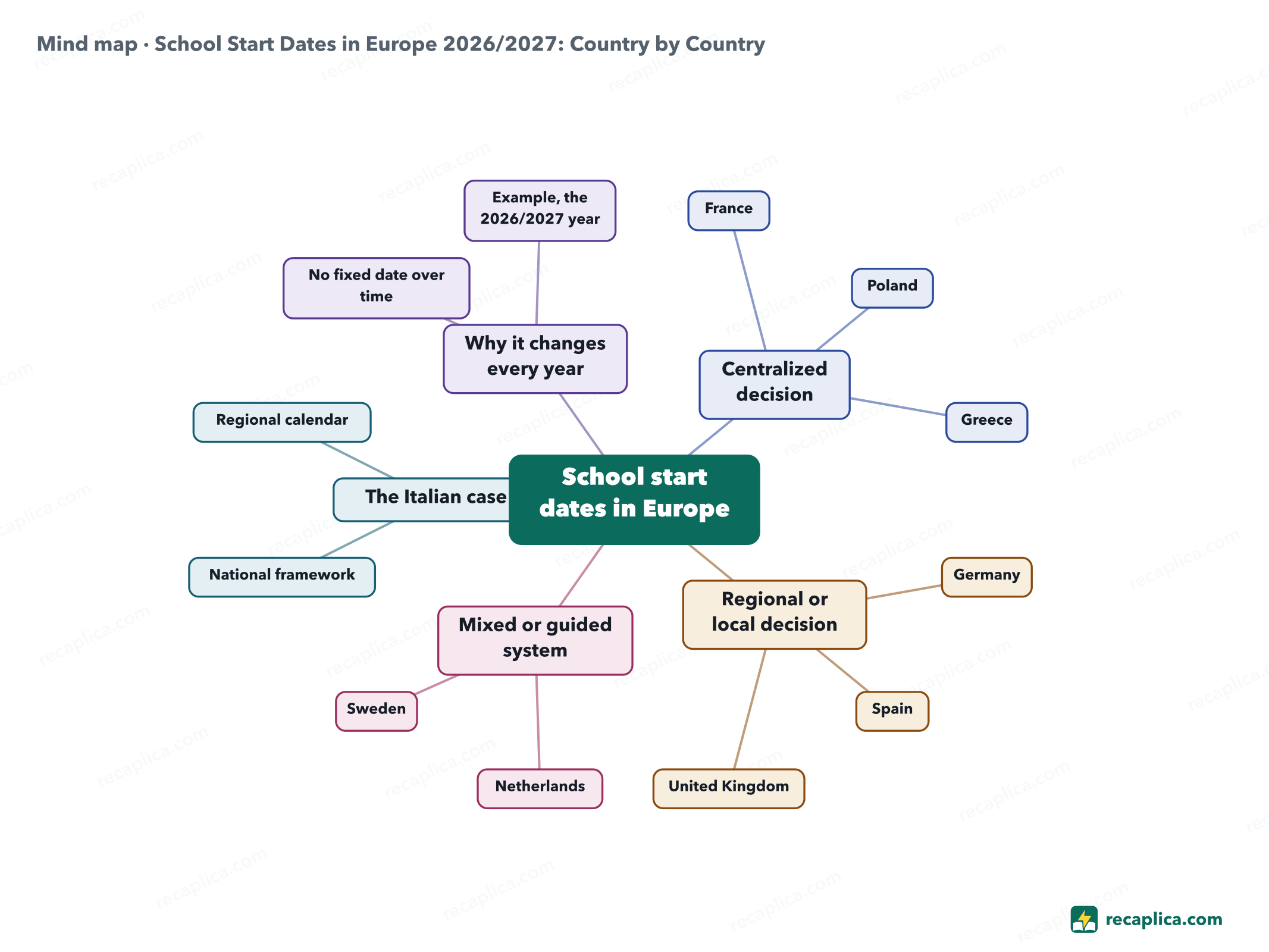
    Mind map: School Start Dates in Europe 2026/2027: Country by Country
    • School start dates in Europe
      • Centralized decision One ministry sets the same date for the whole country
        • France September 1, 2026, mainland France
        • Poland September 1, fixed nationwide every year
        • Greece opening around September 11, classes the following Monday
      • Regional or local decision Regions, local authorities or individual schools decide
        • Germany 16 Länder, coordinated by the KMK
        • Spain autonomous communities set the calendar
        • United Kingdom local authorities and devolved nations
      • Mixed or guided system A central steer, the final call elsewhere
        • Netherlands three regions, the ministry only gives guide dates
        • Sweden August-to-June framework, the municipality decides
      • The Italian case a national framework, a calendar set by region
        • National framework from September 1 to August 31
        • Regional calendar each region adapts the dates to its territory
      • Why it changes every year
        • No fixed date over time a new decree or resolution every year
        • Example, the 2026/2027 year the dates in this Recap hold for a single year

    Quiz: test yourself

    Answer the questions to check what you have learned: you get instant feedback and a short explanation.

    Grade 0/10 0/5
    1 True or false: there's a single school start date across Europe, the same for every country.

    False. Eurydice, the European comparison tool, identifies three different governance models (centralized, regional, mixed), and real dates range from mid-August in Sweden to mid-September in some German states.

    2 Who decides the school start date in Germany?

    In Germany education is a state-level responsibility, not the federal government's. The KMK coordinates the 16 Länder and, since 1964, applies a five-group rotation to stagger summer holidays.

    3 In Italy, who sets the detailed school calendar inside the national September 1-August 31 framework?

    It's the regions that adapt the national calendar to local needs: the start date of classes, and the length of the Christmas and Easter breaks.

    4 According to Eurydice's comparison of academic year start dates, which of these is NOT one of the three governance models identified?

    The three real models are centralized decision, decentralized regional or local decision, and multiple or mixed authorities (as in France, Iceland and Portugal). No European source describes a lottery among schools.

    5 Why doesn't Sweden have a single national date for going back to school?

    Skolverket only sets the framework, the school year must start in August and end in June: the exact start and end date of each term is chosen by the huvudman, meaning the school's operator, typically the municipality.

    Answers: 1-B · 2-B · 3-B · 4-D · 5-A

    Flashcards

    Tap the card to flip it and check whether you remember the answer, then move to the next one.

    1 / 8

    Explain it in your own words

    The ultimate test: if you can explain it in simple words, you've truly understood it. Write your explanation, then compare it with the Recap.

    Your explanation is saved only on this device.

    There's no single date when school starts across Europe: according to Eurydice, the European education network, different countries follow different systems of who decides. In France, Poland and Greece a nationally set date applies to (almost) the whole country; in Germany, Spain and the United Kingdom the decision instead falls to states, autonomous regions and local authorities; in the Netherlands and Sweden the central level only sets guide dates, and the final call belongs to schools or municipalities. Italy is a hybrid case, with a fixed national framework (from September 1 to August 31) inside which each region sets the detailed calendar. The specific dates in this Recap are for the 2026/2027 school year: they change every year, even though the underlying rule for choosing them stays the same.

    Frequently asked questions

    When does school start in France?

    For the 2026/2027 school year, the rentrée for mainland France was set by the Ministry of National Education at September 1, 2026, with Corsica and the overseas territories on their own calendars. The date is set by a ministerial decree each year, so it changes from year to year.

    Who decides summer holidays in Germany?

    Not the federal government: education is a responsibility of the 16 Länder, and dates are coordinated long-term by the Kultusministerkonferenz (KMK) through a five-group rotation in place since 1964, designed to keep German families from all going on holiday at the same time.

    Why doesn't school start on the same day in every Italian region?

    Because the national framework (from September 1 to August 31, with a minimum of 200 teaching days) leaves it to the regions to set the detailed teaching calendar, adapting it to local needs.

    When does school start in Spain?

    There's no single date: Spain's autonomous communities hold authority over the calendar for non-university schools. For the 2026/2027 school year, the return to class fell between September 7 and 10, 2026 depending on the community, with some variation between school levels too.

    Is there a single school start date across Europe?

    No. Eurydice, the European comparison tool, identifies three different ways of deciding that date (a central ministry, regions or local authorities, or a mixed system), and real dates range from mid-August in Sweden to mid-September in some German states.

    Sources

    • Eurydice — Organisation of primary education (Italy)
    • Eurydice — Start of the academic year in Europe
    • Kultusministerkonferenz (KMK) — Ferienregelung
    • School calendar 2026-2027, France (ministerial decree)
    • Rijksoverheid — Overzicht schoolvakanties 2026-2027
    • Skolverket — Undervisningstid, läsårets start
    • Ministerstwo Edukacji Narodowej — Kalendarz roku szkolnego 2026/2027
    • School calendar 2026-2027, Greece (ministerial circular)
    • Eurydice — Organisation of the academic year, Spain
    • School calendar 2026-2027, Spain, autonomous communities
    • gov.uk — School term and holiday dates
    • School term dates 2026-2027, the UK's four nations

    Every Recap goes through an independent review before publication.

    Every evening, the day's new Recaps on our Telegram channel. Join the channel →

    Keep learning

    • Civics Carabinieri Ranks: The Four-Role Hierarchy of the Corps Every member of the Carabinieri sits inside one of four legally defined roles, in force since a 2000 law: Officers, Inspectors, Supervisors, and Corporals and Privates. Promotion happens inside a role first, and the four roles themselves run from the most operational to the most senior. The lowest rank is Carabiniere; the highest is Generale di Corpo d'Armata, in the Officer role. Two abbreviations, Q.S. and C.S., show up next to a handful of ranks — they aren't extra rungs on the ladder, just a qualification attached to the top rank already sitting there. Read the Recap →
    • Civics Codice Fiscale: What It Is, Structure and Everyday Uses The codice fiscale is the code that uniquely identifies a person in every dealing with Italian public bodies and administrations, from healthcare to official paperwork. It is made up of 16 alphanumeric characters derived from the holder's personal data. Only the Agenzia delle Entrate, Italy's tax agency, can issue a valid one: any code generated by an outside tool has no official standing. The system dates back to 1973, created by the same decree that set up Italy's taxpayer register. It is a different thing from the partita IVA, which identifies an economic activity. Read the Recap →
    • Civics Italian Government Structure: Which Bodies Do What The Italian state rests on five bodies that the Constitution sets up and regulates directly: Parliament makes the laws, the Government carries them out, the President of the Republic represents national unity, the judiciary applies the law to individual cases, and the Constitutional Court checks that laws respect the Constitution. Alongside them sit four bodies of constitutional relevance — the High Council of the Judiciary, the Court of Auditors, the CNEL and the Council of State — auxiliary bodies the Constitution sets up but keeps in a separate category from the five essential ones. Knowing who does what, and which bodies the system cannot run without, is the fastest way into how Italy is actually governed. Read the Recap →

    recaplica

    Clear in 30 seconds, yours in 10 minutes.

    Recaps Mind maps Request a Recap Telegram channel Mind map maker Our method About Privacy & cookies Legal notes & terms of use

    © 2026 Recaplica · A project by Curi S.r.l. — VAT IT05472000750

    Statistics, only if you say so

    To learn which Recaps help most we would use Google Analytics, with aggregate, anonymous data. It starts only with your OK, and you can change your mind anytime. Privacy policy