Skip to content
recaplica

    One moment: security check

    Cloudflare wants to make sure you're not a robot. Tick the box below and your search will continue on its own.

    IT
    recaplica Fast Fashion: What It Is and Why It Sheds Microplastics
    © 2026 Recaplica · recaplica.com — All rights reserved
    Home › Civics

    Fast Fashion: What It Is and Why It Sheds Microplastics

    By Recaplica Newsroom · Updated on September 19, 2026

    What to print

    Page numbers appear when printing with default margins.

    Slides

    Choose a cut

    Flash10 slidesThe essential thread, to present in classFull15 slidesEvery chapter and the deeper detail

    Both come with speaker notes.

    Telegram channel
    recaplica Clear in 30 seconds, yours in 10 minutes.
    In 30 seconds Key points Figures Deep dive Slides Myths Mind map Quiz Flashcards FAQ

    In 30 seconds quick read

    Fast fashion is the production model that turns over clothing collections far faster than in the past, with cheap garments built for short use. Most fabric in circulation today is synthetic, meaning it is plastic in thread form, such as polyester, nylon or acrylic, and every wash sheds microscopic fibers that travel through wastewater and into the sea: textile microplastics. The European Environment Agency points to the first few washes of a new garment as the most critical moment for that shedding, though fibers also break off during manufacturing and at the end of a garment's life. This Recap explains where the problem starts, how it can be measured, and which consumption choices a reader can weigh, from fabric type to how many times a new garment gets washed.

    Key Points

    • Fast fashion refreshes clothing collections far more often than in the past, with garments built for only a handful of wears.
    • The European Environment Agency estimates that around 60% of textile fibers used worldwide are synthetic, meaning petroleum-derived, in a 2022 briefing.
    • Every wash of a synthetic fabric sheds plastic microfibers that reach wastewater and then the sea; the first washes of a new garment are the most critical.
    • Microfibers also break off during industrial manufacturing and disposal, not only in the washing machine.
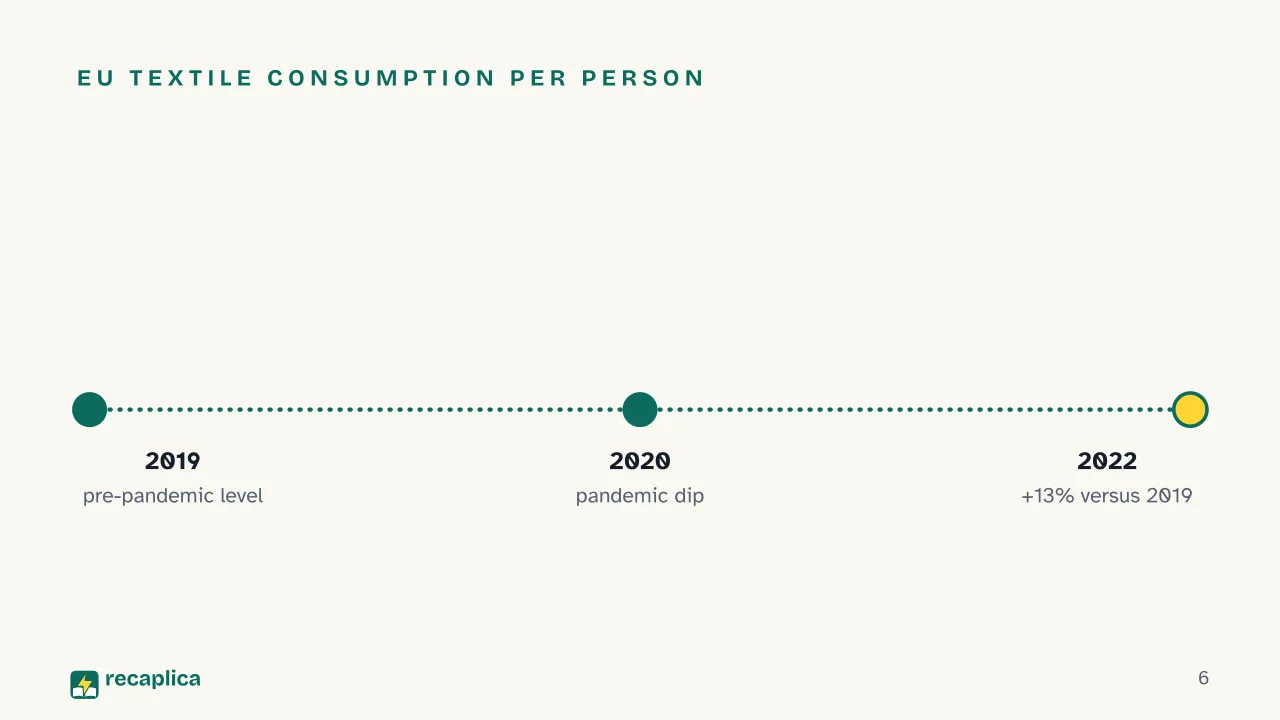
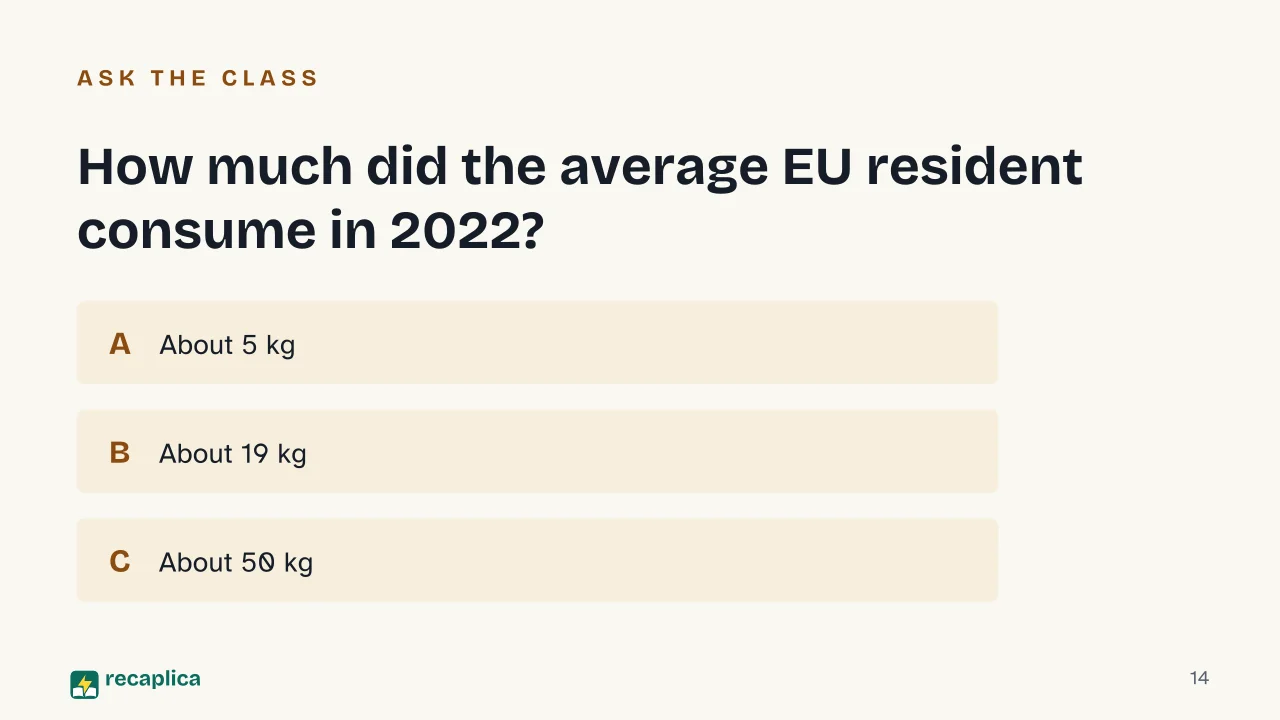
    • In 2022, each person in the European Union consumed on average 19 kg of clothing, footwear and household textiles, 13% more than in 2019.
    • Buying fewer garments and keeping them longer outweighs the choice of a single material, because most of the shedding happens early in a garment's life.

    Key figures

    • 19 kg Average consumption of clothing, footwear and household textiles per person in the European Union in 2022 (8 kg clothing, 4.4 kg footwear, 7.6 kg household textiles). Source: European Environment Agency (EEA), based on Eurostat data
    • +13% Increase in EU textile consumption in 2022 compared with 2019, after the drop recorded in 2020 during the pandemic. Source: European Environment Agency (EEA), based on Eurostat data
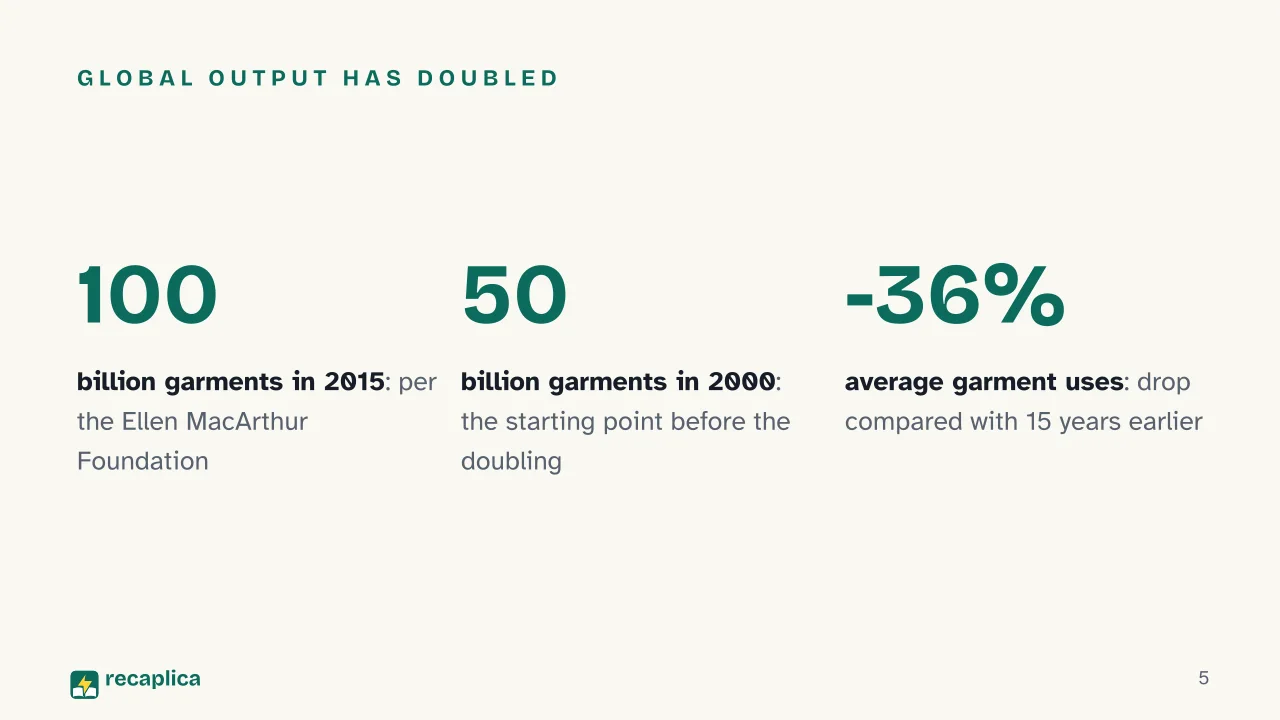
    • 100 billion Garments produced worldwide in 2015, roughly double the 50 billion produced in 2000. Source: Ellen MacArthur Foundation

    Deep Dive

    A production model built for speed

    Fast fashion is a production model that pushes clothing collections to succeed one another far more quickly than they used to, with garments designed to cost little and survive only a few seasons of use. The model also feeds on a supply-and-demand logic that rewards low prices and fast turnaround over how long a garment actually lasts.

    According to the Ellen MacArthur Foundation, worldwide garment production topped 100 billion units in 2015, up from roughly 50 billion in 2000: a doubling in fifteen years. Over the same period, the same source reports, the average number of times a garment gets worn before being discarded dropped 36% compared with fifteen years earlier. More garments made and worn for less time means more fabric flowing through closets and back out again; it is one of the factors behind the parallel rise in textile waste and microfiber shedding as the fast fashion model spread, though not the only one. In Europe, per the European Environment Agency using Eurostat figures, per-person textile consumption kept climbing: in 2022 each EU resident consumed on average about 19 kg of clothing, footwear and household textiles, 13% above the 2019 level, after the dip recorded in 2020.

    Fast fashion’s environmental footprint doesn’t stop at microplastics. Textile production also adds to the greenhouse gas emissions that drive the greenhouse effect, a separate front that the sources behind this Recap don’t quantify in detail.

    Why synthetic fabrics shed microplastics

    Per a 2022 European Environment Agency briefing, around 60% of textile fibers used worldwide are synthetic, meaning derived from petroleum: polyester, nylon and acrylic are the most common. A synthetic fiber is already plastic shaped into thread, and every time the fabric is washed, worn or processed in a factory, microscopic fragments called microfibers break off, a category of microplastics in their own right.

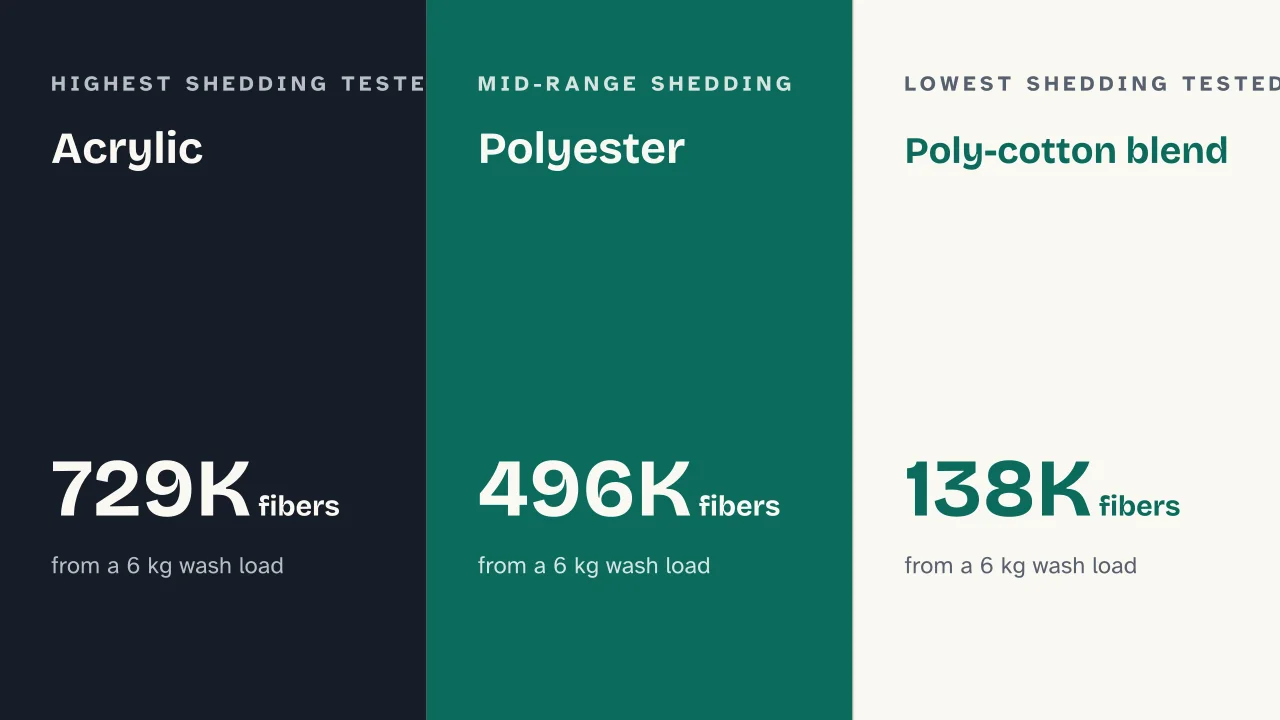
    Real-world example: a 2016 University of Plymouth study (Napper and Thompson, published in Marine Pollution Bulletin) washed 6 kg loads of pure acrylic, pure polyester and a polyester-cotton blend: the acrylic load shed more fibers than the polyester one, and the polyester-cotton blend shed the fewest of the three.

    Fabric testedFibers shed (6 kg load)
    Polyester-cotton blendabout 138,000
    Pure polyesterabout 496,000
    Acrylicabout 729,000

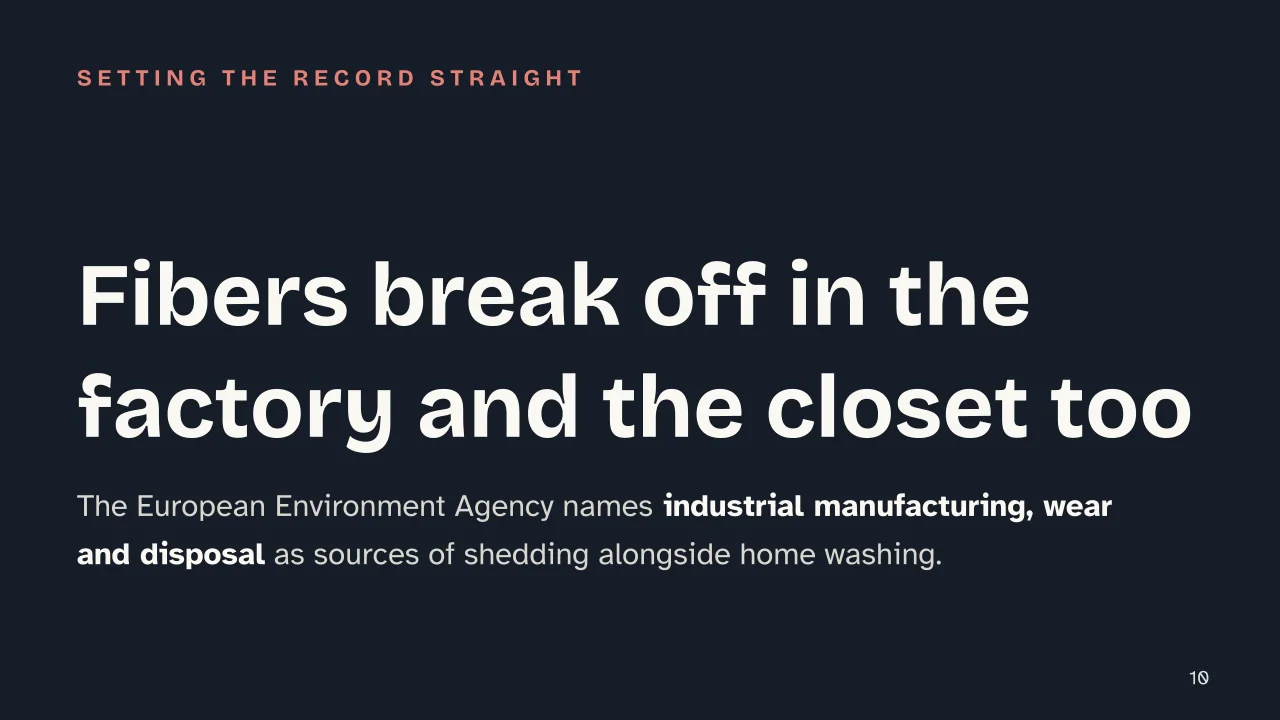
    The heaviest shedding, per the European Environment Agency, happens during the first washes of a new garment, but microfibers also break off before a garment ever reaches the washing machine: during industrial manufacturing, while it’s worn, and once it’s discarded. In Europe this channel accounts for about 8% of total primary microplastics released into water, against a global estimate of 16-35% from the same source: both figures are recurring estimates too, not tied to a specific year, like the tonnage figures further below.

    Where those microfibers end up

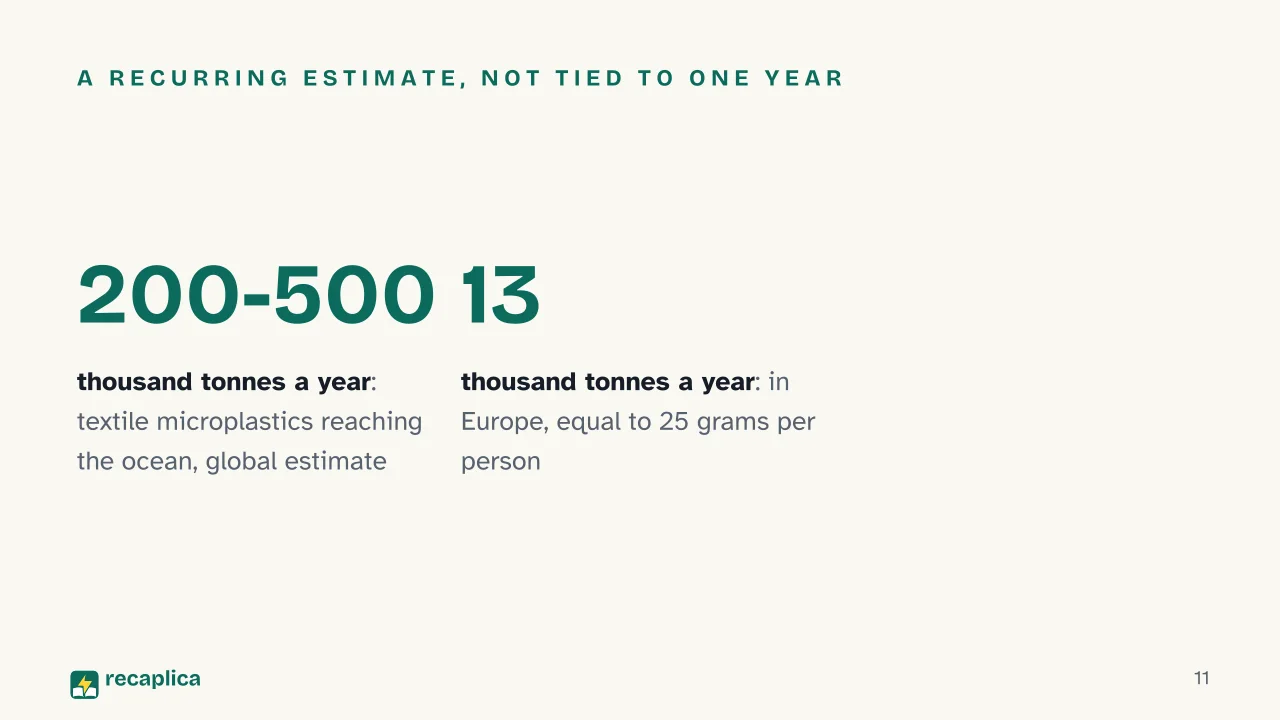
    Loose microfibers travel through wastewater and from there into rivers and seas. The available estimates aren’t tied to a specific year: the European Environment Agency puts global textile microplastics reaching the marine environment at 200,000-500,000 tonnes a year, a figure the same source describes as recurring rather than referring to a single year. For Europe, the same source estimates 13,000 tonnes of textile microfibers reach surface water each year, equal to about 25 grams per person.

    Recycling isn’t already the fix

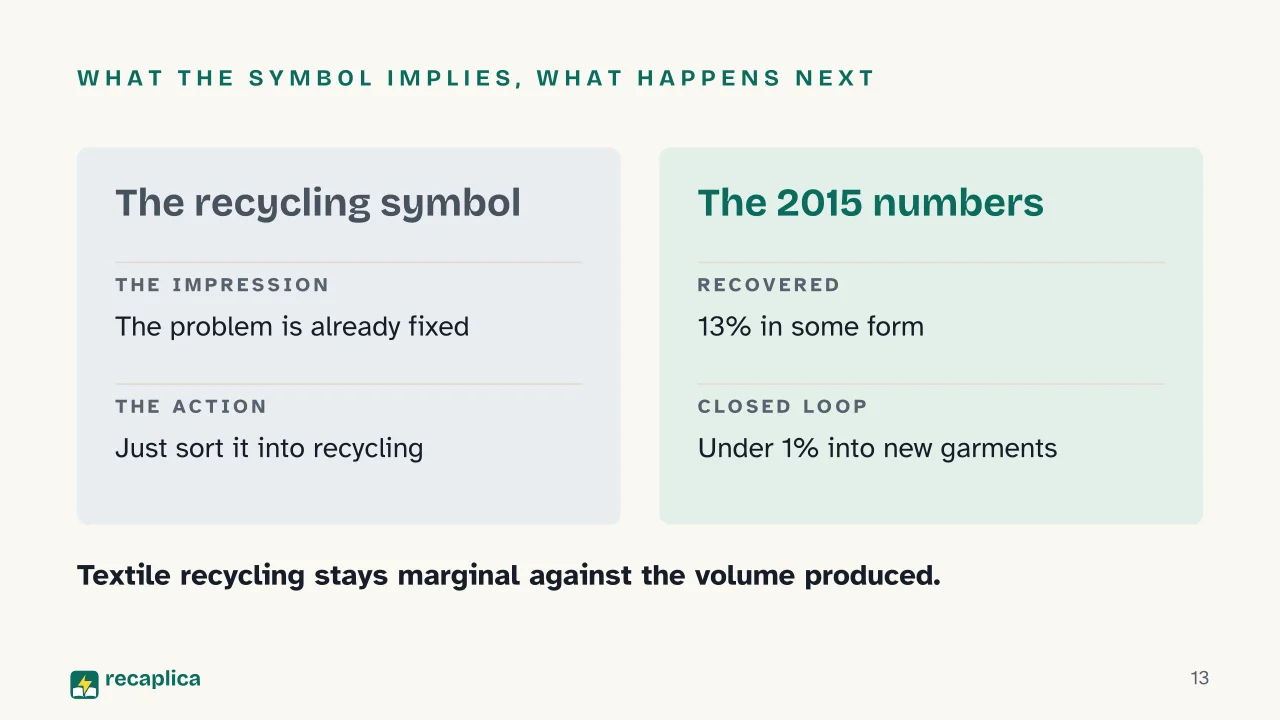
    A recycling symbol on a garment doesn’t mean the problem is already solved. Per the Ellen MacArthur Foundation, in 2015 only 13% of the textile material entering the market was recovered in some form after use, and less than 1% went back into new garments through closed-loop recycling. The rest was incinerated, landfilled or lost: numbers that describe 2015 specifically, but they show how marginal the textile recycling chain still was against the volume of garments produced every year.

    What buyers can actually do

    The sustainable consumption choices that the sources behind this Recap support come down mainly to two levers: how many garments get bought and how long they stay in use. Since most microfiber shedding happens during a garment’s first washes, buying fewer pieces and wearing them longer matters more than the fabric choice of any single purchase. Fabric still counts for something: in the Plymouth study cited above, a fiber blend shed fewer microfibers than pure acrylic in a lab setting, though that result comes from a single test and shouldn’t be generalized to every blended fabric on the market. Plenty of environmental labels and claims circulate too, with varying degrees of rigor; before trusting an “eco friendly” tag on a garment, the same source-checking habits used to spot a fake news story apply here, starting with who certifies the claim and on what data.

    Real-world example: two sweaters, identical in cut and price, can carry different footprints if one is 100% acrylic and the other a wool-polyester blend. The sources behind this Recap can’t say which one is more sustainable overall, but they do show that wash count and length of use weigh as much as fabric composition.

    Slide deck

    Slides ready to download and make your own in PowerPoint or Google Slides, with speaker notes. Pick the Flash cut or the Full one.
    Slide 1 of the presentation on Fast Fashion: Fast FashionSlide 2 of the presentation on Fast Fashion: How many microfibers can a single load of synthetic laundry shed?Slide 3 of the presentation on Fast Fashion: What's aheadSlide 4 of the presentation on Fast Fashion: Chapter 01: How the fast fashion model worksSlide 5 of the presentation on Fast Fashion: Global output has doubledSlide 6 of the presentation on Fast Fashion: EU textile consumption per personSlide 7 of the presentation on Fast Fashion: Chapter 02: Why synthetic fibers shed plasticSlide 8 of the presentation on Fast Fashion: Acrylic · Polyester · Poly-cotton blendSlide 9 of the presentation on Fast Fashion: Chapter 03: Where those microfibers end upSlide 10 of the presentation on Fast Fashion: Fibers break off in the factory and the closet tooSlide 11 of the presentation on Fast Fashion: A recurring estimate, not tied to one yearSlide 12 of the presentation on Fast Fashion: Chapter 04: Choices that actually helpSlide 13 of the presentation on Fast Fashion: What the symbol implies, what happens nextSlide 14 of the presentation on Fast Fashion: How much did the average EU resident consume in 2022?Slide 15 of the presentation on Fast Fashion: The Recap continues on the site
    Flash10 slidesThe essential thread, to present in classFull15 slidesEvery chapter and the deeper detail

    Common myths

    • ✗ Myth Textile microplastics only form when we wash clothes in a washing machine.

      ✓ Reality According to the European Environment Agency, textile manufacturing is already a major source of microfibers, and more break off while garments are worn and at the end of their life, not only during a home wash.

    • ✗ Myth A synthetic garment sheds the same amount of microfibers every time, so it doesn't matter when you wash it.

      ✓ Reality Sources point to the first washes of a new garment as the period of heaviest shedding, according to the European Environment Agency and a 2016 University of Plymouth study of test washes.

    • ✗ Myth If a garment carries a recycling symbol, fast fashion's environmental problem is already solved.

      ✓ Reality According to the Ellen MacArthur Foundation, in 2015 only 13% of textile material entered any form of recycling after use, and less than 1% returned to new garments, so textile recycling stayed marginal compared with the volume produced.

    Mind map

    Drag the background to move around and the nodes to reposition them; use − and + to collapse and expand branches.
    Customize
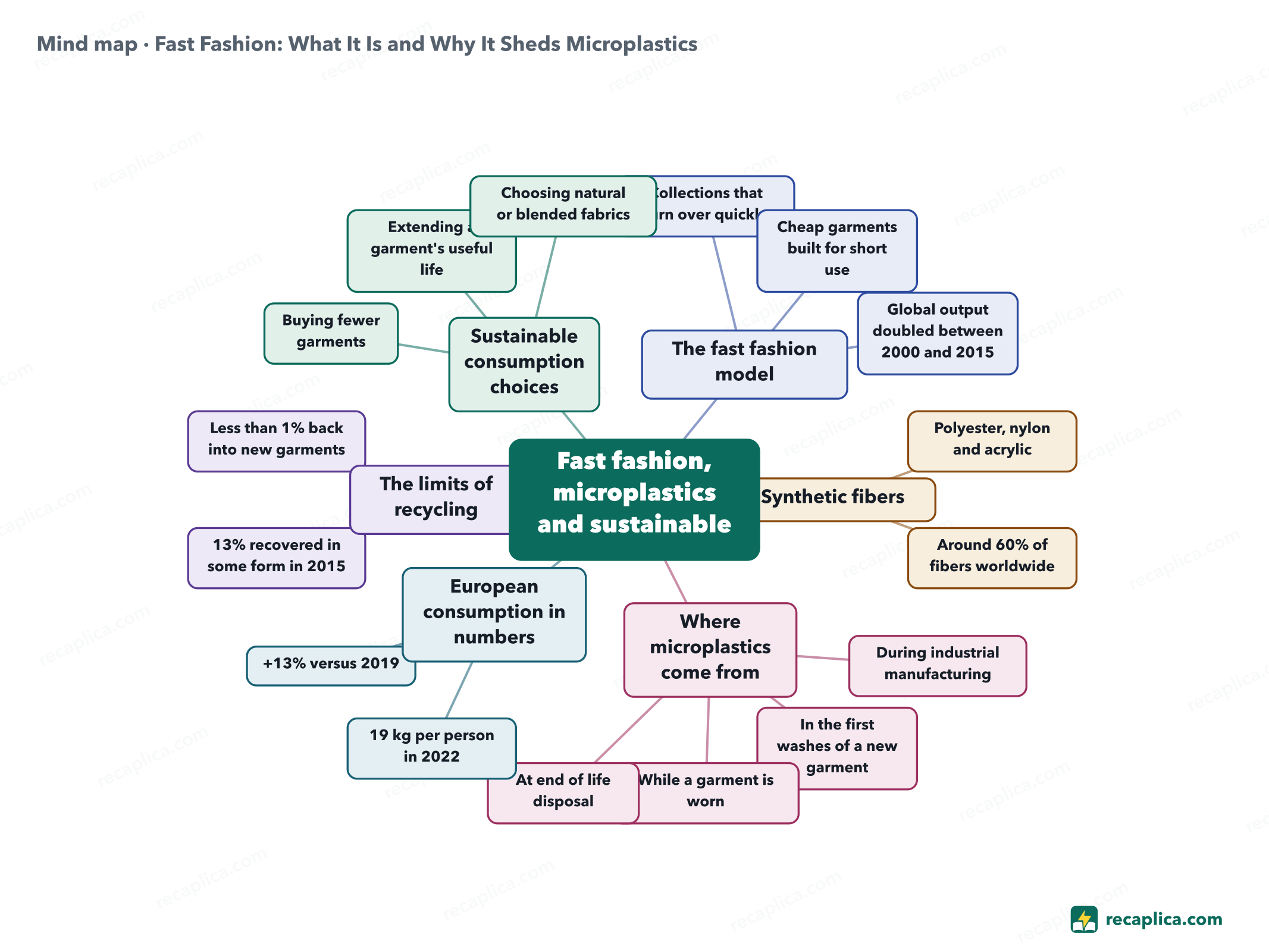
    Mind map: Fast Fashion: What It Is and Why It Sheds Microplastics
    • Fast fashion, microplastics and sustainable choices
      • The fast fashion model
        • Collections that turn over quickly
        • Cheap garments built for short use
        • Global output doubled between 2000 and 2015
      • Synthetic fibers
        • Polyester, nylon and acrylic petroleum-derived
        • Around 60% of fibers worldwide EEA figure, 2022 briefing
      • Where microplastics come from
        • During industrial manufacturing
        • In the first washes of a new garment
        • While a garment is worn
        • At end of life disposal
      • European consumption in numbers
        • 19 kg per person in 2022
        • +13% versus 2019
      • The limits of recycling
        • 13% recovered in some form in 2015
        • Less than 1% back into new garments
      • Sustainable consumption choices
        • Buying fewer garments
        • Extending a garment's useful life
        • Choosing natural or blended fabrics

    Quiz: test yourself

    Answer the questions to check what you have learned: you get instant feedback and a short explanation.

    Grade 0/10 0/5
    1 What is fast fashion?

    Fast fashion describes a production model, not a single brand or a material, built around collections that turn over quickly and garments meant for only a few wears.

    2 True or false, textile microplastics only form during a washing machine cycle.

    According to the European Environment Agency, microfibers also break off during industrial manufacturing and at end-of-life disposal, not just during washing.

    3 Which fabric released the most microfibers in a 6 kg wash load, in a 2016 University of Plymouth test?

    In the 6 kg test load, acrylic shed more fibers than pure polyester and than the polyester-cotton blend, which shed the least of the three.

    4 How much did the average EU resident consume in clothing, footwear and household textiles in 2022?

    According to the European Environment Agency using Eurostat data, average per-person consumption in the EU reached about 19 kg in 2022.

    5 True or false, in 2015 textile recycling already covered most of the material used to make clothes.

    In 2015 only 13% of textile material was recovered in any form after use, and less than 1% returned to new garments, so recycling remained a marginal share.

    Answers: 1-A · 2-B · 3-C · 4-B · 5-B

    Flashcards

    Tap the card to flip it and check whether you remember the answer, then move to the next one.

    1 / 7

    Explain it in your own words

    The ultimate test: if you can explain it in simple words, you've truly understood it. Write your explanation, then compare it with the Recap.

    Your explanation is saved only on this device.

    Fast fashion is the production model that turns over clothing collections far faster than in the past, with cheap garments built for short use. Most fabric in circulation today is synthetic, meaning it is plastic in thread form, such as polyester, nylon or acrylic, and every wash sheds microscopic fibers that travel through wastewater and into the sea: textile microplastics. The European Environment Agency points to the first few washes of a new garment as the most critical moment for that shedding, though fibers also break off during manufacturing and at the end of a garment's life. This Recap explains where the problem starts, how it can be measured, and which consumption choices a reader can weigh, from fabric type to how many times a new garment gets washed.

    Frequently asked questions

    What's the difference between fast fashion and sustainable fashion?

    Fast fashion is built around collections that change rapidly at low prices, with an environmental footprint tied mainly to the sheer volume of garments made and their short useful life. Sustainable fashion works the other way, aiming to reduce that footprint through lower-impact materials, more transparent supply chains and garments designed to last.

    How does fast fashion sustainability actually get measured?

    There's no single scorecard; in practice it comes down to the fibers used, how much water and energy production consumes, and how long a garment stays in use before being discarded. A garment can look sustainable on a label and still fail on any of those three counts.

    Do all fast fashion brands pollute the same amount?

    This Recap draws on sources that look at the fast fashion model as a whole, not at individual brands. How much a garment weighs on the environment depends mostly on the fabric, the number of washes and how long it actually gets worn, more than on the label sewn inside it.

    What does eco friendly clothing actually mean in practice?

    There's no single label recognized across every market; in practice it points to garments made with lower-impact fibers (natural, recycled or blended), production processes that use less water and energy, and a useful life designed to outlast a typical fast fashion piece.

    Does washing synthetic clothes less often solve the microplastics problem?

    It helps reduce shedding in later washes, but it isn't enough on its own. The European Environment Agency notes that microfibers already break off during a garment's first washes and even during manufacturing, so the problem starts before the garment ever reaches a washing machine.

    Sources

    • European Environment Agency, Microplastics from textiles: towards a circular economy for textiles in Europe
    • European Environment Agency, Consumption of clothing, footwear and household textiles per person
    • Ellen MacArthur Foundation, A New Textiles Economy: Redesigning Fashion's Future
    • Phys.org, Thousands of microplastic particles released into the environment from washing machines

    Every Recap goes through an independent review before publication.

    Every evening, the day's new Recaps on our Telegram channel. Join the channel →

    Keep learning

    • Civics Carabinieri Ranks: The Four-Role Hierarchy of the Corps Every member of the Carabinieri sits inside one of four legally defined roles, in force since a 2000 law: Officers, Inspectors, Supervisors, and Corporals and Privates. Promotion happens inside a role first, and the four roles themselves run from the most operational to the most senior. The lowest rank is Carabiniere; the highest is Generale di Corpo d'Armata, in the Officer role. Two abbreviations, Q.S. and C.S., show up next to a handful of ranks — they aren't extra rungs on the ladder, just a qualification attached to the top rank already sitting there. Read the Recap →
    • Civics Codice Fiscale: What It Is, Structure and Everyday Uses The codice fiscale is the code that uniquely identifies a person in every dealing with Italian public bodies and administrations, from healthcare to official paperwork. It is made up of 16 alphanumeric characters derived from the holder's personal data. Only the Agenzia delle Entrate, Italy's tax agency, can issue a valid one: any code generated by an outside tool has no official standing. The system dates back to 1973, created by the same decree that set up Italy's taxpayer register. It is a different thing from the partita IVA, which identifies an economic activity. Read the Recap →
    • Civics Italian Government Structure: Which Bodies Do What The Italian state rests on five bodies that the Constitution sets up and regulates directly: Parliament makes the laws, the Government carries them out, the President of the Republic represents national unity, the judiciary applies the law to individual cases, and the Constitutional Court checks that laws respect the Constitution. Alongside them sit four bodies of constitutional relevance — the High Council of the Judiciary, the Court of Auditors, the CNEL and the Council of State — auxiliary bodies the Constitution sets up but keeps in a separate category from the five essential ones. Knowing who does what, and which bodies the system cannot run without, is the fastest way into how Italy is actually governed. Read the Recap →

    recaplica

    Clear in 30 seconds, yours in 10 minutes.

    Recaps Mind maps Request a Recap Telegram channel Mind map maker Our method About Privacy & cookies Legal notes & terms of use

    © 2026 Recaplica · A project by Curi S.r.l. — VAT IT05472000750

    Statistics, only if you say so

    To learn which Recaps help most we would use Google Analytics, with aggregate, anonymous data. It starts only with your OK, and you can change your mind anytime. Privacy policy