Skip to content
recaplica

    One moment: security check

    Cloudflare wants to make sure you're not a robot. Tick the box below and your search will continue on its own.

    IT
    recaplica Window frame materials compared: wood, steel, uPVC and aluminium
    © 2026 Recaplica · recaplica.com — All rights reserved
    Home › Science

    Window frame materials compared: wood, steel, uPVC and aluminium

    By Recaplica Newsroom · Updated on September 5, 2026

    What to print

    Page numbers appear when printing with default margins.

    Slides

    Choose a cut

    Flash10 slidesThe essential thread, to present in classFull19 slidesEvery chapter and the deeper detail

    Both come with speaker notes.

    Telegram channel
    recaplica Clear in 30 seconds, yours in 10 minutes.
    In 30 seconds Key points Figures Deep dive Slides Myths Mind map Quiz Flashcards FAQ

    In 30 seconds quick read

    Wood, iron/steel, uPVC and aluminium behave very differently in a window frame, and the reason is materials science: every substance conducts heat at a different rate and reacts differently to moisture and oxygen. Aluminium on its own would be a poor insulator, but a plastic interruption in the profile — the thermal break — makes it competitive with wood and uPVC. Unprotected iron rusts, but a zinc coating can protect it for decades by corroding in its place. None of the four materials, though, decides on its own how well a window insulates: the glazing and the frame technology matter too.

    Key Points

    • Thermal transmittance U (in W/m²K) measures how much heat passes through a material: the lower the value, the better it insulates.
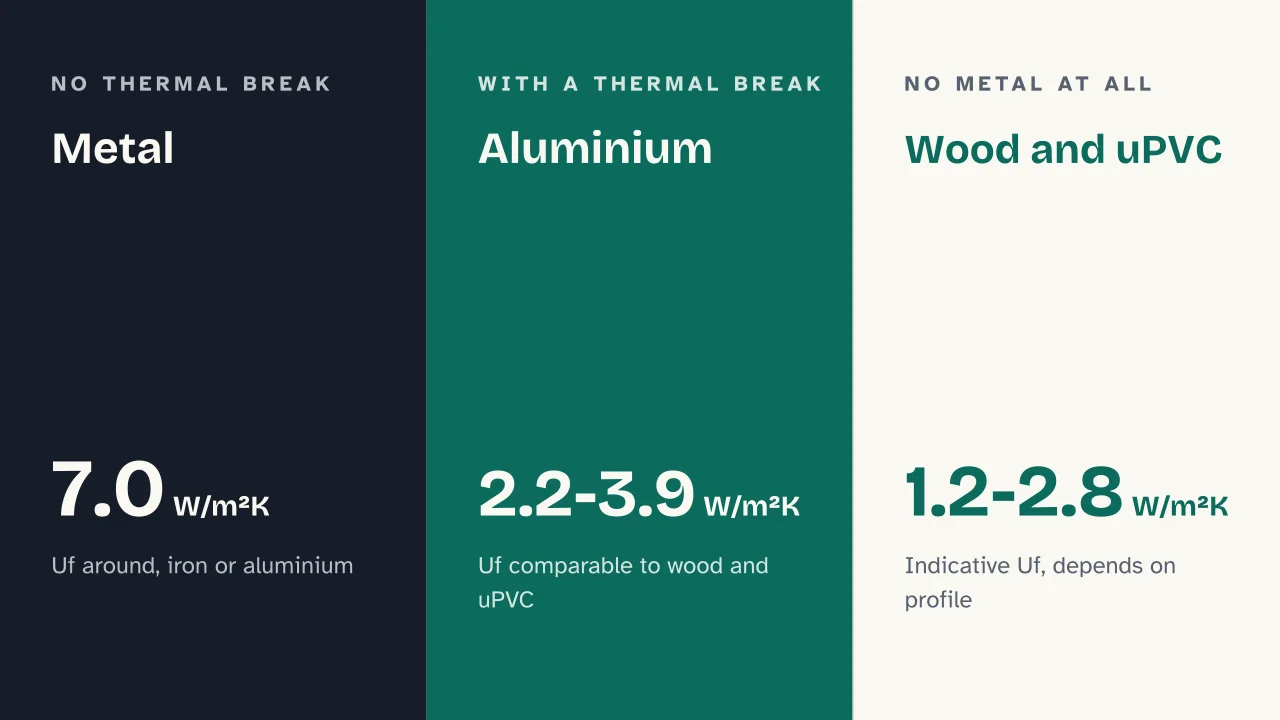
    • A metal frame without a thermal break has a transmittance (Uf) of around 7.0 W/m²K, against indicative values between 1.2 and 2.8 W/m²K for wood and uPVC.
    • The thermal break — a plastic interruption inside the metal profile — brings aluminium's transmittance down to 2.2-3.9 W/m²K, a level comparable to wood and uPVC.
    • Iron and steel are protected from corrosion by hot-dip galvanizing: the zinc oxidizes in place of the iron (sacrificial protection).
    • Recycling aluminium takes about 5% of the energy needed to produce it from virgin raw material.
    • The frame material alone doesn't decide how well a window insulates: the type of glazing and the thermal-break technology matter too.

    Key figures

    • 7.0 W/m²K the thermal transmittance (Uf) of a whole metal frame with no thermal break — an almost identical value for both iron and aluminium, even though aluminium conducts heat almost 3 times more Source: ENEA, based on UNI EN ISO 10077-1/Annex F
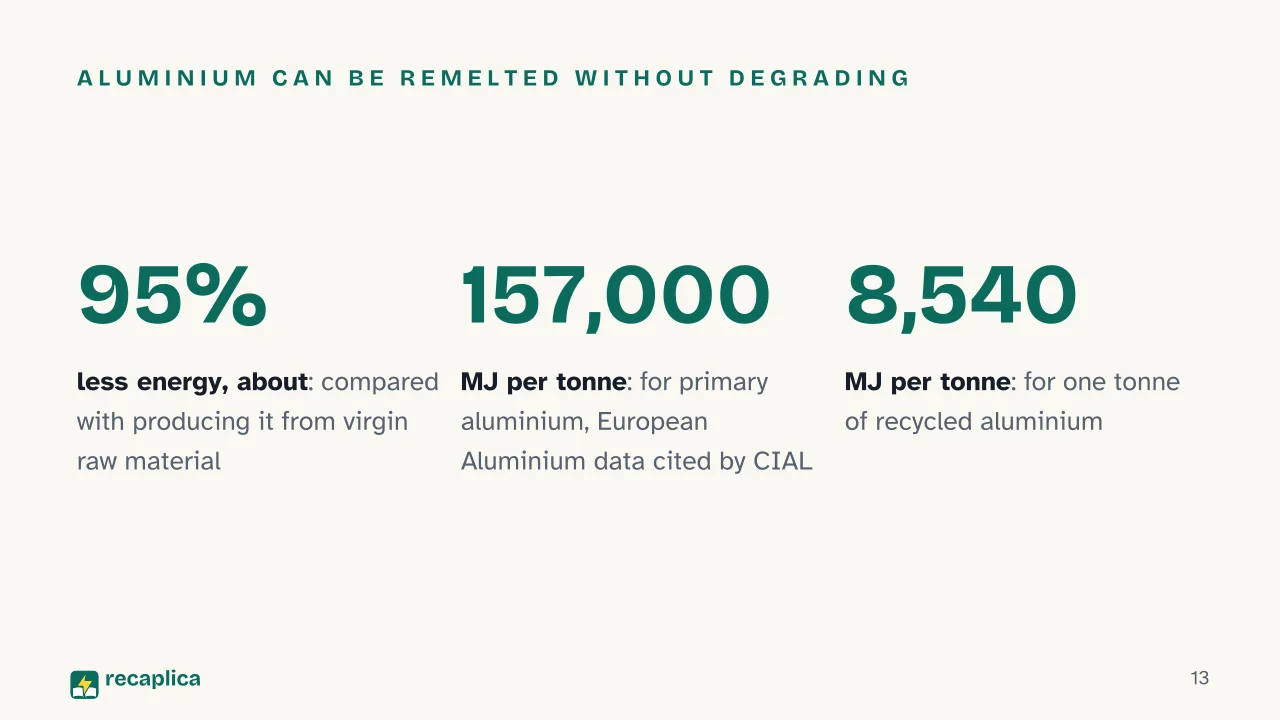
    • 95% the energy saved by recycling aluminium instead of producing it from virgin raw material (8,540 MJ per recycled tonne against 157,000 MJ per tonne of primary aluminium) Source: CIAL, European Aluminium LCI data (April 2013)
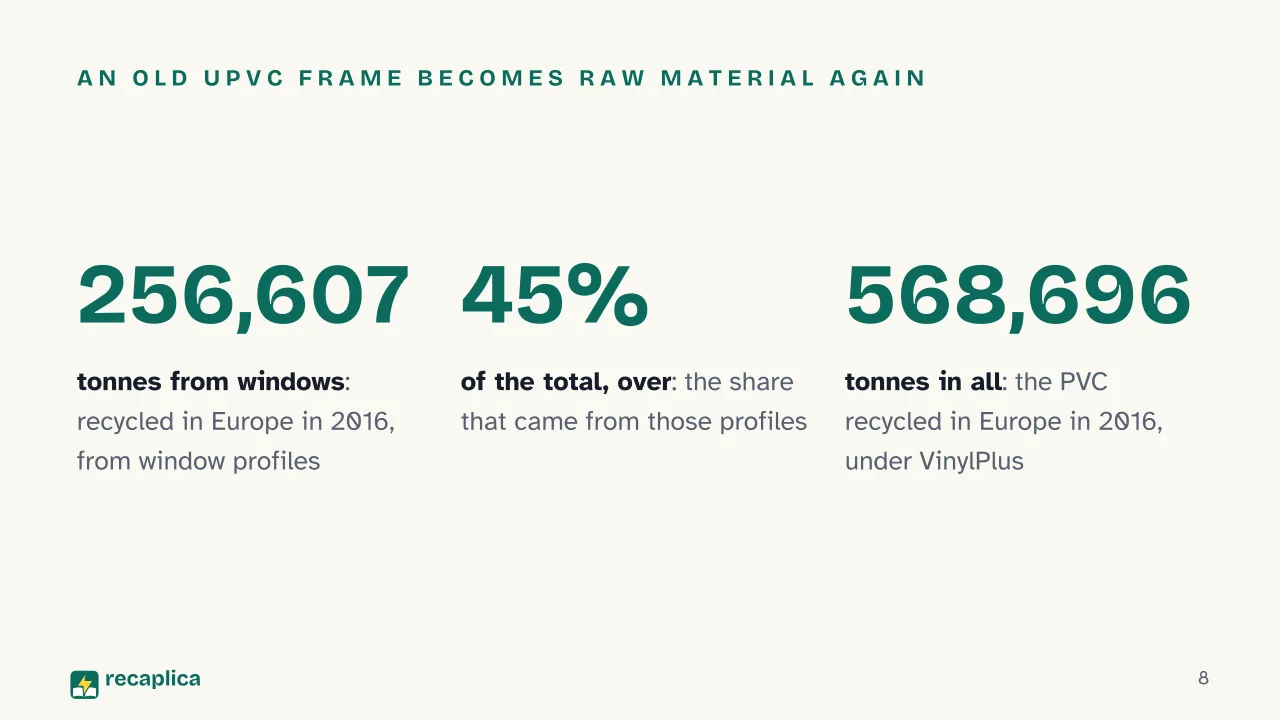
    • 256,607 tonnes the PVC recycled in Europe in 2016 that came from window profiles and related products, over 45% of all PVC recycled that year on the continent Source: PVC Forum Italia / VinylPlus

    Deep Dive

    Heat doesn’t pass through every material the same way

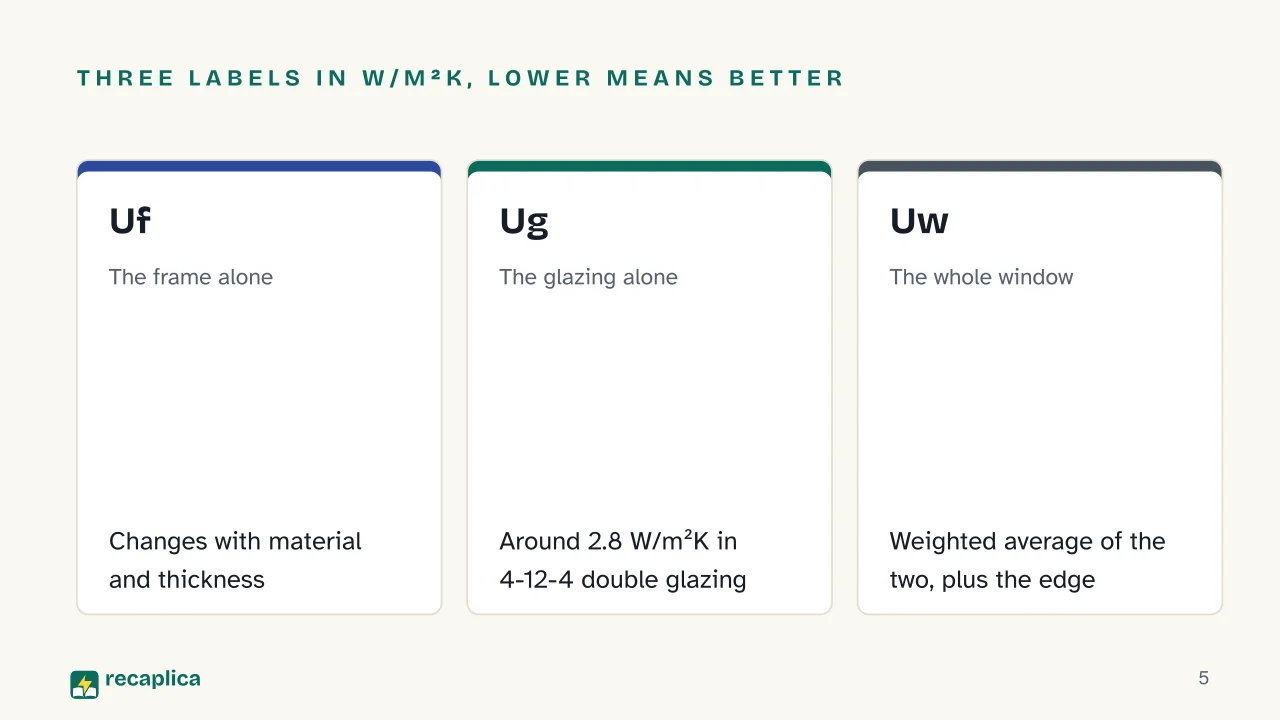
    When people talk about how well a window insulates, the number that matters is thermal transmittance U: the flow of heat that passes, per square meter of surface, through a structure separating two environments at different temperatures. It’s measured in W/m²K, and the lower the number, the better the structure insulates. For a whole window this overall transmittance is called Uw, and it’s a weighted average between the transmittance of the frame (Uf) and that of the glazing (Ug), plus a small contribution from the interaction between frame, glazing and spacer along the edge of the glass pane.

    The reason wood, uPVC, iron and aluminium behave so differently in this calculation is basic materials physics: every substance has a different thermal conductivity (λ), meaning it transports heat at a different speed whenever there’s a temperature difference between its two faces. It’s the same principle that governs how thermal energy enters and leaves any physical system, from a window frame to the planet’s atmosphere described in the article on the greenhouse effect: the materials and the scales change, but heat always moves according to the same laws.

    Wood: it insulates well because it conducts little heat

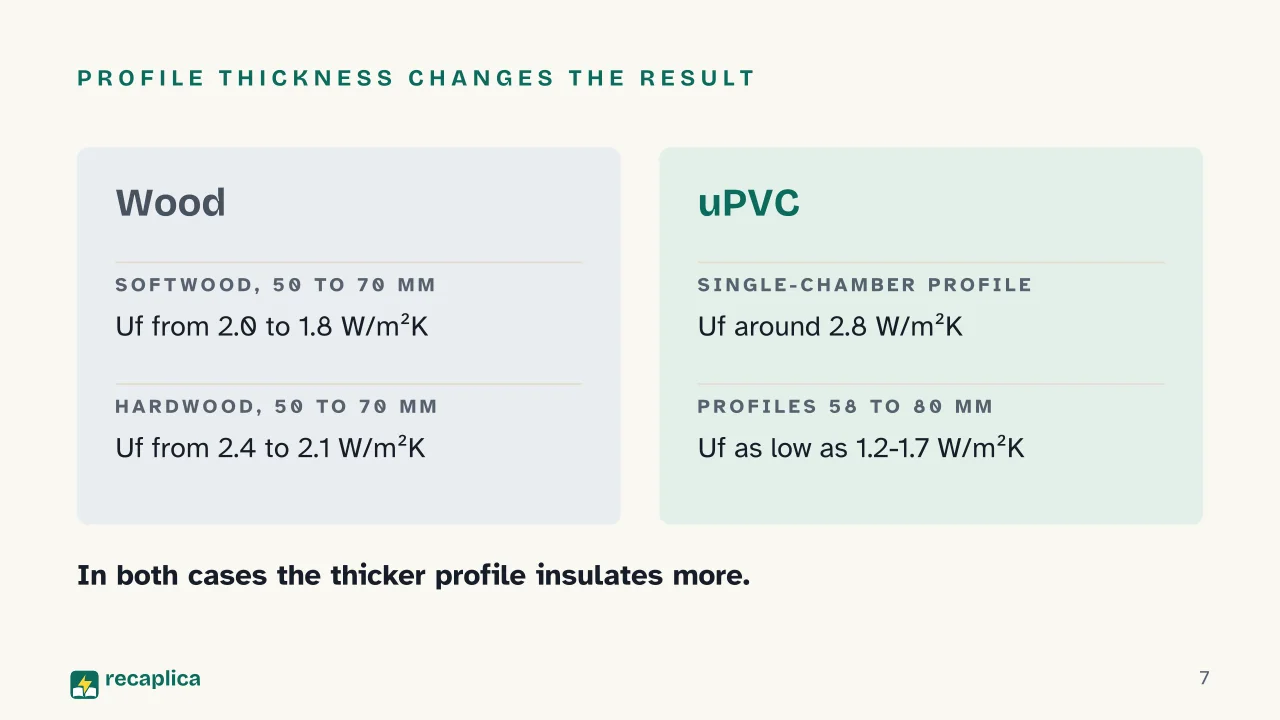
    Wood has an intrinsically low thermal conductivity: around 0.126 W/m·K for spruce, 0.18 for oak, down to 0.079 for chipboard. Translated into frame transmittance, a softwood profile (pine, spruce, larch) has an Uf that starts at 2.0 W/m²K for a 50 mm thickness and drops to 1.8 W/m²K for 70 mm profiles; hardwood (oak, mahogany) starts higher, from 2.4 W/m²K at 50 mm down to 2.1 W/m²K at 70 mm. Other technical estimates place wood in a wider range, between 1.5 and 2.6 W/m²K depending on the profile’s thickness.

    uPVC: internal air chambers and a recycling supply chain few expect

    uPVC has an equally low thermal conductivity, between 0.12 and 0.17 W/m·K. Modern profiles aren’t a solid block of material but a structure with two or three internal chambers, separated by webs that trap still air: this lowers the frame’s transmittance further, ranging from about 2.8 W/m²K for a single-chamber profile down to 2.0-2.2 for two- or three-chamber profiles, and as low as 1.2-1.7 W/m²K in thicker profiles (58-80 mm).

    uPVC is often seen as a plastic destined for the landfill, but its recycling supply chain is far more structured than it looks. In 2016 alone, under VinylPlus, 568,696 tonnes of PVC were recycled in Europe; of these, 256,607 tonnes — over 45% of the total — came from window profiles and related products, thanks to programs such as Recovinyl and EPPA. A dismantled frame doesn’t become waste; it becomes raw material again: once cleaned and ground down into a fine powder, it can be reworked with virgin resin into a completely new profile. A dedicated initiative, the Hybrid Project, also tracks the recycling of composite PVC-aluminium and PVC-wood profiles.

    Iron and steel: high conductivity, and corrosion that can be prevented

    Iron and steel conduct heat far more than the materials above — between 50 and 73 W/m·K, against 0.1-0.2 for wood and uPVC — and a whole metal frame, with no interruption at all, has a transmittance (Uf) of around 7.0 W/m²K: the highest value among the materials considered here.

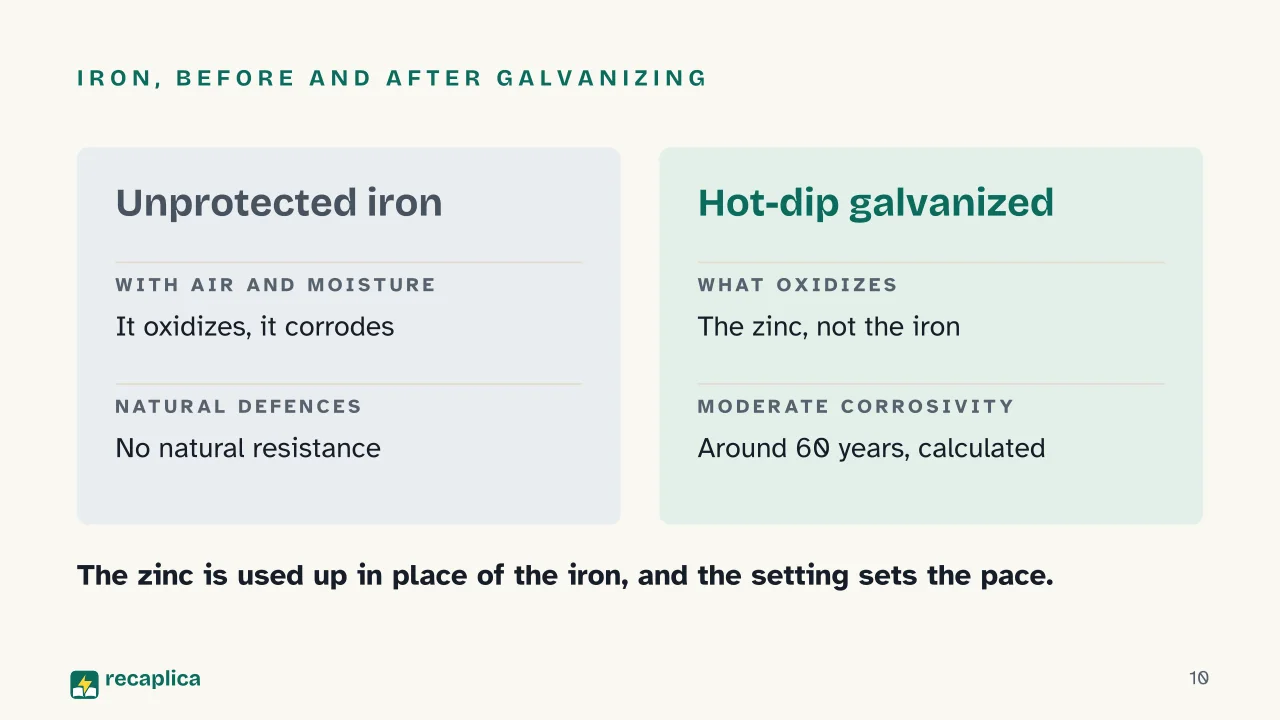
    Iron’s best-known problem, though, isn’t insulation but corrosion. The oxidation of iron on contact with air and moisture — a phenomenon that depends on the presence of water in the environment, the same element that circulates constantly between the atmosphere, the surface and the ground in the water cycle — is countered with hot-dip galvanizing, governed by the EN ISO 1461 standard. The mechanism is a “sacrificial” protection: the zinc oxidizes in place of the underlying iron, because it oxidizes much more slowly than bare iron. The EN ISO 14713-1 standard assigns each environmental corrosivity class a thickness loss in micrometers per year; for a steel item thicker than 6 mm, in a moderately corrosive environment (class C3, typical of urban or non-aggressive industrial settings), a zinc thickness of 40-121 µm and an average annual loss of 1.4 µm give a calculated durability of around 60 years. Real-world durability, however, varies a lot with the environment: a coastal, saline or aggressive industrial setting consumes the zinc much faster than the example above.

    Aluminium: the metal that conducts the most, but can be interrupted

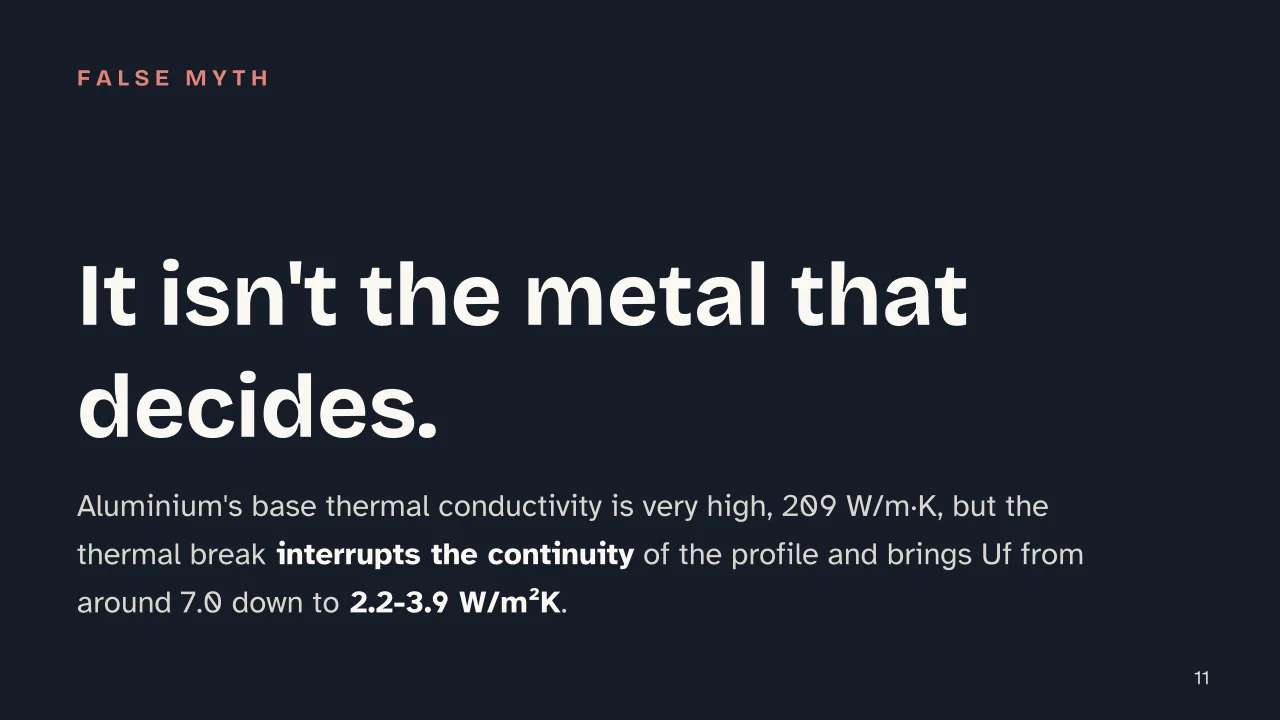
    Aluminium is the material with the highest thermal conductivity among those considered here, 209 W/m·K — almost three times that of iron. An unprotected aluminium frame therefore has a very high transmittance, between 5.2 and 7.0 W/m²K depending on the technical source.

    Here comes the most counterintuitive figure of all: despite aluminium conducting heat almost three times more than iron, a whole iron frame and an aluminium frame without a thermal break end up at practically the same Uf, around 7.0 W/m²K. What really decides a metal frame’s heat loss, then, isn’t so much the metal’s “base” conductivity as whether it has a thermal break: a plastic interruption that breaks the continuity of the metal profile and drastically reduces the thermal bridge. With a thermal break, aluminium’s transmittance drops into a range between 2.2 and 3.9 W/m²K (technical sources don’t fully agree on the exact limits: 2.2 to 3.8 according to ENEA, 2.4 to 3.9 according to ACCA) — a level comparable to wood and uPVC, achieved not by changing the metal but by interrupting it.

    Aluminium also has another strength, this time tied to its end of life: it can be melted down and reworked without losing its mechanical properties, so in principle it can be recycled indefinitely. According to European Aluminium data cited by the Italian consortium CIAL, producing one tonne of primary aluminium takes around 157,000 MJ of energy, against the 8,540 MJ needed for one tonne of recycled aluminium: an energy saving of about 95%. In 2020, recycling 47,400 tonnes of aluminium packaging, with an 87% melting efficiency, avoided the emission of 355,000 tonnes of CO₂ equivalent. These figures are specific to packaging, not window profiles, but the underlying chemical principle — aluminium can be remelted without degrading — holds for any object made of this metal.

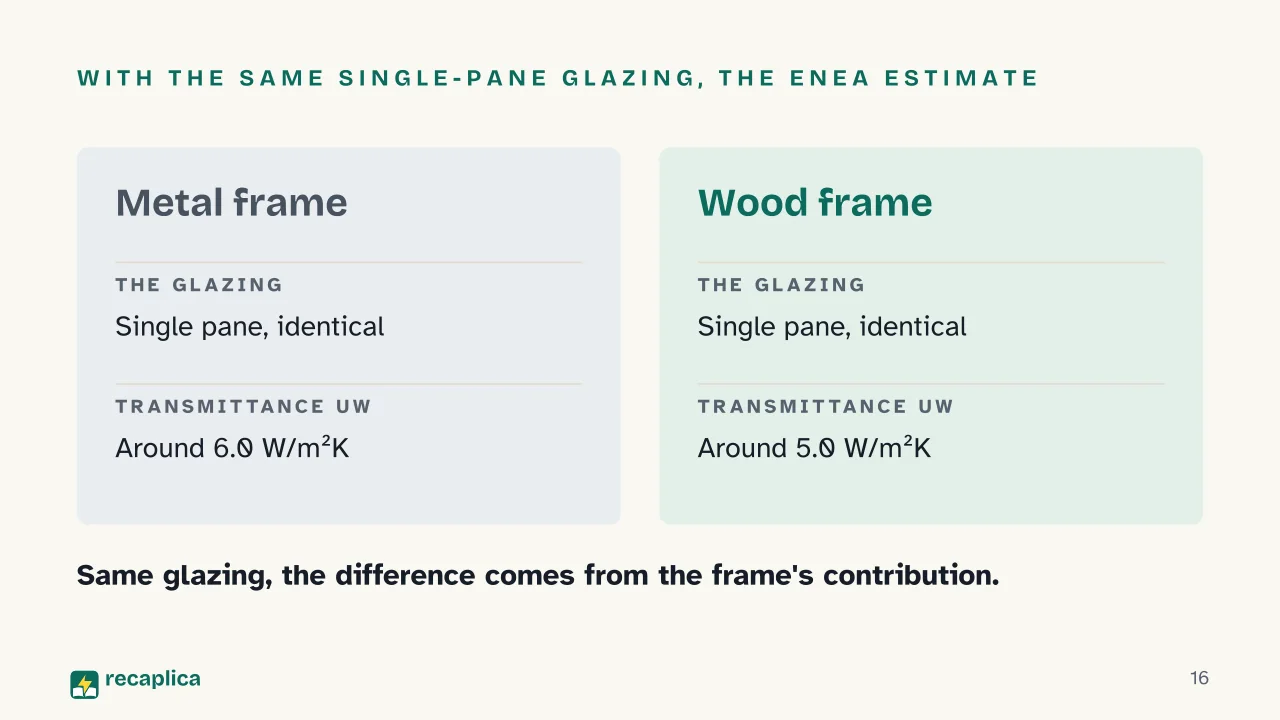
    Practical example: ENEA estimates that, for the same single-pane glazing, an existing window with a whole metal frame has an overall transmittance (Uw) of around 6.0 W/m²K, while one with a wood frame comes in at around 5.0 W/m²K: the difference between the two comes entirely from the frame’s contribution, since the glazing is identical in both cases.

    The comparison in a table

    MaterialMaterial’s thermal conductivity (λ, W/m·K)Typical frame transmittance (Uf, W/m²K)
    Wood0.08 – 0.181.5 – 2.6
    uPVC0.12 – 0.171.2 – 2.8
    Aluminium with thermal break209 (of the pure metal)2.2 – 3.9
    Aluminium without thermal break2095.2 – 7.0
    Iron/steel without thermal protection50 – 73around 7.0

    Values vary from source to source because they depend on profile thickness, wood species and the number of uPVC chambers: they should be read as indicative orders of magnitude, not as single absolute figures.

    The frame material doesn’t decide everything

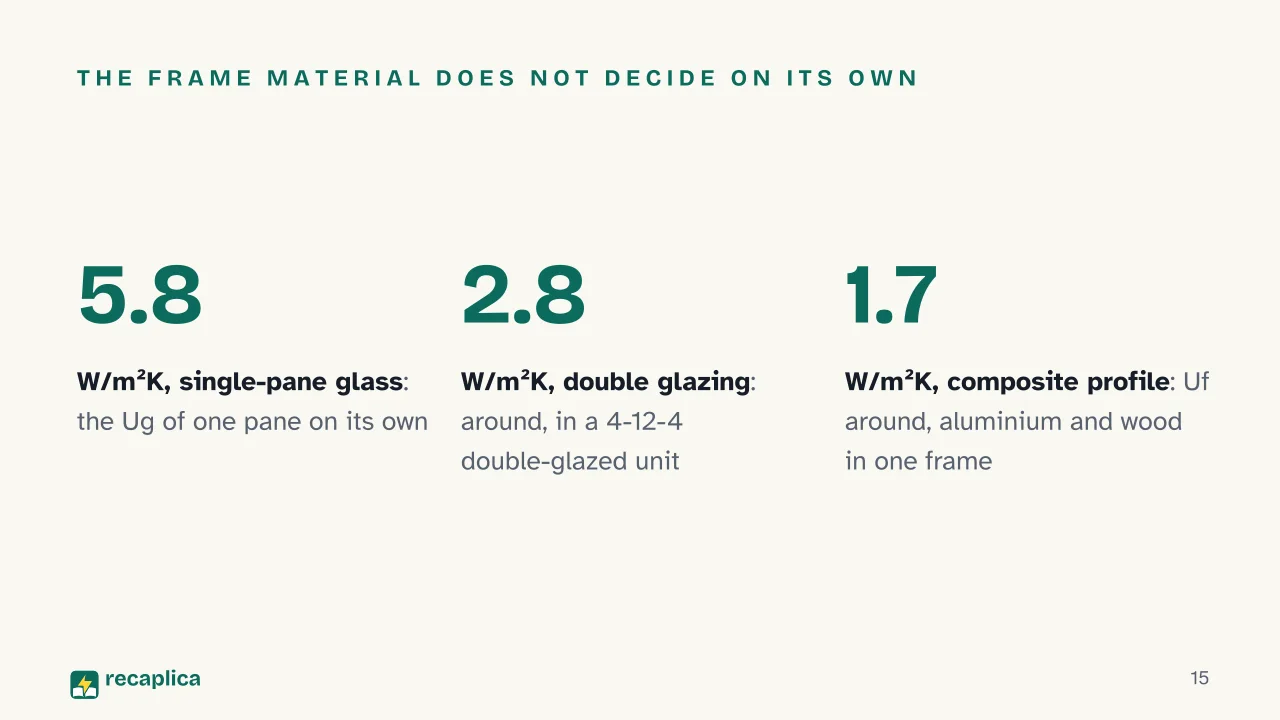
    The same technical sources that report these values flag an important limit: the frame material alone doesn’t determine how well a finished window insulates. The thermal-break technology (how wide it is, what plastic it’s made of) and the type of glazing — single pane, double glazing, with or without inert gases such as argon or krypton in the cavity — matter a great deal too. A 4-12-4 double-glazed unit, for example, has a Ug of around 2.8 W/m²K against 5.8 W/m²K for single-pane glass: a difference that can matter as much as, or more than, the chosen frame material.

    “Composite” or “mixed” profiles also exist, combining two materials in the same frame — typically aluminium and wood, to bring together the metal’s resistance to the elements with the wood’s insulating capacity — with a frame-only transmittance (Uf) of around 1.7 W/m²K; a complete window with this kind of frame and double glazing reaches an overall transmittance (Uw) of around 2.5 W/m²K instead.

    Regulation: when transmittance becomes a legal requirement

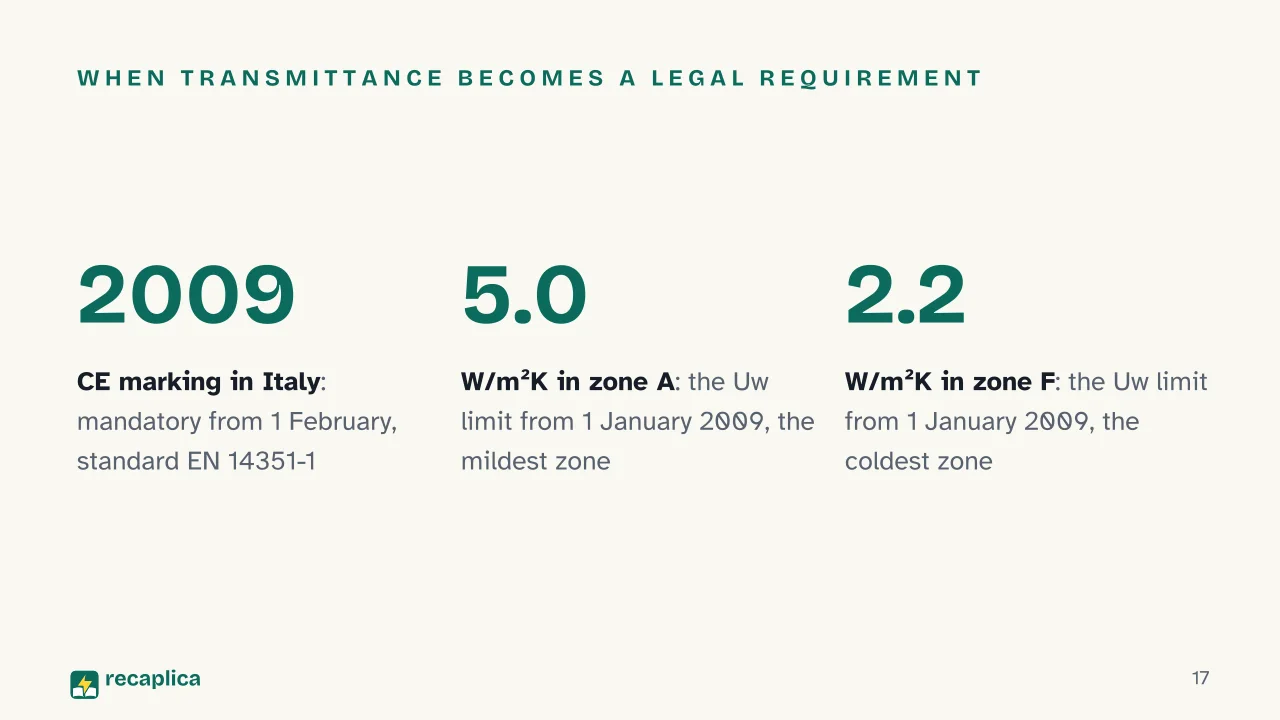
    In Italy, CE marking of windows has been mandatory since 1 February 2009 for all manufacturers, regardless of company size, under the product standard EN 14351-1. Legislative Decree 192/2005 (Annex C), which transposed European directive 2002/91/EC, also set maximum transmittance (Uw) limits for transparent closures including window frames, in force from 1 January 2009 and differentiated by climate zone: from the 5.0 W/m²K allowed in zone A (the mildest) to the 2.2 W/m²K required in zone F (the coldest). These values are calculated following the EN ISO 10077-1 standard (simplified method) and EN ISO 10077-2 (finite-element calculation, for more complex cases).

    Looking at these conductivity and transmittance numbers also helps illustrate a broader principle of materials science: every substance responds to heat differently because its internal structure — how its atoms are arranged, how freely its particles can move — decides how quickly thermal energy can pass through it. It’s the same principle, applied at a completely different scale, that explains why chocolate melts at one precise temperature and not another: a material’s chemical composition, not just its shape, decides how it reacts to heat.

    Slide deck

    Slides ready to download and make your own in PowerPoint or Google Slides, with speaker notes. Pick the Flash cut or the Full one.
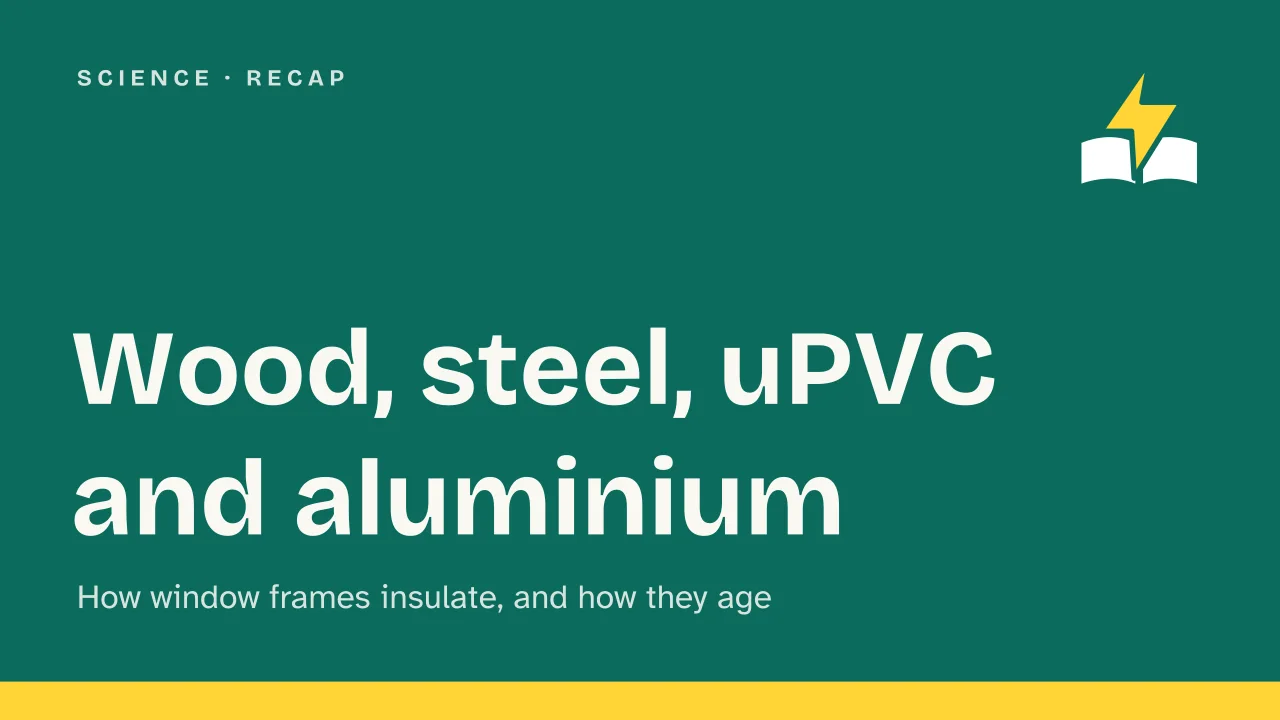
    Slide 1 of the presentation on Window frame materials compared: Wood, steel, uPVC and aluminiumSlide 2 of the presentation on Window frame materials compared: What decides how well a window insulates?Slide 3 of the presentation on Window frame materials compared: What we will coverSlide 4 of the presentation on Window frame materials compared: Chapter 01: The number that mattersSlide 5 of the presentation on Window frame materials compared: Three labels in W/m²K, lower means better: Uf, Ug, UwSlide 6 of the presentation on Window frame materials compared: Chapter 02: Wood and uPVCSlide 7 of the presentation on Window frame materials compared: Profile thickness changes the resultSlide 8 of the presentation on Window frame materials compared: An old uPVC frame becomes raw material againSlide 9 of the presentation on Window frame materials compared: Chapter 03: Iron and aluminiumSlide 10 of the presentation on Window frame materials compared: Iron, before and after galvanizingSlide 11 of the presentation on Window frame materials compared: It isn't the metal that decides.Slide 12 of the presentation on Window frame materials compared: Metal · Aluminium · Wood and uPVCSlide 13 of the presentation on Window frame materials compared: Aluminium can be remelted without degradingSlide 14 of the presentation on Window frame materials compared: Chapter 04: Not just the frameSlide 15 of the presentation on Window frame materials compared: The frame material does not decide on its ownSlide 16 of the presentation on Window frame materials compared: With the same single-pane glazing, the ENEA estimateSlide 17 of the presentation on Window frame materials compared: When transmittance becomes a legal requirementSlide 18 of the presentation on Window frame materials compared: Besides the frame material, what really decides a window's transmittance?Slide 19 of the presentation on Window frame materials compared: And now, the review
    Flash10 slidesThe essential thread, to present in classFull19 slidesEvery chapter and the deeper detail

    Common myths

    • ✗ Myth uPVC is a "throwaway" material that isn't really recycled.

      ✓ Reality It actually has a structured industrial recycling supply chain: in 2016, under VinylPlus, 568,696 tonnes of PVC were recycled in Europe, of which 256,607 (over 45%) came from window profiles and related products. The trick is that rigid uPVC can become raw material again: once cleaned and ground into a fine powder, it can be reworked with virgin resin into a completely new profile.

    • ✗ Myth Aluminium is always a poor insulator because it's a metal.

      ✓ Reality Its base thermal conductivity (209 W/m·K) is very high, but the thermal break — a plastic interruption in the profile — breaks the continuity of the metal and reduces transmittance (Uf) from around 7.0 down to a range of 2.2-3.9 W/m²K, comparable to wood and uPVC. It isn't the metal itself that decides, but whether the thermal bridge has been interrupted or not.

    • ✗ Myth Iron or steel, once installed, need no maintenance and last forever.

      ✓ Reality Without protection, iron corrodes on contact with air and moisture. Hot-dip galvanizing protects it through a sacrificial mechanism, in which zinc oxidizes in place of the underlying iron: in a moderately corrosive environment (class C3) the calculated durability is around 60 years, but it drops a lot in coastal, saline or aggressive industrial environments.

    Mind map

    Drag the background to move around and the nodes to reposition them; use − and + to collapse and expand branches.
    Customize
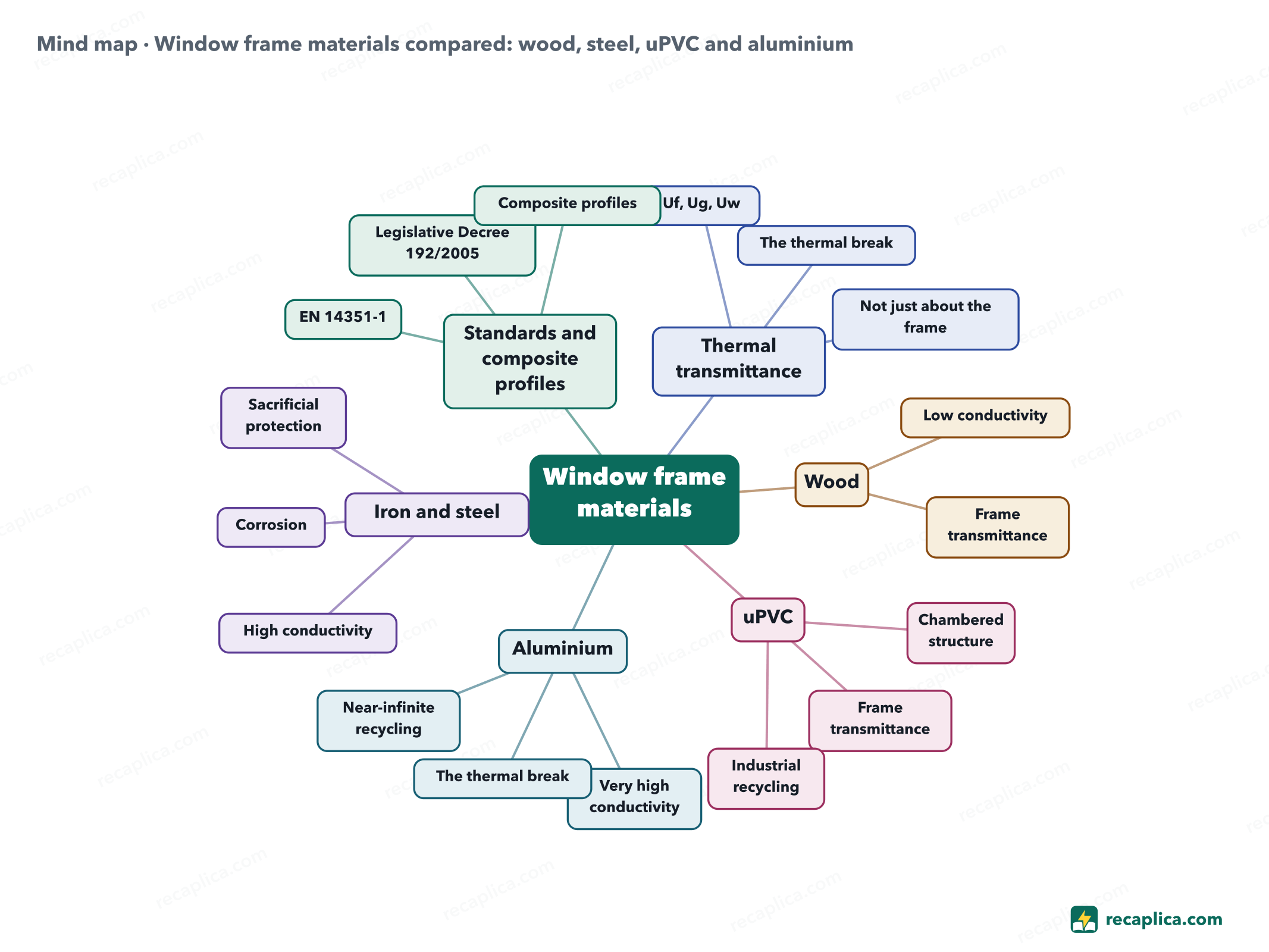
    Mind map: Window frame materials compared: wood, steel, uPVC and aluminium
    • Window frame materials
      • Thermal transmittance
        • Uf, Ug, Uw frame, glazing, whole window
        • The thermal break interrupts the continuity of the metal
        • Not just about the frame glazing and spacer matter too
      • Wood
        • Low conductivity around 0.126 W/m·K for spruce, 0.18 for oak
        • Frame transmittance roughly between 1.5 and 2.6 W/m²K
      • uPVC
        • Chambered structure two or three internal air chambers in the profile
        • Frame transmittance from about 1.2 to 2.8 W/m²K depending on the profile
        • Industrial recycling over 256,000 tonnes from window profiles in 2016
      • Aluminium
        • Very high conductivity 209 W/m·K, among the highest of common metals
        • The thermal break brings Uf from about 7.0 down to 2.2-3.9 W/m²K
        • Near-infinite recycling 95% energy saving compared to primary production
      • Iron and steel
        • High conductivity between 50 and 73 W/m·K
        • Corrosion prevented with hot-dip galvanizing
        • Sacrificial protection the zinc oxidizes in place of the iron
      • Standards and composite profiles
        • EN 14351-1 CE marking mandatory in Italy since 1 February 2009
        • Legislative Decree 192/2005 transmittance limits by climate zone from 2009
        • Composite profiles aluminium and wood together, Uf 1.7, Uw 2.5

    Quiz: test yourself

    Answer the questions to check what you have learned: you get instant feedback and a short explanation.

    Grade 0/10 0/5
    1 An unprotected iron frame and an aluminium frame without a thermal break have a very similar thermal transmittance (Uf), around 7.0 W/m²K. Why, if aluminium conducts heat almost 3 times more than iron?

    The metal's base conductivity matters less than it seems: what really decides a metal frame's transmittance is whether it has a thermal break, the plastic interruption that breaks the profile's continuity.

    2 What is the "thermal break" in an aluminium frame?

    The thermal break physically interrupts the continuity of the metal with a plastic profile: it drastically reduces the thermal bridge and brings aluminium's transmittance down from around 7.0 to 2.2-3.9 W/m²K.

    3 What chemical mechanism does hot-dip galvanizing use to protect iron and steel from corrosion?

    Zinc oxidizes much more slowly than bare iron and corrodes in its place: in a moderately corrosive environment (class C3), a typical galvanized coating gives a calculated durability of around 60 years, though it varies a lot with the environment.

    4 True or false: recycling aluminium takes about 5% of the energy needed to produce it from virgin raw material.

    According to European Aluminium data cited by CIAL, producing one tonne of primary aluminium takes 157,000 MJ against 8,540 MJ for one tonne of recycled aluminium: about 95% less energy.

    5 What else, besides the frame material, really decides a window's overall thermal transmittance (Uw)?

    The technical sources say so explicitly: the frame material alone doesn't decide everything, the thermal-break technology and the type of double glazing it's paired with matter a great deal too.

    Answers: 1-A · 2-A · 3-A · 4-A · 5-A

    Flashcards

    Tap the card to flip it and check whether you remember the answer, then move to the next one.

    1 / 8

    Explain it in your own words

    The ultimate test: if you can explain it in simple words, you've truly understood it. Write your explanation, then compare it with the Recap.

    Your explanation is saved only on this device.

    Wood, iron/steel, uPVC and aluminium behave very differently in a window frame, and the reason is materials science: every substance conducts heat at a different rate and reacts differently to moisture and oxygen. Aluminium on its own would be a poor insulator, but a plastic interruption in the profile — the thermal break — makes it competitive with wood and uPVC. Unprotected iron rusts, but a zinc coating can protect it for decades by corroding in its place. None of the four materials, though, decides on its own how well a window insulates: the glazing and the frame technology matter too.

    Frequently asked questions

    What is the most insulating material for a window frame?

    No material insulates well 'on its own': a frame's transmittance (Uf) also depends on thickness and, for metals, on the thermal break. Wood and uPVC start with Uf values roughly between 1.2 and 2.8 W/m²K; aluminium without a thermal break reaches 7.0 W/m²K, but with a thermal break it drops to 2.2-3.9 W/m²K, a comparable level.

    Why does aluminium conduct heat far more than wood but can still insulate well?

    Because the thermal break interrupts the continuity of the metal along the frame with a plastic profile, breaking the path heat would otherwise use to cross it. Aluminium's 'base' conductivity (209 W/m·K, against about 0.15 for wood) matters less than that interruption.

    Do iron or steel window frames rust?

    If unprotected, yes: iron and steel have a high thermal conductivity (50-73 W/m·K) and no natural resistance to corrosion. Hot-dip galvanizing protects them through sacrificial protection (the zinc oxidizes in place of the iron), with an estimated durability of several decades in moderate urban or industrial environments; in coastal or aggressive industrial environments corrosion moves faster.

    What happens to the uPVC from old window frames?

    The old frame becomes the raw material for a new one: once cleaned and ground into a fine powder, the rigid uPVC is blended with virgin resin and reshaped into a brand-new profile. In 2016, in Europe, over 256,000 tonnes of recycled PVC came precisely from dismantled window profiles.

    What does Italian law require for window transmittance?

    The EN 14351-1 standard has made CE marking mandatory for windows in Italy since 1 February 2009. Legislative Decree 192/2005 (Annex C) also set, from 1 January 2009, maximum transmittance (Uw) limits for transparent closures including window frames, differentiated by Italian climate zone.

    Sources

    • ENEA — La trasmittanza termica degli infissi: cos'è e come si calcola
    • ACCA / BibLus-net — Criteri e valori di riferimento per il calcolo della trasmittanza degli infissi
    • CIAL — Valutazioni energetiche del riciclo dell'alluminio
    • PVC Forum Italia (SiPVC) — Il riciclo europeo dei serramenti in PVC
    • Infobuild — Per quanti anni protegge la zincatura a caldo?

    Every Recap goes through an independent review before publication.

    Every evening, the day's new Recaps on our Telegram channel. Join the channel →

    Keep learning

    • Technology Foldable Smartphones: How the Hinge and Screen Really Work Foldable smartphones pair a flexible screen with an intricate mechanical hinge, and in 2026 Samsung's Galaxy Z Fold8 shows both the strengths and the limits of the category clearly. The Armor FlexHinge and Flex Titanium display have reached a genuinely refined level of engineering, but an independent iFixit teardown found that fine dust can still jam the mechanism despite the phone's stated IP48 rating. The crease down the middle of the screen remains a defining trait of the category, showing up within days on some units and barely noticeable on others after months of use. Globally, foldables are still a niche: 2.5% of smartphone shipments in the third quarter of 2025, though growing. Read the Recap →
    • Technology Smartphone Battery Life: How to Make It Last Longer A phone battery wears out gradually with use, it doesn't fail all at once: every full charge counts as one cycle, and the capacity it can hold drops a little with each one. Heat is the real culprit, and it damages the battery permanently in a way cold never does. Topping up often, instead of waiting for the battery to hit zero, helps it last longer, and modern phones already manage charging for you in the background. Not every tip that circulates online holds up, either — closing apps manually does far less than most people assume. Read the Recap →
    • Technology Clean Junk Files from PC and Mac: Free Up Disk Space Every PC and every Mac quietly fills up with files nobody uses anymore: app and browser caches, temporary files, leftovers from system updates, forgotten downloads. Windows and macOS both include built-in tools to clean the disk without installing any third-party software: on Windows they're called Disk Cleanup and Storage Sense, on Mac it's the Storage panel with three optimization recommendations you can turn on one by one. Using them well means knowing exactly what they delete, and on Windows also which folder is best left alone right after an update. Read the Recap →

    recaplica

    Clear in 30 seconds, yours in 10 minutes.

    Recaps Mind maps Request a Recap Telegram channel Mind map maker Our method About Privacy & cookies Legal notes & terms of use

    © 2026 Recaplica · A project by Curi S.r.l. — VAT IT05472000750

    Statistics, only if you say so

    To learn which Recaps help most we would use Google Analytics, with aggregate, anonymous data. It starts only with your OK, and you can change your mind anytime. Privacy policy