|
recaplica
Manual vs. Automatic Transmission: How Each One Really Works | ||||||||||||||||||||
| © 2026 Recaplica · recaplica.com — All rights reserved | ||||||||||||||||||||
Manual vs. Automatic Transmission: How Each One Really WorksWhat to print Page numbers appear when printing with default margins. SlidesChoose a cut Flash10 slidesThe essential thread, to present in classFull18 slidesEvery chapter and the deeper detailBoth come with speaker notes. In 30 seconds quick readA manual transmission uses a disc clutch and gears that the driver engages by hand, while a traditional automatic shifts on its own using a hydraulic torque converter and planetary gear sets controlled by a computer. Newer designs have joined those two classic layouts: the dual-clutch transmission (DCT, badged DSG at Volkswagen) and the belt-driven CVT, which does away with fixed gears altogether. Until around 2010-2012 manuals used less fuel; since then automatics have taken the lead, mostly thanks to having more gear ratios. In the United States the manual gearbox has nearly vanished from new cars, while in Europe it remains a common choice. Key Points
Key figures
Deep DiveHow a manual transmission worksIn a manual gearbox, the driver decides when to shift and operates the clutch with a dedicated pedal. Mechanically, the clutch is a disc sitting between the engine’s flywheel and the transmission’s pressure plate: when the pedal is pressed, the disc separates from the flywheel and cuts off torque flow to the gears, making it possible to change ratio without forcing the teeth together. Inside the gearbox housing, a modern car typically has three shafts: an input shaft, connected to the clutch; a countershaft; and an output shaft, which sends torque to the wheels. The gears themselves stay in constant mesh and spin freely on the output shaft until a sliding dog clutch locks one of them in place. Before that lock-up happens, conical synchronizer rings match the rotational speed of the gear to that of the shaft — this synchronizer mechanism is what prevents the grinding noise typical of older gearboxes. The earliest car gearboxes, from the late 1800s through the early 1900s, had no synchronizers at all: they were “sliding-mesh” designs, informally known as “crash boxes” for the racket the gears made as they slammed together during a shift. The first three-speed manual gearbox for a car dates back to 1891, on the Panhard et Levassor. The synchronizer was patented in 1919 by Earl Avery Thompson and first appeared on a production car in 1928, on a Cadillac; it wasn’t until 1952, with the Porsche 356, that a car had synchronizers on every forward gear rather than just the higher ones. From there, the number of ratios kept growing: five-speed gearboxes spread widely in the 1980s, six-speeds appeared on sports cars in the early 1990s, and the first seven-speed manual debuted on the 2012 Porsche 911. How a traditional automatic transmission worksA traditional automatic has no driver-operated disc clutch. In its place sits a torque converter, a hydraulic component built from three parts. The impeller is bolted to the engine’s flywheel and, as it spins, drives the transmission fluid; the turbine, connected to the transmission’s input shaft, is set in motion by that fluid; the stator, positioned between the two, redirects the flow. At low speed the stator stays still and sends the fluid back toward the impeller, multiplying engine torque; as engine speed rises, the stator starts spinning freely (hence the “freewheel” name for its one-way clutch) and the converter behaves like a simple fluid coupling, with no more torque multiplication. The fixed ratios themselves come from planetary gear sets: a sun gear at the center, an outer ring gear, and a set of planet gears rotating between the two. Locking one element of the gear set while driving another produces a different ratio; a three-speed traditional automatic, for example, typically combines two planetary gear sets to cover every forward gear plus reverse. A hydraulic valve body decides when to shift, guided by sensors that read engine load, road speed and throttle position — the driver doesn’t have to do anything. The first mass-produced automatic transmission for passenger cars was General Motors’ Hydra-Matic Drive, developed by a team led by the same Earl Thompson who had invented the manual gearbox’s synchronizer. The project started as a Cadillac program in 1932, moved to GM’s research division in 1936, and entered production in May 1939 for the 1940 model year; the first equipped cars, the Oldsmobile Series 60 and 70, shipped in October 1939, priced at 57 dollars on the Oldsmobile (about 1,310 dollars in 2025 money). It became available on Cadillac in 1941. Nearly 200,000 units had been sold by the time civilian car production stopped for the war, in February 1942, and a million had been sold by 1949. Versions of the same transmission were also fitted to US military vehicles in World War II, including the M5 Stuart and M24 Chaffee light tanks. The modern variants: dual-clutch, CVT and automated manualsBetween the pure manual and the torque-converter automatic sits a third family: automated manuals. Mechanically these are manual gearboxes with a conventional clutch, but an electro-hydraulic actuator handles both the shifting and the clutch instead of the driver. The Selespeed, introduced in 1999 on the Alfa Romeo 156 and developed by the Italian supplier Magneti Marelli, made the 156 the first car in its class with this kind of automated gearbox; it could run in a sequential mode, operated through wheel-mounted buttons or paddles, or in a “city” mode that made it behave like a full automatic.
The dual-clutch transmission (DCT) takes the idea of pre-selecting the next gear to its logical extreme: two separate clutches control the even and odd gears, so while one is engaged, the other has already lined up the next ratio, ready to take over in a fraction of a second. The concept was first sketched out in 1939 by French engineer Adolphe Kégresse, who ran out of money before he could build a working model; Porsche developed it for racing starting in the late 1970s, testing its PDK successfully on a 956 in 1983. But it wasn’t until 2003 that dual-clutch technology reached the general public, with the European Volkswagen Golf R32 and its DSG gearbox (DirektSchaltGetriebe), the result of six years of joint work between the Volkswagen Group and supplier BorgWarner. The CVT (Continuously Variable Transmission) follows yet another logic: it has no fixed gears at all. The most common design uses a V-belt running between two variable-diameter pulleys; moving the pulley halves closer together or farther apart changes the transmission ratio continuously, with no perceptible shift steps. The first mass-production car with a CVT was the Dutch DAF 600, in 1958; in 1987 Subaru fitted the Justy with the first electronically controlled steel-belt CVT, and in 1997 the Toyota Prius introduced a distinct variant, the Toyota Hybrid System (THS). A belt-driven CVT reaches a mechanical efficiency of around 88%, a figure that is often offset by the fact that the engine can keep running at its most efficient speed regardless of the vehicle’s road speed; the downside drivers complain about most is the “rubber-band” feel under acceleration, with engine speed climbing without a matching, easily perceived increase in road speed. Fuel economy, maintenance and where each is used: the practical comparisonFor decades the manual transmission was considered the more efficient choice. According to data from the US Environmental Protection Agency, though, the efficiency crossover happened around 2010-2012: in 1990, automatic cars used 5% more fuel on average than equivalent manuals, while by 2022 the picture had reversed, with automatics averaging 5% better fuel economy. The deciding factor is the number of available ratios: in 1980 the market was dominated by three-speed automatics, by 1999 four-speed automatics were already standard on more than 80% of vehicles, and modern automatics commonly offer 8, 9 or even 10 gears, against a typical maximum of 6 for a manual. More gears mean more chances to keep the engine close to its ideal operating speed.
Repair costs tell a more nuanced story than they might seem to at first glance. An oil change on a manual typically costs about half of what a fluid change costs on an automatic (which runs from 100 to 200 dollars); a full transmission replacement on a non-luxury vehicle costs 1,500 to 3,000 dollars for a manual, against 2,000-4,000 dollars for a remanufactured automatic. CVTs, though, can flip that comparison on its head: replacing one on a Nissan Sentra has been estimated at around 4,000 dollars, versus roughly 2,500 dollars for the six-speed automatic in a Chevrolet Cruze. Driving style also weighs on a manual’s costs: aggressive clutch use wears it out far faster than individual driving habits affect an automatic. These numbers help explain why the manual gearbox has nearly disappeared in one market while remaining common in another. In the United States, the share of new cars with a manual transmission fell below 1% starting with model year 2021, down from nearly 35% in 1980; in Europe, by contrast, manuals still accounted for close to 29% of new registrations across the continent’s five largest markets in 2024. Fuel economy isn’t the only factor at play: gasoline in Germany costs around 7.45 dollars a gallon, against a US average of roughly 3 dollars, and in some European countries, such as the United Kingdom, manual and automatic licenses are issued separately, so drivers who learn on a manual can also drive an automatic, but not the other way around. The result is that manufacturers have to keep building different transmissions for markets with very different driving habits. Cars aren’t the only machines that rely on increasingly sophisticated mechanical and electronic systems to run themselves: the same principle, applied to a different mode of transport, shows up in the aircraft flight data recorder, which automatically logs flight data and cockpit conversations without any human intervention. Slide deckSlides ready to download and make your own in PowerPoint or Google Slides, with speaker notes. Pick the Flash cut or the Full one.     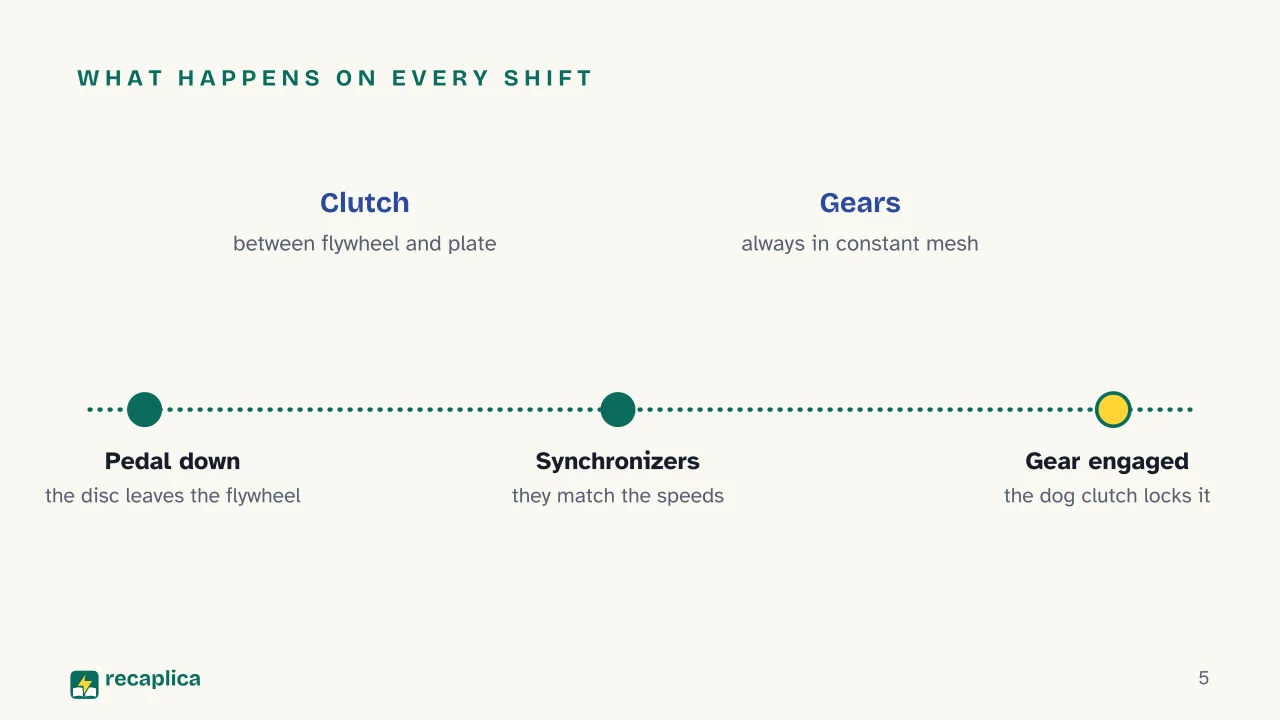 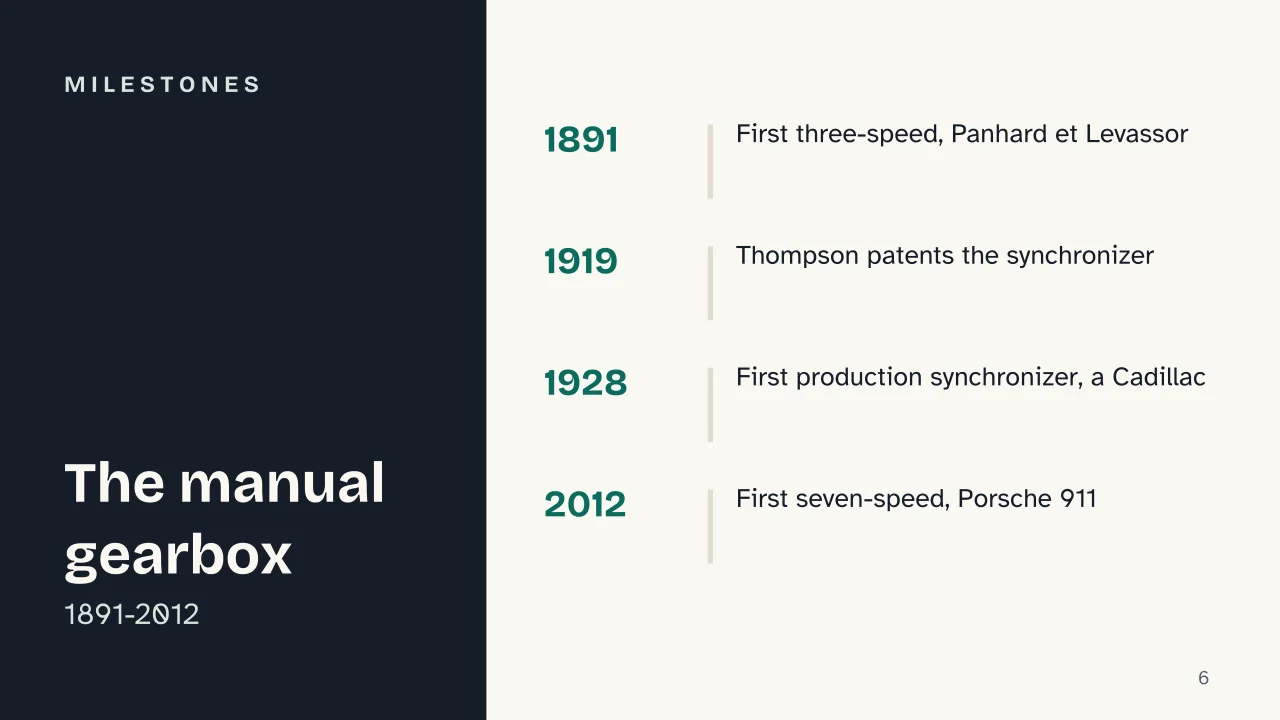  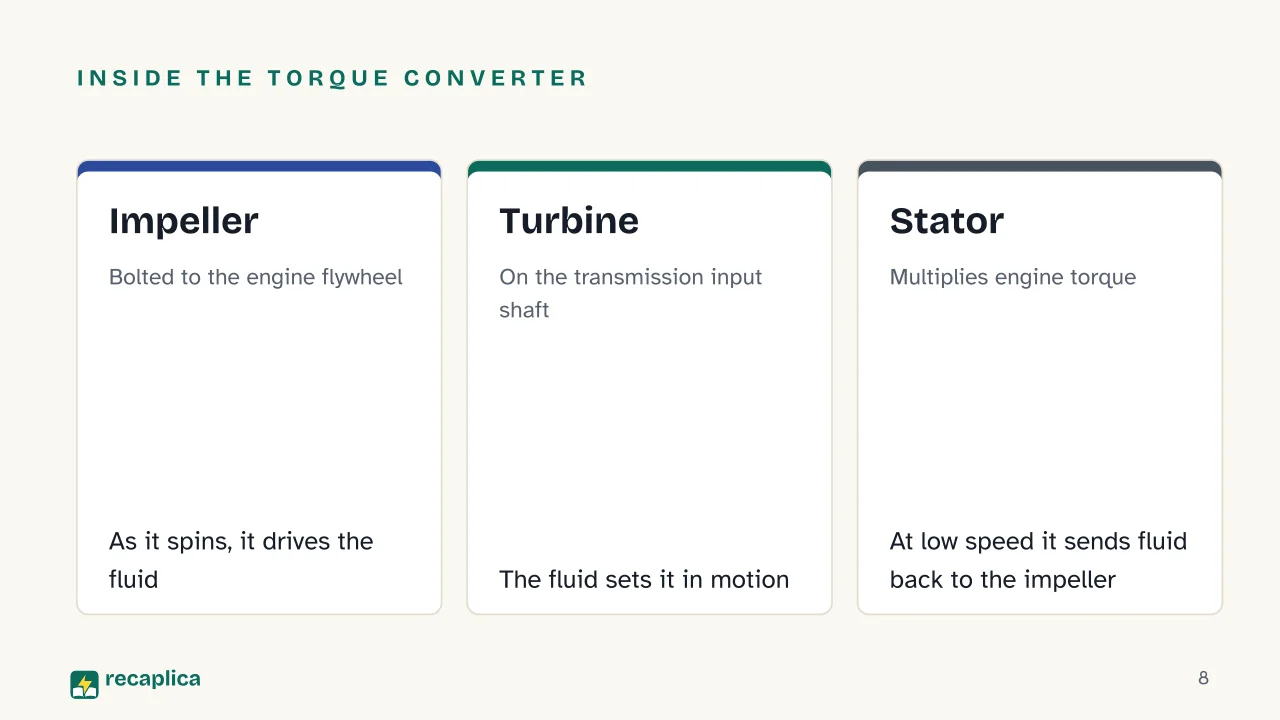 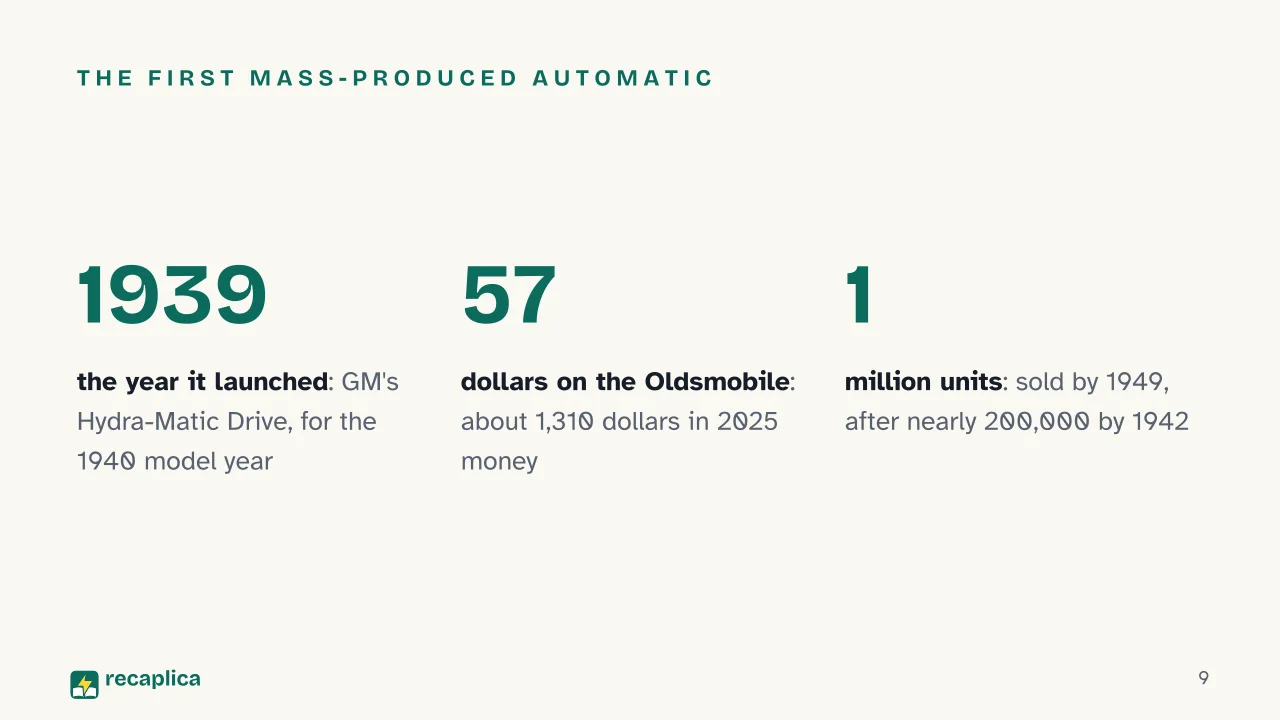  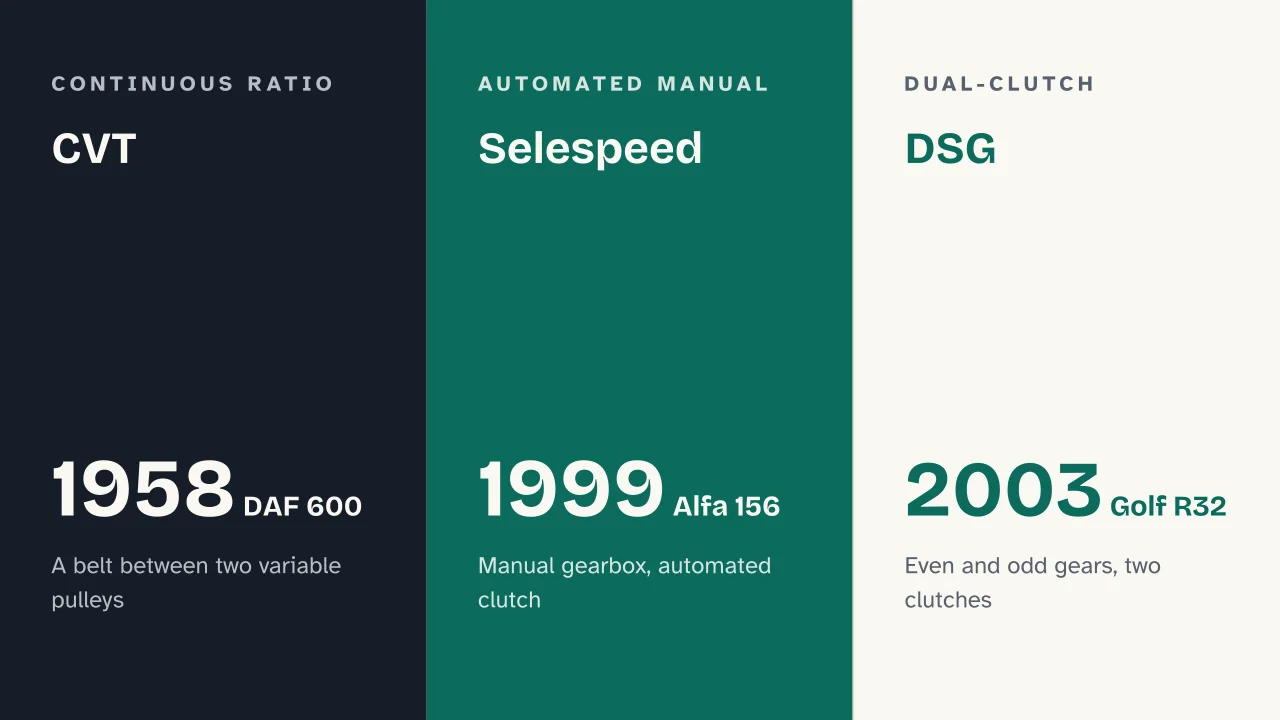 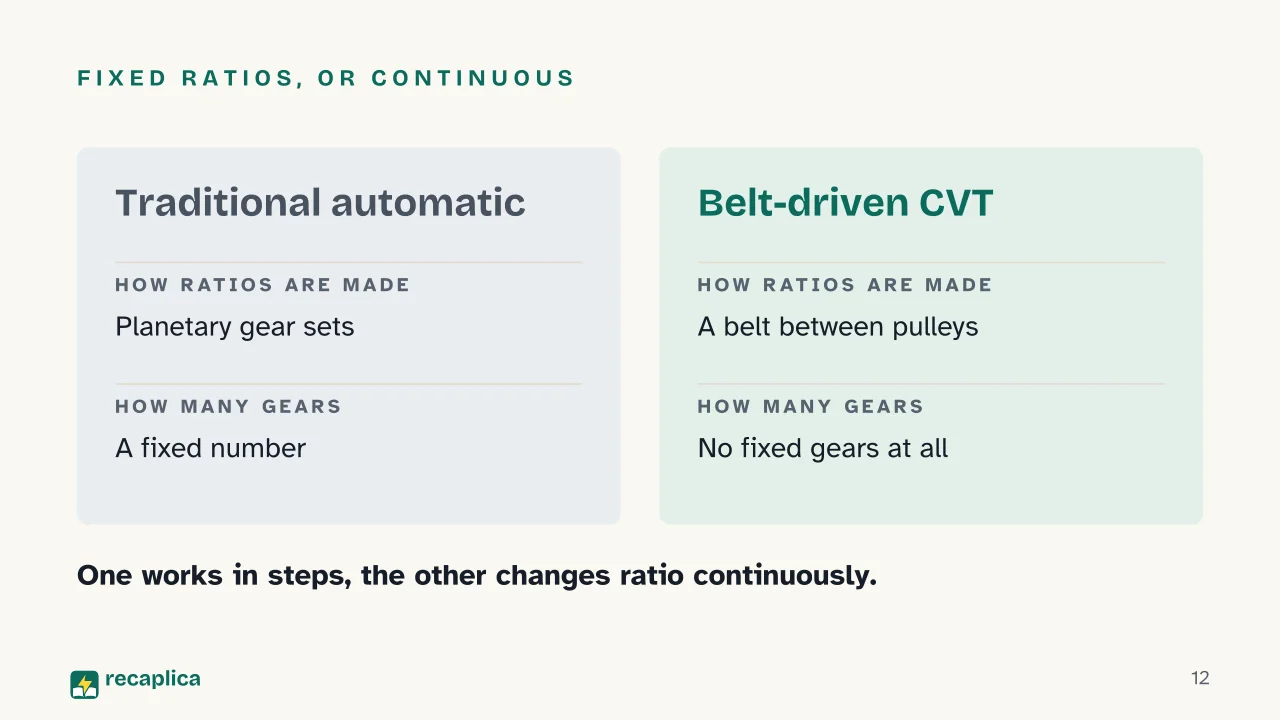  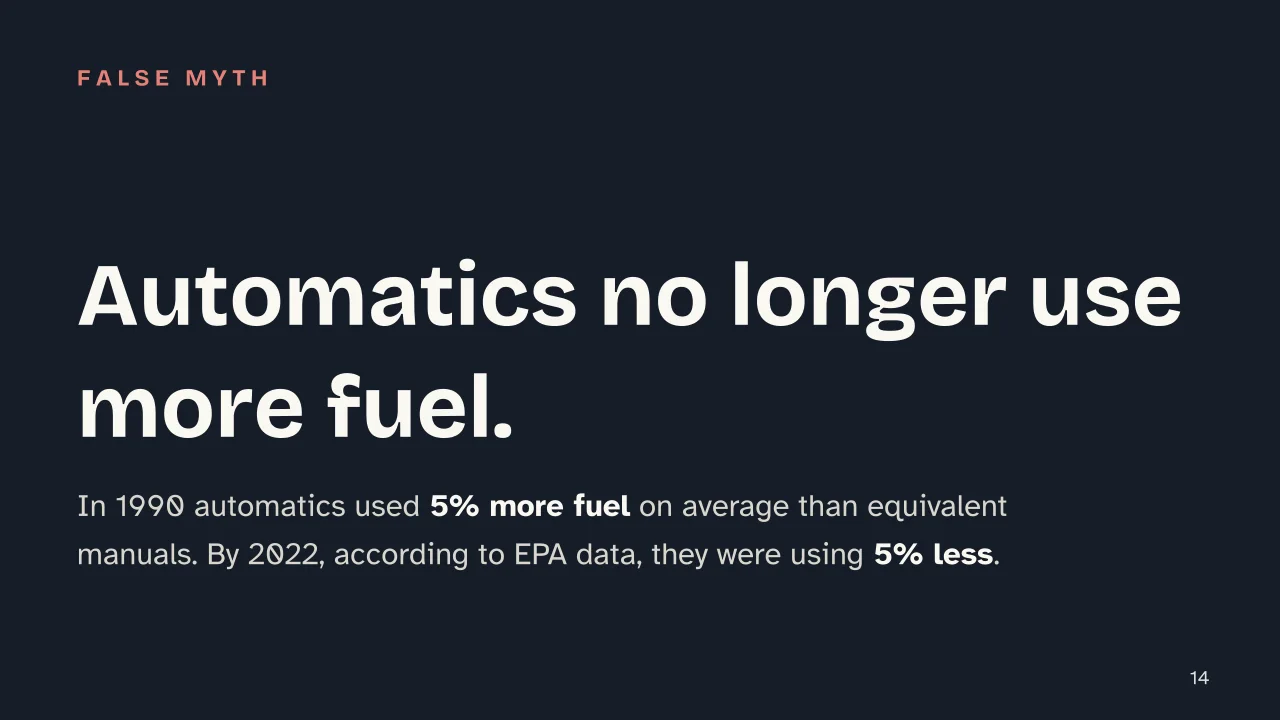 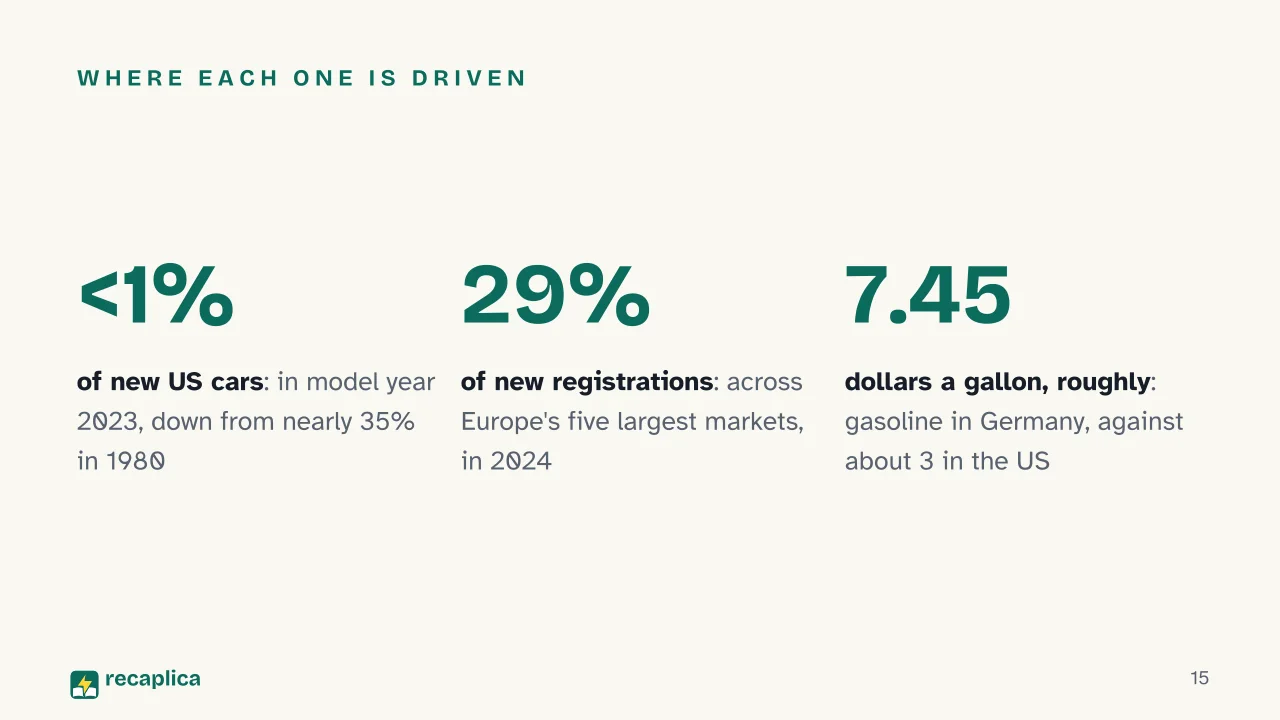 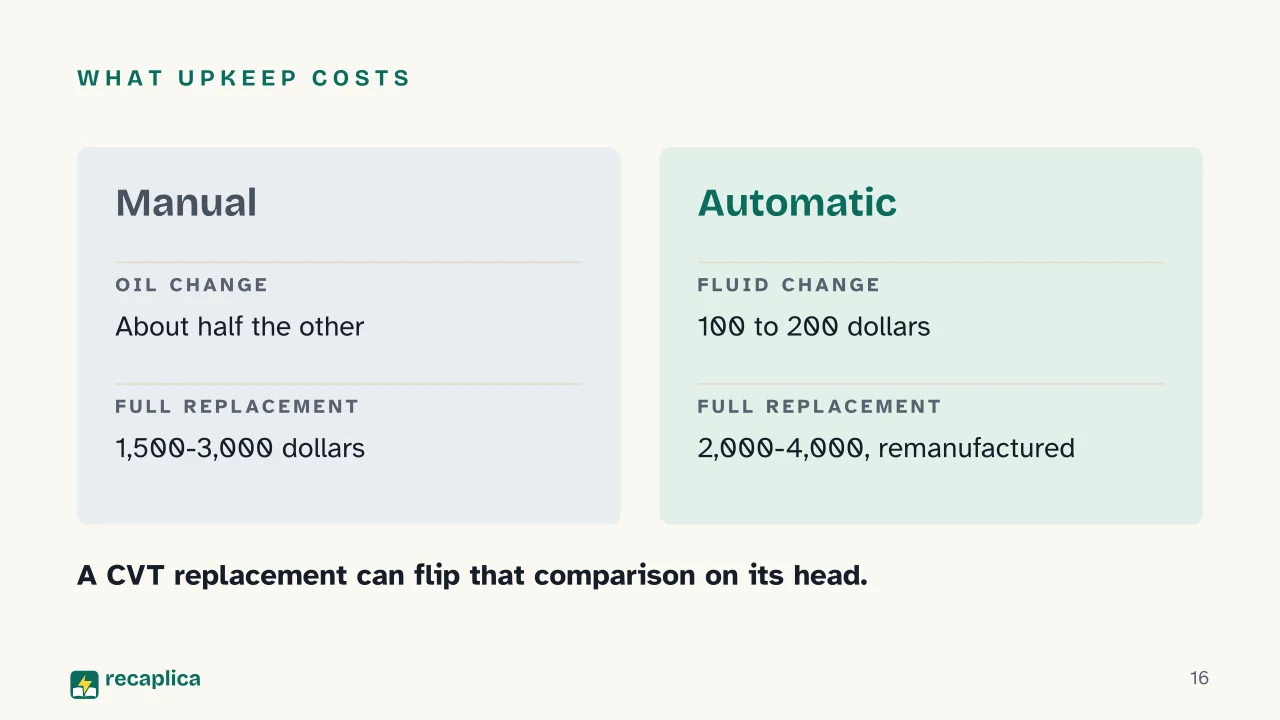 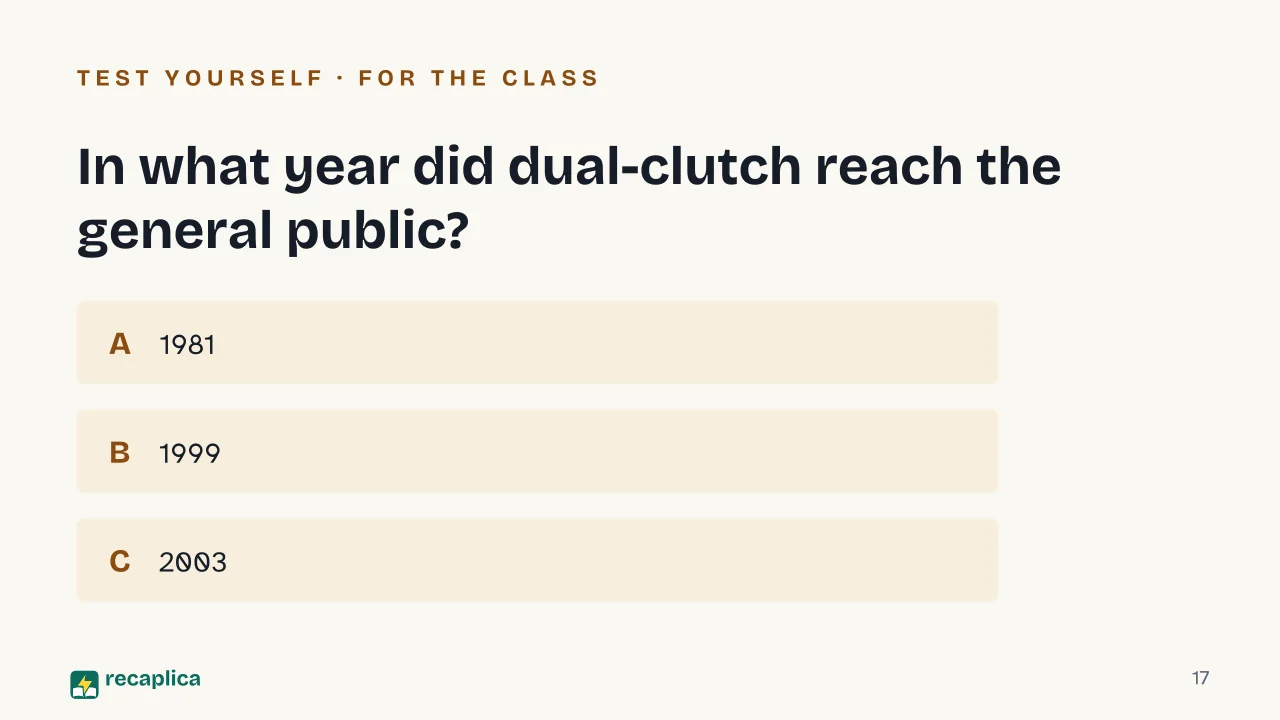  Common myths
Mind mapDrag the background to move around and the nodes to reposition them; use − and + to collapse and expand branches. 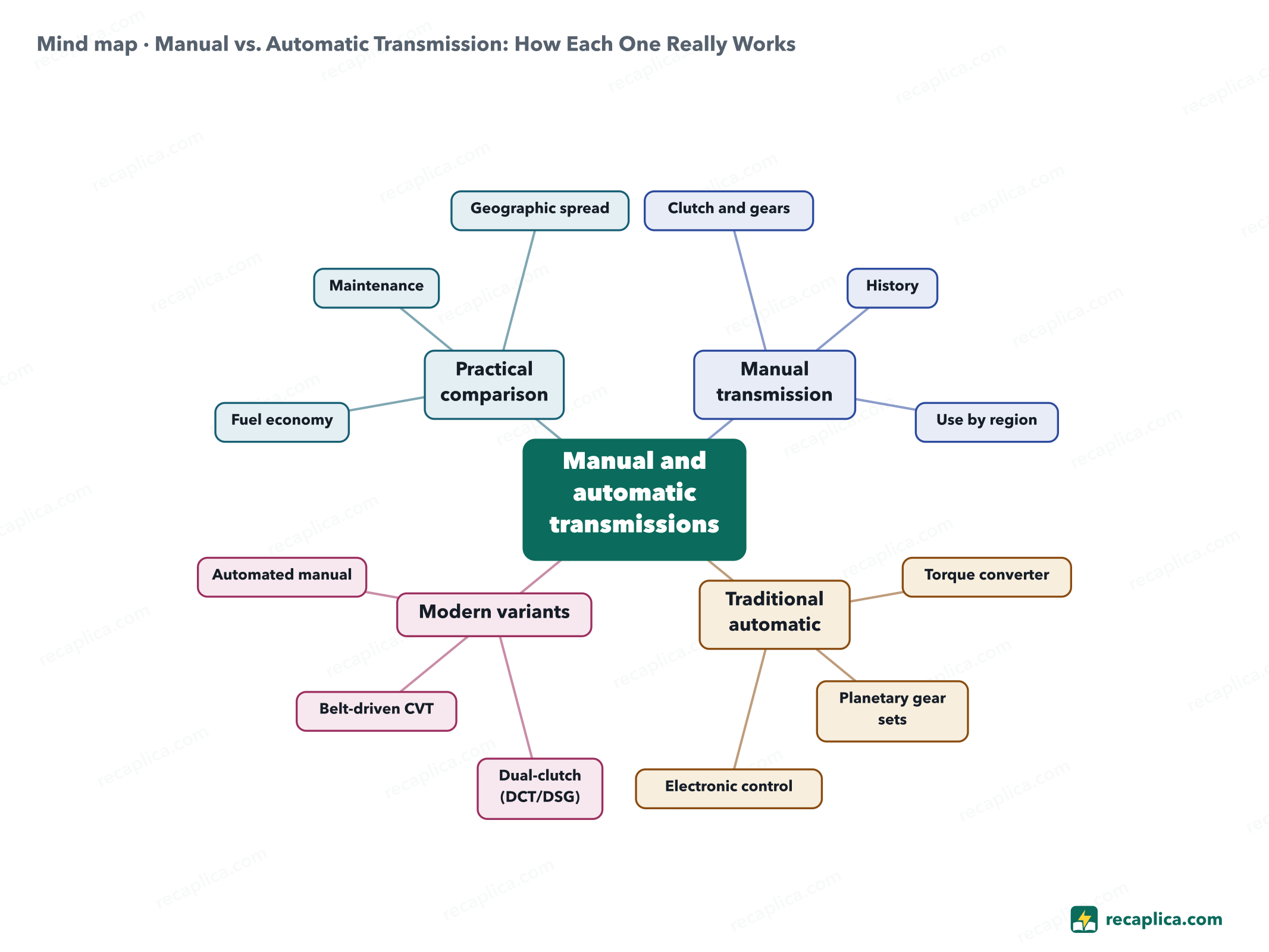
Quiz: test yourselfAnswer the questions to check what you have learned: you get instant feedback and a short explanation. Grade 0/10 0/5
FlashcardsTap the card to flip it and check whether you remember the answer, then move to the next one. 1 / 8 Explain it in your own wordsThe ultimate test: if you can explain it in simple words, you've truly understood it. Write your explanation, then compare it with the Recap. Your explanation is saved only on this device.
Frequently asked questionsWhat is the main difference between a manual and an automatic transmission?In a manual gearbox, the driver picks the gear and operates the clutch with a dedicated pedal. In an automatic, shifting happens on its own — in the traditional version through a hydraulic torque converter and planetary gear sets, and in newer designs through two electronically controlled clutches (dual-clutch) or a continuously variable belt (CVT). Does an automatic transmission really use more fuel than a manual?It depends on when you're comparing them. Until around 2010-2012, manuals were, on average, more fuel-efficient; since then the picture has reversed, and by 2022 automatics were using about 5% less fuel on average than equivalent manuals, according to EPA data, largely thanks to having far more gear ratios (up to 8-10, versus the 5-6 typical of a manual). What is a DSG or DCT gearbox?It is a dual-clutch transmission (DCT; Volkswagen brands its version DSG), in which two separate clutches control the even and odd gears, allowing the next ratio to be pre-selected and engaged without interrupting torque flow to the wheels. The 2003 Volkswagen Golf R32 was the first mass-production car for the general public to use one. How does a CVT differ from a traditional automatic transmission?A traditional automatic has a fixed number of ratios, produced by locking different elements of one or more planetary gear sets. A CVT has no fixed gears at all — instead a belt runs between two variable-diameter pulleys, and the ratio changes continuously, with no perceptible shift steps. Is a manual or an automatic transmission cheaper to maintain?A manual transmission generally has lower routine maintenance costs (an oil change costs roughly half of what a fluid change costs on an automatic), but it's not an absolute rule — a CVT, if it needs a full replacement, can end up costing more than replacing the clutch on a manual. Every Recap goes through an independent review before publication. |