Skip to content
recaplica

    One moment: security check

    Cloudflare wants to make sure you're not a robot. Tick the box below and your search will continue on its own.

    IT
    recaplica How air fryers work (and why they don't really fry anything)
    © 2026 Recaplica · recaplica.com — All rights reserved
    Home › Technology Food and cooking

    How air fryers work (and why they don't really fry anything)

    By Recaplica Newsroom · Updated on September 6, 2026

    What to print

    Page numbers appear when printing with default margins.

    Slides

    Choose a cut

    Flash10 slidesThe essential thread, to present in classFull19 slidesEvery chapter and the deeper detail

    Both come with speaker notes.

    Telegram channel
    recaplica Clear in 30 seconds, yours in 10 minutes.
    In 30 seconds Key points Figures Deep dive Slides Myths Mind map Quiz Flashcards FAQ

    In 30 seconds quick read

    An air fryer is, mechanically speaking, a small forced-convection oven: a heating element warms the air, and a powerful fan pushes it around the food at high speed inside a perforated basket. The result mimics deep frying in hot oil, but needs only a light coating of fat instead of full immersion. The browning comes from the same chemical reaction as traditional frying, the Maillard reaction, triggered once the food's surface passes roughly 140-165°C. Compared with deep frying, the appliance cuts fat intake and some unwanted compounds like acrylamide by a wide margin, but it doesn't eliminate them.

    Key Points

    • An air fryer is a small forced-convection oven, a heating element warms the air and a powerful fan circulates it around the food inside a perforated basket, producing an effect similar to deep frying without the oil bath.
    • The first countertop air fryer was SEB's Actifry, launched by the French group in 2006; global popularity came in 2010 with the Philips Airfryer and its patented "Rapid Air" technology.
    • Browning comes from the same Maillard reaction as oil frying, triggered above 140-165°C, it isn't different chemistry, only a different medium for delivering the heat.
    • 'Oil-free' is misleading: many foods, especially the leaner ones, still need a light coating of oil to brown properly, even though the overall fat savings are real, up to 80% less fat-derived calories according to the Cleveland Clinic.
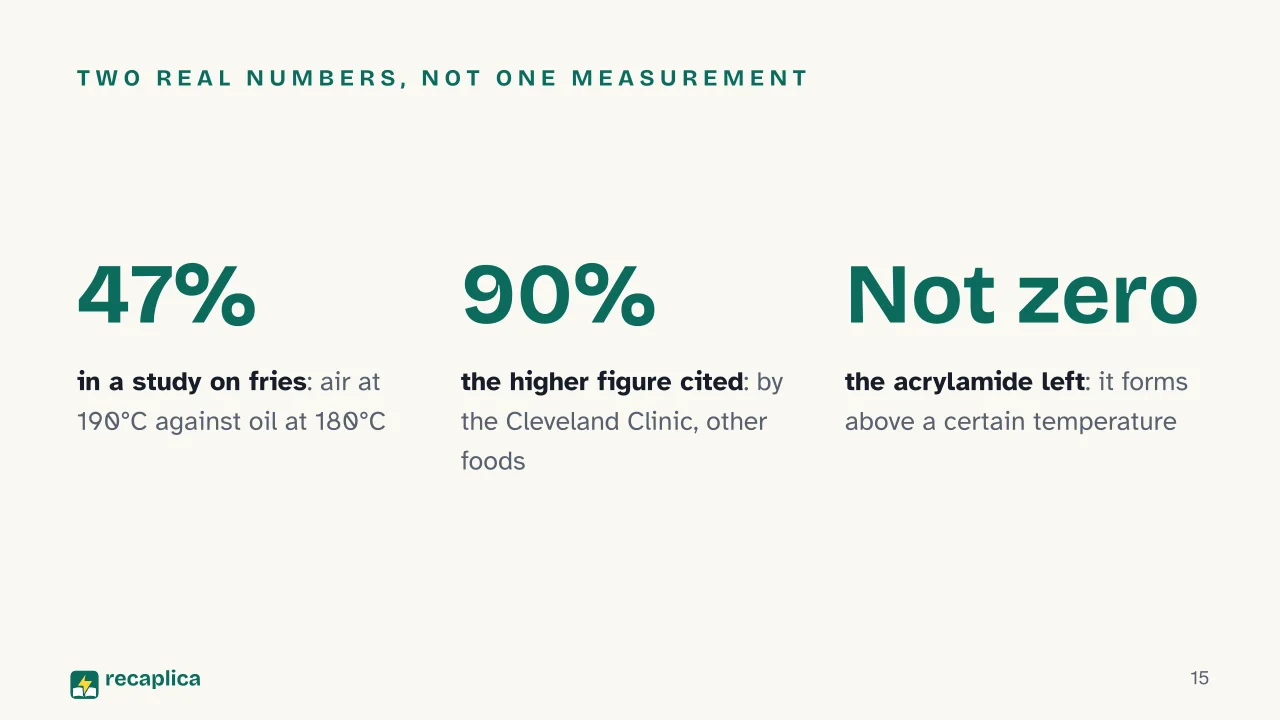
    • An air fryer reduces, but doesn't eliminate, acrylamide formation compared with deep frying; the reduction estimates (47% measured in one scientific study on French fries, up to higher figures cited elsewhere) depend on the experimental conditions and aren't directly comparable.
    • Food safety rules stay the same no matter the cooking method, always check the food's internal temperature with a kitchen thermometer, according to the USDA.

    Key figures

    • Up to 80% less the reduction in fat-derived calories from switching from deep frying to an air fryer, according to dietitian Julia Zumpano Source: Cleveland Clinic, Are Air Fryers Actually Healthy?
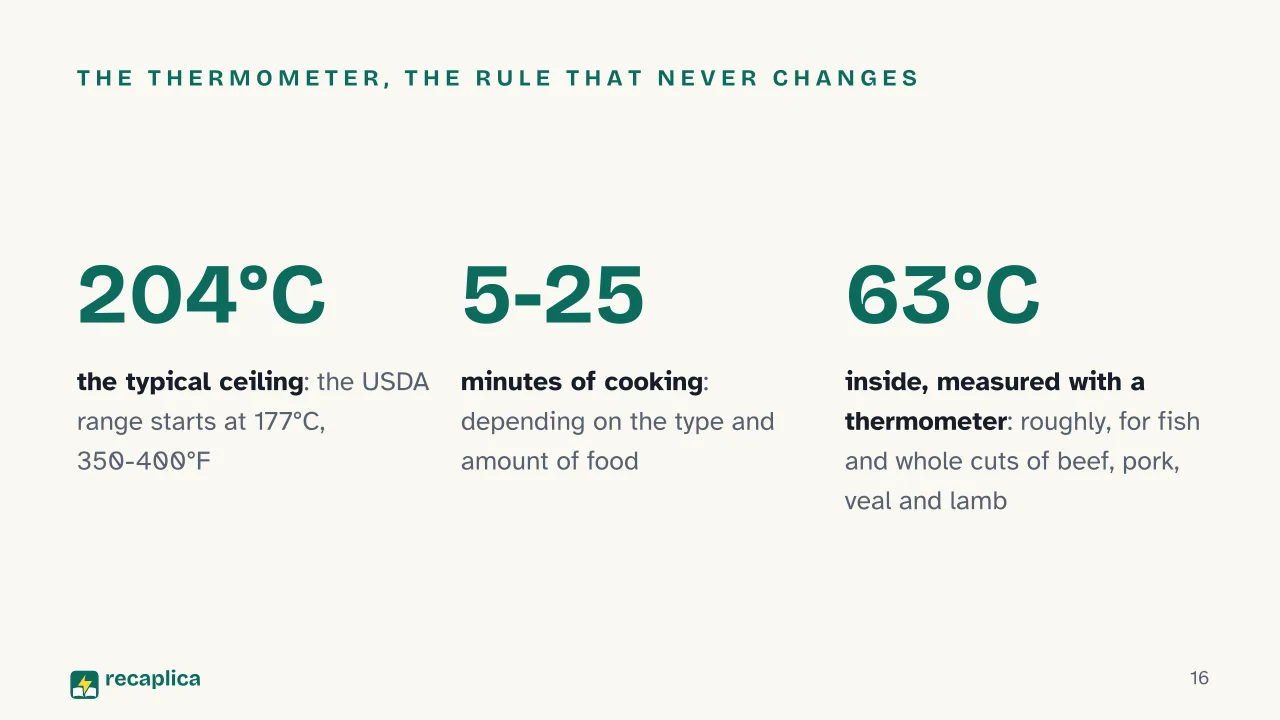
    • 177-204°C the typical cooking temperature range for air fryers (350-400°F), with cooking times from 5 to 25 minutes depending on the food Source: USDA Food Safety and Inspection Service
    • 47% vs. up to 90% two separate acrylamide reductions compared with deep frying, measured under different experimental conditions (one scientific study on French fries, one figure cited for other foods), numbers to read as estimates that aren't directly comparable Source: Frontiers in Nutrition via PMC, and Cleveland Clinic

    Deep Dive

    A small oven in disguise

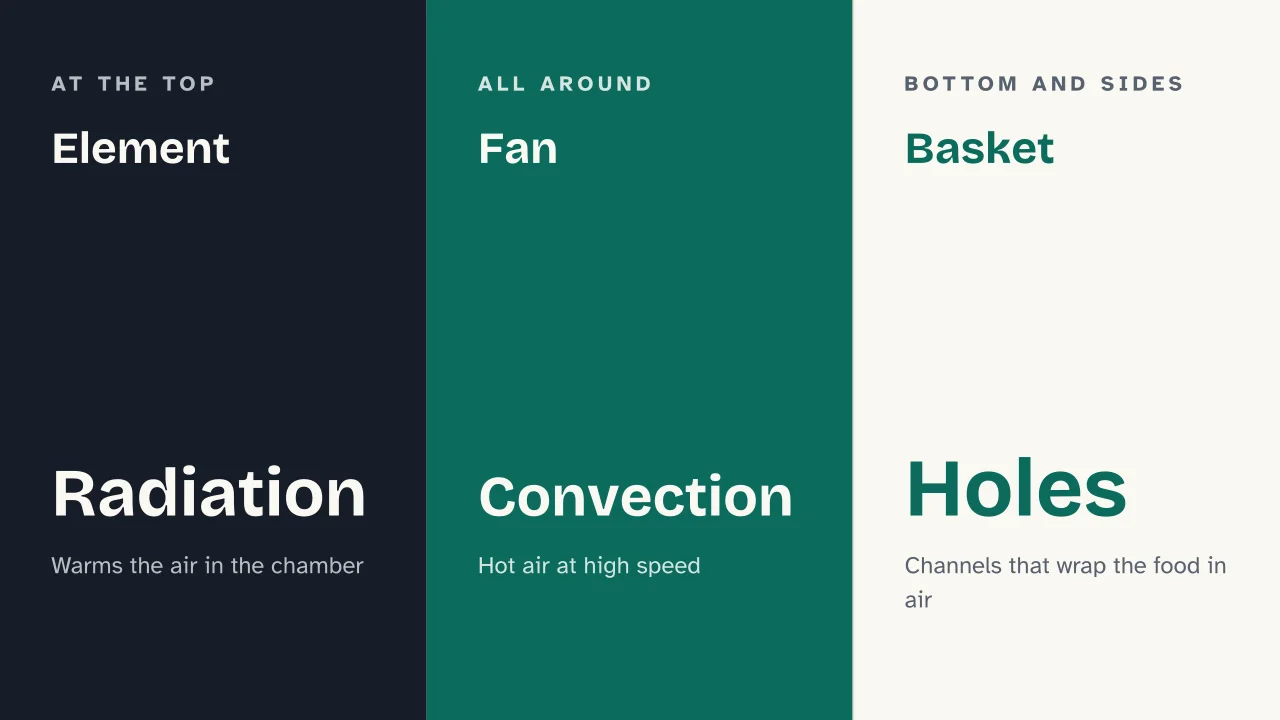
    Open the basket and there’s nothing resembling a tub of hot oil inside. All that’s there is a heating element at the top and a fan, and the entire “fried” effect comes from just those two parts. The element heats the air in the cooking chamber by radiation, while the fan pushes it around the food at high speed, a principle very close to a convection oven, only squeezed into a much smaller space with a more intense airflow. The basket, with its channels and holes along the bottom and sides, lets the hot air wrap the food from every angle, top, bottom, and sides, roughly reproducing the effect of deep frying in hot oil.

    It isn’t an isolated case among kitchen appliances: robot vacuum cleaners look like a recent invention too, yet the core technology behind them predates the first model sold in stores by decades. Something similar happened with the air fryer.

    An idea older than the countertop appliance

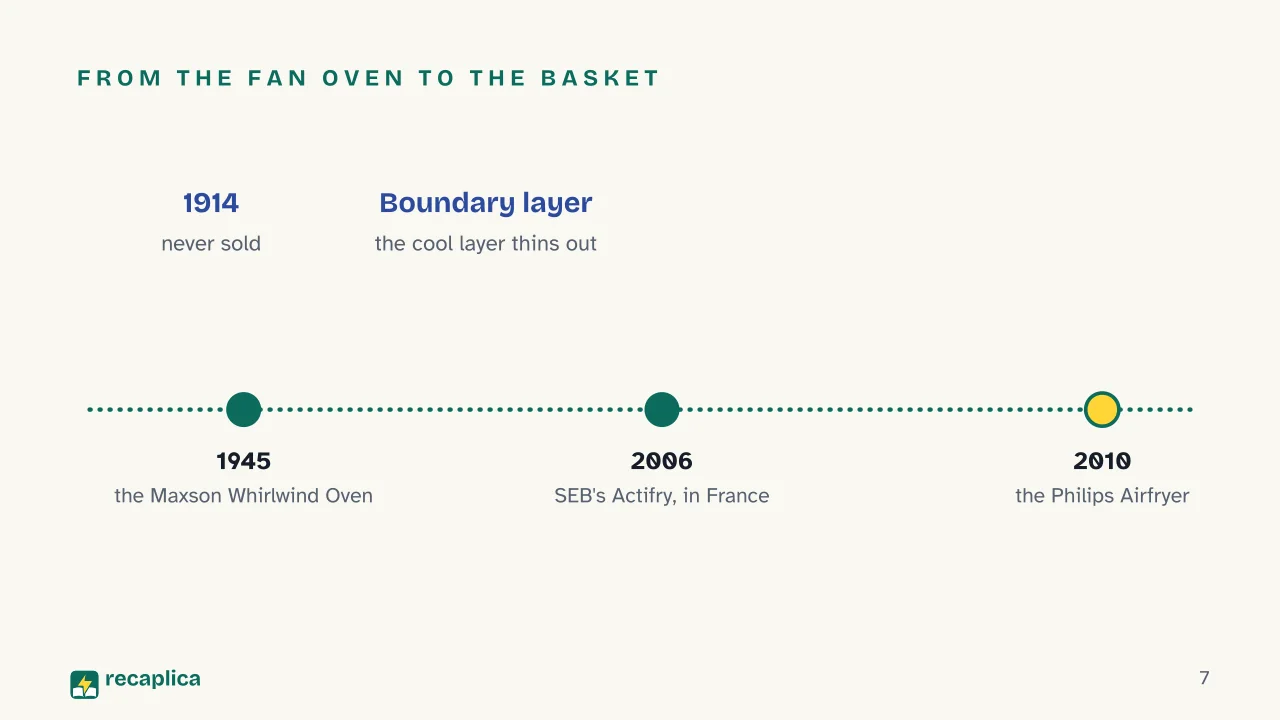
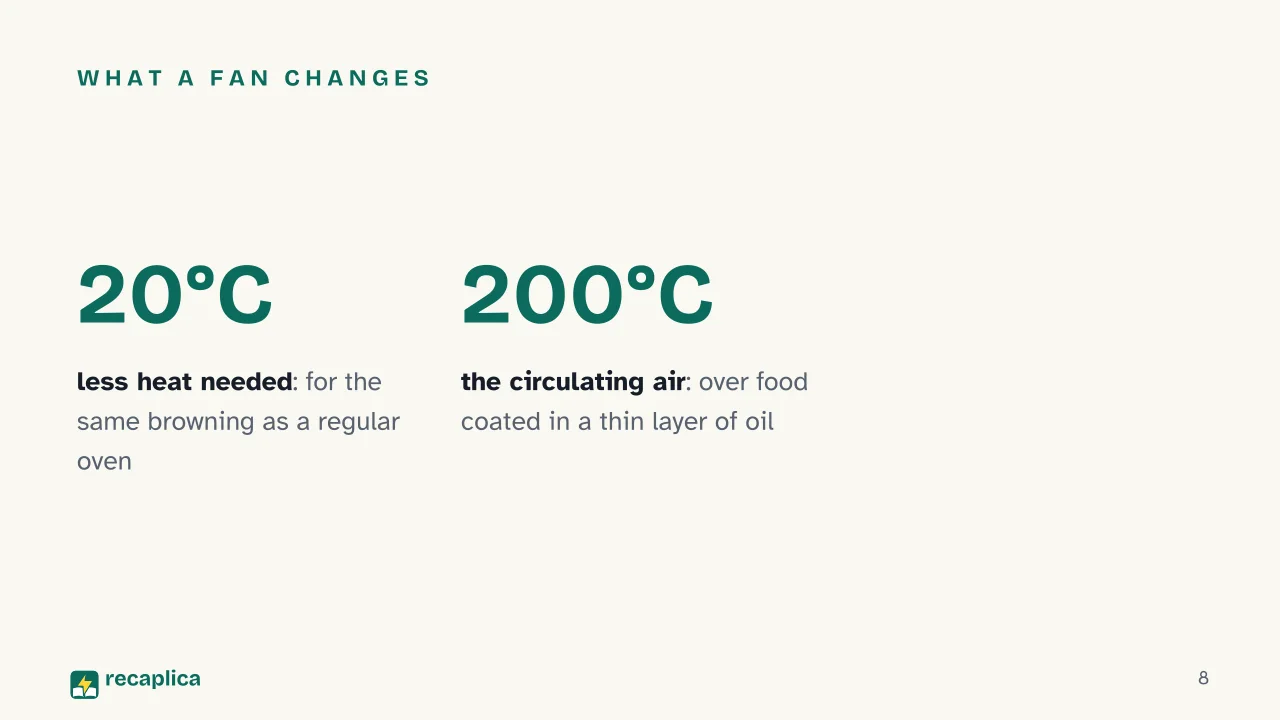
    The true ancestor of the air fryer is the fan oven. An early oven with a built-in fan was patented in 1914 but never reached the market; the first model to actually spread was the Maxson Whirlwind Oven, from 1945. The physical principle behind it is the reduction of the so-called “boundary layer,” the thin layer of cooler air that normally insulates a food’s surface inside a conventional oven: by moving air faster around a heating element, that insulating layer thins out, and the temperature needed to reach the same browning result drops by roughly 20°C compared with a regular oven.

    As a countertop appliance built specifically for frying, the first air fryer didn’t arrive until 2006, when the French group SEB launched it on the French market under the Actifry brand. Global popularity, though, owes more to a different launch: in 2010 Philips unveiled its Airfryer at the IFA trade fair in Berlin, with a patented technology called “Rapid Air” (short for RUSH, Radiant and UpStream Heating). In air fryers generally, hot air circulates up to roughly 200°C over food coated in a thin layer of oil, a temperature high enough to trigger browning.

    Same frying chemistry, different medium

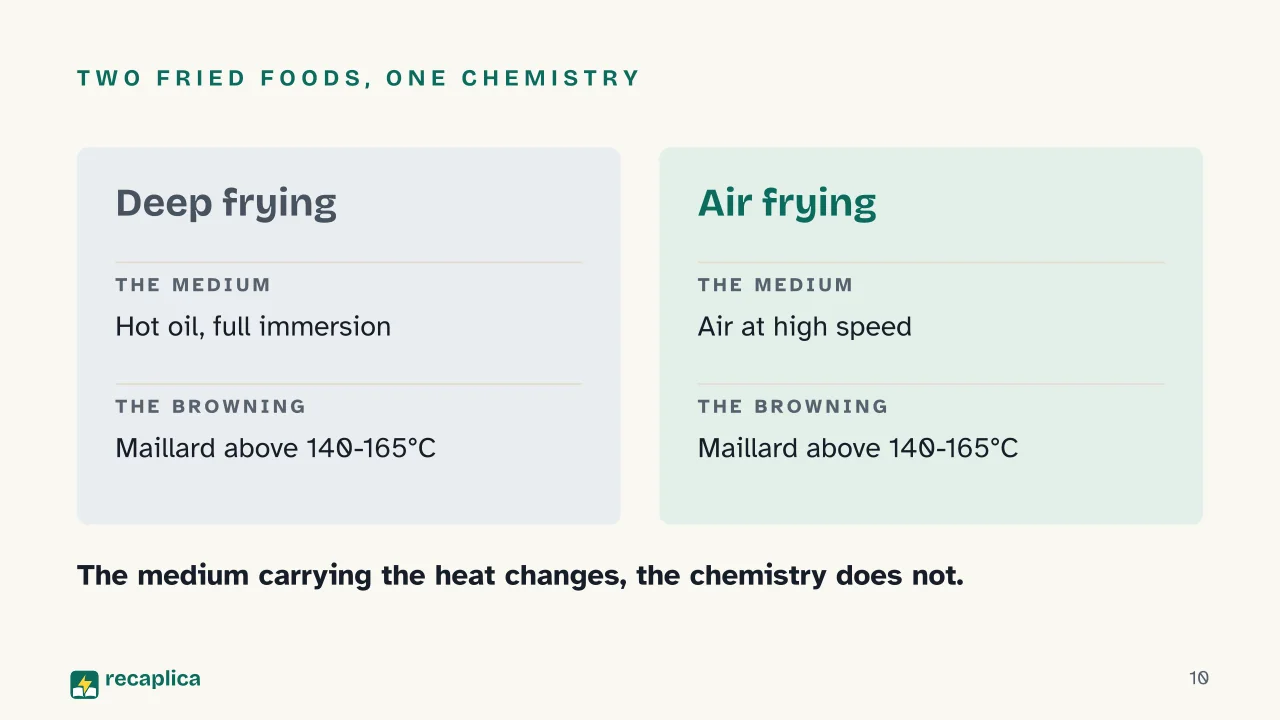
    Whether the heat comes from hot air or from boiling oil, the same thing happens chemically. Once a food’s surface passes roughly 140-165°C, its proteins denature, its sugars caramelize, its starches gelatinize, and the Maillard reaction kicks in, the same reaction behind the golden crust of freshly baked bread or the caramelized top of a baked dish. It’s a temperature threshold, not a secret recipe: an air fryer doesn’t invent a new chemistry of crispness, it uses the same one as always, just with a different medium for delivering the heat.

    The practical difference lies entirely in the physics of heat transfer. Liquid oil carries far more heat per unit of volume than air does, which is why deep frying works even at comparatively lower temperatures, typically between 140 and 165°C (some sources put it as high as 150-200°C, depending on the food). Air, to compensate, has to be moved faster with a powerful fan, which explains the air fryer’s design choice: a small chamber with concentrated airflow.

    Deep fryingAir frying
    Typical temperatureRoughly 140-165°C (some studies go up to 180°C)Roughly 177-204°C (up to 200°C over a thin coat of oil)
    Oil neededFull immersion of the foodNone to a couple of tablespoons, depending on the food
    Cooking timeShorter for the same food (6 minutes for fries in one lab test)Longer for the same food in the same test (12-24 minutes)
    Fat absorbedHigher, oil penetrates the food during cookingReduced by up to 80% in fat-derived calories
    Residual moisture in the foodLowerSlightly higher

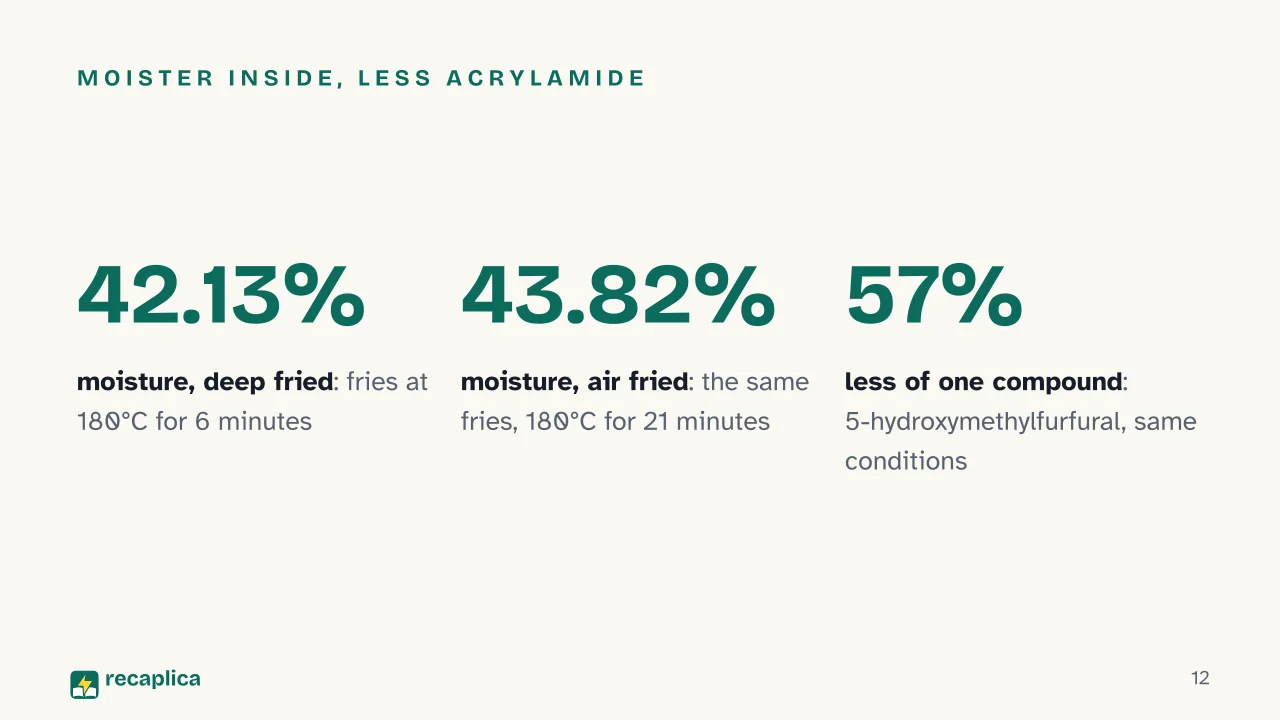
    Practical example: in a scientific study published in Frontiers in Nutrition, French fries deep-fried at 180°C for 6 minutes ended up with a moisture content of 42.13%, while the same fries cooked in an air fryer at 180°C for 21 minutes stayed moister, at 43.82%. The difference isn’t just about texture: in the same study, higher moisture content was linked to lower formation of unwanted Maillard reaction compounds, including acrylamide.

    The oil-free myth

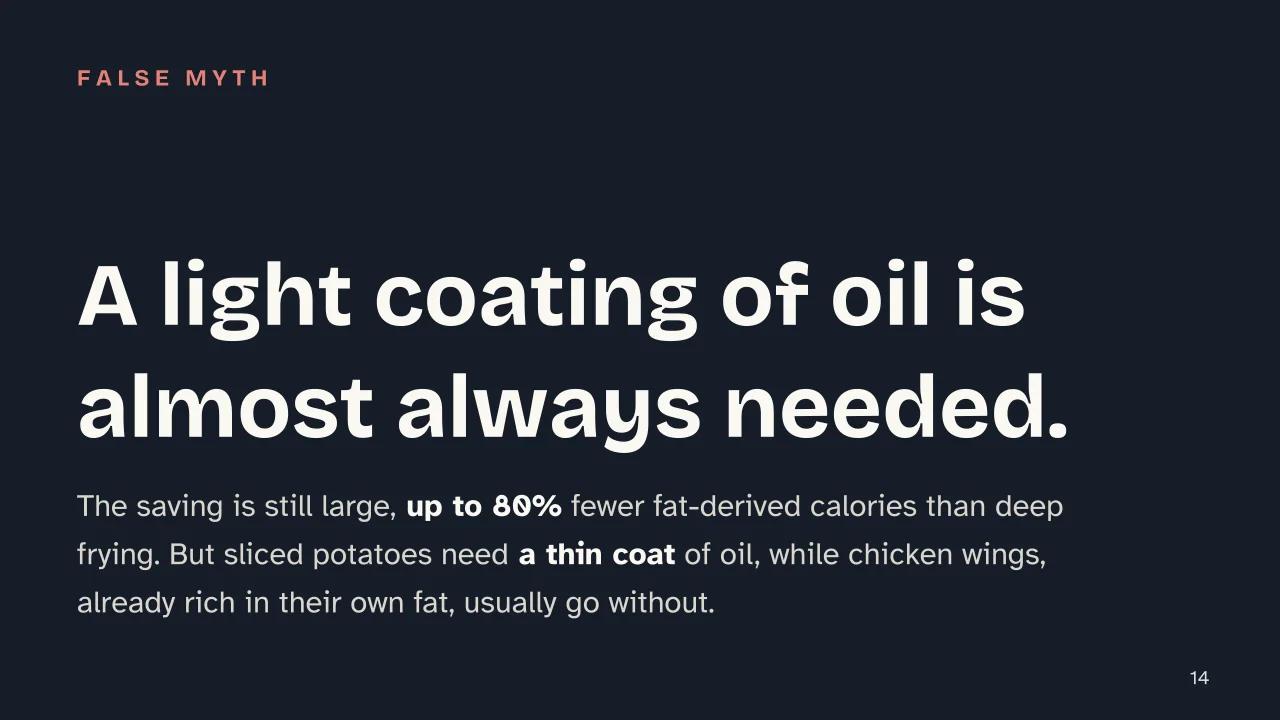
    “Oil-free frying” is more of a slogan than an accurate description. For foods already rich in their own fat, like chicken wings, adding oil often isn’t necessary at all. For drier foods, like sliced potatoes, a light coating of oil, usually a tablespoon or two, is still needed to get good browning and crispness: air alone isn’t as efficient a cooking medium as oil, and without a little fat on the surface, the Maillard reaction struggles to kick in evenly.

    What genuinely changes compared with deep frying is the amount. According to dietitian Julia Zumpano of the Cleveland Clinic, switching from deep frying to an air fryer can cut fat-derived calories by up to 80%, because the excess fat that renders out of the food during cooking drains into a compartment below the basket instead of staying trapped on the plate.

    Acrylamide and other compounds: two estimates, not one number

    An air fryer reduces, but doesn’t eliminate, some unwanted chemical compounds that form at high temperatures, acrylamide among them. The figures floating around on this topic vary widely. A peer-reviewed scientific study on French fries, published in Frontiers in Nutrition, measured a 47.31% reduction in acrylamide with air frying (190°C, 18 minutes) compared with deep frying under the same experimental setup (180°C, 6 minutes). The Cleveland Clinic instead cites, for other foods and other conditions, a reduction of up to 90%. Both are valid estimates, but not the same data point: the experimental conditions, food, temperature, cooking time, differ, and the numbers shouldn’t be added together or averaged as if they measured the same thing.

    The same study also measured other Maillard reaction compounds, such as 5-hydroxymethylfurfural (reduced by 57% under the same conditions) and methylglyoxal, the compound most closely linked to acrylamide formation. One interesting finding concerns starch digestibility: fries cooked in an air fryer showed a higher share of slowly digestible starch than deep-fried ones, a possible hint of a more balanced glycemic profile, even though perceived taste stayed comparable between the two methods in the tests.

    Anyone used to thinking about food transformation through chemical reactions can spot the same logic, temperature as a switch, in very different phenomena: fermentation, where food changes without any heat at all, or the melting of chocolate, a change of state tied to a precise temperature threshold, covered in this Recap.

    Food safety rules don’t change

    According to the USDA Food Safety and Inspection Service, most foods cooked in an air fryer take between 5 and 25 minutes, within a temperature range of roughly 177 to 204°C (350-400°F). The agency’s core recommendation stays the same regardless of cooking method: always check that the food has reached the minimum safe internal temperature with a kitchen thermometer, for example roughly 63°C for fish and for whole cuts of beef, pork, veal, and lamb (with a few minutes of rest).

    The general rules of food hygiene still apply too: wash your hands before and after handling raw food, never put cooked food back on a plate that held raw food, and use separate cutting boards for raw meat and fish versus fruit and vegetables. One rule specific to air fryers concerns the basket: overloading it blocks hot air from circulating properly around the food, with a real risk of uneven cooking and an undercooked center.

    A cheaper appliance to run

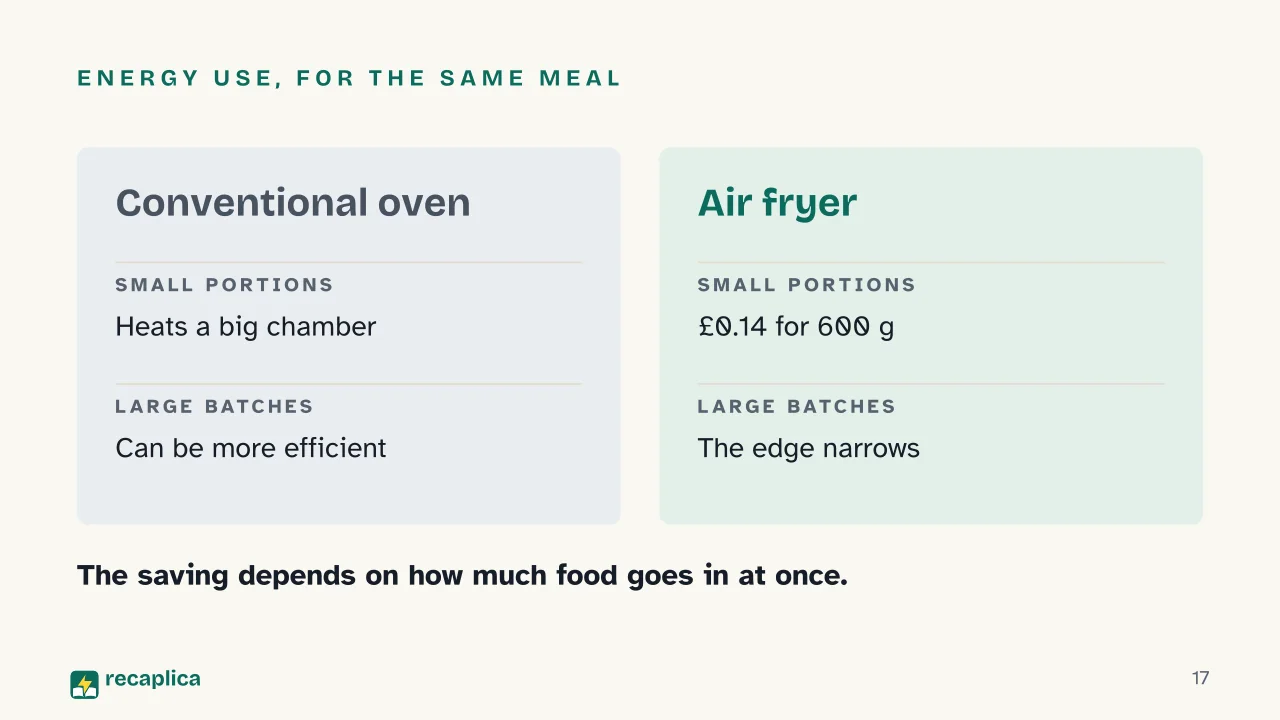
    Beyond the fat savings, an air fryer typically uses less energy than a conventional oven for the same meal, thanks to shorter cooking times and a smaller cooking chamber. According to the UK’s Energy Saving Trust, cooking 600 grams of chicken breast in an air fryer costs roughly £0.14, a figure the agency lists as generally lower than cooking the same dish in a conventional oven. The advantage is most noticeable for small or medium portions: for large batches, a full oven can become comparable or even more efficient per portion, simply because it makes better use of the available cooking space.

    One thing no cooking technology can change on its own: an already industrially fried, frozen food, like chicken nuggets or fish sticks, doesn’t become healthier just because it ends up in an air fryer instead of an oven. A food’s nutritional value depends mostly on how it was prepared upstream, not on the last cooking step done at home.

    Slide deck

    Slides ready to download and make your own in PowerPoint or Google Slides, with speaker notes. Pick the Flash cut or the Full one.
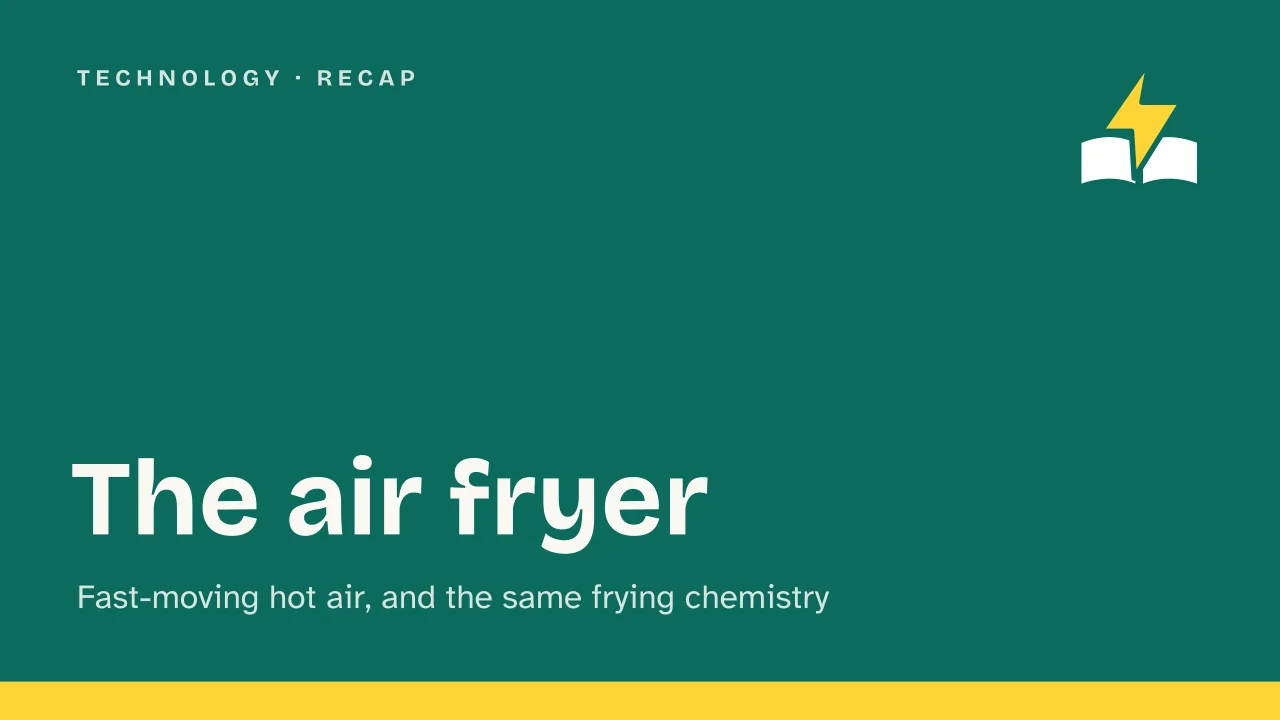
    Slide 1 of the presentation on How air fryers work (and why they don't really fry anything): The air fryerSlide 2 of the presentation on How air fryers work (and why they don't really fry anything): Which part of an air fryer does the frying?Slide 3 of the presentation on How air fryers work (and why they don't really fry anything): What we will coverSlide 4 of the presentation on How air fryers work (and why they don't really fry anything): Chapter 01: Only air insideSlide 5 of the presentation on How air fryers work (and why they don't really fry anything): Element · Fan · BasketSlide 6 of the presentation on How air fryers work (and why they don't really fry anything): Chapter 02: The ancestor is the fan ovenSlide 7 of the presentation on How air fryers work (and why they don't really fry anything): From the fan oven to the basketSlide 8 of the presentation on How air fryers work (and why they don't really fry anything): What a fan changesSlide 9 of the presentation on How air fryers work (and why they don't really fry anything): Chapter 03: Same chemistry, different mediumSlide 10 of the presentation on How air fryers work (and why they don't really fry anything): Two fried foods, one chemistrySlide 11 of the presentation on How air fryers work (and why they don't really fry anything): Why is the cooking chamber so small?Slide 12 of the presentation on How air fryers work (and why they don't really fry anything): Moister inside, less acrylamideSlide 13 of the presentation on How air fryers work (and why they don't really fry anything): Chapter 04: How much lighter, reallySlide 14 of the presentation on How air fryers work (and why they don't really fry anything): A light coating of oil is almost always needed.Slide 15 of the presentation on How air fryers work (and why they don't really fry anything): Two real numbers, not one measurementSlide 16 of the presentation on How air fryers work (and why they don't really fry anything): The thermometer, the rule that never changesSlide 17 of the presentation on How air fryers work (and why they don't really fry anything): Energy use, for the same mealSlide 18 of the presentation on How air fryers work (and why they don't really fry anything): Which two physical mechanisms cook the food?Slide 19 of the presentation on How air fryers work (and why they don't really fry anything): And now, the review
    Flash10 slidesThe essential thread, to present in classFull19 slidesEvery chapter and the deeper detail

    Common myths

    • ✗ Myth An air fryer cooks food without using a single drop of oil.

      ✓ Reality It depends on the food. Items already rich in their own fat, like chicken wings, often need no added oil. Drier foods, like sliced potatoes, still need a light coating of oil, typically a tablespoon or two, or even just one, because the Maillard reaction and crispness both improve with a small amount of surface fat. The oil savings remain substantial compared with full immersion in traditional deep frying.

    • ✗ Myth A frozen food that's already fried at the factory, like chicken nuggets or fish sticks, automatically becomes healthier if you cook it in an air fryer instead of an oven.

      ✓ Reality No. A food's nutritional value depends mostly on how it was prepared upstream, at the factory, not on the last cooking step done at home. An air fryer doesn't change the breading or the composition of a product that was already fried industrially, it can only make it crispier or shorten the cooking time.

    • ✗ Myth An air fryer completely eliminates the harmful compounds produced by frying, like acrylamide.

      ✓ Reality It reduces them, but doesn't eliminate them. Estimates vary widely depending on the food and the experimental conditions, from 47% measured in one scientific study on French fries up to higher figures cited in other contexts, numbers that should be treated as separate estimates, not as the same data point. Acrylamide still forms through a chemical reaction between sugars and amino acids above a certain temperature, regardless of whether the heat arrives through air or through oil.

    Mind map

    Drag the background to move around and the nodes to reposition them; use − and + to collapse and expand branches.
    Customize
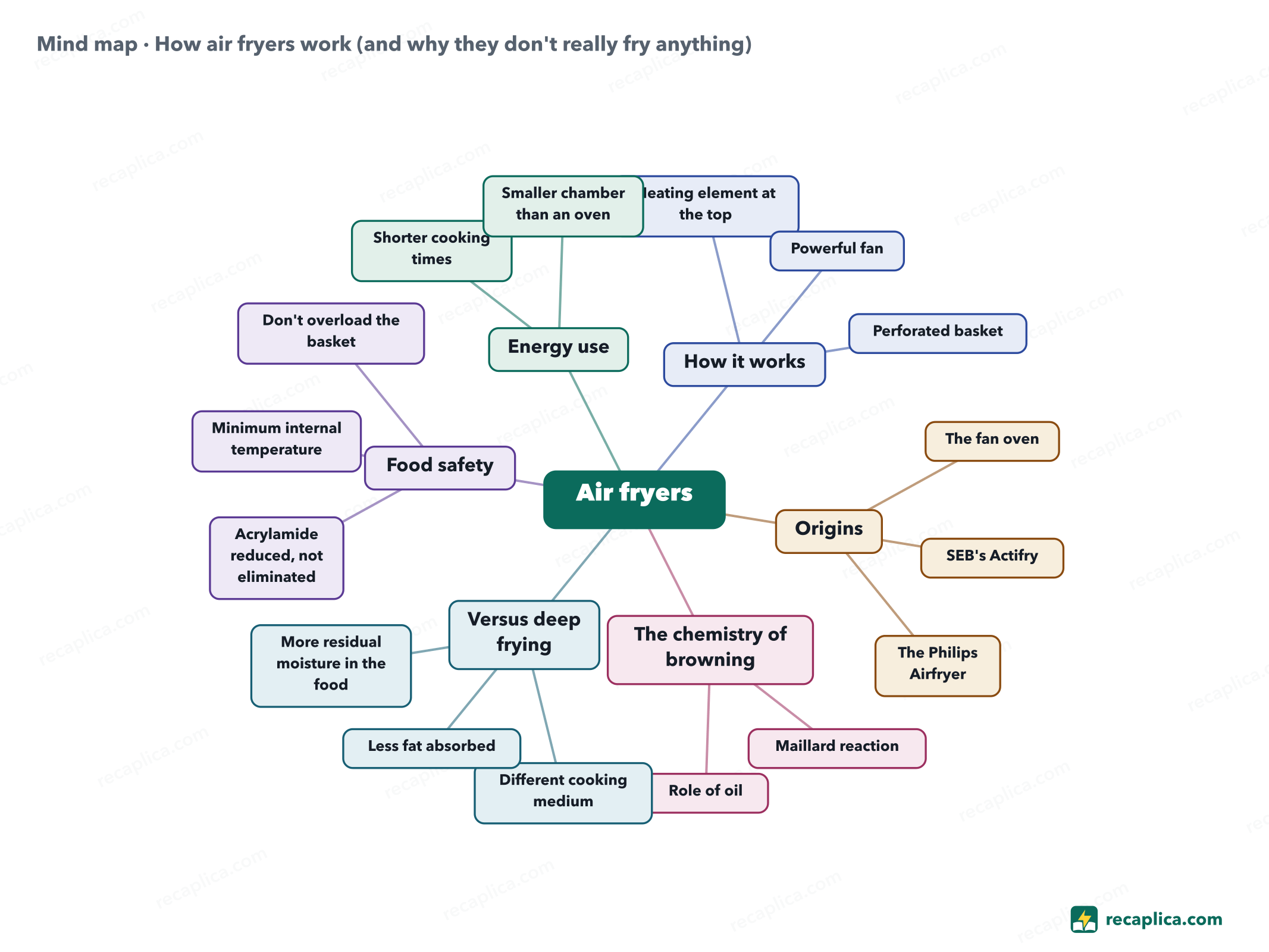
    Mind map: How air fryers work (and why they don't really fry anything)
    • Air fryers
      • How it works
        • Heating element at the top Warms the air in the cooking chamber by radiation.
        • Powerful fan Circulates hot air at high speed.
        • Perforated basket Channels and holes that mimic oil immersion.
      • Origins
        • The fan oven Technological ancestor, widespread since 1945 with the Maxson Whirlwind Oven.
        • SEB's Actifry First countertop air fryer, France, 2006.
        • The Philips Airfryer Launched in 2010, "Rapid Air" technology.
      • The chemistry of browning
        • Maillard reaction Kicks in above 140-165°C, same as deep frying.
        • Role of oil Small amount, but often needed for good browning.
      • Versus deep frying
        • Different cooking medium Air instead of liquid oil.
        • Less fat absorbed Up to 80% less fat-derived calories.
        • More residual moisture in the food Measured in lab tests versus deep frying.
      • Food safety
        • Acrylamide reduced, not eliminated
        • Minimum internal temperature Always check with a kitchen thermometer.
        • Don't overload the basket Prevents uneven cooking.
      • Energy use
        • Shorter cooking times
        • Smaller chamber than an oven

    Quiz: test yourself

    Answer the questions to check what you have learned: you get instant feedback and a short explanation.

    Grade 0/10 0/5
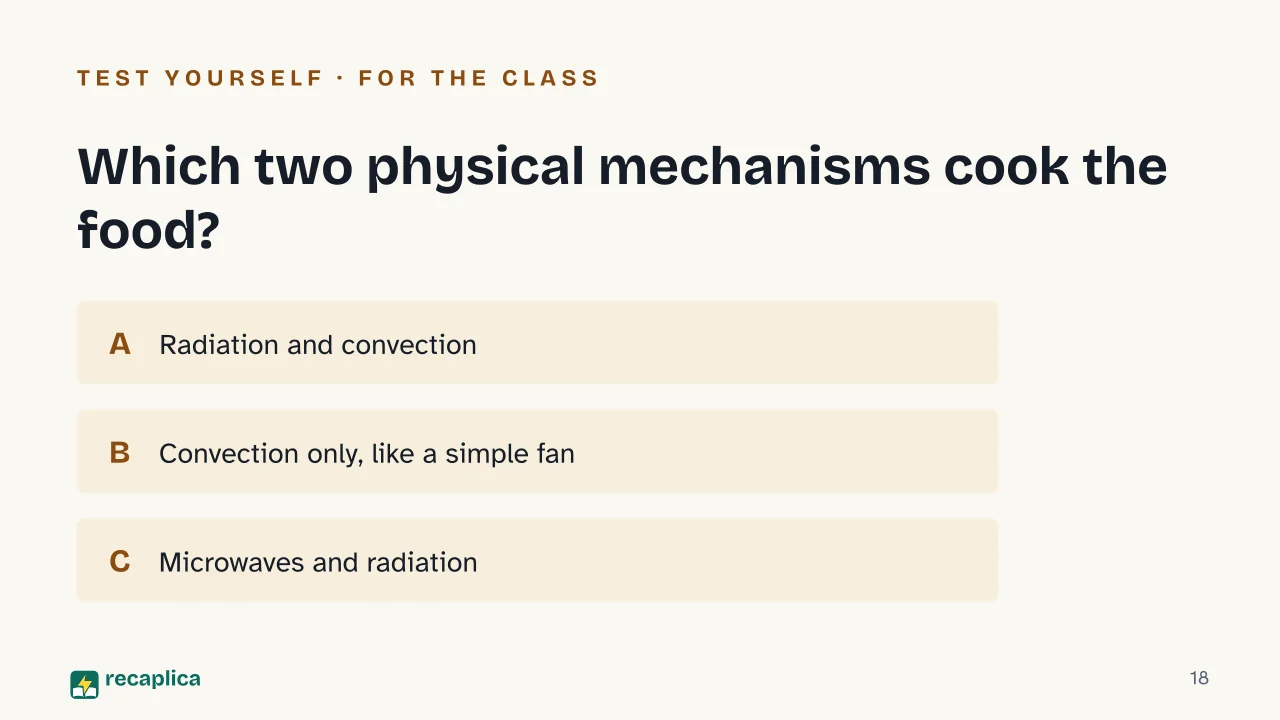
    1 What two basic physical mechanisms does an air fryer rely on to cook food?

    The heating element at the top gives off heat by radiation, while a fan rapidly circulates the hot air through the cooking chamber (convection). Combining the two effects in a small enclosed space produces more intense heat transfer than a regular fan oven.

    2 True or false: an air fryer cooks food without using a single drop of oil.

    False, or only partly true for some foods. Items that are already rich in their own fat, like chicken wings, often need no added oil. Drier foods, like sliced potatoes, still need a light coating of oil to brown well and turn crisp.

    3 At roughly what surface temperature does the Maillard reaction kick in, the reaction responsible for browning in both deep frying and air frying?

    Above this threshold, the Maillard reaction kicks in, browning the food and producing the aromas typical of frying. It's the same chemistry whether the heat arrives through air or through oil.

    4 A scientific study on French fries measured a 47% reduction in acrylamide with air frying compared with deep frying, while the Cleveland Clinic cites a reduction of up to 90% elsewhere. Why shouldn't these two figures be treated as the same data point?

    The two figures come from studies with different foods, temperatures, and cooking times. Both are valid signs of a real acrylamide reduction compared with deep frying, but they should be read as separate estimates, not as two measurements of the same phenomenon.

    5 According to the USDA, what is the typical temperature range used in air fryers?

    The USDA lists a range of 350-400°F, roughly 177-204°C, with cooking times from 5 to 25 minutes depending on the food. The agency's core recommendation is still to check the food's internal temperature with a thermometer, not to rely on the timer alone.

    Answers: 1-A · 2-B · 3-C · 4-B · 5-C

    Flashcards

    Tap the card to flip it and check whether you remember the answer, then move to the next one.

    1 / 8

    Explain it in your own words

    The ultimate test: if you can explain it in simple words, you've truly understood it. Write your explanation, then compare it with the Recap.

    Your explanation is saved only on this device.

    An air fryer is, mechanically speaking, a small forced-convection oven: a heating element warms the air, and a powerful fan pushes it around the food at high speed inside a perforated basket. The result mimics deep frying in hot oil, but needs only a light coating of fat instead of full immersion. The browning comes from the same chemical reaction as traditional frying, the Maillard reaction, triggered once the food's surface passes roughly 140-165°C. Compared with deep frying, the appliance cuts fat intake and some unwanted compounds like acrylamide by a wide margin, but it doesn't eliminate them.

    Frequently asked questions

    How exactly does an air fryer work?

    It's a small forced-convection oven. A heating element at the top warms the air inside the cooking chamber, while a powerful fan circulates it rapidly around the food, which sits in a basket with channels and holes. The hot air wraps around the food from every side, mimicking the effect of deep frying without actually submerging it in oil.

    Does an air fryer really save calories?

    Yes, substantially, when it replaces deep frying. According to the Cleveland Clinic, switching from deep frying to an air fryer can cut fat-derived calories by up to 80%, since it takes roughly a tablespoon of oil rather than fully submerging the food.

    Does an air fryer completely eliminate acrylamide and other unwanted compounds from frying?

    No. It reduces them, but doesn't eliminate them. A scientific study on French fries measured a 47% reduction compared with deep frying under its specific experimental conditions; other sources cite higher reductions in different contexts. Acrylamide still forms through a chemical reaction between sugars and amino acids above a certain temperature, regardless of whether the heat comes from air or oil.

    Does an already-fried frozen food, like fish sticks, become healthier if I cook it in an air fryer instead of an oven?

    No. The cooking method chosen at home doesn't change the nutritional makeup of a product that was already fried and breaded at the factory. An air fryer can make it crispier or cut the cooking time, but it doesn't rewrite the product's industrial recipe.

    How long and at what temperature does air frying typically take?

    According to the USDA, most foods take 5 to 25 minutes at a temperature range of roughly 177 to 204°C (350-400°F). Exact times depend on the type and amount of food in the basket.

    Sources

    • BBC Science Focus, How do air fryers work? The science of everyone's favourite kitchen gadget
    • Wikipedia (EN), Air fryer
    • Science Meets Food, The Science Behind Air Fryers
    • Frontiers in Nutrition via PMC, Effects of Air Frying on French Fries, The Indication Role of Physicochemical Properties on the Formation of Maillard Hazards, and the Changes of Starch Digestibility
    • USDA Food Safety and Inspection Service, Air Fryers and Food Safety
    • Cleveland Clinic, Are Air Fryers Actually Healthy?
    • Energy Saving Trust, Air fryer vs oven, which is cheaper to run?

    Every Recap goes through an independent review before publication.

    Every evening, the day's new Recaps on our Telegram channel. Join the channel →

    Keep learning

    • Technology How microwave ovens work, and why they don't make food radioactive A microwave oven heats food with a component called a magnetron, which generates high-power radio waves strong enough to make water molecules vibrate. That vibration produces heat through friction, not through a flame or a heating element. The effect was discovered by accident in 1945 by Percy Spencer, a Raytheon engineer, after a candy bar melted in his pocket while he stood near a running magnetron. The oven's metal interior walls bounce the microwaves back toward the food like a mirror, while an isolated piece of metal inside can throw off sparks. It isn't a radiation that makes food radioactive, and the most common practical risk isn't the microwaves themselves but the heat, meaning burns from food or liquids that come out hotter than expected. Read the Recap →
    • Technology Foldable Smartphones: How the Hinge and Screen Really Work Foldable smartphones pair a flexible screen with an intricate mechanical hinge, and in 2026 Samsung's Galaxy Z Fold8 shows both the strengths and the limits of the category clearly. The Armor FlexHinge and Flex Titanium display have reached a genuinely refined level of engineering, but an independent iFixit teardown found that fine dust can still jam the mechanism despite the phone's stated IP48 rating. The crease down the middle of the screen remains a defining trait of the category, showing up within days on some units and barely noticeable on others after months of use. Globally, foldables are still a niche: 2.5% of smartphone shipments in the third quarter of 2025, though growing. Read the Recap →
    • Technology Smartphone Battery Life: How to Make It Last Longer A phone battery wears out gradually with use, it doesn't fail all at once: every full charge counts as one cycle, and the capacity it can hold drops a little with each one. Heat is the real culprit, and it damages the battery permanently in a way cold never does. Topping up often, instead of waiting for the battery to hit zero, helps it last longer, and modern phones already manage charging for you in the background. Not every tip that circulates online holds up, either — closing apps manually does far less than most people assume. Read the Recap →

    recaplica

    Clear in 30 seconds, yours in 10 minutes.

    Recaps Mind maps Request a Recap Telegram channel Mind map maker Our method About Privacy & cookies Legal notes & terms of use

    © 2026 Recaplica · A project by Curi S.r.l. — VAT IT05472000750

    Statistics, only if you say so

    To learn which Recaps help most we would use Google Analytics, with aggregate, anonymous data. It starts only with your OK, and you can change your mind anytime. Privacy policy