Skip to content
recaplica

    One moment: security check

    Cloudflare wants to make sure you're not a robot. Tick the box below and your search will continue on its own.

    IT
    recaplica World Space Week: what it is and why it runs every October 4-10
    © 2026 Recaplica · recaplica.com — All rights reserved
    Home › Science

    World Space Week: what it is and why it runs every October 4-10

    By Recaplica Newsroom · Updated on October 9, 2026

    What to print

    Page numbers appear when printing with default margins.

    Slides

    Choose a cut

    Flash10 slidesThe essential thread, to present in classFull14 slidesEvery chapter and the deeper detail

    Both come with speaker notes.

    Telegram channel
    recaplica Clear in 30 seconds, yours in 10 minutes.
    In 30 seconds Key points Figures Deep dive Slides Myths Mind map Quiz Flashcards FAQ

    In 30 seconds quick read

    According to the UN, World Space Week is the biggest annual space event celebrated anywhere, every year from October 4 to 10. The United Nations General Assembly created it with resolution 54/68, adopted on December 6, 1999, to recognize what space science and technology contribute to a better life on Earth. The two dates mark real anniversaries: October 4 recalls the 1957 launch of Sputnik 1, and October 10 recalls when the treaty setting out the rules of space exploration took effect, in 1967. Each edition turns around a theme chosen jointly by the World Space Week Association and the United Nations Office for Outer Space Affairs, and it pushes schools and space agencies to organize events around the globe.

    Key Points

    • World Space Week is celebrated every year from October 4 to 10.
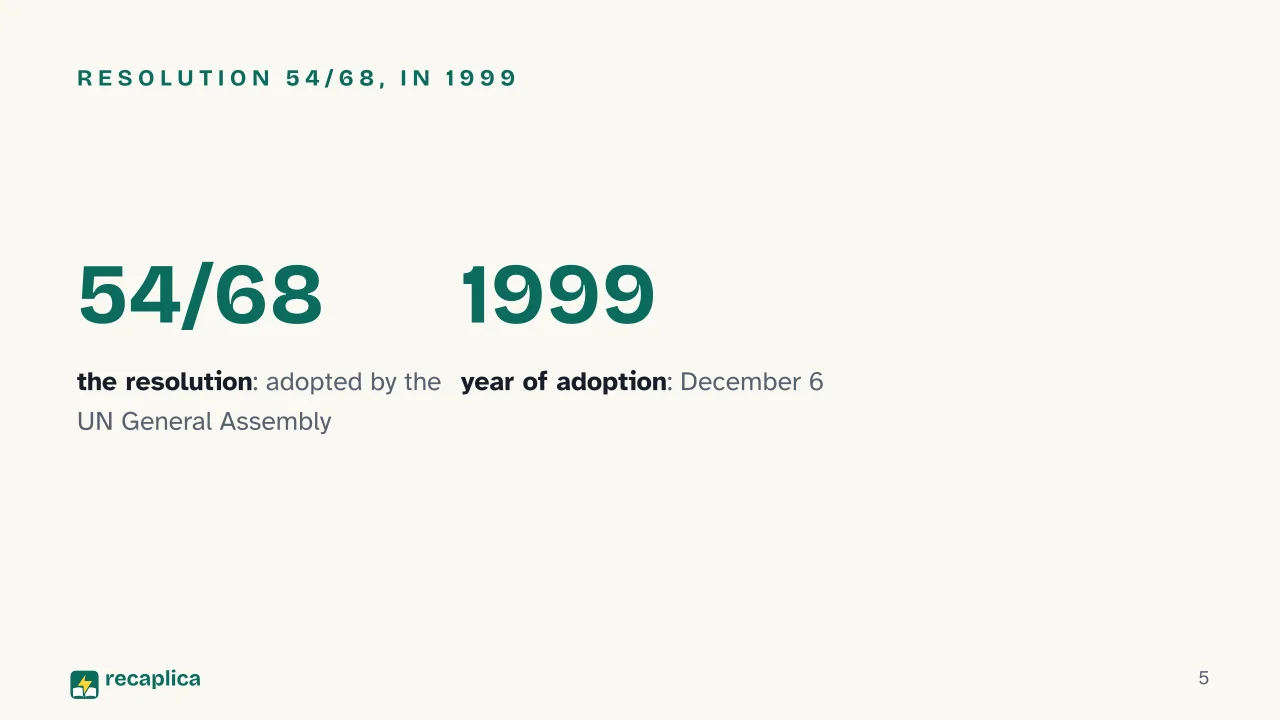
    • The United Nations created it with resolution 54/68, adopted on December 6, 1999.
    • October 4 recalls the launch of Sputnik 1, the first artificial satellite, in 1957.
    • October 10 recalls the 1967 entry into force of the Outer Space Treaty, the pact that sets out the rules of space exploration.
    • The UN states four goals for the week: it should inspire students, show public support, educate the public and build international cooperation.
    • The World Space Week Association and the United Nations Office for Outer Space Affairs (UNOOSA) choose each year's theme together.

    Key figures

    • 1999 year of UN resolution 54/68, which created World Space Week, adopted by the General Assembly on December 6 Source: UN
    • 1957 year of the Sputnik 1 launch, the first artificial satellite, marked by the opening day of the week, October 4 Source: UN (Indonesia office)
    • 1967 year the treaty on the principles of space exploration entered into force, marked by the closing day of the week, October 10 Source: UN (Indonesia office)

    Deep Dive

    What World Space Week is

    World Space Week is an observance created by the United Nations to tell the public what space science and technology contribute to everyday life. The UN General Assembly established it with resolution 54/68, adopted on December 6, 1999. The UN calls it the largest annual space event in the world: during the week, schools hold extra lectures, observatories open for special viewing nights, science museums run exhibits, and space agencies, universities and enthusiasts organize online events.

    Anyone curious about what astronomy actually studies can start with the solar system: most of the missions celebrated during the week are set there, from satellites in Earth orbit to probes headed toward other planets.

    The dates: why October 4 to 10

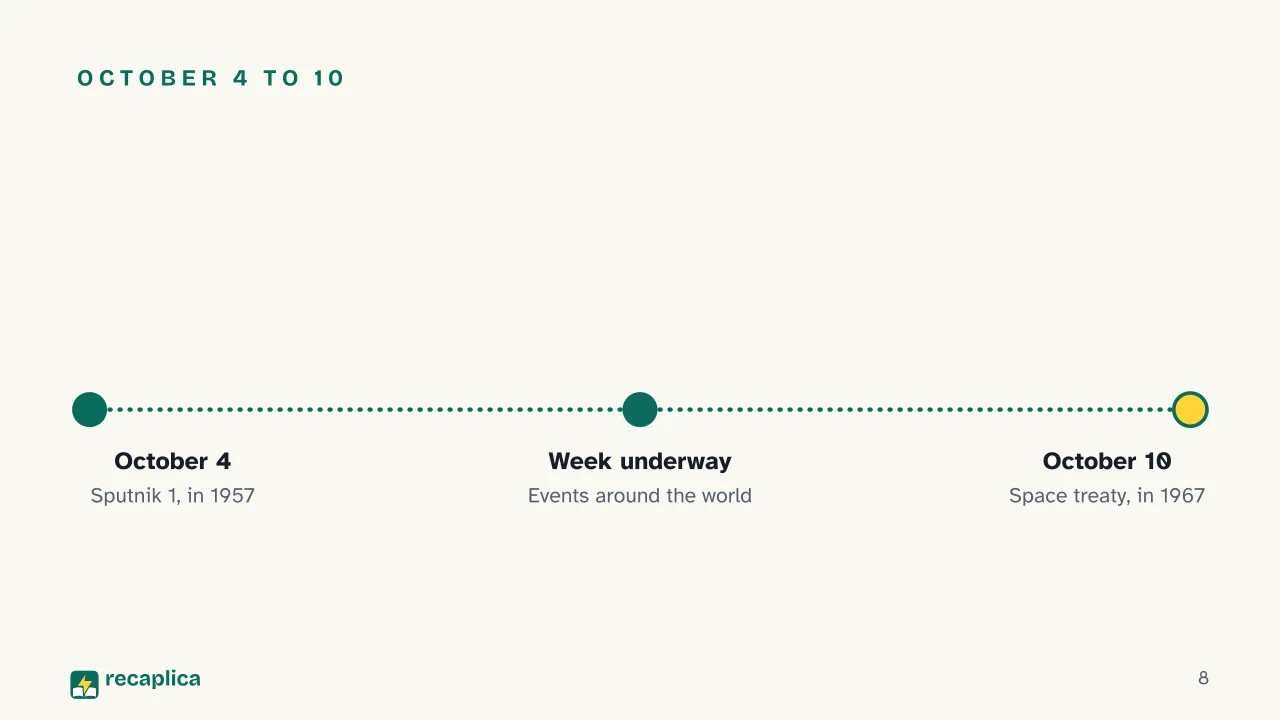
    The opening and closing dates weren’t picked at random. October 4 marks the 1957 launch of Sputnik 1, the first artificial satellite sent into orbit, an event that opened the era of space exploration. October 10 marks instead the 1967 entry into force of the Outer Space Treaty, the pact that lays out the rules states must follow when they explore and use space, Moon and other celestial bodies included: the first international agreement to set common ground rules for sending objects and people beyond Earth’s atmosphere.

    Practical example: a school running a field trip during the week can tie the two dates to a history lesson and an international law lesson, no planetarium required: the Sputnik 1 launch and the 1967 treaty are enough as two episodes worth telling in full.

    The goals stated by the UN

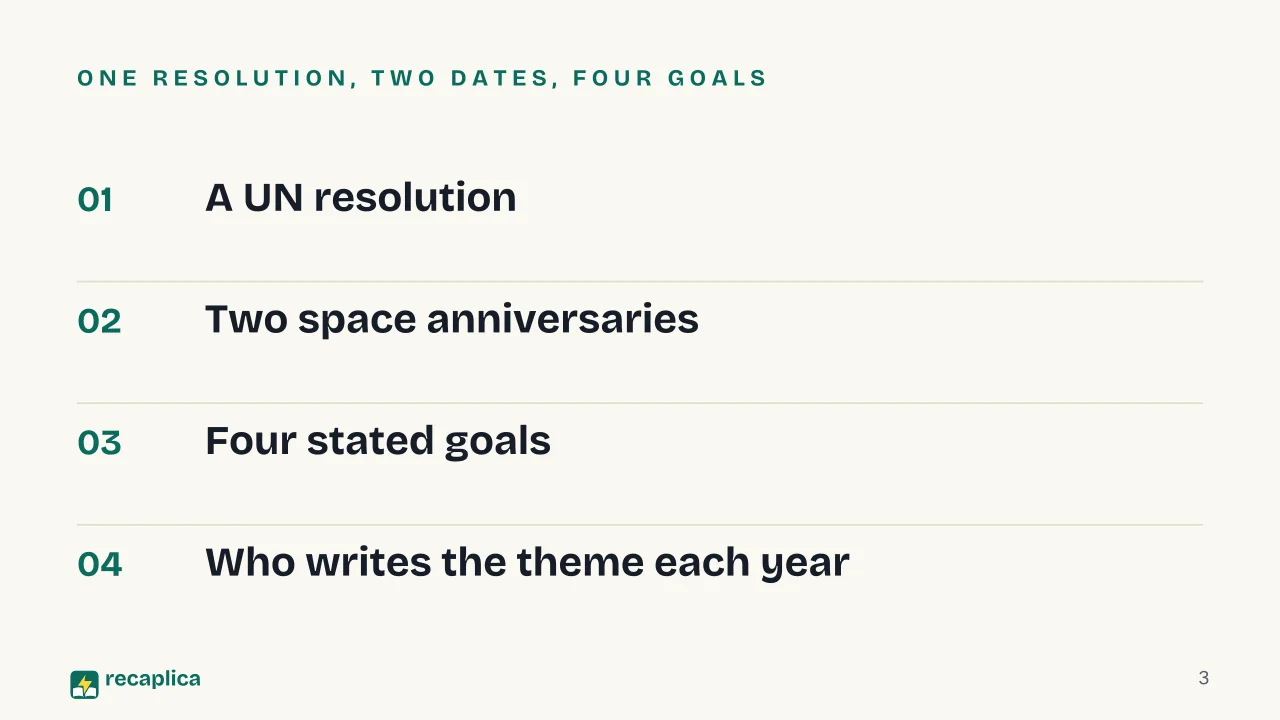
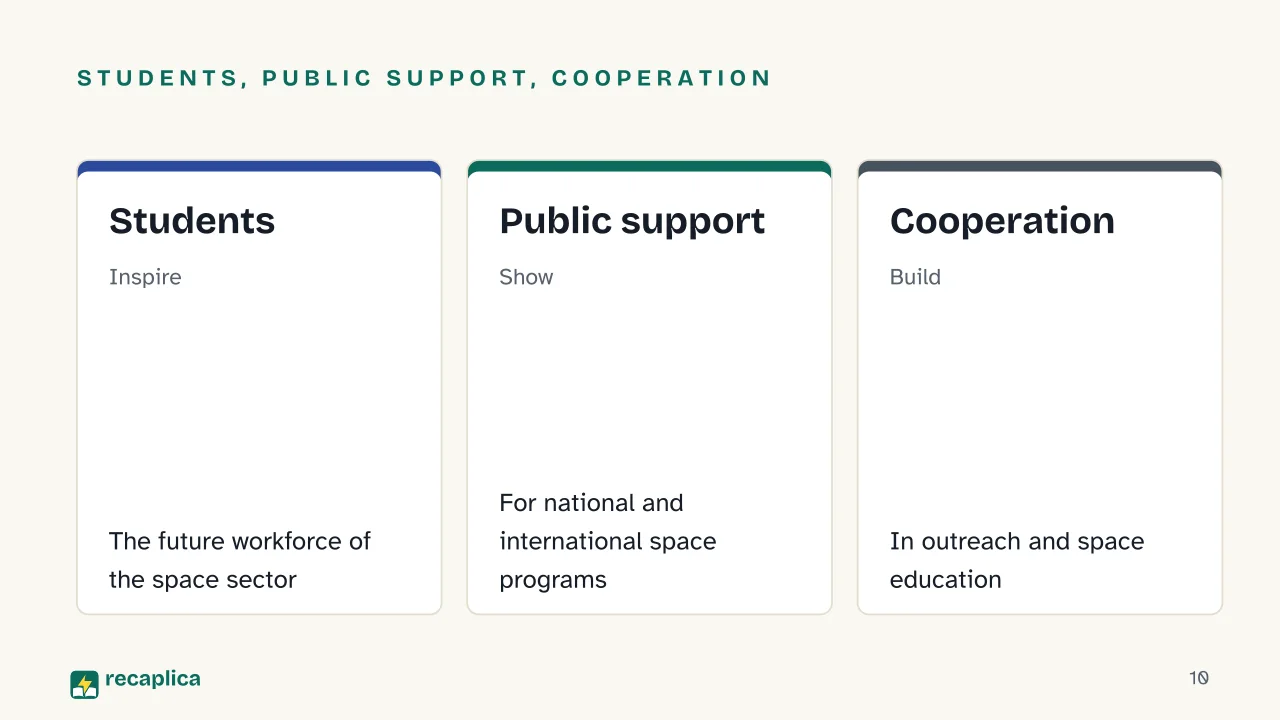
    The UN set four goals for the week. The first is inspiring students, thought of as the future workforce of the space sector. The second is showing public support for national and international space programs. The third is informing the public about activities tied to space. The fourth is building international cooperation in outreach and education on space topics.

    These goals explain why the week’s calendar leans so heavily on educational activities. Anyone wondering how a space mission actually gets built, step by step, can look at the scientific method: observation, hypothesis and testing are the same stages behind every mission told during the week.

    Who decides each year’s theme

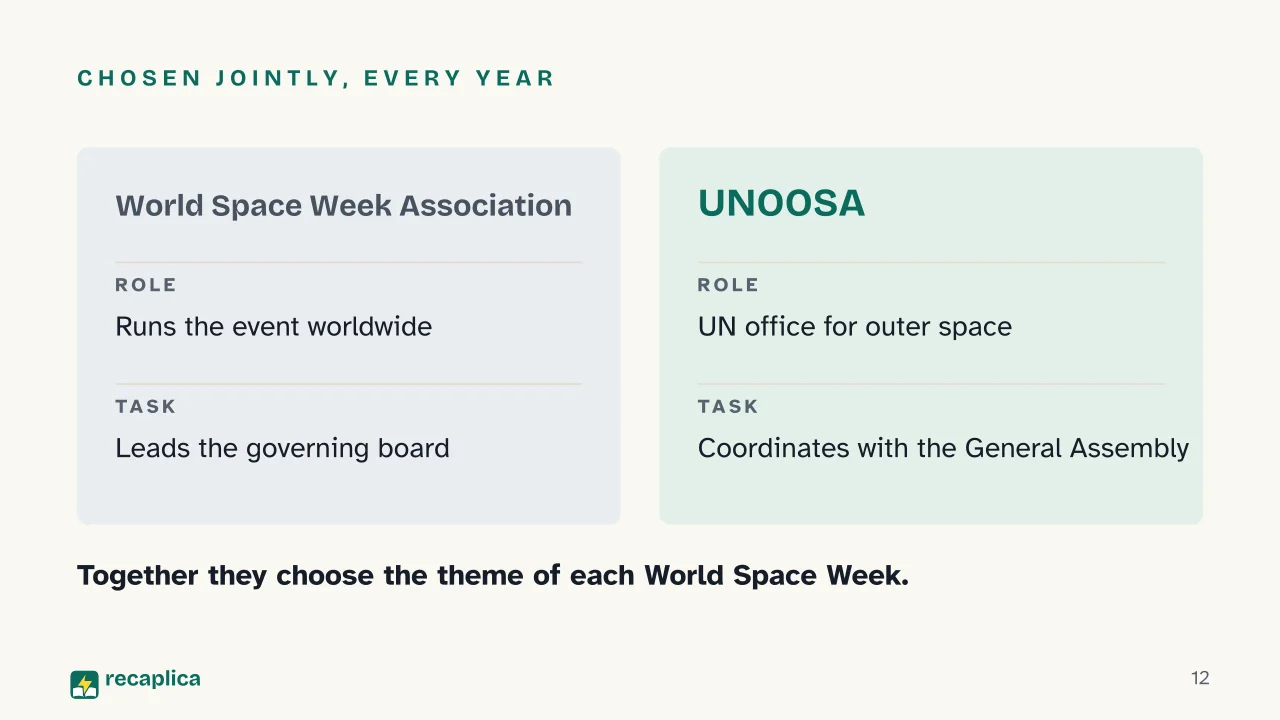
    Every World Space Week has an annual theme. It’s chosen jointly by the governing board of the World Space Week Association, the organization that runs the event worldwide, and the United Nations Office for Outer Space Affairs (UNOOSA), the agency that handles the UN’s legal and scientific work on space.

    Why the week matters even if you’re not into space

    Much of what the week celebrates doesn’t stay confined to research: weather satellites and communications satellites are direct applications of the space programs the UN wants people to know about. Satellite navigation belongs on that list too, and behind it sit measurable economic returns. Anyone curious about the numbers behind that sector can look at the space economy, which tracks the value of satellite services and space-related manufacturing. The orbits those satellites travel follow the same rules described by Kepler’s laws, formulated centuries before anyone sent the first human-built object into the sky.

    Slide deck

    Slides ready to download and make your own in PowerPoint or Google Slides, with speaker notes. Pick the Flash cut or the Full one.
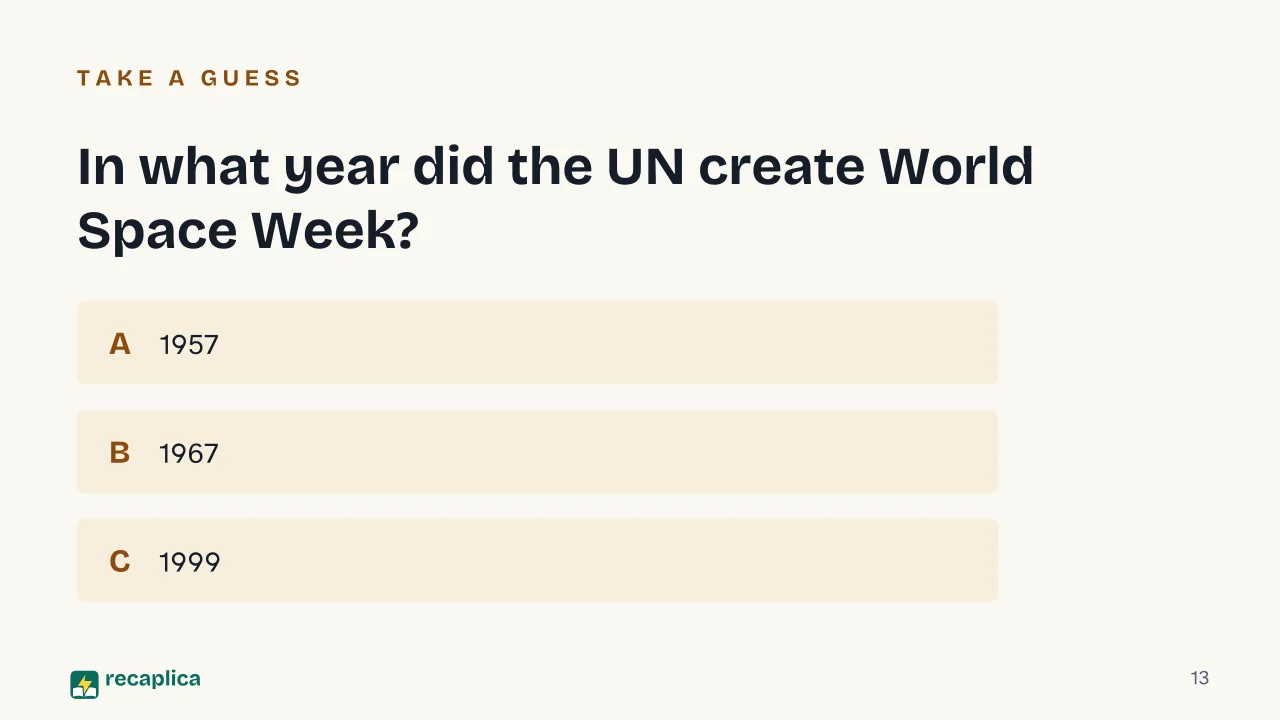
    Slide 1 of the presentation on World Space Week: World Space WeekSlide 2 of the presentation on World Space Week: Why does the week run exactly from October 4 to 10?Slide 3 of the presentation on World Space Week: One resolution, two dates, four goalsSlide 4 of the presentation on World Space Week: Chapter 01: A UN resolutionSlide 5 of the presentation on World Space Week: Resolution 54/68, in 1999Slide 6 of the presentation on World Space Week: The week was born at the UN, not at NASA or ESA.Slide 7 of the presentation on World Space Week: Chapter 02: Two space anniversariesSlide 8 of the presentation on World Space Week: October 4 to 10Slide 9 of the presentation on World Space Week: Chapter 03: Four stated goalsSlide 10 of the presentation on World Space Week: Students, public support, cooperation: Students, Public support, CooperationSlide 11 of the presentation on World Space Week: Chapter 04: Who decides the themeSlide 12 of the presentation on World Space Week: Chosen jointly, every yearSlide 13 of the presentation on World Space Week: In what year did the UN create World Space Week?Slide 14 of the presentation on World Space Week: Now, the recap
    Flash10 slidesThe essential thread, to present in classFull14 slidesEvery chapter and the deeper detail

    Common myths

    • ✗ Myth Many people assume World Space Week is a NASA or ESA initiative.

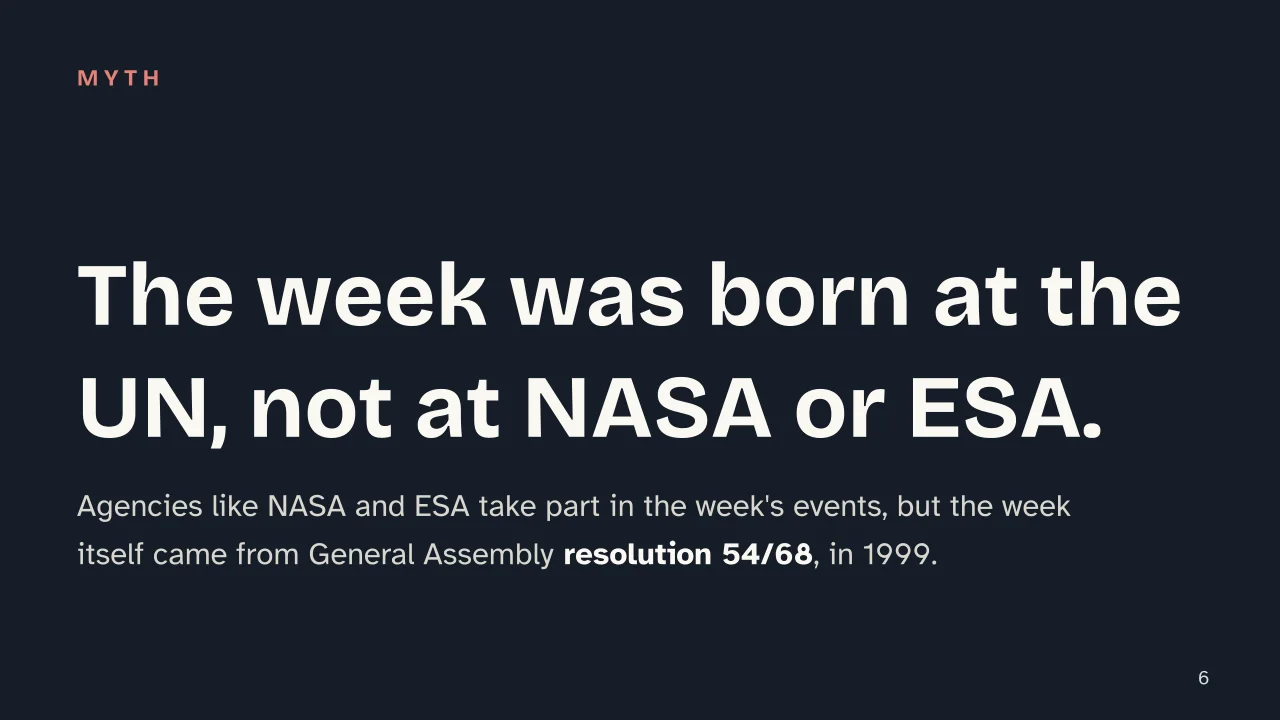
      ✓ Reality It's actually a United Nations institution, created by General Assembly resolution 54/68 in 1999. Agencies like NASA and ESA take part in the week's events, but they didn't start it.

    • ✗ Myth Many people assume the October 4-10 dates were picked just for calendar convenience, with no real reason behind them.

      ✓ Reality They actually mark two precise anniversaries: the week is built between two milestones of space history, the October 4 launch of Sputnik 1 in 1957 and the October 10 date when the Outer Space Treaty took effect, in 1967.

    Mind map

    Drag the background to move around and the nodes to reposition them; use − and + to collapse and expand branches.
    Customize
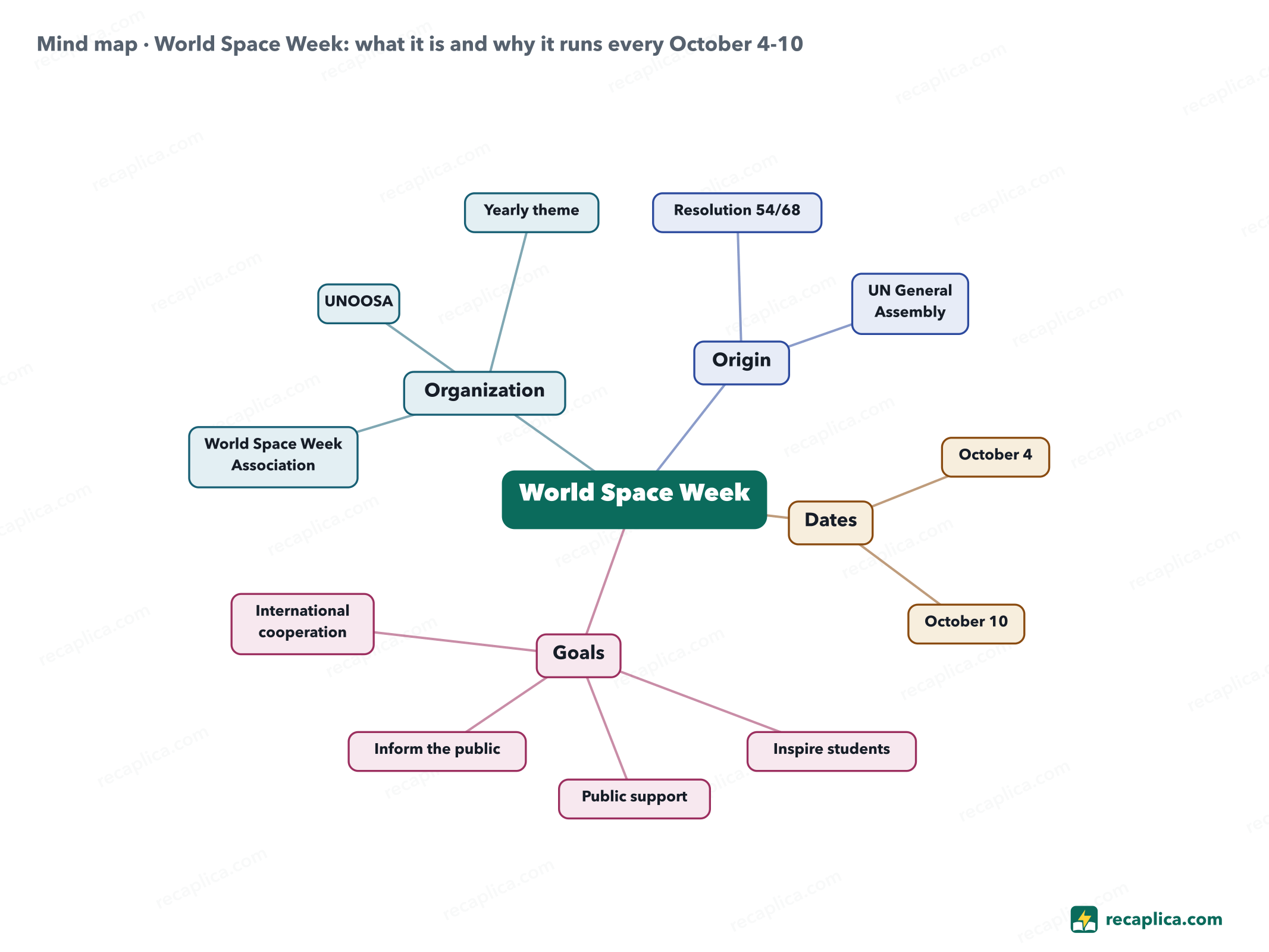
    Mind map: World Space Week: what it is and why it runs every October 4-10
    • World Space Week
      • Origin
        • Resolution 54/68 Adopted on December 6, 1999
        • UN General Assembly The body that created it
      • Dates
        • October 4 Launch of Sputnik 1, in 1957
        • October 10 Space treaty in force, in 1967
      • Goals
        • Inspire students
        • Public support
        • Inform the public
        • International cooperation
      • Organization
        • World Space Week Association Runs the event worldwide
        • UNOOSA UN Office for Outer Space Affairs
        • Yearly theme Chosen jointly by the two bodies

    Quiz: test yourself

    Answer the questions to check what you have learned: you get instant feedback and a short explanation.

    Grade 0/10 0/5
    1 In what year did the UN General Assembly create World Space Week?

    Resolution 54/68 was adopted by the General Assembly on December 6, 1999.

    2 What are the dates of World Space Week?

    The week is celebrated every year from October 4 to 10, as confirmed on the official World Space Week Association website.

    3 True or false: October 4, the opening day of the week, marks the launch of Sputnik 1.

    True. Sputnik 1, the first artificial satellite, launched on October 4, 1957, and that date opens every edition of the week.

    4 What does October 10, the closing day of the week, mark?

    October 10 marks 1967, the year the Outer Space Treaty, the pact setting common rules for exploring and using space, took effect.

    5 Which of these is NOT one of the stated goals of World Space Week?

    The UN lists four stated goals, inspiring students, showing public support, informing the public and building international cooperation; funding missions is not among them.

    Answers: 1-C · 2-B · 3-A · 4-B · 5-C

    Flashcards

    Tap the card to flip it and check whether you remember the answer, then move to the next one.

    1 / 7

    Explain it in your own words

    The ultimate test: if you can explain it in simple words, you've truly understood it. Write your explanation, then compare it with the Recap.

    Your explanation is saved only on this device.

    According to the UN, World Space Week is the biggest annual space event celebrated anywhere, every year from October 4 to 10. The United Nations General Assembly created it with resolution 54/68, adopted on December 6, 1999, to recognize what space science and technology contribute to a better life on Earth. The two dates mark real anniversaries: October 4 recalls the 1957 launch of Sputnik 1, and October 10 recalls when the treaty setting out the rules of space exploration took effect, in 1967. Each edition turns around a theme chosen jointly by the World Space Week Association and the United Nations Office for Outer Space Affairs, and it pushes schools and space agencies to organize events around the globe.

    Frequently asked questions

    What is World Space Week?

    According to the UN, it's the world's biggest annual space event, marked every year from October 4 to 10 with events, exhibits and educational activities about space exploration.

    Who created World Space Week, and when?

    The United Nations General Assembly, with resolution 54/68, adopted on December 6, 1999.

    Why does the week run exactly from October 4 to 10?

    Because October 4 recalls the 1957 launch of Sputnik 1 and October 10 recalls when the Outer Space Treaty took effect, in 1967; the two dates frame two milestones of space history.

    What are the goals of World Space Week?

    Inspiring students toward space careers, showing public support for space programs, informing the public about space activities and building international cooperation in outreach and education.

    Who decides the theme of each World Space Week?

    The governing board of the World Space Week Association, together with the United Nations Office for Outer Space Affairs (UNOOSA).

    What kind of activities happen during World Space Week?

    It varies by year and place, but typically schools add lectures and workshops, observatories hold public nights, museums set up exhibits, and universities and space agencies run talks tied to that year's theme.

    Sources

    • UN, "World Space Week" (observances)
    • World Space Week Association, official website
    • UN (Indonesia country office), "World Space Week, 4-10 October"

    Every Recap goes through an independent review before publication.

    Every evening, the day's new Recaps on our Telegram channel. Join the channel →

    Keep learning

    • Science Kepler's Laws of Planetary Motion, Explained Kepler's laws are three rules that describe how the planets move around the sun. Johannes Kepler worked them out from Tycho Brahe's observations, publishing the first two in 1609 and the third in 1619. They say that orbits are ellipses with the sun at one of the two foci, that a planet speeds up when it's close to the sun and slows down when it's far away, and that the square of the orbital period is proportional to the cube of the average distance from the sun. Before Kepler, orbits were assumed to be perfect circles, as in Copernicus's model. Read the Recap →
    • Science The solar system: the planets and what holds them together The solar system is the Sun plus everything that circles it: eight planets, hundreds of moons, millions of asteroids and comets. It formed about 4.6 billion years ago when a dense cloud of gas and dust collapsed, and the Sun took more than 99% of the available matter — the planets are what was left over. Gravity is what holds it together: the Sun's pull bends each planet's path without ever pulling it in, because the planet is moving sideways fast enough to keep missing. Close to the star only rock survived and small solid worlds formed; far out, where ice held on, the giants grew. Read the Recap →
    • Economics What Is the Space Economy? Value, Growth and Who Runs It The space economy covers every economic activity built around space: launches, satellites, telecommunications, Earth observation and, increasingly, lunar resources. In 2025 the global market was worth about $600 billion, according to the OECD, while McKinsey and the World Economic Forum project it could reach $1.8 trillion by 2035. Before 2010, launches were mostly government-run; by 2025, 88% launched privately. Control of the busiest orbits and of the Moon has meanwhile become a contest between two coalitions, the US-led Artemis Accords and the China-Russia International Lunar Research Station. Read the Recap →

    recaplica

    Clear in 30 seconds, yours in 10 minutes.

    Recaps Mind maps Request a Recap Telegram channel Mind map maker Our method About Privacy & cookies Legal notes & terms of use

    © 2026 Recaplica · A project by Curi S.r.l. — VAT IT05472000750

    Statistics, only if you say so

    To learn which Recaps help most we would use Google Analytics, with aggregate, anonymous data. It starts only with your OK, and you can change your mind anytime. Privacy policy