Skip to content
recaplica

    One moment: security check

    Cloudflare wants to make sure you're not a robot. Tick the box below and your search will continue on its own.

    IT
    recaplica Leavening: what it is and how it works
    © 2026 Recaplica · recaplica.com — All rights reserved
    Home › Science Food and cooking

    Leavening: what it is and how it works

    By Recaplica Newsroom · Updated on September 1, 2026

    What to print

    Page numbers appear when printing with default margins.

    Slides

    Choose a cut

    Flash10 slidesThe essential thread, to present in classFull17 slidesEvery chapter and the deeper detail

    Both come with speaker notes.

    Telegram channel
    recaplica Clear in 30 seconds, yours in 10 minutes.
    In 30 seconds Key points Figures Deep dive Slides Myths Mind map Quiz Flashcards FAQ

    In 30 seconds quick read

    Leavening is the process that inflates a dough from the inside: a gas (almost always carbon dioxide) forms bubbles that get trapped in the stretchy mesh of gluten. The gas can come from living microorganisms that ferment sugars (baker's yeast, sourdough), from a chemical reaction between baking soda and an acid (baking powder), or simply from steam and air expanding in the oven. During baking the bubbles grow one last time, then the structure sets: that is how bread gets its crumb and cakes get their softness.

    Key Points

    • Leavening means producing gas inside a dough and holding onto it: gluten forms the stretchy net that traps the bubbles.
    • Biological leavening: yeast (the single-celled fungus Saccharomyces cerevisiae) ferments sugars into carbon dioxide and ethanol.
    • Sourdough is an ecosystem: wild yeasts plus lactic acid bacteria, which add lactic and acetic acid (the tangy flavor).
    • Chemical leavening: nothing alive, just a reaction between baking soda and an acid that releases CO₂ fast.
    • Physical leavening: steam and whipped-in air expand with heat, without any new gas being produced.
    • In the oven, yeast dies at around 59 °C (138 °F); soon after, starch gelatinizes and the bubble-filled structure sets for good.

    Key figures

    • 59 °C the temperature (138 °F) at which yeast dies during baking and stops producing gas Source: Chemistry LibreTexts
    • 68% of 394 sourdoughs surveyed in one study had Saccharomyces cerevisiae, the baker's yeast species, as their most common yeast Source: PubMed Central
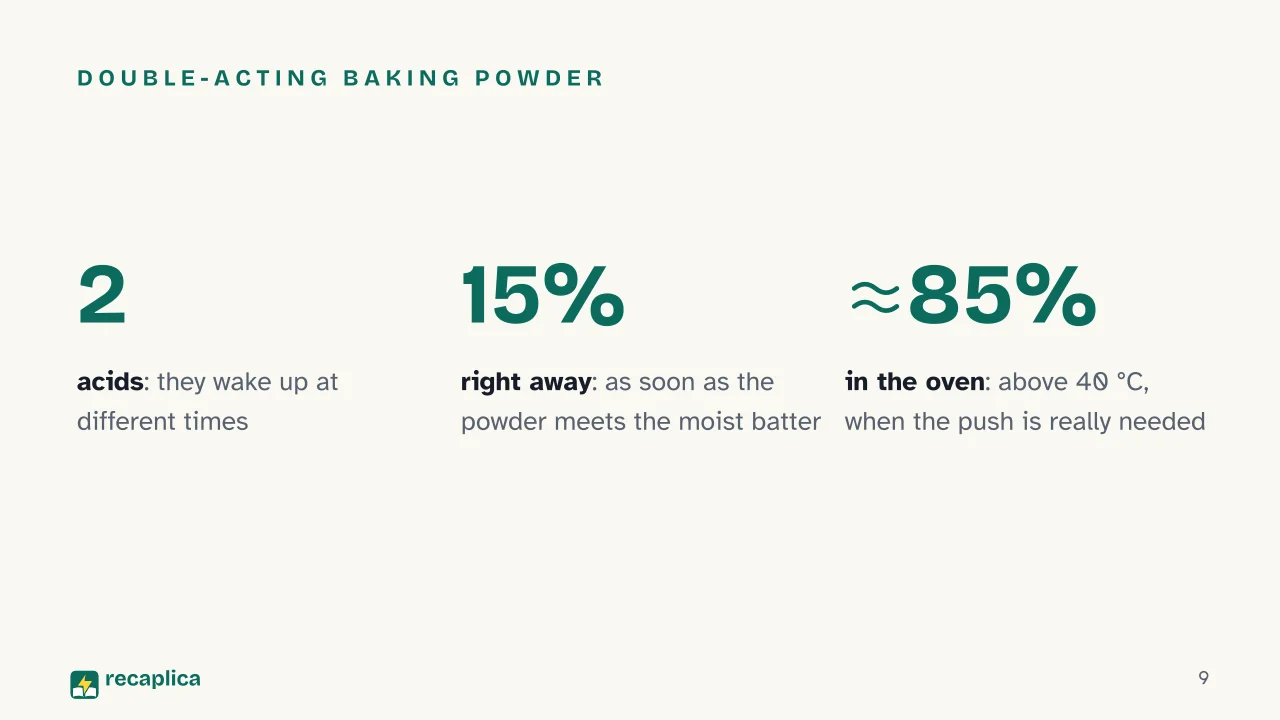
    • ≈85% the share of gas that double-acting baking powder releases only in the oven, above 40 °C (105 °F) Source: Chemistry LibreTexts

    Deep Dive

    A balloon inflated from the inside

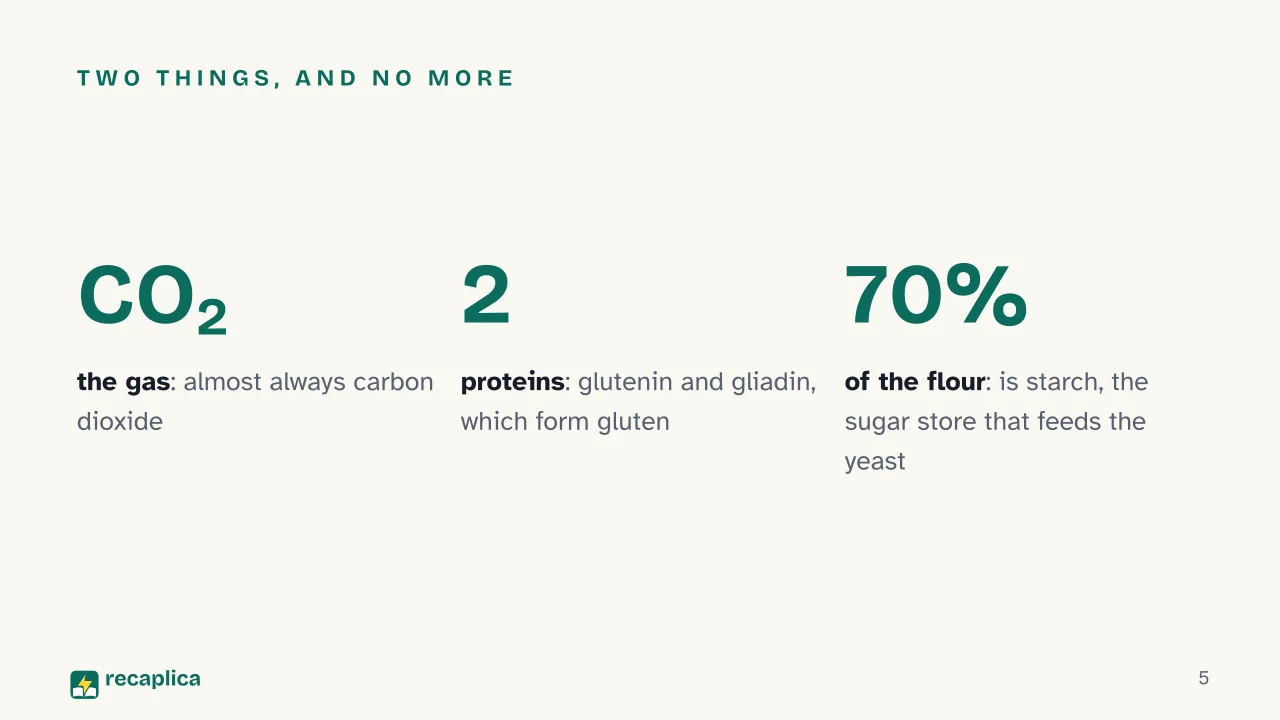
    A rising dough is a balloon inflated from the inside. Two things are needed: something that produces a gas, almost always carbon dioxide (CO₂), and something that holds it in, the balloon’s stretchy wall. Every leavening method — biological, chemical, physical — only changes the first ingredient, the way the gas gets made. The wall is nearly always the same: gluten.

    The gluten net

    Wheat flour contains two proteins, glutenin and gliadin. On their own they do nothing remarkable; once they meet water, though, they bond together and form gluten. Kneading exists precisely for this: the longer a dough is worked, the more continuous and stretchy the gluten mesh becomes, able to stretch around gas bubbles without letting them escape.

    The rest of the flour is mostly starch, about 70% of its weight: a store of sugars that the wheat plant packed into its seed through photosynthesis. Enzymes in the flour break part of that starch down into simple sugars, which become the yeast’s food.

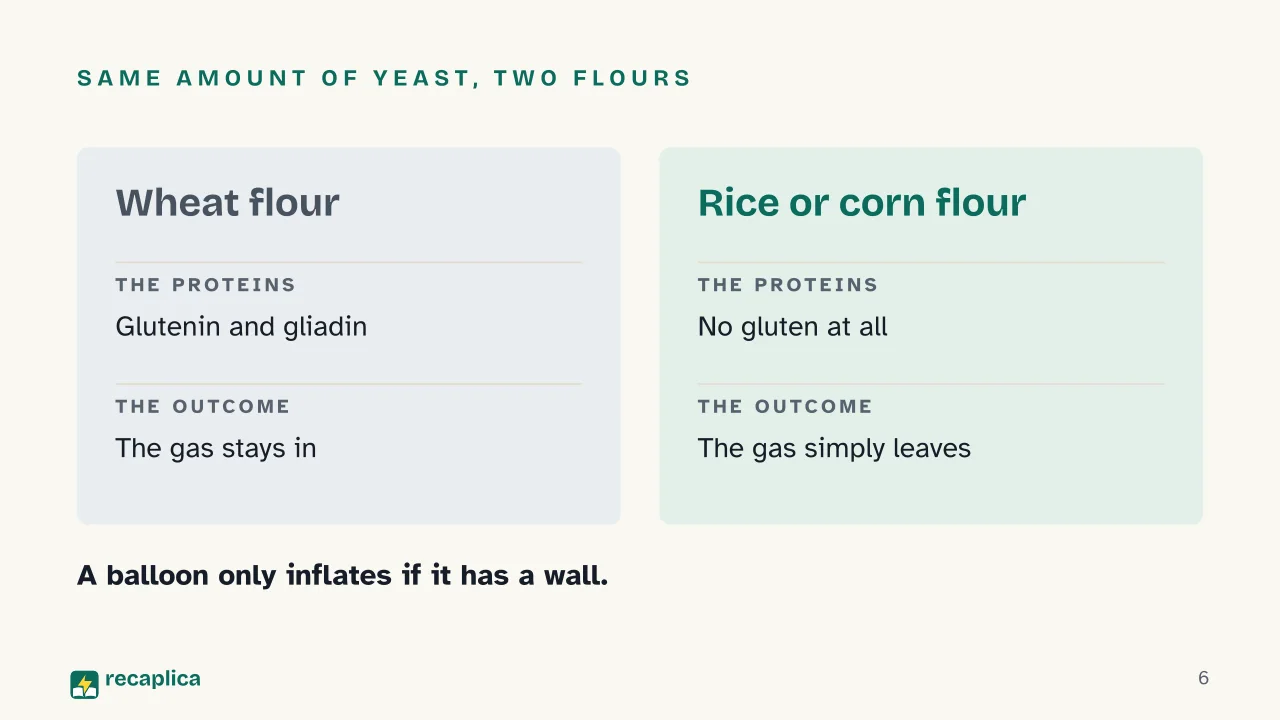
    Practical example: cakes made only with rice or corn flour stay low and dense no matter how much leavening you add. The gas gets produced just fine, but those flours lack the gluten proteins: the balloon inflates without a wall, and the gas simply leaves.

    Biological leavening: baker’s yeast

    Baker’s yeast is a living thing: the fungus Saccharomyces cerevisiae, made of a single cell. Inside a dough, moist and full of sugars, it finds its ideal home and does what it has done for millions of years: it ferments. It consumes sugars and produces two things: carbon dioxide, which inflates the dough one bubble at a time, and ethanol, which will almost entirely evaporate during baking.

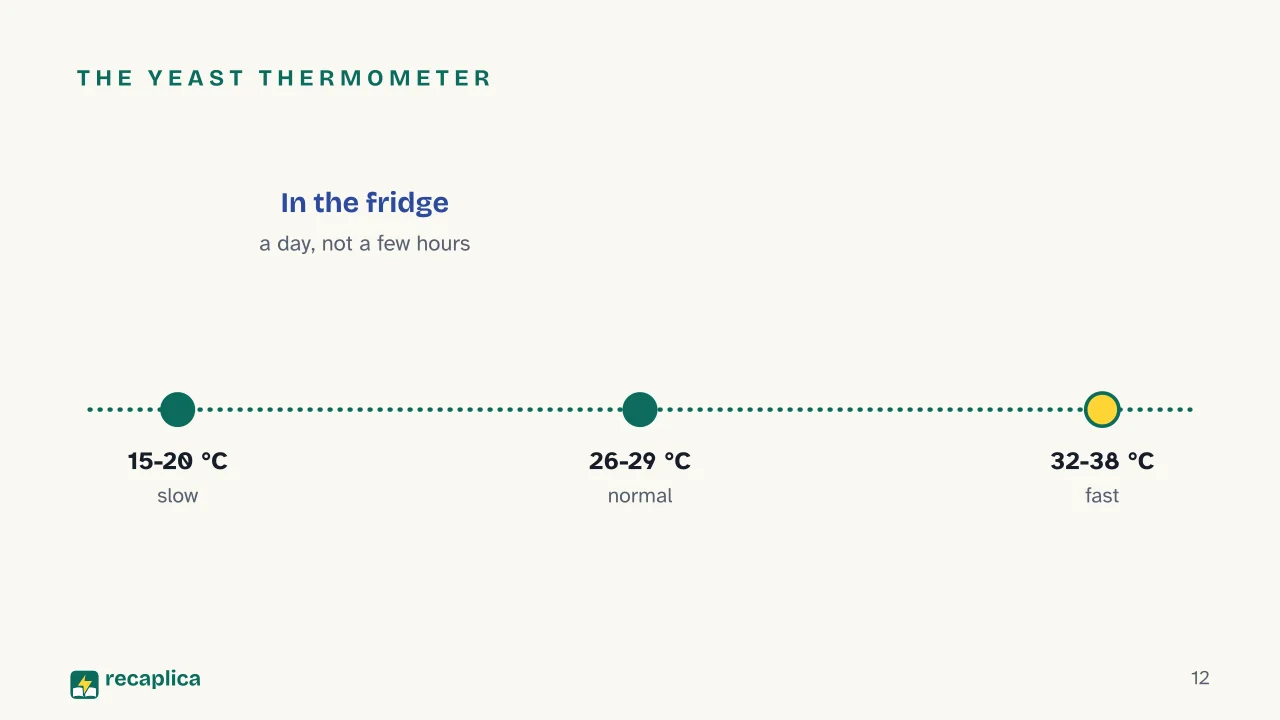
    Being alive, yeast keeps its own pace, and that pace depends on temperature: fermentation is slow between 15 and 20 °C (60-68 °F), runs at normal speed between 26 and 29 °C (80-85 °F) and speeds up between 32 and 38 °C (90-100 °F). Past a certain threshold, though, warmth stops helping and starts killing the cells.

    Practical example: a dough left in the refrigerator still rises, but over a day rather than a few hours. Below 15 °C the yeast’s metabolism slows dramatically without shutting down: the exact same process, played in slow motion.

    Sourdough: an apartment building of microbes

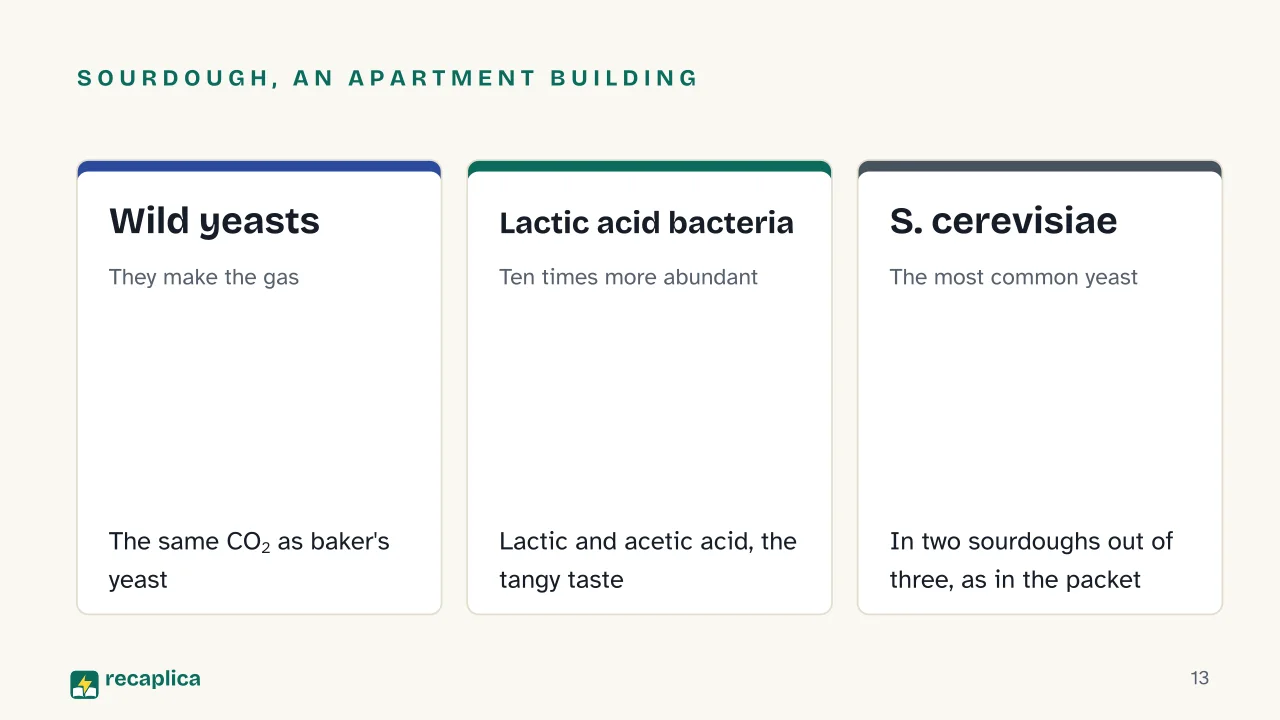
    A sourdough starter is not an ingredient but an ecosystem: a mix of flour and water where a community of wild yeasts and lactic acid bacteria has settled in. The bacteria outnumber everyone, at least ten times more abundant than the yeasts. Each tenant has a job:

    • the yeasts produce the gas that makes the dough rise, just as in baker’s yeast;
    • the lactic acid bacteria produce lactic acid and acetic acid, which give the typical tangy taste, and some species contribute a little extra CO₂.

    The species vary from one starter to the next: microbiologists tell them apart by reading their DNA, and among the bacteria a frequent find is Fructilactobacillus sanfranciscensis, which carries the name of San Francisco’s famous sourdough bread. Among the yeasts, a surprise: very often the most common one is Saccharomyces cerevisiae itself, the same species as the packet from the supermarket.

    Chemical leavening: nothing alive

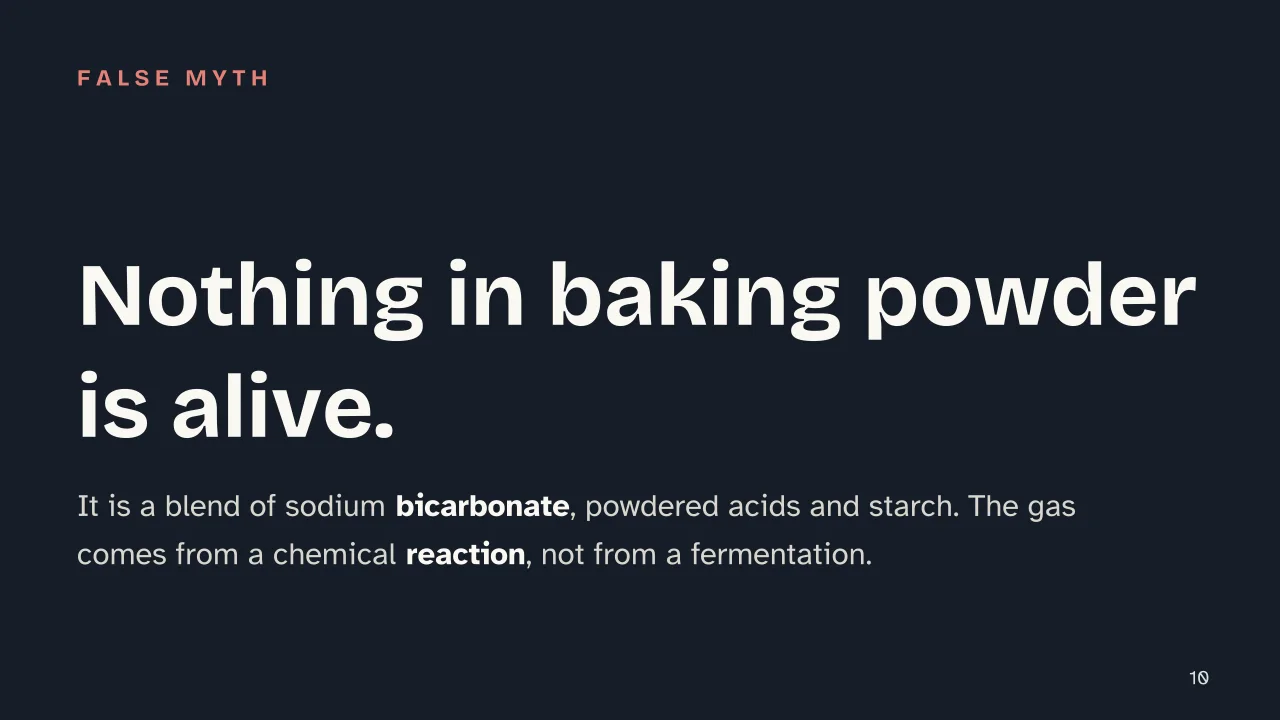
    Baking powder has no life in it at all: it is a blend of sodium bicarbonate (baking soda), one or more powdered acids, and a little starch that keeps them dry and apart. As long as the powder stays dry, nothing happens; the moment it lands in a moist batter, bicarbonate and acid finally meet and the reaction releases CO₂. Bicarbonate on its own, heated, gives off some gas; paired with an acid it releases twice as much.

    Double-acting versions contain two acids that wake up at different times: one reacts right away in the cold batter, releasing about 15% of the gas, while the other kicks in inside the oven, above 40 °C (105 °F), where it delivers the remaining 85%. Most of the push arrives exactly when it is needed, as the batter is already baking.

    Practical example: this is why cakes and muffins rely on baking powder rather than yeast: their batters come together in ten minutes, without the time (or the developed gluten mesh) that a fermentation would demand. A chemical reaction needs no hours: moisture and oven heat are enough.

    Physical leavening: steam and air

    There is a third way to inflate a dough, the simplest of all: produce no new gas and let heat expand what is already there. The water in a dough turns to steam in the oven and pushes: that is what lifts puff pastry into its thin layers. Or the gas gets folded in beforehand, by whipping: eggs beaten at length fill up with microscopic air bubbles, which expand in the oven and raise a sponge cake without a gram of yeast.

    In the oven: the final push

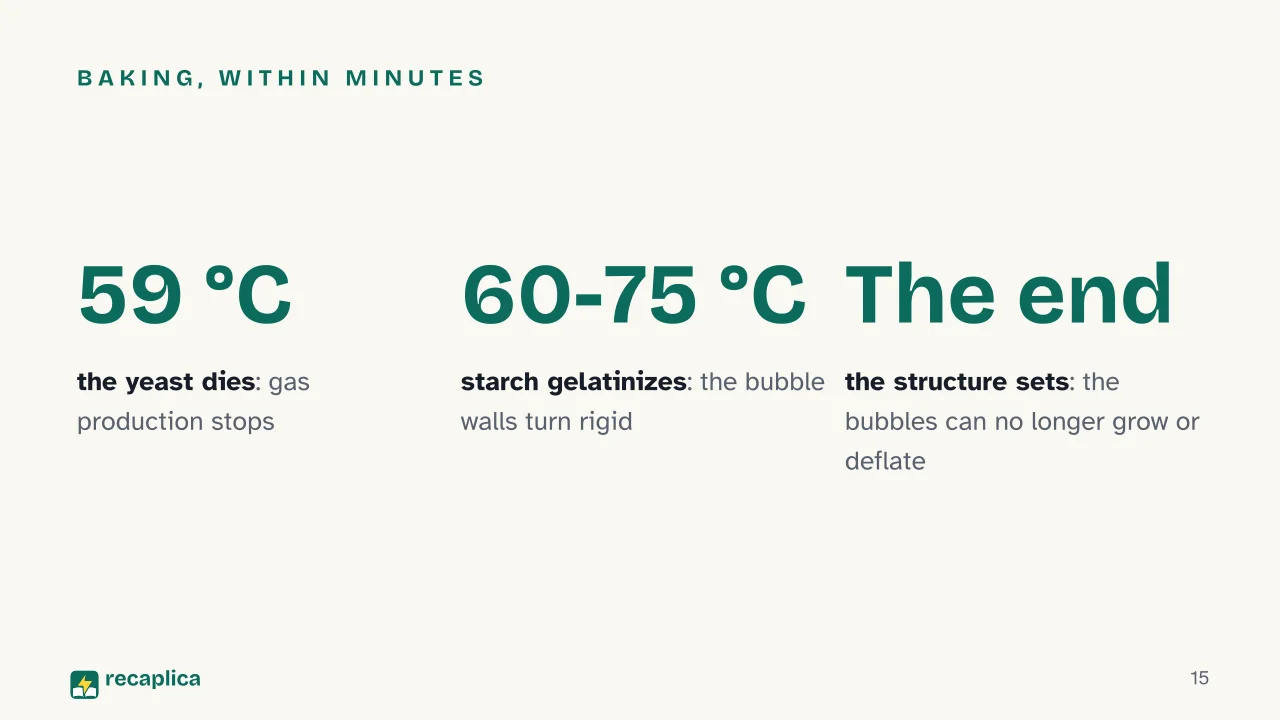
    Baking is the last act, and it all happens within minutes. Heat first delivers one final push: gases expand, steam builds, and for a short while the warmed-up yeast ferments faster than ever. Then, at around 59 °C (138 °F), the yeast dies: gas production stops. Almost at the same moment, between 60 and 75 °C, the starch gelatinizes: the bubble walls, stretchy until now, turn rigid.

    The balloon, in other words, becomes a solid structure: the bubbles can no longer grow or deflate. A bread’s crumb is a snapshot of that instant.

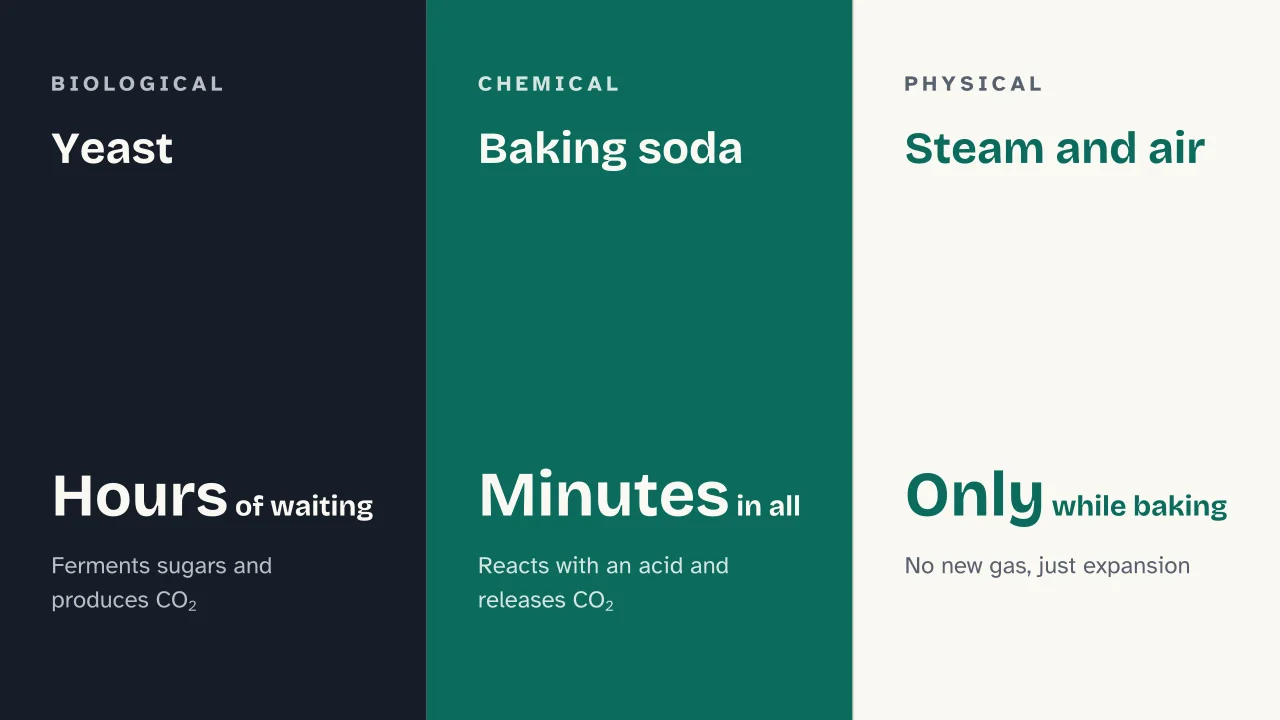
    BiologicalChemicalPhysical
    What makes the gasYeast, fermenting sugarsThe reaction of bicarbonate with acidNothing new, steam and air expand
    TimingHoursMinutesOnly during baking
    Anything alive?YesNoNo
    Added flavorsFermentation aromas, tang (sourdough)None (when properly dosed)None

    Seen up close, leavening brings biology, chemistry and physics together in the same bowl. The gas can be born in three different ways, but the ending never changes: the gluten net holds the bubbles until heat fixes the shape.

    Slide deck

    Slides ready to download and make your own in PowerPoint or Google Slides, with speaker notes. Pick the Flash cut or the Full one.
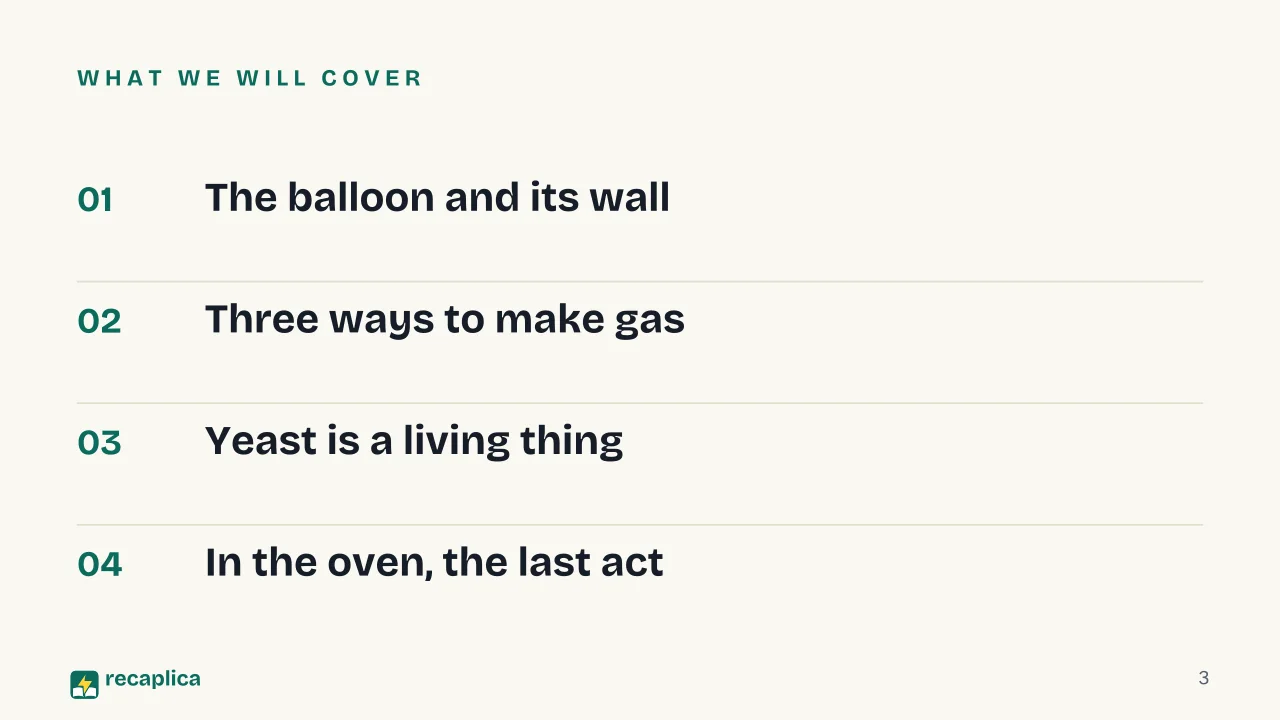
    Slide 1 of the presentation on Leavening: LeaveningSlide 2 of the presentation on Leavening: Who inflates the dough, and who holds it in?Slide 3 of the presentation on Leavening: What we will coverSlide 4 of the presentation on Leavening: Chapter 01: The balloon and its wallSlide 5 of the presentation on Leavening: Two things, and no moreSlide 6 of the presentation on Leavening: Same amount of yeast, two floursSlide 7 of the presentation on Leavening: Chapter 02: Three ways to make gasSlide 8 of the presentation on Leavening: Yeast · Baking soda · Steam and airSlide 9 of the presentation on Leavening: Double-acting baking powderSlide 10 of the presentation on Leavening: Nothing in baking powder is alive.Slide 11 of the presentation on Leavening: Chapter 03: Yeast is a living thingSlide 12 of the presentation on Leavening: The yeast thermometerSlide 13 of the presentation on Leavening: Sourdough, an apartment building: Wild yeasts, Lactic acid bacteria, S. cerevisiaeSlide 14 of the presentation on Leavening: Chapter 04: In the oven, the last actSlide 15 of the presentation on Leavening: Baking, within minutesSlide 16 of the presentation on Leavening: Why does a dough stop rising at some point during baking?Slide 17 of the presentation on Leavening: And now, the review
    Flash10 slidesThe essential thread, to present in classFull17 slidesEvery chapter and the deeper detail

    Common myths

    • ✗ Myth Baker's yeast is made from beer.

      ✓ Reality Baker's yeast is an organism in its own right: the single-celled fungus Saccharomyces cerevisiae, grown today specifically for baking. The name is a historical leftover from the times when bakers collected yeast from the fermentation froth of breweries; even the scientific name, 'cerevisiae', comes from the Latin word for beer.

    • ✗ Myth Sourdough is more 'alive' and natural than baker's yeast, which is an industrial product.

      ✓ Reality Both are alive, and they often share the same yeast: in a survey of 394 sourdoughs, Saccharomyces cerevisiae was the most common species in 68% of them. The real difference is that sourdough is an ecosystem that also hosts lactic acid bacteria, responsible for its acidity and aromas.

    • ✗ Myth Baker's yeast and baking powder are the same thing in two different forms.

      ✓ Reality They are opposite worlds: the first is a microorganism that makes gas by fermenting sugars, the second is a mixture with nothing alive in it, where the gas comes from a reaction between bicarbonate and an acid. Both are called leavening agents only because the outcome, an inflated dough, is the same.

    Mind map

    Drag the background to move around and the nodes to reposition them; use − and + to collapse and expand branches.
    Customize
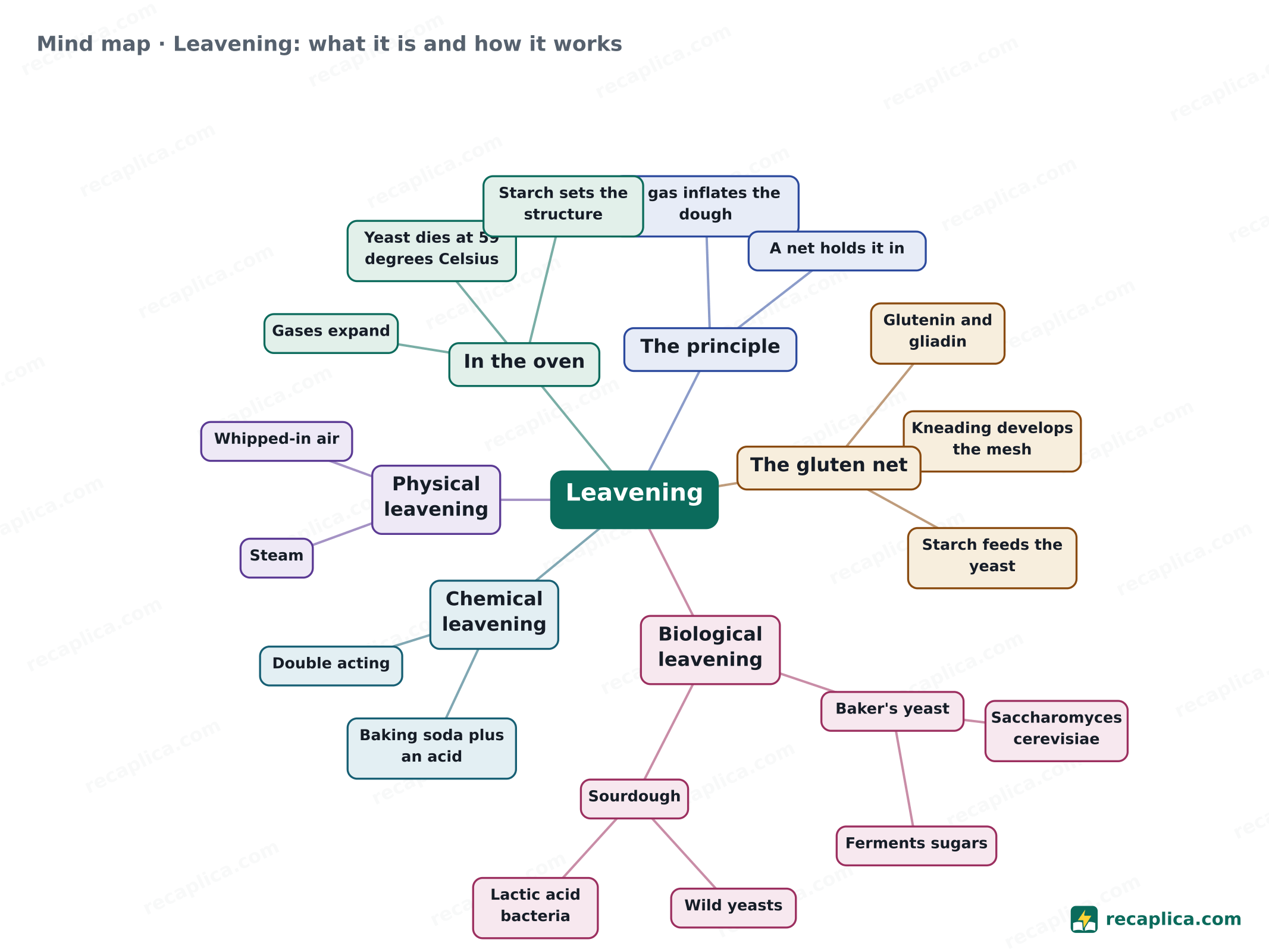
    Mind map: Leavening: what it is and how it works
    • Leavening
      • The principle
        • A gas inflates the dough Almost always carbon dioxide.
        • A net holds it in The stretchy mesh of gluten.
      • The gluten net
        • Glutenin and gliadin Two wheat proteins that bond with water.
        • Kneading develops the mesh
        • Starch feeds the yeast Enzymes break it into simple sugars.
      • Biological leavening
        • Baker's yeast
          • Saccharomyces cerevisiae A fungus made of a single cell.
          • Ferments sugars Produces carbon dioxide and ethanol.
        • Sourdough
          • Wild yeasts
          • Lactic acid bacteria Produce lactic and acetic acid.
      • Chemical leavening
        • Baking soda plus an acid A chemical reaction releases CO₂ fast.
        • Double acting Little gas when cold, most of it in the oven.
      • Physical leavening
        • Steam Expands in the oven, as in puff pastry.
        • Whipped-in air Trapped bubbles expand with heat.
      • In the oven
        • Gases expand
        • Yeast dies at 59 degrees Celsius
        • Starch sets the structure The bubbles stay fixed as they are.

    Quiz: test yourself

    Answer the questions to check what you have learned: you get instant feedback and a short explanation.

    Grade 0/10 0/5
    1 What does yeast produce when it ferments the sugars in a dough?

    Fermentation turns sugars into carbon dioxide, which inflates the dough, and ethanol, which almost entirely evaporates during baking. Oxygen has nothing to do with it: fermentation happens precisely without it.

    2 What is gluten's job in leavening?

    Gluten produces nothing: it forms when glutenin and gliadin, two wheat proteins, bond with water. Kneading makes the mesh stretchy so it can hold the gas made by the other players. The yeast is fed by sugars released from starch instead.

    3 True or false: baking powder contains living microorganisms.

    Baking powder contains nothing alive: it is a mix of sodium bicarbonate, powdered acids and starch. The gas comes from a chemical reaction between the bicarbonate and the acid, not from fermentation.

    4 What really sets sourdough apart from baker's yeast?

    Both are alive. The difference is that sourdough is a community: besides yeasts it hosts lactic acid bacteria, which produce lactic and acetic acid. The gas is the same (CO₂), and in about two sourdoughs out of three the most common yeast is Saccharomyces cerevisiae itself.

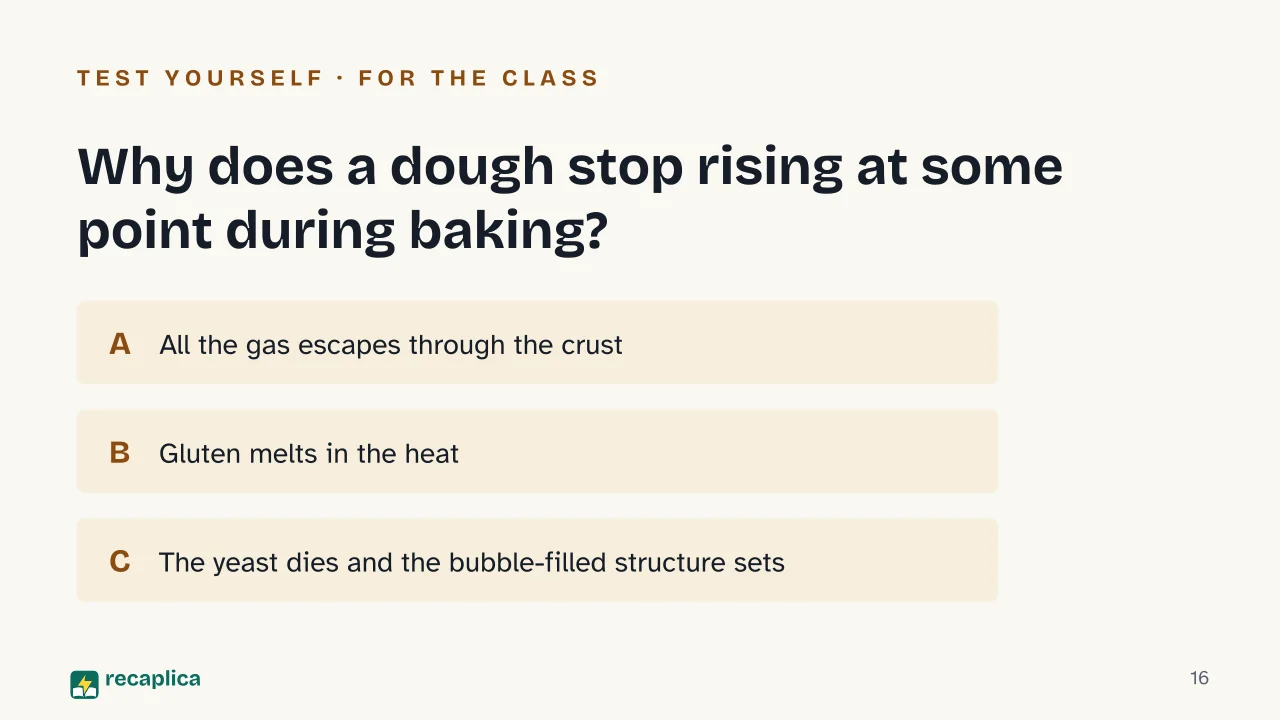
    5 Why does a dough stop rising at some point during baking?

    At around 59 °C (138 °F) the yeast dies and gas production stops; between 60 and 75 °C the starch gelatinizes and the bubble walls turn rigid. The crumb keeps the shape of the bubbles from that moment.

    Answers: 1-A · 2-B · 3-B · 4-B · 5-C

    Flashcards

    Tap the card to flip it and check whether you remember the answer, then move to the next one.

    1 / 8

    Explain it in your own words

    The ultimate test: if you can explain it in simple words, you've truly understood it. Write your explanation, then compare it with the Recap.

    Your explanation is saved only on this device.

    Leavening is the process that inflates a dough from the inside: a gas (almost always carbon dioxide) forms bubbles that get trapped in the stretchy mesh of gluten. The gas can come from living microorganisms that ferment sugars (baker's yeast, sourdough), from a chemical reaction between baking soda and an acid (baking powder), or simply from steam and air expanding in the oven. During baking the bubbles grow one last time, then the structure sets: that is how bread gets its crumb and cakes get their softness.

    Frequently asked questions

    Are baker's yeast and baking powder interchangeable?

    No, because they work in different ways and on different clocks. Baker's yeast is a living organism that ferments for hours and needs sugars and a developed gluten mesh; baking powder releases its gas in minutes through a reaction between bicarbonate and acid, which is why it suits quick batters like cakes and muffins.

    Why does dough rise faster in a warm place?

    Because yeast is alive and its metabolism depends on temperature: fermentation is slow between 15 and 20 °C (60-68 °F), normal between 26 and 29 °C (80-85 °F) and fast between 32 and 38 °C (90-100 °F). That is why refrigerated dough takes a day instead of a few hours: the cold slows the yeast down without killing it.

    What makes a sponge cake rise if there is no yeast in it?

    Air and steam. Whipping eggs for a long time traps millions of tiny air bubbles; in the oven those bubbles expand with the heat, together with the water vapor forming from the batter's moisture. That is physical leavening: no new gas, just gas that expands.

    Where does the tangy taste of sourdough bread come from?

    From the lactic acid bacteria in the starter, which live alongside the yeasts and produce lactic and acetic acid. Those acids create the typical tangy flavor of that bread, something baker's yeast alone cannot deliver.

    Does the alcohol produced by fermentation stay in the bread?

    Practically none of it: the ethanol made by the yeast almost entirely evaporates during baking, along with much of the water. At most, a trace remains in the aroma of freshly baked crumb.

    Sources

    • Exploratorium — The Science of Bread
    • Chemistry LibreTexts — Chemistry of Cooking: Leavening Agents
    • PMC — Role of lactic acid bacteria and yeasts in sourdough fermentation
    • PMC — Yeast bloom in sourdough microbiota evolution

    Every Recap goes through an independent review before publication.

    Every evening, the day's new Recaps on our Telegram channel. Join the channel →

    Keep learning

    • Science How Beer Is Made: The Brewing Process, from Barley to Glass Beer comes from four ingredients — water, malted barley, hops and yeast — combined through four main steps: malting, mashing, boiling and fermentation. During malting, barley germinates and is then dried, developing the enzymes that mashing later uses to turn starch into fermentable sugar. Boiling dissolves the hops' alpha acids, which barely dissolve in water on their own, giving beer its characteristic bitterness. The yeast strain and fermentation temperature then determine whether the result is an ale, a lager, or a spontaneously fermented beer like Belgian lambic. Read the Recap →
    • Science How Wine Is Made: The Winemaking Process, from Grape to Bottle Wine comes from the alcoholic fermentation of grape must, the process in which yeast converts sugar into ethanol and carbon dioxide. Before fermentation, grapes are crushed and destemmed to free the juice from the berries and separate it from the stems. For red wine, the must stays in contact with the skins during maceration, which gives it color and tannins; for white wine, the juice is drawn off almost immediately, so the wine stays pale. After fermentation, wine rests in barrels, oak casks or steel tanks to age before it's filtered and bottled. Under the standard set by the OIV, the international body that regulates the industry, a drink can only be called wine once it reaches a minimum alcohol content. Read the Recap →
    • Science Fermentation: What It Is and How It Transforms Food Fermentation is the process by which yeasts, bacteria and even our own muscle cells extract energy from sugars without using oxygen. It yields little, 2 molecules of ATP per glucose against roughly 38 from respiration, but it works wherever oxygen cannot reach. Its waste products, such as alcohol and lactic acid, give food its flavour and protect it from harmful microbes: that is how wine, beer, bread, yogurt and vinegar are born. It was Louis Pasteur who proved, from 1857 onwards, that living microorganisms are behind fermentation. Read the Recap →

    recaplica

    Clear in 30 seconds, yours in 10 minutes.

    Recaps Mind maps Request a Recap Telegram channel Mind map maker Our method About Privacy & cookies Legal notes & terms of use

    © 2026 Recaplica · A project by Curi S.r.l. — VAT IT05472000750

    Statistics, only if you say so

    To learn which Recaps help most we would use Google Analytics, with aggregate, anonymous data. It starts only with your OK, and you can change your mind anytime. Privacy policy