Skip to content
recaplica

    One moment: security check

    Cloudflare wants to make sure you're not a robot. Tick the box below and your search will continue on its own.

    IT
    recaplica Layers of the Earth: Crust, Mantle and Core
    © 2026 Recaplica · recaplica.com — All rights reserved
    Home › Science

    Layers of the Earth: Crust, Mantle and Core

    By Recaplica Newsroom · Updated on October 10, 2026

    What to print

    Page numbers appear when printing with default margins.

    Slides

    Choose a cut

    Flash10 slidesThe essential thread, to present in classFull14 slidesEvery chapter and the deeper detail

    Both come with speaker notes.

    Telegram channel
    recaplica Clear in 30 seconds, yours in 10 minutes.
    In 30 seconds Key points Figures Deep dive Slides Myths Mind map Quiz Flashcards FAQ

    In 30 seconds quick read

    Earth is not a single solid block. It is a set of concentric layers, each with its own composition, temperature and physical state. The outer crust, thin and solid, is the layer we live on; below it, the mantle is far thicker and mostly solid rock, despite the heat. At the center sits the core, split into a liquid outer part and a solid inner part, made almost entirely of iron and nickel. Scientists map this structure by studying seismic waves, since no one has ever drilled that deep.

    Key Points

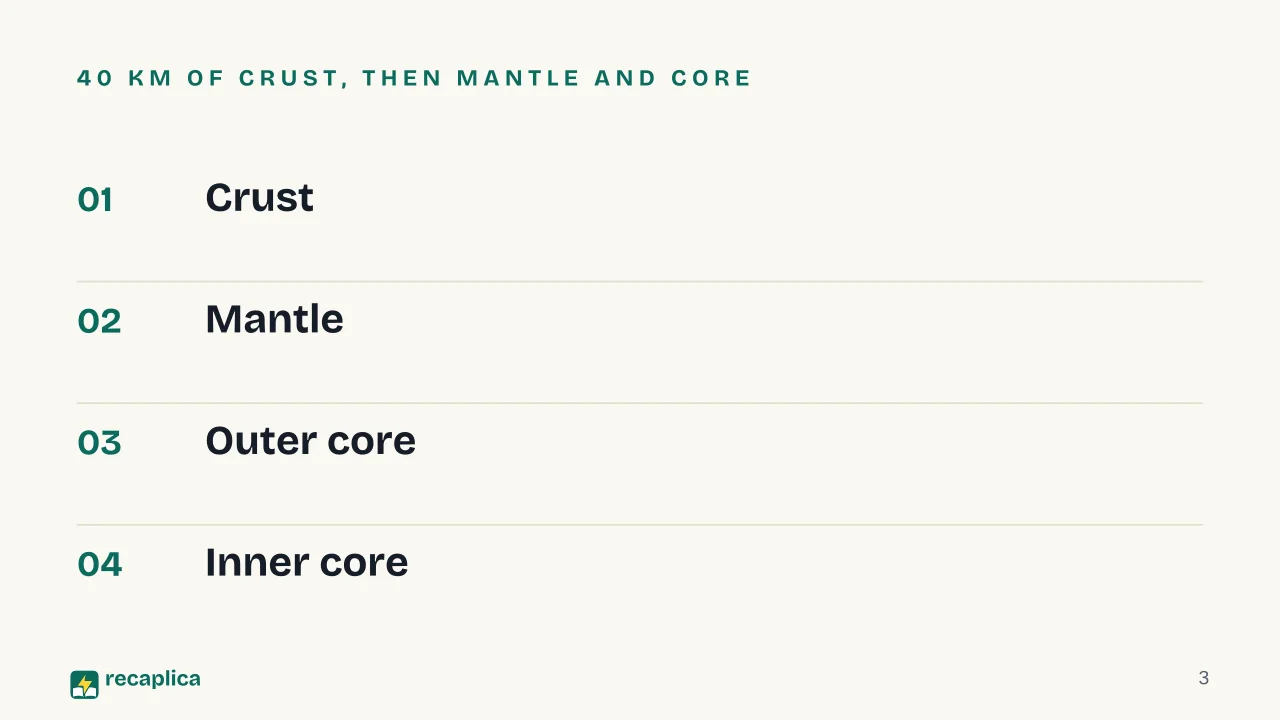
    • Earth's crust is thin, about 40 km thick on average according to National Geographic Education, and makes up only 1% of the planet's mass.
    • The mantle, about 2,900 km thick, takes up 84% of Earth's volume: the USGS describes it as mostly solid rock.
    • The outer core, about 2,200 km thick, is liquid; the inner core, about 1,250 km thick, is solid because of the weight of the entire planet pressing on it.
    • The core is made almost entirely of iron and nickel. The crust and mantle are rich mainly in silicates.
    • According to the USGS, the rotation of the liquid outer core generates Earth's magnetic field.
    • Scientists reconstruct the internal layers by studying how seismic waves from earthquakes travel through the planet.

    Key figures

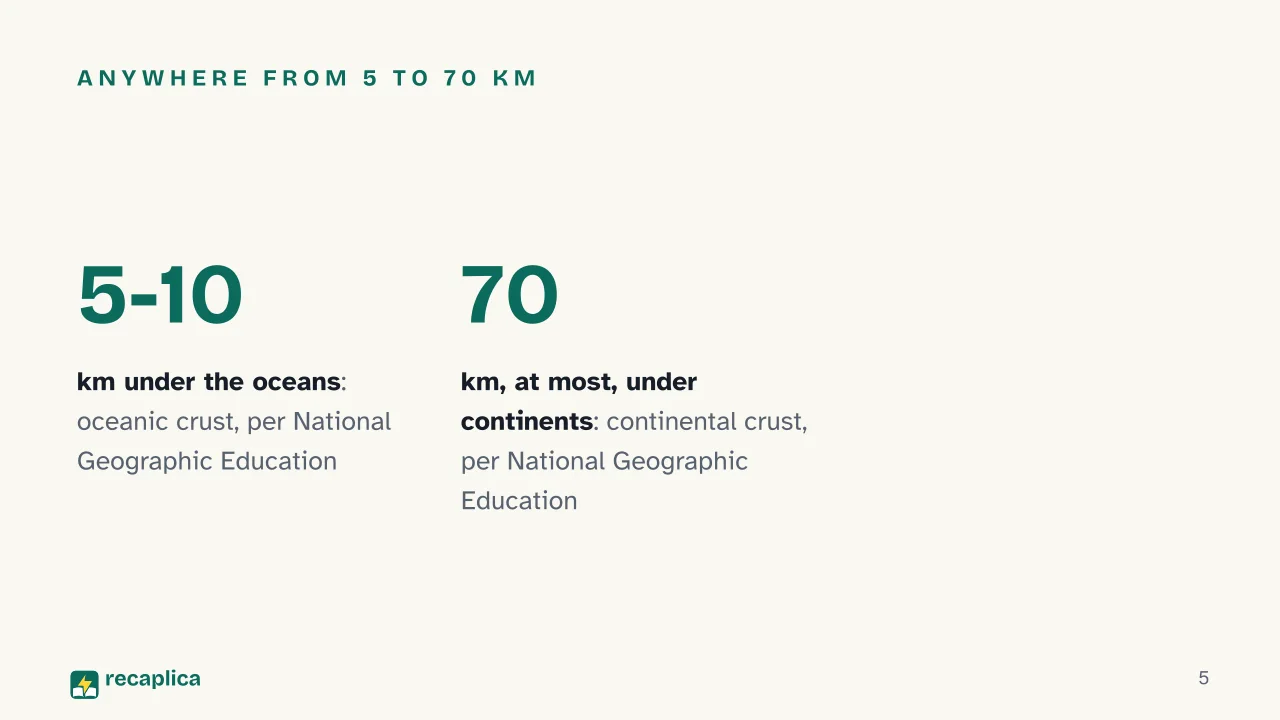
    • 40 km average thickness of Earth's crust, against just 5-10 km under the oceans, according to National Geographic Education. Source: National Geographic Education
    • 2,900 km thickness of the mantle, 84% of Earth's volume, according to National Geographic Education. Source: National Geographic Education
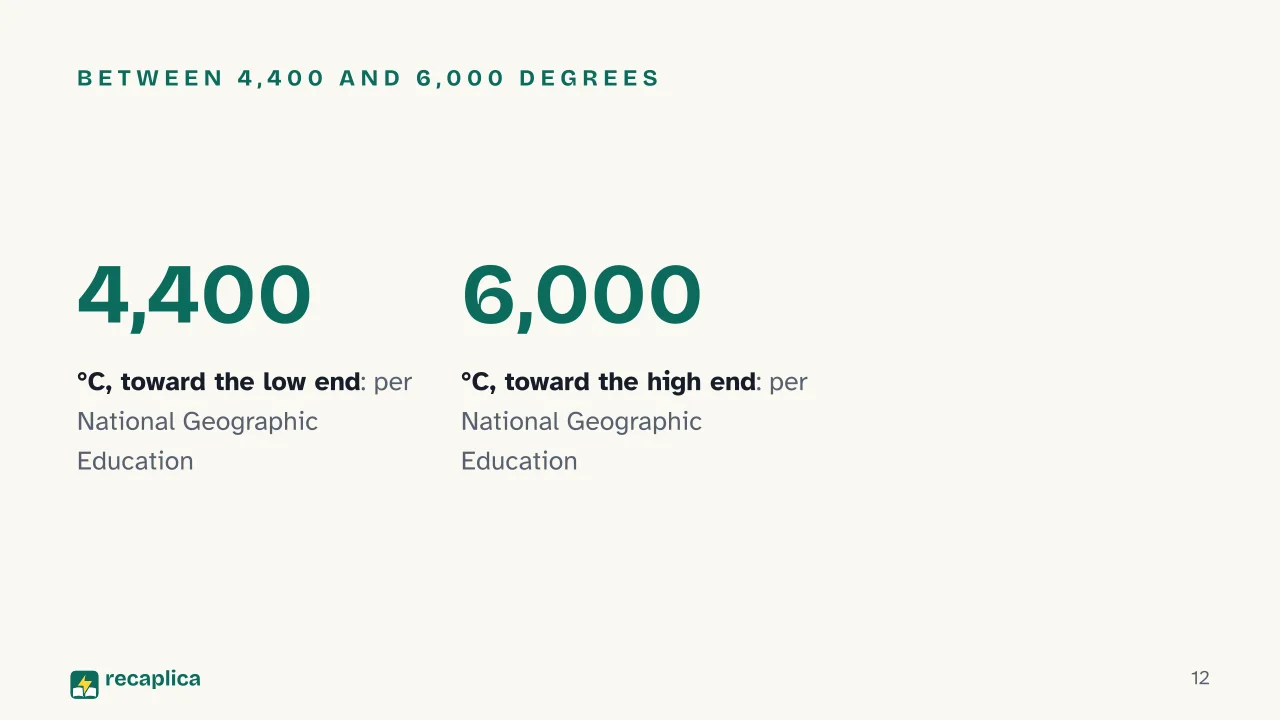
    • 4,400-6,000 °C temperature range inside Earth's core, according to National Geographic Education. Source: National Geographic Education

    Deep Dive

    Earth is one of the rocky planets of the solar system, but below the surface we see, the interior splits into layers that differ sharply in composition, temperature and physical state.

    Earth’s crust

    According to National Geographic Education, Earth’s crust is about 40 km thick on average and makes up only 1% of the planet’s mass. Yet it holds all known life.

    The crust is not uniform. According to National Geographic Education, oceanic crust (the sima) runs 5-10 km below the seafloor, while continental crust (the sial) can reach 70 km, far thicker than oceanic crust. The USGS gives a somewhat different picture for continental crust, putting the average closer to 30 km, with peaks up to 100 km under major mountain ranges: the two sources measure with different methods and samples, which is why the figures for the same thing diverge. Either way, the composition stays the same: according to National Geographic Education, both oceanic and continental crust consist mainly of silicates, the compounds of silicon and oxygen that make up most common rocks.

    Earth’s mantle

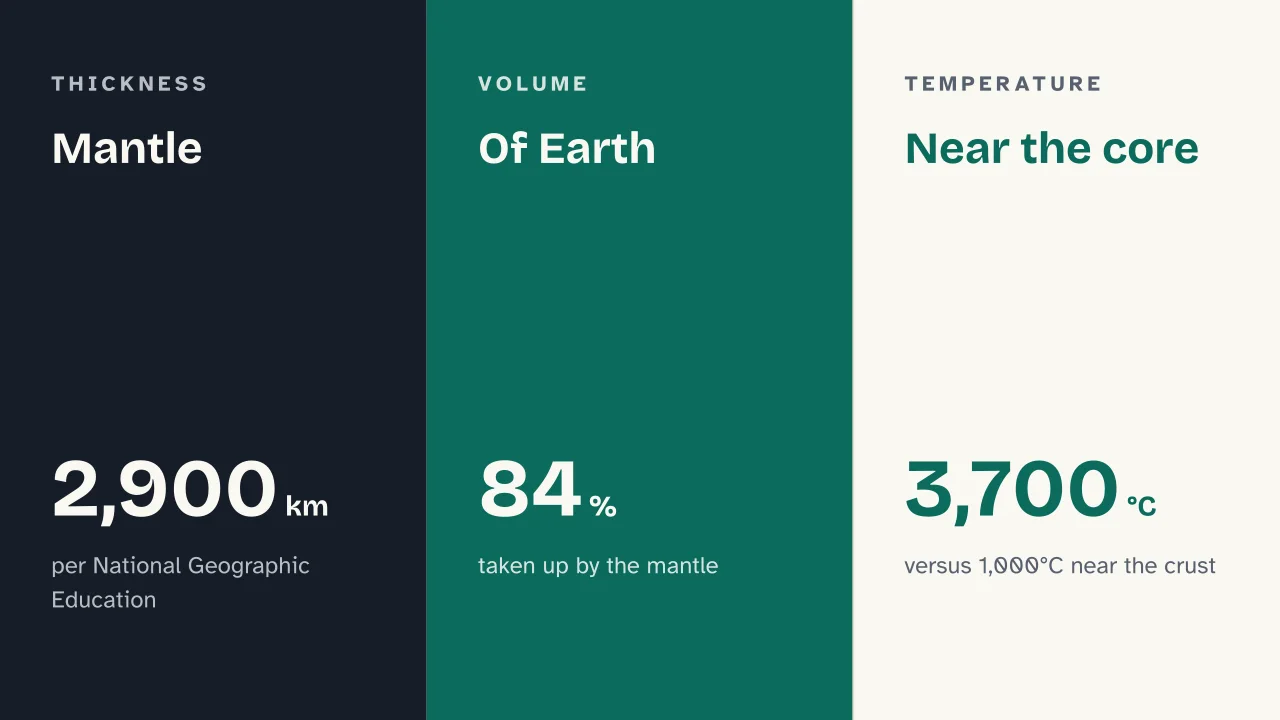
    Below the crust lies the mantle. According to National Geographic Education, it is about 2,900 km thick and takes up 84% of Earth’s volume, made mostly of silicates such as olivine, garnet and pyroxene, plus magnesium oxide and traces of other elements.

    According to the USGS, the mantle is a dense, hot layer of mostly solid rock, holding higher levels of iron, magnesium and calcium than the crust sitting above it. According to National Geographic Education, temperature rises with depth, from about 1,000°C near the crust to about 3,700°C near the core. Only in certain spots — tectonic plate boundaries and mantle plumes, columns of hot rock rising toward the surface, according to National Geographic Education — does the rock become less viscous. It is at those plate boundaries that the mantle’s effects show up most clearly, from volcanoes to earthquakes.

    Outer core and inner core

    According to National Geographic Education, the core begins at a depth of about 2,900 km and has a radius of about 3,485 km. Unlike the mineral-rich crust and mantle, it is made almost entirely of metal, mostly iron and nickel.

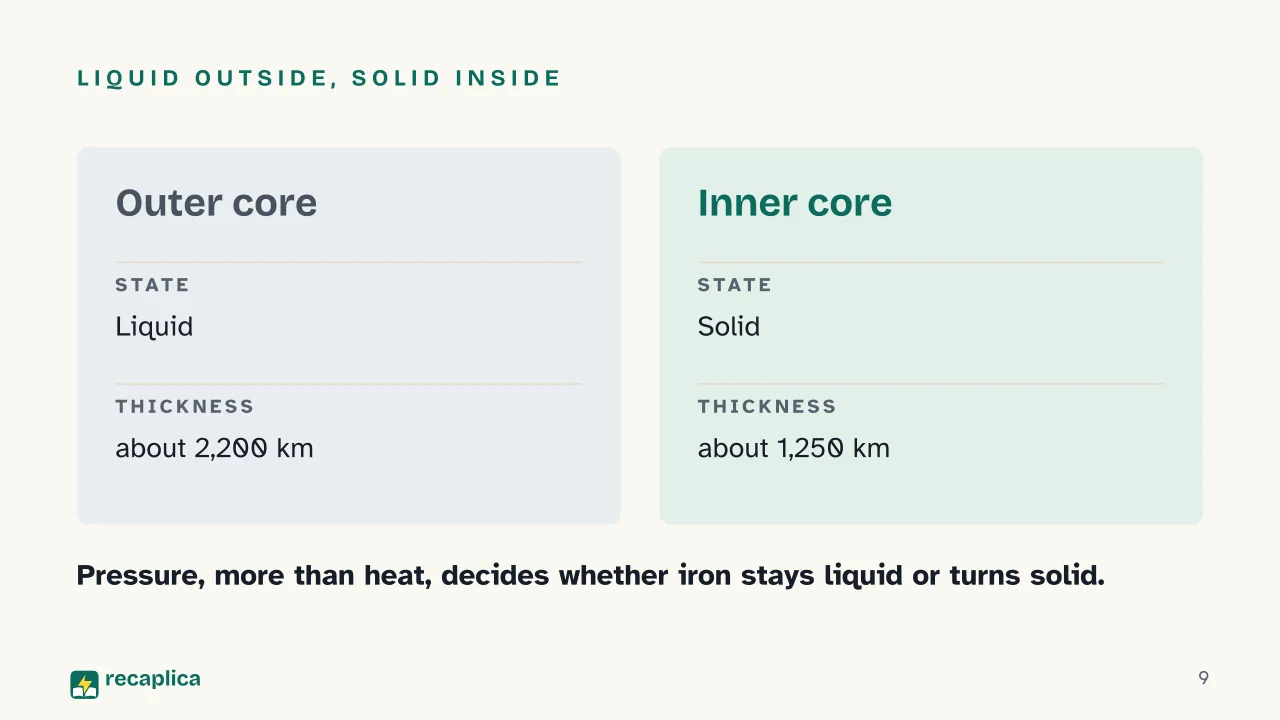
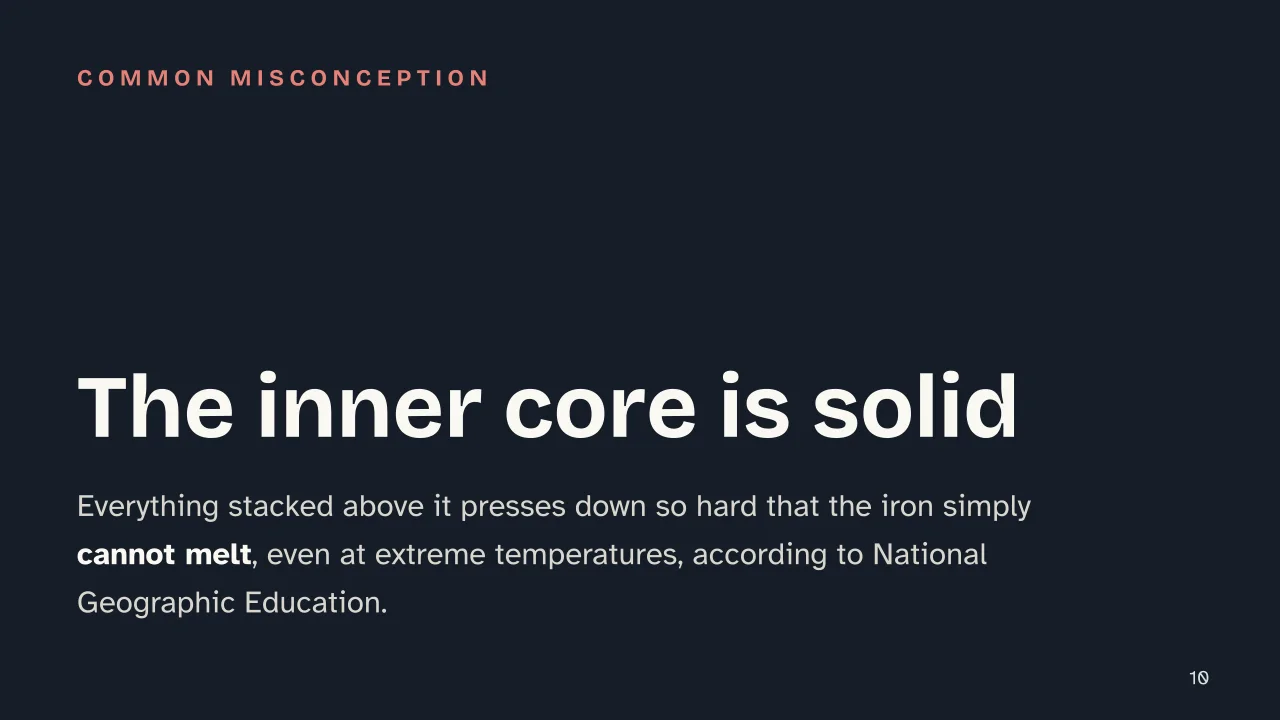
    It splits into two parts. According to the USGS, the outer core, about 2,200 km thick, is liquid iron and nickel, and its rotation, combined with Earth’s own rotation, generates the planet’s magnetic field. The inner core, about 1,250 km thick according to the USGS, is solid instead: according to National Geographic Education, the pressure of the entire planet pressing down on it keeps the iron from melting, even though it stays at extreme temperatures. Overall, according to National Geographic Education, the core ranges from about 4,400°C to about 6,000°C.

    Practical example: imagine drilling a well down to the deepest point of continental crust, about 70 km according to National Geographic Education. You would have crossed only the planet’s outer skin: below you would still lie about 2,900 km of mantle, and then the core, all the way to Earth’s center.

    How we know what’s inside Earth

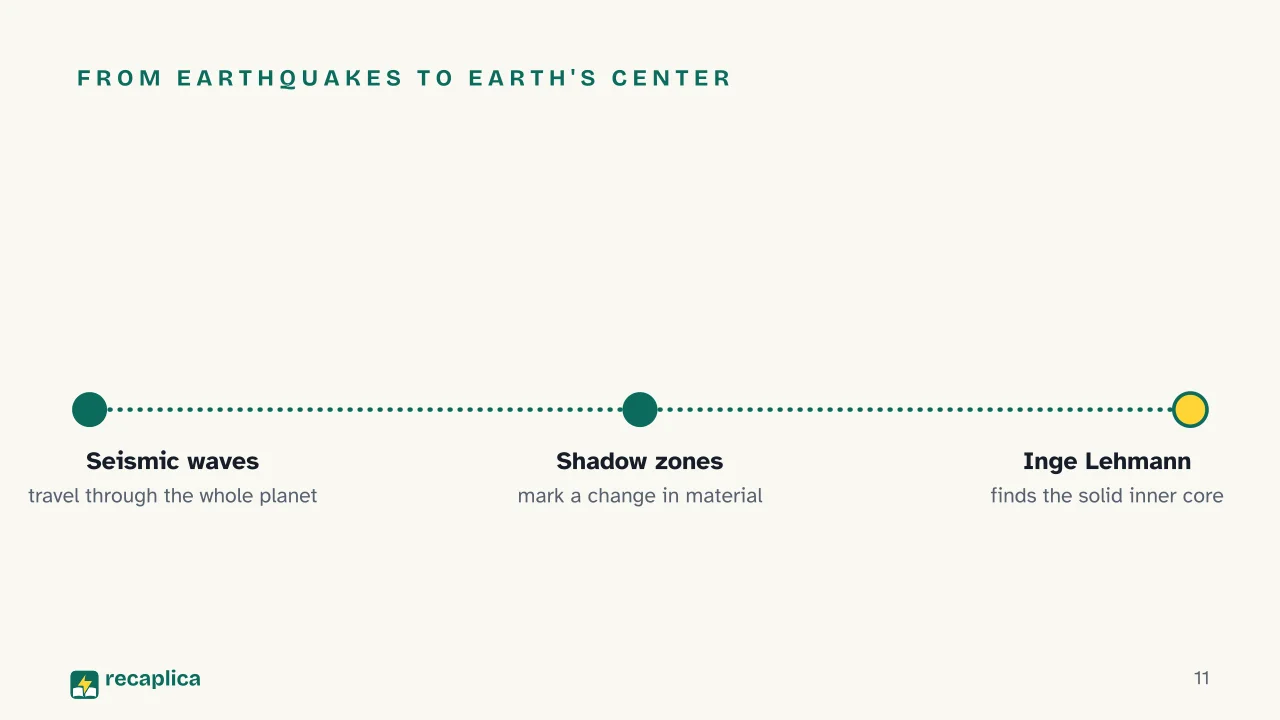
    According to INGV, Earth’s internal structure is reconstructed by studying seismic waves: when an earthquake sends waves through the planet, changes in their speed and “shadow zones” (regions the waves never reach) reveal where the material changes, for instance from the solid mantle to the liquid outer core. No drill has ever reached that deep.

    The discovery of the solid inner core, distinct from the liquid outer core, is credited to seismologist Inge Lehmann, according to INGV. Further research has found hints of a structure inside the inner core itself, a so-called “innermost inner core” still under study.

    Does Earth have 3 layers or 5?

    According to Geosciences LibreTexts, Earth can be divided into layers either by chemical composition or by physical behavior under mechanical stress: two different criteria describing the same planet from two angles. The chemical count — crust, mantle, core — lands on three layers; the physical count instead distinguishes the lithosphere, asthenosphere, mesosphere, outer core and inner core, adding up to five. These are not rival theories, just two ways of counting the same planet. The four-layer model common in school textbooks grows out of exactly this overlap: a core split in two, borrowed from the physical criterion, next to a single mantle, borrowed from the chemical one.

    LayerThicknessTemperatureState
    Crust5-10 km under the oceans, up to 70 km under continents (National Geographic Education)rises with depth (USGS)solid
    Mantleabout 2,900 km1,000°C to 3,700°Cmostly solid
    Outer coreabout 2,200 km4,400°C to 6,000°C (core overall)liquid
    Inner coreabout 1,250 km4,400°C to 6,000°C (core overall)solid

    Slide deck

    Slides ready to download and make your own in PowerPoint or Google Slides, with speaker notes. Pick the Flash cut or the Full one.
    Slide 1 of the presentation on Layers of the Earth: Layers of the EarthSlide 2 of the presentation on Layers of the Earth: What's really beneath your feet?Slide 3 of the presentation on Layers of the Earth: 40 km of crust, then mantle and coreSlide 4 of the presentation on Layers of the Earth: Chapter 01: CrustSlide 5 of the presentation on Layers of the Earth: Anywhere from 5 to 70 kmSlide 6 of the presentation on Layers of the Earth: Chapter 02: MantleSlide 7 of the presentation on Layers of the Earth: Mantle · Of Earth · Near the coreSlide 8 of the presentation on Layers of the Earth: Chapter 03: Outer and Inner CoreSlide 9 of the presentation on Layers of the Earth: Liquid outside, solid insideSlide 10 of the presentation on Layers of the Earth: The inner core is solidSlide 11 of the presentation on Layers of the Earth: From earthquakes to Earth's centerSlide 12 of the presentation on Layers of the Earth: Between 4,400 and 6,000 degreesSlide 13 of the presentation on Layers of the Earth: Earth's mantle is mostly...Slide 14 of the presentation on Layers of the Earth: Time to review
    Flash10 slidesThe essential thread, to present in classFull14 slidesEvery chapter and the deeper detail

    Common myths

    • ✗ Myth Right below the crust there is a sea of lava, ready to erupt anywhere.

      ✓ Reality According to the USGS, the mantle is a layer of rock that is mostly solid. It only turns less viscous in specific spots, such as plate boundaries or mantle plumes.

    • ✗ Myth Earth's core is entirely liquid, the way a molten planet center is often pictured.

      ✓ Reality According to the USGS, the core has two parts. The outer core is liquid. The inner core is solid: the weight of the layers above it keeps the iron from melting, even at extremely high temperatures, according to National Geographic Education.

    • ✗ Myth Scientists drilled wells to see what is inside Earth.

      ✓ Reality According to INGV, researchers instead study seismic waves, whose discontinuities and shadow zones reveal what lies at depth: no drill has ever reached the mantle or the core.

    Mind map

    Drag the background to move around and the nodes to reposition them; use − and + to collapse and expand branches.
    Customize
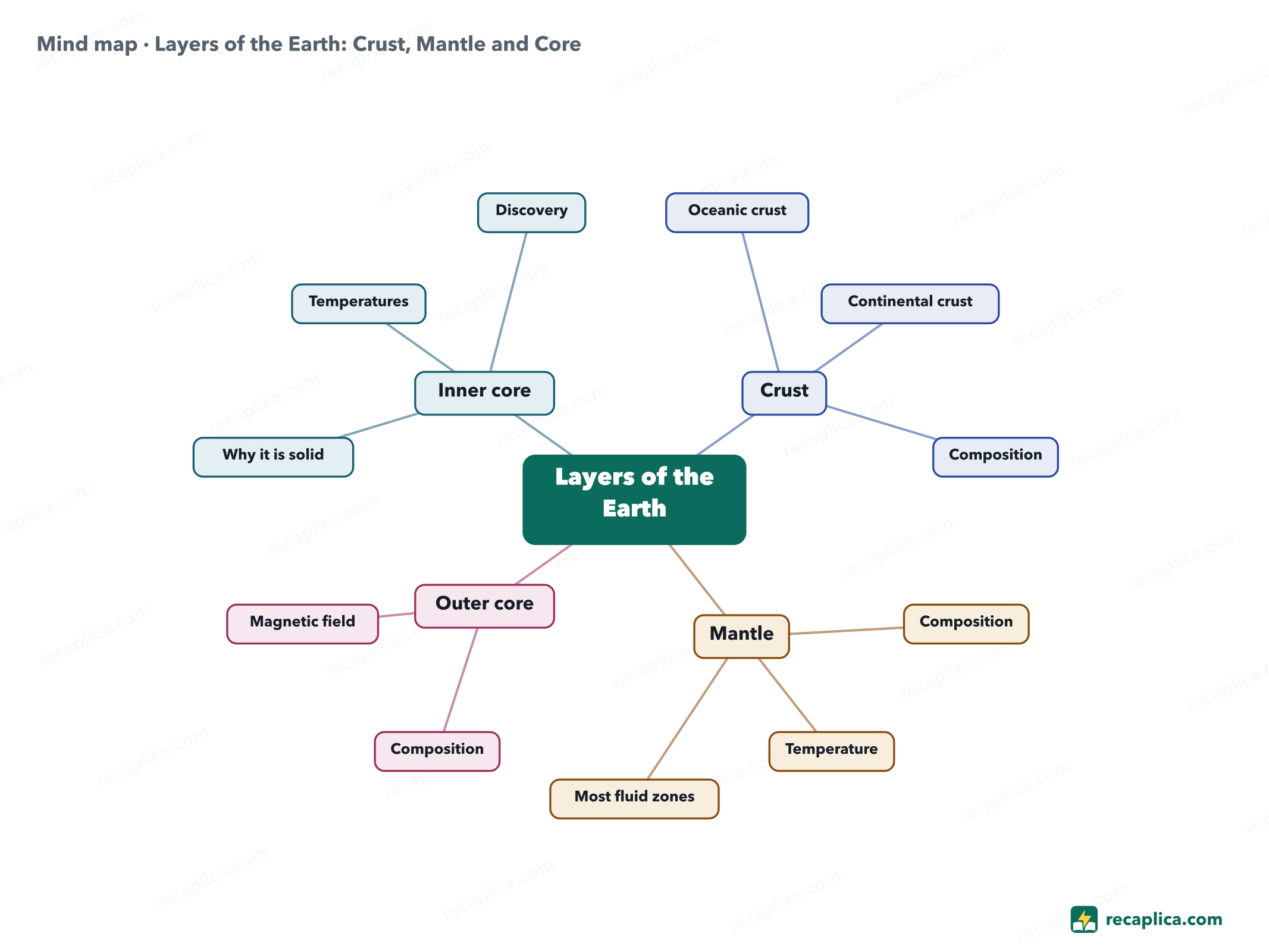
    Mind map: Layers of the Earth: Crust, Mantle and Core
    • Layers of the Earth
      • Crust about 1% of Earth's mass
        • Oceanic crust 5-10 km thick, sima
        • Continental crust up to 70 km, sial
        • Composition mostly silicates
      • Mantle about 2,900 km, 84% of volume
        • Composition silicates and magnesium oxide
        • Temperature 1,000 to 3,700 degrees
        • Most fluid zones plate boundaries, plumes
      • Outer core about 2,200 km, liquid
        • Composition liquid iron and nickel
        • Magnetic field generated by its rotation
      • Inner core about 1,250 km, solid
        • Why it is solid pressure keeps the iron from melting
        • Temperatures up to 6,000 degrees
        • Discovery seismologist Inge Lehmann

    Quiz: test yourself

    Answer the questions to check what you have learned: you get instant feedback and a short explanation.

    Grade 0/10 0/5
    1 On average, how thick is Earth's crust, according to National Geographic Education?

    According to National Geographic Education, the crust is about 40 km thick on average, just 1% of Earth's mass.

    2 What is the mantle mostly made of, according to the USGS?

    The USGS describes the mantle as an extremely hot layer made mostly of solid rock; according to National Geographic Education, it turns fluid only in specific spots, such as mantle plumes.

    3 True or false: the outer core is liquid, while the inner core is solid.

    According to the USGS, the outer core (about 2,200 km) is liquid, while the inner core (about 1,250 km) is solid because of the pressure surrounding it.

    4 According to INGV, how is Earth's internal structure mainly reconstructed?

    According to INGV, studying seismic waves, with their discontinuities and shadow zones, remains the main method: the deep interior cannot be observed directly.

    5 Why do some sources count 3 layers and others 5?

    According to Geosciences LibreTexts, chemical composition gives 3 layers (crust, mantle, core); physical behavior under stress instead splits them into 5 (lithosphere, asthenosphere, mesosphere, outer core, inner core): two different criteria applied to the same planet.

    Answers: 1-A · 2-B · 3-A · 4-B · 5-B

    Flashcards

    Tap the card to flip it and check whether you remember the answer, then move to the next one.

    1 / 8

    Explain it in your own words

    The ultimate test: if you can explain it in simple words, you've truly understood it. Write your explanation, then compare it with the Recap.

    Your explanation is saved only on this device.

    Earth is not a single solid block. It is a set of concentric layers, each with its own composition, temperature and physical state. The outer crust, thin and solid, is the layer we live on; below it, the mantle is far thicker and mostly solid rock, despite the heat. At the center sits the core, split into a liquid outer part and a solid inner part, made almost entirely of iron and nickel. Scientists map this structure by studying seismic waves, since no one has ever drilled that deep.

    Frequently asked questions

    What is the simplest way to picture the layers of the Earth?

    Think of four concentric layers: a thin, solid crust; a thick mantle that is mostly solid; a liquid outer core; and a solid inner core. It is the model most textbooks use, even if it blends two different criteria (see the question below).

    Why do some sources count 3 layers of the Earth and others 5?

    It depends on the criterion. According to Geosciences LibreTexts, by chemical composition Earth has 3 layers (crust, mantle, core); by physical behavior under stress it has 5 instead (lithosphere, asthenosphere, mesosphere, outer core, inner core). The common 4-layer school model (crust, mantle, outer core, inner core) blends the two: it splits the core the way the physical criterion does, but keeps the mantle whole the way the chemical criterion does.

    What is exactly below Earth's crust?

    The mantle: according to the USGS it is mostly solid, hot rock; according to National Geographic Education it turns more fluid only in a few places, such as plate margins or where columns of hot rock rise upward.

    How do we know what's inside Earth if no one has ever seen it?

    Seismologists track how seismic waves change speed and where they vanish entirely, in so-called shadow zones: from there they infer where the material inside changes state, according to INGV.

    Is Earth's core liquid or solid?

    Both, in two separate parts: the outer core, about 2,200 km thick, is liquid; the inner core, about 1,250 km thick, is solid, according to the USGS.

    Sources

    • National Geographic Education, "Crust"
    • National Geographic Education, "Mantle"
    • National Geographic Education, "Core"
    • USGS, "This Dynamic Earth: Inside the Earth"
    • INGV, "Interno della Terra"
    • Geosciences LibreTexts, "2.2: Layers of the Earth"

    Every Recap goes through an independent review before publication.

    Every evening, the day's new Recaps on our Telegram channel. Join the channel →

    Keep learning

    • Science Correlation: What It Means and How to Read the Coefficient Correlation measures how closely two variables move together, and the most common way to put a number on it is the correlation coefficient, which runs from -1 to +1. A value near +1 means the two variables rise together, near -1 means one rises while the other falls, and near 0 means no linear relationship stands out. The coefficient only captures the strength of a straight-line relationship, and a single unusual data point can push it up or down by a lot. Even when it's strong, a correlation between two variables never shows that one causes the other. Read the Recap →
    • Science Light Refraction: What It Is, the Laws Behind It, and Examples A surface that separates two transparent materials sends some light back, reflecting it, and lets the rest through while bending it toward a new direction. The law of reflection keeps the incoming and outgoing angles equal, both measured from the normal to the surface. Snell's law governs refraction instead, linking the index of each material to how much the ray tilts before and after it crosses over. These two laws alone explain mirrors, lenses, prisms and everyday sights such as a pencil that appears to snap inside a glass of water. Read the Recap →
    • Science Total Internal Reflection and the Critical Angle: Definition and Formula Total internal reflection is what happens when a light ray stops being able to leave a transparent medium and gets sent back inside it completely. It takes place past a specific angle of incidence, called the critical angle, calculated with Snell's law by comparing the refractive indices of the two materials involved. It only happens under one precise condition: the ray must be traveling from an optically denser medium into a less dense one, such as from water into air or from glass into air. Optical fibers and, in part, the sparkle of diamonds rely on this same principle. Read the Recap →

    recaplica

    Clear in 30 seconds, yours in 10 minutes.

    Recaps Mind maps Request a Recap Telegram channel Mind map maker Our method About Privacy & cookies Legal notes & terms of use

    © 2026 Recaplica · A project by Curi S.r.l. — VAT IT05472000750

    Statistics, only if you say so

    To learn which Recaps help most we would use Google Analytics, with aggregate, anonymous data. It starts only with your OK, and you can change your mind anytime. Privacy policy