|
recaplica
Law of Conservation of Mass, Definite Proportions and Dalton's Atomic Theory | ||||||||||||||||||
| © 2026 Recaplica · recaplica.com — All rights reserved | ||||||||||||||||||
Law of Conservation of Mass, Definite Proportions and Dalton's Atomic TheoryWhat to print Page numbers appear when printing with default margins. SlidesChoose a cut Flash10 slidesThe essential thread, to present in classFull15 slidesEvery chapter and the deeper detailBoth come with speaker notes. In 30 seconds quick readBetween 1772 and 1794, Lavoisier's work showed that a chemical reaction leaves the total mass unchanged. Proust argued that a pure compound always holds its elements in the same proportions by mass, and Dalton noticed that when two elements form several compounds, the masses combine in small whole-number ratios. All three rules make sense if matter is built from atoms, which is the idea of Dalton's atomic theory, with each element's atoms carrying a mass of their own. Later work on electrons, protons and neutrons corrected the picture: atoms can be split, and atoms of one element do not all have the same mass. Key Points
Key figures
Deep DiveLaw of conservation of mass: what Lavoisier foundPurdue University dates the turning point in the study of chemical reactions to the French chemist Lavoisier’s work between 1772 and 1794. He found that the total mass of the products always equals the total mass of the starting materials that were used up. Eames, of City College of San Francisco, adds that the law carries his name, though others had used it before him. During a reaction no matter is created or destroyed. Purdue gives the reason in terms of atoms: a reaction neither makes them nor removes them.
Water by mass in Lavoisier and in EamesLate in the eighteenth century Lavoisier published a list of elements. In the Traité élémentaire de chimie, from 1789, he gave water as roughly 85% oxygen and 15% hydrogen by weight. Eames gives about 89% and 11% by mass, for water made by burning hydrogen in oxygen. Law of constant proportion (definite proportions)At the time, Eames writes, people argued over whether elements always combine in the same ratio. Berthollet, a respected scientist, held that the constant ratios seen in experiments came from the conditions of the experiment, and that without them the ratios could vary continuously. Proust took the opposite view and eventually persuaded him. On how an observation becomes a law, see the Recap on the scientific method. In Eames’s view Proust came out right since he tested pure compounds alone and knew how precise his own measurements were.
Eames adds that some materials, such as minerals and alloys, can have variable proportions. The law of definite proportions applies to pure compounds. Law of multiple proportionsDalton went through the data of Proust, Lavoisier and others and spotted a pattern. Eames explains that the law of multiple proportions compares two or more compounds of the same elements in different proportions, and shows that the elements combine in small whole-number ratios.
The three laws side by side
Dalton’s atomic theory and the billiard ball modelFor Eames, the three laws made sense if every element is made of atoms that combine as whole atoms. That is the idea behind Dalton’s atomic theory, also called the Dalton model: matter is made of atoms, which are not created, not destroyed and do not change in chemical reactions. All atoms of one element are identical, and the atoms of each element have a mass of their own, different from that of the other elements. The AIP gives a five-point version, taken from Partington (1962). One of the five points says the particle of a compound holds a fixed number of atoms of its elements; Partington’s list goes on with six more statements, so the five points are only part of it. Eames compares the atom to a ball, small and distinct from the others, and the nickname billiard ball model echoes that image. John Dalton (1766-1844) was born in Cumberland, England, into a modest Quaker family, and spent nearly all his life as a teacher and public lecturer. The Science History Institute tells us he came to atomism through meteorology. The paper with the first form of the theory, titled On the Absorption of Gases by Water and Other Liquids, was read on 21 October 1803. According to the AIP, William Henry and Thomas Thomson deserve credit for the first accounts, before Dalton published it himself in 1808, and the discovery was not free of controversy: Dalton was accused of using earlier work without citing it. The same source says it is far from obvious how Dalton arrived at the idea of atoms combining in small whole numbers. Dalton gathered his theories in A New System of Chemical Philosophy, published between 1808 and 1827. He worked out atomic weights from the percentage composition of compounds, with an arbitrary system to decide the likely structure of each. His rule: for two elements, A and B, that combine, the first compound has one atom of each, and the next has one atom of A and two of B.
What was corrected in Dalton’s modelAccording to Eames, the atoms of an element are neither all identical nor indivisible: they are made of three main kinds of particle, electrons, protons and neutrons. Protons and neutrons together form a tiny, dense center, the nucleus. In 1897 J. J. Thomson suggested that cathode rays were particles with a much larger charge or a much smaller mass than hydrogen ions, and many were skeptical. Electrons turned out to be part of every kind of atom. The evidence against Dalton’s identical, indivisible atoms grew strong. An element is defined by its number of protons, the atomic number (see also the periodic table). Isotopes are atoms with the same number of protons and a different number of neutrons. Chemistry follows the atomic number closely, so isotopes behave almost alike in reactions, yet their masses differ.
Slide deckSlides ready to download and make your own in PowerPoint or Google Slides, with speaker notes. Pick the Flash cut or the Full one.     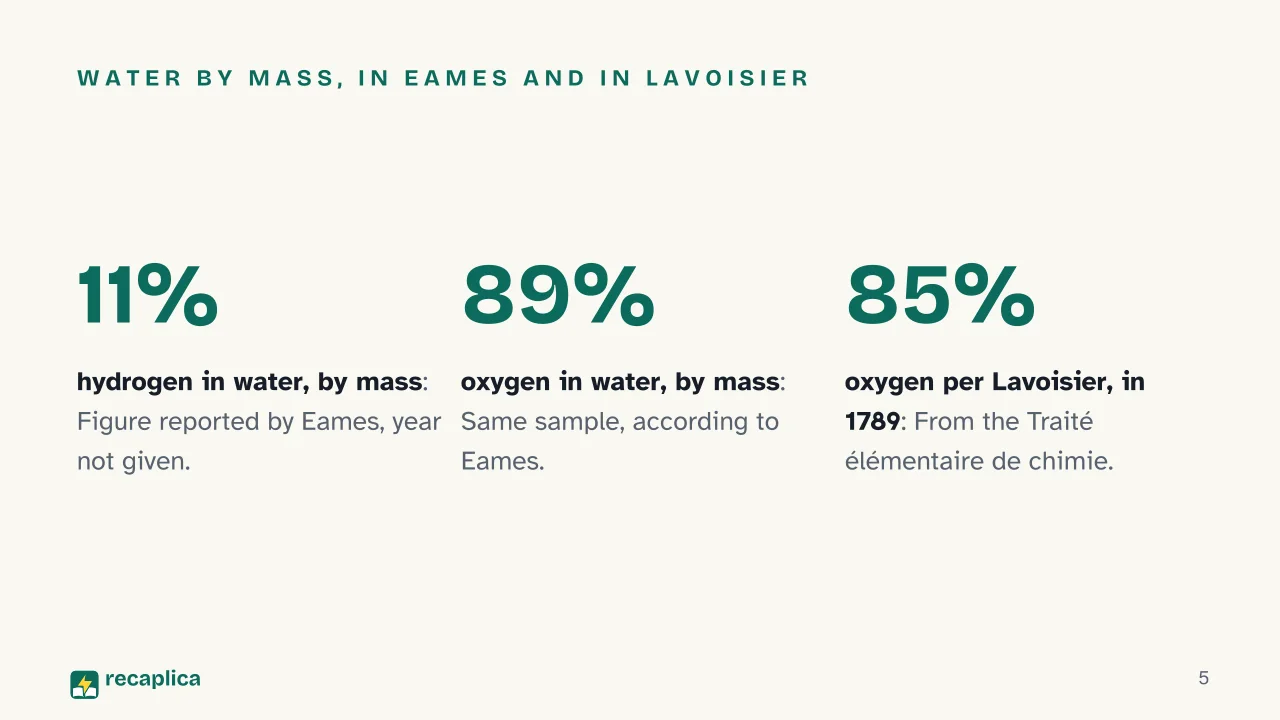  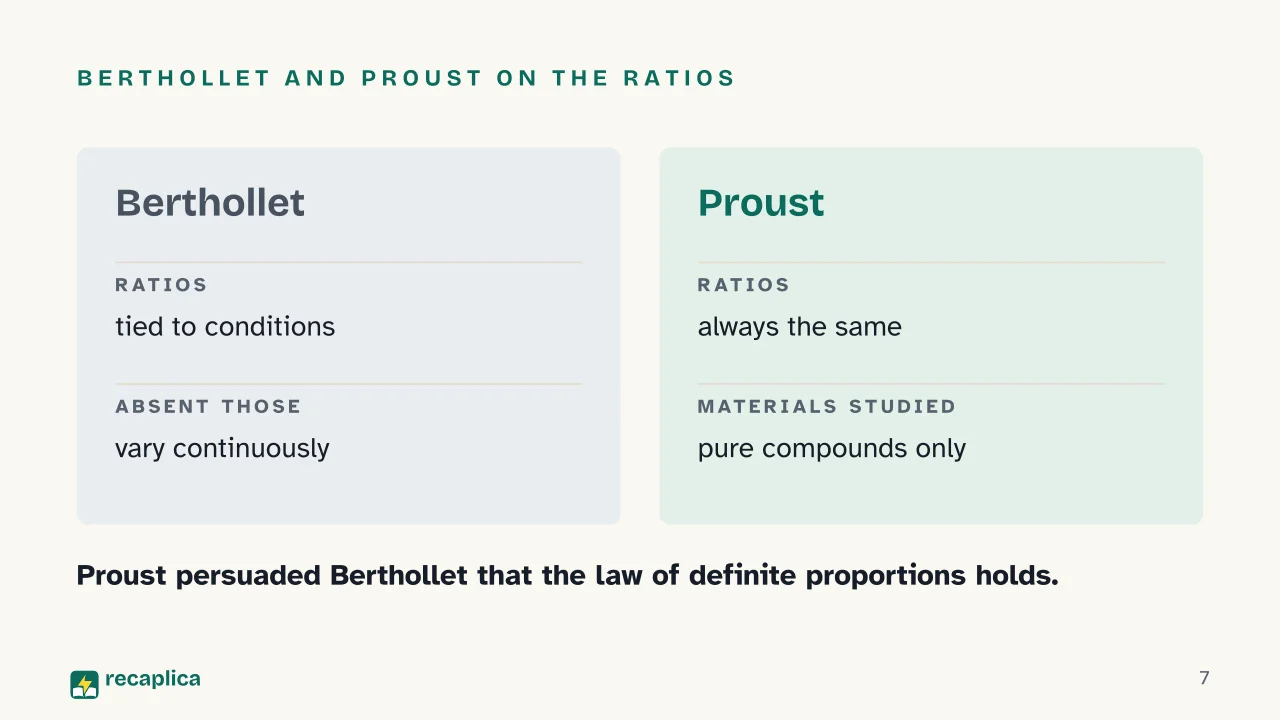  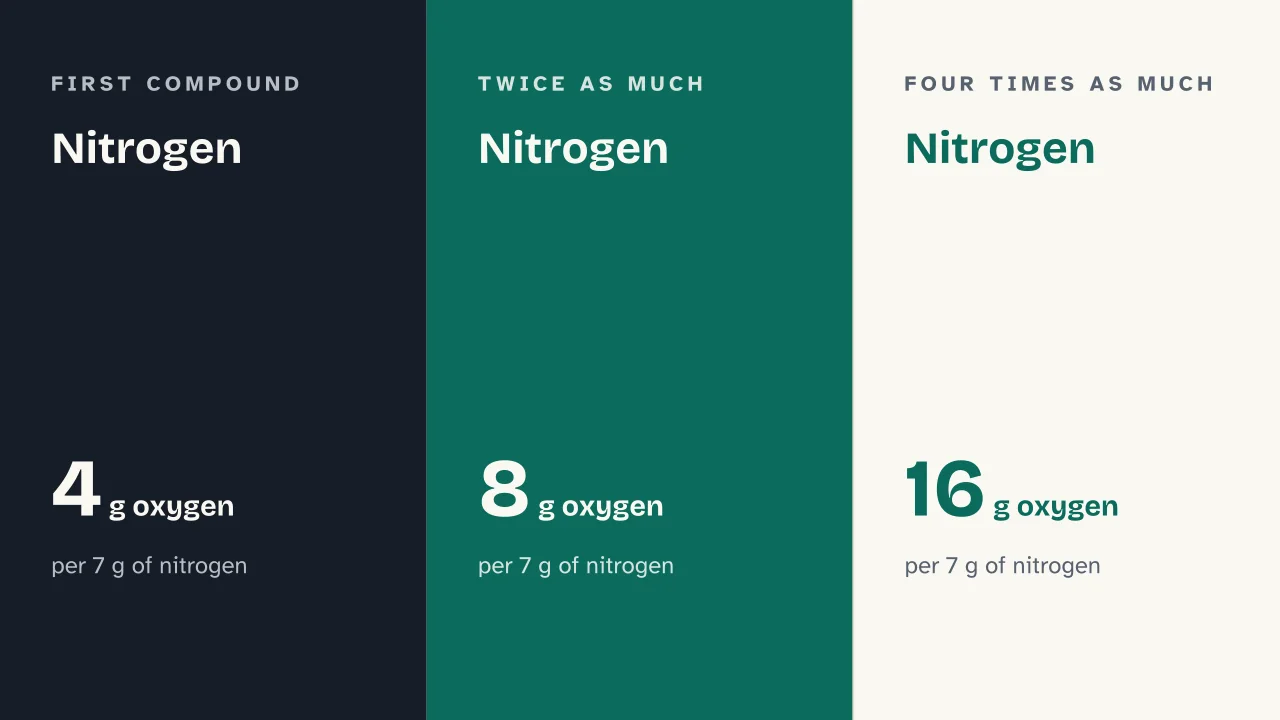  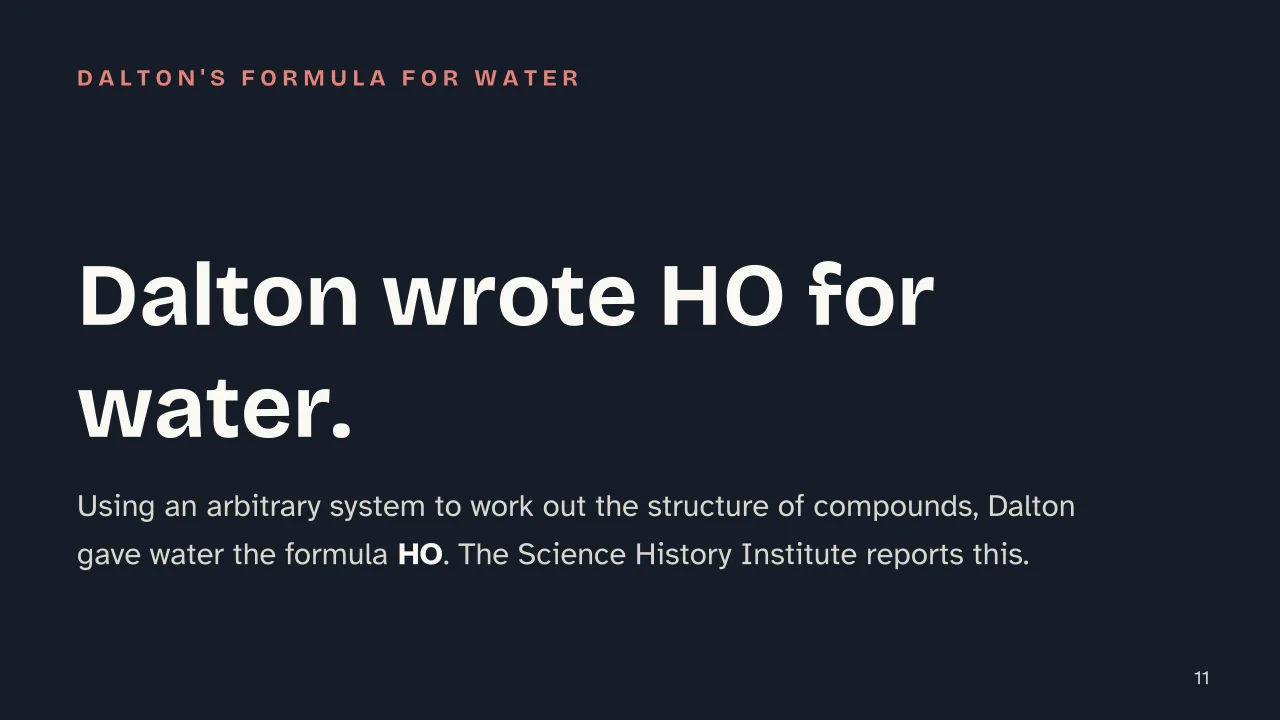 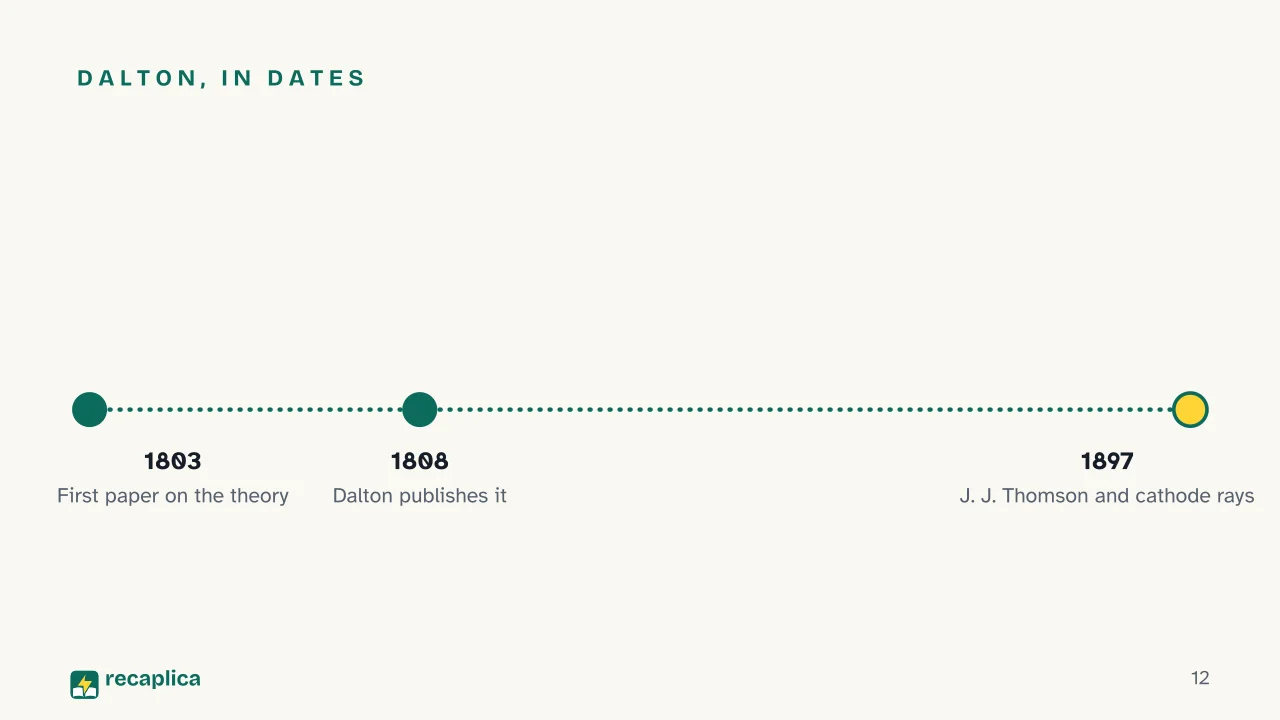 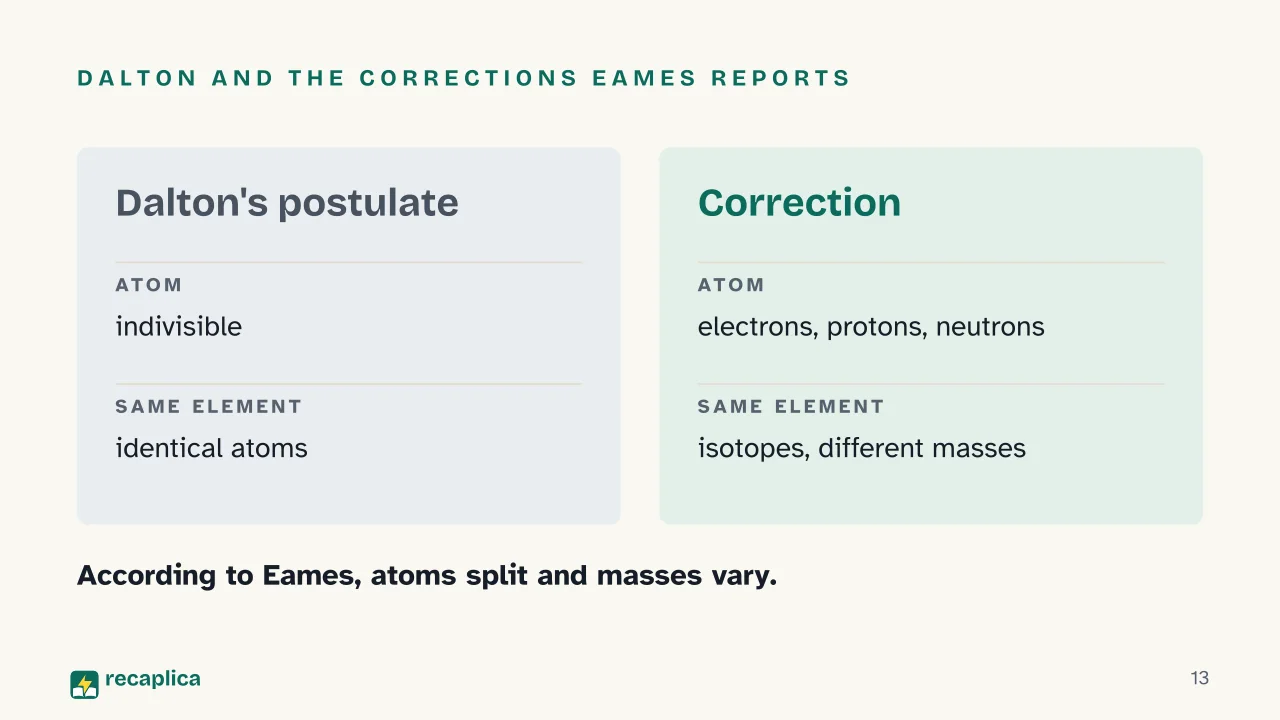 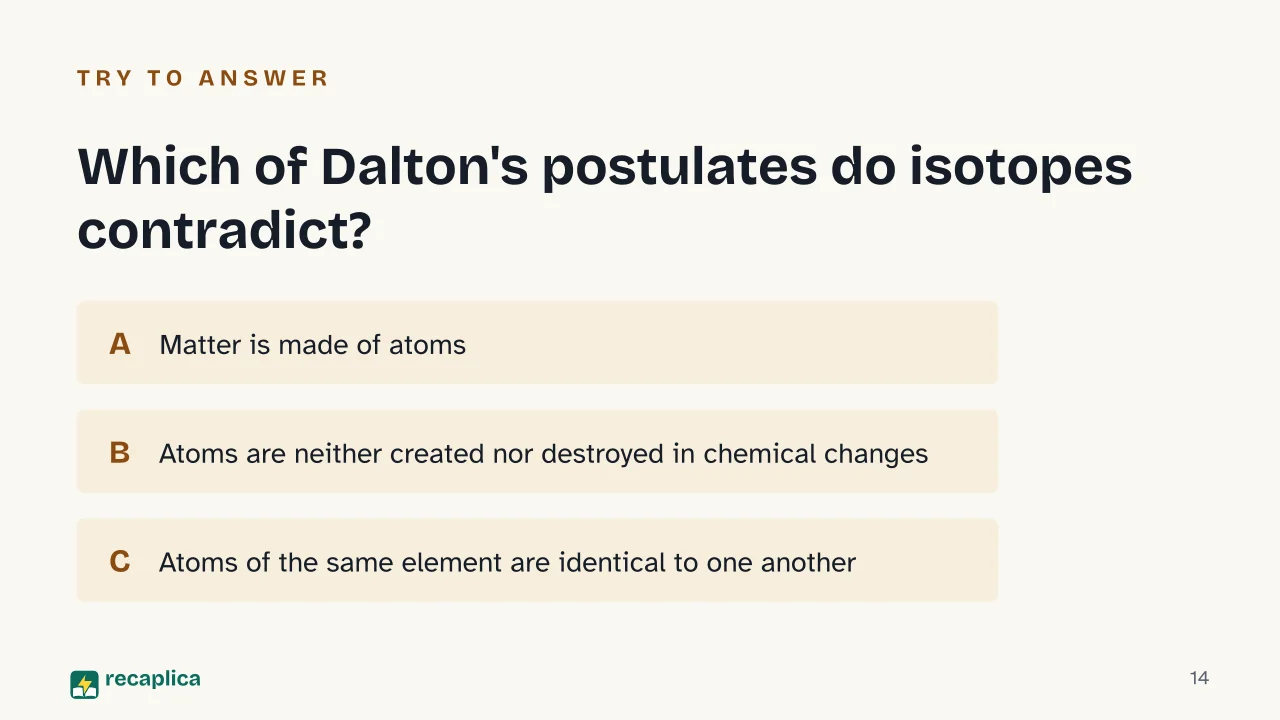  Common myths
Mind mapDrag the background to move around and the nodes to reposition them; use − and + to collapse and expand branches. 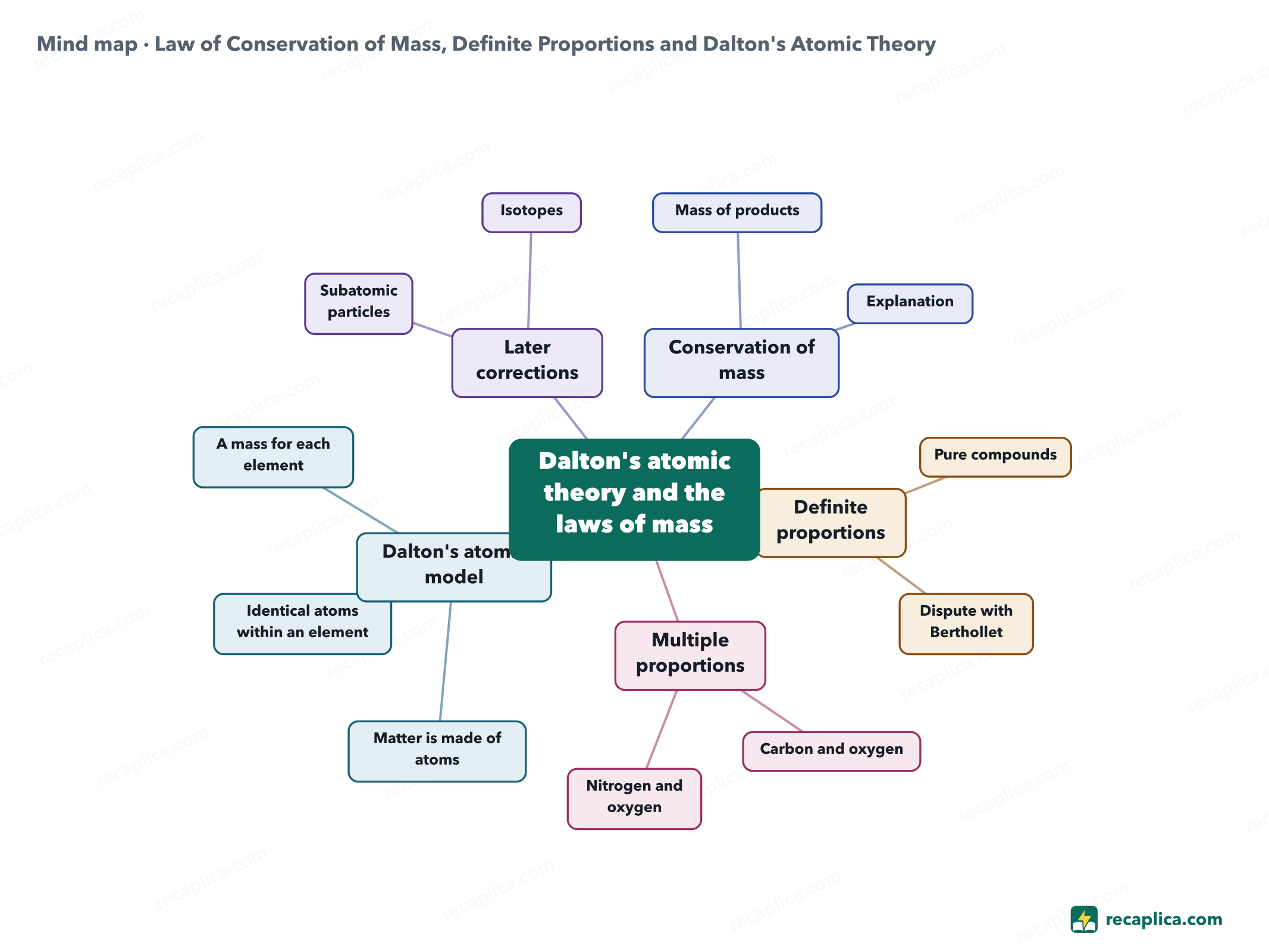
Quiz: test yourselfAnswer the questions to check what you have learned: you get instant feedback and a short explanation. Grade 0/10 0/5
FlashcardsTap the card to flip it and check whether you remember the answer, then move to the next one. 1 / 7 Explain it in your own wordsThe ultimate test: if you can explain it in simple words, you've truly understood it. Write your explanation, then compare it with the Recap. Your explanation is saved only on this device.
Frequently asked questionsWhat is the law of conservation of mass?It says that in a chemical reaction the total mass of the reactants equals the total mass of the products, written as an equality: total mass of reactants = total mass of products. Purdue University credits Lavoisier with the discovery, in work between 1772 and 1794, and explains it through atoms: their number is the same before and after the reaction. What is the law of constant proportion?It is another name for the law of definite proportions, credited to Proust. In a pure compound the mass proportions between the elements stay fixed. In water, for example, Eames gives about 11% hydrogen and 89% oxygen by mass. What does Dalton's atomic theory say?Every element is made of atoms identical to one another, with a mass different from that of other elements. Atoms combine as whole units and do not change in chemical reactions. The same ideas are called the Dalton model. How do you solve a conservation of mass problem?Use the equality between the masses. A worked example of our own: if a reaction uses up 3 g of one reactant and 4 g of another, the products weigh 7 g in total. What was corrected in Dalton's model?Atoms turned out to have parts (electrons, protons and neutrons), and isotopes of one element have different masses. Every Recap goes through an independent review before publication. |