|
recaplica
How Helicopters Fly: Lift, Controls and Autorotation | ||||||||||||||||||||||||||||||||||||
| © 2026 Recaplica · recaplica.com — All rights reserved | ||||||||||||||||||||||||||||||||||||
How Helicopters Fly: Lift, Controls and AutorotationWhat to print Page numbers appear when printing with default margins. SlidesChoose a cut Flash10 slidesThe essential thread, to present in classFull17 slidesEvery chapter and the deeper detailBoth come with speaker notes. In 30 seconds quick readA helicopter flies because its rotor blades are small wings that make lift as they spin, even while the aircraft stays in one place. To climb or descend, the pilot changes the angle of every blade at once with the collective; to move forward, back or sideways, the cyclic tilts the rotor disk. The tail rotor stops the body from spinning the opposite way to the main rotor. If the engine quits, air flowing up through the blades keeps them turning so the pilot can still land, a technique called autorotation. Key Points
Key figures
Deep DiveIn the FAA’s Helicopter Flying Handbook (the FAA is the US federal aviation agency), a helicopter is an aircraft that gets both its lift and its forward drive from one or more horizontal rotors, each with two blades or more. Another name for it is rotary-wing aircraft, and that label is meant literally: every blade is a wing that goes round and round a shaft instead of moving straight ahead. The controls, the tail rotor and everything else follow from that one idea. The word comes from the French hélicoptère, coined by Gustave de Ponton d’Amécourt in 1861 from two Greek roots, helix (spiral) and pteron (wing). A spinning wingAn airplane has to roll down a runway until air moves over its wings fast enough. A helicopter gets the same airflow by spinning its blades, so lift appears even when the aircraft is not moving. That is how it can hold a position in the air and take off or land vertically, with no runway at all. The rotor has three parts. The mast is a hollow shaft turned by the transmission; the hub sits on top of it and holds the blades; and the blades themselves are shaped like a wing. As that airfoil cuts through the air, the flow speeds up over the curved upper surface and its pressure falls, which is what Bernoulli’s principle describes. The lower surface stays at higher pressure, and the difference pushes the blade upward. There is a second contribution too. Air hitting the underside of the blade is pushed downward and, under Newton’s third law, the blade gets an equal push back up. Air pressure by itself is no help. At sea level it presses on every square foot with about 2,116 pounds of force, but it does so equally above and below the blade, so only the difference counts. The blades are also twisted. Near the hub, where they move slowly, the pitch is steeper; toward the tip, where they move fastest, it flattens out. The air driven downward also moves fastest at the tip, since that is where the blade travels quickest. Pitch and angle of attackThe handbook separates two angles. The pitch angle, also called the angle of incidence, is mechanical: it is how steeply the blade is set relative to the rotor disk, and the pilot changes it with the controls. The angle of attack is aerodynamic, measured between the blade and the relative wind actually reaching it. The two are the same only in still, undisturbed air; once the rotor starts pushing air down or the helicopter starts moving, they part ways. Raising the angle of attack adds lift up to a critical angle, and beyond that the blade stalls and lift collapses. Four forces, one rotorFour forces act on a helicopter in flight: lift, weight, thrust and drag. Thrust is where it differs from an airplane. On a plane, the engine supplies it. On a helicopter, lift and thrust both come from the main rotor, and in powered flight their combined force points at right angles to the rotor disk. With the disk level, the helicopter climbs or hovers; tip the disk forward and part of that force becomes horizontal thrust. It also explains why a helicopter moving off from a hover tends to sink a little: some of its lift has been redirected into thrust.
Three controlsAccording to the handbook, a helicopter pilot works in three dimensions and needs both arms and both legs all the time. Here is what each one does.
The collective does not change how fast the rotor turns. More pitch at the same rpm means more lift, and up the helicopter goes. Extra pitch also brings extra drag, though, and that affects rotor rpm. The cyclic works differently: it varies blade pitch as each blade goes around, which tilts the disk without changing the total lift. Because the rotor behaves like a gyroscope, a blade reaches its biggest deflection about 90 degrees after the point where the input is applied, so the control linkages make the pitch change about a quarter turn early. The part that turns the pilot’s movements into changes on the spinning blades is the swash plate, made of a fixed plate and a rotating one.
Torque and the tail rotorWhen the engine turns the rotor one way, the fuselage tries to turn the other way: Newton’s third law again. Torque rises with the power being used, so whenever the pilot asks for more power, a pedal input is needed to get more push from the tail rotor. That sideways push is strong enough to make a hovering helicopter drift, which is why it hovers with one skid hanging slightly lower than the other. Igor Sikorsky settled on one main rotor and a variable-pitch tail rotor for his VS-300, and that layout became what the whole world recognizes as a helicopter. It is not the only answer. The Fenestron hides the tail blades inside a circular duct in the tail fin, which makes them less likely to hit people or objects. NOTAR replaces the tail rotor with a fan inside the aircraft: air leaves through two slots along the tail boom, and thanks to the Coanda effect the boom acts like a wing in the rotor’s downwash, supplying up to 60% of the antitorque needed in a hover, while a steerable jet does the rest. Other designs get rid of the problem entirely with two rotors spinning in opposite directions. On tandem helicopters the two big rotors cancel each other’s torque, so all of the engine power can go into lift. Coaxial rotors share the same shaft, one above the other: no tail rotor and no dissymmetry of lift, at the cost of more complicated mechanics. There are also intermeshing rotors, set on two slightly angled masts so the blades pass between each other without colliding.
Hovering and ground effectThe rotor works better close to the ground, because the ground gets in the way of the air being pushed down. For most helicopters, ground effect is felt up to about one rotor diameter, measured from the ground to the rotor disk, and it cuts the power needed to hover. It is strongest over smooth, hard surfaces; tall grass, trees, bushes, rough terrain and water weaken it. Out of ground effect, the same hover takes more power. Flying forwardWhen the helicopter gains speed, or when there is wind, the rotor becomes more efficient. This is translational lift. Somewhere between 16 and 24 knots, about 30-44 km/h, the disk moves clear of the vortices it has been creating and starts working in undisturbed air. The pilot notices a brief vibration and better performance, and the nose tends to pitch up. Forward flight brings an imbalance, though. On one side of the disk the blade is moving into the oncoming air, so its speed adds to the helicopter’s; on the other side the blade is moving away and the two speeds subtract. In the handbook’s example, with the blade tips at about 400 knots and the helicopter at 100 knots, the advancing blade feels 500 knots and the retreating blade 300. Left uncorrected, this dissymmetry of lift would leave the helicopter impossible to control except when hovering with no wind. The main fix is flapping, the up-and-down movement of the blades. On fully articulated rotors it happens around a hinge, on semirigid rotors the blades move as a single unit, and on rigid rotors they bend. The advancing blade rises and its angle of attack drops, while the retreating blade sinks and its angle of attack grows. With help from the cyclic, lift is balanced again. There is a limit. Beyond a certain speed the retreating blade, moving slowly and at a high angle of attack, stalls and loses lift. Retreating blade stall is one of the factors behind the never-exceed speed, marked with a red line on the airspeed indicator, and it arrives sooner with heavy weight, low rotor rpm, high altitude or turbulence. When the engine stops: autorotationIn normal flight, air enters the rotor from above and leaves downward. In autorotation it is the other way round: the helicopter descends and air flows up through the disk, turning the blades with no engine involved. This works because of the freewheeling unit, a clutch-like device that lets the rotor spin even with the engine stopped. Each blade splits into three regions. The inner quarter, near the hub, is stalled and acts as a brake. The middle section, from about 25% to 70% of the radius, is the driving region and produces the force that keeps the blades turning. Toward the tips, over roughly 30% of the radius, lies the driven region, which on balance also slows the blades. The pilot controls the descent with airspeed and rotor rpm. With zero airspeed the helicopter comes down fast; the descent is slowest at around 50-60 knots, depending on the model. At touchdown, the pilot has nothing left to slow the descent and land gently except the energy stored in the spinning blades. The FAA handbook points out that every helicopter has to show it can land this way before it can be certified. Autorotation is possible even after a complete tail rotor failure, because the rotor produces almost no torque in that state. Helicopter, autogyro and airplaneAn autogyro looks like a helicopter but flies on a different principle. Autogiro was a trademark name coined by Juan de la Cierva. In flight its rotor is not driven by the engine: it turns in autorotation as air passes through it from below and in front, much as wind turns the sails of a windmill. Keeping that airflow going takes forward speed, which comes from an engine-driven propeller. In 1928 Harold Pitcairn brought Cierva’s C.8W to the United States, the first rotary-wing aircraft to fly successfully there.
A history of attemptsThe National Museum of Science and Technology in Milan holds a model of the aerial screw Leonardo drew in Manuscript B, but it cautions that connecting that study to the helicopter is a mistake. True vertical flight came much later. The FAA handbook explains that reliable helicopters able to hover steadily appeared decades after airplanes, largely because they needed engines with more power for their weight. Between 8 and 13 October 1930, the Italian Corradino D’Ascanio had his D’AT3 tested. Powered by an 85-horsepower Fiat engine, it took three world records: 8 minutes 45 seconds of endurance, 18 metres of height and 1,078.60 metres of straight-line distance. In 1935 the French Breguet-Dorand flew with two coaxial rotors; in 1936 came the German Focke-Achgelis Fw-61, with two side-by-side rotors, which the ASME brochure names as the world’s first practical helicopter. The Flettner synchrocopter, sometimes called an “eggbeater” type, was built for military use between 1942 and 1945, during World War II. On 14 September 1939, Igor Sikorsky lifted the VS-300 off the ground in Stratford, Connecticut, for about ten seconds and just a few inches up. It had a three-bladed rotor 28 feet across, about 8.5 metres, and a 75-horsepower engine. In 1942 a Sikorsky-designed helicopter entered full-scale production, with 131 built. As for speed, on 11 August 1986 the Westland Lynx “G-LYNX”, flown by Trevor Egginton, covered a 15-kilometre course in Somerset at an average of 400.87 km/h (249.10 mph), using experimental BERP blades. According to Leonardo, the flight earned two official records from the Fédération Aéronautique Internationale.
Slide deckSlides ready to download and make your own in PowerPoint or Google Slides, with speaker notes. Pick the Flash cut or the Full one.     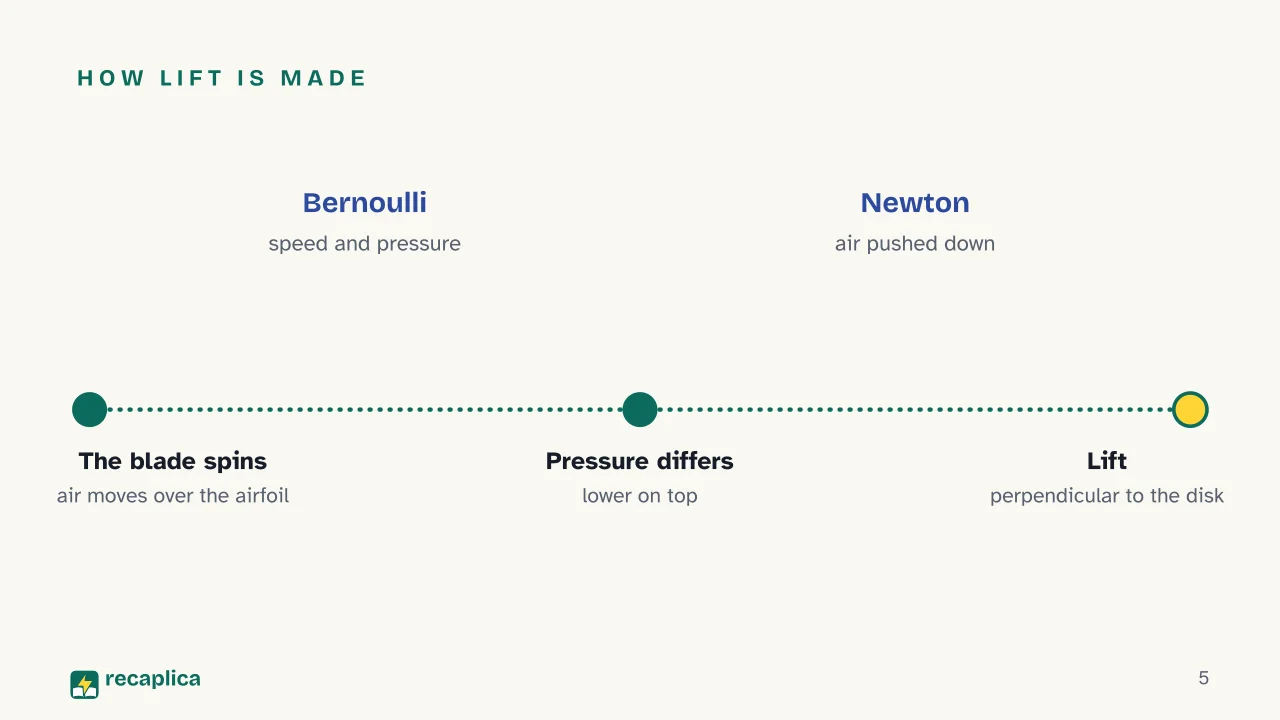  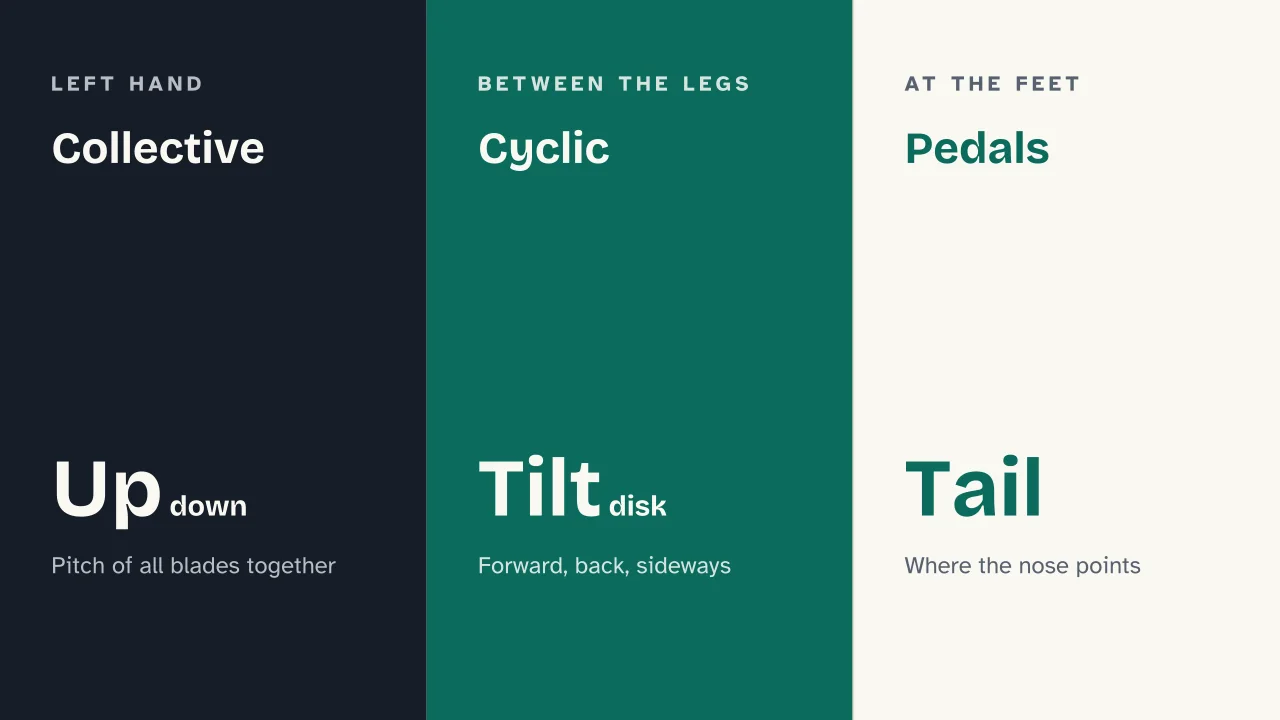  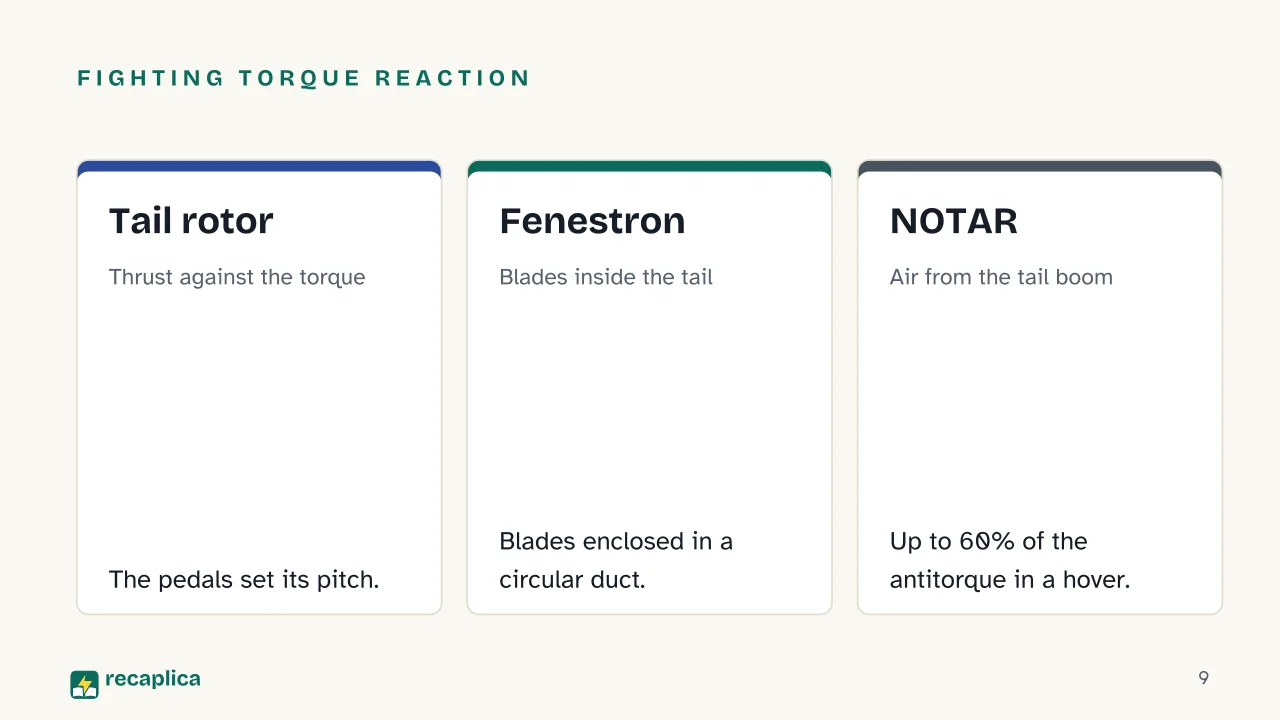  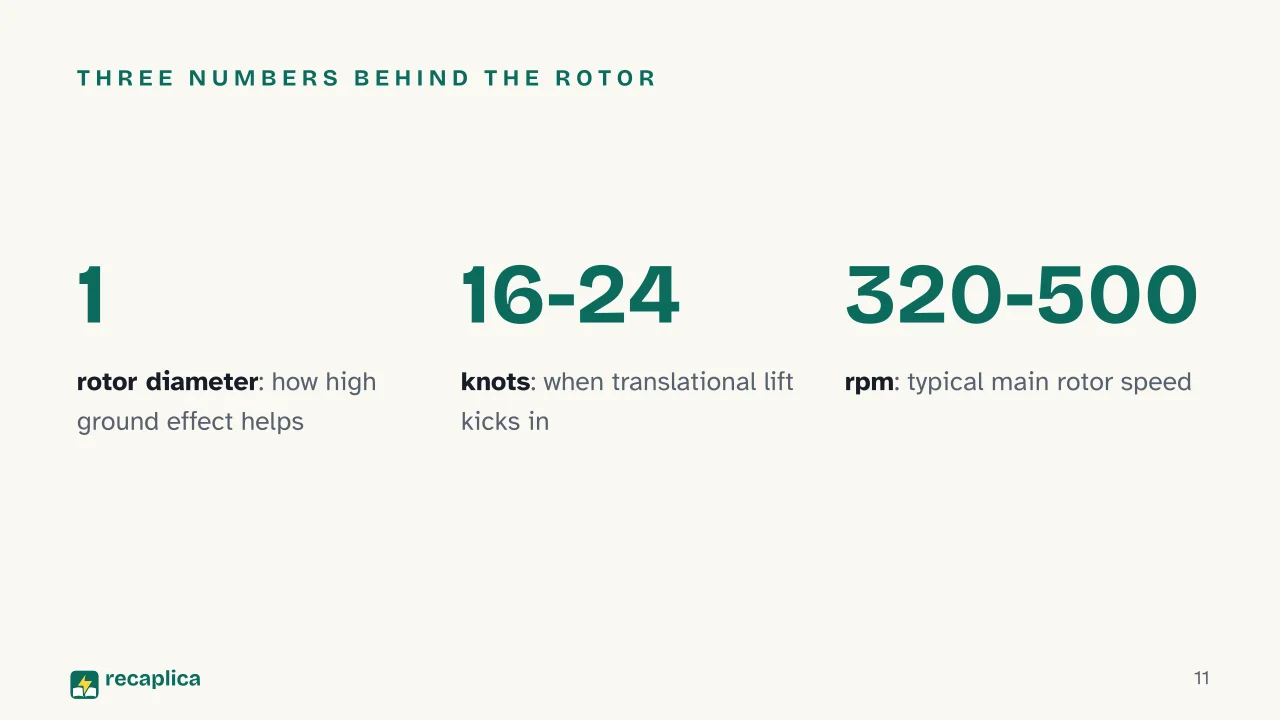 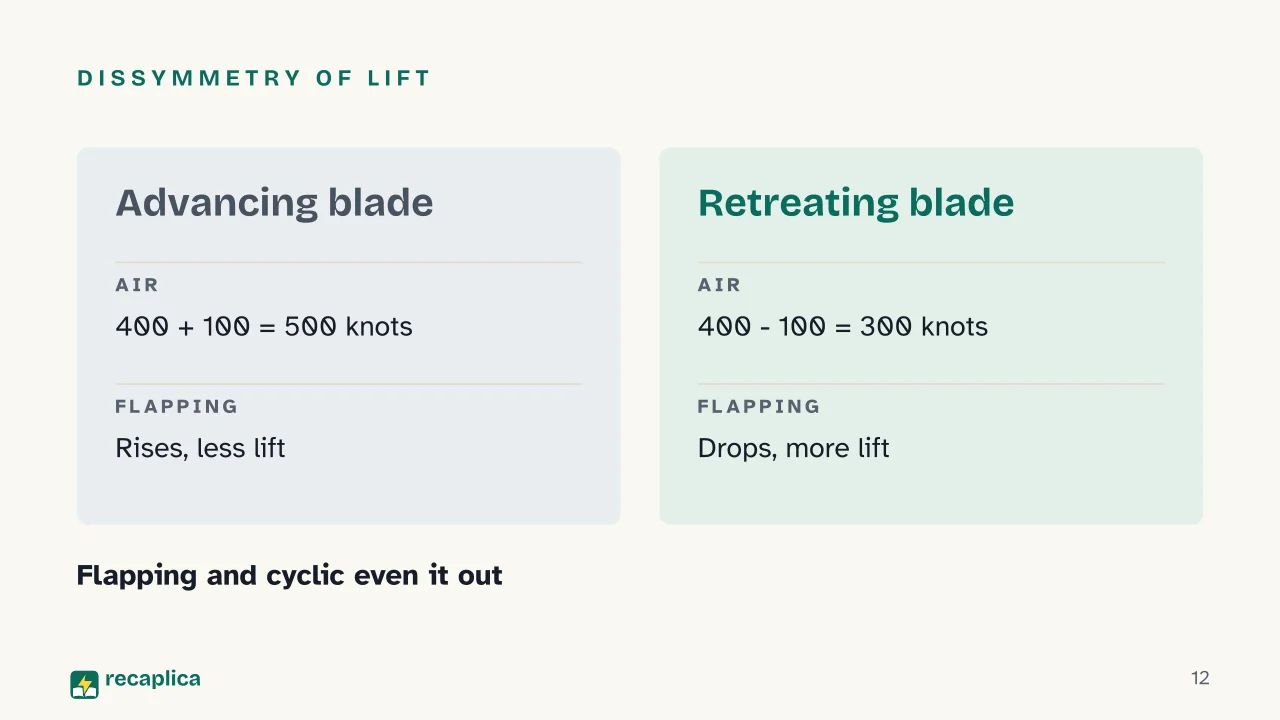 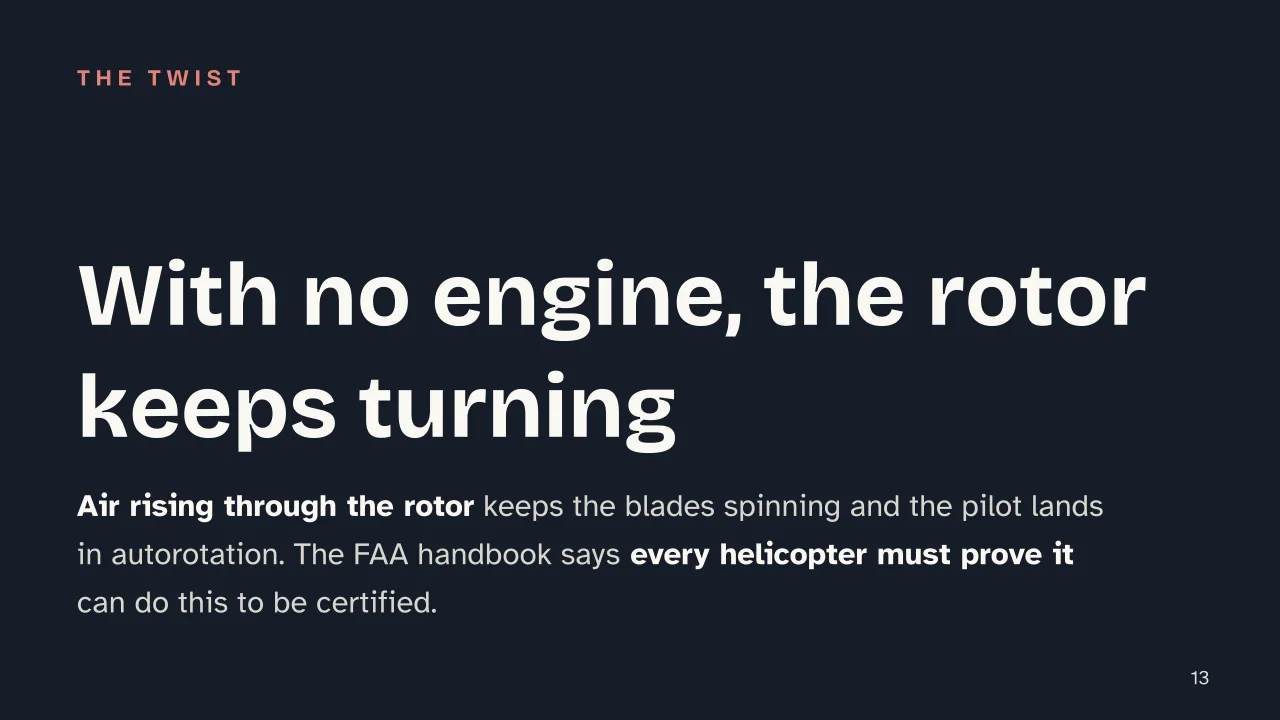 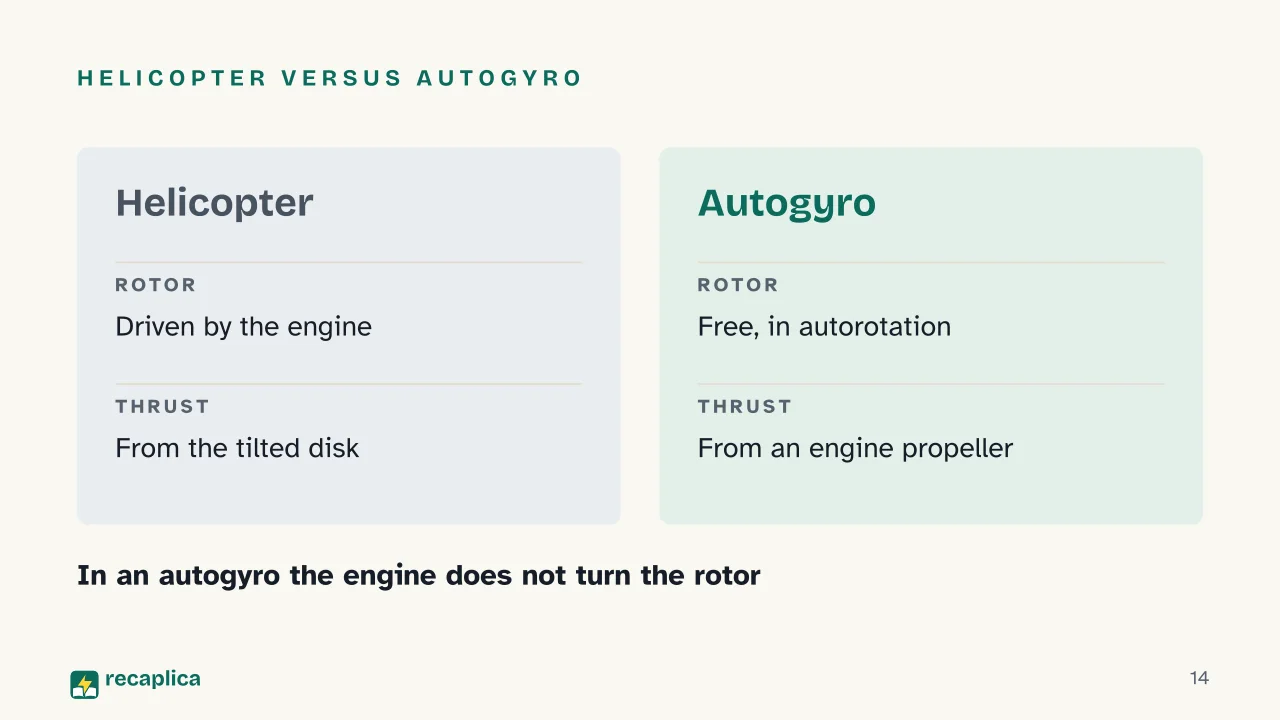 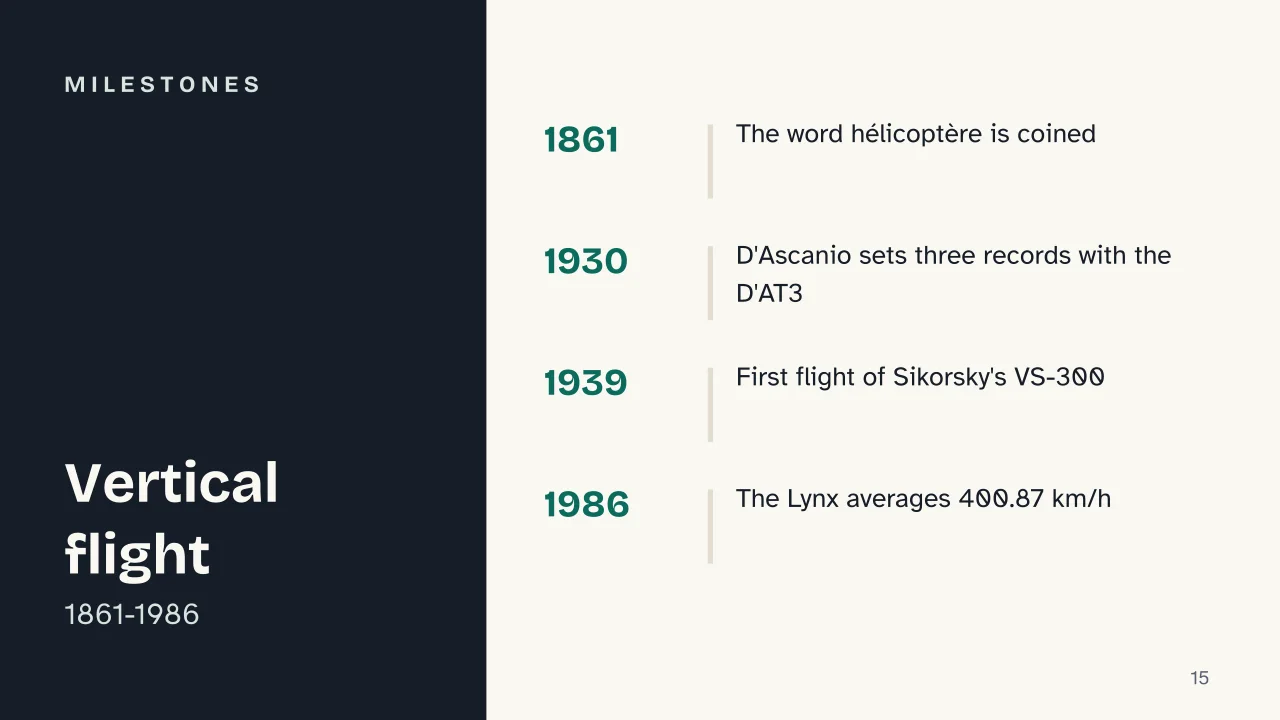 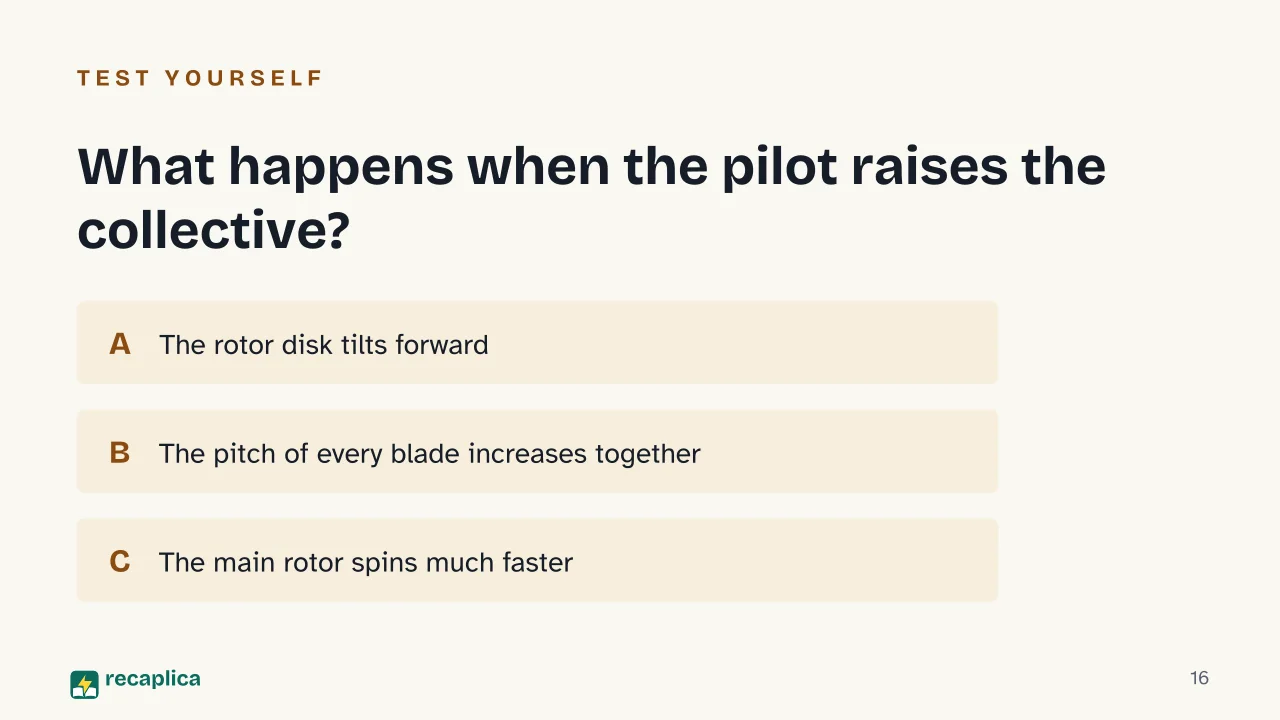  Common myths
Mind mapDrag the background to move around and the nodes to reposition them; use − and + to collapse and expand branches. 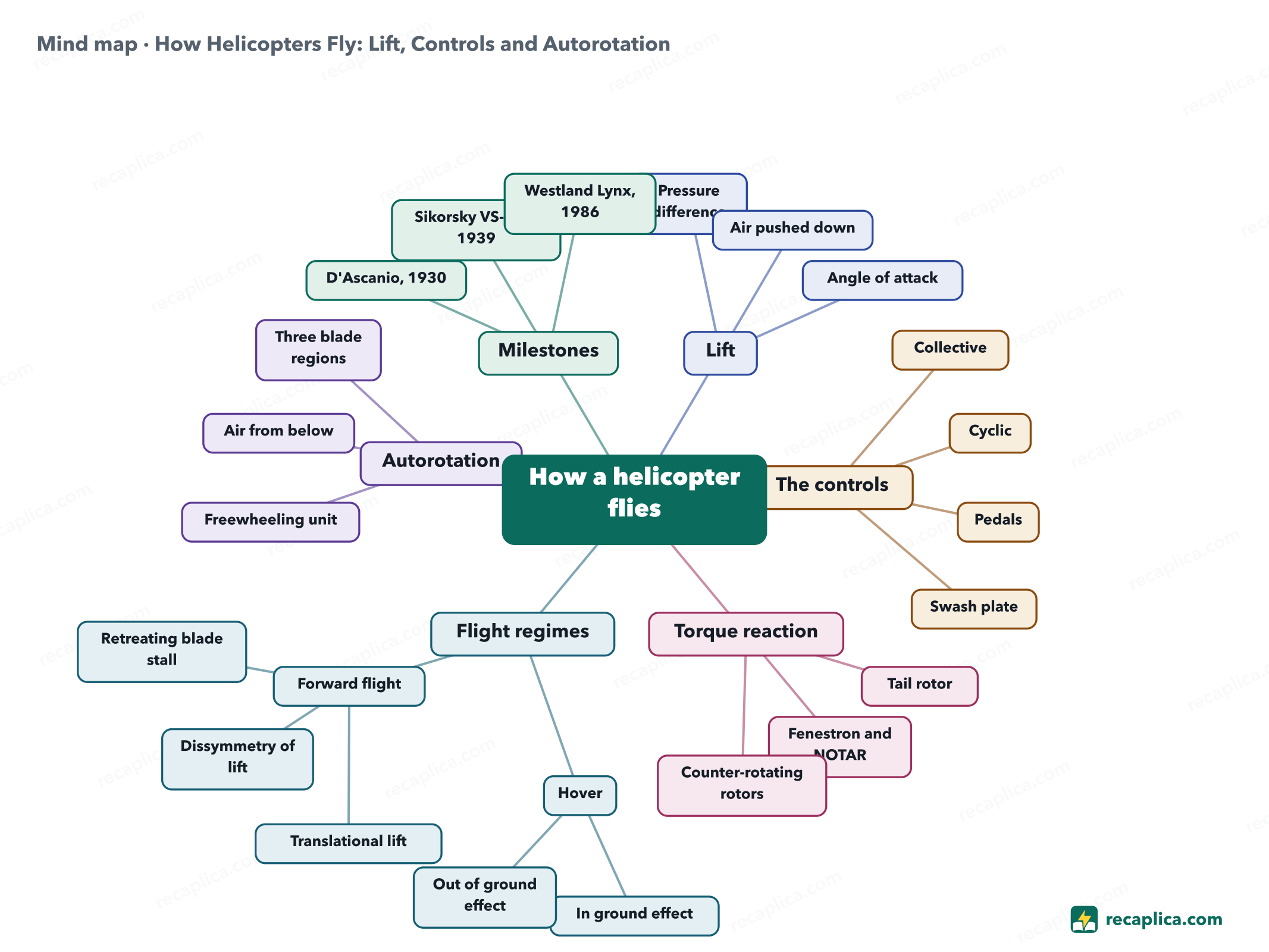
Quiz: test yourselfAnswer the questions to check what you have learned: you get instant feedback and a short explanation. Grade 0/10 0/5
FlashcardsTap the card to flip it and check whether you remember the answer, then move to the next one. 1 / 8 Explain it in your own wordsThe ultimate test: if you can explain it in simple words, you've truly understood it. Write your explanation, then compare it with the Recap. Your explanation is saved only on this device.
Frequently asked questionsHow does a helicopter hover in one place?The spinning blades move air over their airfoil shape and make lift even though the helicopter is not going anywhere. Once that lift equals the weight, the aircraft hangs in the air. The pilot is busy the whole time, though: the cyclic stops it drifting, the collective holds the height, the pedals keep the nose pointing the right way, and every correction on one control means adjusting the other two. What happens to a helicopter if the engine fails?It does not have to fall out of the sky. A freewheeling unit lets the rotor keep turning and the pilot enters autorotation: air rises through the disk and keeps the blades spinning, the descent is managed with airspeed and rotor rpm, and just before touchdown the energy stored in the blades is used to slow down. The FAA handbook states that every helicopter must demonstrate this ability to be certified. What is the difference between a helicopter and an autogyro?In a helicopter the engine turns the rotor, which provides both lift and thrust. In an autogyro, a name coined by Juan de la Cierva, the engine does not drive the rotor in flight: the rotor spins in autorotation thanks to the air moving through it, and an engine-driven propeller supplies the speed it needs. Who invented the helicopter?No single person. Gustave de Ponton d'Amécourt coined the French word hélicoptère in 1861. In 1930 the Italian Corradino D'Ascanio set three world records with his D'AT3; the French Breguet-Dorand flew in 1935, the German Focke-Achgelis Fw-61 in 1936, and Igor Sikorsky's VS-300, which first flew on 14 September 1939, established the layout of one main rotor and one tail rotor. Why can't a helicopter fly as fast as an airplane?One limit is retreating blade stall. The faster the helicopter goes, the slower the air over the retreating blade and the higher its angle of attack, until it stalls and loses lift. Partly because of this, every helicopter has a never-exceed speed, shown by a red line on the airspeed indicator. Every Recap goes through an independent review before publication. |