|
recaplica
Le Chatelier's Principle: Definition and Examples | ||||||||||||||||||||||||
| © 2026 Recaplica · recaplica.com — All rights reserved | ||||||||||||||||||||||||
Le Chatelier's Principle: Definition and ExamplesWhat to print Page numbers appear when printing with default margins. SlidesChoose a cut Flash10 slidesThe essential thread, to present in classFull15 slidesEvery chapter and the deeper detailBoth come with speaker notes. In 30 seconds quick readLe Chatelier's principle says that when something changes in a system at chemical equilibrium, the equilibrium moves in the direction that works against the change. It helps predict which way a reaction shifts after a change in concentration, pressure or temperature. A catalyst is outside the rule: it gets the system to equilibrium sooner and leaves the position where it was. Key Points
Deep DiveLe Chatelier’s principle answers a practical question: if you change something in a chemical equilibrium, which way does the reaction go? According to Jim Clark’s page on Chemistry LibreTexts, the French chemist and engineer Henry-Louis Le Chatelier proposed the idea in 1884, and the page calls it one of the central concepts of chemical equilibrium. Le Chatelier’s principle: definition and statementA chemical equilibrium is dynamic. The forward and reverse reactions both keep running. Change the conditions and the position shifts to oppose the change, until a new equilibrium sets in. Clark warns that this is a guide for predicting what happens and that it does not say why at the molecular level. Effect of concentrationWhen the products increase, the reaction quotient Qc grows and rises above the equilibrium constant Kc. Adding a reactant, say A in the reaction A + 2B ⇌ C + D, sends the equilibrium to the right and uses up part of what was added. Taking a product away as soon as it forms pushes the equilibrium further and further toward the products, until the reaction is effectively one-way. Chemguide points out that this is handy when one reactant is expensive: use a cheap one in excess and the costly one gets converted as fully as possible.
Effect of pressurePressure matters only when gases are involved. Chemguide explains that pressure depends on the number of gas molecules, so raising it sends the reaction to whichever side has fewer moles of gas, where the system can lower the pressure by making fewer molecules. Shrinking the volume pushes toward the side with fewer moles, and enlarging it pushes toward the side with more. If both sides have the same moles of gas, pressure does not shift the equilibrium. The same goes for an inert gas added at constant volume: the total pressure goes up, yet the partial pressures of the reacting gases stay as they were and the constant is unchanged. The link between pressure, volume and moles of gas is the one covered in gas laws and kinetic theory.
Effect of temperatureAccording to Clark, its main effect is to change the value of the equilibrium constant. Heating a system at equilibrium favors the endothermic reaction, which absorbs the extra heat, and cooling it favors the exothermic one. Clark admits that treating heat as a reactant or a product is strictly incorrect, but he accepts it as a convenient shortcut for predicting the shift. Chemguide offers a teaching reaction whose forward step is exothermic (250 kJ per mole of A): heating from 300 to 500 °C sends the equilibrium left, toward the reaction that absorbs heat, and more A and B remain.
Chemical equilibrium and Le Chatelier’s principle in industry: the Haber processTo make ammonia, the Haber process takes nitrogen from the air and hydrogen, produced mostly from methane. The reaction is reversible and exothermic, and nitrogen and hydrogen enter the reactor in a 1 to 3 ratio by volume, as the equation requires. Chemguide, in a page updated in April 2013, gives a reference pressure of 200 atmospheres. It is always high because the ammonia side has fewer moles of gas, and higher pressures call for sturdier vessels and cost too much. For the best yield at equilibrium the temperature would have to be as low as possible, but Chemguide explains that the reaction is too slow when it is colder. Plants therefore run at roughly 400-450 °C and accept a smaller yield: each pass through the reactor converts about 15% of the nitrogen and hydrogen, with figures that vary from plant to plant. Ammonia liquefies easily under pressure if it is not too hot, and that is how it is separated from the unreacted gases, which stay gaseous and are recycled. It also amounts to removing the product continuously. With recycling, the overall conversion rises to about 98%, according to Chemguide. A 2026 review by Arroyo-Caire and colleagues in Molecules describes ammonia production as still based mainly on the Haber-Bosch process at 400-500 °C and 150-250 bar. The authors trace the harsh conditions to kinetics, meaning speed, because the N≡N bond is very stable. According to the review, research aims at catalysts that work at 200-300 °C and 20-30 bar. What Le Chatelier’s principle leaves outA catalyst falls outside the principle. According to Clark it does not change the position of equilibrium, because it speeds up the forward and reverse reactions equally. For a very slow reaction, getting to equilibrium can take years, and a catalyst shortens that. In the Haber process, iron with a promoter makes the reaction fast enough and leaves the percentage of ammonia at equilibrium as it was. Chemists also voice reservations. Eric Scerri, in a 2015 opinion piece on RSC Education, observes that textbooks do not give two identical statements of the principle, and that many replace “counter” with “accommodate” the change, to avoid wrong predictions. For changes in concentration the classic wording seems to work well, he writes, which adds to the confusion, but temperature needs another approach because K itself depends on temperature. Scerri proposes replacing the principle with a calculation of Kp, using mole fractions and total pressure. Slide deckSlides ready to download and make your own in PowerPoint or Google Slides, with speaker notes. Pick the Flash cut or the Full one.     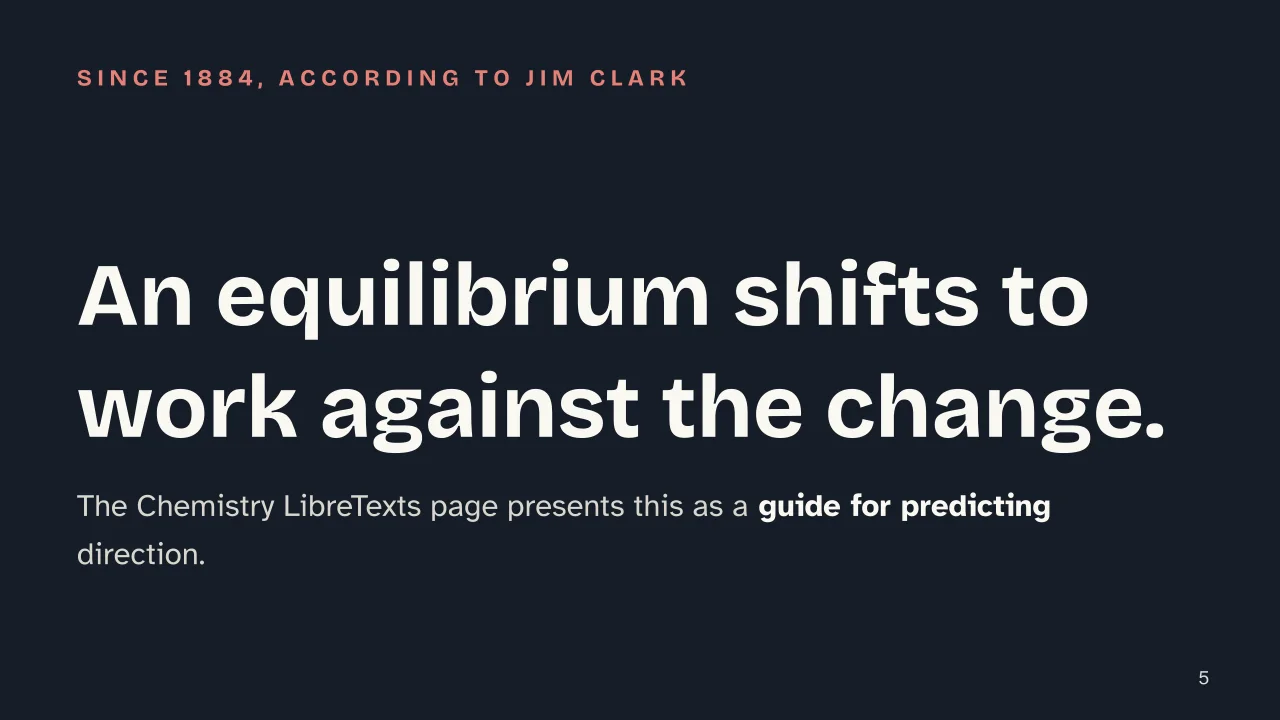  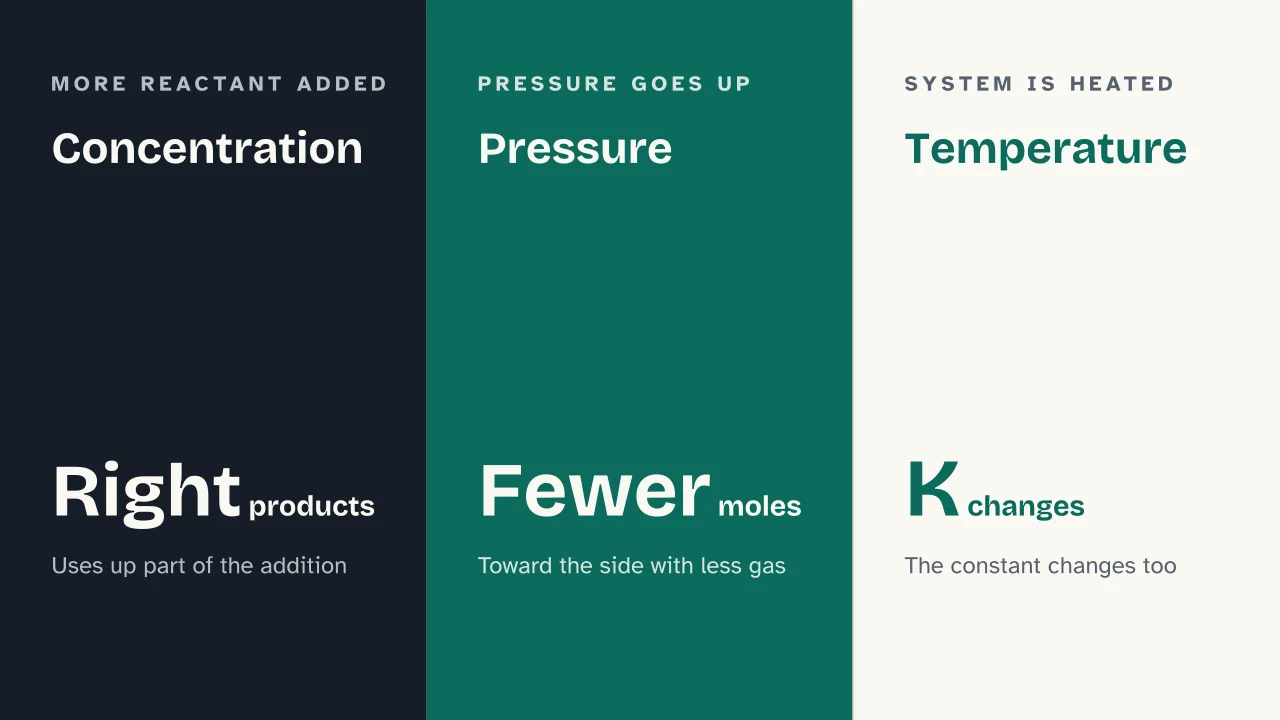  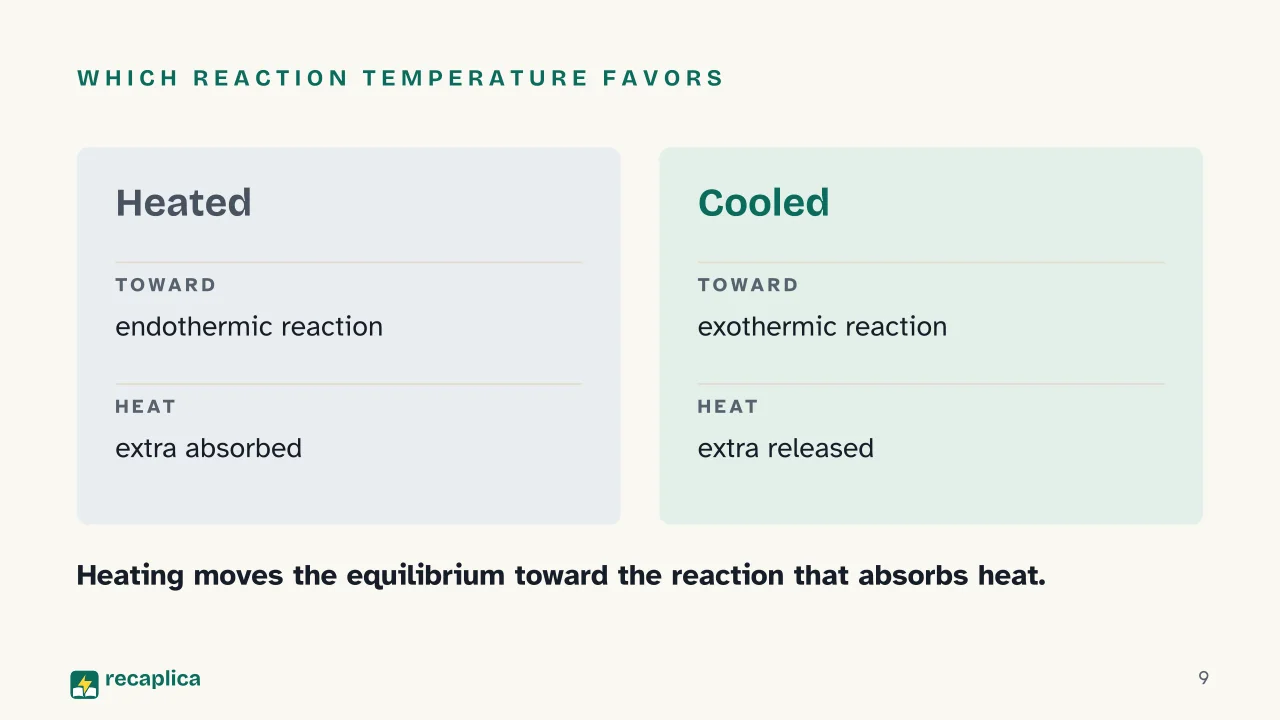 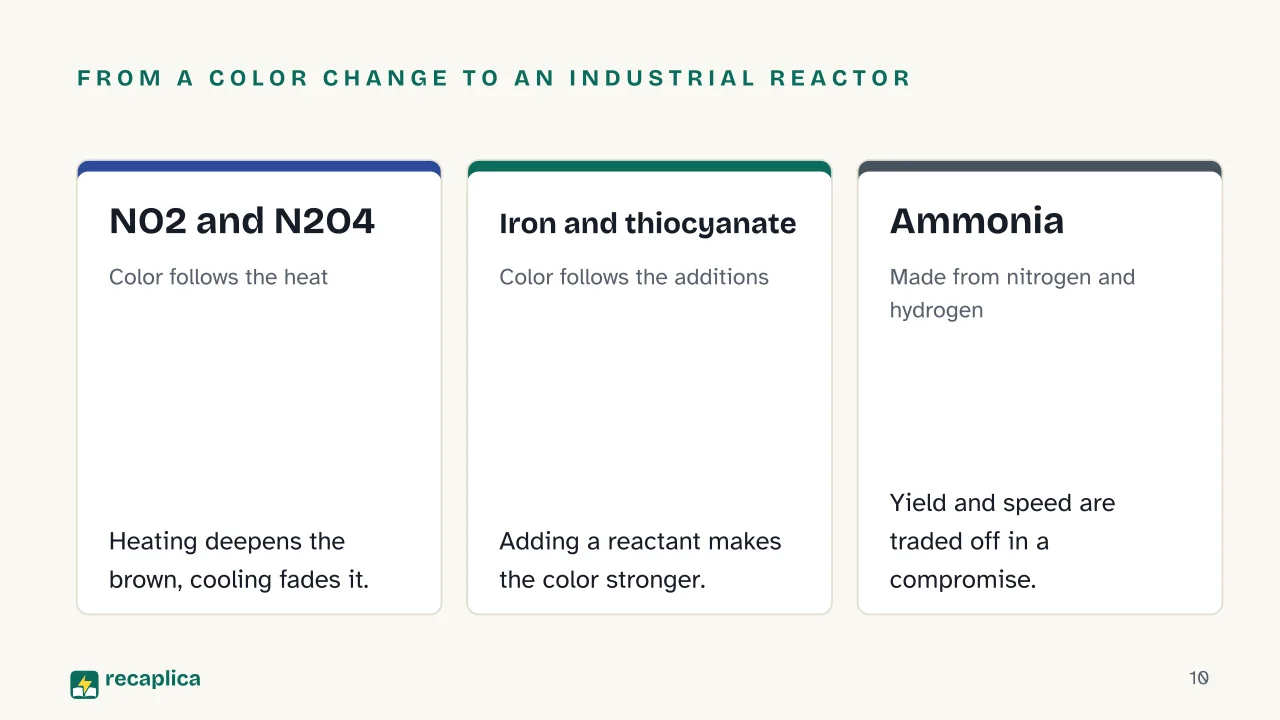 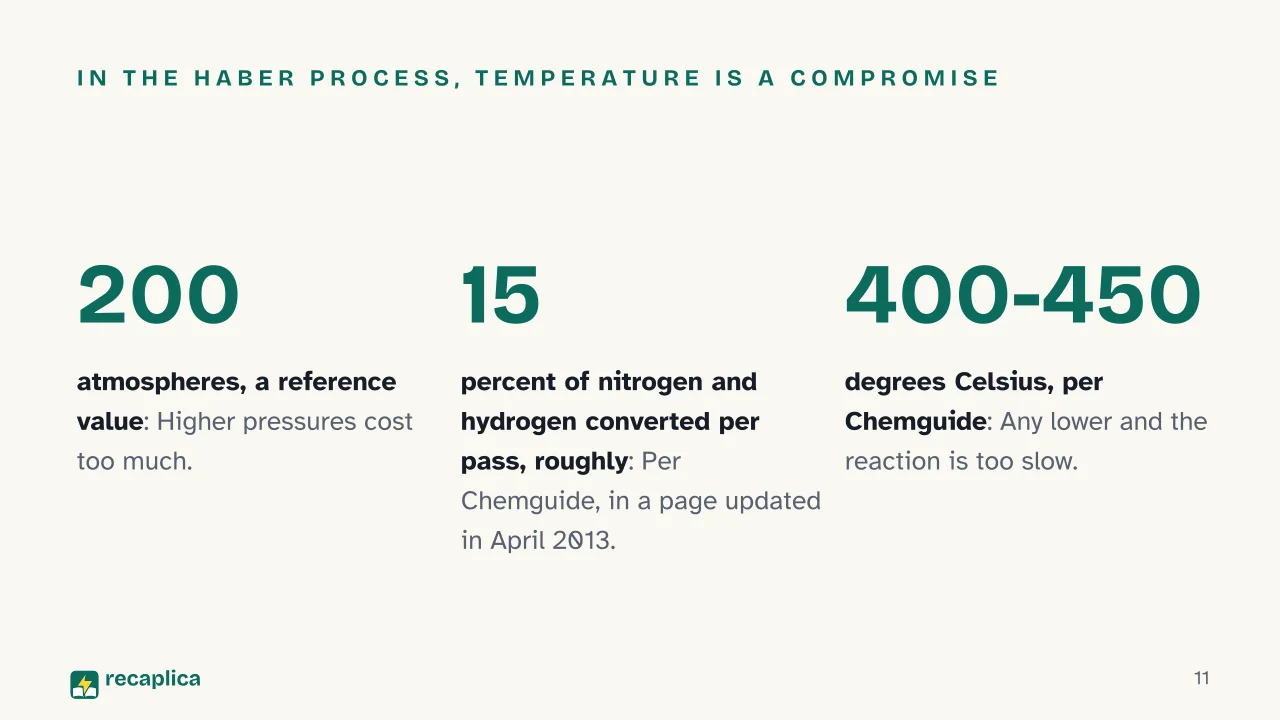  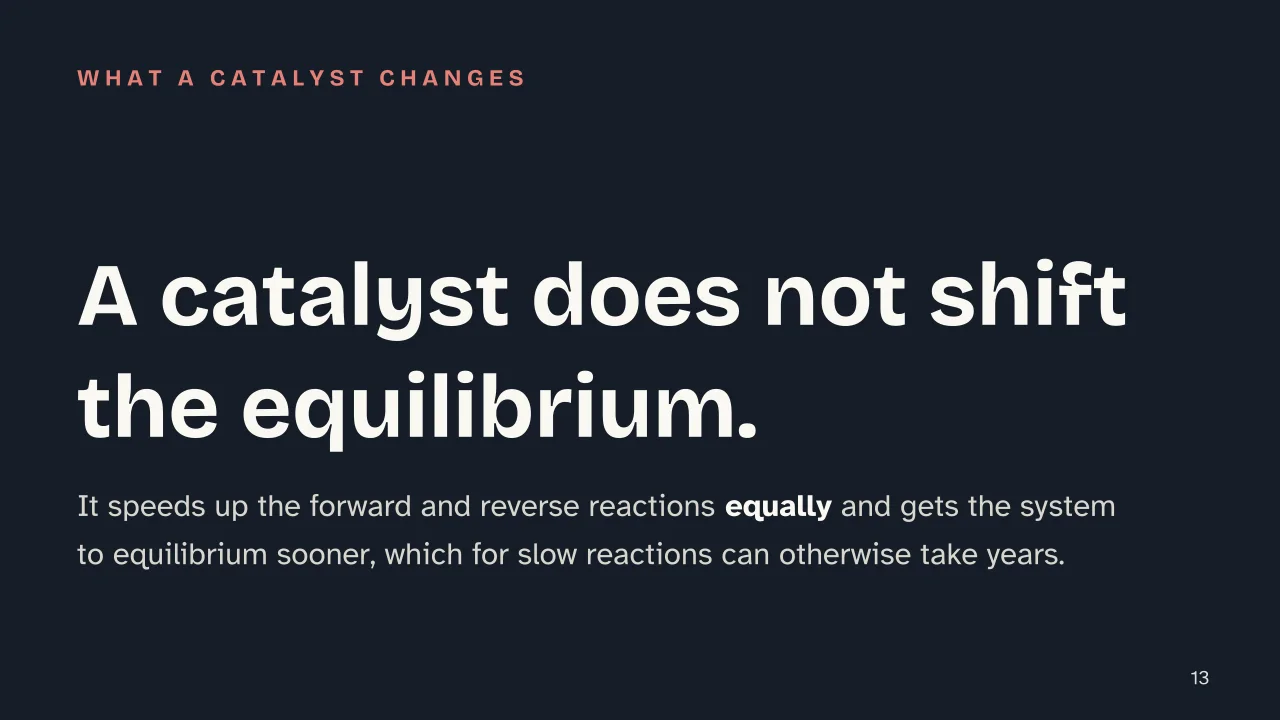 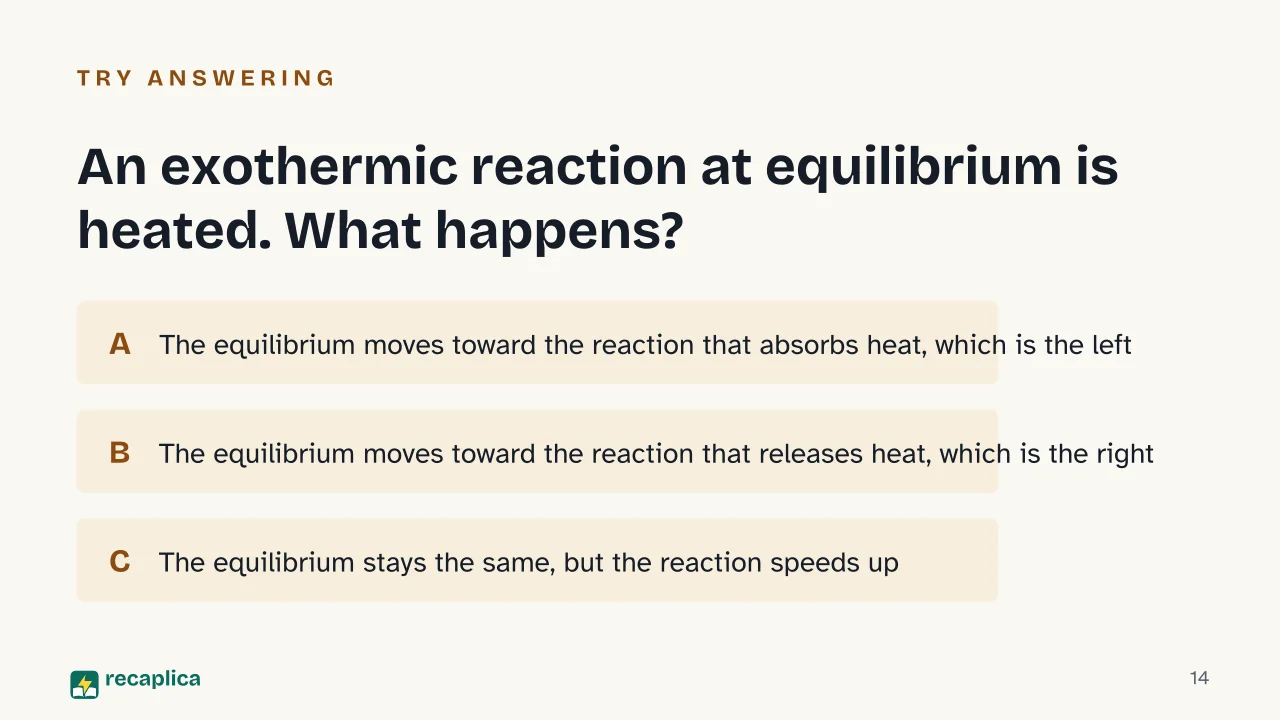  Common myths
Mind mapDrag the background to move around and the nodes to reposition them; use − and + to collapse and expand branches. 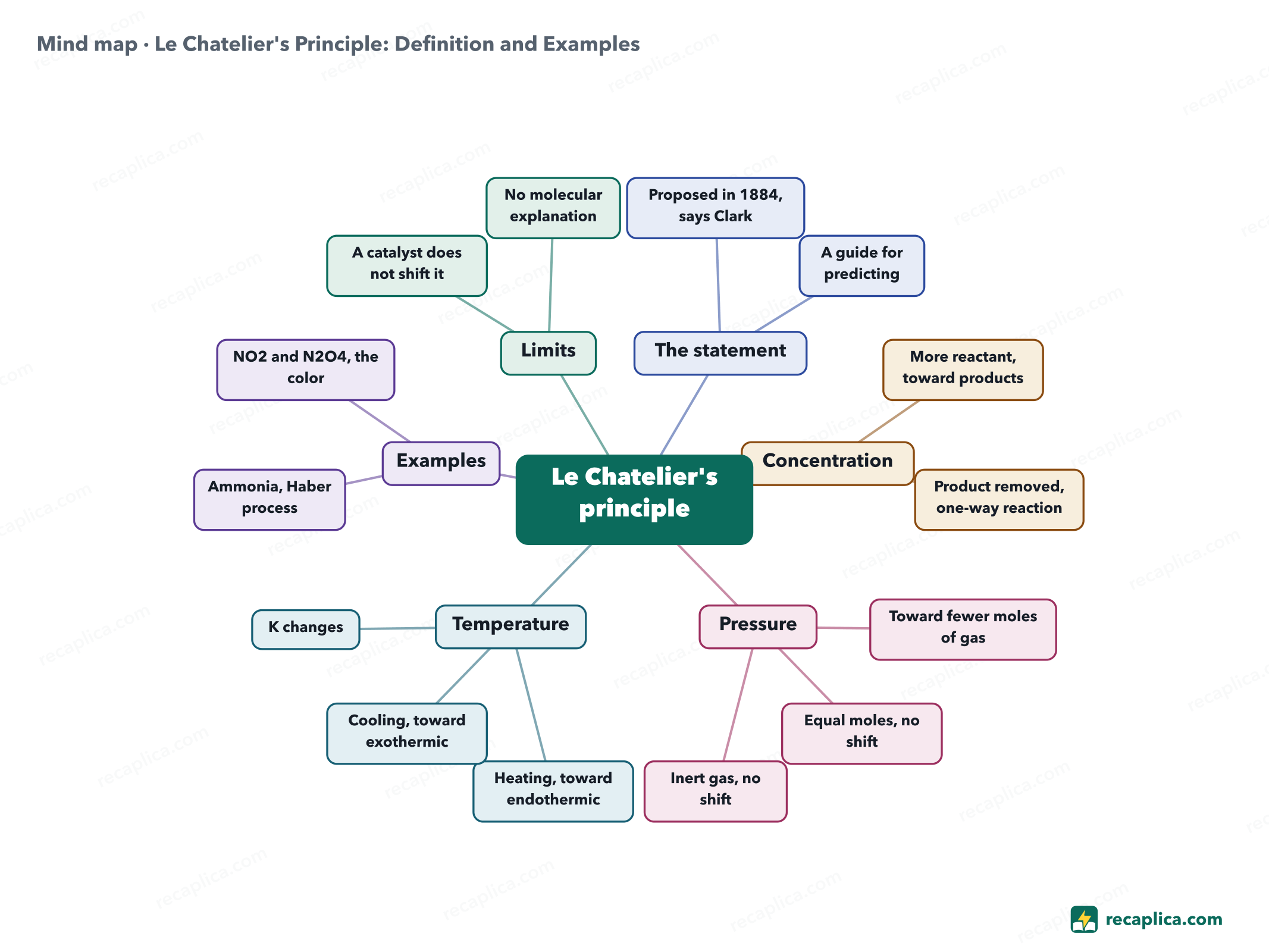
Quiz: test yourselfAnswer the questions to check what you have learned: you get instant feedback and a short explanation. Grade 0/10 0/5
FlashcardsTap the card to flip it and check whether you remember the answer, then move to the next one. 1 / 8 Explain it in your own wordsThe ultimate test: if you can explain it in simple words, you've truly understood it. Write your explanation, then compare it with the Recap. Your explanation is saved only on this device.
Frequently asked questionsWhat is Le Chatelier's principle?It is a rule for predicting how a chemical equilibrium responds when conditions change. According to Jim Clark's page on Chemistry LibreTexts, it was proposed in 1884 by the French chemist and engineer Henry-Louis Le Chatelier. The equilibrium responds to a change in conditions by working against it. How do you state Le Chatelier's principle?The classroom version says that a system at equilibrium, when stressed, reacts to counter the stress. Eric Scerri (RSC Education, 2015) points out that textbooks do not give two identical statements, and that many use the verb "accommodate" in place of "counter". How does the equilibrium change if I raise the pressure?It depends on the number of moles of gas on each side of the equation. The equilibrium shifts toward the side with fewer. If the moles are equal, the position is unchanged, and the same holds when pressure rises because an inert gas was added at constant volume. What is the effect of temperature on a chemical equilibrium?A hotter system leans toward the endothermic reaction, a colder one toward the exothermic reaction. According to Clark, temperature acts mainly by changing the value of the equilibrium constant K. Does a catalyst shift the equilibrium?No. A catalyst acts the same way on the forward and reverse reactions, so the ratio between them is unchanged. It helps the system reach equilibrium sooner, and for very slow reactions that can otherwise take years. Every Recap goes through an independent review before publication. |