|
recaplica
The Servant of Two Masters: Plot and Characters | ||||||||||||
| © 2026 Recaplica · recaplica.com — All rights reserved | ||||||||||||
The Servant of Two Masters: Plot and CharactersWhat to print Page numbers appear when printing with default margins. SlidesChoose a cut Flash10 slidesThe essential thread, to present in classFull15 slidesEvery chapter and the deeper detailBoth come with speaker notes. In 30 seconds quick readThe Servant of Two Masters is a play by Carlo Goldoni, also staged under the title Arlecchino, Servant of Two Masters: it begins life as a scenario in 1745, written for the actor Antonio Sacchi, and becomes a full script only in 1753. The story is set in Venice, in the house of the merchant Pantalone de' Bisognosi, and turns on a mix-up: the servant Truffaldino ends up secretly serving two masters, Beatrice Rasponi disguised as a man and her lover Florindo, simply to get enough to eat. It is the last of Goldoni's plays to bring commedia dell'arte masks on stage, marking the shift toward the character-driven comedy of his reform. In the twentieth century, Giorgio Strehler's productions, starting in 1947, remain among its most remembered stagings. Key Points
Key figures
Deep DiveA scenario written for a great ArlecchinoIn 1745, during the Pisan years of his career as a lawyer, Goldoni wrote a scenario — not yet a full script, just a sketch of scenes for improvisation — for Antonio Sacchi, the actor who played the mask of Truffaldino and would be remembered as the last great Arlecchino of the commedia dell’arte. The plot came from France: Goldoni drew it from Luigi Riccoboni’s Arlequin valet de deux maîtres. The scenario belongs to the long arc of Carlo Goldoni’s comedy reform, already under way since 1738 with «Mòmolo cortesan»: it remains a work halfway between the old theatre and the new, written for an actor still tied to the masks. Only in 1753, once the reform was well under way, did Goldoni pick those pages back up and rewrite them in full, turning the scenario into a finished script. The play still circulates today under the alternate title Arlecchino, Servant of Two Masters, naming the mask at its center.
An engagement, a dead man who isn’t, a double jobThe comedy is set in Venice, in the house of the merchant Pantalone de’ Bisognosi. The story opens with the engagement of Clarice, Pantalone’s daughter, to Silvio, son of Doctor Lombardi: the two can finally marry because Federico Rasponi, the wealthy Turinese man Clarice had previously been promised to, is believed dead after a duel. Brighella, an innkeeper who stands as witness, and Smeraldina, Clarice’s maid, are also present at the engagement. Right at that moment, Truffaldino, a young servant, bursts onto the scene announcing the arrival of his master: Federico Rasponi, far from dead, come to claim his promised bride and her dowry. In reality, the person knocking at Pantalone’s door isn’t Federico but his sister Beatrice, disguised as a man to claim the dowry and help her lover Florindo Aretusi, who fled to Venice after killing Federico in a duel. Brighella recognizes Beatrice right away; even Truffaldino, who serves her, has no idea who she really is.
Truffaldino, or Arlecchino: the servant who just wants to eatThe protagonist appears in the play under two names, Truffaldino and Arlecchino, and is the most recognizable mask in Italian theatre. His defining trait, according to VIVIT, is a kind of double register: he acts foolish when something doesn’t concern him directly, but turns sharp the moment a situation touches his real interest, which in the play almost always means his stomach. It’s exactly this single goal — eating his fill — that pushes Truffaldino to secretly serve two masters at once, risking exposure in every scene. Around him move the rest of the Venetian cast: Pantalone de’ Bisognosi, the merchant and Clarice’s father; Clarice and Silvio, the young couple; Beatrice Rasponi, disguised as her brother, and her lover Florindo Aretusi; Brighella, the innkeeper who recognizes Beatrice; Smeraldina, Clarice’s maid, whom Truffaldino falls for as the story unfolds. After a string of twists tied to the double-service mix-up, the comedy closes with two weddings: Silvio and Clarice, and Arlecchino with Smeraldina. Goldoni’s last maskThe Servant of Two Masters keeps some traits of the commedia dell’arte it grew out of — fixed masks, fast and tight dialogue — but stands apart through the pace and liveliness of its written text. According to VIVIT, it’s the last play in which Goldoni still brings the masks on stage: after it, his output moves away from that model for good, toward the character-driven comedies that mark the full maturity of his reform. The actor Antonio Sacchi, though, stays loyal to Arlecchino even as masks lose ground in reformed theatre, and keeps performing the role for years with the playwright Carlo Gozzi’s backing. The scenario is born in Venice, the city where Goldoni sets the story and where he will often turn to the Venetian dialect in his plays — a linguistic choice the Recap on Italian dialects traces in its history and features. Italian theatre kept reckoning with Goldoni’s legacy well past the eighteenth century: in the twentieth, Luigi Pirandello would bring a new idea of character to the stage, just as in the nineteenth Giovanni Verga would use Verismo to tell of an Italy far removed from Goldoni’s Venetian drawing rooms. Giorgio Strehler’s productions in the twentieth centuryThe Servant of Two Masters doesn’t stay confined to eighteenth-century Venice: among its most remembered productions in the twentieth century are those directed by Giorgio Strehler, starting with his 1947 staging. The sources consulted for this Recap don’t record the theatre or the exact date of the play’s very first performance: the available sources only mention a highly successful debut in Milan and Venice, with no further detail. Slide deckSlides ready to download and make your own in PowerPoint or Google Slides, with speaker notes. Pick the Flash cut or the Full one.     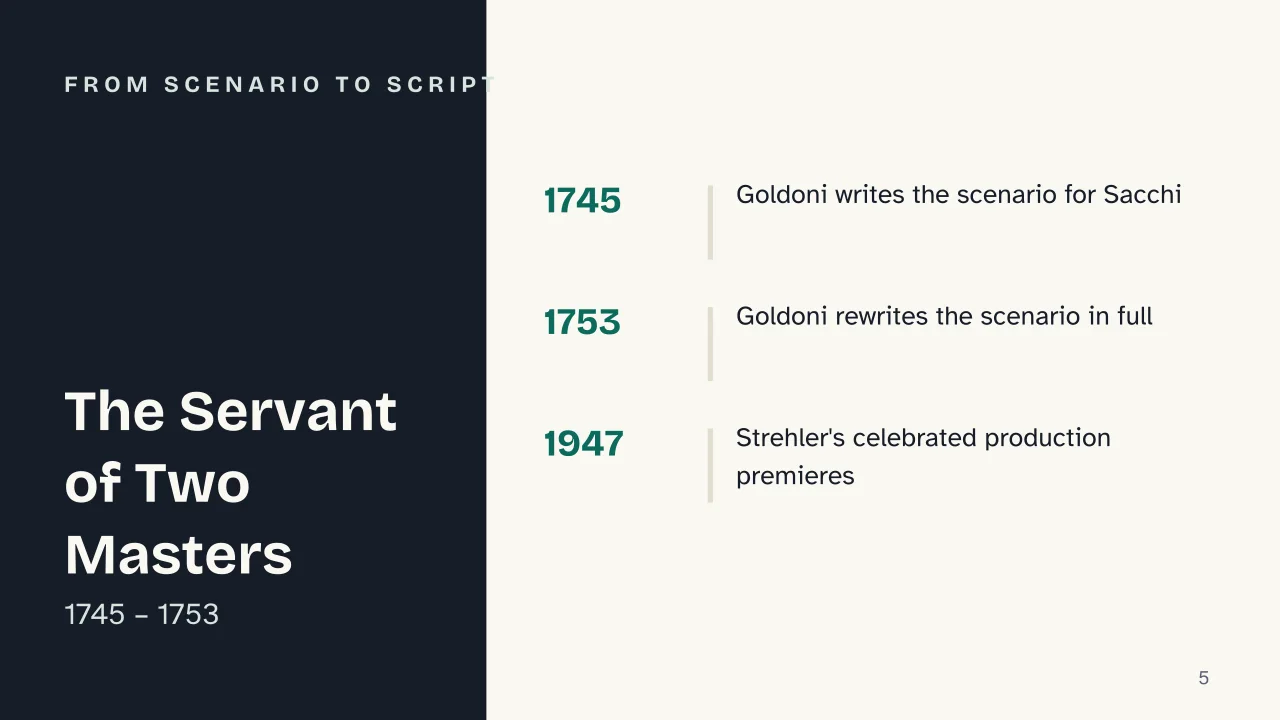  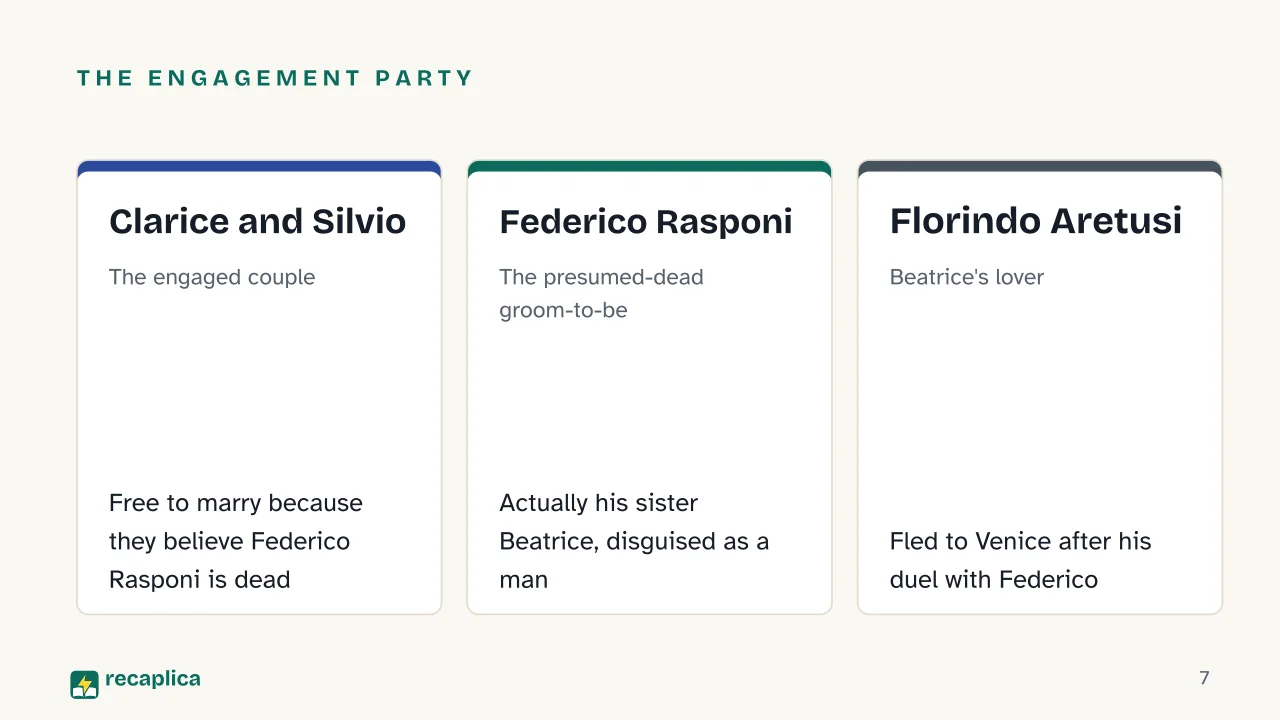 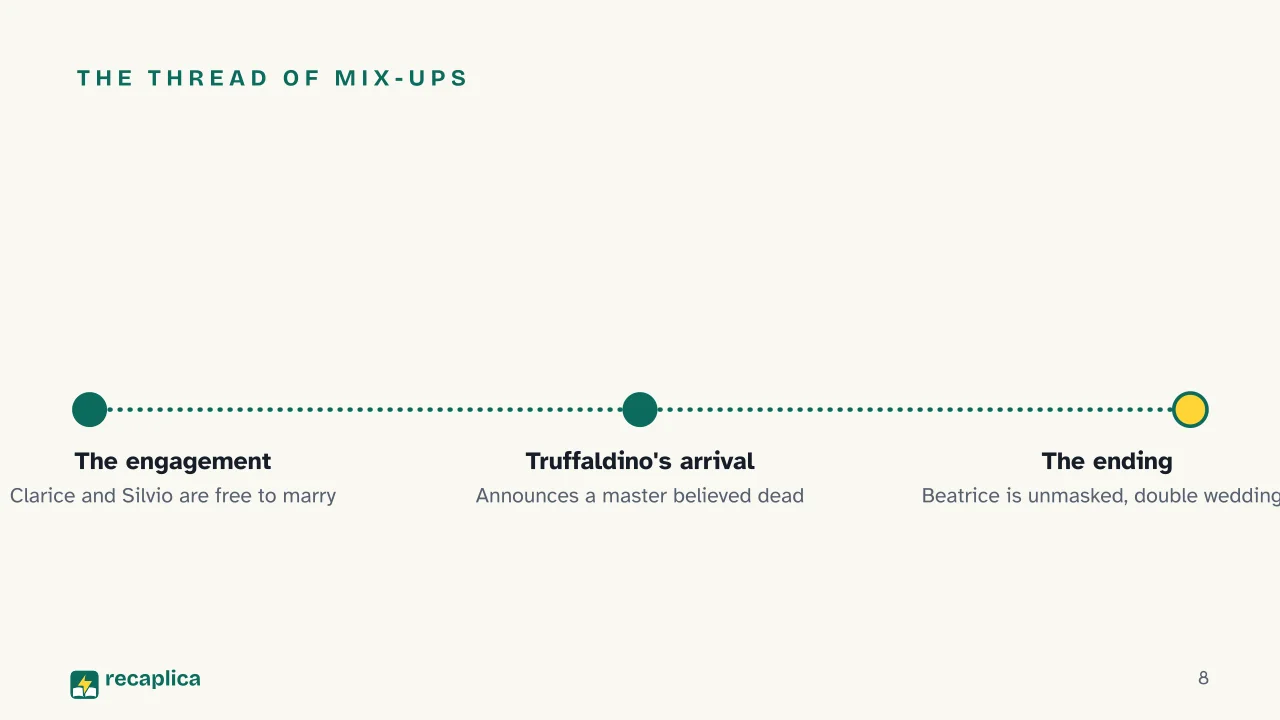   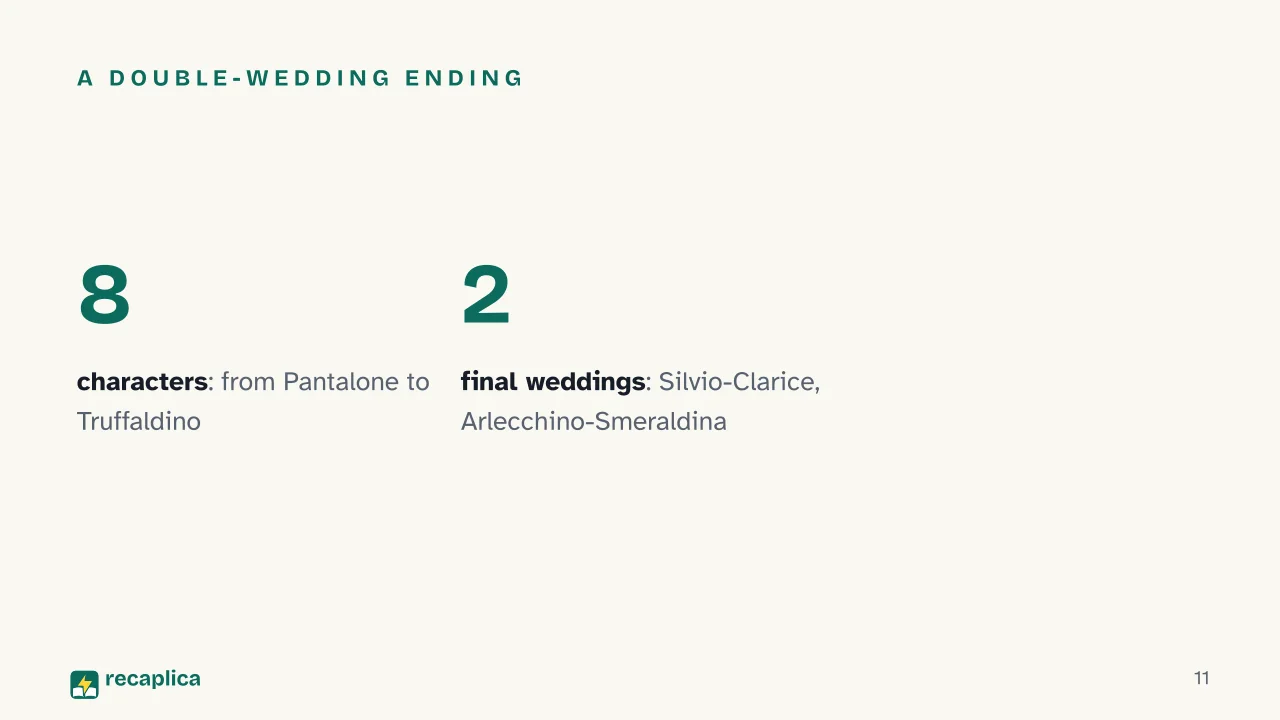  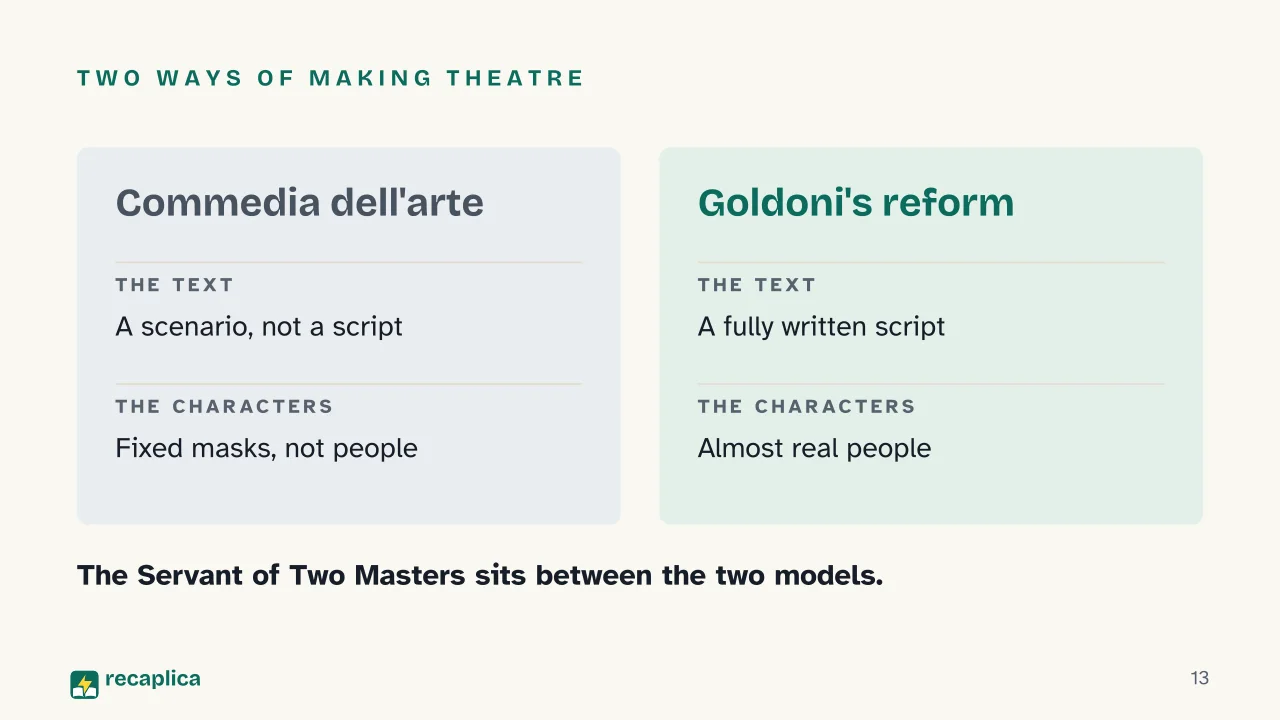   Common myths
Mind mapDrag the background to move around and the nodes to reposition them; use − and + to collapse and expand branches. 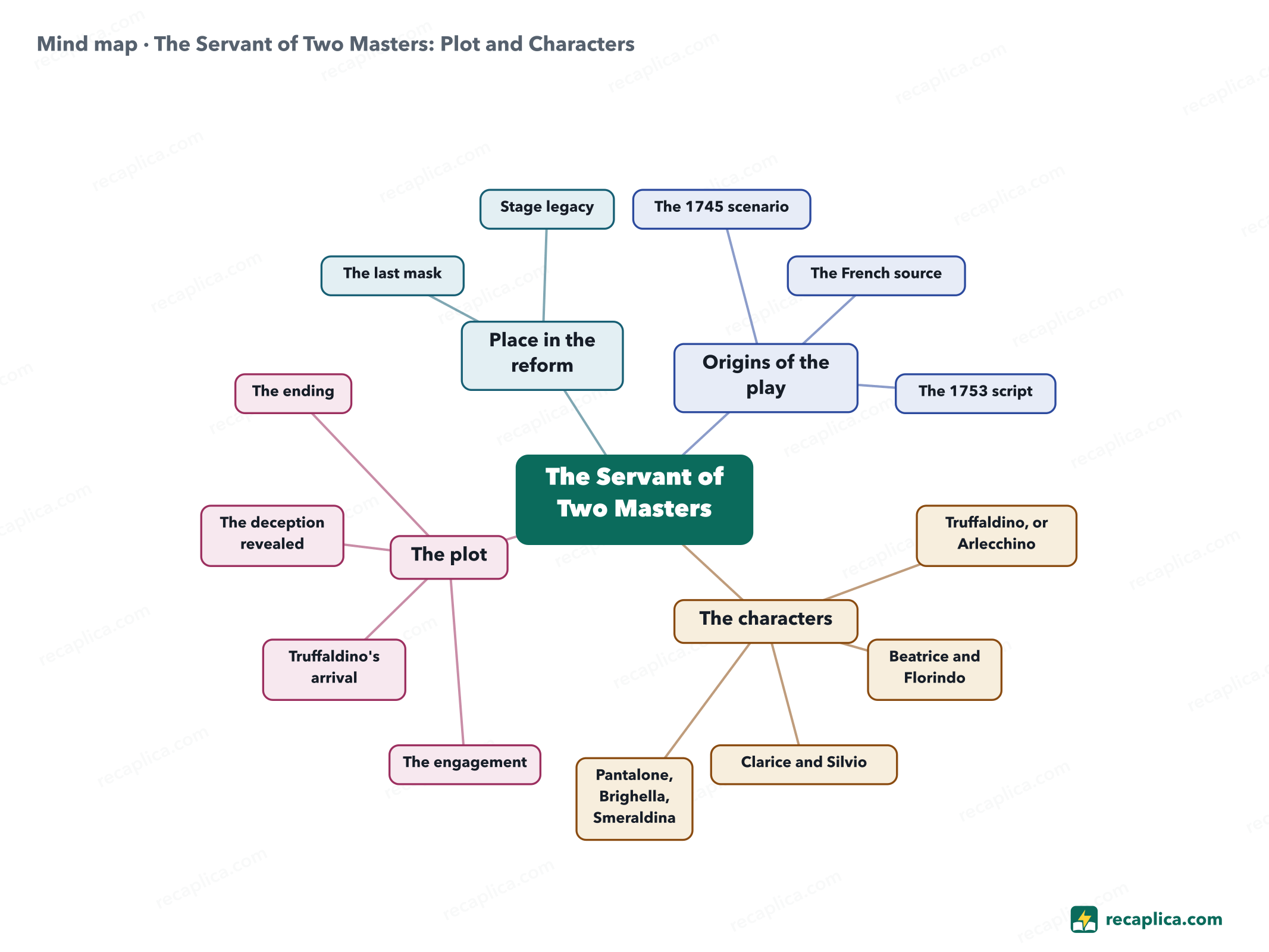
Quiz: test yourselfAnswer the questions to check what you have learned: you get instant feedback and a short explanation. Grade 0/10 0/5
FlashcardsTap the card to flip it and check whether you remember the answer, then move to the next one. 1 / 8 Explain it in your own wordsThe ultimate test: if you can explain it in simple words, you've truly understood it. Write your explanation, then compare it with the Recap. Your explanation is saved only on this device.
Frequently asked questionsWho wrote The Servant of Two Masters?Carlo Goldoni wrote it, first as a scenario in 1745 for the actor Antonio Sacchi, then rewrote it as a full script in 1753, partway through his theatre reform. What is the plot of The Servant of Two Masters?In Venice, Clarice gets engaged to Silvio after the presumed death of Federico Rasponi. The person who actually shows up is Federico's sister Beatrice, disguised as a man, while the servant Truffaldino ends up secretly serving both her and her lover Florindo, just to earn double pay. The play closes with the weddings of Silvio and Clarice, and of Arlecchino and Smeraldina. Who are the main characters in The Servant of Two Masters?Truffaldino, or Arlecchino, the servant lead; Beatrice Rasponi and Florindo Aretusi; Clarice and Silvio; Pantalone de' Bisognosi; Brighella and Smeraldina. Why is it also called Arlecchino, Servant of Two Masters?Because the protagonist, Truffaldino, also carries the name of the traditional mask Arlecchino in the text. The play circulates under both titles, alongside the original The Servant of Two Masters. What year did the play premiere?The available sources don't give an exact date or theatre for the first performance — they only note that it was a major success in Milan and Venice. Every Recap goes through an independent review before publication. |