|
recaplica
What Is German Expressionism? Meaning and Concept Map | |||||||||||||||
| © 2026 Recaplica · recaplica.com — All rights reserved | |||||||||||||||
What Is German Expressionism? Meaning and Concept MapWhat to print Page numbers appear when printing with default margins. SlidesChoose a cut Flash10 slidesThe essential thread, to present in classFull16 slidesEvery chapter and the deeper detailBoth come with speaker notes. In 30 seconds quick readGerman Expressionism took shape in the early twentieth century as a reaction against art seen as too descriptive: painters, writers and later filmmakers pushed intense feeling over a faithful copy of reality. The movement grew out of two painters' groups, Die Brücke in Dresden from 1905 and Der Blaue Reiter in Munich from 1911, and spread into literature through the Berlin magazine Der Sturm, founded in 1910. In the 1920s the same visual language reached the screen, in films such as "The Cabinet of Dr. Caligari" and "Nosferatu." In 1937 the Nazi regime branded much of this work "degenerate" art and displayed confiscated pieces in Munich, visited according to the United States Holocaust Memorial Museum by more than two million people. Key Points
Key figures
Deep DiveGerman Expressionism took shape in Germany at the start of the twentieth century, as painters and later writers turned away from art they saw as too descriptive. According to Tate, they wanted to give the work an emotional and spiritual charge: colors grew intense and non-naturalistic, shapes pulled away from the real world. Expressionism carries that reaction onto new ground: group painting, a literary magazine, cinema. German Expressionism Art: Die Brücke and Der Blaue ReiterThe movement took painted form in two groups, born in different cities six years apart. Die Brücke, the bridge from DresdenDie Brücke was founded in Dresden in 1905. Tate describes the group as fusing elements of early German art and tribal art from Africa and the South Pacific with Post-Impressionism and Fauvism, in a style built on vivid, non-naturalistic color and a free brushstroke, with paint laid on thick and dense. The name, “bridge,” is thought to allude to a link between the artist and society; in the 1906 manifesto the group declares it wants to win freedom of life and action against older, already established forces. Otto Müller joins the group in 1910, while Emil Nolde is a member for only a short period.
Der Blaue Reiter, the blue rider from MunichDer Blaue Reiter formed in Munich in 1911, founded by Wassily Kandinsky and Franz Marc. According to the German History in Documents and Images project (GHDI), the group brings together artists of both German and Russian background: among others, Gabriele Münter, August Macke, Alexej von Jawlensky, Marianne von Werefkin and Paul Klee. Its first exhibition is held at the Galerie Thannhauser in Munich between 1911 and 1912. Compared with Die Brücke, the style of Der Blaue Reiter is generally softer and more lyrical, and moves further toward abstraction over time; it shares, though, the use of color for spiritual and symbolic ends. The group breaks up once World War 1 begins, in 1914: Kandinsky and the other Russian citizens are forced to leave Germany, while Franz Marc and August Macke enlist in the German army and die at the front.
Expressionism in Literature: the Magazine Der SturmExpressionism did not stay confined to canvas. In Berlin, in 1910, Herwarth Walden founds the magazine Der Sturm together with Alfred Döblin, and it becomes a mouthpiece for the German Expressionist avant-garde: according to the online collection of the Leopold Museum, its literary contributors include Adolf Loos, Peter Altenberg, Paul Scheerbart and Else Lasker-Schüler. Der Sturm also publishes work by visual artists linked to Der Blaue Reiter — Kandinsky, Kokoschka, Macke, Marc and Münter — a direct bridge between the literary magazine and the painters’ movement. Around the Walden name a gallery and a publishing house also grow, both also called Sturm. The Naturalism of Gerhart Hauptmann had already described social reality with near-photographic rigor, staying faithful to observation rather than distorting it the way Expressionism does. Walden leaves Germany for the Soviet Union in 1932, driven out by the rise of National Socialism, and with his departure the activities built around Der Sturm come to an end. German Expressionist CinemaIn the 1920s the same visual language reaches the screen. The British Film Institute notes that German Expressionist cinema flourishes after the horrors of World War 1 and the economic devastation that follows: film sets turn slanted and impossible, shot from high angles, drenched in deep shadow, in strong light-dark contrast (Helldunkel). Das Cabinet des Dr. Caligari, directed by Robert Wiene, comes out in 1920 and is famous for its painted sets, full of crooked, unsettling angles, and for the nightmarish tension of its macabre plot. Nosferatu, directed by F.W. Murnau, comes out in 1922 and is an outlier among Expressionist films because it is shot largely on real locations instead of being built entirely in a studio. Nazi Censorship: the “Degenerate” Art of 1937In July 1937 the exhibition Entartete Kunst (Degenerate Art) opens in Munich, a day after the opening of the adjoining Great German Art Exhibition, conceived as its counterpoint. The show was promoted by propaganda minister Joseph Goebbels, and its stated purpose, according to the United States Holocaust Memorial Museum, was to define and publicly mock the kinds of art the Nazi regime considered “degenerate”: the works were hung with mocking captions, calling them “crazy at any price” or presenting a piece as how a diseased mind sees nature. The exhibition displays more than 600 works confiscated from German museums, among them pieces by Emil Nolde, alongside non-German, non-Expressionist modern masters such as Picasso, Matisse and Van Gogh. More than two million people visited it in 1937 alone, more than double the rival Great German Art Exhibition’s fewer than 500,000 visitors. It is an ideological classification by the regime, not a shared judgment on quality: Goebbels himself had once admired artists of the German avant-garde and for a time hoped some form of “Nordic Expressionism” would become the official art style of Nazism, but Hitler preferred a realistic, classical idiom, and that line prevailed. Slide deckSlides ready to download and make your own in PowerPoint or Google Slides, with speaker notes. Pick the Flash cut or the Full one.     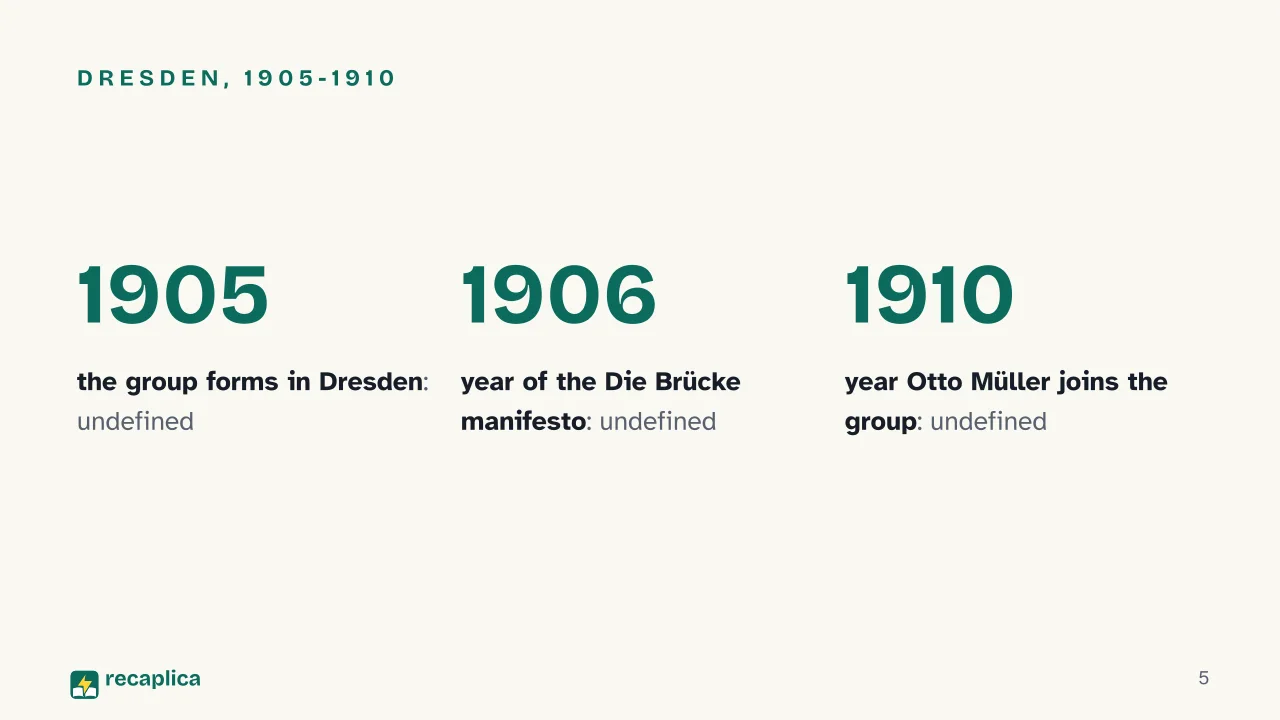 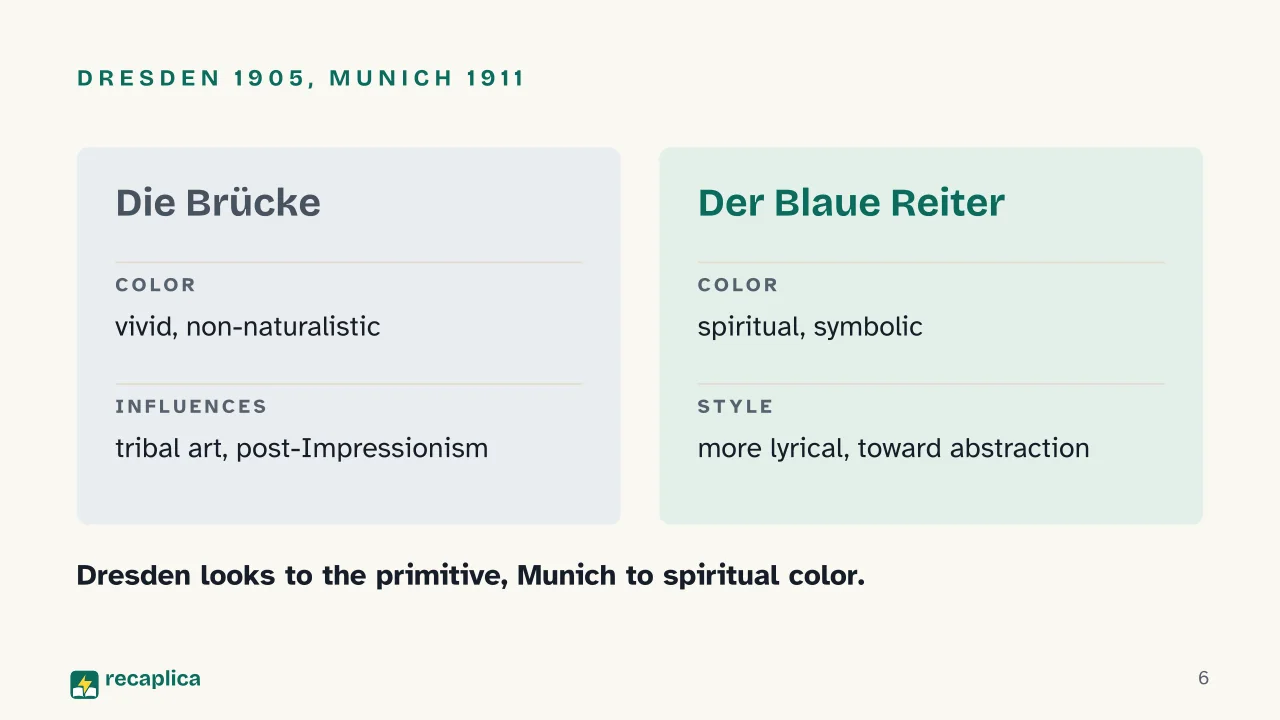  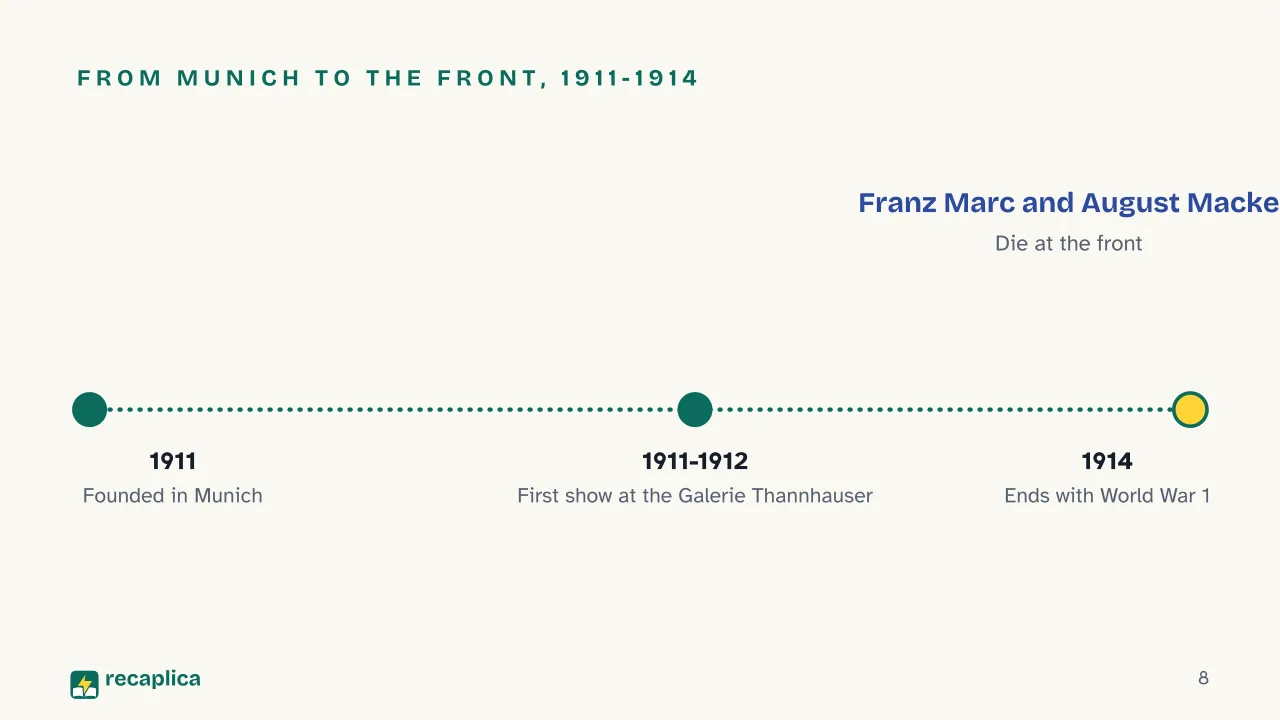  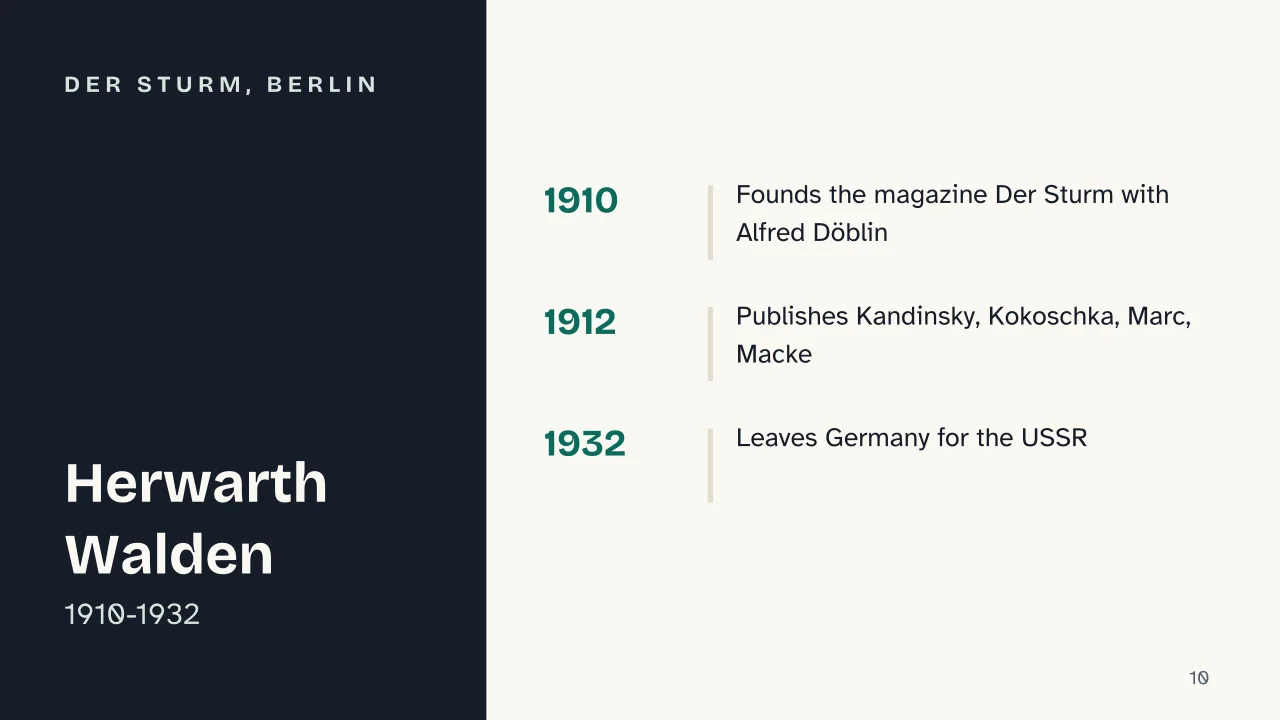 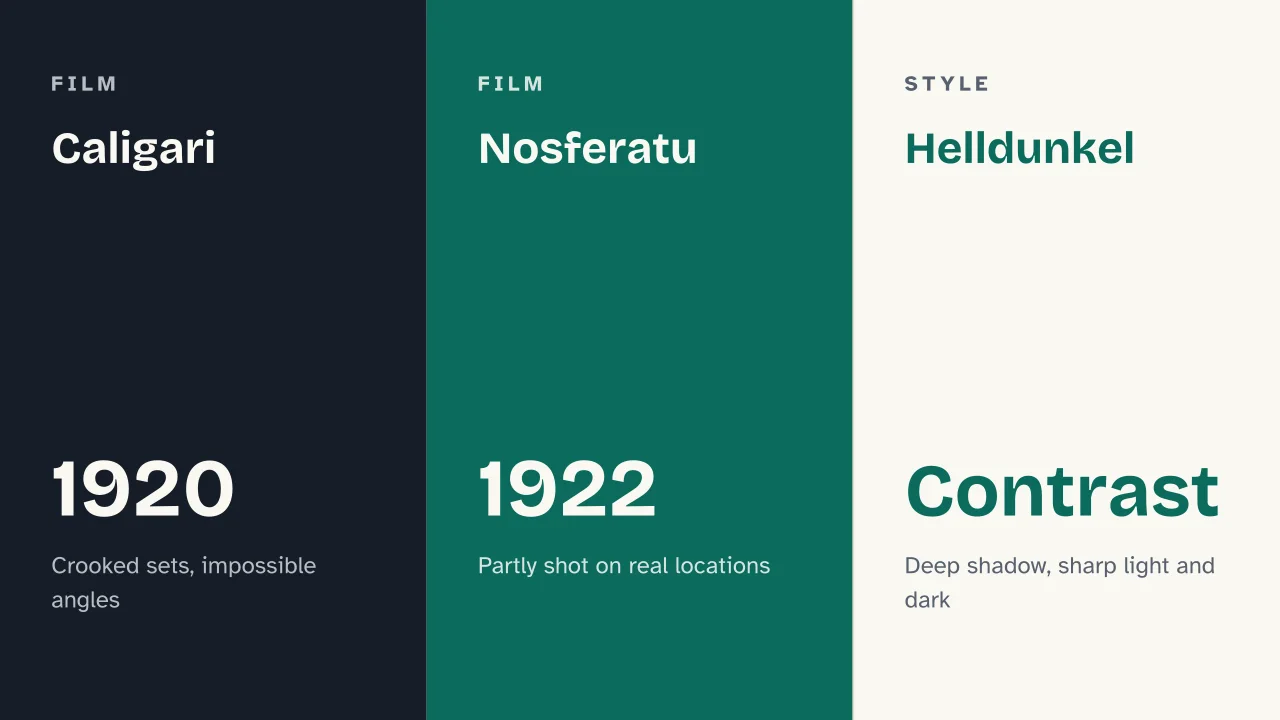  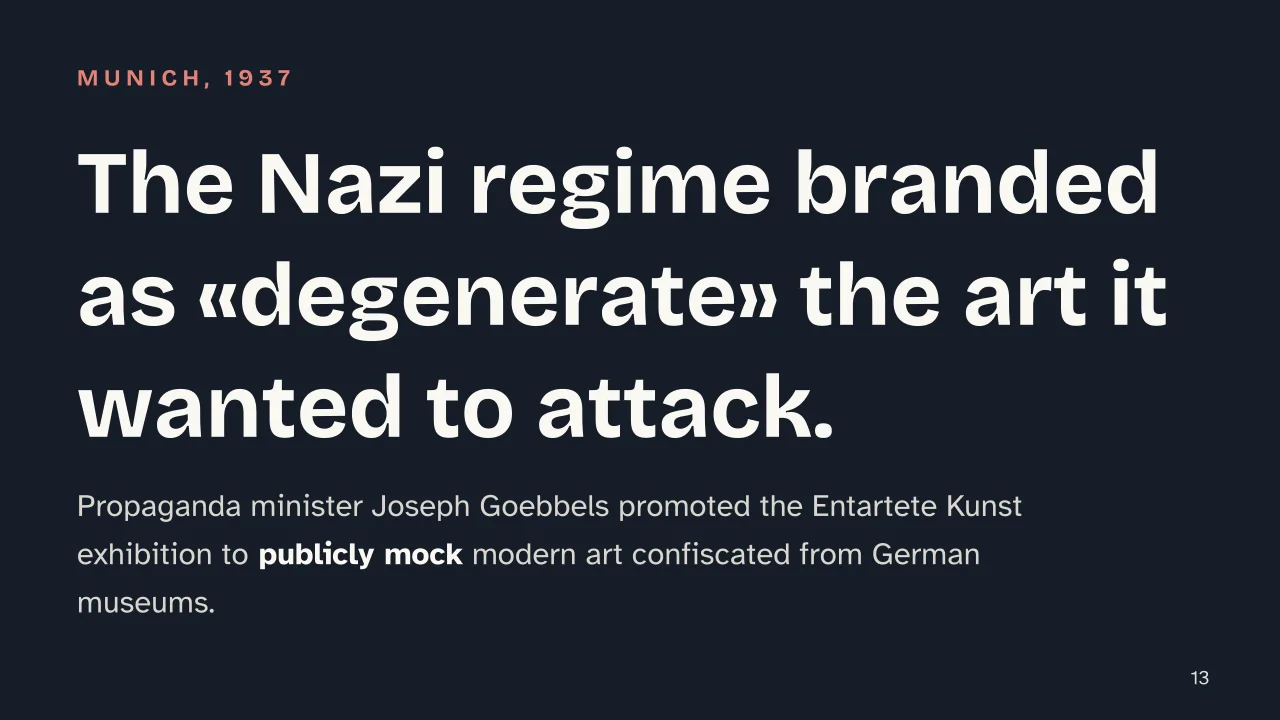 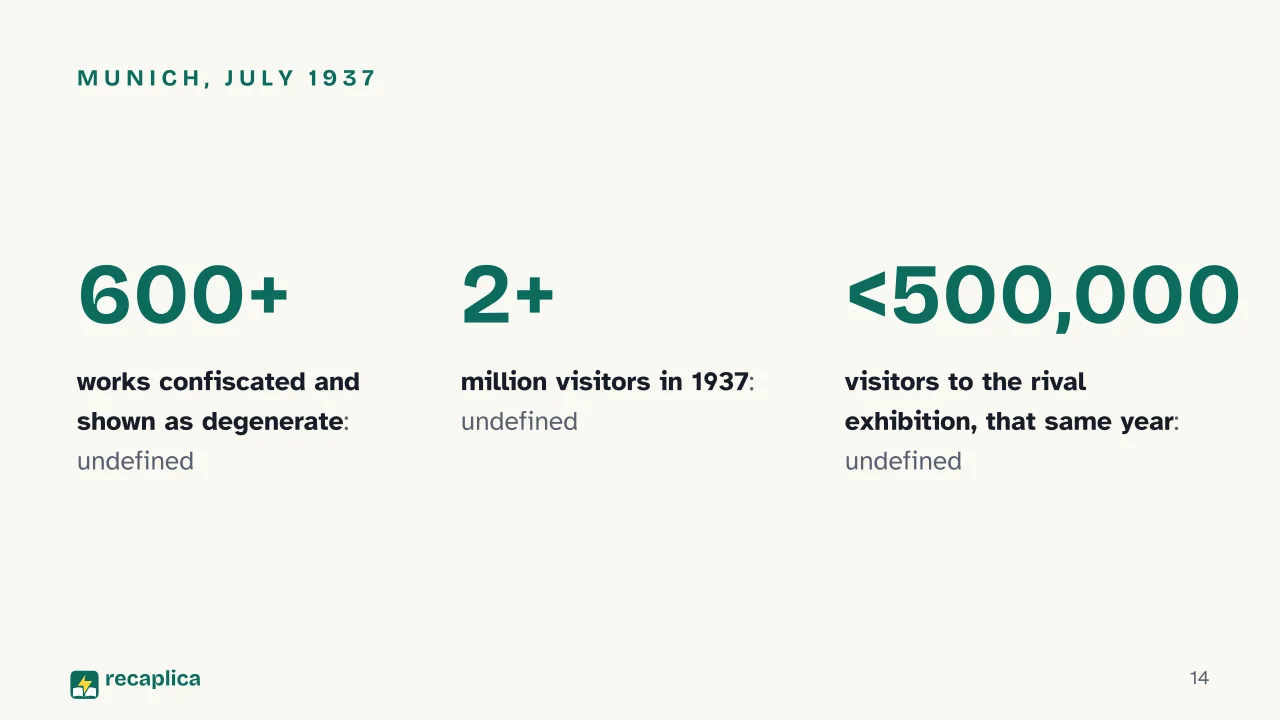   Common myths
Mind mapDrag the background to move around and the nodes to reposition them; use − and + to collapse and expand branches. 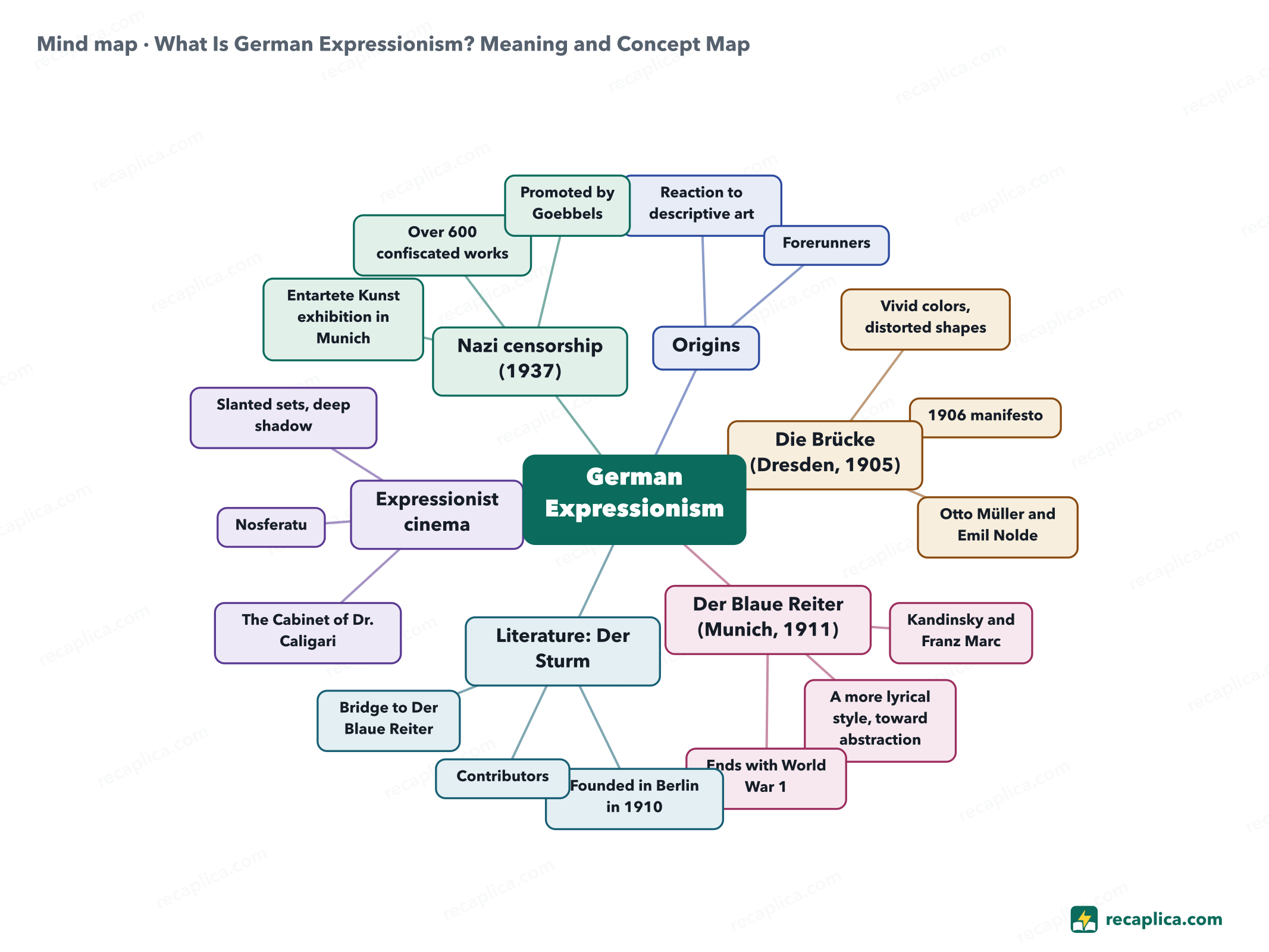
Quiz: test yourselfAnswer the questions to check what you have learned: you get instant feedback and a short explanation. Grade 0/10 0/5
FlashcardsTap the card to flip it and check whether you remember the answer, then move to the next one. 1 / 8 Explain it in your own wordsThe ultimate test: if you can explain it in simple words, you've truly understood it. Write your explanation, then compare it with the Recap. Your explanation is saved only on this device.
Frequently asked questionsWhat is German Expressionism?It is an artistic and cultural movement born in Germany in the early twentieth century: painters, writers and, later, filmmakers used intense colors, distorted shapes and charged moods to convey feeling rather than a faithful copy of reality. It took shape in the painters' groups Die Brücke (Dresden, 1905) and Der Blaue Reiter (Munich, 1911), in the literary magazine Der Sturm, and, in the 1920s, in cinema. When did German Expressionism begin?The first group, Die Brücke, was founded in Dresden in 1905; Der Blaue Reiter formed in Munich in 1911 and effectively broke up when World War 1 began, in 1914. German Expressionist cinema, by contrast, flourished after the war, in the 1920s. What is the difference between Expressionism and Impressionism?They are two different, partly successive movements. Impressionism, born earlier in France, aims to capture the immediate impression of light and scene as the eye sees it. According to Tate, German Expressionism moves the other way: it uses intense, non-naturalistic colors and distorts shapes away from reality, to convey emotional charge rather than a faithful visual impression. Why did the Nazi regime brand Expressionism «degenerate» art?In 1937 the Nazi regime staged the «Entartete Kunst» exhibition in Munich, promoted by propaganda minister Joseph Goebbels, to define and publicly mock the modern art it considered «degenerate»: according to the United States Holocaust Memorial Museum, it displayed more than 600 works confiscated from German museums, with mocking captions, alongside non-German masters such as Picasso and Matisse. What are the most famous German Expressionist films?Among those most often cited by the British Film Institute are «Das Cabinet des Dr. Caligari» (1920, directed by Robert Wiene), with its painted sets and crooked angles, and «Nosferatu» (1922, directed by F.W. Murnau), shot partly on real locations. Every Recap goes through an independent review before publication. |