|
recaplica
Emil Nolde: Who He Was and His Expressionist Paintings |
| © 2026 Recaplica · recaplica.com — All rights reserved |
Emil Nolde: Who He Was and His Expressionist PaintingsWhat to print Page numbers appear when printing with default margins. SlidesChoose a cut Flash10 slidesThe essential thread, to present in classFull10 slidesEvery chapter and the deeper detailBoth come with speaker notes. In 30 seconds quick readEmil Nolde, born Hansen in 1867 in the village that later gave him his name, became one of the best-known painters of German Expressionism. He joined the Die Brücke group in 1906 and left it a year later to work on his own, developing a personal style built on intense color, watercolors and religious subjects. In 1937 the Nazis branded his art degenerate and stripped more than a thousand of his works from German museums; by 1941 he was even forbidden to buy canvas and paint. Nolde kept painting watercolors in secret at his house in Seebüll, but he had been a party member since 1934 and held antisemitic views: his story is not, as it is often told, that of a man who resisted the regime, but of an artist persecuted for his style while remaining sympathetic to the people persecuting him. Key Points
Key figures
Deep DiveEmil Nolde the painter: who he wasEmil Nolde was born with the surname Hansen in 1867, in the village of Nolde in Schleswig, a region fought over by Denmark and Germany. He took his artist’s name from his birthplace only in 1902, by which point he had already spent thirty years finding his way. Painting came after wood: starting in 1884 he spent four years apprenticed as a carver and furniture designer in several factories, his first real contact with artistic work. In the years that followed he studied at the School of Applied Arts in Karlsruhe, between 1889 and 1890, and later with the painter Adolf Hölzel at the school in Neu-Dachau, near Munich. The Die Brücke years and the breakIn February 1906 Karl Schmidt-Rottluff invited him to join Die Brücke, the group that had launched German Expressionism. Nolde accepted, but the arrangement did not last: in November 1907 he told the group he was leaving, after less than two years. From then on he worked alone, without looking for a collective language again. Emil Nolde’s watercolor paintings and flowersBetween 1909 and 1910 Nolde found the voice that would make him recognizable, built on saturated color and broad brushwork. Flowers became a subject he returned to for the rest of his life, mostly in watercolor, a technique that let him work quickly and let the color spread on its own across the paper.
From 1909 Nolde also turned increasingly to biblical subjects. Emil Nolde’s paintings and artwork: the key worksThis religious phase produced some of the best-known paintings by Emil Nolde: Pentecost, The Last Supper and Mockery, all made from 1909 onward. A few years later, during his 1913-1914 expedition to the South Pacific, Nolde shifted subject for a time and made numerous watercolor portraits of the people he met along the way. Degenerate art: the Nazi campaign against NoldeAccording to Tate, in 1937 the Nazis declared Nolde a “degenerate” artist and removed all of his works from German museums. According to the University of Cambridge, the propaganda exhibition “Degenerate Art,” which opened in Munich in July 1937, included 33 works by Nolde out of a total of 650 by 112 artists. That same year, across Germany, museums removed 1,052 of his works, more than from any other artist caught up in the campaign. In 1941 an order forbade him from buying canvas and paint, and in August of that year he was expelled from the Reich Chamber of Visual Arts, which amounted to a final ban on painting and selling his work. Nolde kept working regardless, making watercolors away from view at his home in Seebüll. Nolde and Nazism: a more complicated storyThis is where Nolde’s biography stops being straightforward. Holding Danish citizenship since 1920, he joined the NSAN, the National Socialist Association of Northern Schleswig, in late summer 1934 — years before he himself became a target of the regime’s cultural crackdown. Historians cited by the University of Cambridge document that he came to see himself as both a victim and the leading opponent of a supposed “Jewish dominance” in the German art world, an antisemitic position. Despite the persecution his art suffered, he and his wife Ada kept expressing sympathy for the regime. After 1945 a different story took hold in Germany: that of a victim-painter who had resisted Nazism by secretly painting his watercolors, the so-called “unpainted pictures.” Historians cited by the University of Cambridge call that narrative a myth built after the war: the persecution targeted Nolde’s style, judged at odds with the regime’s artistic doctrine, while his political convictions stayed close to those of his persecutors. It is an episode that belongs to the wider story of German culture swept up first by Nazism and then by World War 2, the same context in which other figures on the German cultural scene, such as the Nobel laureate Gerhart Hauptmann, had to find their own way of dealing with Nazi power. Slide deckSlides ready to download and make your own in PowerPoint or Google Slides, with speaker notes. Pick the Flash cut or the Full one.  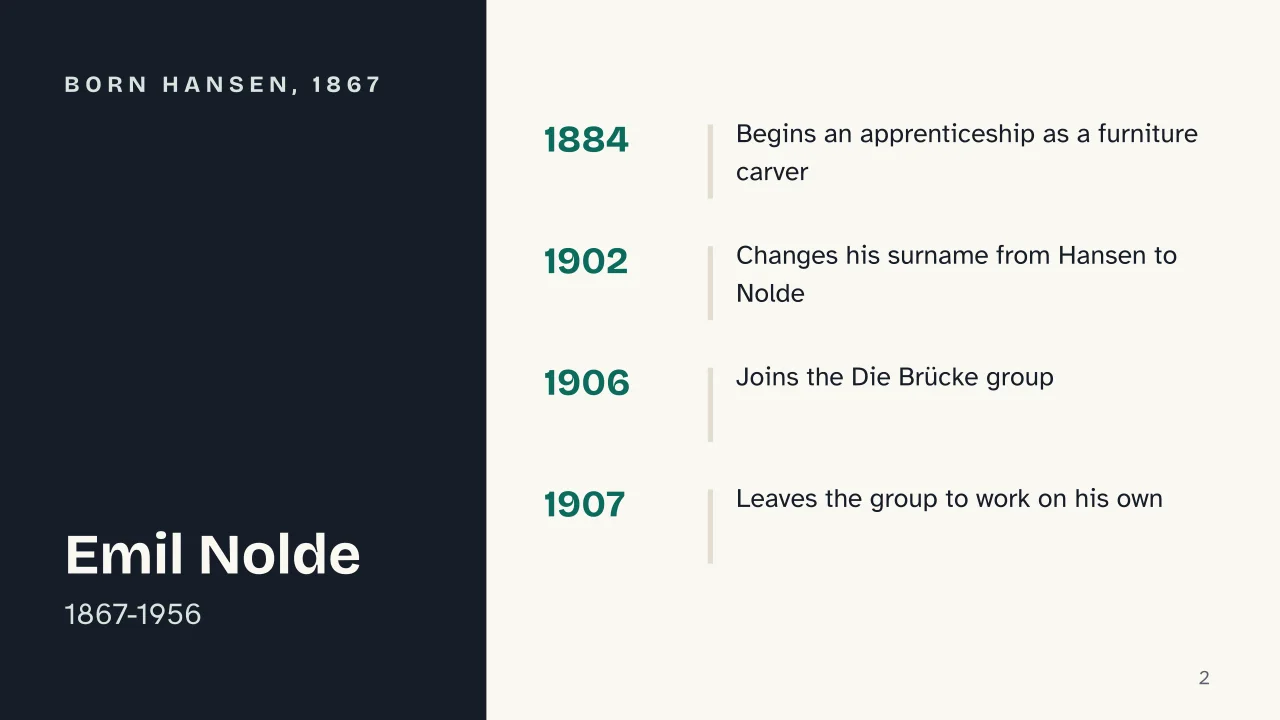  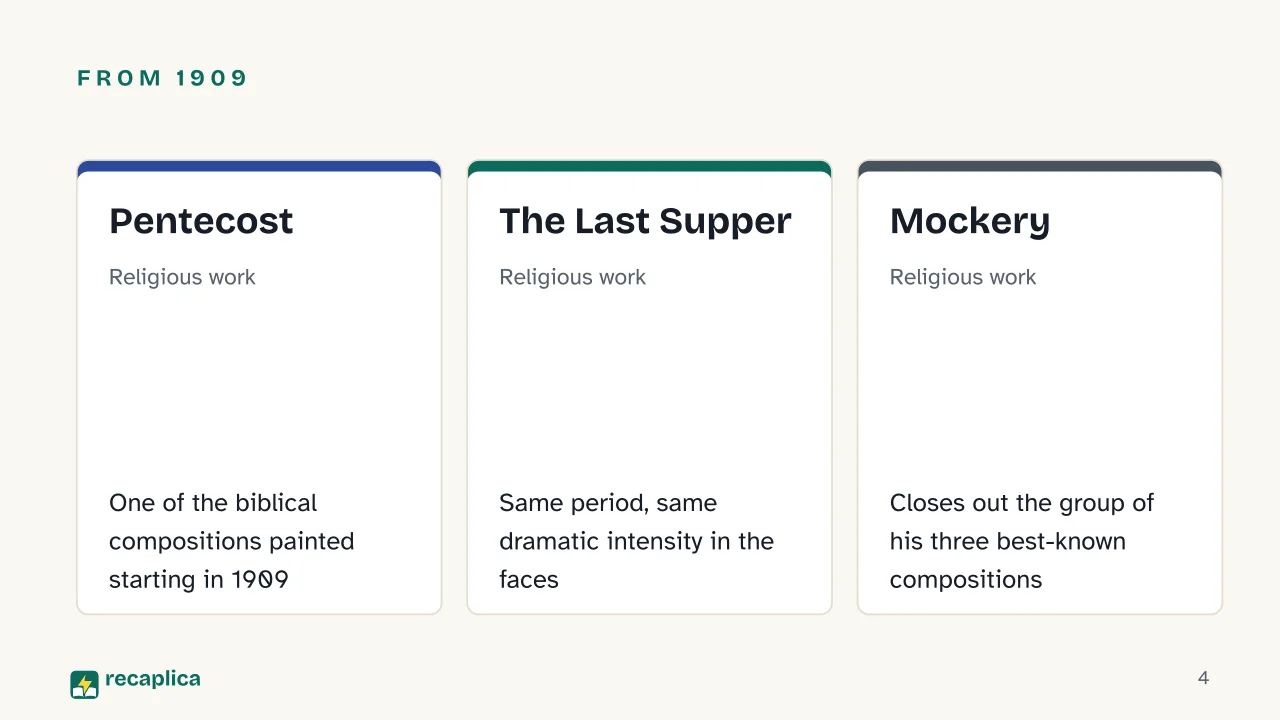 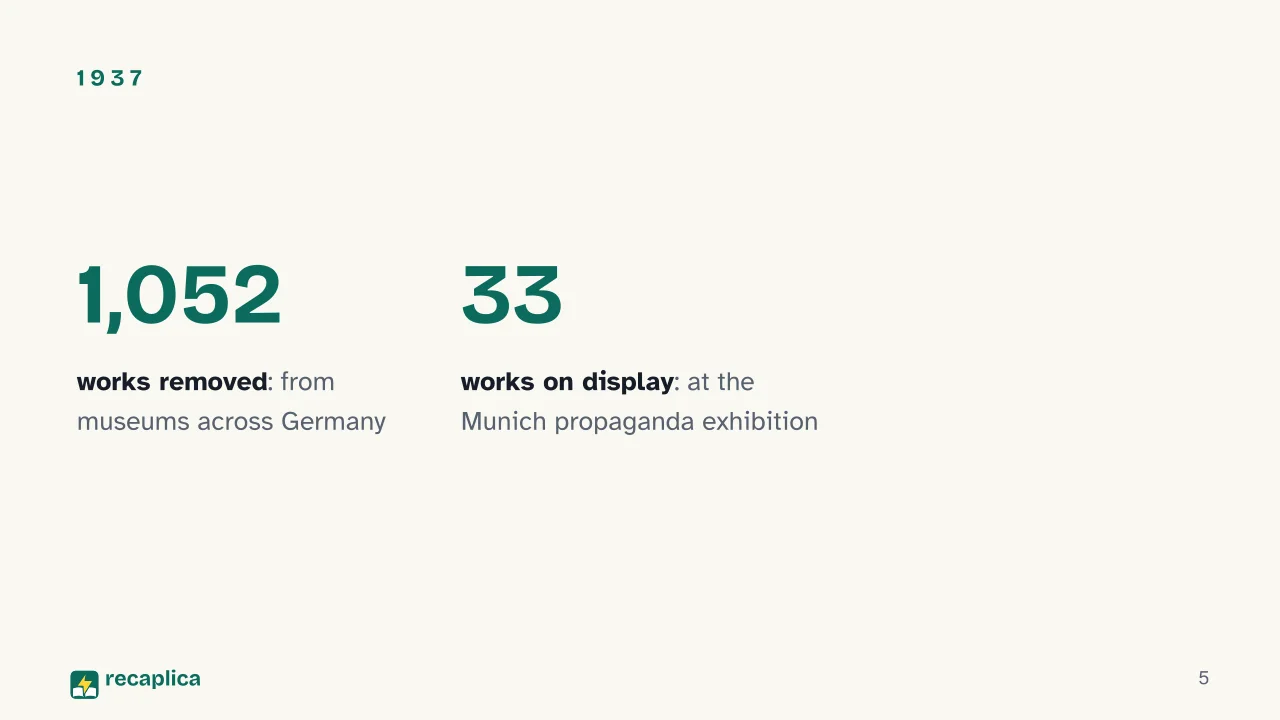    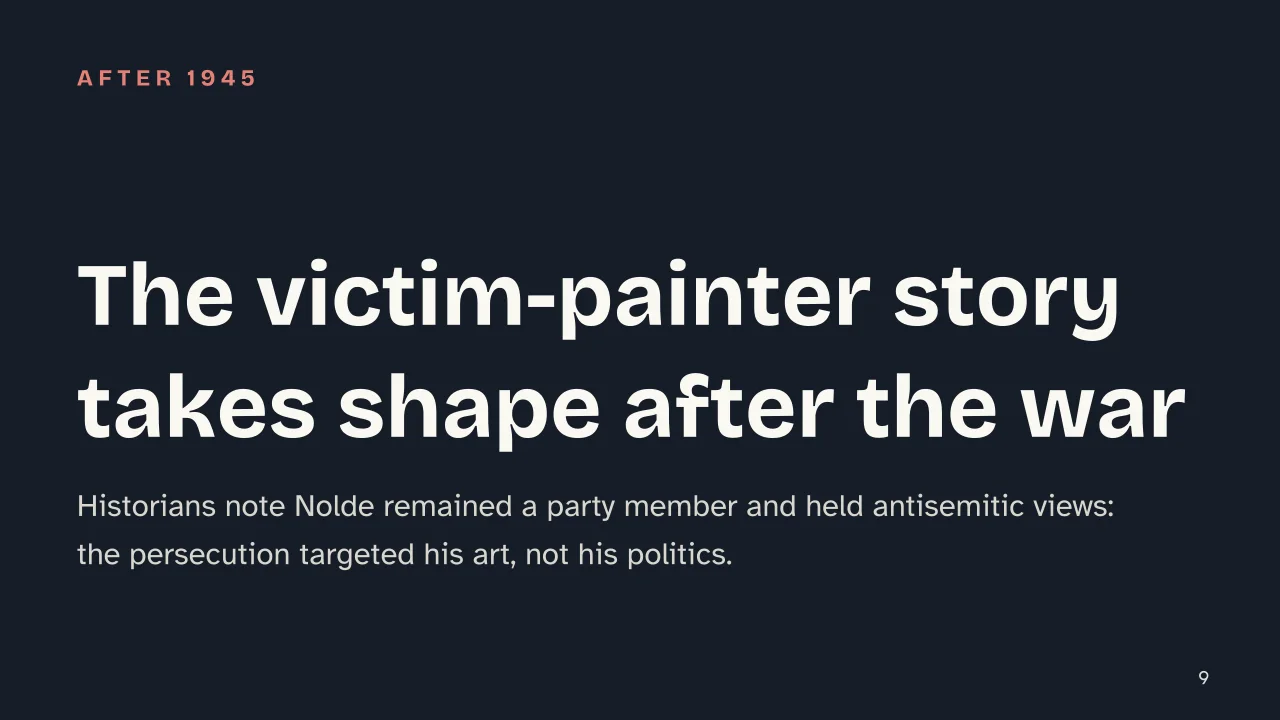  Common myths
Mind mapDrag the background to move around and the nodes to reposition them; use − and + to collapse and expand branches. 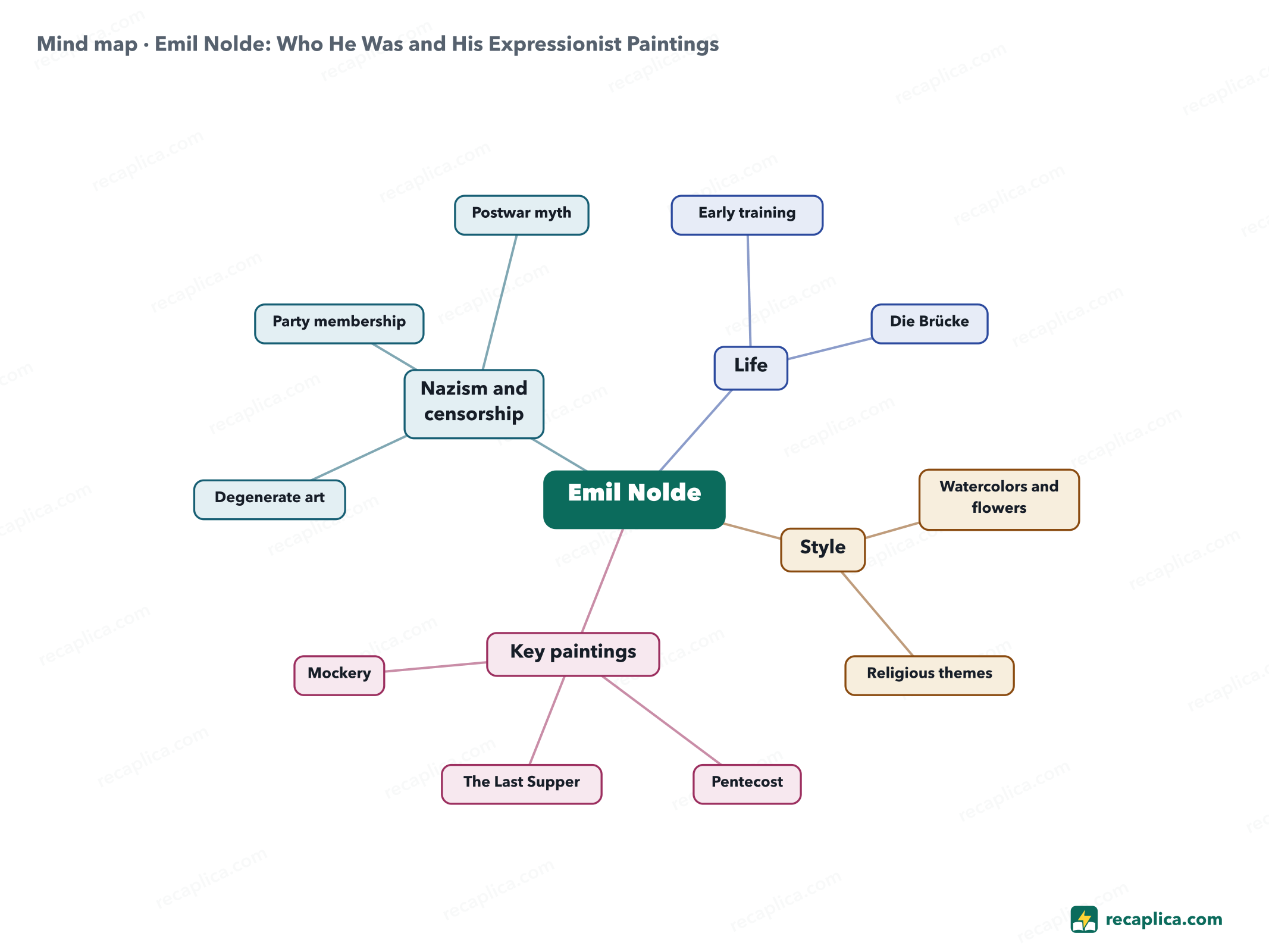
Quiz: test yourselfAnswer the questions to check what you have learned: you get instant feedback and a short explanation. Grade 0/10 0/5
FlashcardsTap the card to flip it and check whether you remember the answer, then move to the next one. 1 / 7 Explain it in your own wordsThe ultimate test: if you can explain it in simple words, you've truly understood it. Write your explanation, then compare it with the Recap. Your explanation is saved only on this device.
Frequently asked questionsDid Emil Nolde paint The Last Supper?Yes. The Last Supper was one of the religious compositions Nolde made starting in 1909, alongside Pentecost and Mockery, during the years when he defined his personal Expressionist style. Why is Emil Nolde considered an Expressionist painter?Because from around 1909-1910 he developed a language built on intense color and emotional force, typical of German Expressionism, after a brief spell in the Die Brücke group between 1906 and 1907. What was degenerate art, and why did it affect Nolde?It was the label the Nazis used for modern art that did not fit their aesthetic ideology. In 1937 it affected Nolde too: museums across Germany pulled 1,052 of his works, the largest number taken from any single artist. Was Emil Nolde a victim of Nazism or a supporter of it?Both, according to historians cited by the University of Cambridge: his art was persecuted from 1937 onward, but he had joined the Nazi party in 1934 and held antisemitic views. The story of Nolde as an opponent of the regime only emerged after 1945. What are Emil Nolde's main paintings and artworks?Among his best-known works are the religious compositions Pentecost, The Last Supper and Mockery, from 1909, and the many watercolor portraits he made during his 1913-1914 expedition to the South Pacific. Every Recap goes through an independent review before publication. |