Skip to content
recaplica

    One moment: security check

    Cloudflare wants to make sure you're not a robot. Tick the box below and your search will continue on its own.

    IT
    recaplica Gerhart Hauptmann: the Nobel playwright of German Naturalism
    © 2026 Recaplica · recaplica.com — All rights reserved
    Home › Literature

    Gerhart Hauptmann: the Nobel playwright of German Naturalism

    By Recaplica Newsroom · Updated on October 5, 2026

    What to print

    Page numbers appear when printing with default margins.

    Slides

    Choose a cut

    Flash10 slidesThe essential thread, to present in classFull17 slidesEvery chapter and the deeper detail

    Both come with speaker notes.

    Telegram channel
    recaplica Clear in 30 seconds, yours in 10 minutes.
    In 30 seconds Key points Figures Deep dive Slides Myths Mind map Quiz Flashcards FAQ

    In 30 seconds quick read

    Gerhart Hauptmann (1862-1946) was the German playwright who won the 1912 Nobel Prize in Literature, an award tied above all to his work for the stage. He stands as the central figure of German Naturalism, a movement sources trace back to 1882, to brothers Heinrich and Julius Hart, and to which Arno Holz gave a rigorous theoretical base with the formula Art = Nature - x. Hauptmann's best-known play, Die Weber (The Weavers, 1892), tells the story of the Silesian weavers' uprising that broke out in 1844 at Peterswaldau. The Nobel came alongside other plays such as Rose Bernd and Die Ratten, written after the movement's innovative drive had already faded, around 1900.

    Key Points

    • Gerhart Hauptmann was born in 1862 in Obersalzbrunn, Silesia, and died in 1946 in Agnetendorf, today near Jelenia Góra, Poland.
    • In 1912 he received the Nobel Prize in Literature, an award directed mainly at his work as a playwright.
    • German Naturalism is traced back to 1882, to the Kritische Waffengänge written by brothers Heinrich and Julius Hart.
    • Arno Holz gave the movement its theoretical foundation with the formula Art = Nature - x, set out in 1891-92.
    • Die Weber (The Weavers), from 1892, follows the Silesian weavers who rose up on 4 June 1844 at Peterswaldau.
    • Among Hauptmann's other naturalist plays are Vor Sonnenaufgang (1889), Rose Bernd (1903) and Die Ratten (1911).

    Key figures

    • 1912 The year Gerhart Hauptmann received the Nobel Prize in Literature, awarded mainly for the value of his dramatic work. Source: Nobel Committee, Swedish Academy
    • 1844 The year of the Silesian weavers' uprising at Peterswaldau, the subject of Hauptmann's Die Weber (1892). Source: Wikipedia (EN), Silesian weavers' uprising
    • 1892 The year Die Weber was published and first staged, the play sources point to as the high point of German naturalist theatre. Source: Deutschland-Lese

    Deep Dive

    The groundwork: the break of 1882

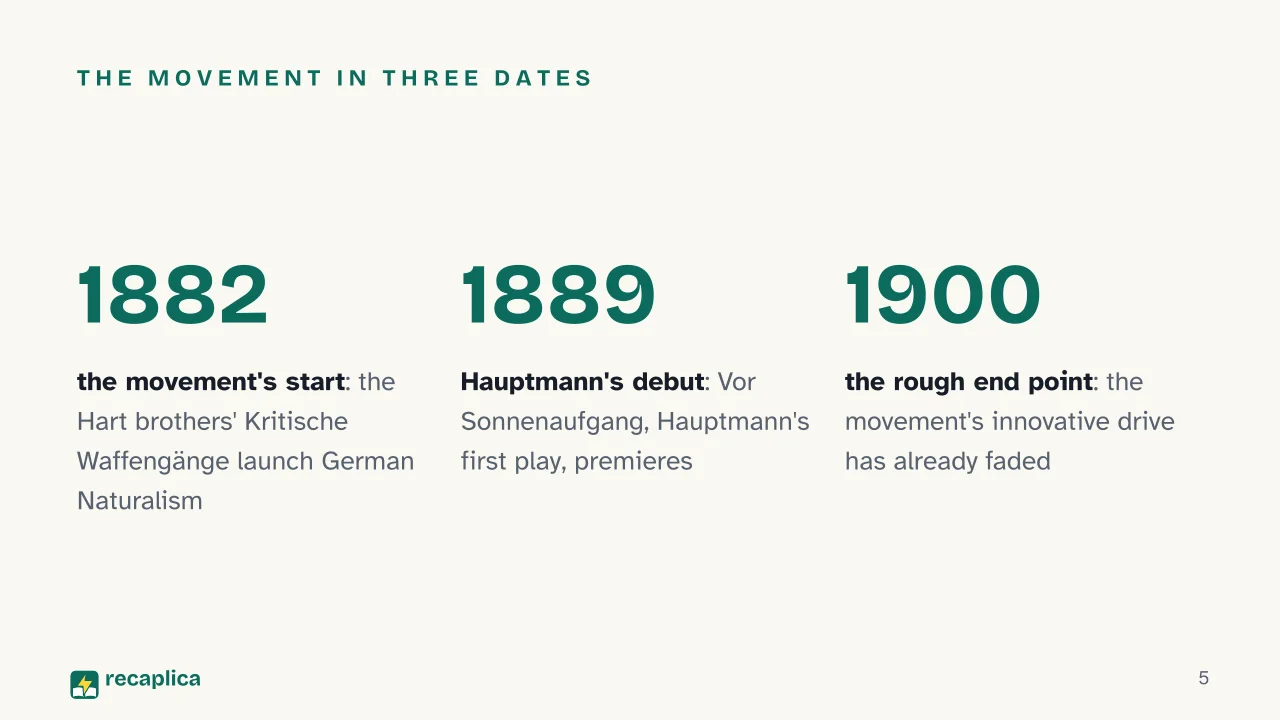
    German Naturalism does not start from a single manifesto. Sources date its beginning to 1882, with the Kritische Waffengänge written by brothers Heinrich (1855-1906) and Julius Hart (1859-1930).

    From there the movement runs for roughly two decades, its innovative drive fading out around 1900. It is a different kind of break from the one Sturm und Drang had made a century earlier against Enlightenment reason: here the target is not individual feeling but a method that observes social reality with something like scientific attention.

    Arno Holz and consistent naturalism

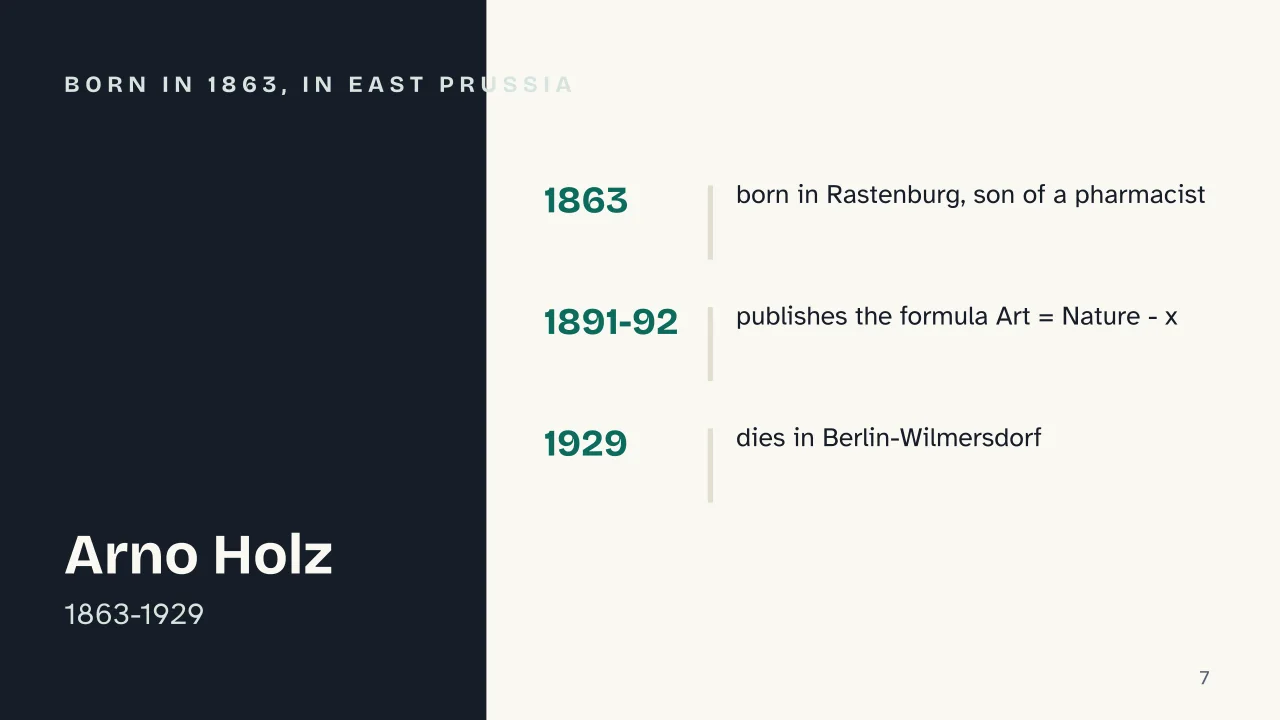
    The theoretical foundation of the German movement came from Arno Holz (1863-1929), born in Rastenburg, East Prussia, son of the pharmacist Hermann Holz. Together with his friend Johannes Schlaf, Holz worked out what he called “consistent naturalism” (konsequenter Naturalismus), laid out in Die Kunst. Ihr Wesen und ihre Gesetze (Art: Its Essence and Its Laws), published in 1891-92. His best-known formula sums up the program as a subtraction: Art = Nature - x, where x is the share of the artist’s own subjectivity that a naturalist writer has to shrink as far as possible. Deutschland-Lese ranks Holz’s place in the history of German literature alongside Opitz and Herder in earlier periods; the same source credits Émile Zola as the theoretical and practical guide of European Naturalism as a whole.

    Practical example: Holz’s formula can be read as an exercise in subtraction. A naturalist writer does not invent polished dialogue for working-class characters: the writer lets them speak the way they actually would, even when the result is rougher than a page built for effect.

    Gerhart Hauptmann, from sculpture to theatre

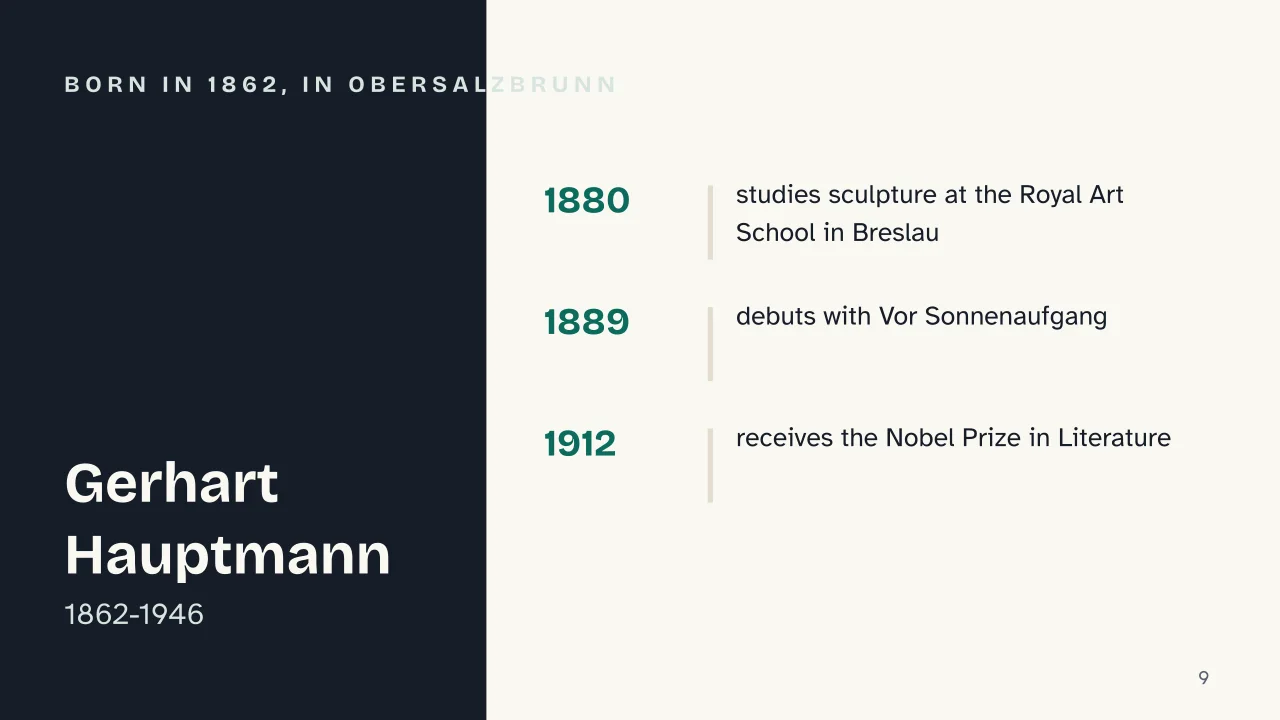
    Gerhart Hauptmann was born on 15 November 1862 in Obersalzbrunn, Silesia, then part of the Kingdom of Prussia. Before turning to writing, he studied sculpture at the Royal Art School in Breslau starting in 1880, then philosophy and literary history at the University of Jena and history at the University of Berlin. His first play, Vor Sonnenaufgang (Before Sunrise), was staged for the first time in 1889: sources point to it as the work that opens German Naturalism in modern literature, a few years after the Hart brothers’ Kritische Waffengänge and Holz’s theory.

    Die Weber and the 1844 uprising

    Hauptmann’s best-known play is Die Weber (The Weavers), from 1892. It is the work behind his reputation as the leading figure of German naturalist theatre.

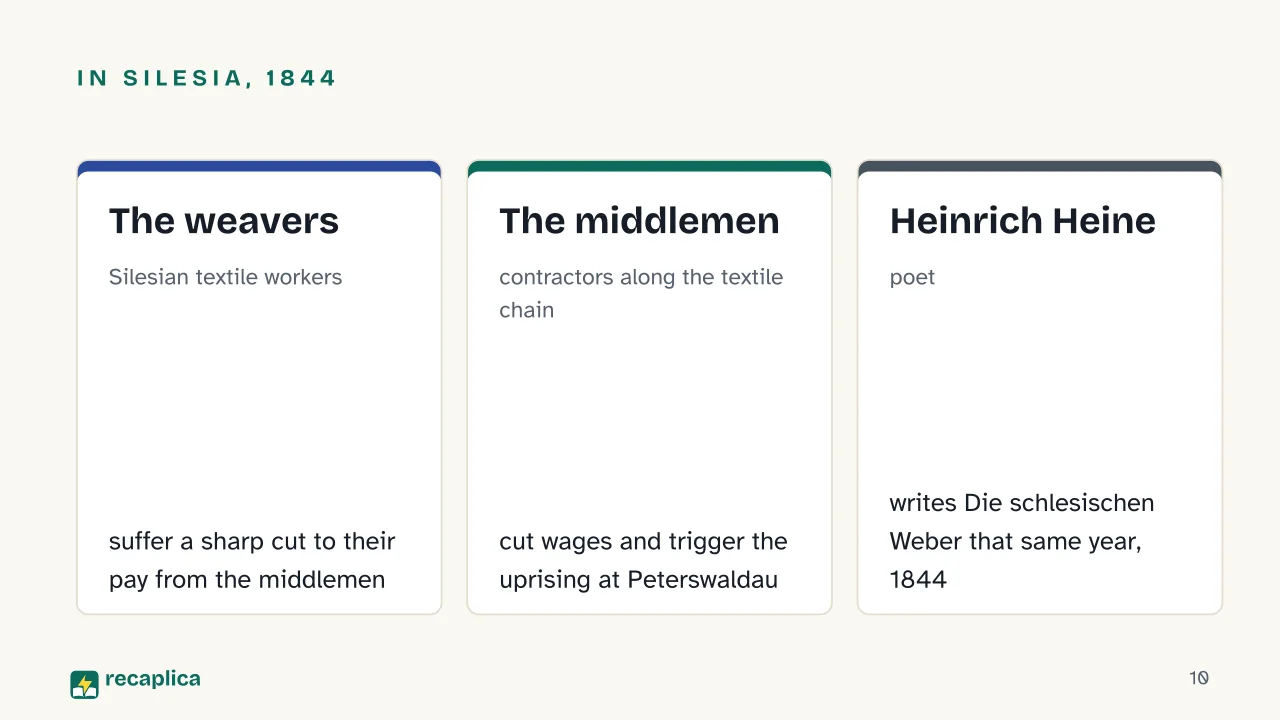
    The play, which sources point to as the peak of that theatre, tells the story of the Silesian weavers’ uprising: the protest broke out on 4 June 1844 at Peterswaldau, after middlemen along the textile chain had sharply cut workers’ pay. The same events had already inspired, that same year, Heinrich Heine’s poem Die schlesischen Weber. In Italy, a project that shares something of this method — looking at the life of the working classes without softening it — is Giovanni Verga and Verismo, even though the two movements developed independently, with no direct link between them. In the same decades, Italian Decadence through Gabriele D’Annunzio moved in the opposite direction, reaching for symbol and individual exception rather than social chronicle.

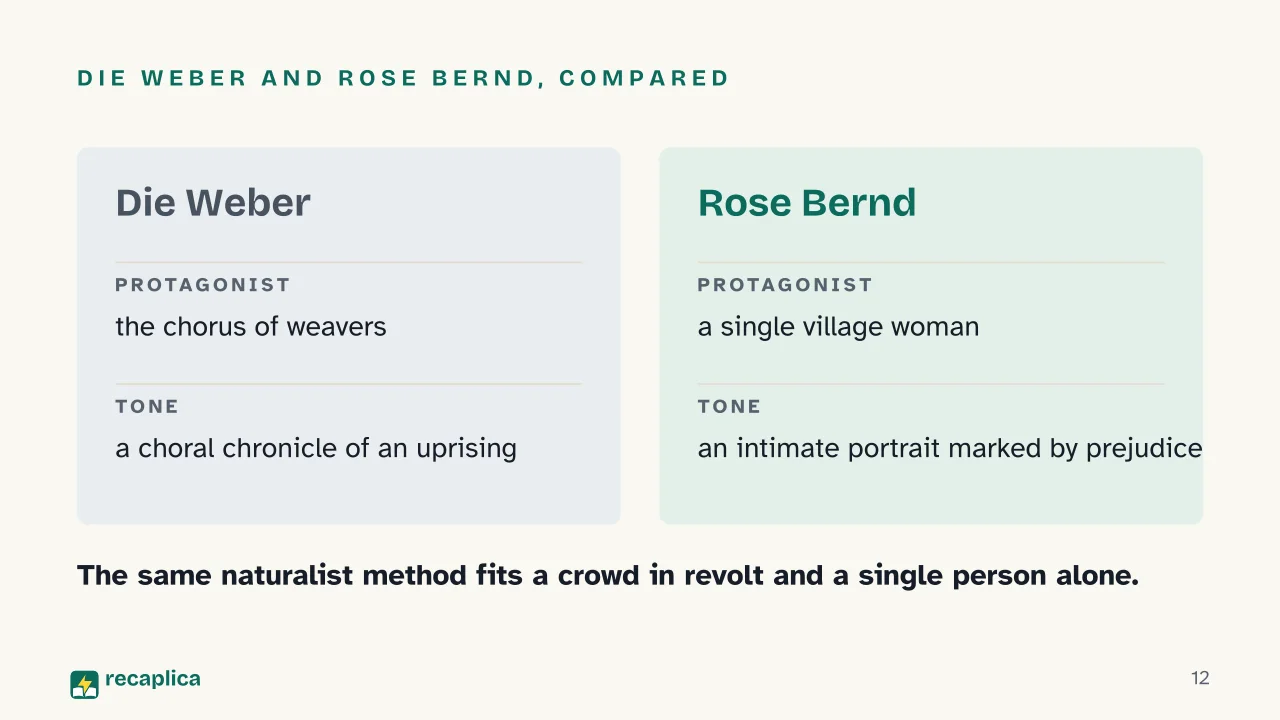
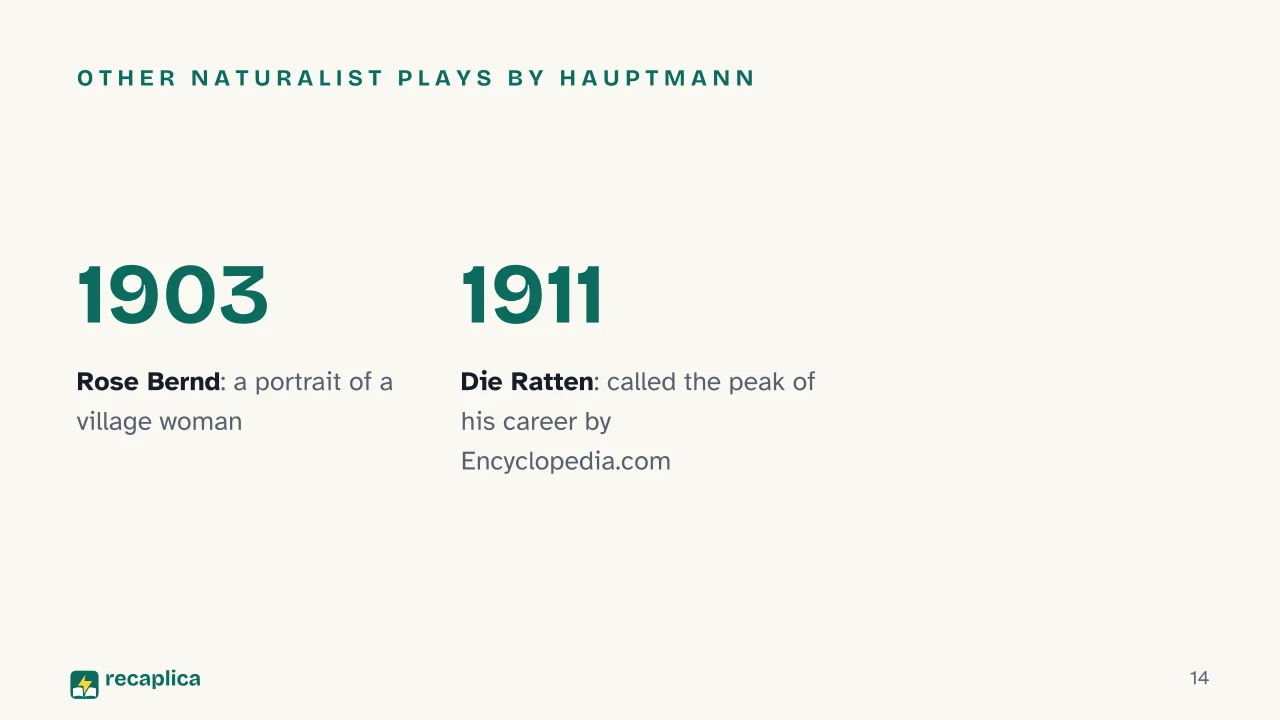
    Hauptmann’s other naturalist plays apply the same method in different registers: Rose Bernd (1903) follows a woman alone, crushed by her village’s judgment, while Die Ratten (The Rats, 1911) sets a mix of tragedy and grotesque comedy inside a Berlin tenement. Encyclopedia.com calls the 1911 staging of the latter the high point of Hauptmann’s career.

    The 1912 Nobel Prize

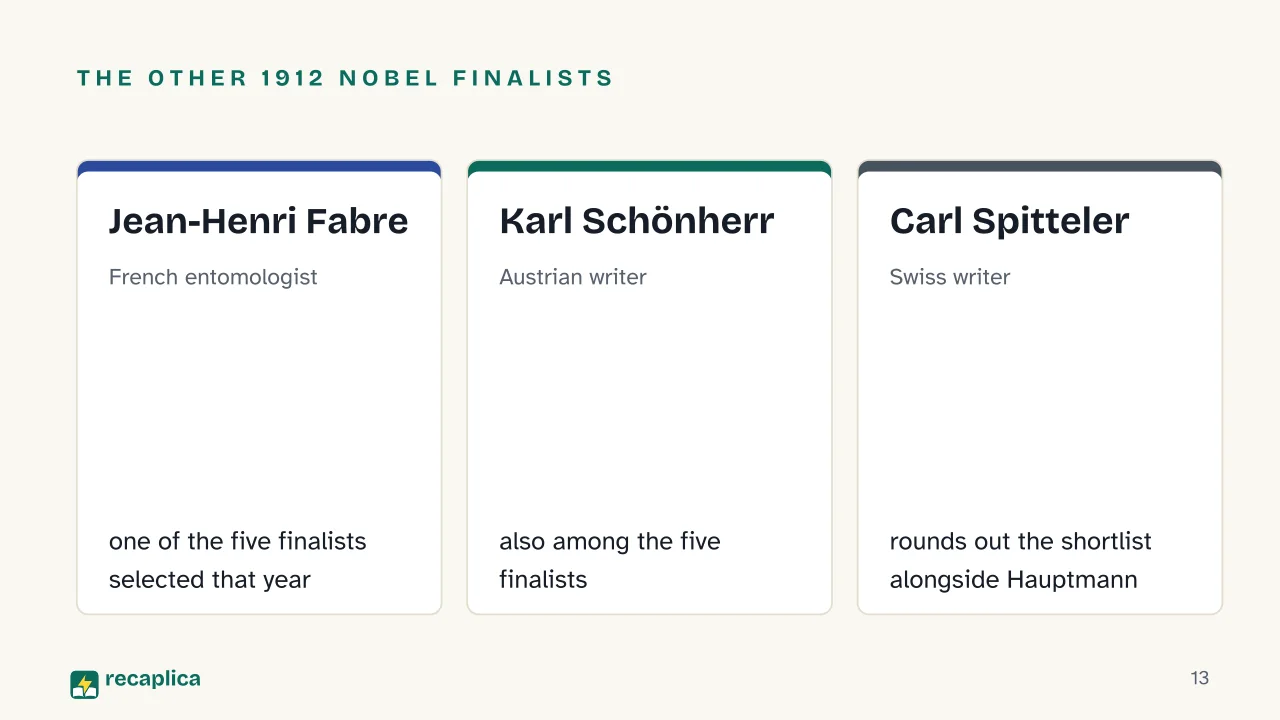
    In 1912 Hauptmann received the Nobel Prize in Literature, with a citation recognizing him for his fruitful, varied and excellent work in dramatic art. That year the Swedish Academy’s Nobel Committee received 40 nominations covering 30 writers; among the five finalists selected, besides Hauptmann, were the French entomologist Jean-Henri Fabre, the Austrian Karl Schönherr, the Swiss Carl Spitteler and the French historian Ernest Lavisse.

    Hauptmann kept writing until his death on 6 June 1946 in Agnetendorf, in the part of Silesia that passed to Poland after the war; among the Italian writers who would later receive the same prize is Luigi Pirandello, awarded in 1934.

    Slide deck

    Slides ready to download and make your own in PowerPoint or Google Slides, with speaker notes. Pick the Flash cut or the Full one.
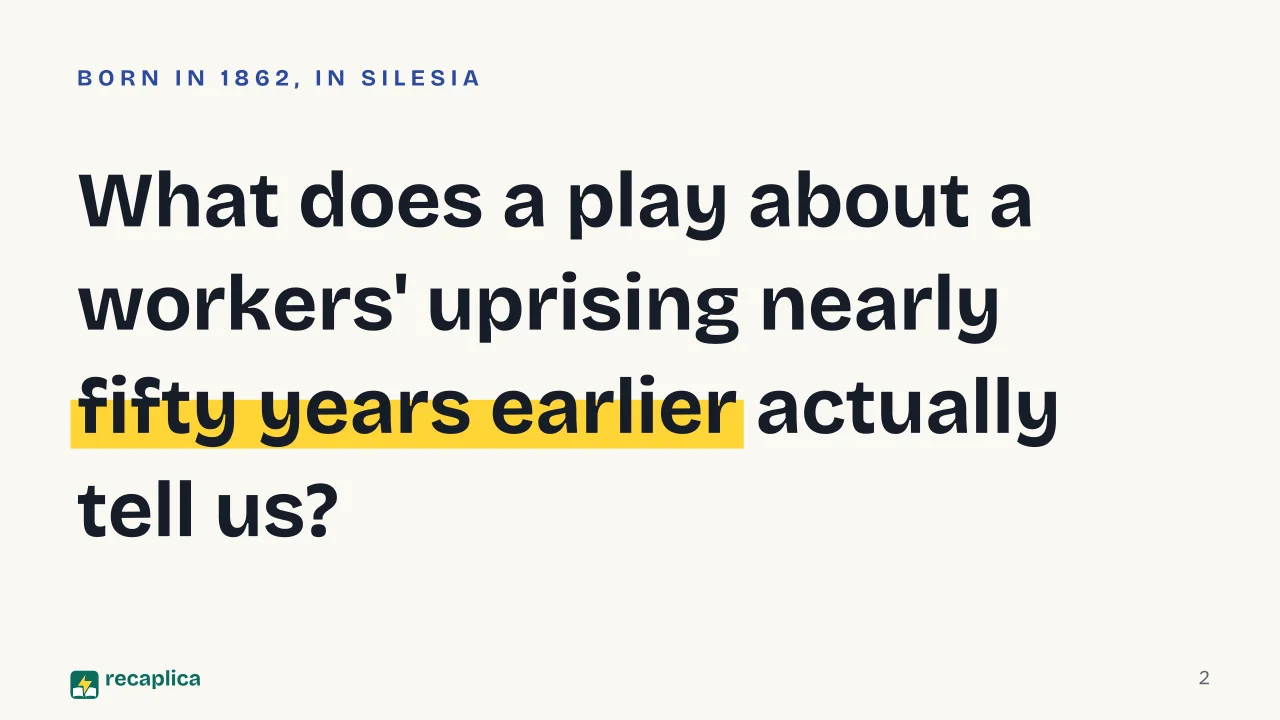
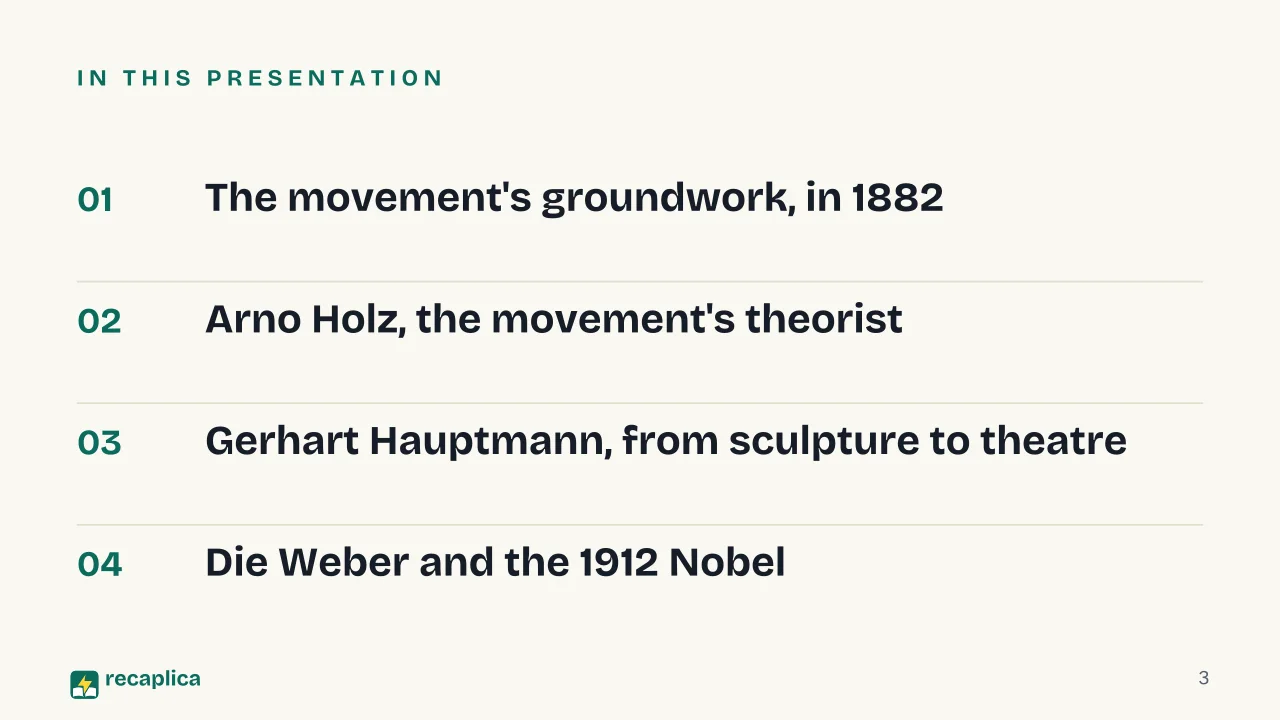
    Slide 1 of the presentation on Gerhart Hauptmann: Gerhart HauptmannSlide 2 of the presentation on Gerhart Hauptmann: What does a play about a workers' uprising nearly fifty years earlier actually tell us?Slide 3 of the presentation on Gerhart Hauptmann: In this presentationSlide 4 of the presentation on Gerhart Hauptmann: Chapter 01: The groundworkSlide 5 of the presentation on Gerhart Hauptmann: The movement in three datesSlide 6 of the presentation on Gerhart Hauptmann: Chapter 02: Arno Holz, the movement's theoristSlide 7 of the presentation on Gerhart Hauptmann: Born in 1863, in East PrussiaSlide 8 of the presentation on Gerhart Hauptmann: Chapter 03: Gerhart HauptmannSlide 9 of the presentation on Gerhart Hauptmann: Born in 1862, in ObersalzbrunnSlide 10 of the presentation on Gerhart Hauptmann: In Silesia, 1844: The weavers, The middlemen, Heinrich HeineSlide 11 of the presentation on Gerhart Hauptmann: Chapter 04: Die Weber and the NobelSlide 12 of the presentation on Gerhart Hauptmann: Die Weber and Rose Bernd, comparedSlide 13 of the presentation on Gerhart Hauptmann: The other 1912 Nobel finalists: Jean-Henri Fabre, Karl Schönherr, Carl SpittelerSlide 14 of the presentation on Gerhart Hauptmann: Other naturalist plays by HauptmannSlide 15 of the presentation on Gerhart Hauptmann: Naturalism is not an unfiltered photographSlide 16 of the presentation on Gerhart Hauptmann: In what year did Gerhart Hauptmann receive the Nobel Prize in Literature?Slide 17 of the presentation on Gerhart Hauptmann: Now for the recap
    Flash10 slidesThe essential thread, to present in classFull17 slidesEvery chapter and the deeper detail

    Common myths

    • ✗ Myth Many people think Naturalism is a straight photograph of reality, with no selection at all on the writer's part.

      ✓ Reality Arno Holz, the theorist behind consistent naturalism, admitted that a share of subjectivity always remained: it is the x in his formula Art = Nature - x. The writer's job was to shrink that share as much as possible, not to erase it.

    • ✗ Myth Many assume Hauptmann only wrote social dramas about crowds.

      ✓ Reality His plays cover different registers: Die Weber follows an entire community in revolt, Rose Bernd follows a single woman crushed by her village's judgment, and Die Ratten mixes tragedy and the grotesque inside a Berlin tenement.

    • ✗ Myth Many believe German Naturalism began with Hauptmann himself.

      ✓ Reality Sources date the movement's start to 1882, with the Kritische Waffengänge of brothers Heinrich and Julius Hart. Hauptmann arrives later, in 1889, with the premiere of Vor Sonnenaufgang.

    Mind map

    Drag the background to move around and the nodes to reposition them; use − and + to collapse and expand branches.
    Customize
    Mind map: Gerhart Hauptmann: the Nobel playwright of German Naturalism
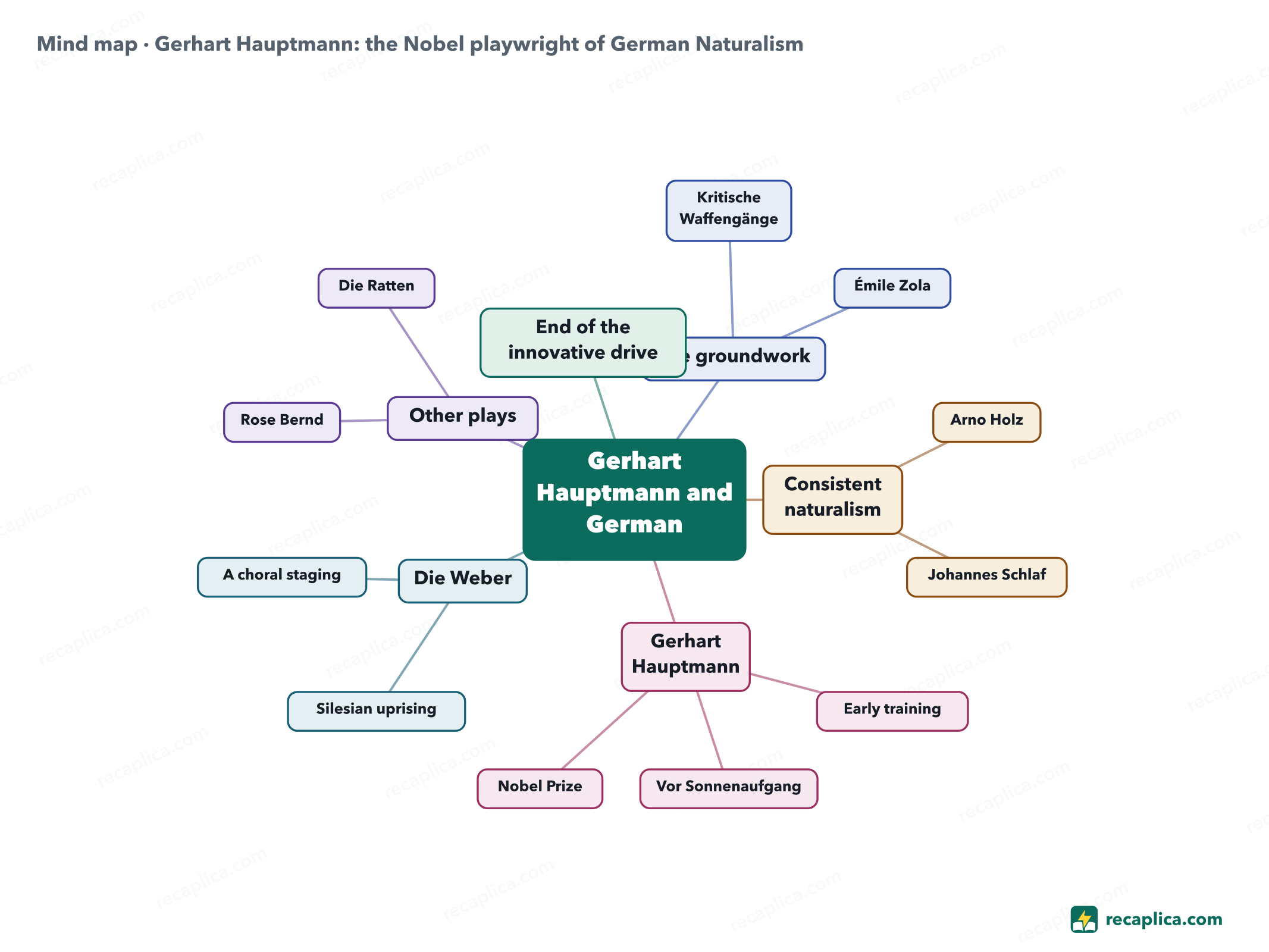
    • Gerhart Hauptmann and German Naturalism
      • The groundwork 1882, the Hart brothers
        • Kritische Waffengänge Heinrich and Julius Hart
        • Émile Zola leading figure of European Naturalism
      • Consistent naturalism
        • Arno Holz formula Art = Nature - x
        • Johannes Schlaf friend and collaborator of Holz
      • Gerhart Hauptmann
        • Early training sculpture, then philosophy and history
        • Vor Sonnenaufgang 1889, first play
        • Nobel Prize 1912
      • Die Weber
        • Silesian uprising Peterswaldau, 1844
        • A choral staging
      • Other plays
        • Rose Bernd 1903
        • Die Ratten 1911
      • End of the innovative drive around 1900

    Quiz: test yourself

    Answer the questions to check what you have learned: you get instant feedback and a short explanation.

    Grade 0/10 0/5
    1 In what year did Gerhart Hauptmann receive the Nobel Prize in Literature?

    The Nobel came in 1912: the committee's citation points above all to his work as a playwright.

    2 Which Hauptmann play tells the story of the 1844 Silesian weavers' uprising?

    Die Weber, from 1892, is the play that tells the story of the uprising that broke out at Peterswaldau in 1844.

    3 Who set out the formula Art = Nature - x for consistent naturalism?

    Arno Holz laid out the theory in Die Kunst. Ihr Wesen und ihre Gesetze, published in 1891-92.

    4 True or false: according to sources, German Naturalism is dated back to 1882, before Hauptmann's own stage debut.

    The movement starts in 1882 with the Hart brothers' Kritische Waffengänge; Hauptmann debuts only in 1889 with Vor Sonnenaufgang.

    5 What role does Deutschland-Lese assign to Émile Zola with respect to German Naturalism?

    This source credits Zola as the leading figure of European Naturalism overall, while German consistent naturalism was born with Holz and Schlaf.

    Answers: 1-A · 2-A · 3-A · 4-A · 5-A

    Flashcards

    Tap the card to flip it and check whether you remember the answer, then move to the next one.

    1 / 8

    Explain it in your own words

    The ultimate test: if you can explain it in simple words, you've truly understood it. Write your explanation, then compare it with the Recap.

    Your explanation is saved only on this device.

    Gerhart Hauptmann (1862-1946) was the German playwright who won the 1912 Nobel Prize in Literature, an award tied above all to his work for the stage. He stands as the central figure of German Naturalism, a movement sources trace back to 1882, to brothers Heinrich and Julius Hart, and to which Arno Holz gave a rigorous theoretical base with the formula Art = Nature - x. Hauptmann's best-known play, Die Weber (The Weavers, 1892), tells the story of the Silesian weavers' uprising that broke out in 1844 at Peterswaldau. The Nobel came alongside other plays such as Rose Bernd and Die Ratten, written after the movement's innovative drive had already faded, around 1900.

    Frequently asked questions

    Who was Gerhart Hauptmann?

    A German playwright born in 1862 in Obersalzbrunn, Silesia, who won the Nobel Prize in Literature in 1912 and stands as the leading figure of German Naturalism, above all for his play Die Weber.

    What is German Naturalism?

    A literary movement sources trace back to 1882, to the Kritische Waffengänge of brothers Heinrich and Julius Hart. Arno Holz gave it a rigorous theoretical base, consistent naturalism, through the formula Art = Nature - x.

    What does Die Weber (The Weavers) tell the story of?

    It follows the Silesian weavers' uprising, which broke out on 4 June 1844 at Peterswaldau after middlemen along the supply chain sharply cut workers' pay.

    Why did Gerhart Hauptmann win the Nobel Prize?

    In 1912 the Swedish Academy awarded him the Nobel, recognizing above all the value of his dramatic work as a whole.

    What is the difference between Gerhart Hauptmann and Arno Holz?

    Arno Holz was the theorist who gave German Naturalism its foundation (the formula Art = Nature - x), while Hauptmann was the playwright who staged that method in his plays, from Vor Sonnenaufgang to Die Weber.

    Sources

    • Deutsches Historisches Museum, LeMO Biografie, "Arno Holz"
    • Deutschland-Lese, "Naturalismus oder Moderne (1880-1900)"
    • Encyclopedia.com, "Gerhart Hauptmann"
    • Wikipedia (EN), "Gerhart Hauptmann"
    • Wikipedia (EN), "Silesian weavers' uprising"

    Every Recap goes through an independent review before publication.

    Every evening, the day's new Recaps on our Telegram channel. Join the channel →

    Keep learning

    • Literature Best Dark Romance Books: A List for Every Subgenre A selection of dark romance books sorted by subgenre, for readers who already know what the genre is and just want a place to start. Dark mafia romance books cover forced marriages and warring crime families, as in Ruthless People and Killing Sarai. Dark fantasy romance books and paranormal romance move the same pull between desire and threat into worlds with gods, vampires and power struggles. Dark academia romance sets it among visions and fairy tales, while spicy dark romance books and stalker romance push the premise to the edge of real obsession. Read the Recap →
    • Literature Best Stephen King Books: 10 Novels and the Case for Each One Stephen King has written novels across several genres, from Carrie in 1974 to The Institute in 2019, and Wikipedia credits his books with more than 400 million copies sold overall. This list lines up ten titles that come up often in recommendations, with a reason for each pick, from horror staples like It and The Shining to novels that step outside the genre, such as 11/22/63 and The Green Mile. Every book comes with its publication year, its publisher and, where one exists, the award it won or was nominated for. There's no single agreed ranking: Hans-Åke Lilja, interviewed by Five Books as someone who has followed King's career for over 40 years, leaves well-known titles such as Carrie and The Shining out of his own personal picks. Read the Recap →
    • Literature Horror Story Ideas: Everyday Details, Old Fears and a Twist That Lands Writing a horror story often starts with a blank page more uncomfortable than the story itself. This Recap collects starting situations, recurring fears and ways to build a twist, with concrete examples to work from. It doesn't cover the techniques that build tension on the page — those live in the parent Recap on how to write a horror story. The sturdiest ideas tend to start with an everyday detail that stops behaving the way it should, or an old fear dressed in a setting readers recognize. Read the Recap →

    recaplica

    Clear in 30 seconds, yours in 10 minutes.

    Recaps Mind maps Request a Recap Telegram channel Mind map maker Our method About Privacy & cookies Legal notes & terms of use

    © 2026 Recaplica · A project by Curi S.r.l. — VAT IT05472000750

    Statistics, only if you say so

    To learn which Recaps help most we would use Google Analytics, with aggregate, anonymous data. It starts only with your OK, and you can change your mind anytime. Privacy policy