Skip to content
recaplica

    One moment: security check

    Cloudflare wants to make sure you're not a robot. Tick the box below and your search will continue on its own.

    IT
    recaplica What Is Totemism? How Anthropologists Explained It
    © 2026 Recaplica · recaplica.com — All rights reserved
    Home › History

    What Is Totemism? How Anthropologists Explained It

    By Recaplica Newsroom · Updated on October 23, 2026

    What to print

    Page numbers appear when printing with default margins.

    Slides

    Choose a cut

    Flash10 slidesThe essential thread, to present in classFull15 slidesEvery chapter and the deeper detail

    Both come with speaker notes.

    Telegram channel
    recaplica Clear in 30 seconds, yours in 10 minutes.
    In 30 seconds Key points Deep dive Slides Myths Mind map Quiz Flashcards FAQ

    In 30 seconds quick read

    Totemism is the name scholars gave to the bond between a person or a clan and its totem, most often an animal species, felt as kinship and mutual protection. The word comes from the Ojibwe language of North America and entered English in 1791. In the last third of the 19th century it became a key to the origin of religion, with theories that disagreed sharply. Early in the 20th century the picture changed: in 1916 Boas called totemism an artificial unit, and according to Treccani, Lévi-Strauss showed in 1962 that the category was a projection by scholars.

    Key Points

    • According to the Italian encyclopedia Treccani, beliefs, customs and prohibitions are organized around the relationship with the totem. The totem can be a whole animal species, a plant or a natural phenomenon.
    • The word "totem" comes from the Ojibwe of North America and entered English in 1791, spelled "totam" by the interpreter J. Long.
    • Scholars explained the origin of totemism in different ways: animal worship (McLennan), the external soul (Frazer), humanity's original religion (Durkheim), the Oedipus complex (Freud).
    • In 1916 Boas defined totemism as an artificial unit, held together by customs that vary widely from one region to another.
    • According to Treccani, in 1962 Lévi-Strauss placed totemic operations among the ways of classifying the world. Hecht concludes that totemism is not a distinct starting stage in the history of religions.

    Deep Dive

    The Italian encyclopedia Treccani describes totemism as the customs, beliefs and prohibitions that follow from one idea: a person or a group and its totem are supposed to be bound by kinship and to protect each other. The totem is most often an animal species and only occasionally a plant or a natural phenomenon.

    What totemism describes

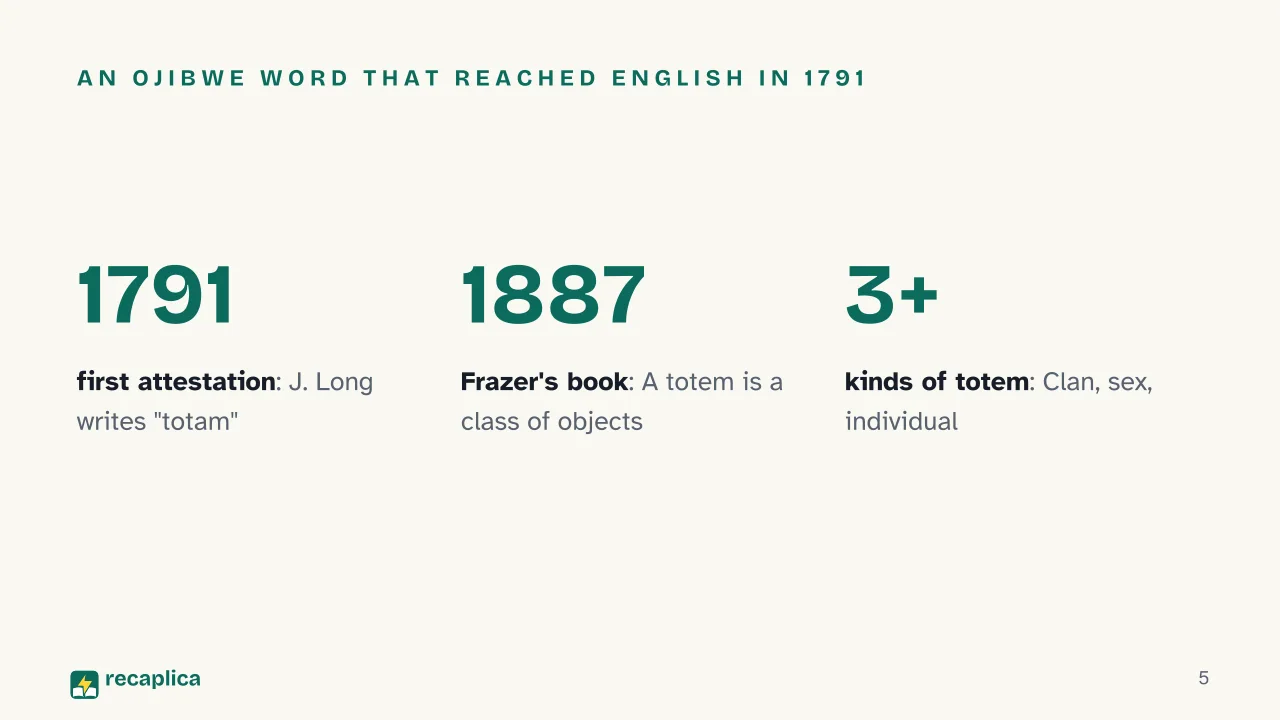
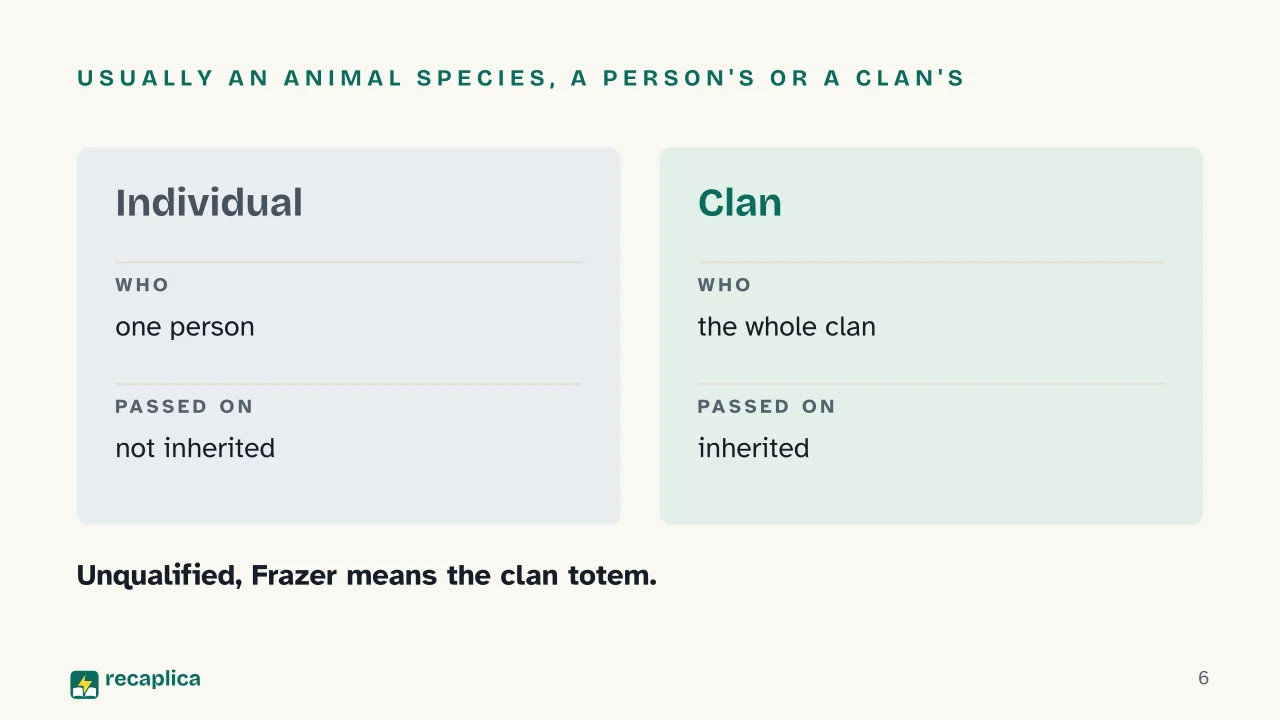
    Treccani separates individual totemism from group or social totemism. In the individual kind an animal protects a person, who in return neither kills nor eats its species. In the group kind the totem can belong to families, local groups, clans, phratries or tribes; a tribal totem is fairly rare. Frazer, in his 1887 book, counted at least three kinds. The clan totem belongs to the whole clan and passes down the generations; the sex totem is shared by all the men or all the women of a tribe; the individual totem belongs to one person and is not inherited. When he speaks of totemism without qualification, he says, he means the clan totem.

    For Frazer a fetish is a single object, while a totem is always a class, generally an animal or plant species.

    Esempio pratico: in Frazer’s description, the members of a totemic clan believe they share the same blood, descend from a common ancestor and owe each other obligations. The totem protects the person; in return the person spares the animal and leaves the plant alone, neither cutting nor gathering it. Lang adds that the totem is almost always tied to marriage rules (people with the same totem may not marry one another, except in central Australia), and that as a rule an individual may not kill or eat the object that gives his group its name, except in extreme necessity.

    The ban on marriage inside the totemic group is, for Treccani, a taboo as important as the one against killing the totem, and many scholars have treated exogamy (the rule of marrying outside one’s own group) and totemism as two faces of one phenomenon.

    Totem meaning and where the word comes from

    The word comes from the language of the Ojibwe, also called Chippewa, of North America. Treccani credits the interpreter J. Long with bringing it into English in 1791; Hecht gives the same year. According to Frazer, Long was an interpreter for Native peoples and wrote the word “totam” in a travel book published in London; the exact spelling of the Ojibwe word, he adds, is uncertain.

    According to Lang, Long used it for the personal protector, usually an animal, that each person chose for himself. In the narrower usage, Lang writes in 1911, “totem” means instead an object, usually an animal or plant species, that gives its name to a group of real or supposed kin. Lang himself noted that scholars used the word in too many different senses.

    The first theories: a religion of the beginning?

    For Treccani, totemism counted for a long time in the study of religion because of two readings: McLennan, Robertson Smith and Tylor saw in it one of the oldest religions, Durkheim the symbolic foundation that holds the group together. The first systematic theories date from the last third of the 19th century.

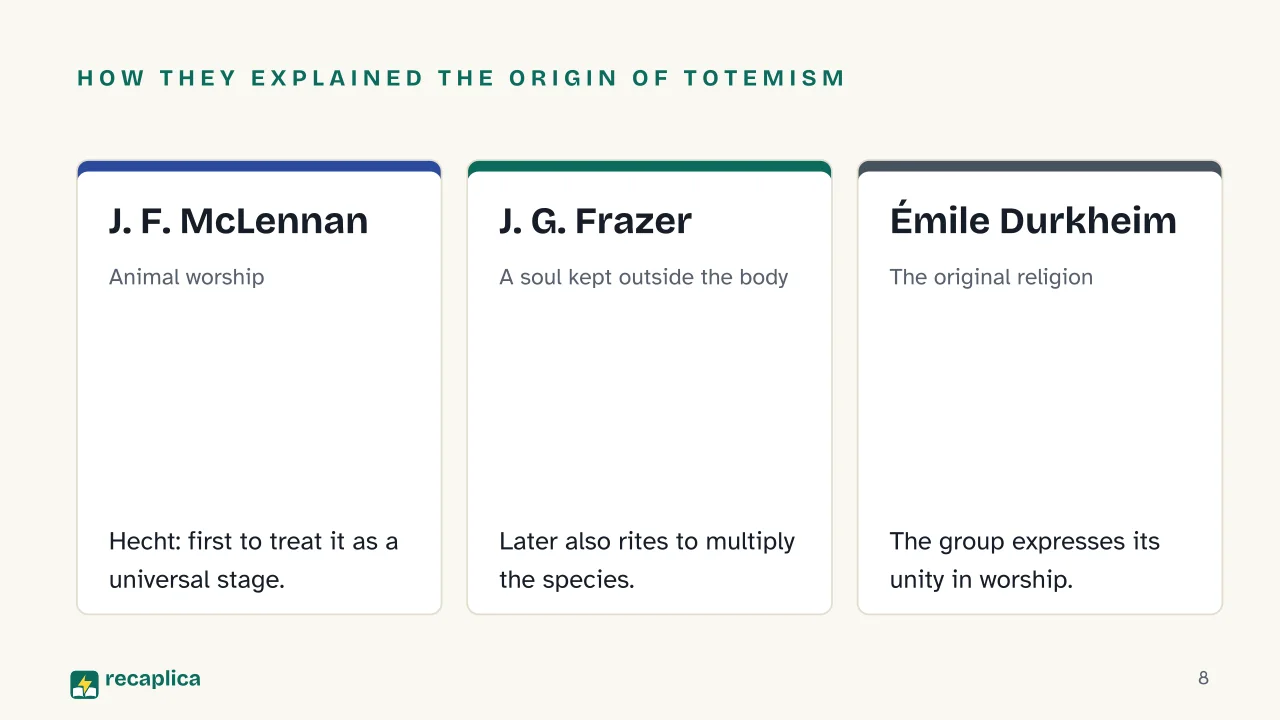
    ScholarHow he explained totemismSource
    McLennanAnimal worship (zoolatry); animal, plant and bird gods would precede gods in human formTreccani, Hecht
    SpencerAncestor worship: the animal aspect of the ancestor would arise from nicknamesTreccani
    TylorBelief in the transmigration of souls, from animals to humansTreccani
    FrazerThe idea of the “external soul”, kept outside the body; later, with Spencer and Gillen, rites to multiply the totem speciesTreccani
    DurkheimHumanity’s original religion, in which the unity of the group is expressed in the cult of the shared totemTreccani
    FreudThe Oedipus complex, with the totem animal symbolizing the fatherTreccani

    Durkheim wrote about it in 1912, and according to Hecht he rejected in that year the evolutionary thinking of his predecessors: in his vocabulary “elementary” means the simplest and most exemplary form of religion. The full argument is in The Elementary Forms of Religious Life, and his intellectual biography is in Émile Durkheim: thought and works. As early as 1902, the Catholic Encyclopedia reports, he had written that the totem is first of all a religious principle.

    Freud (on him, see Sigmund Freud and the birth of psychoanalysis) saw in totemism, Hecht summarizes, an expression of guilt toward an offended father, appeased by total obedience.

    The explanations did not converge. Lang judged all theories of the origin of totemic exogamy to be conjecture, and on the Arunta of Australia he noted that the theories of the origin of totemism diverge beyond reconciliation. Frazer himself proposed several explanations (economic and magical, external soul, conception) and abandoned more than one, the Catholic Encyclopedia reports.

    The doubt: a category built by scholars

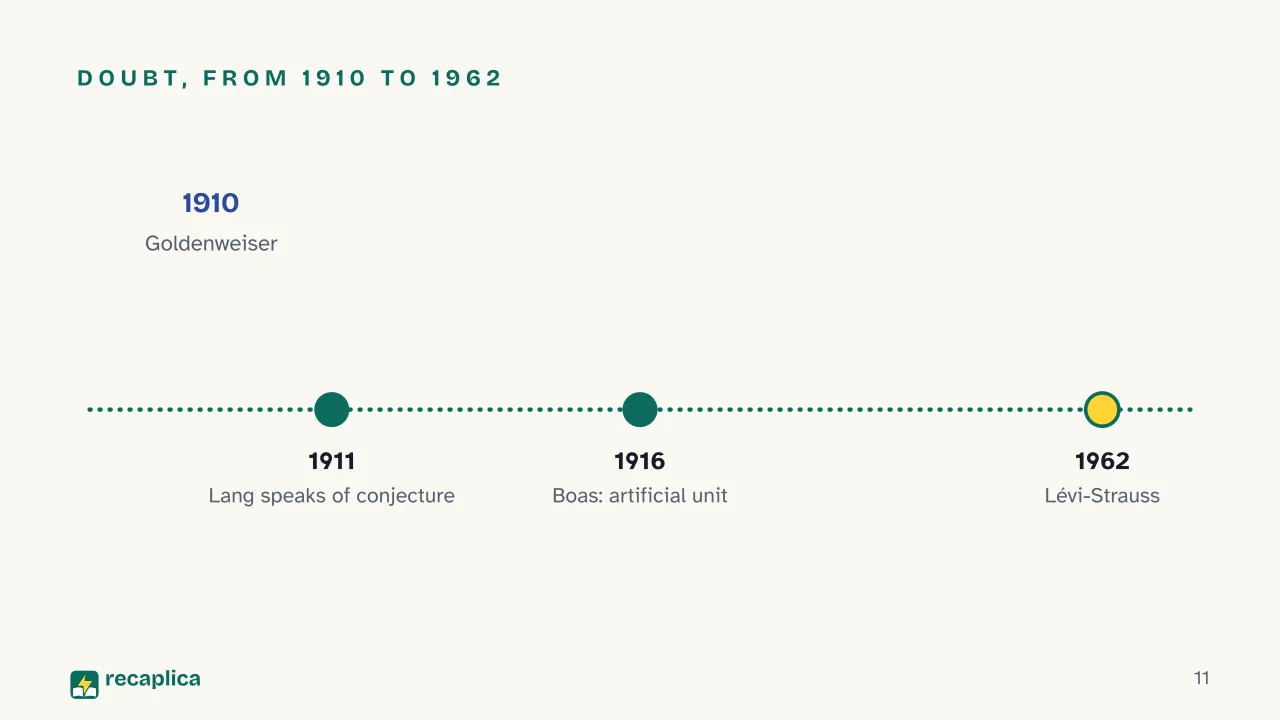
    In the early 20th century, with the evolutionist schemes gone, the facts were looked at again with a more critical eye. With E. Reuterskiöld came the doubt that the phenomena called totemism had a single origin, and the most contested point became their universality. Alexander Goldenweiser had already pointed out in 1910, according to Treccani, how elusive the phenomenon was to any definition.

    Esempio pratico: Lang observed in 1911 that the “religious” status of the totem is lowest exactly where its influence on social rules is greatest, and the other way round.

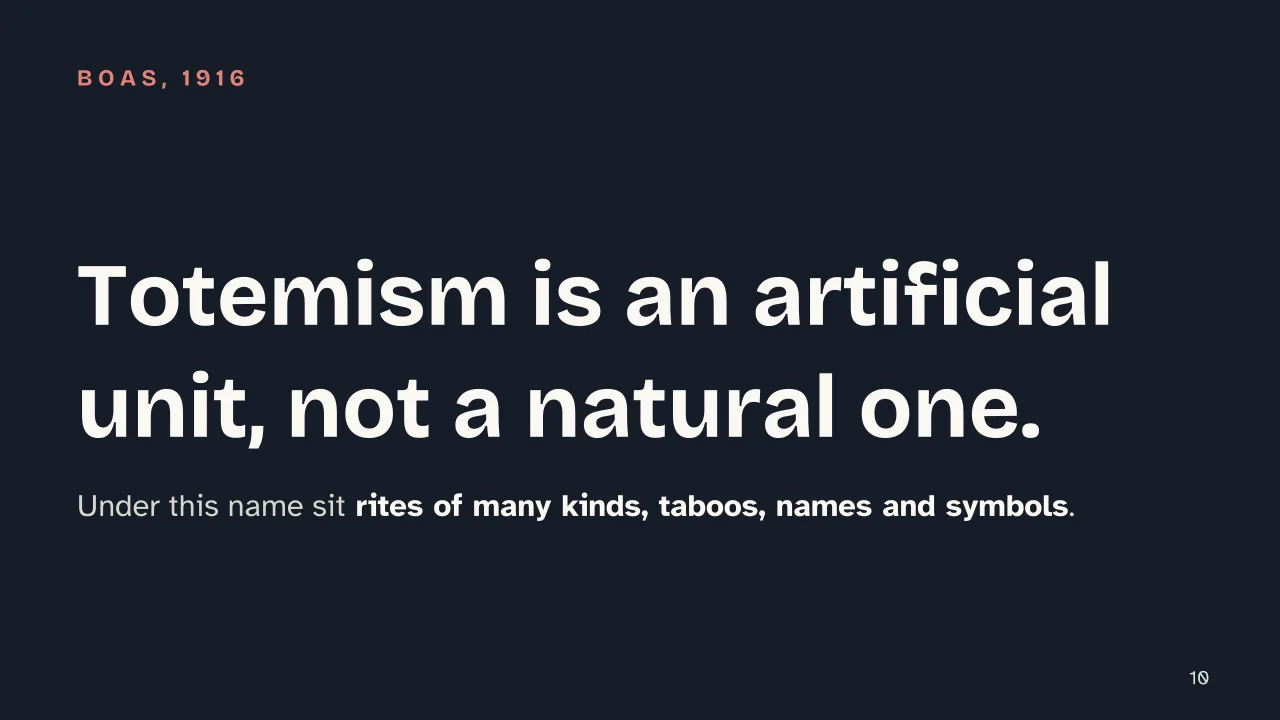
    In 1916 Franz Boas concluded that totemism is an artificial unit, not a natural one, and that the unity of the concept is subjective. Boas agreed with Goldenweiser that the concrete content varies widely from one area to another. What got grouped under “totemism” from case to case were religious practices of various kinds, taboos, names and symbols, and for Boas there was no proof that they formed a necessary whole, what Goldenweiser called the “totemic complex”.

    Boas also criticized the method of Frazer and Durkheim, who explained ethnic phenomena as the effect of one psychological process. He noted as well that Wundt and Durkheim put the identification of humans with animals at the center, a different problem from totemism as a social institution. His own proposal: since the kinship group and exogamy are universal and totemism is not, totemism arose where exogamy already existed.

    According to the Catholic Encyclopedia, Boas’s research in northwestern Canada and that of Spencer and Gillen in Australia dealt the decisive blow to the evolutionary theory.

    Lévi-Strauss: totemism as a way of classifying

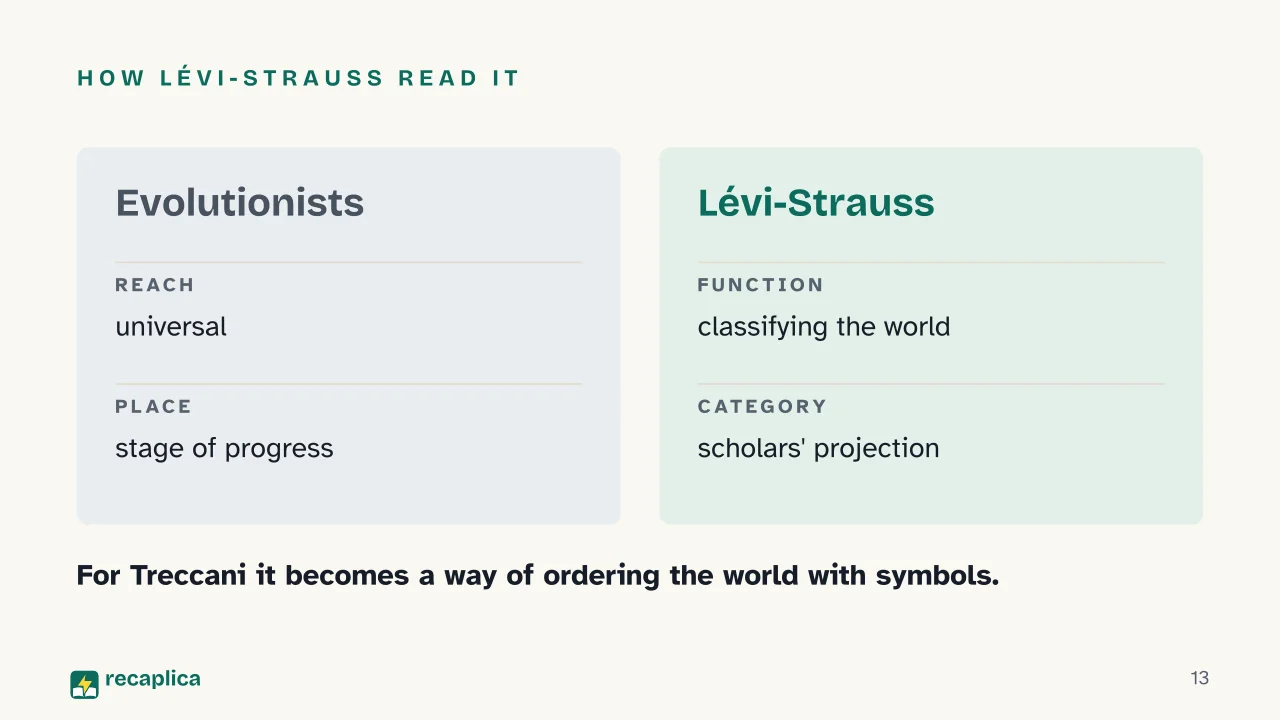
    In 1962, according to Treccani, Lévi-Strauss showed that scholars had projected the very category of totemism onto non-European material. What his predecessors had missed, for him, was that totemic operations are systematic and serve to classify. Read this way, totemism becomes one of many ways of ordering the world with symbols and logic, part of what Lévi-Strauss calls “the savage mind”.

    Hecht presents Lévi-Strauss’s structuralist study as a broad critique of the evolutionary thinking that preceded it. In his judgment Lévi-Strauss demonstrated that totemic relations run through the whole history of religious traditions, including outside tribal societies, and that they are tied to the binary oppositions of thought. Hecht concludes that totemism, understood as a distinct starting stage of religious evolution, does not exist. What remains are deities and totemic relations that help explain kinship and how authority is legitimized in some traditions.

    Slide deck

    Slides ready to download and make your own in PowerPoint or Google Slides, with speaker notes. Pick the Flash cut or the Full one.
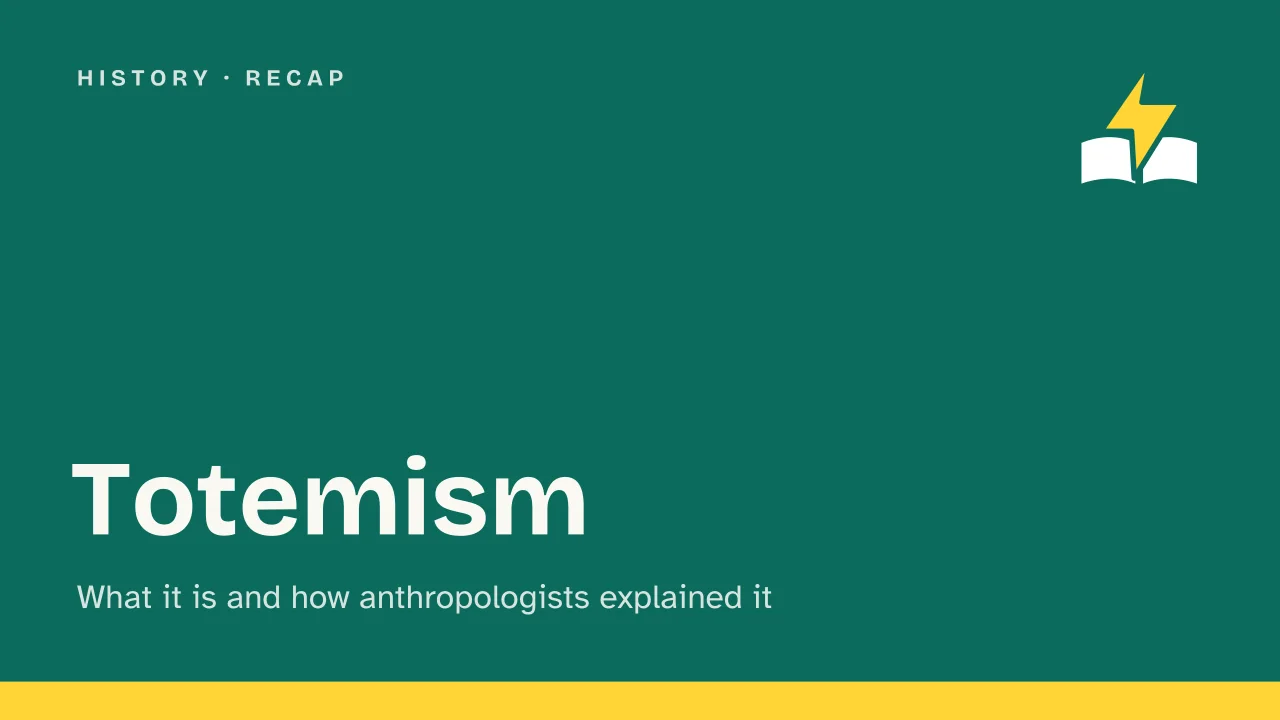
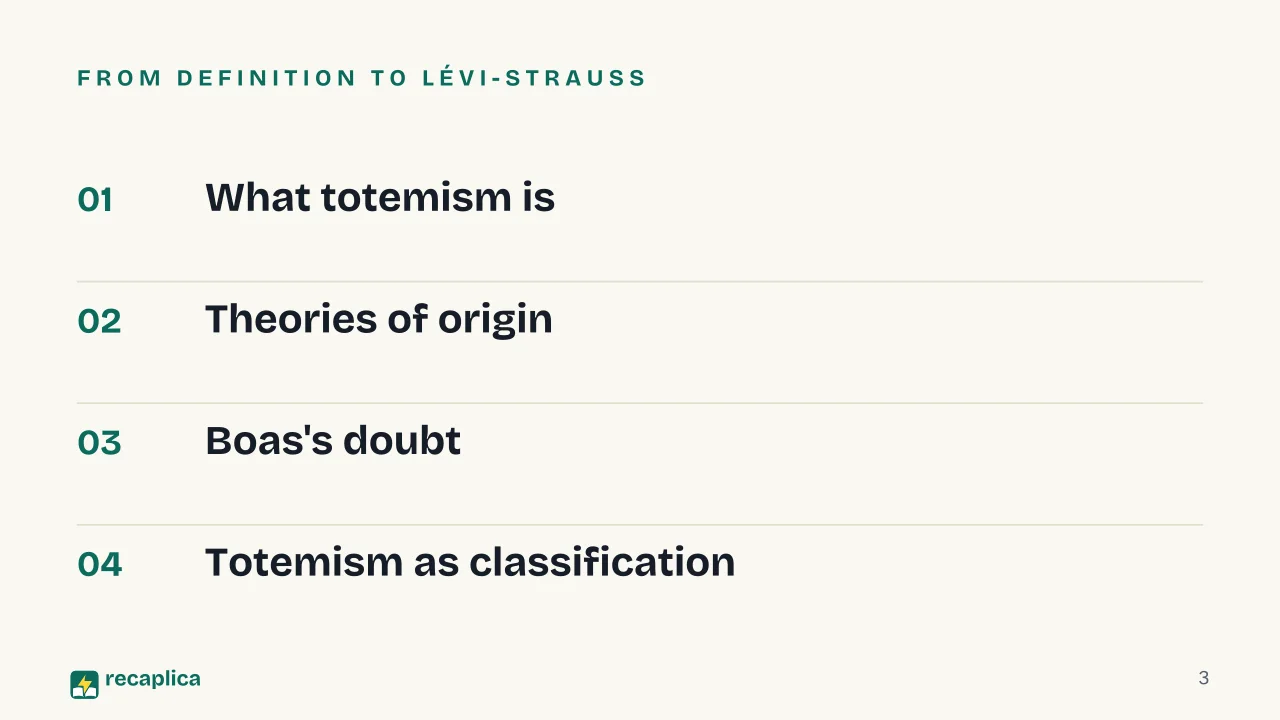
    Slide 1 of the presentation on What Is Totemism? How Anthropologists Explained It: TotemismSlide 2 of the presentation on What Is Totemism? How Anthropologists Explained It: Who decided that totemism is a single thing?Slide 3 of the presentation on What Is Totemism? How Anthropologists Explained It: From definition to Lévi-StraussSlide 4 of the presentation on What Is Totemism? How Anthropologists Explained It: Chapter 01: What totemism isSlide 5 of the presentation on What Is Totemism? How Anthropologists Explained It: An Ojibwe word that reached English in 1791Slide 6 of the presentation on What Is Totemism? How Anthropologists Explained It: Usually an animal species, a person's or a clan'sSlide 7 of the presentation on What Is Totemism? How Anthropologists Explained It: Chapter 02: Theories of originSlide 8 of the presentation on What Is Totemism? How Anthropologists Explained It: How they explained the origin of totemism: J. F. McLennan, J. G. Frazer, Émile DurkheimSlide 9 of the presentation on What Is Totemism? How Anthropologists Explained It: Chapter 03: Boas's doubtSlide 10 of the presentation on What Is Totemism? How Anthropologists Explained It: Totemism is an artificial unit, not a natural one.Slide 11 of the presentation on What Is Totemism? How Anthropologists Explained It: Doubt, from 1910 to 1962Slide 12 of the presentation on What Is Totemism? How Anthropologists Explained It: Chapter 04: Totemism as classificationSlide 13 of the presentation on What Is Totemism? How Anthropologists Explained It: How Lévi-Strauss read itSlide 14 of the presentation on What Is Totemism? How Anthropologists Explained It: What is totemism according to Boas, in 1916?Slide 15 of the presentation on What Is Totemism? How Anthropologists Explained It: Now, the review
    Flash10 slidesThe essential thread, to present in classFull15 slidesEvery chapter and the deeper detail

    Common myths

    • ✗ Myth Totemism is the first stage of every religion.

      ✓ Reality The 19th-century evolutionists treated it as universal and tied to a fixed phase of cultural progress, as Treccani summarizes. Then Boas pointed out in 1916 that totemism is not found everywhere. Hecht concludes that no such starting stage exists, though some totemic relationships help explain kinship and authority in certain traditions.

    • ✗ Myth A totem is a sacred object, like an amulet.

      ✓ Reality In 1887 Frazer separated it from the fetish, the single object: a totem is a class, usually an animal or plant species. In his description the relationship runs both ways. The totem protects the person, who in return does not kill the animal or cut or gather the plant.

    • ✗ Myth Anthropologists have always known how totemism began.

      ✓ Reality As early as 1911 Lang dismissed the explanations of totemism's original purpose as guesses. On the Arunta of Australia he noted that the theories diverge beyond reconciliation. Even Frazer proposed several explanations and gave up more than one, according to the Catholic Encyclopedia.

    Mind map

    Drag the background to move around and the nodes to reposition them; use − and + to collapse and expand branches.
    Customize
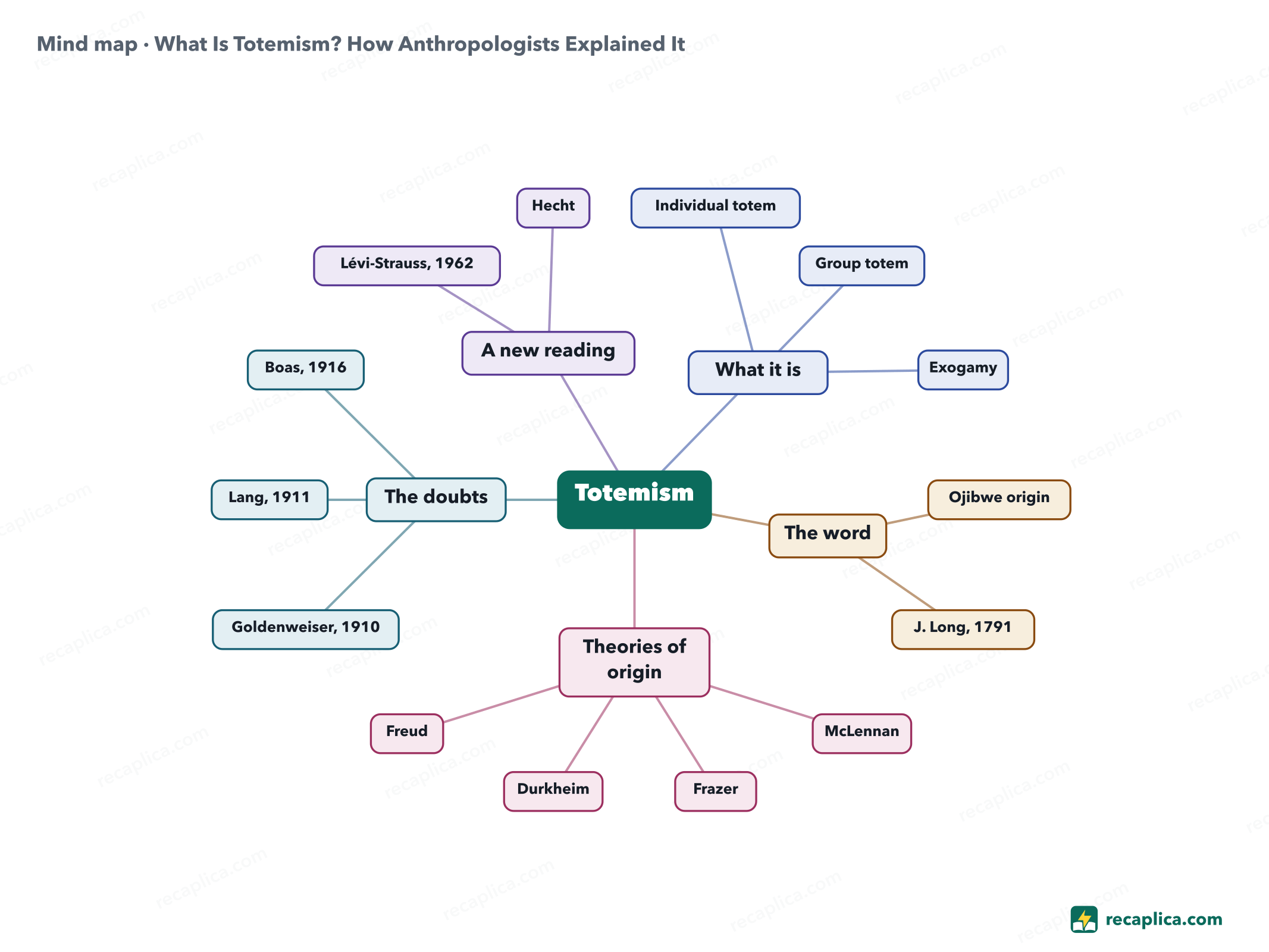
    Mind map: What Is Totemism? How Anthropologists Explained It
    • Totemism
      • What it is A bond of kinship and protection with the totem
        • Individual totem An animal protects one person
        • Group totem Family, clan, phratry, tribe
        • Exogamy
      • The word
        • Ojibwe origin
        • J. Long, 1791 Writes "totam"
      • Theories of origin
        • McLennan Animal worship
        • Frazer External soul, rites for the species
        • Durkheim Humanity's original religion
        • Freud Oedipus complex
      • The doubts
        • Goldenweiser, 1910 An elusive phenomenon
        • Lang, 1911 Explanations are conjecture
        • Boas, 1916 Artificial unit
      • A new reading
        • Lévi-Strauss, 1962 Operations of classification
        • Hecht No distinct starting stage

    Quiz: test yourself

    Answer the questions to check what you have learned: you get instant feedback and a short explanation.

    Grade 0/10 0/5
    1 Which language does the word "totem" come from?

    Treccani and Hecht agree on the Ojibwe origin. The earliest attestation in English that the sources give is J. Long's, in 1791, who wrote "totam".

    2 What is totemism according to Boas, in 1916?

    Boas saw no proof that such different customs formed a necessary whole. Ancestor worship was Spencer's explanation, reported by Treccani.

    3 Which scholar, according to Treccani, derived totemism from the idea of the "external soul"?

    Frazer was thinking of a soul kept outside the body. McLennan spoke of animal worship.

    4 What did Lévi-Strauss show in 1962, according to Treccani?

    Lévi-Strauss read totemism as a way of classifying. The original religion is Durkheim's thesis, the father is Freud's.

    5 According to Frazer in 1887, how does a totem differ from a fetish?

    For Frazer the totem is a class of objects, usually a species. Natural phenomena as totems, according to Treccani, are a rarer case.

    Answers: 1-C · 2-A · 3-D · 4-B · 5-C

    Flashcards

    Tap the card to flip it and check whether you remember the answer, then move to the next one.

    1 / 7

    Explain it in your own words

    The ultimate test: if you can explain it in simple words, you've truly understood it. Write your explanation, then compare it with the Recap.

    Your explanation is saved only on this device.

    Totemism is the name scholars gave to the bond between a person or a clan and its totem, most often an animal species, felt as kinship and mutual protection. The word comes from the Ojibwe language of North America and entered English in 1791. In the last third of the 19th century it became a key to the origin of religion, with theories that disagreed sharply. Early in the 20th century the picture changed: in 1916 Boas called totemism an artificial unit, and according to Treccani, Lévi-Strauss showed in 1962 that the category was a projection by scholars.

    Frequently asked questions

    What is totemism in anthropology?

    It is the name scholars gave to a set of beliefs and prohibitions tied to a totem, most often an animal species. Since the early 20th century it has been debated whether it is a real category: in 1916 Boas called it an artificial unit.

    What does totem mean, and where does the word come from?

    In the anthropological sense, "totem" means the being or class of beings, usually an animal species, with which a person or group has a special bond. The word is Ojibwe and appears in English in 1791 as "totam", in the book of the interpreter J. Long.

    Who developed the first theories of totemism?

    The first systematic theories appear in the last third of the 19th century, according to Treccani. According to Hecht, James Ferguson McLennan (1827-1881) was the first to see the totem as a universal stage of religious evolution. Spencer, Tylor, Frazer, Durkheim and Freud, among others, each offered a different explanation.

    Is totemism a religion?

    It depends on who answers. For Durkheim the cult of the totem was humanity's original religion. Hecht argues that a starting stage called totemism never existed, and for Boas and Lévi-Strauss the category itself is a construction of scholars.

    Sources

    • Treccani, Enciclopedia on line, entry "Totemismo"
    • James G. Frazer, "Totemism" (Edinburgh, 1887), Internet Archive
    • Franz Boas, "The Origin of Totemism", American Anthropologist, 1916
    • Richard Hecht, entry "Totem", Contemporary American Religion, on Encyclopedia.com
    • Andrew Lang, entry "Totemism", Encyclopaedia Britannica, 11th edition (1911)
    • Entry "Totemism", Catholic Encyclopedia

    Every Recap goes through an independent review before publication.

    Every evening, the day's new Recaps on our Telegram channel. Join the channel →

    Keep learning

    • History Ancient Greek Art: The Periods, Statues and Temples From Kouroi to the Hellenistic Age Greek art is usually split into four periods, from Geometric to Hellenistic, with the Severe style as the bridge between the two in the middle. Statues begin as the stiff kouroi of the sixth century BC, turn into the moving bodies of the Classical age and end as the theatrical groups of the Hellenistic world. Temples such as the Parthenon give sculpture its places: pediments, friezes and metopes. The dates are a teaching convention, because the changes were never sharp. Read the Recap →
    • History What Is Kinship? Types of Family, Descent and Residence Across Cultures In anthropology, kinship is the set of ties that a culture recognises as family: ties of blood, ties created by marriage and, in some cases, ties with neither, such as adoption. Families exist in every society, but in very different forms: nuclear, extended, joint, with several wives or several husbands. Cultures also differ in the line through which descent is counted, in where a couple goes to live and in the names given to relatives. A couple with young children is therefore one form among many. Read the Recap →
    • History Geocentric vs heliocentric model: from Ptolemy to Galileo In Ptolemy's system the Earth sat at the center of the cosmos, and the movements of the planets were explained by combining circles. Copernicus moved the Earth, which also called Aristotle's physics into question. Tycho Brahe, the greatest observer before the telescope, found none of the parallax that the Copernican model implied, and he proposed a compromise. Kepler's ellipses came in 1609 and Galileo's telescope discoveries in 1610, followed by Galileo's condemnation in 1633. Read the Recap →

    recaplica

    Clear in 30 seconds, yours in 10 minutes.

    Recaps Mind maps Request a Recap Telegram channel Mind map maker Our method About Privacy & cookies Legal notes & terms of use

    © 2026 Recaplica · A project by Curi S.r.l. — VAT IT05472000750

    Statistics, only if you say so

    To learn which Recaps help most we would use Google Analytics, with aggregate, anonymous data. It starts only with your OK, and you can change your mind anytime. Privacy policy