|
recaplica
John Dewey: Educational Philosophy, Key Works and the Laboratory School | |||||||||||||||||||||
| © 2026 Recaplica · recaplica.com — All rights reserved | |||||||||||||||||||||
John Dewey: Educational Philosophy, Key Works and the Laboratory SchoolWhat to print Page numbers appear when printing with default margins. SlidesChoose a cut Flash10 slidesThe essential thread, to present in classFull15 slidesEvery chapter and the deeper detailBoth come with speaker notes. In 30 seconds quick readJohn Dewey (1859-1952) was an American philosopher and educator, and one of the first founders of pragmatism. In 1896 he opened a laboratory school in Chicago to try out his ideas about education with real pupils. He held that people learn from experience: they act, watch what happens and then think it over. School, in his view, should run as a small community where children pick up democracy by practising it. His books on education include My Pedagogic Creed (1897), Democracy and Education (1916) and Experience and Education (1938). Key Points
Key figures
Deep DiveWho was John DeweyJohn Dewey was born on 20 October 1859 in Burlington, Vermont, the third of four sons. He graduated from the University of Vermont in 1879 and spent two years teaching high school before turning to philosophy, and he earned his doctorate at Johns Hopkins in Baltimore in 1884. A decade at the University of Michigan followed, broken by a year at Minnesota. In 1894 the University of Chicago put him in charge of a department that covered philosophy, psychology and pedagogy, and his theory of knowledge took shape there. He moved to Columbia University in New York in 1904 and also worked with Teachers College, the university’s school for training teachers. He retired from teaching in 1930 but kept writing: the Stanford Encyclopedia of Philosophy (SEP) counts eleven more books. He died in New York in 1952. He lectured in Japan in 1919 and in China from 1919 to 1921. The Italian encyclopedia Treccani presents him as a philosopher and educator, and judges his influence on education to have been even greater than his political influence. Pragmatism and the theory of inquiryThe SEP places Dewey among the first founders of American pragmatism, with Peirce and James. The Internet Encyclopedia of Philosophy (IEP) describes this school as treating knowledge as the product of an organism adapting actively to its surroundings. Dewey called his own approach “instrumentalism”, since knowledge in it serves as a tool for steering the dealings between organism and environment, though his preferred name was “theory of inquiry”. For his philosophy as a whole he liked yet another label, “cultural naturalism”, which the SEP reads as rebuilding philosophy inside the picture of life drawn by Darwin. An inquiry starts from a problematic situation, when the usual responses can no longer carry forward what someone was doing. Possible solutions get imagined, and whether they hold up shows only once they are put into practice. Treccani also describes how it ends. Either a test settles the original doubt, or it fails and the search begins again with fresh hypotheses. In this scheme, for Dewey, knowing is the most complex way of working through life’s difficulties, continuous with biological adaptation. The Laboratory School in ChicagoThe experimental elementary school opened in January 1896 in a small house on Chicago’s South Side, with 16 pupils, three rooms and a large yard. Treccani calls it a nursery and elementary school built for observing and experimenting, in support of the education courses Dewey taught at the university. The SEP sees it as the testing ground for his instrumental logic and for functionalist psychology. His wife, Alice Chipman, was among those who ran it. In the history the school tells about itself, Dewey wanted to challenge traditional education and find out how a class could become a cooperative community. Each child had a role and tasks, and learned through them what it means to be an active citizen. Around the turn of the twentieth century, garden work was a regular part of the curriculum. The school, which became the University of Chicago Laboratory Schools, calls itself the first “laboratory school” in the United States and a pioneer of American progressive education. Dewey’s relationship with the university broke down over the school. In 1904, after disputes with the administration about the Laboratory School’s status, he resigned and went to Columbia. My Pedagogic Creed (1897)My Pedagogic Creed appeared in January 1897 in the magazine School Journal, signed by Dewey as a professor at the University of Chicago. Education in it has two sides, a psychological one and a social one, and neither is to be ranked below the other. The raw material is the child’s instincts and powers. The school remains first of all a social institution, and what holds the subjects together is the child’s own social activity. Dewey describes education as a process of living, and refuses to treat it as preparation for some future life. In the Creed the teacher does not impose ideas. He is a member of the community who selects the influences the child meets and helps the child respond to them. A child’s interests are signs of growing powers. The Creed asks that they be neither humoured nor repressed, and humouring all of them mistakes the passing for the lasting. The text also defines education as a continuous reconstruction of experience, where process and goal coincide, and calls it “the fundamental method of social progress and reform”. Between the child and the curriculumIn the 1890s American educators argued over where schooling should start. For the “traditionalists”, as the SEP calls them, it was the curriculum; this was the “old” education in Dewey’s vocabulary. The “romantics”, his “new” or “progressive” education, wanted to start from the child and the child’s natural impulses. Dewey proposed a model of interaction that gave priority neither to the child nor to society. For him the child was an indispensable starting point, to be held together with everything else. Of the two camps, he pushed back harder against the traditional one, for the weight it gave to discipline and memorisation. Educators, he argued, should abandon teaching methods that treat the mind as a blank slate. The Laboratory School recalls his view that instruction built on memorising and drill left children underdeveloped. In his teaching, rewards and punishments gave way to work on the setting itself: the teacher reorganised it so that the school’s aims met the interests pupils had at that moment. Concrete problems, chosen to bring curriculum and student together, were one way of getting there, with lessons built around them. In the SEP’s account this asked a lot of teachers, who needed child psychology as well as their subjects, and the skill to combine the two. Learning from experience: the five steps in Democracy and EducationFor Dewey experience is activity, an involvement in life. In Democracy and Education (1916) it has an active side, trying, as in an experiment, and a passive side, undergoing the consequences of what was tried. The two belong together, and experience is not primarily a matter of knowing. What an experience is worth depends on the connections it lets us see. Dewey’s line that “an ounce of experience is better than a ton of theory” rests on the idea that a theory only gains a meaning anyone can check inside experience. The book offers what it calls a “technical” definition of education: a reconstruction of experience that adds to its meaning and leaves a person better able to direct later experience. That education means drawing pupils into an active process is, Dewey remarks, a principle accepted in theory and broken in practice. The methods that work give pupils something to do, and the doing demands thought and an eye for connections. The elements of teaching method are the same as those of reflective thinking, and the book lists five:
Learning by doing in Dewey’s own wordsThe phrase “learning by doing” appears in the 1916 text. Natural development, Dewey writes, always starts from situations where children learn by doing, and the arts and practical occupations form the first stage of the curriculum. The idea is far older than he is. In the Nicomachean Ethics, Aristotle had already observed that people become builders by building and harp players by playing the harp. Dewey adds a warning: activity on its own does not make an experience. You can do things you don’t understand, because many consequences of an action can’t be foreseen. The learning happens when, after acting, you notice results that had escaped you before. Democratic educationIn Democracy and Education democracy means more than a system of government. It is a way of living together, made of experience that people share and pass on to one another. Randall Curren, in the SEP entry on philosophy of education, reads Dewey’s idea this way: a democratic society is a community that investigates its problems and solves them together, with respect for persons and for the scientific method. The IEP finds the same argument in The School and Society as well as Democracy and Education, where democratic habits are formed from the first years of school. The idea goes back to the Chicago years. In an 1897 essay, “Ethical Principles Underlying Education”, Dewey wrote that school can prepare children for social life only if the conditions typical of that life exist inside the school itself. Drawing on George Herbert Mead, he wanted schools turned into small communities. In the 1916 book the school can itself become a form of social life, a community in miniature in contact with the society beyond its walls. Dewey also attacks one specific split, the one that sent privileged children to the humanities and everyone else to vocational training, and proposes a mixed course of study for all. He goes so far as to define philosophy as the general theory of education, meaning the shaping of intellectual and emotional dispositions toward nature and toward other people. On the SEP’s reading, he held that the success or failure of democracy depends on education. Experience and Education (1938): continuity and interactionDewey published Experience and Education in 1938. Kevin Smith of Cardiff University, writing in 2019 on the blog of the British Educational Research Association, says the book set out to clear up misunderstandings about what “progressive education” was. Massimiliano Fiorucci and Gennaro Lopez, in their introduction to the proceedings of a 2016 conference on Dewey, read it as Dewey’s reply to traditionalist critics who accused him of a model that relied too much on spontaneity. They also see in it a step away from the most extreme activists, who had pulled his theory off course. In the book Dewey sets two criteria for judging an experience. The first is continuity: every experience changes the person who has it, and that change bears on the experiences that follow. Interaction, which Dewey later renamed “transaction”, is read by the educational theorist Gert Biesta (2014) as the search for a sensible link between curriculum and child that avoids both extremes, imposing content or leaving the child to do as it pleases. For Smith, continuity leads to growth, yet experiences are not all equal. Some are educative and some are what Dewey calls “mis-educative”, and telling them apart takes a skilled teacher. On page 82 of the book an experience is educative only if it leads to knowing more facts and more ideas and to arranging them better. Smith uses these pages to answer critics such as Daisy Christodoulou, whose Seven Myths About Education (2014) portrays a Dewey hostile to facts and to the teacher’s authority. On page 42 Dewey locates the fault of traditional schooling in its neglect of what goes on inside the learner, more than in its care for external conditions. Dewey’s main works on education
Dewey in the new education movements, and in ItalyFiorucci and Lopez use the familiar image of a “Copernican revolution” for the shift that the new education in Europe and the activist movement in American schooling brought to pedagogy between the late nineteenth and early twentieth centuries. In their reading the movement’s principles became the base of Dewey’s pedagogy, and he had already set them out in the five articles of the 1897 Creed. In postwar Italy, as the country rebuilt, Dewey became a point of reference. Maura Striano of the University of Naples Federico II credits Ernesto Codignola and his son Tristano with an important part in spreading his work, through the Florentine publisher La Nuova Italia and the journal Scuola e Città. In 1949 Democracy and Education was among the first of his books to appear in a series devoted to educators of the past and present. The translator was Enzo Enriques Agnoletti, who later edited the magazine Il Ponte. According to Striano, that Italian edition became the book on which two generations of education scholars and practitioners were trained. Slide deckSlides ready to download and make your own in PowerPoint or Google Slides, with speaker notes. Pick the Flash cut or the Full one.     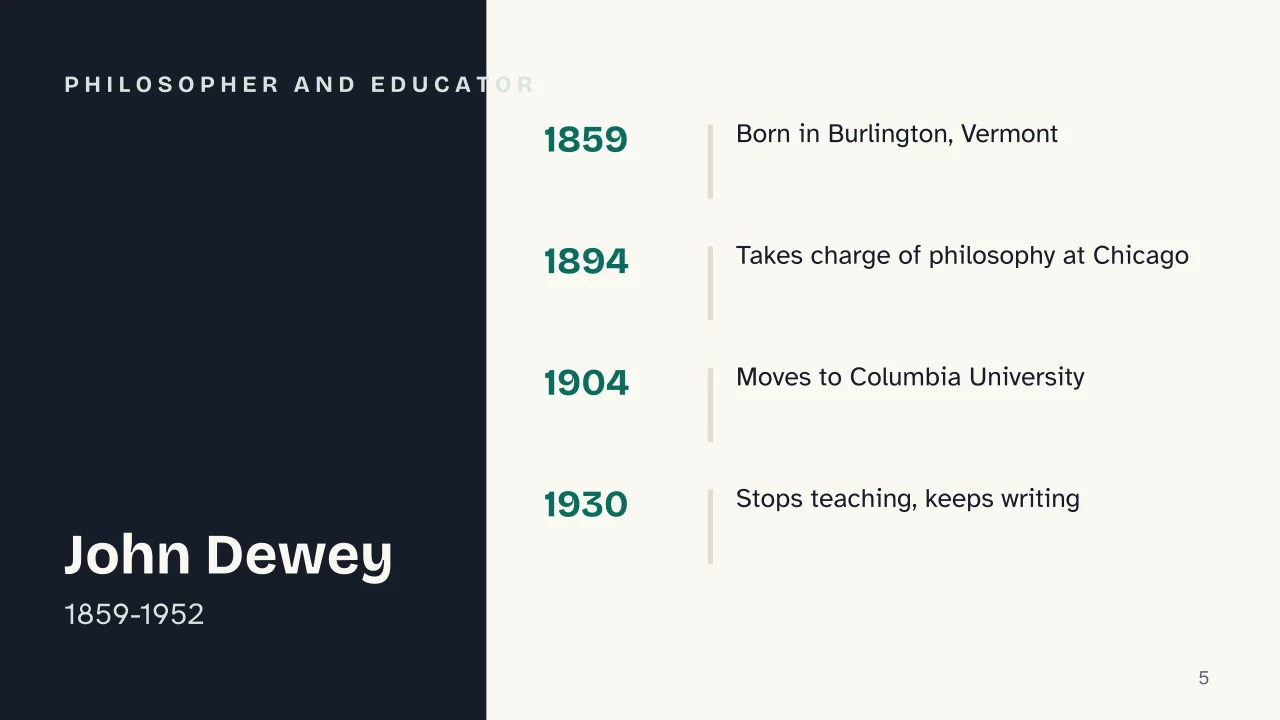  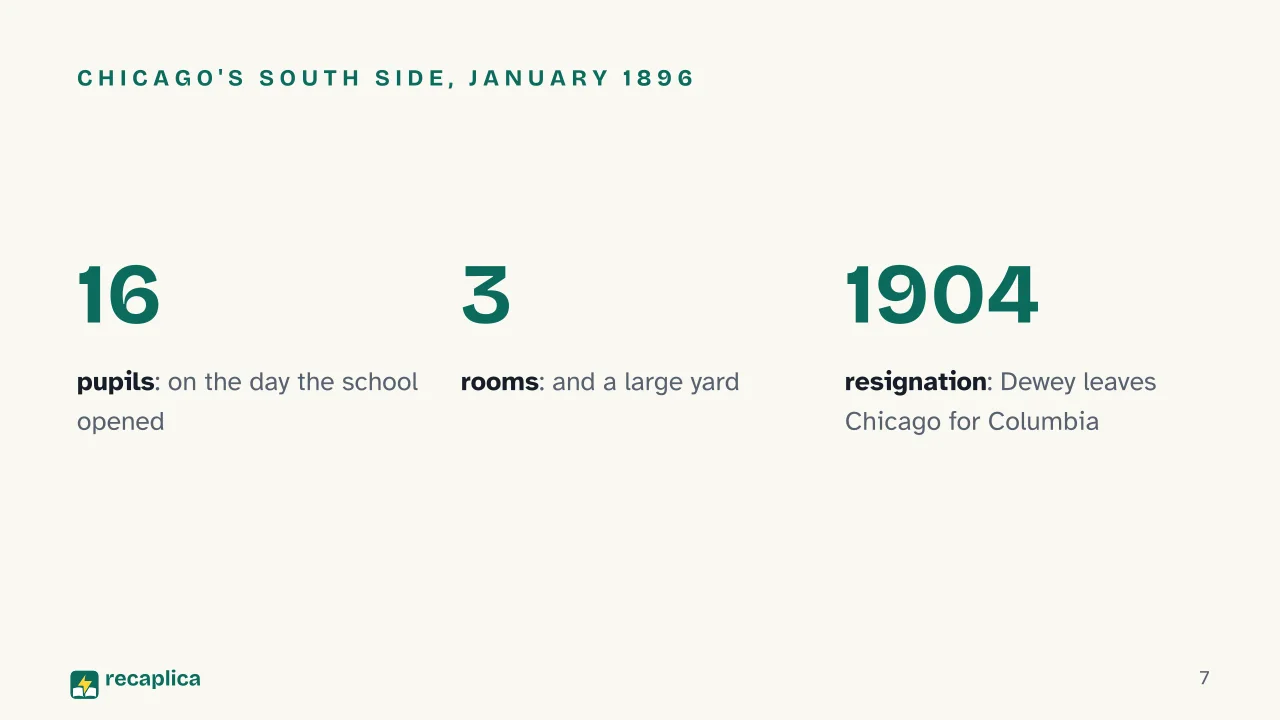  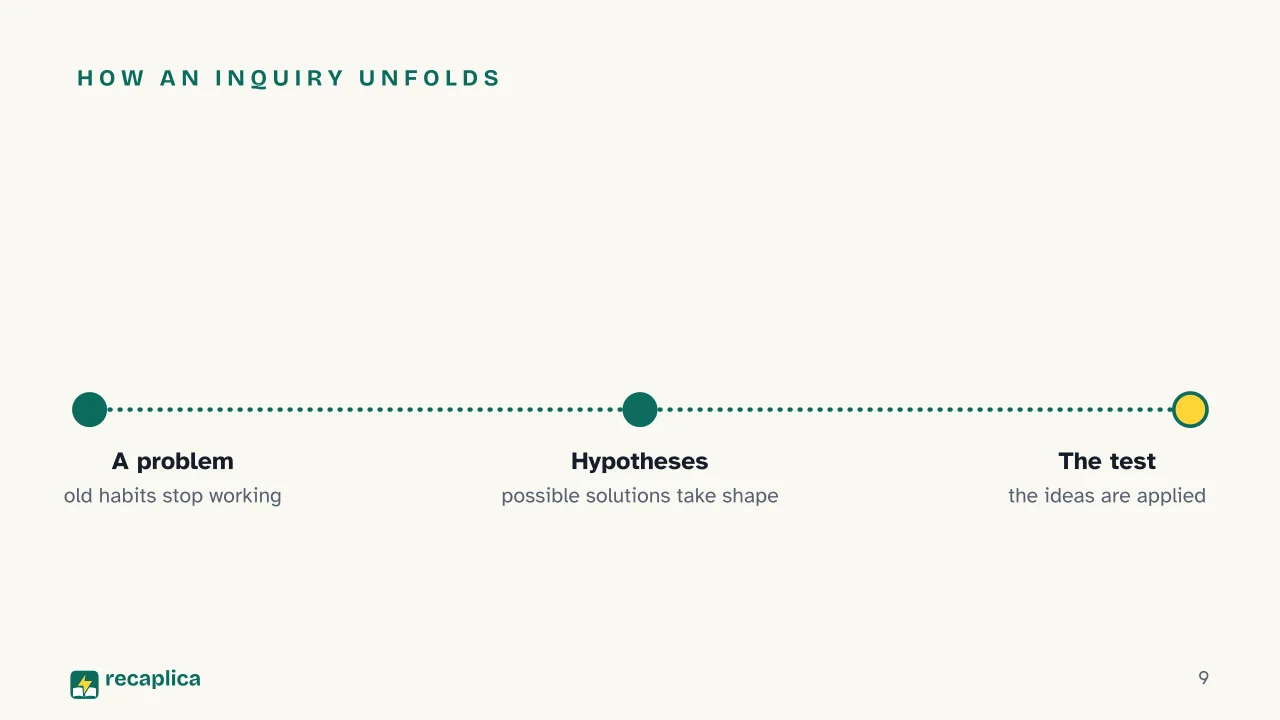 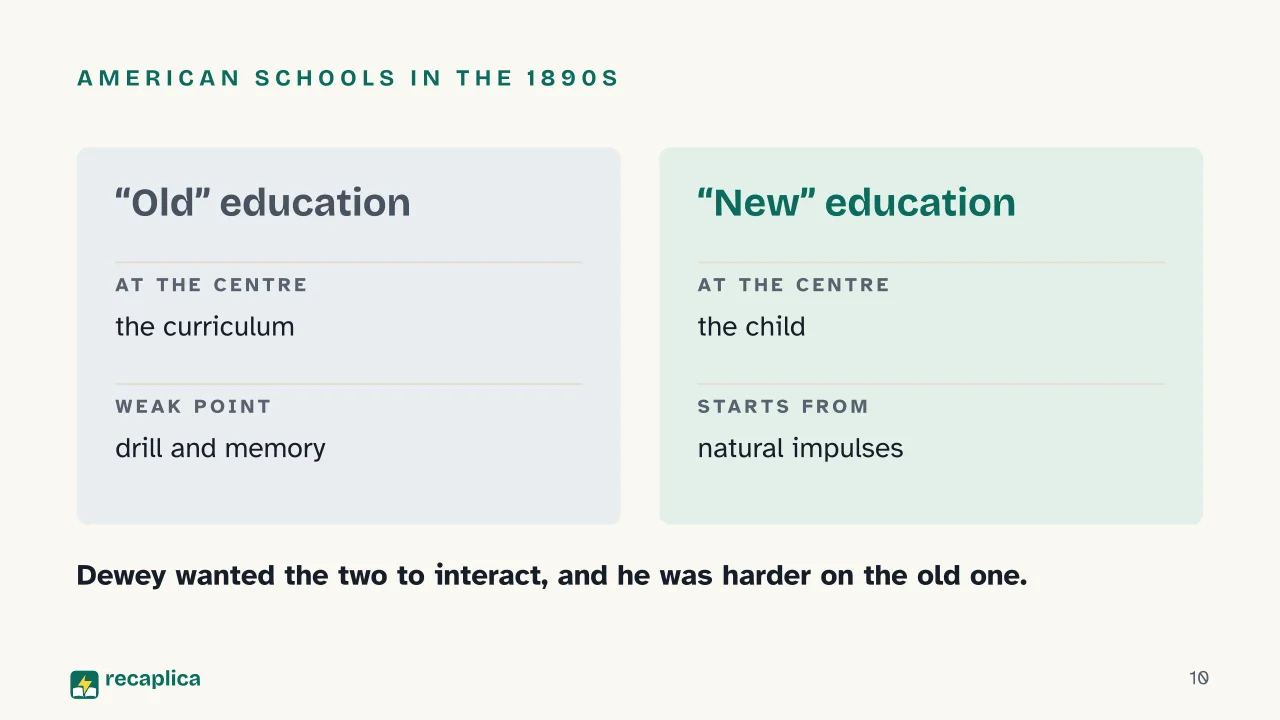 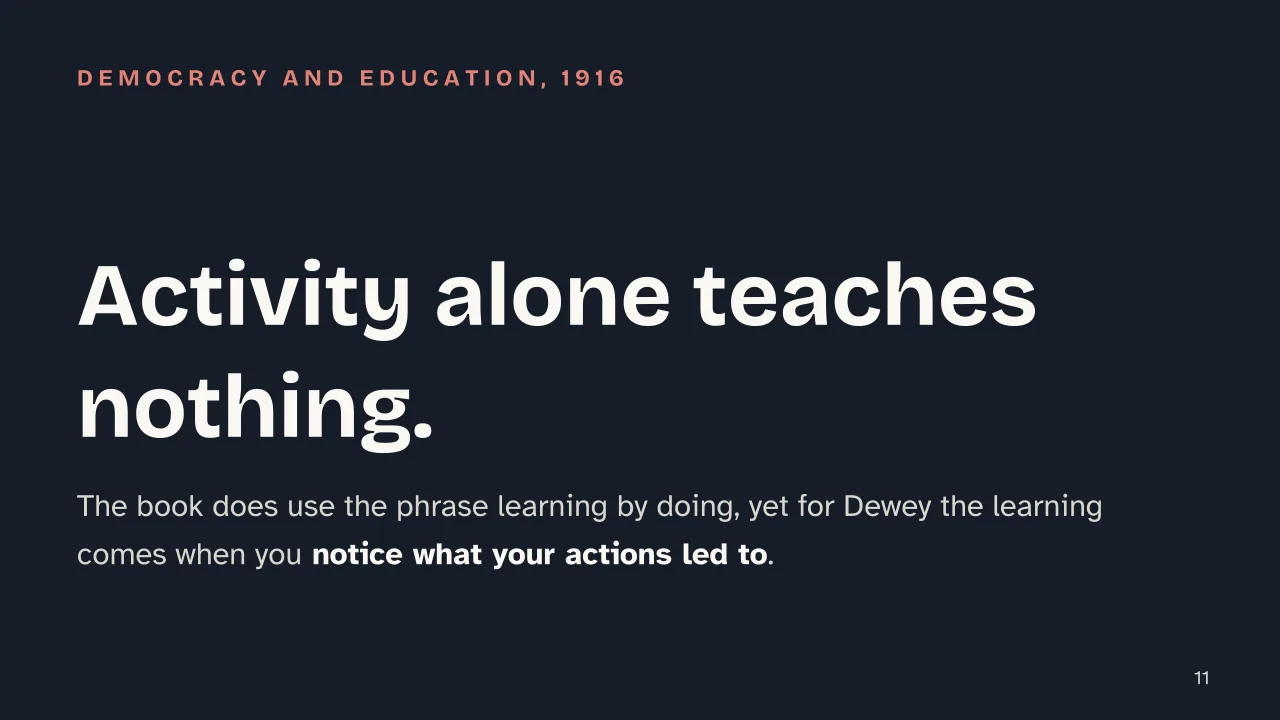  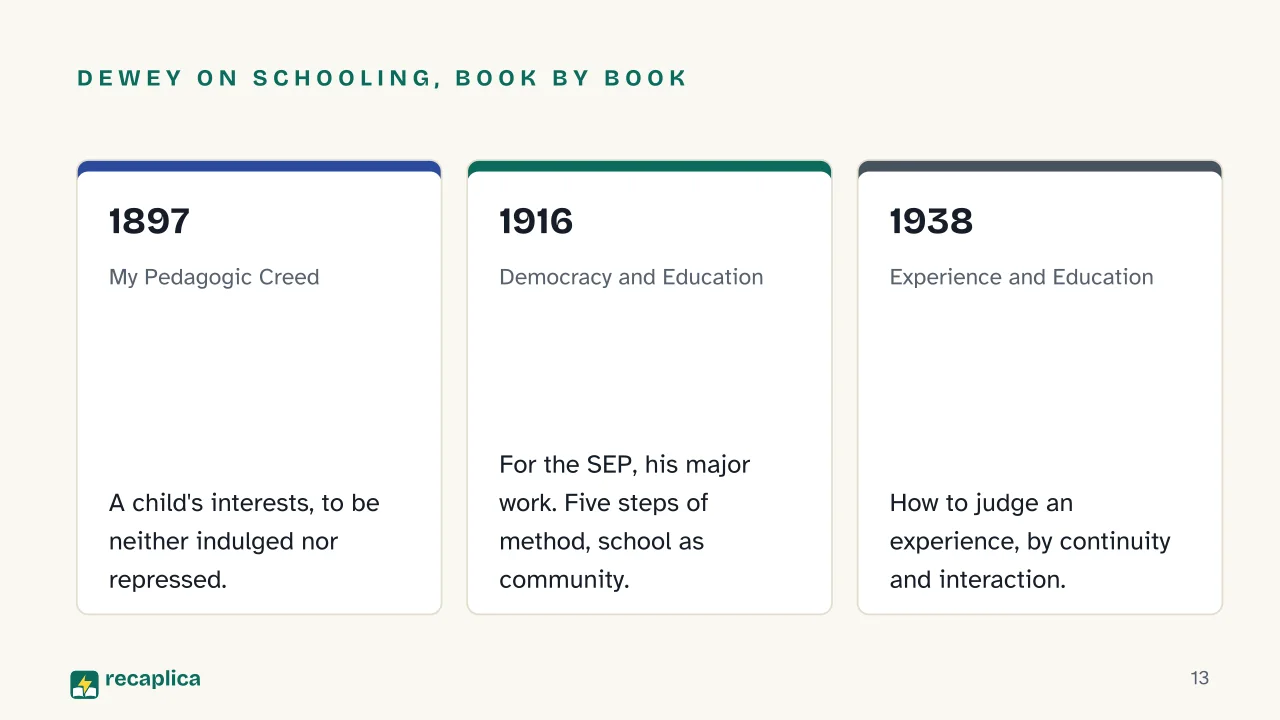 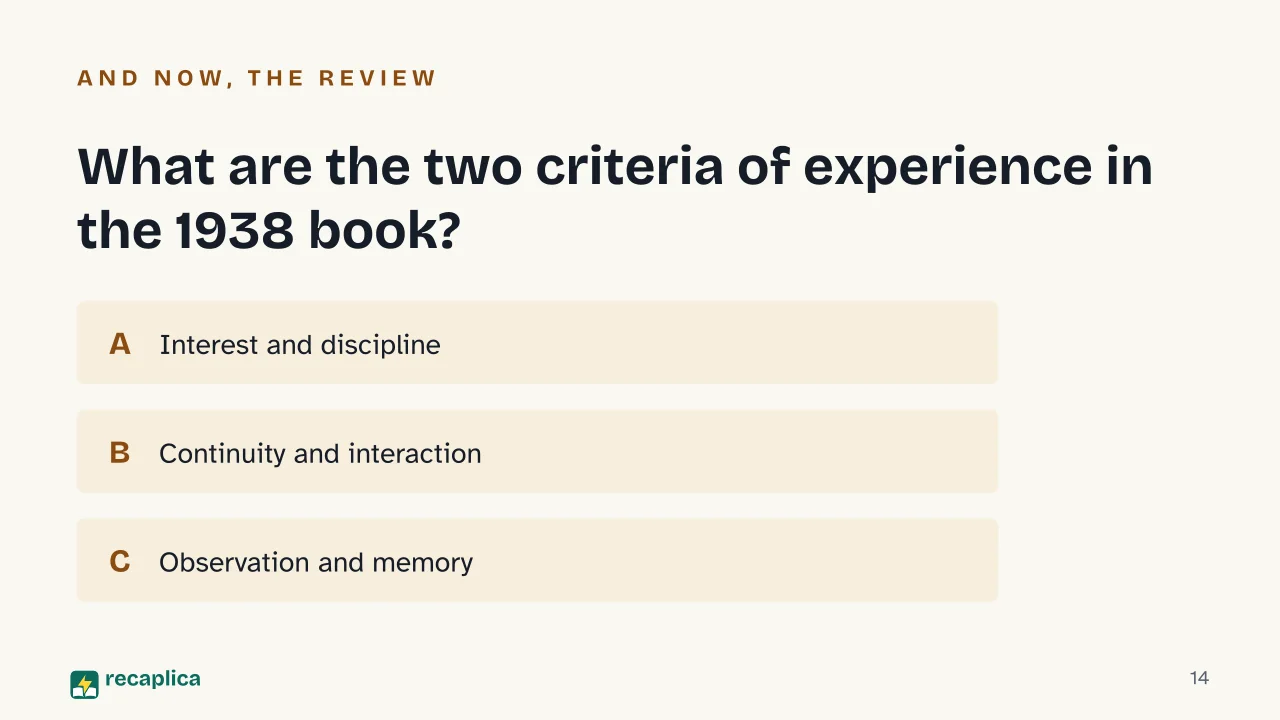  Common myths
Mind mapDrag the background to move around and the nodes to reposition them; use − and + to collapse and expand branches. 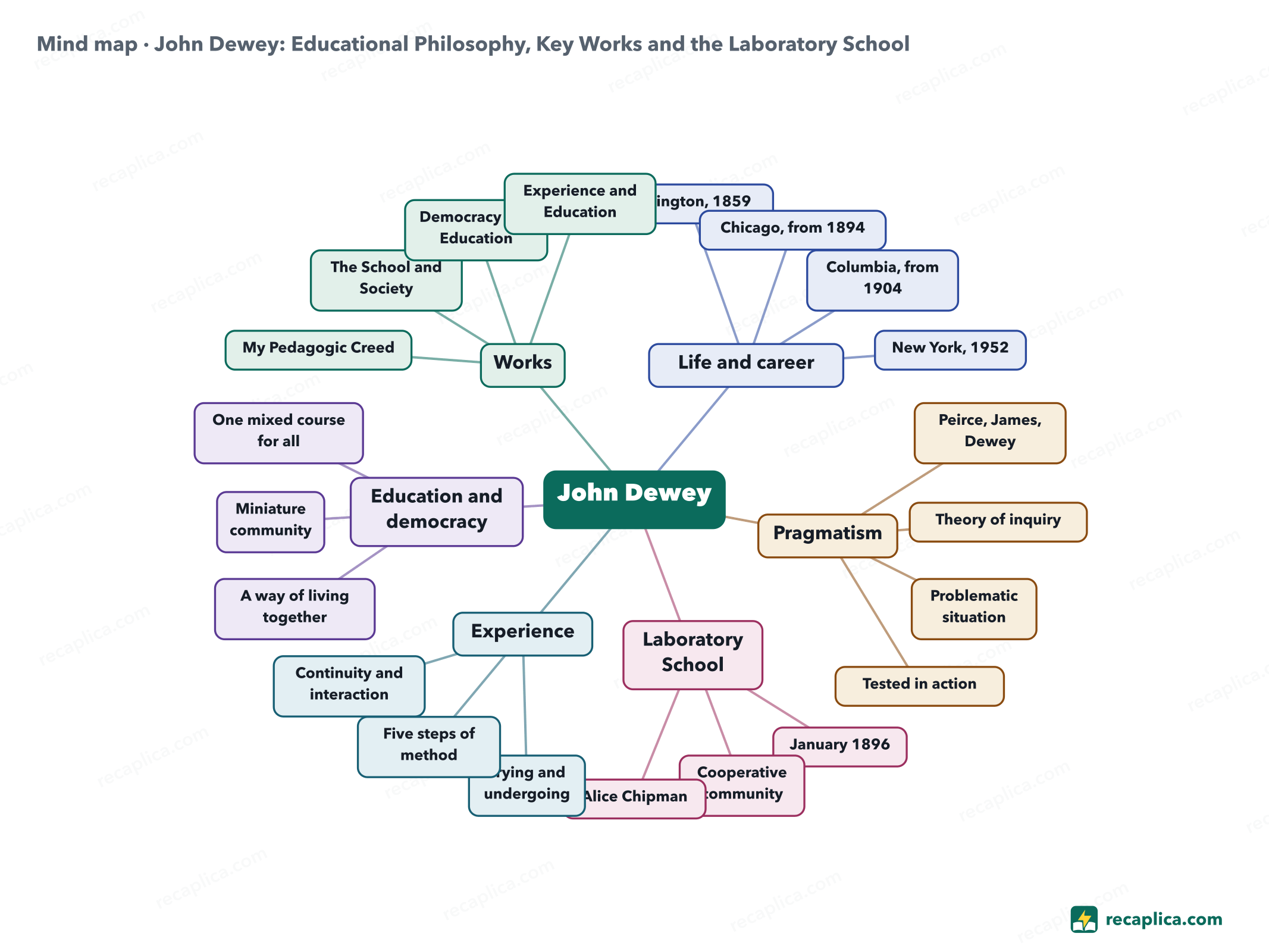
Quiz: test yourselfAnswer the questions to check what you have learned: you get instant feedback and a short explanation. Grade 0/10 0/5
FlashcardsTap the card to flip it and check whether you remember the answer, then move to the next one. 1 / 7 Explain it in your own wordsThe ultimate test: if you can explain it in simple words, you've truly understood it. Write your explanation, then compare it with the Recap. Your explanation is saved only on this device.
Frequently asked questionsWhat is John Dewey's My Pedagogic Creed?It is a short text Dewey published in January 1897 in the magazine School Journal, while he was a professor at the University of Chicago. He argues that education has a psychological side and a social side of equal weight, that the school is first of all a social institution, and that education is the main way to move society forward and reform it. What did Dewey mean by democratic education?In Democracy and Education (1916) democracy is a way of living together, and the habits it rests on are formed from the first years of school. That is why Dewey wanted schools organised as miniature communities with ties to the society around them, and a single mixed course of study for all young people, privileged or not. How did Dewey's school differ from traditional schooling?The schooling Dewey criticised put the curriculum, discipline and memorisation first, with pupils taking in disconnected facts. His started from concrete problems chosen to connect the curriculum with what pupils cared about, and it replaced rewards and punishments with a rethinking of the setting in which children learn. Where does Dewey fit in progressive education?According to the SEP, Dewey called the child-centred camp of the 1890s debate “new” or “progressive” education, and he tried to find a model that brought that camp and the traditional one into interaction. The school he founded in Chicago calls itself a pioneer of progressive education in the United States. Kevin Smith writes that Dewey's 1938 book Experience and Education was his attempt to correct how people had misread the progressive label. Where does “learning by doing” come from?The words appear in Democracy and Education (1916), where Dewey writes that natural development begins with situations in which children learn by doing, and he puts arts and practical occupations at the start of the curriculum. The thought itself is much older. Aristotle's Nicomachean Ethics already says that we acquire a skill such as building by practising it. Every Recap goes through an independent review before publication. |