Skip to content
recaplica

    One moment: security check

    Cloudflare wants to make sure you're not a robot. Tick the box below and your search will continue on its own.

    IT
    recaplica Johann Heinrich Pestalozzi: Who He Was and His Educational Method
    © 2026 Recaplica · recaplica.com — All rights reserved
    Home › History

    Johann Heinrich Pestalozzi: Who He Was and His Educational Method

    By Recaplica Newsroom · Updated on October 20, 2026

    What to print

    Page numbers appear when printing with default margins.

    Telegram channel
    recaplica Clear in 30 seconds, yours in 10 minutes.
    In 30 seconds Key points Figures Deep dive Myths Mind map Quiz Flashcards FAQ

    In 30 seconds quick read

    Johann Heinrich Pestalozzi was born in Zurich in 1746 and died in Brugg in 1827, testing his educational convictions in real schools for most of his life. At Neuhof, Stans and later Yverdon he opened schools for poor or orphaned children, convinced that learning should start from direct experience rather than rote memorization. His method became known as "head, heart and hands": it aimed to shape a child's thinking, moral sense and practical skill together. The institutes he ran became a reference point for governments and teachers across Europe, and among those who studied his methods in person was Friedrich Fröbel.

    Key Points

    • Pestalozzi was born in Zurich in 1746 and died in Brugg in 1827.
    • After his farming venture failed, in 1777 Pestalozzi turned the Neuhof estate into a home for poor children, who were trained in a trade.
    • He saw education as a balanced mix of mind, heart and manual skill.
    • He favored learning through direct observation of things over the rote memorization of facts.
    • He ran the Yverdon institute from 1804 to 1825, a model of educational reform for Europe.
    • Fröbel studied his methods at Yverdon and incorporated some of their principles into his own pedagogy.

    Key figures

    • 80 the children taken in at the Stans orphanage by spring 1799, up from fifty beds in January of that same year. Source: Arthur Brühlmeier, Pestalozzi's Biography
    • 20 the years the Yverdon institute operated, opened in 1804 and closed in 1825. Source: Community Playthings
    • 14 the letters to Gessner in which Pestalozzi explained his teaching method in Wie Gertrud ihre Kinder lehrt, published in 1801. Source: Treccani

    Deep Dive

    Johann Heinrich Pestalozzi was born in Zurich on January 12, 1746. He studied at the city’s Collegium Carolinum, where he came into contact with teachers tied to the Swiss Enlightenment and with the thought of Jean-Jacques Rousseau. He died in Brugg on February 17, 1827, after a life spent almost entirely testing his educational convictions in real institutes.

    The first experiment began almost by accident. Pestalozzi had bought twenty hectares of land and built a farm he named Neuhof; when the farming venture failed, in 1777 he turned the same land into a home for poor children, aiming to train them for work. The experiment did not last long: it closed as early as 1779. Still, Pestalozzi spent nearly thirty years at Neuhof, moving from agricultural experimentation to social reform through education.

    The second institute was born in a much harsher context. After the French invasion of Switzerland in 1798 and the burning of the village of Stans, Pestalozzi was allowed to open an institute there for orphaned children and others marked by the war, which he personally ran for six months. The orphanage officially opened in January 1799 with fifty beds, rising to eighty children by spring.

    The broadest and longest-lasting experience came with Yverdon. In 1804 Pestalozzi moved his institute into a castle in the town, where the educational experiment continued for twenty years, until it closed in 1825 (Treccani gives 1824; Brühlmeier and Community Playthings, more specific on this point, agree on 1825). The institute grew to more than one hundred fifty pupils between the ages of seven and fifteen, around thirty teachers and a similar number of trainee teachers. Among the visitors who passed through Yverdon over the years were Johann Gottlieb Fichte, Johann Friedrich Herbart and Friedrich Fröbel: the latter studied Pestalozzi’s methods there in person and incorporated several of their principles into his own pedagogy as an outside visitor.

    Pestalozzi’s educational philosophy

    At the core of Pestalozzi’s method was the idea of teaching built on a family-like bond between teacher and pupil. He valued intuition and direct contact with experience over the rote memorization of facts: this is known as the intuitive method. For this reason, head, heart and hands had to be educated together, with equal weight. For Pestalozzi, the goal of education was not the accumulation of knowledge but the formation of the person, with love at the center of the teaching relationship.

    Practical example: in a lesson built on the intuitive method, a teacher following Pestalozzi’s approach would not start from an abstract definition written on the board, but from a real object the child could observe, touch or handle, letting direct experience come before the rule.

    Pestalozzi also put his ideas into writing. In 1780 he published Abendstunde eines Einsiedlers, an early sketch of his pedagogical thinking, along with the first part of Lienhard und Gertrud — the second part followed in 1787 — the work considered his masterpiece. In 1801 he returned to the method more directly with Wie Gertrud ihre Kinder lehrt, fourteen letters addressed to his friend Gessner in which he explained his teaching step by step.

    The three institutes Pestalozzi ran had very different purposes and lifespans:

    InstituteYears activeFeatures
    Neuhof1777-1779Home for poor children, education through work
    Stans1799 (six months)Orphanage for children orphaned or affected by the war
    Yverdon1804-1825More than 150 pupils, 30 teachers, a model for Europe

    His institutes served as a model for philanthropists and governments across Europe, and trained a generation of teachers. Among the educators who drew on his ideas were Fröbel and Herbart — both, according to the sources, among the visitors to Yverdon during the years the institute was active.

    The idea of a school open even to the children of the poor, not reserved for the elite, places Pestalozzi within a debate on education that runs across centuries and traditions: in ancient Rome, for instance, the refined education of Roman education remained tied to a specific social class, while Pestalozzi’s project aimed explicitly at the children left out of it. Reflections on popular education also intersect with the broader Enlightenment debate on the relationship between the individual and society: the same climate of ideas, widespread across eighteenth-century Europe, also produced the theories on the social contract of Hobbes, Locke and Rousseau, and it was Rousseau’s thought that shaped Pestalozzi’s own upbringing. The broader cultural context in which this interest in education matured is explored further in the piece on the Age of Enlightenment.

    Pestalozzi’s legacy also touches the practical organization of public schooling, a subject that still translates into different rules from one European country to another: calendars, cycles and the start of lessons remain far from uniform, as the piece on school start dates in Europe shows.

    Common myths

    • ✗ Myth Pestalozzi was only a theorist, who wrote about education without ever testing it in practice.

      ✓ Reality He personally ran real institutes at Neuhof, Stans and Yverdon for several decades, testing his method with hundreds of real children.

    • ✗ Myth Fröbel was Pestalozzi's direct collaborator.

      ✓ Reality According to the sources, Fröbel visited and studied Pestalozzi's methods at Yverdon in person, incorporating several of their principles into his own pedagogy; there is no record of a close working partnership between the two.

    • ✗ Myth For Pestalozzi, popular education meant only teaching poor children to read and write.

      ✓ Reality His goal was a complete education, built on head, heart and hands together: intellect, moral feeling and practical skill cultivated within the same program.

    Mind map

    Drag the background to move around and the nodes to reposition them; use − and + to collapse and expand branches.
    Customize
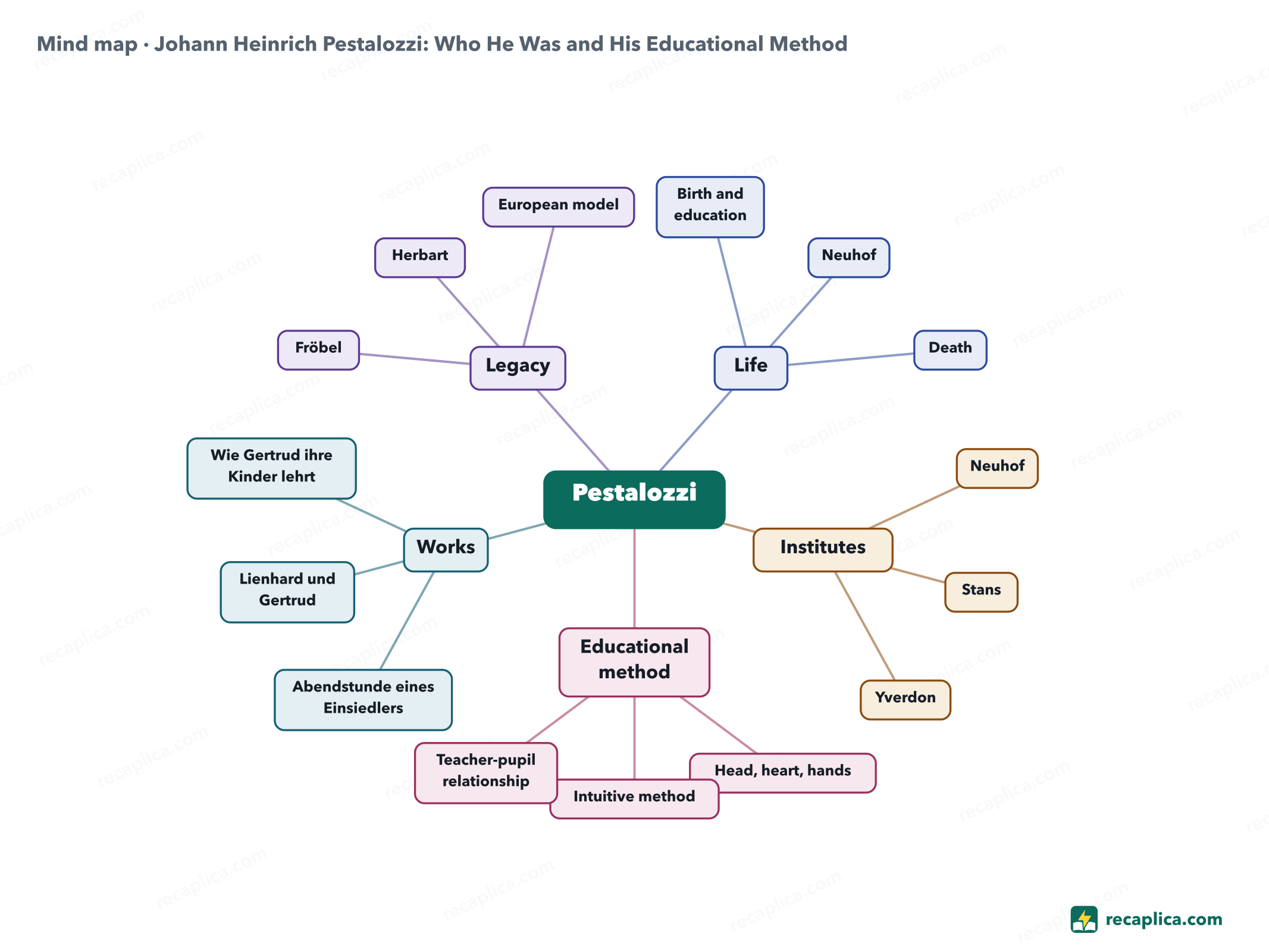
    Mind map: Johann Heinrich Pestalozzi: Who He Was and His Educational Method
    • Pestalozzi
      • Life
        • Birth and education Zurich, 1746, Collegium Carolinum
        • Neuhof farm, then a home for poor children, 1777-1779
        • Death Brugg, 1827
      • Institutes
        • Neuhof 1777-1779, education through work
        • Stans 1799, wartime orphanage
        • Yverdon 1804-1825, European model
      • Educational method
        • Head, heart, hands intellect, moral feeling, practical skill
        • Intuitive method direct experience before abstract rule
        • Teacher-pupil relationship modeled on family bonds
      • Works
        • Abendstunde eines Einsiedlers 1780, first sketch of his system
        • Lienhard und Gertrud 1780 and 1787, main work
        • Wie Gertrud ihre Kinder lehrt 1801, fourteen letters to Gessner
      • Legacy
        • Fröbel studied his methods at Yverdon
        • Herbart among those influenced by his ideas
        • European model institutes used as a reference by governments

    Quiz: test yourself

    Answer the questions to check what you have learned: you get instant feedback and a short explanation.

    Grade 0/10 0/5
    1 In what year was Johann Heinrich Pestalozzi born?

    Pestalozzi was born in Zurich in 1746 and died in Brugg in 1827.

    2 What happened at Neuhof in 1777?

    After his farming venture failed, Pestalozzi turned Neuhof into a home where poor children were educated through work.

    3 What does Pestalozzi's "head, heart and hands" formula mean?

    For Pestalozzi, education had to grow on three equal planes: thinking, moral feeling and knowing how to do things.

    4 True or false: Friedrich Fröbel was a direct collaborator of Pestalozzi in running the Yverdon institute.

    The sources describe Fröbel spending time at Yverdon to observe the institute as a visitor.

    5 Why did the Stans institute, opened in 1799, close after just a few months?

    Pestalozzi ran the Stans institute for six months, during the period marked by the French invasion of Switzerland in 1798 and the burning of the village.

    Answers: 1-A · 2-A · 3-B · 4-B · 5-B

    Flashcards

    Tap the card to flip it and check whether you remember the answer, then move to the next one.

    1 / 7

    Explain it in your own words

    The ultimate test: if you can explain it in simple words, you've truly understood it. Write your explanation, then compare it with the Recap.

    Your explanation is saved only on this device.

    Johann Heinrich Pestalozzi was born in Zurich in 1746 and died in Brugg in 1827, testing his educational convictions in real schools for most of his life. At Neuhof, Stans and later Yverdon he opened schools for poor or orphaned children, convinced that learning should start from direct experience rather than rote memorization. His method became known as "head, heart and hands": it aimed to shape a child's thinking, moral sense and practical skill together. The institutes he ran became a reference point for governments and teachers across Europe, and among those who studied his methods in person was Friedrich Fröbel.

    Frequently asked questions

    Who was Johann Heinrich Pestalozzi?

    A Swiss educator, born in Zurich in 1746 and died in Brugg in 1827, who ran institutes for the education of poor or orphaned children at Neuhof, Stans and Yverdon.

    What is Pestalozzi's head, heart and hands method?

    The principle that head, heart and hands — thinking, moral feeling and practical skill — should be cultivated side by side, with the same educational weight.

    What is Pestalozzi's intuitive method?

    A teaching approach built on direct observation and the child's concrete experience, leaving the memorization of rules in the background.

    What was the relationship between Pestalozzi and Fröbel?

    According to the sources, Fröbel spent time at Yverdon closely observing how the institute was run, and carried several of its elements into his own pedagogy as an outside visitor.

    Why is Pestalozzi considered a pioneer of popular education?

    Because he opened schools dedicated to poor children, at a time when structured schooling was mostly reserved for the elite, and because his institutes served as a model for governments and philanthropists across Europe.

    Sources

    • Treccani, voce «Pestalòzzi, Johann Heinrich»
    • Arthur Brühlmeier, Pestalozzi's Biography
    • Community Playthings, Johann Heinrich Pestalozzi
    • Early Years TV, Johann Heinrich Pestalozzi: Philosophy of Education

    Every Recap goes through an independent review before publication.

    Every evening, the day's new Recaps on our Telegram channel. Join the channel →

    Keep learning

    • History Ancient Greek Art: The Periods, Statues and Temples From Kouroi to the Hellenistic Age Greek art is usually split into four periods, from Geometric to Hellenistic, with the Severe style as the bridge between the two in the middle. Statues begin as the stiff kouroi of the sixth century BC, turn into the moving bodies of the Classical age and end as the theatrical groups of the Hellenistic world. Temples such as the Parthenon give sculpture its places: pediments, friezes and metopes. The dates are a teaching convention, because the changes were never sharp. Read the Recap →
    • History What Is Kinship? Types of Family, Descent and Residence Across Cultures In anthropology, kinship is the set of ties that a culture recognises as family: ties of blood, ties created by marriage and, in some cases, ties with neither, such as adoption. Families exist in every society, but in very different forms: nuclear, extended, joint, with several wives or several husbands. Cultures also differ in the line through which descent is counted, in where a couple goes to live and in the names given to relatives. A couple with young children is therefore one form among many. Read the Recap →
    • History Geocentric vs heliocentric model: from Ptolemy to Galileo In Ptolemy's system the Earth sat at the center of the cosmos, and the movements of the planets were explained by combining circles. Copernicus moved the Earth, which also called Aristotle's physics into question. Tycho Brahe, the greatest observer before the telescope, found none of the parallax that the Copernican model implied, and he proposed a compromise. Kepler's ellipses came in 1609 and Galileo's telescope discoveries in 1610, followed by Galileo's condemnation in 1633. Read the Recap →

    recaplica

    Clear in 30 seconds, yours in 10 minutes.

    Recaps Mind maps Request a Recap Telegram channel Mind map maker Our method About Privacy & cookies Legal notes & terms of use

    © 2026 Recaplica · A project by Curi S.r.l. — VAT IT05472000750

    Statistics, only if you say so

    To learn which Recaps help most we would use Google Analytics, with aggregate, anonymous data. It starts only with your OK, and you can change your mind anytime. Privacy policy