|
recaplica
Definition of Culture in Anthropology, from Tylor to Geertz | |||||||||||||||||||||
| © 2026 Recaplica · recaplica.com — All rights reserved | |||||||||||||||||||||
Definition of Culture in Anthropology, from Tylor to GeertzWhat to print Page numbers appear when printing with default margins. SlidesChoose a cut Flash10 slidesThe essential thread, to present in classFull16 slidesEvery chapter and the deeper detailBoth come with speaker notes. In 30 seconds quick readTo anthropologists, culture is the way of life a person learns by growing up in a group, with its knowledge, beliefs, rules and habits. According to Francesco Remotti, the first complete definition in this sense came from the Englishman Edward B. Tylor in 1871. Understood this way, even someone who never went to school has a culture, like anyone who lives in a society. Franz Boas turned attention to cultures in the plural, Malinowski tied culture to needs and Geertz to meanings. In the 1990s and 2000s criticism of the concept grew within anthropology, because it suggests closed, uniform groups. Key Points
Key figures
Deep DiveCulture in everyday speech and in anthropologyIn everyday speech a cultured person is someone well educated. The Treccani dictionary of Italian lists this meaning first: the knowledge a person builds up through study and experience. It gives the social sciences a separate and more technical meaning, which takes in the material activities a group lives by alongside its patterns of behavior, its symbols, beliefs and values. Francesco Remotti, who wrote the entry «Cultura» for the Enciclopedia delle scienze sociali (1992), keeps the two ideas firmly apart. The classical one is an ideal for shaping the individual and describes how a person ought to be; it applies only to some people in some societies. The modern one, established by the social sciences, describes how human groups live and applies to every member of a group. Anyone who talks about Maori culture or youth culture is using this second sense, which has nothing to do with being educated. Christoph Brumann, author of the entry «Culture» in the Open Encyclopedia of Anthropology (2026), observes that in popular use the word calls up the arts and polite manners; anthropologists give it a far wider reach, covering the behaviors, feelings and ways of thinking that members of a group have in common.
Anthropologists also use the word in the singular and the plural. In the singular it means human culture as a whole; in the plural, the cultures of particular groups, which for Brumann can be the Japanese, cyclists or bakers. From colere to Pufendorf: the history of the wordThe word goes back to the Latin verb colere, to cultivate, whose past participle is cultus. Remotti points out that the verb covered many actions: worshipping a god, tilling the soil, exercising a faculty, living in a place, adorning the body. Both ideas of culture grow out of this farming image. In the Tusculan Disputations Cicero calls philosophy cultura animi, the cultivation of the mind, and that classical sense runs all the way down to our cultured person. Brumann traces the shift another way. At first the word named what cultivation produced, like a harvest or a culture of bacteria, and later the fruits of cultivating oneself. According to a study by Hahn (2002) that Brumann cites, the first person to apply it to the customs and habits of whole societies was the German philosopher Samuel von Pufendorf, in 1672. Through thinkers such as Herder this usage reached the founders of anthropology in the nineteenth century. With Herder, objects such as bows and arrows also become part of culture. Remotti finds in him the idea that human ways of life are many and cannot be boiled down to one, which is where the plural «cultures» comes from. Tylor’s definition of 1871In 1871 the London publisher John Murray brought out Primitive Culture by the Englishman Edward B. Tylor. The first chapter opens with the definition. Tylor treats culture and civilization, understood broadly in the ethnographic sense, as a complex whole: knowledge, belief, art, morals, law and custom, plus whatever other capabilities and habits someone picks up as a member of a society. Remotti regards it as the first complete definition of culture in the anthropological sense. As Remotti reads it, the definition holds ideas that have lasted. Culture is acquired and is not passed down through the genes, and it is learned precisely because a person belongs to a social group. It also spans a wide range of activities, far beyond the intellectual pursuits that mattered to philosophers. Tylor, however, looked at culture through the lens of evolutionism. In his view similarities between civilizations come from uniform causes, and the different degrees of civilization are stages of development, each the outcome of the history before it. Tylor himself says he devotes the two volumes mainly to comparing what he calls lower tribes with what he calls higher nations, so a ranking of peoples is built into his scheme.
Culture is learned: enculturation and acculturationAlfred L. Kroeber explained the anthropological concept of culture in his 1917 essay The Superorganic with an example from the Arctic. The other mammals that live there grow thick fur; humans wear the skins of animals. Language too, for Kroeber, is acquired entirely and is a product of society.
The name for this process is enculturation. In the human sciences it means absorbing one’s own culture during socialization, especially in childhood. Melville J. Herskovits, writing in 1955, used the same word and argued that everyone reads their own experience through the culture they grew up in. Remotti observes that the older people get, the harder it becomes to make a different culture their own. The Treccani encyclopedia warns against a mix-up. Acculturation is something else, the change a people’s culture goes through on contact with other peoples, and the word is sometimes wrongly used in place of enculturation. Boas and cultures in the pluralFranz Boas, a German ethnologist born in Minden in 1858 who died in New York in 1942, moved anthropology away from evolutionism and the comparative method. For him every culture grows out of its own internal history and its contacts with neighboring cultures. In The Mind of Primitive Man (1911) he attacked the racism of Gobineau, Chamberlain and Grant and argued that the human mind is essentially the same in all groups. In a passage collected in 1940 in Race, Language, and Culture, as the Stanford Encyclopedia of Philosophy reports, he wrote that ethnological data tie both knowledge and emotions to social life and to the history of one’s own people. Boas and his students Margaret Mead and Ruth Benedict spread the broad sense of the word. According to Brumann, Boas showed in 1912 that even the shape of the skull varies for social reasons, and Mead (1928) and Benedict (1934, 1946) showed that the culture a person grows up in leaves a lasting mark on personality. Brumann judges this an important result at a time when scientific racism had not yet been fully taken apart. Cultural anthropology arose in the United States in the early twentieth century, largely through the work of Boas and his students. The Treccani encyclopedia sets it apart from British social anthropology, which developed after 1870, because it puts the notion of culture at the center, and Brumann notes that the North American branch takes its name from that notion. Cultural relativism and ethnocentrismThe sociologist William G. Sumner defined ethnocentrism in his 1906 book Folkways. The term describes the habit of judging other groups by the values and customs one grew up with, and according to the Treccani it nearly always leads people to overrate their own culture and underrate other people’s. The idea that norms and values come from convention is an old one. The Stanford Encyclopedia of Philosophy traces it to the Greek historian Herodotus (c. 484-425 BC), though cultural relativism only spread in the twentieth century, through anthropology. In anthropology the term refers to the approaches of the Boas school, which study each culture in its own time and place instead of lining cultures up for comparison. With Herskovits’s «principle of cultural relativism», Boas’s ideas became the dominant line in anthropology; in a 1955 text Herskovits summed it up this way: judgments come from experience, and experience always passes through the enculturation of whoever is judging. For the Stanford Encyclopedia of Philosophy, the core of the idea is that cultural perspectives and values have equal standing and vary with the setting they come from. To relativists, holding one outlook to be objectively superior to the others is itself ethnocentrism. The Treccani adds that cultural relativism is also a method for understanding others from the inside, and takes up Malinowski’s call to grasp how a Trobriand Islander sees his own world. In Local Knowledge, which the Stanford Encyclopedia quotes, Geertz treated cultural and historical relativism as a single idea: a people far away and an age long gone both imagine the world in ways we cannot easily read as if they were our own.
Malinowski and culture as a response to needsBronisław Malinowski, a Polish social anthropologist who later became a British citizen, was born in Kraków in 1884 and died in New Haven in 1942. Between 1914 and 1918 he did research in New Guinea, above all in the Trobriand Islands, and that work, written up in Argonauts of the Western Pacific (1922), gave rise to the fieldwork method, participant observation in particular. The Treccani encyclopedia names him as the figure usually regarded as the father of functionalism. In the entry «Culture» he wrote in 1931 for an encyclopedia of the social sciences, Malinowski argued that in every civilization each custom, object, idea and belief performs a task within an organic whole. As Remotti reads him, culture is above all a response to people’s biological needs: the needs are the same for everyone, while cultures meet them in very different ways. Geertz and culture as a web of meaningsTylor’s definition took in objects and habits as well. According to Brumann, after the Second World War North American anthropologists moved culture onto the plane of ideas, and many of them, including interpretive anthropologists such as Clifford Geertz, saw it as made of meanings, values and symbolic systems. Geertz, who was born in San Francisco in 1926 and died in Philadelphia in 2006, published The Interpretation of Cultures in 1973. Remotti sums up his view this way: culture is a system of symbols, sources of information that lie outside the human body, and the brain on its own could not steer behavior. The book also gives the image of webs of meaning that human beings have spun themselves and in which they hang suspended. For the Treccani, the anthropologist’s task according to Geertz is to decipher the meaning of a community’s actions, practices and rituals; it is an interpretation of an interpretation, because people already make sense of what they do. Material and non-material cultureBy material culture the Treccani dictionary means the visible side of a culture: works of art, everyday tools, buildings. It also records a three-way division that is sometimes used, into ideological, material and behavioral culture. Brumann notes that practices and objects are shared just as much as ideas and values. That is why many anthropological definitions include practices, objects or both, putting material culture alongside the non-material kind. Remotti observes that those who see culture only as an aid to survival tend to reduce it to tools. Criticism of the concept of cultureIn the 1990s and 2000s the term drew more and more criticism within anthropology. Critics objected that talking about cultures suggests closed, uniform blocks, like the complex whole of Tylor’s definition. Brumann calls Lila Abu-Lughod’s essay Writing against culture (1991) the most concise statement of this view; it urges anthropologists to write against the concept. The philosopher Michele Moody-Adams (1997) describes cultures as porous, full of contradictions and open to change. Others question how different cultures really are. According to Brown (2004), constants of human experience such as empathy, fear, kinship and the rituals around birth and death undercut part of the diversity that ethnographers have described. Brumann grants that the differences were hard to deny: most Japanese people greet one another differently from most Italians. Even so, he writes, skepticism seems to have won out, and anthropologists talk much less about culture and about specific cultures. He proposes thinking of culture as a toolkit of tried and tested responses, an idea he takes from Swidler (1986), and he notes that socially transmitted behavior has been documented in many animal species, especially great apes and cetaceans. Slide deckSlides ready to download and make your own in PowerPoint or Google Slides, with speaker notes. Pick the Flash cut or the Full one.     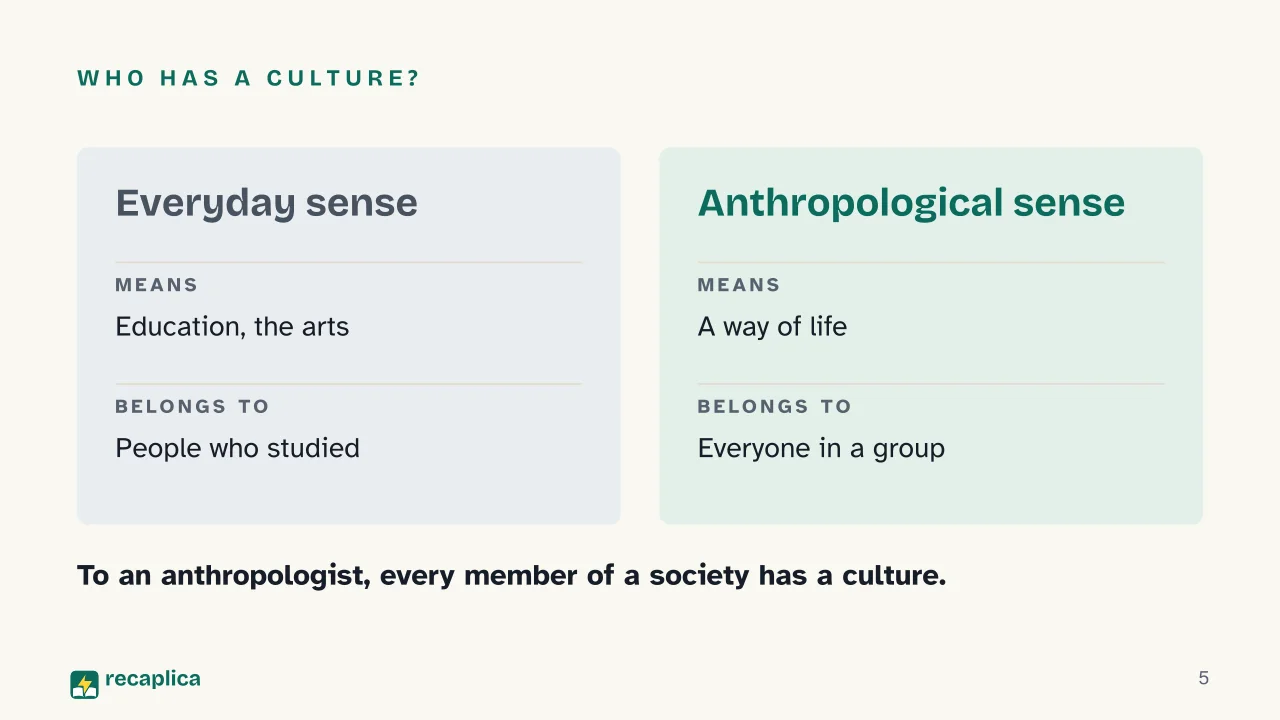  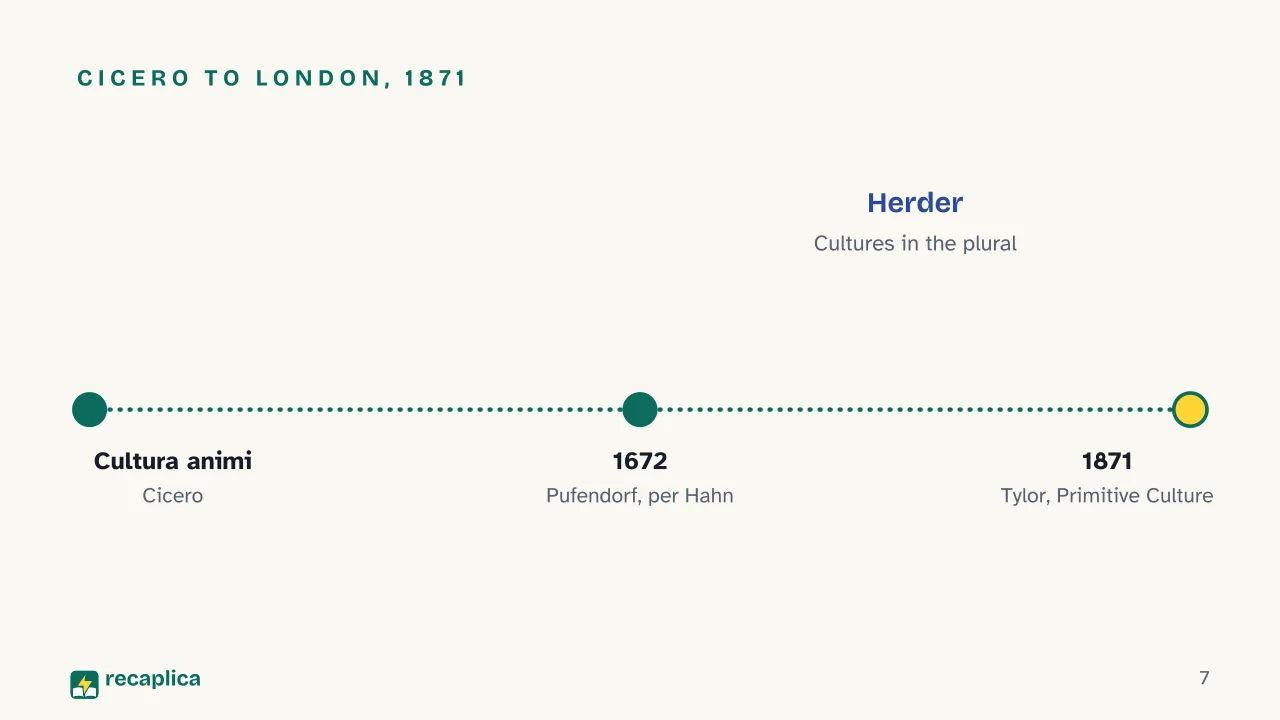 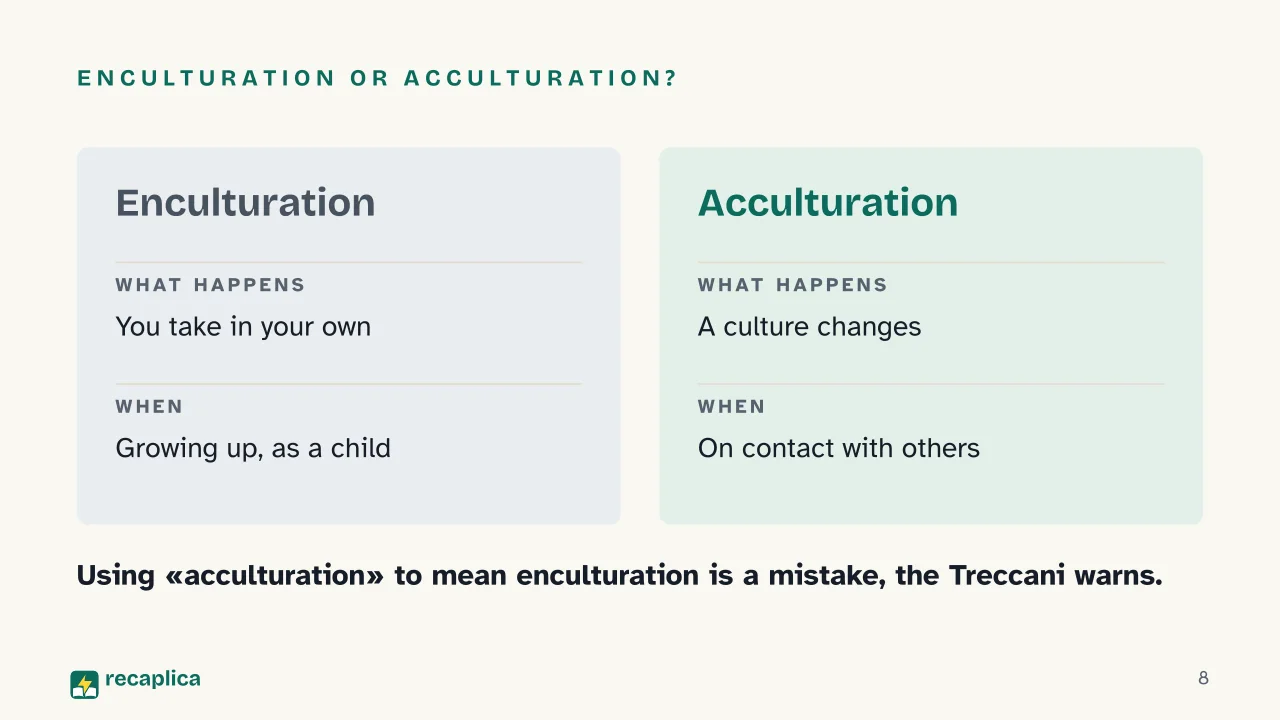  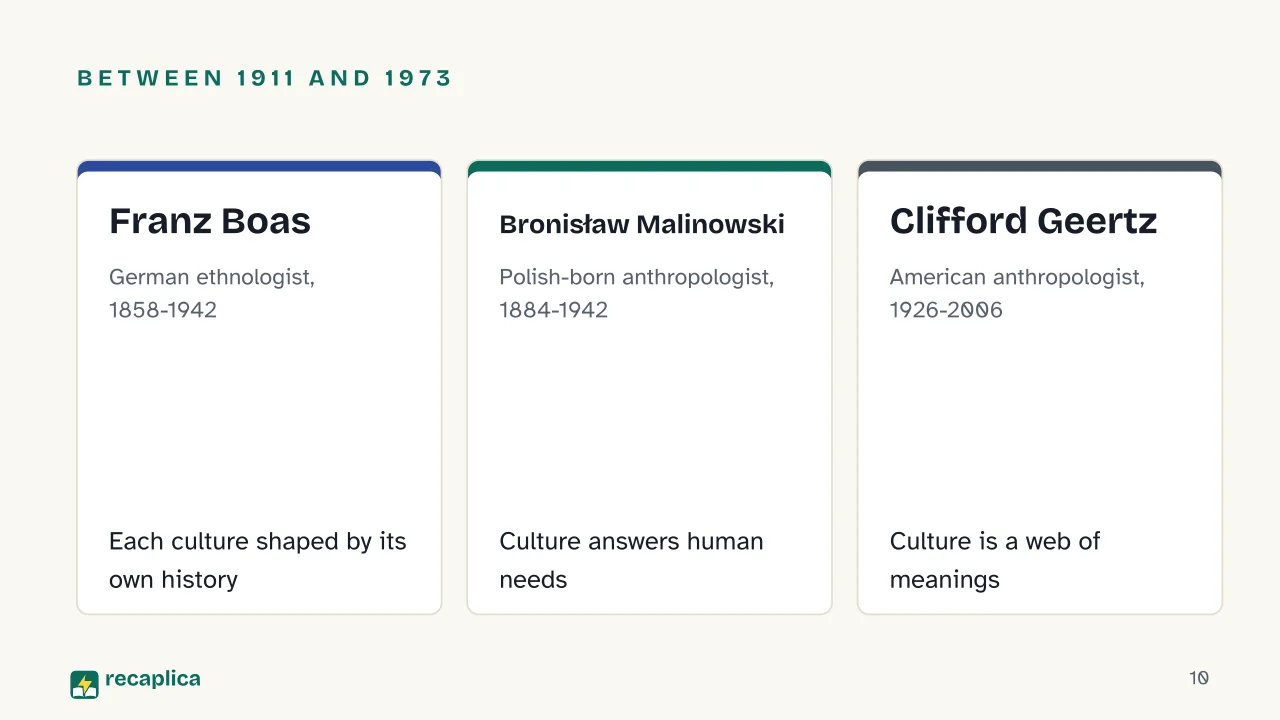  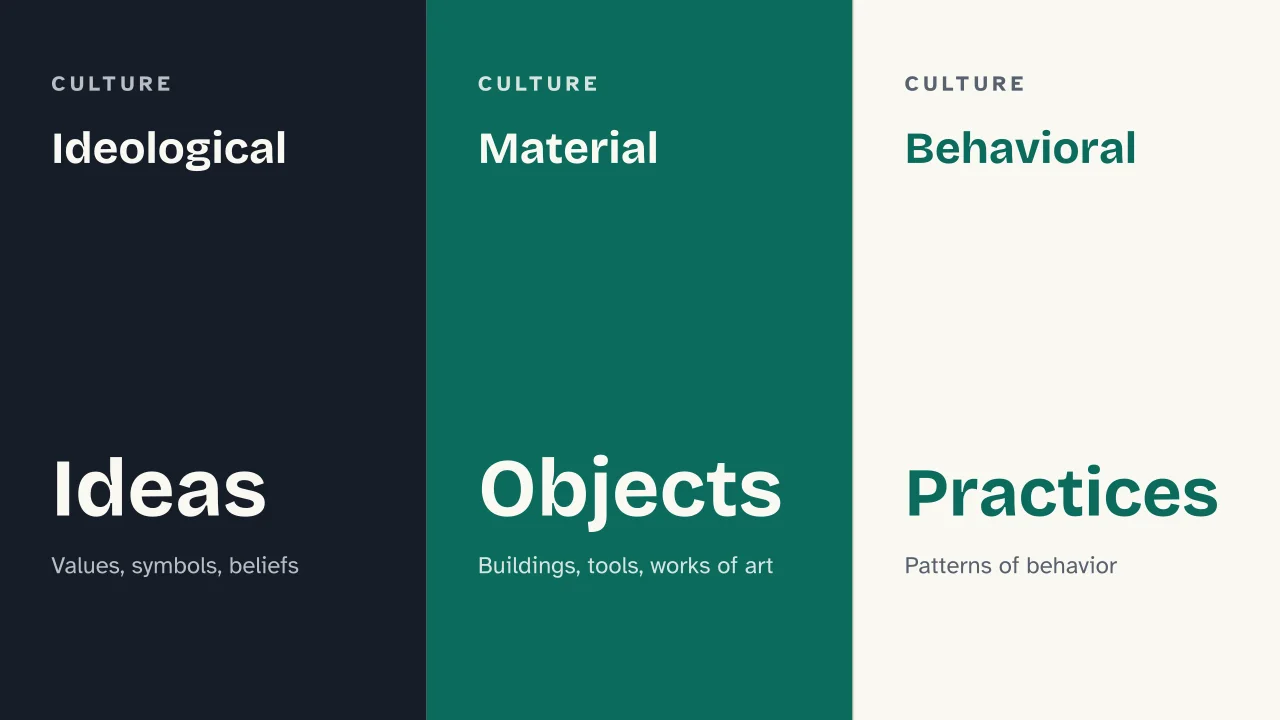  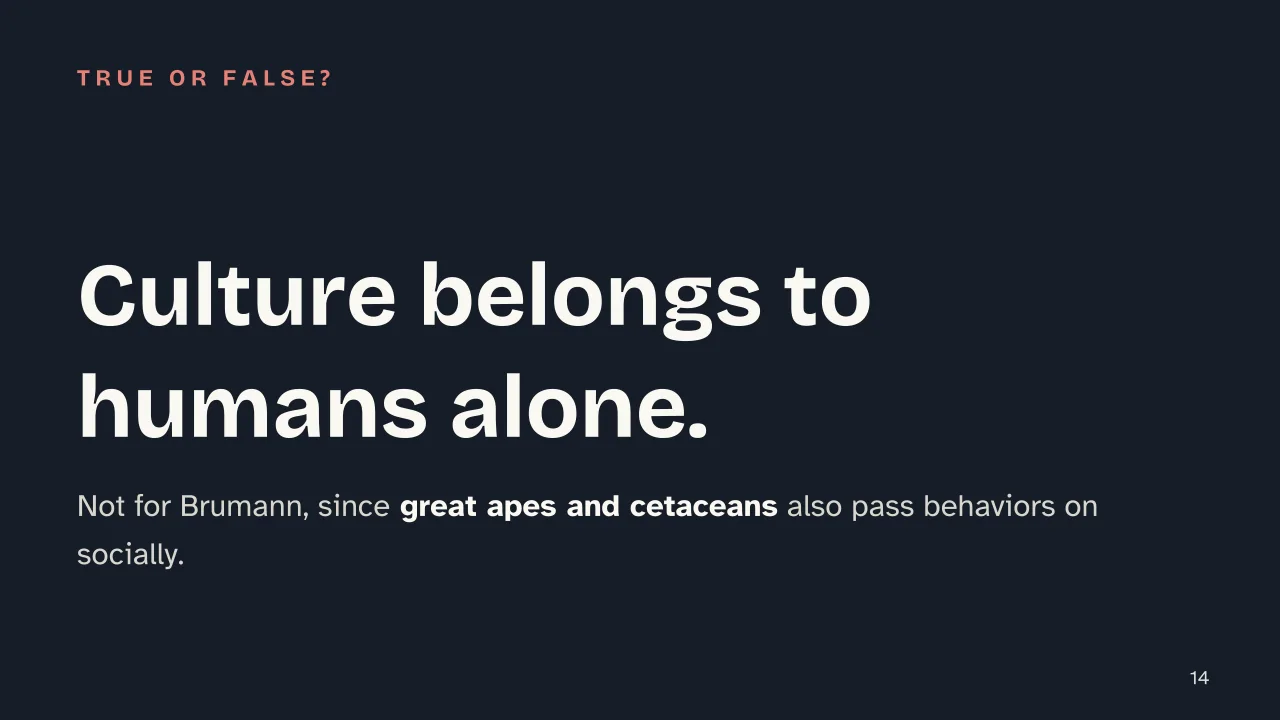 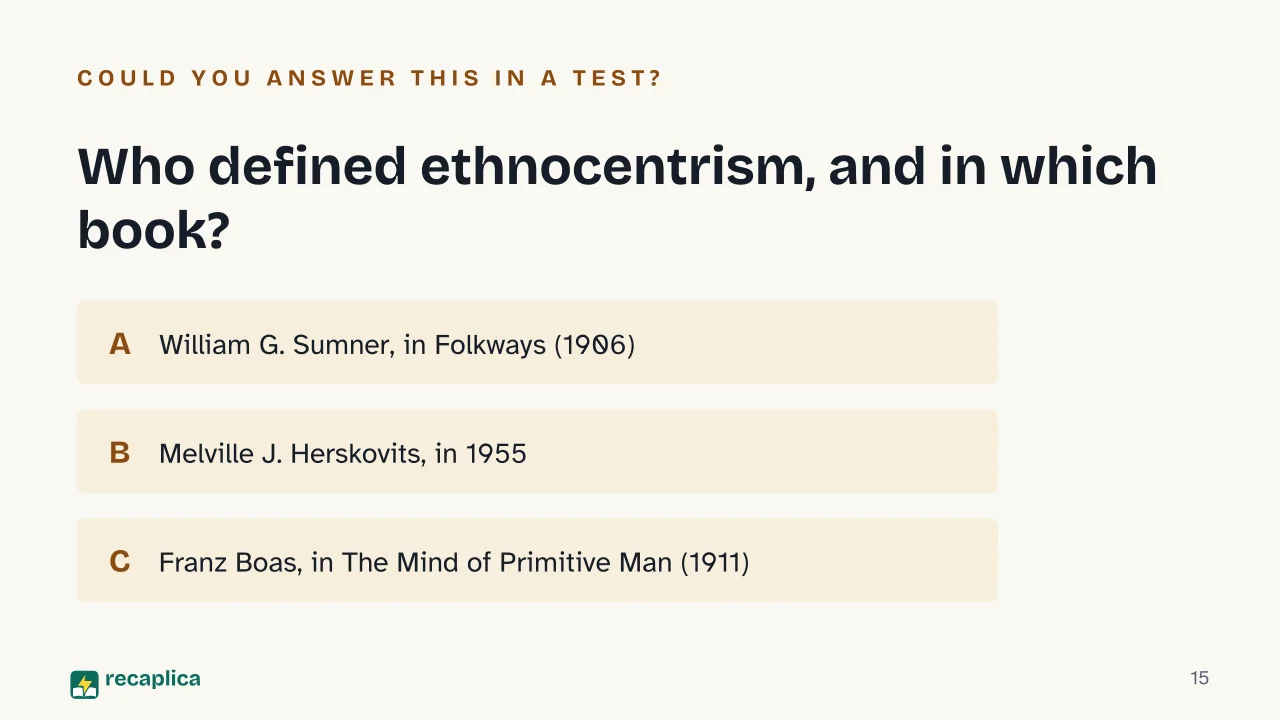  Common myths
Mind mapDrag the background to move around and the nodes to reposition them; use − and + to collapse and expand branches. 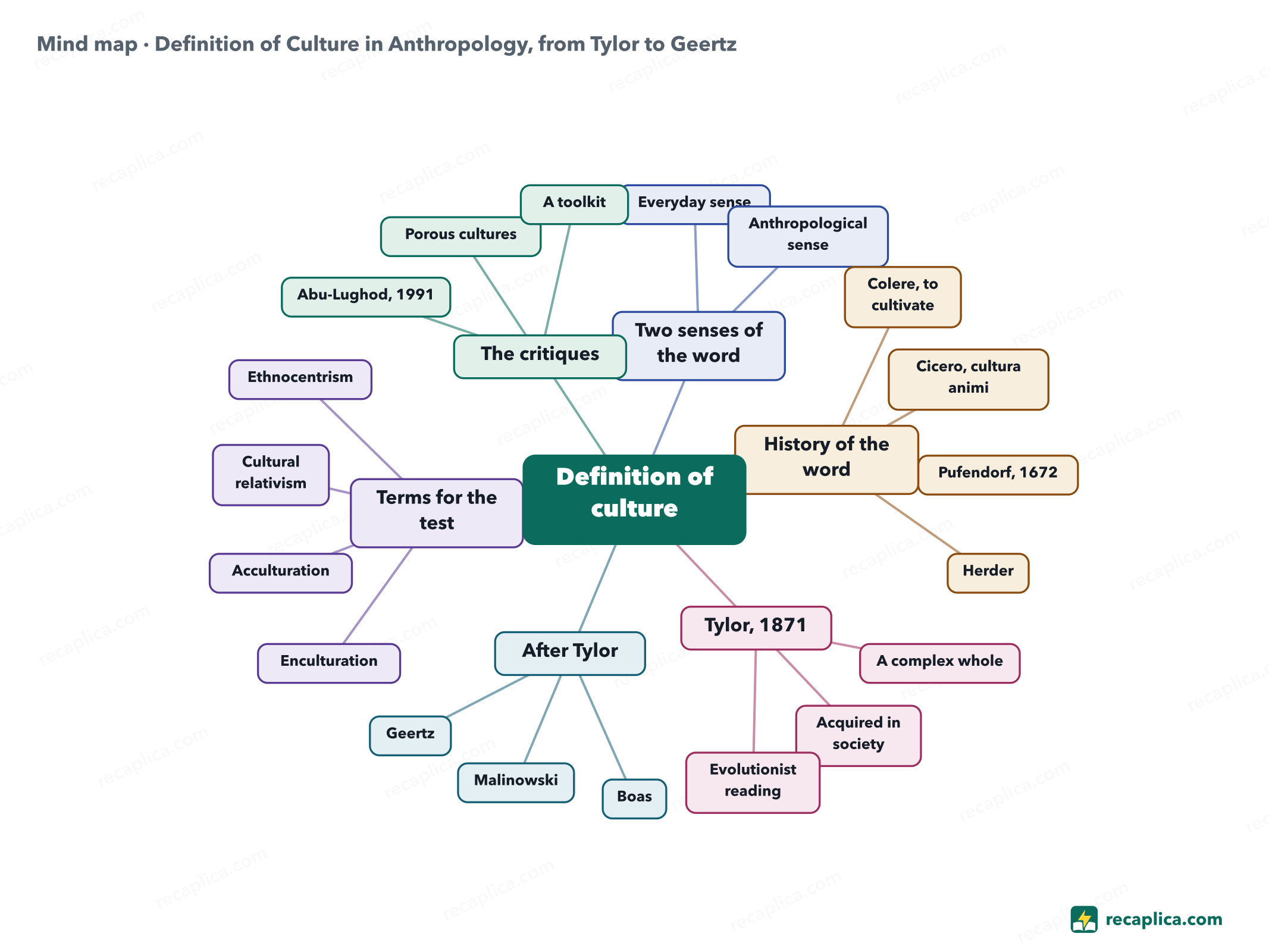
Quiz: test yourselfAnswer the questions to check what you have learned: you get instant feedback and a short explanation. Grade 0/10 0/5
FlashcardsTap the card to flip it and check whether you remember the answer, then move to the next one. 1 / 7 Explain it in your own wordsThe ultimate test: if you can explain it in simple words, you've truly understood it. Write your explanation, then compare it with the Recap. Your explanation is saved only on this device.
Frequently asked questionsWhat does the word culture mean?In everyday use, culture means education and the arts, the sense behind calling someone cultured. In anthropology it means the shared way of life of a human group, including its customs, beliefs and objects. In that second sense everyone who lives in a society has a culture. Who gave the first anthropological definition of culture?According to Francesco Remotti, it was the Englishman Edward B. Tylor, who wrote it in the first chapter of Primitive Culture, published in London in 1871. His definition brings together knowledge and belief, art and morals, law and custom, all of which a person acquires by living in society. How is the concept of culture linked to society?In the anthropological concept, culture and society go together. Tylor's definition covers everything someone picks up by belonging to a society, and in Remotti's reading it is learned precisely because one belongs to a social group. That is why anyone who is part of a society has a culture. What is the difference between enculturation and acculturation?Enculturation is the way each person absorbs the culture of their own group while growing up, especially in childhood. Acculturation is the change a culture goes through when it comes into contact with other peoples. The Treccani encyclopedia notes that the second word is sometimes used in place of the first, which is a mistake. Do animals have culture?For Christoph Brumann, writing in the Open Encyclopedia of Anthropology (2026), they do: culture is not limited to our species. In many animals, especially great apes and cetaceans, researchers have observed behaviors that pass from one individual to another socially. Every Recap goes through an independent review before publication. |