|
recaplica
History of Christmas: Origins and Traditions Around the World | ||||||||||||||||||
| © 2026 Recaplica · recaplica.com — All rights reserved | ||||||||||||||||||
History of Christmas: Origins and Traditions Around the WorldWhat to print Page numbers appear when printing with default margins. SlidesChoose a cut Flash10 slidesThe essential thread, to present in classFull18 slidesEvery chapter and the deeper detailBoth come with speaker notes. In 30 seconds quick readChristmas began as a Christian holiday, but it inherited rituals and symbols from much older pagan celebrations, including Roman Saturnalia and Nordic Yule. December 25 has no basis in the Gospels: it was chosen centuries later, most likely to overlap with existing winter-solstice festivals. Over the centuries the holiday swung between extremes, from rowdy medieval carnival to an outright ban in Puritan America, before being reshaped in the 1800s into the quiet family celebration familiar today. Around the world it's still celebrated on different days and in very different ways: Orthodox Christians mark it on January 7 because of a calendar gap, while countries such as Italy and Japan have built their own traditions, from the Befana to Christmas Eve fried chicken. Key Points
Key figures
Deep DiveBefore Christianity: Saturnalia and YuleMany of the customs we now call “Christmas traditions” existed long before Christianity did. In Rome, around the winter solstice, people celebrated Saturnalia, a festival dedicated to the god Saturn that started on December 17 and grew longer over time; sources disagree on by how much, with some describing a week-long extension and others a full month. During Saturnalia the usual social hierarchies were suspended, and the festival already featured feasting, singing, candles, and gift exchanges. The Romans also observed Juvenalia, a festival honoring children, and marked December 25 as the birthday of the god Mithras, believed at the time to be the date of the winter solstice in the Roman calendar. Farther north, Germanic and Norse peoples celebrated Yule, also tied to the return of light after the solstice. Its exact origins remain uncertain, but one of its best-known customs was the Yule log: a trunk, in some versions an entire tree, burned slowly for the whole length of the festival, up to twelve days. The Old Norse name for this festival, “jól”, is the root of words such as the Swedish and Norwegian “Jul”, which still mean Christmas in those languages. Why December 25, specificallyNo Gospel gives a date for the birth of Jesus. The choice of December 25 came centuries later, made by Pope Julius I, and historians often point to the same explanation: by the end of the 4th century, many Saturnalia customs, gifts, candles, songs, feasts, had already made their way into Christian Christmas celebrations. The most widely accepted explanation, then, is that the Church chose that date to absorb and overlay a pagan festival already deeply rooted in the Roman calendar, alongside the cult of Mithras celebrated on the same day. It remains a hypothesis, the strongest one in circulation, not a precisely documented fact: no ancient source explains the decision in the terms we use to describe it now. For anyone curious about how Rome’s calendar took shape, and how later reforms reshuffled its months, the history of the Roman calendar and the names of the months traces the system onto which the date of Christmas was later grafted. From medieval chaos to a Victorian ChristmasThe quiet, family-centered Christmas familiar today hasn’t always looked this way. Medieval celebrations were described as loud and unruly, closer to a drunken carnival than a hushed family gathering: a figure known as the “lord of misrule” led the festivities, briefly turning the usual social order upside down. In Puritan America the reaction to those excesses was drastic. In Boston, between 1659 and 1681, celebrating Christmas was against the law: anyone caught doing so risked a fine of five shillings.
It wasn’t until the 19th century, with writers like Washington Irving, who painted an idealized Christmas in his 1819 writings, and Charles Dickens, that the holiday was reinvented as a peaceful family occasion, leaving behind the carnival image of earlier centuries. Around the same time, German and other European settlers spread the custom of decorating a tree across America, a practice that in Germany already dated back to the Middle Ages. Santa Claus: from a Turkish bishop to an advertising iconThe figure of Santa Claus traces back to a real historical person: St Nicholas, born around 280 CE in Asia Minor, in what is now Turkey. His name, in the Dutch tradition “Sint Nikolaas”, gradually became “Sinter Klaas”, the root of the English “Santa Claus”. Two later milestones fixed the image still recognized today. In 1822 Clement Clarke Moore wrote the poem “A Visit from St. Nicholas” (also known as “‘Twas the Night Before Christmas”), the first to depict Santa Claus with reindeer. In 1881, cartoonist Thomas Nast drew the modern image of “Old Saint Nick”: red coat, white beard, sack of toys on his back. That has been the standard image ever since, decades before Coca-Cola launched its own holiday advertising campaigns: the company arrived once the image was already fixed, and simply carried it around the world without inventing it. Checking the real origin of a popular tradition, rather than settling for the most repeated version, is the same exercise worth applying to other customs widely assumed to be older or more “authentic” than they are: it holds for Santa Claus just as it does for the real history of carbonara, another case where popular legend and documented fact tell two different stories. One holiday, two dates: the Orthodox worldAround 260 million Orthodox Christians worldwide celebrate Christmas not on December 25 but on January 7. The reason isn’t theological, it’s calendrical. In 325 CE the Council of Nicaea standardized the Christian calendar on the Julian calendar, whose calculations, the work of the astronomer Sosigenes, overestimated the length of the solar year by about 11 minutes. A tiny error, but one that accumulated over the centuries into something significant. In 1582 Pope Gregory XIII introduced the Gregorian calendar to correct the gap, but the Orthodox Church, split from Rome since the Great Schism of 1054, didn’t adopt it: doing so would have meant accepting, under the Orthodox reading of scripture, occasional overlaps between Passover and Easter. By 1923 the gap between the two calendars had reached 13 days, which is why the Julian December 25 falls on the Gregorian January 7. Not every Orthodox country still follows the full Julian calendar: Greece, Cyprus, and Romania, for instance, adopted a revised version of the Julian calendar in 1923 and now celebrate Christmas on December 25, like the West. Russia and Egypt, along with various communities in Ethiopia, Georgia, Serbia, and Poland, still follow the full Julian calendar and celebrate on January 7. Customs, meanwhile, vary widely from country to country. Many Orthodox traditions involve a fast that can last up to 40 days before Christmas, abstaining from meat, dairy, fish, wine, and olive oil.
For more on the historical and cultural backdrop behind the Coptic Christmas Eve dish, this Recap on ancient Egypt covers the wider context. In Italy: from the Befana to EpiphanyIn Italy the Christmas season traditionally closes with Epiphany, on January 6, and with the folk figure of the Befana. The name itself is a corruption of “Epifania”, from the ancient Greek for “manifestation”. In folk tradition, the Befana comes down the chimney on the night between January 5 and 6 and leaves gifts and sweets in the stockings of well-behaved children, and coal, in the more recent version of the tradition typically a black sugar candy shaped like coal, for those who misbehaved. Scholars link the Befana figure to magical traditions that predate Christianity, tied to the twelve days following the winter solstice, a period folk belief associated with the rebirth of nature and future harvests. In several parts of Europe, including the French region of Franche-Comté, this period was marked by fire rituals: bonfires lit in sequence, one of them dedicated to burning the effigy of an old witch, a gesture read as a symbol of driving away the malevolent spirits of winter. Japan’s secular ChristmasIn Japan, Christmas is an almost entirely secular, commercial holiday: fewer than 1% of the Japanese population identifies as Christian. By the late 1960s, Japanese households had already started marking the season as a secular event, with home parties and sweets promoted by bakeries. In 1974 the KFC chain launched its “Kentucky for Christmas” campaign in Japan (“Kurisumasu ni wa Kentakkii”), pairing fried chicken with Christmas Eve. The company itself tells the story of a foreign customer who, unable to find turkey in Japan, supposedly decided to celebrate Christmas with fried chicken instead, an appealing story, but one that several independent news outlets consider closer to corporate folklore than a verified historical fact. What can be measured is the effect on sales: December 24 has become the busiest day of the year for KFC restaurants in Japan, with traffic roughly ten times the annual average.
The way a dish can turn into tradition, often far beyond its real origins, shows up elsewhere too: the history of pizza tells a similar story for another food, born as a poor man’s meal and later turned into a symbol recognized worldwide. One holiday, many historiesThe Christmas celebrated in Italy on December 25, the one Orthodox Christians mark on January 7, and Japan’s secular, commercial version all share a common origin but developed along very different paths: agricultural solstice rites, calendar decisions made by a pope in Rome, an eleven-minute astronomical error accumulated over centuries, a 19th-century American cartoonist, a 1970s Japanese advertising campaign. Knowing these steps takes nothing away from the meaning of the holiday; if anything, it helps separate what’s documented from what’s legend, and shows why the same word, “Christmas”, can describe such different experiences from one country to the next. Slide deckSlides ready to download and make your own in PowerPoint or Google Slides, with speaker notes. Pick the Flash cut or the Full one.     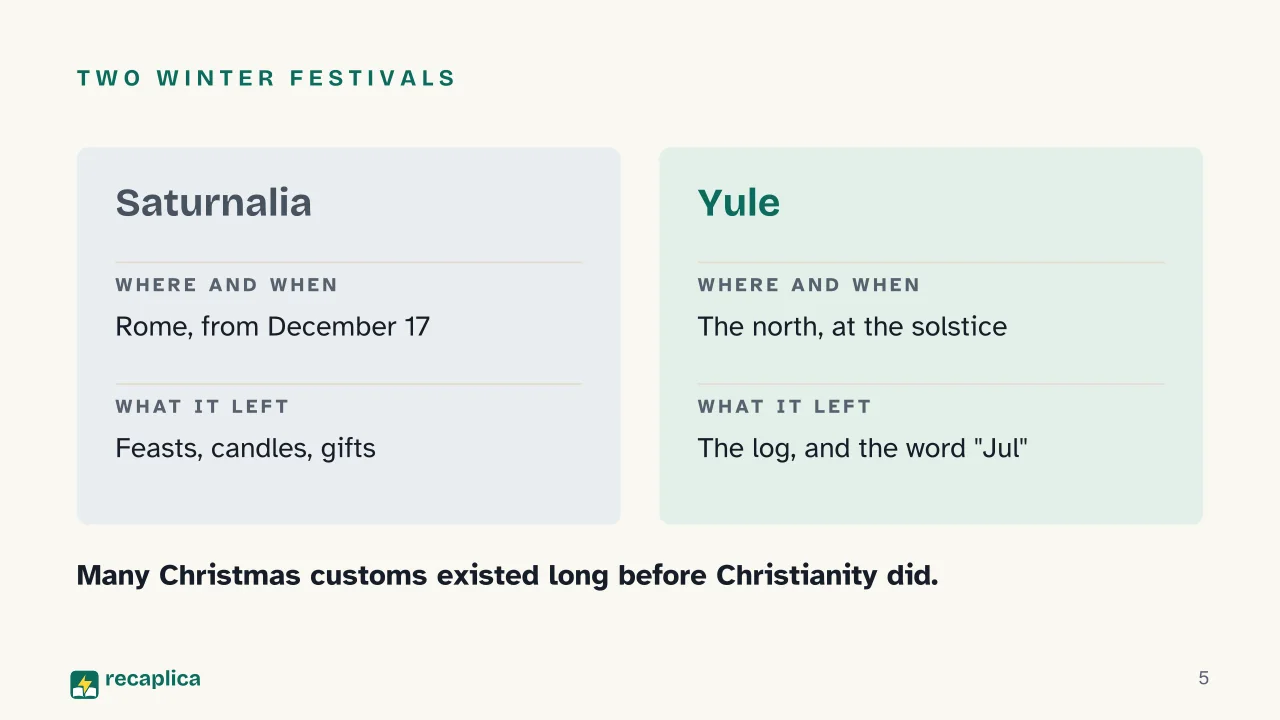  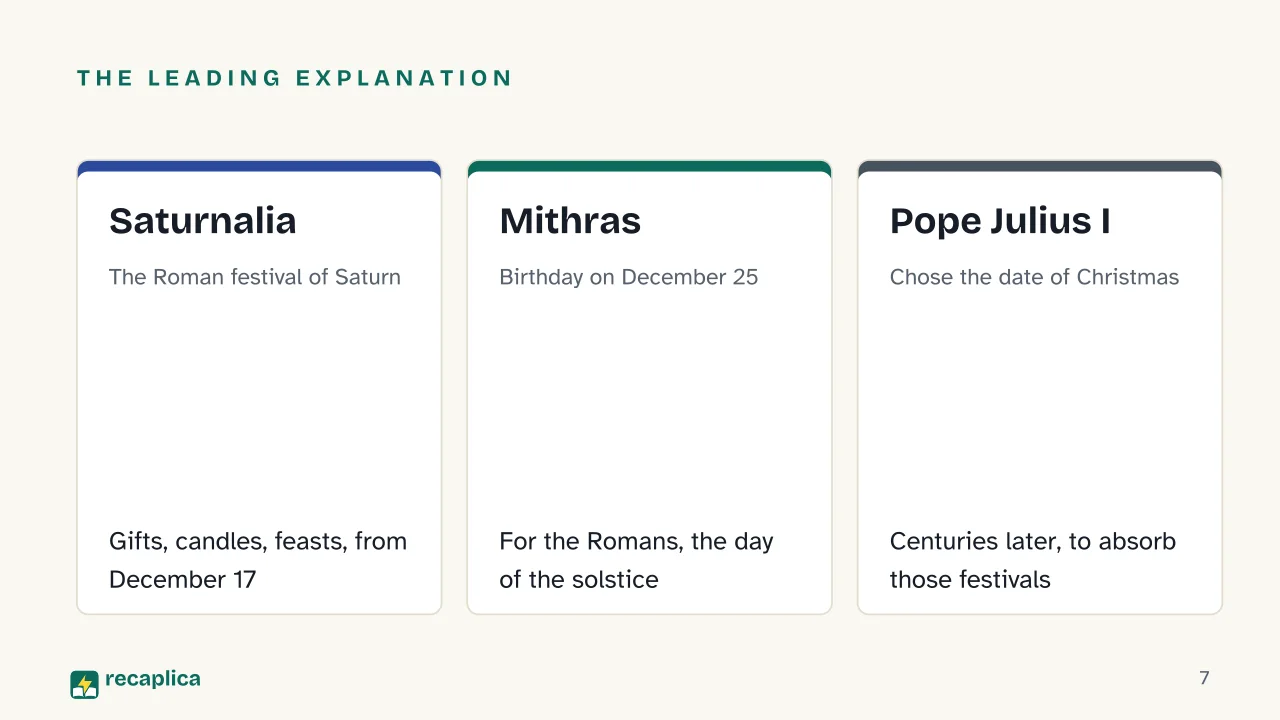  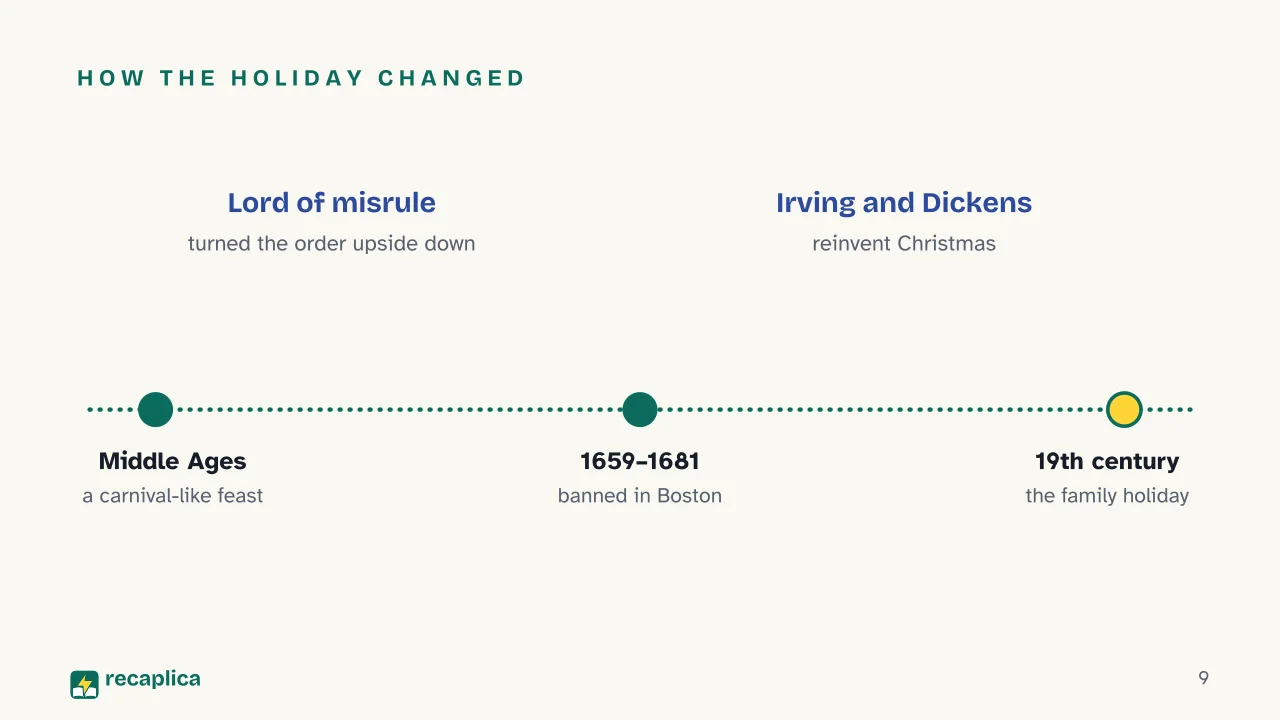 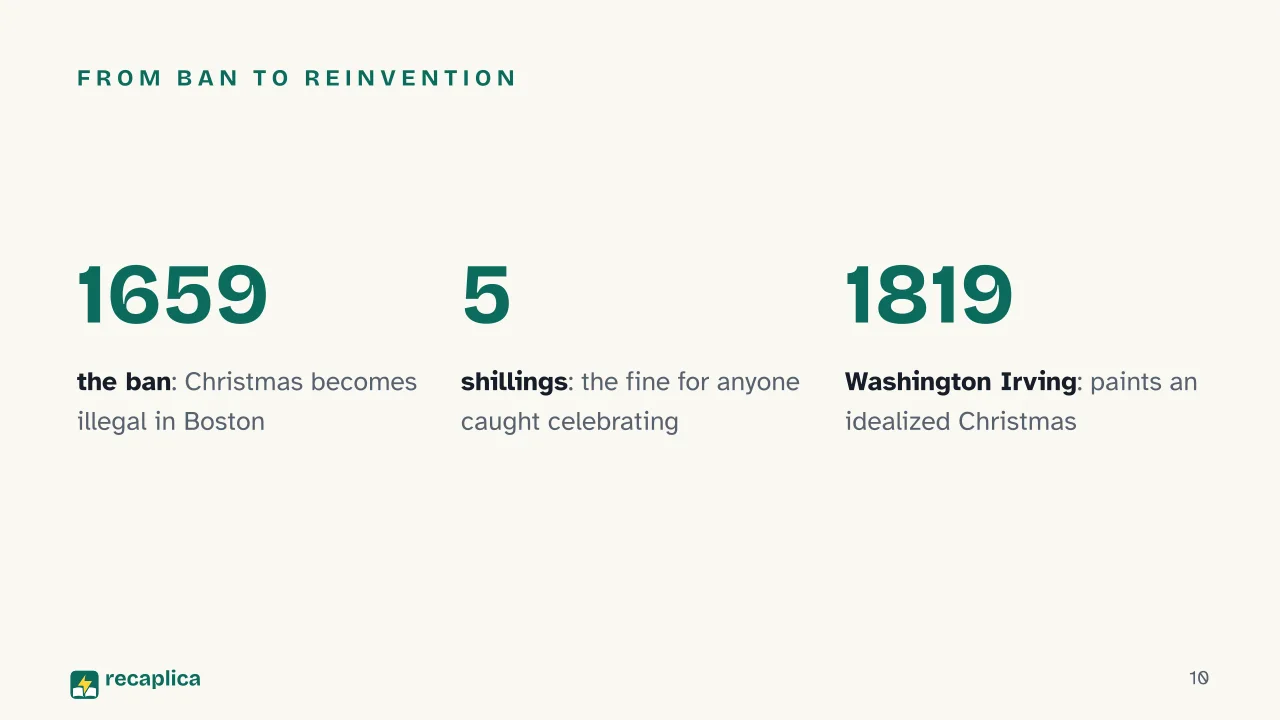  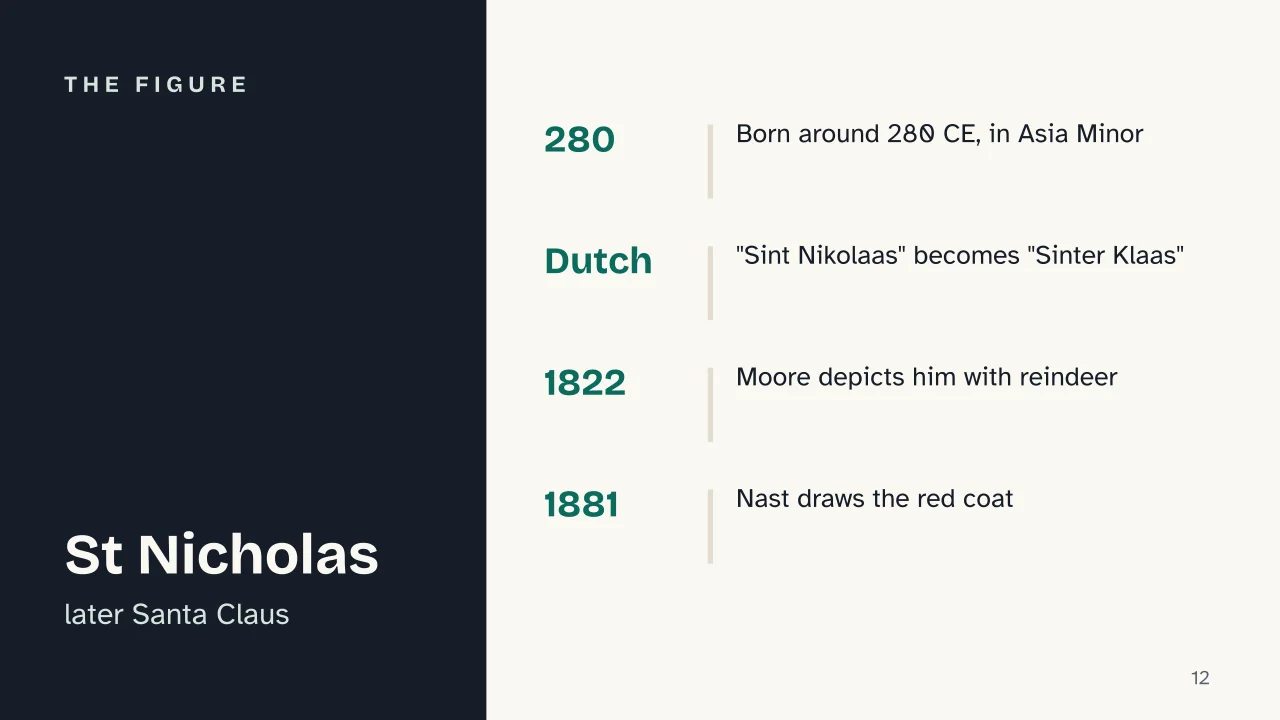 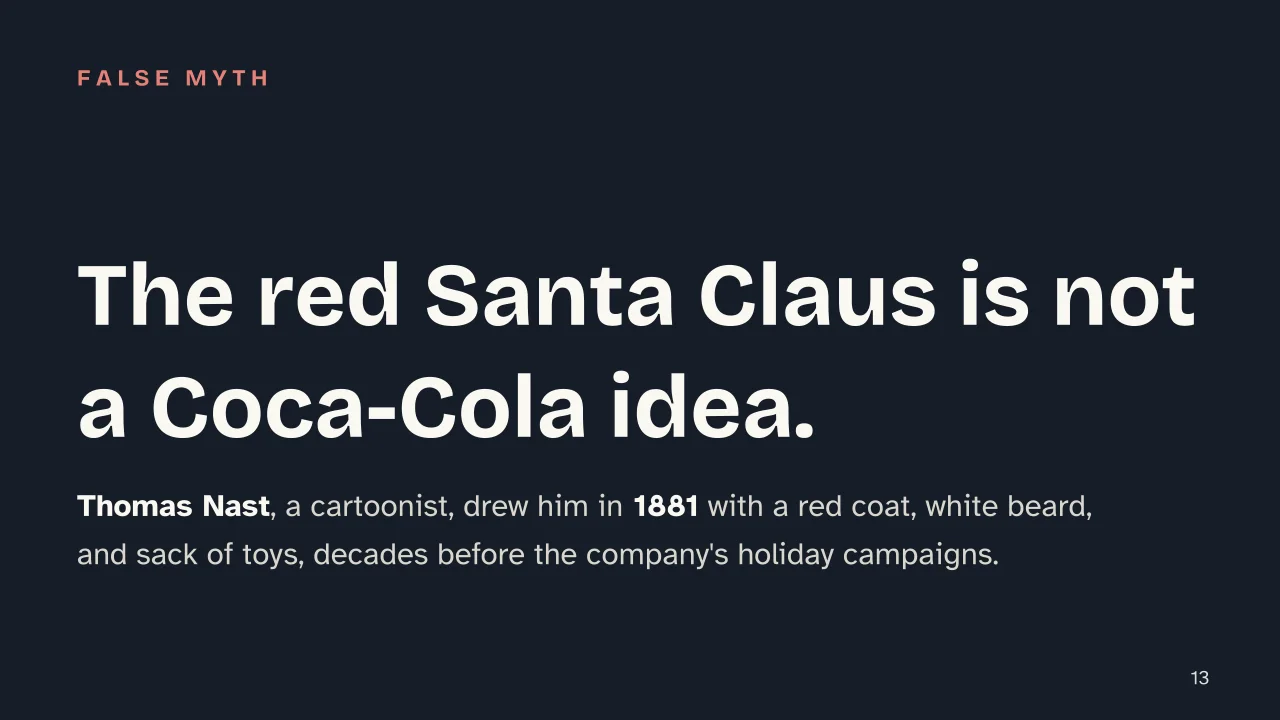 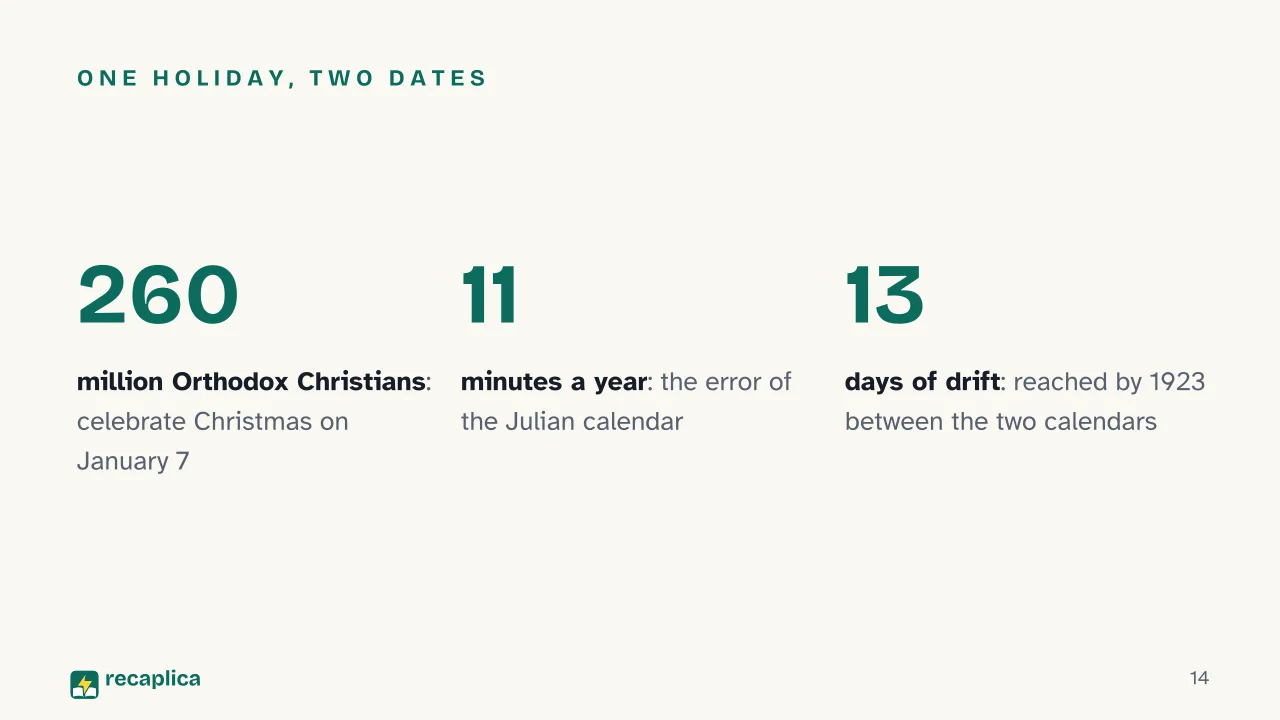 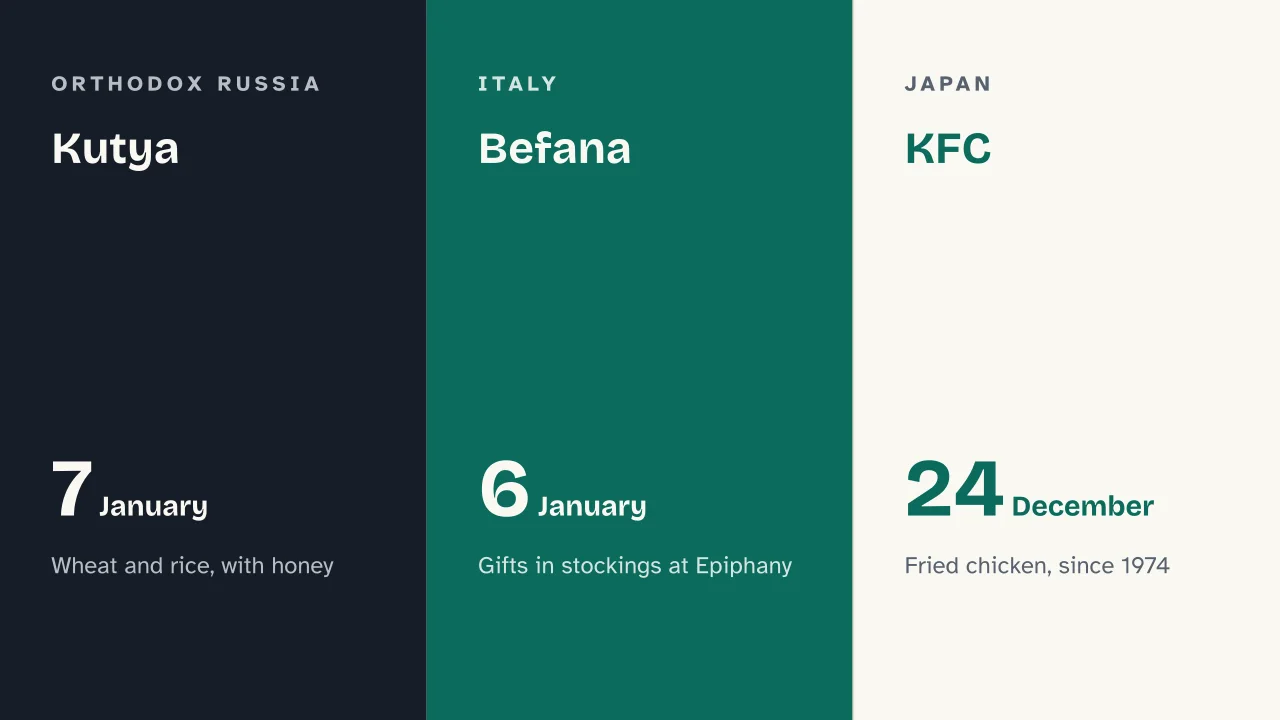  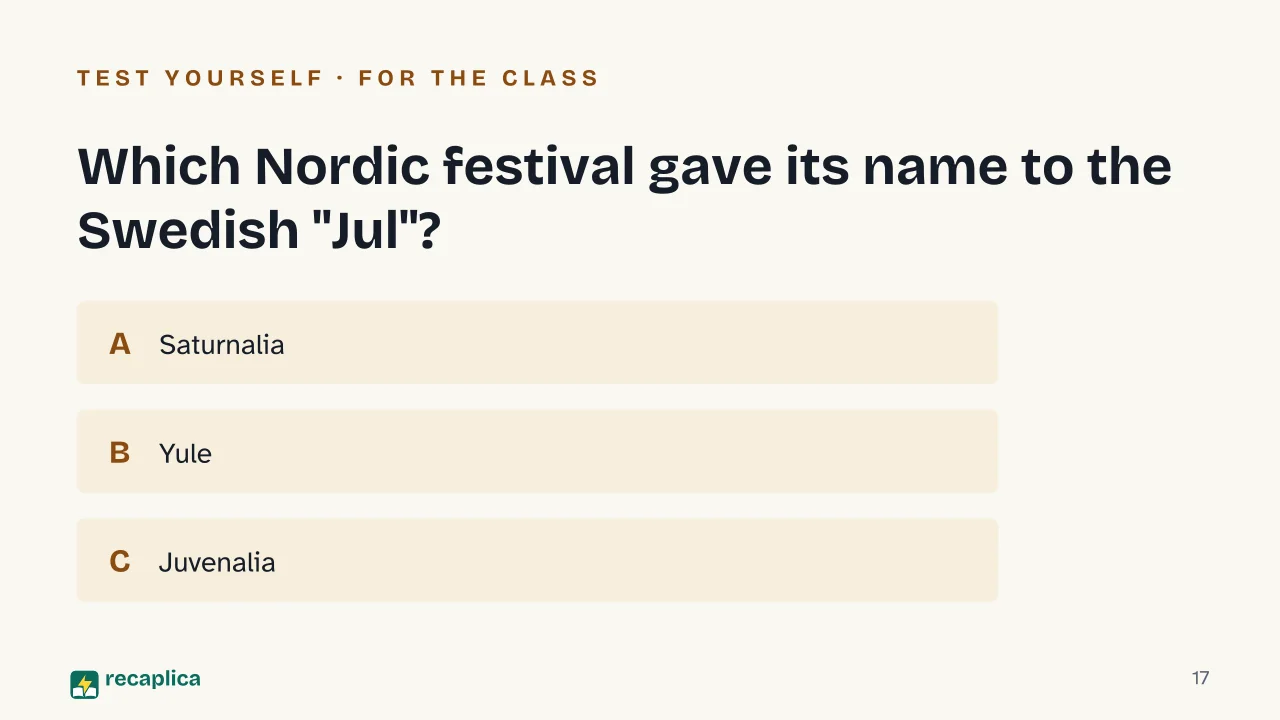  Common myths
Mind mapDrag the background to move around and the nodes to reposition them; use − and + to collapse and expand branches. 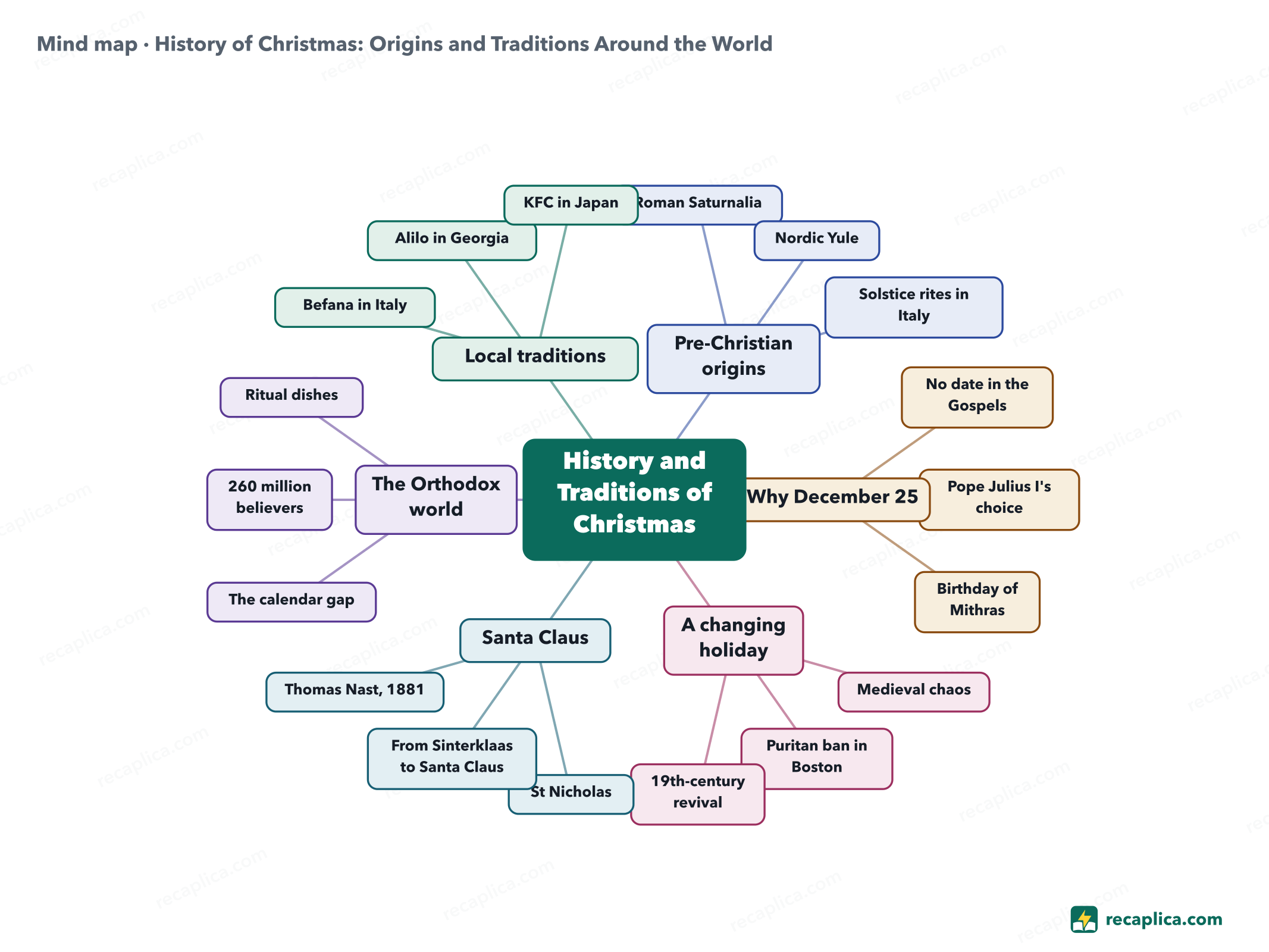
Quiz: test yourselfAnswer the questions to check what you have learned: you get instant feedback and a short explanation. Grade 0/10 0/5
FlashcardsTap the card to flip it and check whether you remember the answer, then move to the next one. 1 / 8 Explain it in your own wordsThe ultimate test: if you can explain it in simple words, you've truly understood it. Write your explanation, then compare it with the Recap. Your explanation is saved only on this device.
Frequently asked questionsWhy is Christmas celebrated on December 25?Not for a reason found in the Gospels, which give no date for the birth of Jesus. Pope Julius I fixed that day, and historians' leading explanation is that the Church wanted to absorb the Roman festival of Saturnalia and the cult of the god Mithras, whose birthday fell on the same day in the Roman calendar. Why do Orthodox Christians celebrate Christmas on January 7?Because of a gap between calendars, not a different belief about the birth of Jesus. The Julian calendar, still followed by part of the Orthodox world, overestimates the solar year by about 11 minutes; the error built up over the centuries and reached 13 days by 1923, shifting the Julian December 25 to the Gregorian January 7. Did Coca-Cola really invent the red-suited Santa Claus?No. The image of Santa Claus with a red coat, white beard, and sack of toys was drawn by cartoonist Thomas Nast in 1881, decades before Coca-Cola's first Christmas advertising campaigns. The company helped make that image famous worldwide, but it did not create it. Where does the Christmas tree tradition come from?Decorated trees go back to medieval Germany; German and other European settlers then popularized the custom in America, where it had taken hold by the early 19th century. Why is Christmas in Japan associated with fried chicken?Because of a KFC advertising campaign launched in 1974 under the slogan "Kentucky for Christmas," in a country where Christmas is a secular, commercial holiday (fewer than 1% of the Japanese population identifies as Christian). December 24 has become the busiest day of the year for KFC restaurants in Japan. Every Recap goes through an independent review before publication. |