Skip to content
recaplica

    One moment: security check

    Cloudflare wants to make sure you're not a robot. Tick the box below and your search will continue on its own.

    IT
    recaplica History of Pizza: From Naples to UNESCO Heritage
    © 2026 Recaplica · recaplica.com — All rights reserved
    Home › History Food and cooking

    History of Pizza: From Naples to UNESCO Heritage

    By Recaplica Newsroom · Updated on September 6, 2026

    What to print

    Page numbers appear when printing with default margins.

    Slides

    Choose a cut

    Flash10 slidesThe essential thread, to present in classFull18 slidesEvery chapter and the deeper detail

    Both come with speaker notes.

    Telegram channel
    recaplica Clear in 30 seconds, yours in 10 minutes.
    In 30 seconds Key points Figures Deep dive Slides Myths Mind map Quiz Flashcards FAQ

    In 30 seconds quick read

    The word "pizza" already appears in a document from 997 written in Gaeta, but the dish as we know it today was born in nineteenth-century Naples, sold cheap as street food and in humble pizzerias. The most famous story, that Queen Margherita gave her name to the pizza with the three colors of the Italian flag in 1889, is actually a popular but historically disputed legend: very similar pizzas were already around decades earlier. In 2017 UNESCO recognized the art of the Neapolitan pizzaiuolo as intangible cultural heritage of humanity. From there pizza spread across the world, spawning thousands of local variants and a few very Neapolitan social customs along the way.

    Key Points

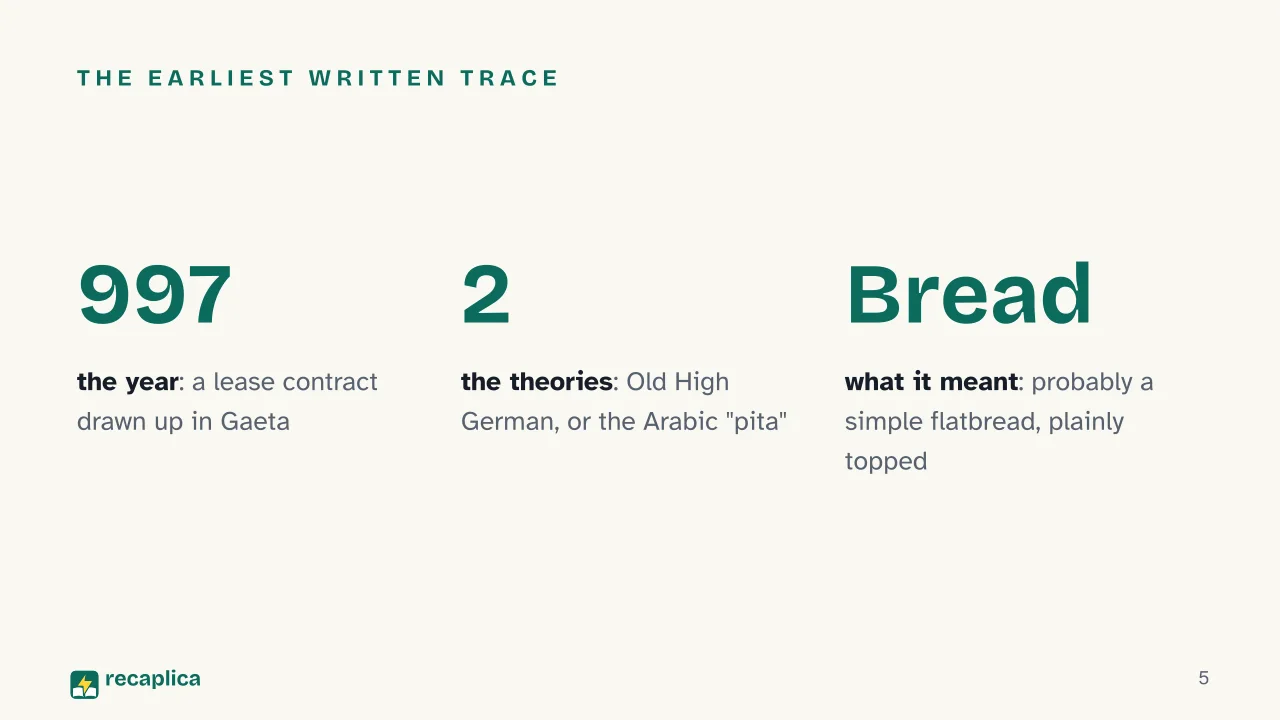
    • The word "pizza" is first attested in 997, in a lease contract drawn up in Gaeta; its origins remain uncertain, disputed between a theory tracing it to Old High German and one linking it to the Arabic "pita".
    • The dish as a preparation of flour dough, yeast and toppings, baked in a round shape, was born in Naples in the first half of the nineteenth century, as cheap, popular food.
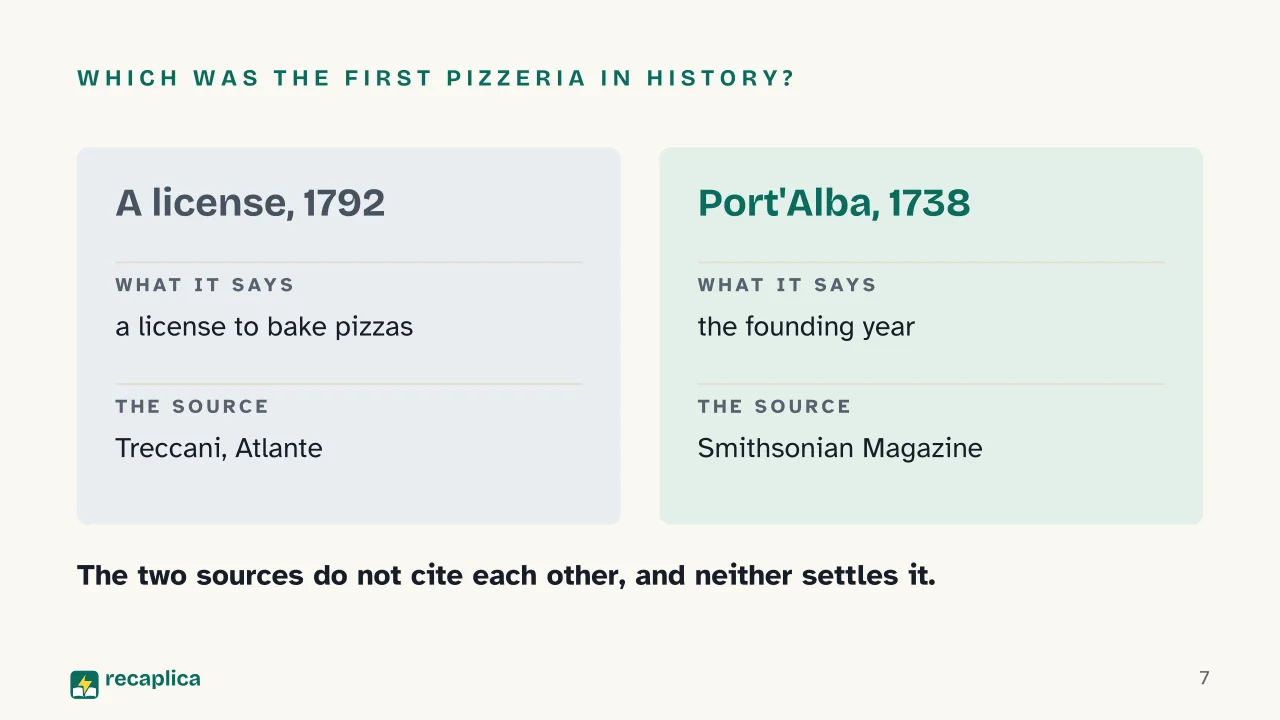
    • Sources disagree on the first pizzeria in history, a document dated 21 July 1792 records a license to bake pizzas in Naples, but other sources put the founding of the Antica Pizzeria Port'Alba in 1738.
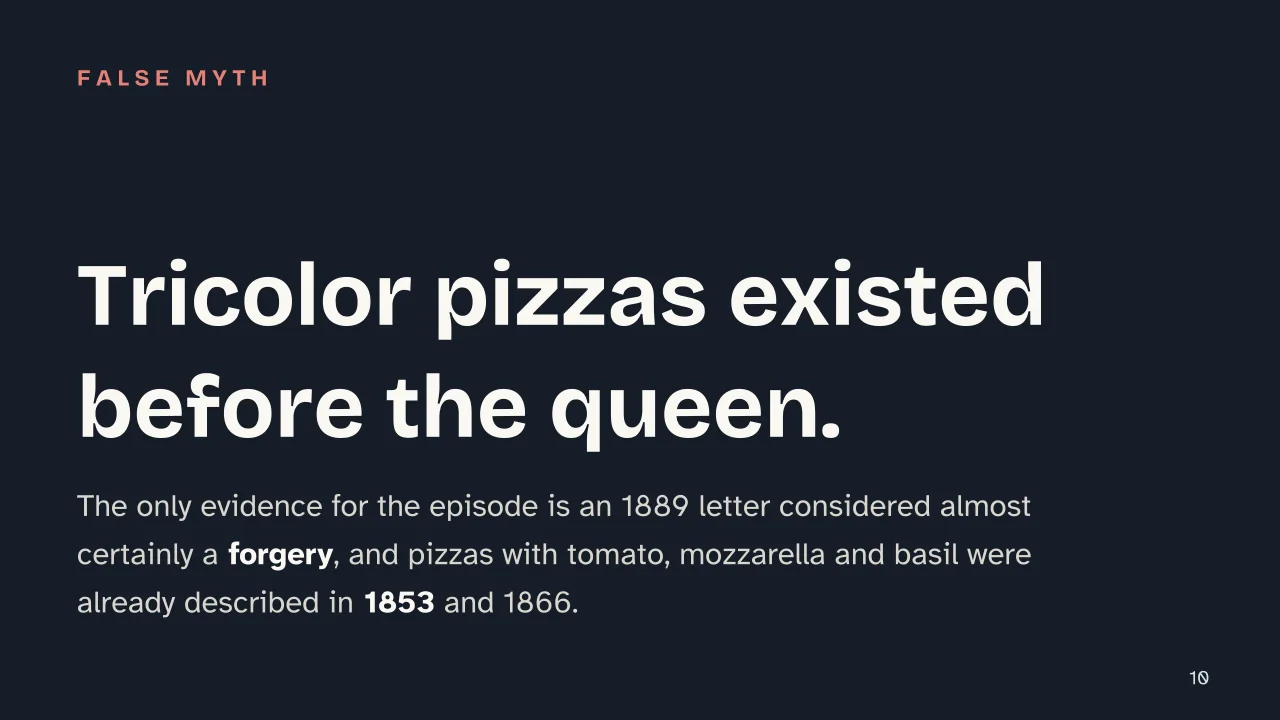
    • The story of Queen Margherita, who supposedly gave her name to the pizza with the three colors of the Italian flag in 1889, is a popular but historically disputed legend, the letter that tells it is almost certainly a forgery, and similar pizzas were already described in 1853 and 1866.
    • In 2017 UNESCO added the art of the Neapolitan pizzaiuolo to its list of intangible cultural heritage of humanity, after a bid backed by around two million signatures.
    • Tomato, now linked to pizza more than any other ingredient, only reached Europe from the Americas in the sixteenth century and was considered poisonous by Europeans for roughly two centuries.

    Key figures

    • 997 the year of the lease contract drawn up in Gaeta that contains the earliest known attestation of the word "pizza" Source: Treccani, Atlante magazine
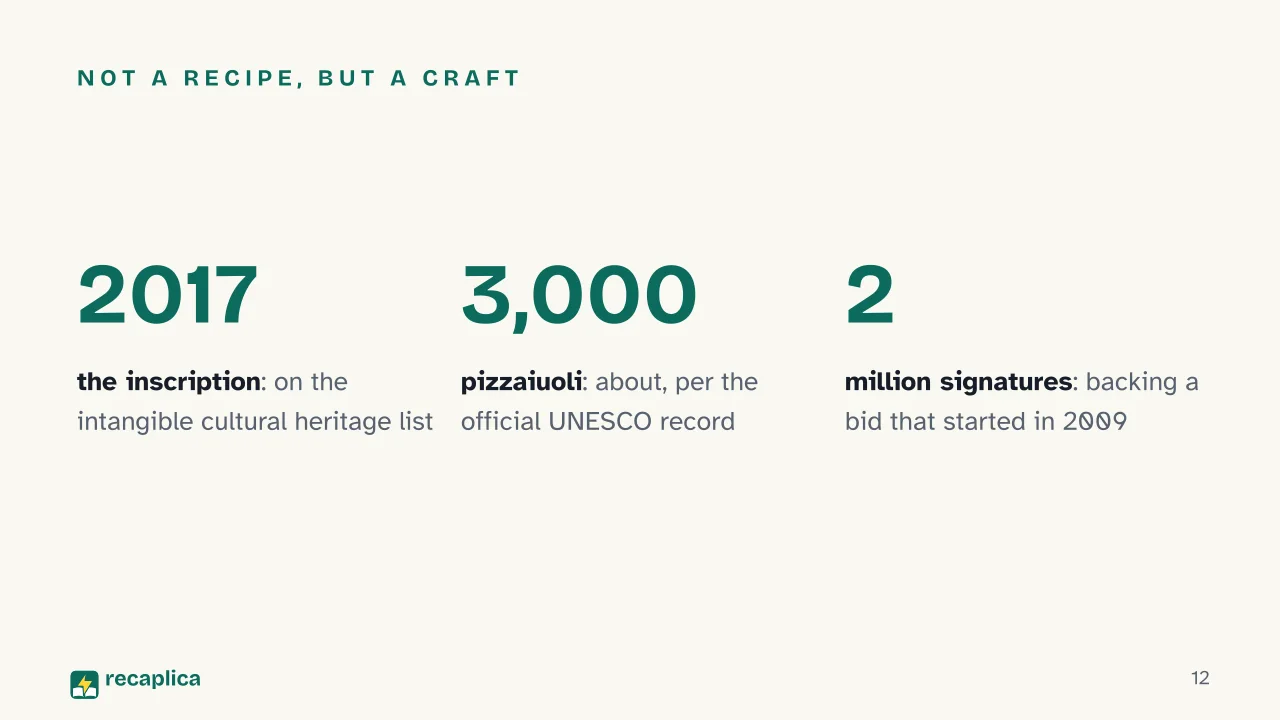
    • about 3,000 the pizzaiuoli who, according to the official UNESCO record, practice the art of the Neapolitan pizzaiuolo Source: UNESCO, Intangible Cultural Heritage
    • 2017 the year the art of the Neapolitan pizzaiuolo was inscribed on the UNESCO Representative List of intangible cultural heritage Source: UNESCO / Treccani magazine
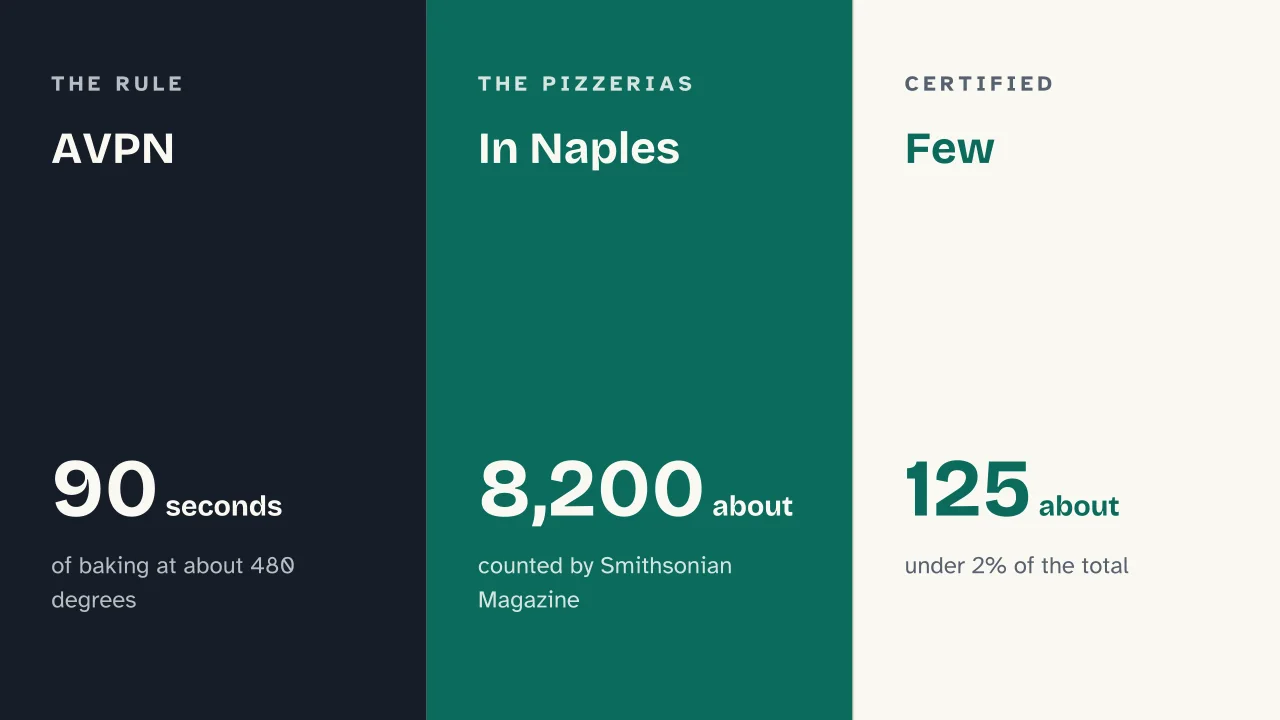
    • under 2% the share of Naples's roughly 8,200 pizzerias that has earned the official AVPN certification, Associazione Verace Pizza Napoletana Source: Smithsonian Magazine

    Deep Dive

    A word older than the dish

    The word “pizza” existed long before pizza as it’s eaten today. It already appears in a lease contract from 997, drawn up in Gaeta — the oldest document in which scholars have found it so far. Two different theories circulate about the word’s origin, and neither has been fully settled: one traces it to an Old High German word, bizzo or pizzo, meaning a bite or a piece of bread; the other links it to the Arabic pita. Neither has convinced every scholar, and Treccani’s own dictionary entry describes the origin as “possibly” Germanic, without closing the question.

    Whatever the word indicated in 997 was, in any case, something quite different from Neapolitan pizza: probably a flatbread or focaccia, simply topped. Flat, topped breads did exist in various cuisines of the ancient world, though no solid source documents a direct link between those dishes and modern pizza — a leap worth not taking for granted.

    Naples, where the dish was born

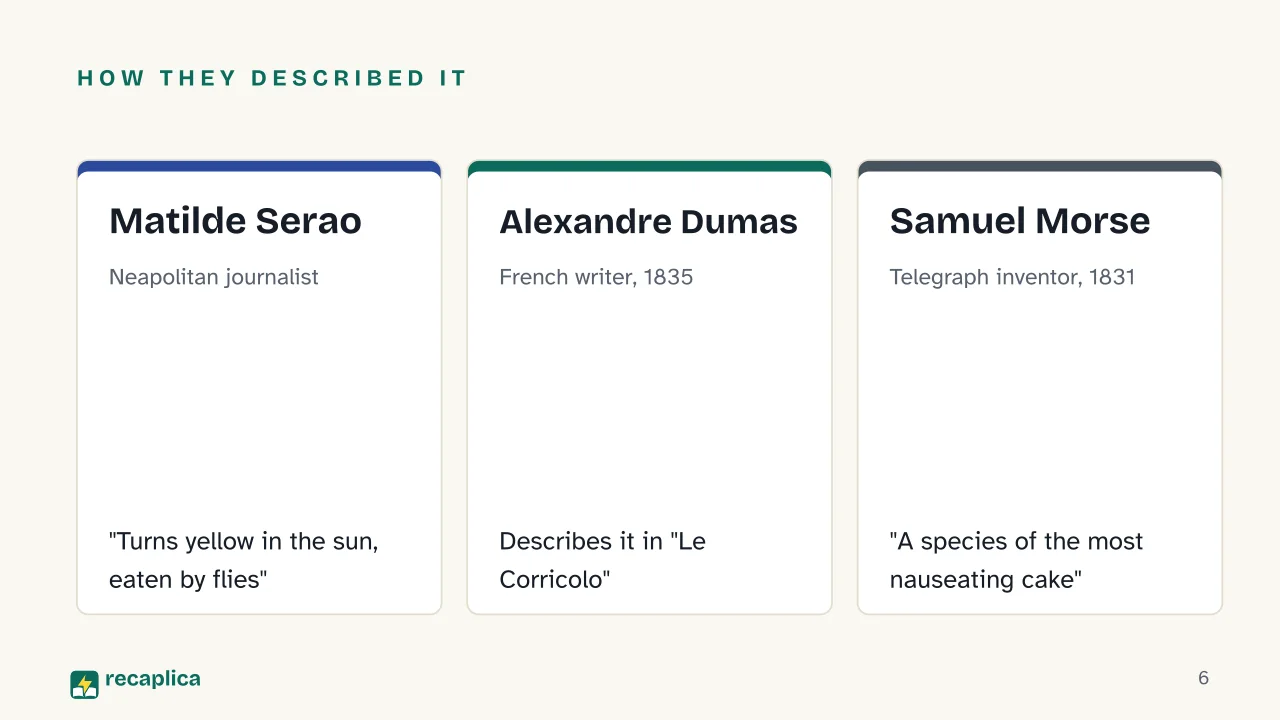
    The dish recognizable today, leavened dough stretched into a round, flat shape, baked in an oven and topped, was born in Naples in the first half of the nineteenth century. It was not a refined dish: it was street food, cheap, meant to fill people up quickly. The journalist Matilde Serao, describing the Naples of her time, called it food “that turns yellow in the sun, eaten by flies” — an image about as far as possible from the gourmet dish pizza would become much later.

    On the date of the first pizzeria in history, though, sources disagree, and it’s more honest to say so than to invent a synthesis that doesn’t exist. A document dated 21 July 1792 records that the Kingdom’s Ministry of General Police granted a license to a certain Giuseppe Sorrentino to bake pizzas in the Loreto district of Naples: it’s the earliest known document of this kind. Another source, however, points to an earlier origin for the Antica Pizzeria Port’Alba, founded in 1738 and turned into a proper restaurant with tables in 1830. The two sources don’t cite each other, and neither is enough on its own to settle the question.

    FactSourceYear
    License to bake pizzas in Naples (Giuseppe Sorrentino)Treccani, Atlante magazine1792
    Founding of the Antica Pizzeria Port’AlbaSmithsonian Magazine1738
    Port’Alba becomes a restaurant with tablesSmithsonian Magazine1830

    Practical example: in 1835 the French writer Alexandre Dumas père stayed in Naples and described pizza in his book Le Corricolo, a sign that the dish was already well known enough to strike a foreign visitor. A few years earlier, in 1831, the American inventor of the telegraph, Samuel Morse, had instead dismissed it as “a species of the most nauseating cake”: pizza, it turns out, didn’t win over every tourist of the time.

    Anyone curious how a poor person’s dish turns, over time, into a national symbol can find a parallel in another Italian food story, that of carbonara, also born from simple ingredients and later wrapped in legends about its own origin.

    The case of Queen Margherita

    The most retold story about pizza concerns a royal visit in 1889. According to the most popular version, the cook Raffaele Esposito, together with his wife, prepared three different pizzas for King Umberto I and Queen Margherita of Savoy, who were visiting Naples; the queen supposedly chose the one with the three colors of the Italian flag, red tomato, green basil and white mozzarella, which has carried her name ever since. It’s the story that also appears in Treccani’s Encyclopedia for young readers, told as a straightforward fact.

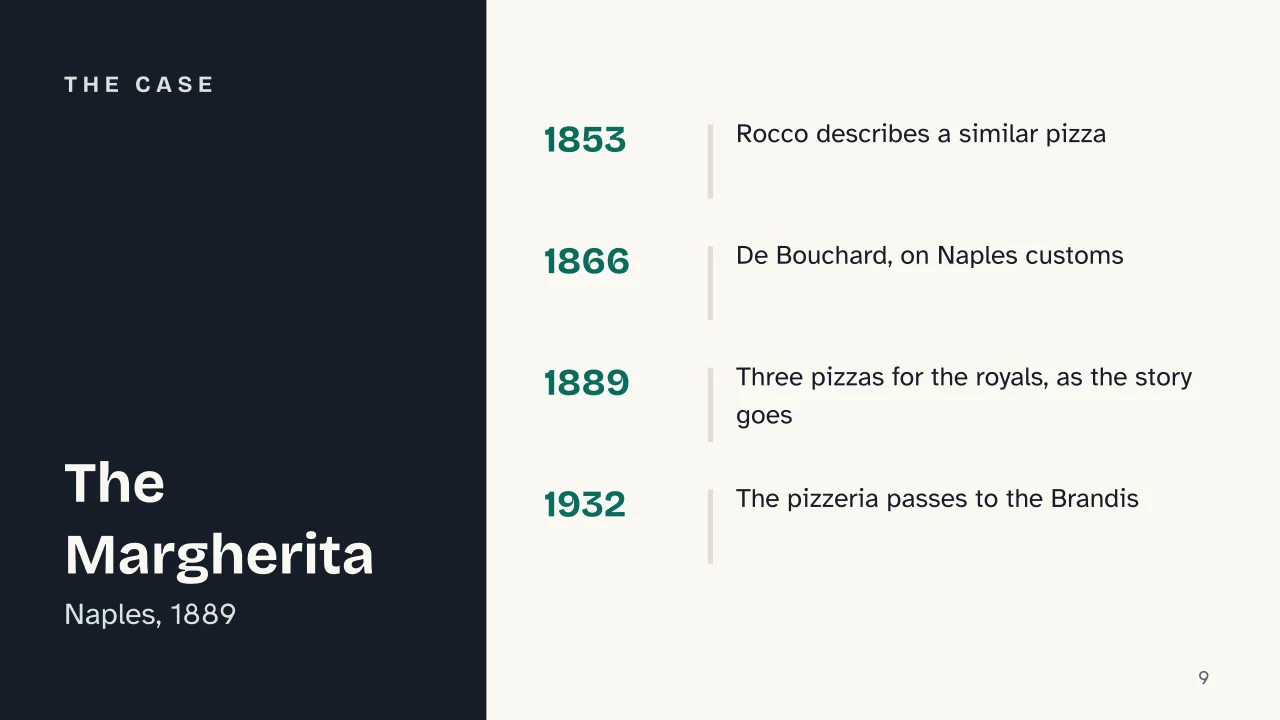
    Another reconstruction, though, calls for more caution: the letter that would document the episode, dated 11 June 1889 and attributed to Camillo Galli, head of the Royal Household staff, is considered almost certainly a forgery, the only evidence for an event no other document confirms. Not only that: pizzas very similar to the “Margherita,” with basil, mozzarella and tomato, already appeared in written sources well before 1889. Emanuele Rocco described one in 1853, and the writer Francesco De Bouchard did the same in his 1866 book on the customs of Naples. A similar story to the queen’s, moreover, had already circulated in 1880 in a newspaper of the time, referring to a different episode.

    It isn’t possible, with the sources available, to establish with certainty what really happened in June 1889. The fairest thing to say is that the Queen Margherita story remains a popular but historically disputed legend, not an established fact: the tricolor pizza almost certainly already existed before, and the real episode may have given a name to a dish that already existed, rather than creating it.

    For context: southern Italy had joined the Kingdom in 1861, Rome was annexed in 1870, and Umberto I was crowned king in 1878. Esposito’s pizzeria later passed to the Brandi family in 1932, and in 1989 a commemorative plaque was placed in Naples that marks the episode, legendary or not.

    A recognition that arrived late, but official

    Far more solid, because confirmed by two independent sources, is what happened in 2017. That year UNESCO added the “Art of Neapolitan Pizzaiuolo” to the Representative List of the Intangible Cultural Heritage of Humanity, during a session held in Jeju, South Korea. The bid had started in 2009, backed by Coldiretti, the Associazione Pizzaiuoli Napoletani and the Fondazione UniVerde, and had gathered around two million signatures of support.

    According to the official UNESCO record, what is recognized isn’t a recipe but a know-how: the practice covers four distinct phases, from preparing the dough to baking it in a wood-fired oven with the pizzaiolo’s characteristic rotating movement. About 3,000 pizzaiuoli live and work in Naples, according to UNESCO, divided into three recognized categories: the Master Pizzaiuolo, the pizzaiuolo, and the baker, plus the Neapolitan families who pass the craft down at home.

    Practical example: the Associazione Verace Pizza Napoletana (AVPN) certifies establishments that follow a precise set of rules, baking for about 90 seconds at around 480°C (900°F), nearly double American gas ovens, a maximum diameter of about 35 centimeters, and dough fermented from 12 hours up to several days. Of the roughly 8,200 pizzerias counted in Naples, according to Smithsonian Magazine, only about 125, under 2% of the total, have earned this certification: a sign of just how much the “official” recipe remains a minority within the real variety of Neapolitan pizzerias.

    Tomato, an ingredient that arrived later

    A detail that surprises anyone who thinks of pizza as an “unchanging” dish: tomato, now its most recognizable ingredient, reached Europe from the Americas in the sixteenth century, and for roughly two centuries Europeans considered it a poisonous plant, unfit to eat. Among the historic variants of Neapolitan pizza, the “Marinara” was born in the eighteenth century.

    Anyone curious about why certain foods stay outside common use for a long time, for reasons that aren’t always scientific, can find a parallel in the history of fermentation, a process used for centuries in many of the world’s kitchens well before it was understood at a chemical level. The science of leavening, essential to pizza dough, also has its own story of practical intuition arriving long before the scientific explanation.

    From Naples to the world

    For most of its history, pizza remained an almost exclusively Neapolitan dish. Its spread on an industrial scale, according to Treccani’s Encyclopedia for young readers, began only in the 1960s, driven above all by the American chain Pizza Hut, one of the reasons the dish eventually became, in more recent times, one of the most widespread foods in the world.

    From there, pizza took different paths depending on the country. In the United States, regional variants emerged quite far from the Neapolitan original: the “pies” of New Jersey, New Haven’s “apizza” in Connecticut, or the version made with Provel cheese typical of St. Louis. Several Neapolitan pizza makers have also opened branches abroad: the most cited case is Gino Sorbillo, with locations in Milan, New York, Rome, Tokyo, Miami and Genoa.

    In Naples, meanwhile, some social customs tied to pizza as a shared food have stayed alive. “Pizza sospesa” (“suspended pizza”) means paying for an extra pizza, left available for someone who can’t afford one. “Pizza a otto” traditionally allows a pizza to be paid for even eight days after eating it. And the “portafoglio” (“wallet”) fold is the gesture of folding a pizza in half to eat it while walking down the street, without cutlery.

    Summary table of key milestones

    YearEvent
    997First attestation of the word “pizza,” in a document from Gaeta
    First half of the nineteenth centuryPizza as known today is born in Naples
    1738 or 1792 (sources disagree)First pizzeria in history
    1835Alexandre Dumas describes pizza in Le Corricolo
    1889Alleged Queen Margherita episode (disputed legend)
    1960sIndustrial spread of pizza, helped by Pizza Hut
    2009-2017Bid and UNESCO recognition of the art of the Neapolitan pizzaiuolo

    Slide deck

    Slides ready to download and make your own in PowerPoint or Google Slides, with speaker notes. Pick the Flash cut or the Full one.
    Slide 1 of the presentation on History of Pizza: The History of PizzaSlide 2 of the presentation on History of Pizza: Who invented pizza?Slide 3 of the presentation on History of Pizza: What we will coverSlide 4 of the presentation on History of Pizza: Chapter 01: From the word to the dishSlide 5 of the presentation on History of Pizza: The earliest written traceSlide 6 of the presentation on History of Pizza: How they described it: Matilde Serao, Alexandre Dumas, Samuel MorseSlide 7 of the presentation on History of Pizza: Which was the first pizzeria in history?Slide 8 of the presentation on History of Pizza: Chapter 02: The Queen Margherita caseSlide 9 of the presentation on History of Pizza: The caseSlide 10 of the presentation on History of Pizza: Tricolor pizzas existed before the queen.Slide 11 of the presentation on History of Pizza: Chapter 03: The UNESCO recognitionSlide 12 of the presentation on History of Pizza: Not a recipe, but a craftSlide 13 of the presentation on History of Pizza: AVPN · In Naples · FewSlide 14 of the presentation on History of Pizza: Chapter 04: From Naples to the worldSlide 15 of the presentation on History of Pizza: From the word to world heritageSlide 16 of the presentation on History of Pizza: Three Neapolitan customs: Pizza sospesa, Pizza a otto, PortafoglioSlide 17 of the presentation on History of Pizza: Why did tomato stay out of common use in cooking for so long?Slide 18 of the presentation on History of Pizza: And now, the review
    Flash10 slidesThe essential thread, to present in classFull18 slidesEvery chapter and the deeper detail

    Common myths

    • ✗ Myth Pizza Margherita was invented from scratch in 1889 in honor of Queen Margherita of Savoy.

      ✓ Reality It's a popular but historically disputed legend. The only evidence for the episode is a letter from 1889 considered almost certainly a forgery. Very similar pizzas, with basil, mozzarella and tomato, had already been described by witnesses in 1853 and 1866, decades before the story about the queen.

    • ✗ Myth Pizza is an ancient invention that already existed in essentially the same form in the ancient world.

      ✓ Reality The dish and the word "pizza" as we know them were born in Naples, with the word attested from 997 and the modern dish dating from the first half of the nineteenth century. Flattened, topped breads did exist in the ancient world, but no solid source documents a direct link between those foods and Neapolitan pizza.

    • ✗ Myth Pizza has always had tomato as its main topping.

      ✓ Reality Tomato reached Europe from the Americas in the sixteenth century and was considered a poisonous, inedible plant for roughly two centuries. It became a common ingredient in cooking only much later.

    Mind map

    Drag the background to move around and the nodes to reposition them; use − and + to collapse and expand branches.
    Customize
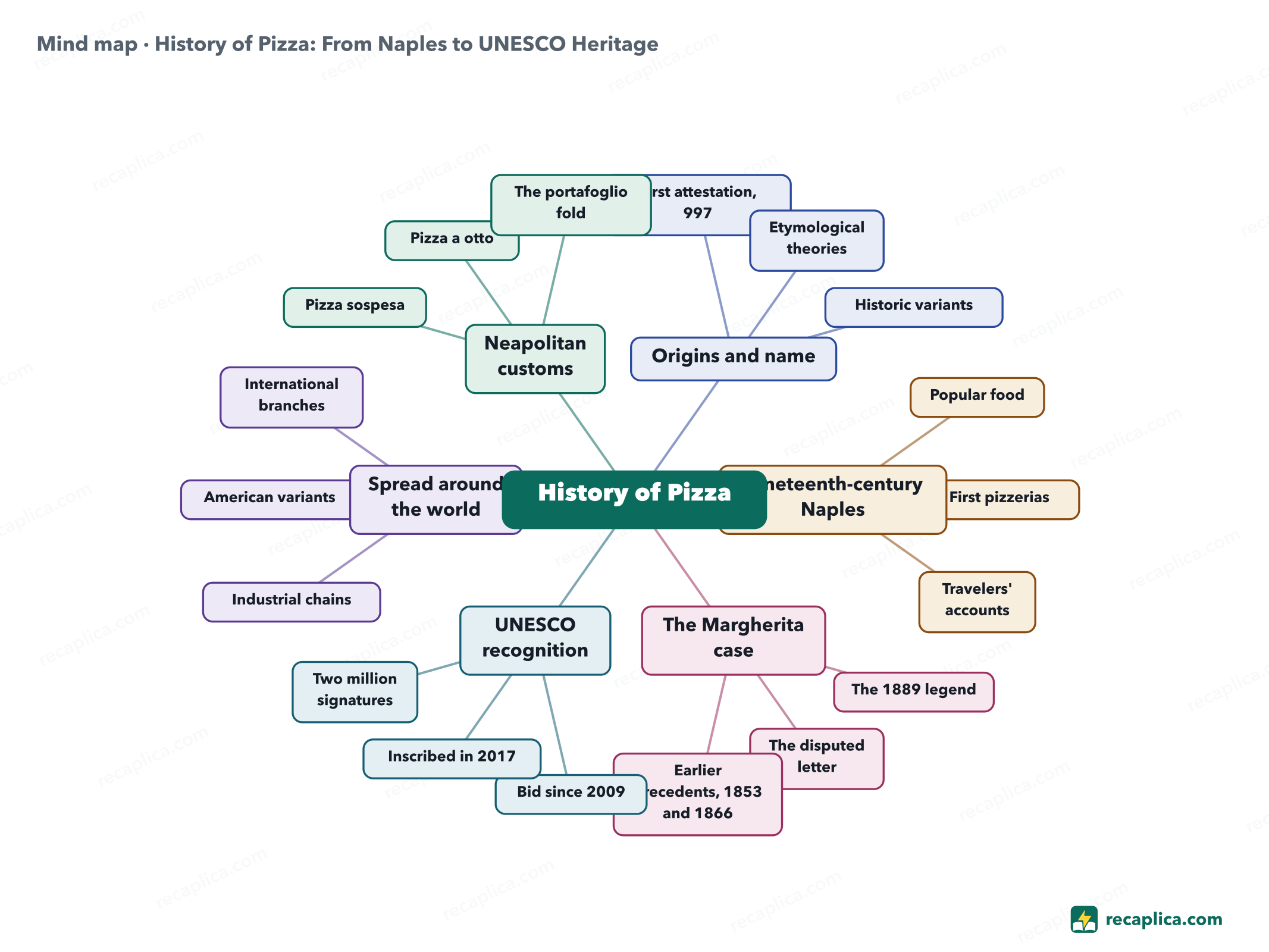
    Mind map: History of Pizza: From Naples to UNESCO Heritage
    • History of Pizza
      • Origins and name
        • First attestation, 997 Gaeta document, the word "pizza"
        • Etymological theories Old High German or Arabic "pita"
        • Historic variants Neapolitan, marinara, by-the-slice, white
      • Nineteenth-century Naples
        • Popular food Cheap, sold on the street
        • First pizzerias Disagreement between 1792 and 1738
        • Travelers' accounts Alexandre Dumas, 1835
      • The Margherita case
        • The 1889 legend
        • The disputed letter Considered almost certainly a forgery
        • Earlier precedents, 1853 and 1866 Similar pizzas already described
      • UNESCO recognition
        • Bid since 2009
        • Inscribed in 2017 About 3,000 practicing pizzaiuoli
        • Two million signatures
      • Spread around the world
        • Industrial chains Global spread from the 1960s
        • American variants New Jersey, New Haven, St. Louis
        • International branches Milan, New York, Tokyo, Miami
      • Neapolitan customs
        • Pizza sospesa
        • Pizza a otto
        • The portafoglio fold Folded in half to eat on the street

    Quiz: test yourself

    Answer the questions to check what you have learned: you get instant feedback and a short explanation.

    Grade 0/10 0/5
    1 In which document does the word "pizza" first appear?

    The earliest known attestation of the word "pizza" is found in a lease contract from 997, drawn up in Gaeta. Its exact origins are still debated among scholars.

    2 What do the sources say about the date of the first pizzeria in history?

    A document dated 21 July 1792 records a license to bake pizzas in Naples, but other sources put the founding of the Antica Pizzeria Port'Alba in 1738. The two sources don't cite each other, so this remains a genuine discrepancy, not a single settled fact.

    3 True or false: the historical evidence for the 1889 Queen Margherita story is considered solid and uncontested by historians.

    False. The letter that would document the episode is considered almost certainly a forgery by some historical reconstructions, and very similar pizzas, with basil, mozzarella and tomato, were already described in 1853 and 1866, decades before 1889.

    4 In 2017, UNESCO recognized as intangible cultural heritage of humanity...

    The 2017 UNESCO recognition specifically concerns the art of the Neapolitan pizzaiuolo, that is, the know-how and gestures of the craft, not a single recipe or a particular establishment.

    5 Why did tomato, which arrived in Europe from the Americas in the sixteenth century, stay out of common use in cooking for so long?

    For roughly two hundred years after its arrival from the Americas, tomato was considered poisonous in Europe. Only later did it enter common use in cooking, eventually becoming the ingredient most associated with pizza today.

    Answers: 1-A · 2-C · 3-B · 4-B · 5-B

    Flashcards

    Tap the card to flip it and check whether you remember the answer, then move to the next one.

    1 / 8

    Explain it in your own words

    The ultimate test: if you can explain it in simple words, you've truly understood it. Write your explanation, then compare it with the Recap.

    Your explanation is saved only on this device.

    The word "pizza" already appears in a document from 997 written in Gaeta, but the dish as we know it today was born in nineteenth-century Naples, sold cheap as street food and in humble pizzerias. The most famous story, that Queen Margherita gave her name to the pizza with the three colors of the Italian flag in 1889, is actually a popular but historically disputed legend: very similar pizzas were already around decades earlier. In 2017 UNESCO recognized the art of the Neapolitan pizzaiuolo as intangible cultural heritage of humanity. From there pizza spread across the world, spawning thousands of local variants and a few very Neapolitan social customs along the way.

    Frequently asked questions

    Who invented pizza Margherita?

    According to the most popular version, pizza Margherita was created in 1889 by the cook Raffaele Esposito in honor of Queen Margherita of Savoy, who was visiting Naples. It is, however, a popular but historically disputed legend, the only evidence for the episode, a letter from 1889, is considered almost certainly a forgery, and pizzas with mozzarella, basil and tomato were already described in 1853 and 1866, well before the episode said to have taken place.

    When was pizza born?

    The word "pizza" already appears in a document from 997 written in Gaeta, but it probably referred to a kind of bread or flatbread quite different from today's dish. The dish as we know it, with the shape and toppings of the Neapolitan tradition, was born in Naples in the first half of the nineteenth century.

    Why is Neapolitan pizza a UNESCO heritage?

    In 2017 UNESCO added the art of the Neapolitan pizzaiuolo to its list of intangible cultural heritage of humanity, recognizing the know-how and gestures handed down among Naples's pizza makers, not a single recipe. The bid was backed by around two million signatures.

    Which was the world's oldest pizzeria?

    Sources do not agree on a single answer. A document dated 21 July 1792 records a license to bake pizzas in Naples granted to Giuseppe Sorrentino, but another source puts the founding of the Antica Pizzeria Port'Alba in Naples in 1738.

    Since when has tomato been a common ingredient in cooking?

    Much later than most people think. Tomato reached Europe from the Americas in the sixteenth century, but for roughly two centuries it was considered a poisonous plant and was not used in cooking. Only later did it enter common use, eventually becoming the ingredient most associated with pizza today.

    Sources

    • Treccani, Vocabolario, voce "pizza"
    • Treccani, Enciclopedia dei ragazzi, voce "Pizza"
    • Treccani, magazine Atlante, L'arte "immateriale" della pizza
    • UNESCO, Art of Neapolitan "Pizzaiuolo"
    • National Geographic, Pizza Margherita may be fit for a queen, but was it really named after one?
    • Smithsonian Magazine, Inside Naples' World-Famous Pizza Culture

    Every Recap goes through an independent review before publication.

    Every evening, the day's new Recaps on our Telegram channel. Join the channel →

    Keep learning

    • History The History of Carbonara: True Origins and False Myths Carbonara passes for one of the oldest dishes in the Roman tradition, but it is a twentieth-century dish: classic Roman cookbooks never mention it, and as late as 1949 Ada Boni's famous collection does not record it. The oldest known written trace of the name dates from 23 August 1939, in a Dutch-language newspaper of the Dutch East Indies that mentions a trattoria in Trastevere. The most famous hypothesis has the dish born in September 1944 from the meeting between an Italian cook and Allied army rations, but it remains a hypothesis, and historians still argue about it. The first written recipes, from the 1950s, were very different from today's: the first Italian version, from 1954, called for pancetta, gruyère and garlic. The modern canon — guanciale, pecorino, egg and pepper — only settled in the 1990s. Read the Recap →
    • History Italian City-State: What It Was, How It Began, and How It Changed The Italian city-state was the form of self-government with which, starting in the late 11th century, many cities in northern and central Italy ran their own affairs, pulling free of direct control by bishops and feudal lords. It began as a government of consuls elected by an assembly of heads of household, then shifted to a foreign official called the podestà, and from the mid-13th century saw the institutions of the popolo take shape alongside it, organized by guild and led by the captain of the people. Through the 13th and 14th centuries, conflict between leading families and the popolo wore this balance down and opened the way to city lordships, the signorie. Venice followed a different path from the start, with an elected doge and its own system of councils. Read the Recap →
    • History The Renaissance: What It Was, When It Began, and Why It Changed Europe The Renaissance is the period of European history in which, starting from Florence and the other Italian city-states, scholars rediscovered the texts and ideals of ancient Greece and Rome and developed new approaches to art, science and politics. It begins around the middle of the fourteenth century and runs through the fifteenth and sixteenth, with exact boundaries still debated among historians. It grew out of the work of chancellors, philosophers and artists in Italian courts and republics, then spread across Europe helped along by the printing press. Its most lasting legacy is the method of observation and verification that would feed into the scientific revolution. Read the Recap →

    recaplica

    Clear in 30 seconds, yours in 10 minutes.

    Recaps Mind maps Request a Recap Telegram channel Mind map maker Our method About Privacy & cookies Legal notes & terms of use

    © 2026 Recaplica · A project by Curi S.r.l. — VAT IT05472000750

    Statistics, only if you say so

    To learn which Recaps help most we would use Google Analytics, with aggregate, anonymous data. It starts only with your OK, and you can change your mind anytime. Privacy policy