|
recaplica
Why September Isn't the Seventh Month: The Origin of Month Names | ||||||||||||||||||||||||||||||
| © 2026 Recaplica · recaplica.com — All rights reserved | ||||||||||||||||||||||||||||||
Why September Isn't the Seventh Month: The Origin of Month NamesWhat to print Page numbers appear when printing with default margins. SlidesChoose a cut Flash10 slidesThe essential thread, to present in classFull18 slidesEvery chapter and the deeper detailBoth come with speaker notes. In 30 seconds quick readNearly all twelve month names come from the calendar of ancient Rome, a mix of gods, emperors and plain numbers. The earliest Roman year had only ten months and began in March, not January. Over time two more months were added, then Julius Caesar reformed the calendar to run 365 days a year, and two months, July and August, were renamed to honor him and the emperor Augustus. September, October, November and December still carry a number in their name that no longer matches their real position in the year. Key Points
Key figures
Deep DiveA year that began in March, not JanuaryRome’s oldest calendar is credited to Romulus, the city’s legendary founder. It ran for ten months and 304 days, starting in March rather than January, a choice tied to the return of farm work in spring after the winter lull. The winter months, roughly from late December to the start of March, weren’t counted at all: a gap in the calendar the Romans simply left unnamed, since there was no field work in that stretch to mark off. The ten original months were Martius, Aprilis, Maius, Iunius, then Quintilis, Sextilis, September, October, November and December: the last six, as their names suggest, were simply the fifth, sixth, seventh, eighth, ninth and tenth months of the year. Some sources note that the divine origins assigned to the first four months may partly be later reconstructions, not necessarily what the names meant when they were first chosen. Numa Pompilius adds two winter monthsIt was Rome’s second king, Numa Pompilius, who added two months to cover the winter gap: Februarius and Ianuarius. With this addition the year reached 355 days, with an intercalary month inserted from time to time to keep it lined up with the seasons. February takes its name from the Latin “februa”, the purification rites held during that period, just before the arrival of spring. The less intuitive detail is the order in which these two months were placed. February and January were initially added at the end of the calendar, after December; only later, according to one source, around 450 BC, were the two swapped, and January became the first month of the year. Not every source recounts this step with the same chronological detail, so the exact sequence deserves a degree of caution.
Why September isn’t the seventh monthHere’s the detail that trips people up most: September, October, November and December still carry their old numeral names, “seventh”, “eighth”, “ninth” and “tenth” month in Latin, even though today they sit in ninth, tenth, eleventh and twelfth place. Once January and February were moved to the front of the calendar, every month after them slid forward by two positions, and nobody bothered updating the names. That mismatch has survived intact into the calendar we still use, a small linguistic fossil sitting in plain sight. Where the month names actually come from
For April, May and June, the historical sources won’t commit to a single explanation: each comes with two competing theories, with no indication of which one is correct. It’s a case where the honest answer is “nobody knows for certain”, rather than picking one version at random. Julius Caesar and the “year of confusion”Numa Pompilius’s calendar, built around lunar cycles with an intercalary month added at someone’s discretion, had a practical flaw: it drifted out of step with the actual seasons easily, especially when that extra month went unadded. Julius Caesar reformed the system, introducing a 365-day year with one extra day every four years, the leap year, added in February. To reconcile the old, drifted calendar with the new system, 46 BC was artificially stretched to 445 days: historians call it the “year of confusion” for exactly this reason. The reform itself took effect on January 1, 45 BC. July and August, the emperors’ monthsTwo months changed names to honor two politicians, not gods. Quintilis, the “fifth month” of the old calendar, was renamed Iulius in honor of Julius Caesar; one source places the renaming in 44 BC, though the exact year isn’t confirmed to the same degree by every source consulted. Sextilis, the “sixth month”, was renamed Augustus in 8 BC in honor of the emperor Augustus. A detail undercuts a popular assumption: August wasn’t Augustus’s birth month, which was September. One source says the month was chosen instead because it was when Augustus first became consul and conquered Egypt. The final touch-up: the Gregorian reform of 1582The Julian calendar, a clear improvement on Numa Pompilius’s system, still overestimated the length of the solar year by about eleven minutes. A tiny error, but one that over centuries nudged the date of Easter noticeably, by roughly one day every 130 years. Pope Gregory XIII fixed the problem with the bull “Inter Gravissimas”, issued on February 24, 1582. The most visible correction was a jump in the calendar itself: Thursday, October 4, 1582, was followed directly by Friday, October 15, 1582, dropping ten days from the calendar in one stroke. October was chosen because few major holidays or religious observances fell in that stretch. Alongside the jump came a new leap-year rule: the extra day is added only in years divisible by 4, with an exception for centuries not divisible by 400 (1600, for instance, stayed a leap year, but 1700 didn’t).
A linguistic fossil we still carry aroundBehind twelve words we say without a second thought, the names of the months, sits more than two thousand years of layered reform: a ten-month farming calendar, the addition of two winter months, a solar reform from Julius Caesar, and a precision fix ordered by a pope. The numerals in September, October, November and December remain a visible trace of that first ten-month calendar, while July and August still carry the names of two men who wanted their mark written into time itself, quite literally. Slide deckSlides ready to download and make your own in PowerPoint or Google Slides, with speaker notes. Pick the Flash cut or the Full one.   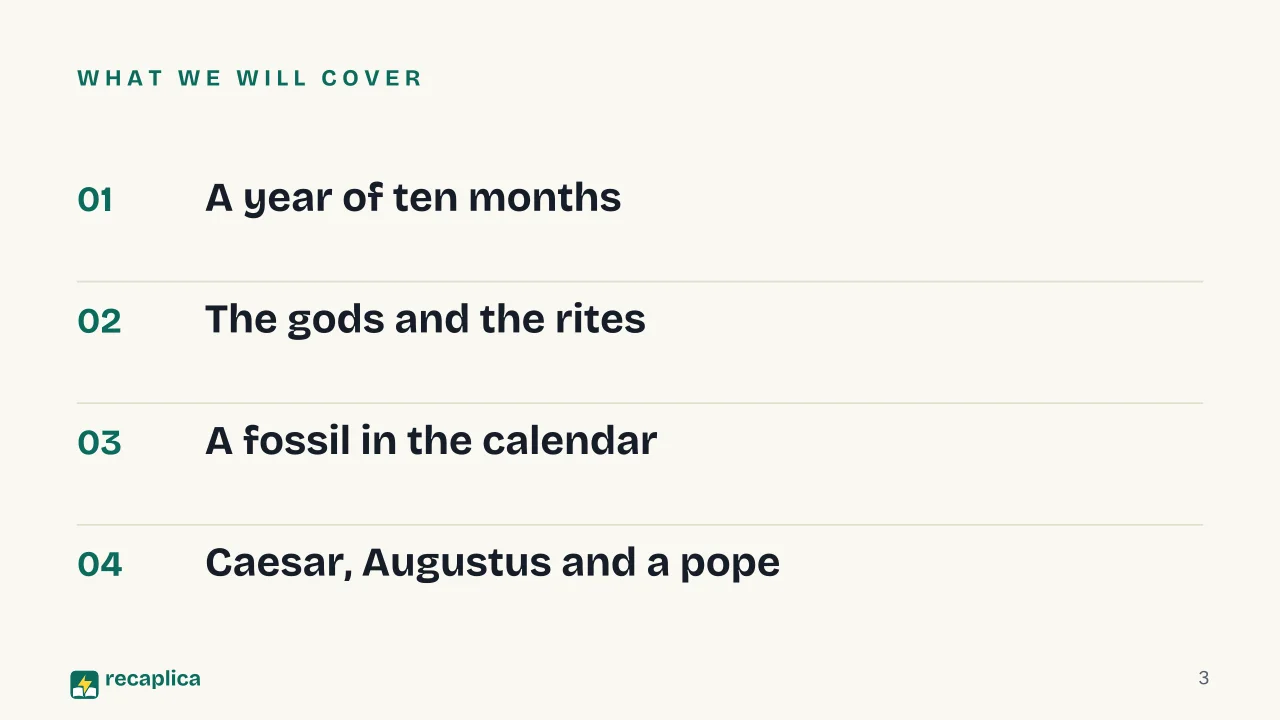  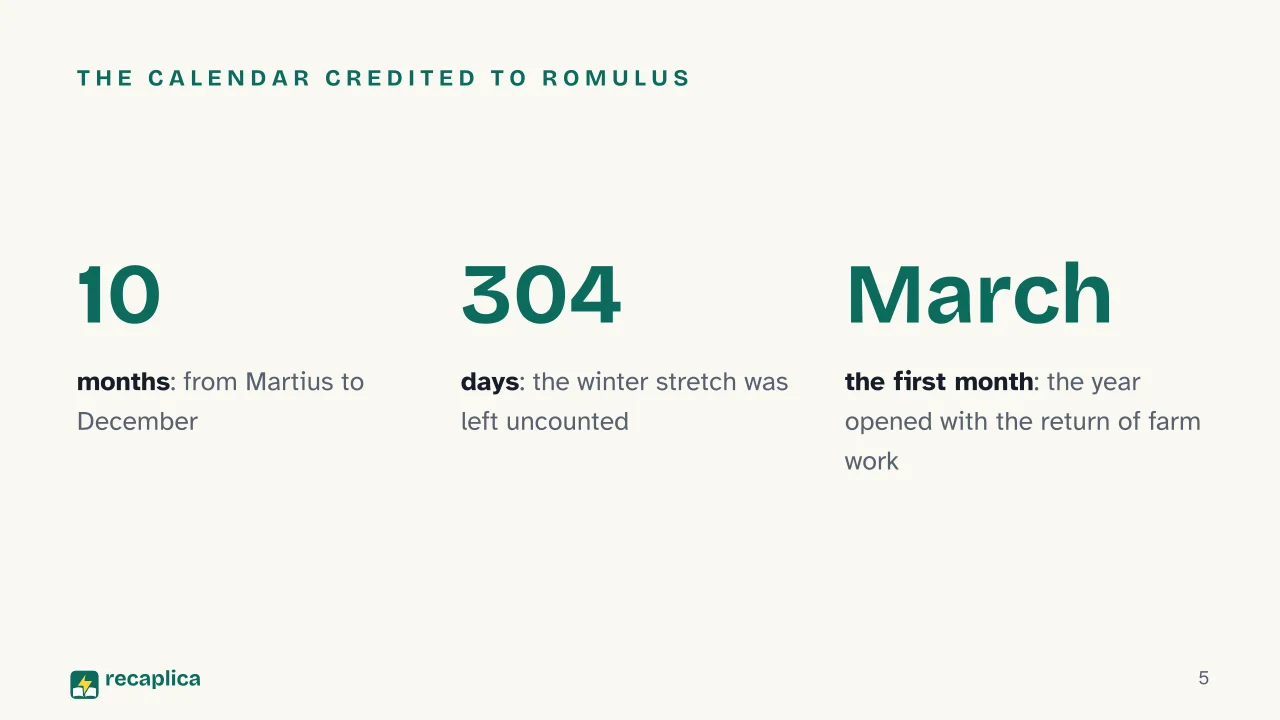 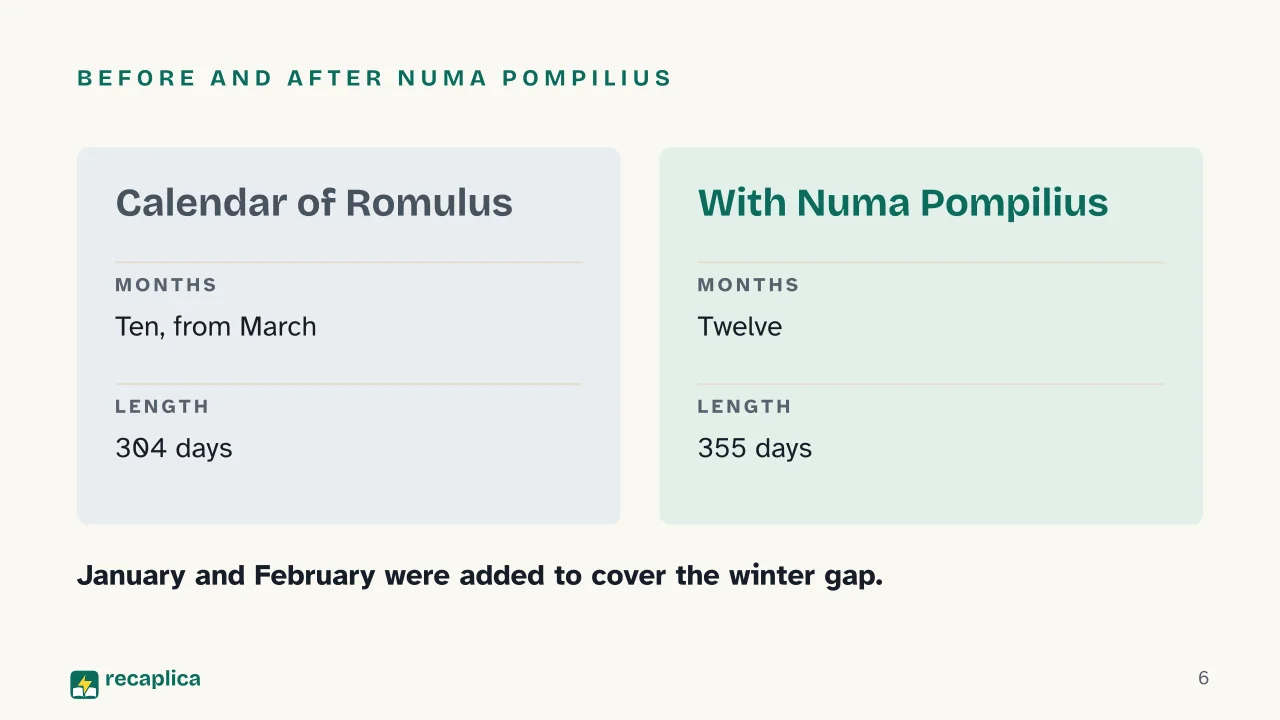  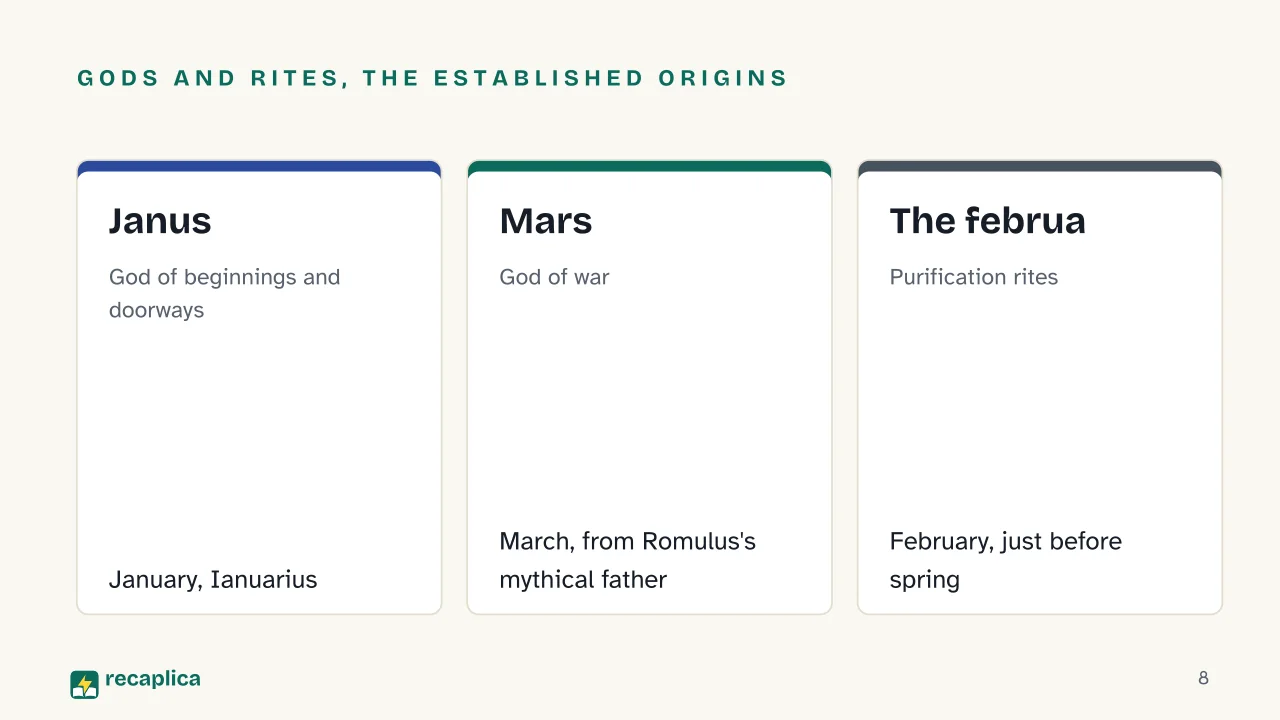 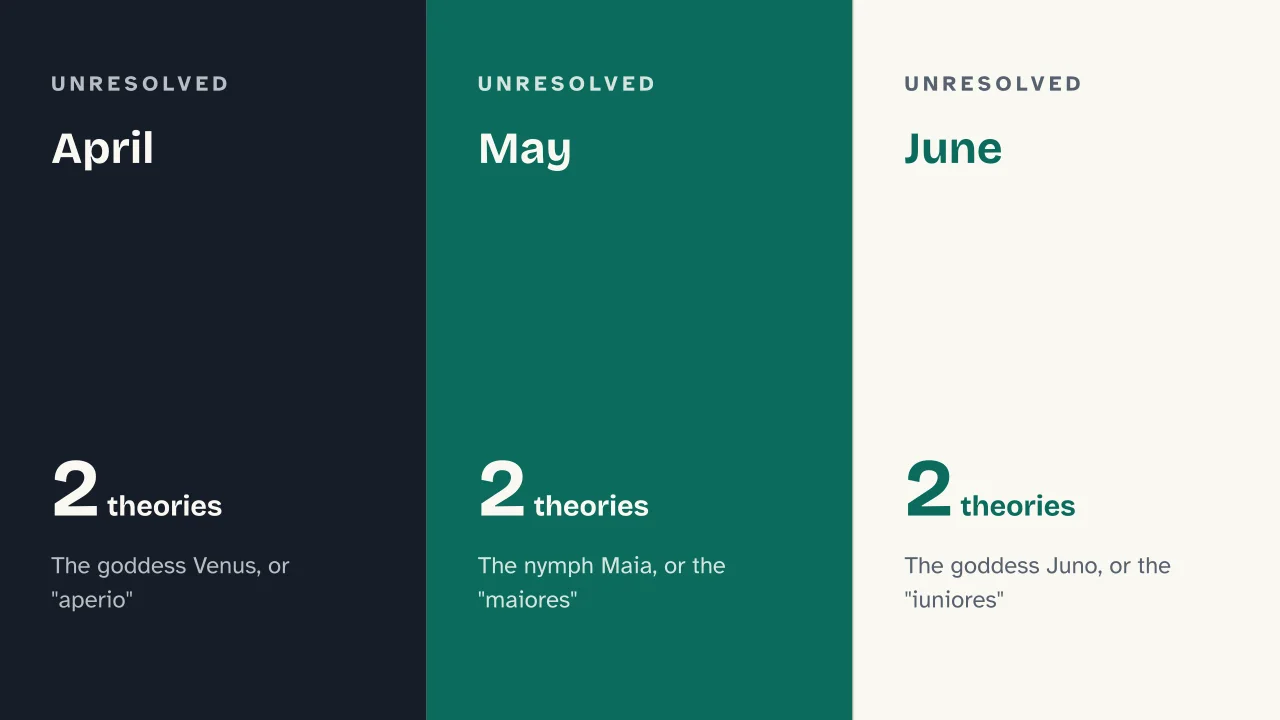  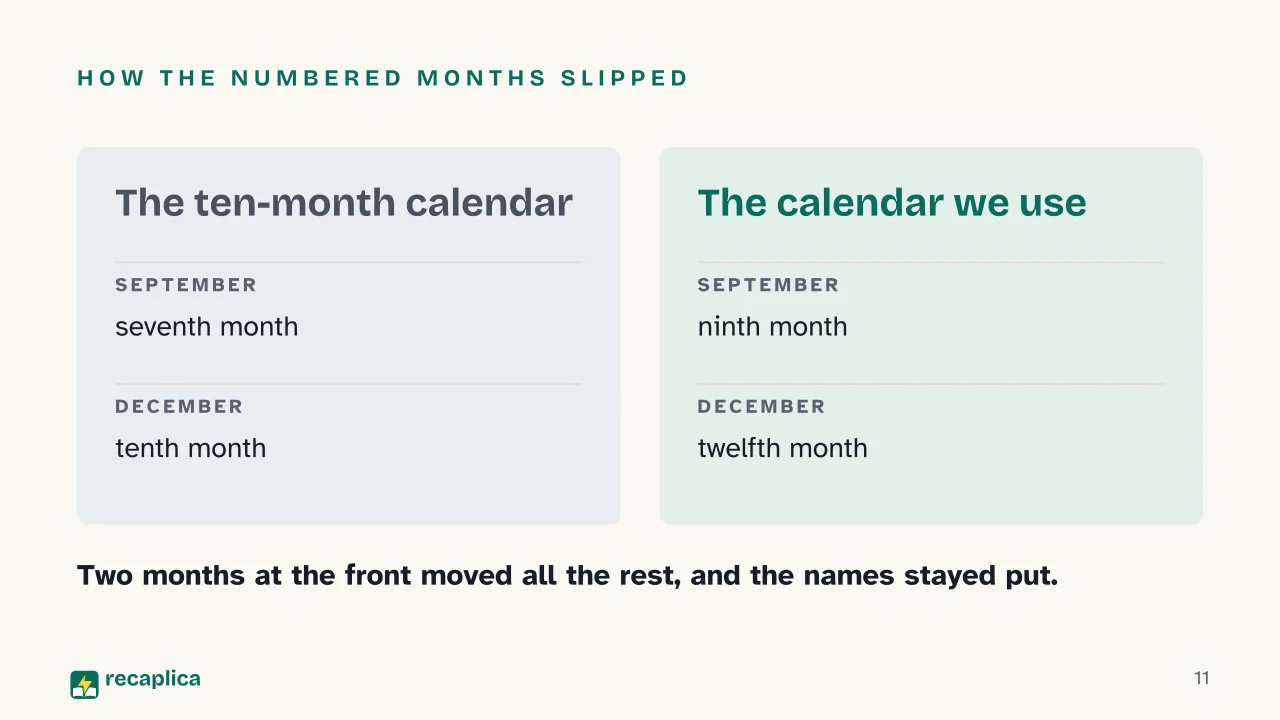   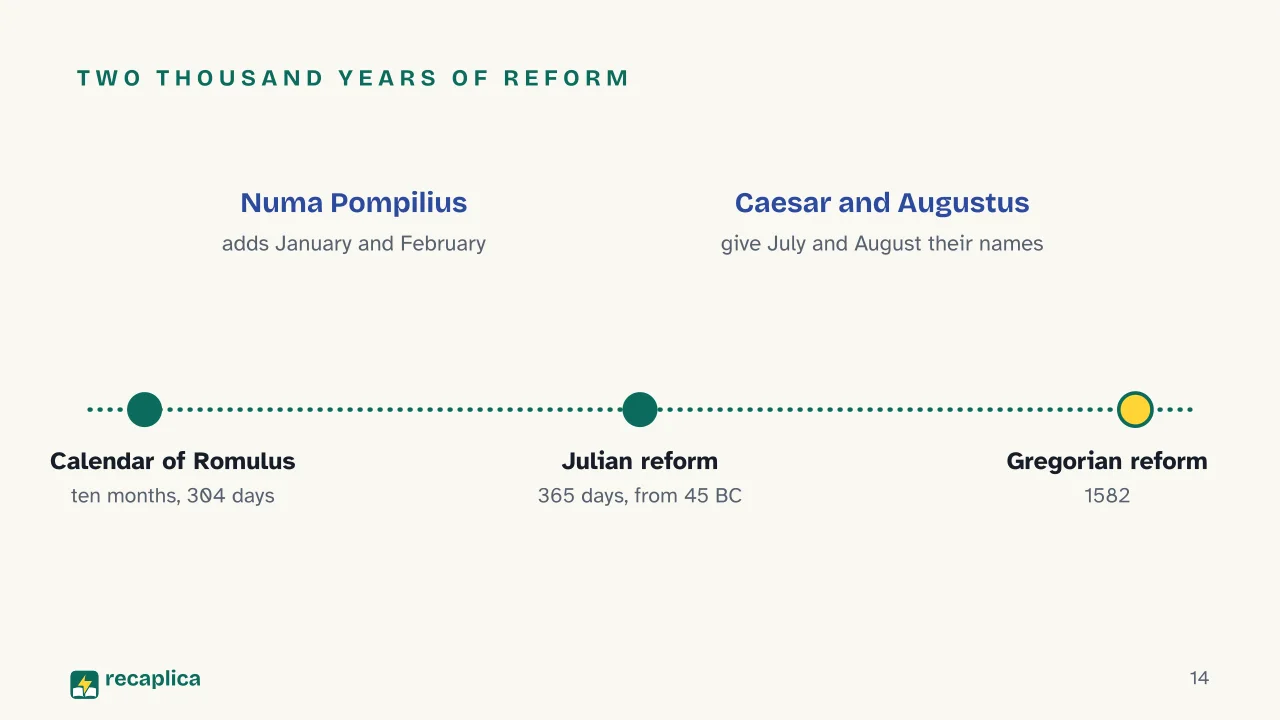 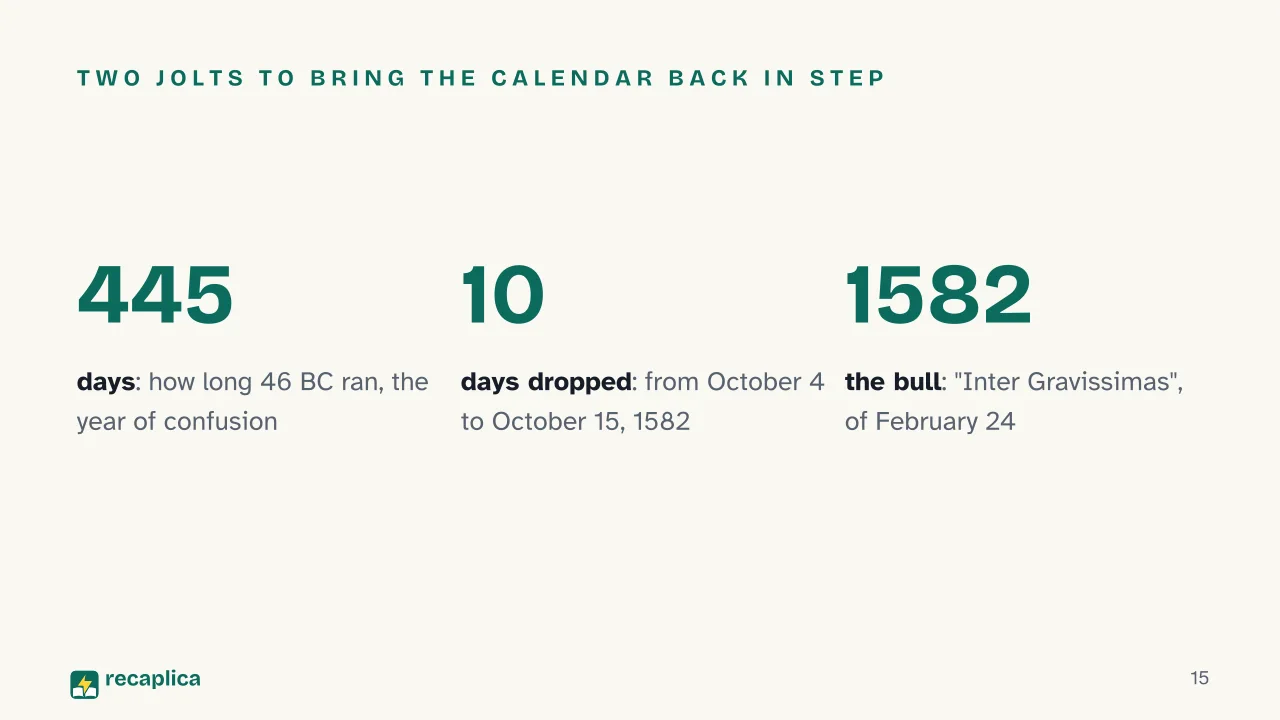  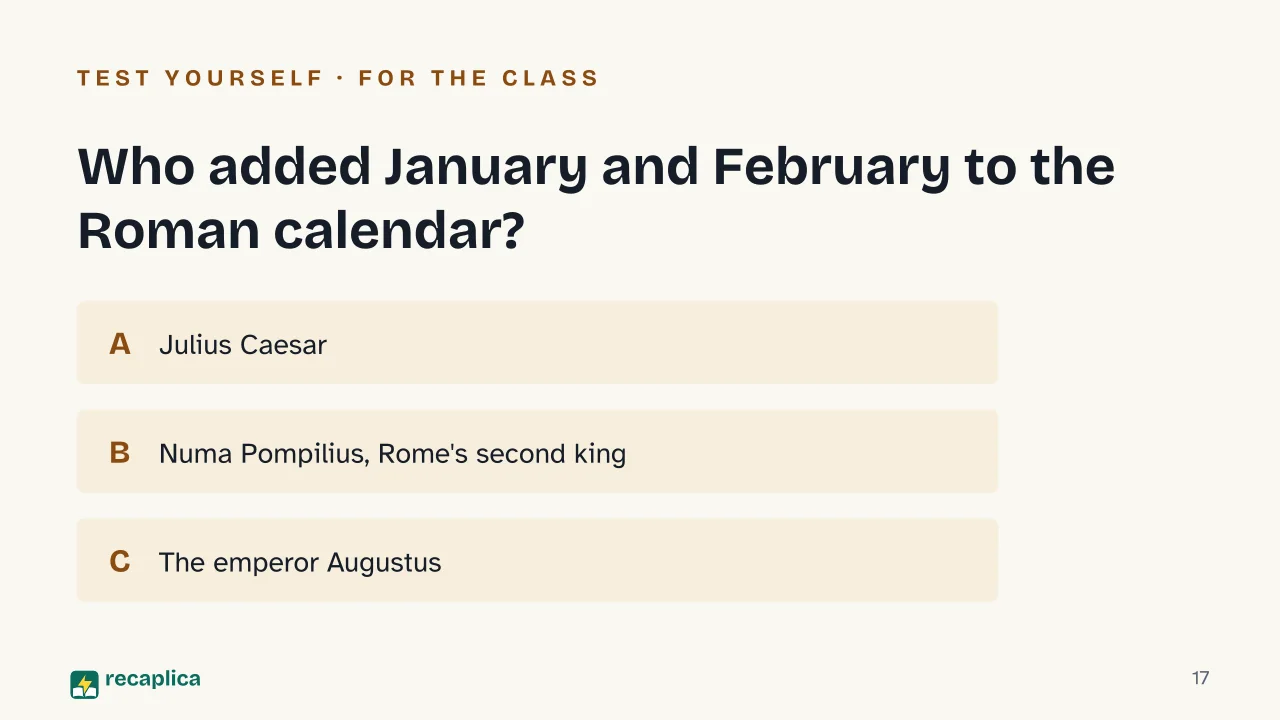  Common myths
Mind mapDrag the background to move around and the nodes to reposition them; use − and + to collapse and expand branches. 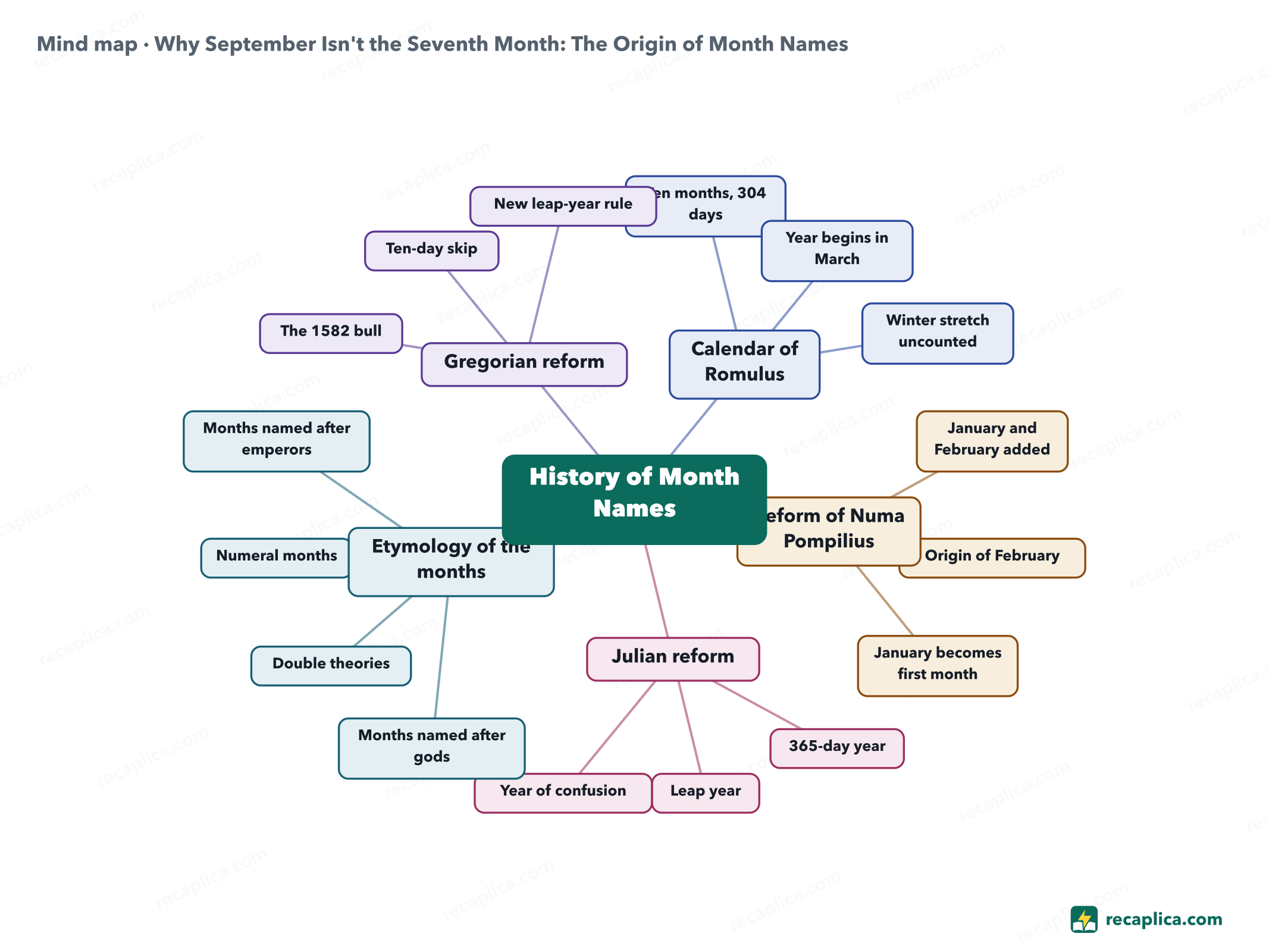
Quiz: test yourselfAnswer the questions to check what you have learned: you get instant feedback and a short explanation. Grade 0/10 0/5
FlashcardsTap the card to flip it and check whether you remember the answer, then move to the next one. 1 / 8 Explain it in your own wordsThe ultimate test: if you can explain it in simple words, you've truly understood it. Write your explanation, then compare it with the Recap. Your explanation is saved only on this device.
Frequently asked questionsWhy isn't September the seventh month, despite its name?Because September, October, November and December are Latin numerals inherited from an older Roman calendar that had only ten months and began in March. When January and February were later added as the first two months of the year, these four months shifted two places forward, but their numeral names were never updated. Why doesn't the year start in March anymore, as it did in the earliest Roman calendar?In the calendar attributed to Romulus, the year genuinely began in March, tied to the return of farm work in spring. When Numa Pompilius added January and February as winter months, they were initially placed at the end of the calendar; only later, according to one source around 450 BC, were the two swapped, making January the first month of the year. Who named the month of July?The month, originally called Quintilis ("fifth month" in the old ten-month calendar), was renamed Julius in honor of Julius Caesar. One source places the renaming in 44 BC, though the exact year isn't confirmed with equal precision across all the sources consulted. Why is August called August?The month, originally called Sextilis ("sixth month"), was renamed Augustus in 8 BC in honor of the emperor Augustus. It wasn't his birth month, which was September. One source says August was chosen because it was the month he first became consul and conquered Egypt. How many days did the year have in the calendar attributed to Romulus?304 days, spread across ten months running from March to December. The winter stretch between late December and the start of March wasn't counted as part of any month, a gap that was only filled once January and February were added. Every Recap goes through an independent review before publication. |