recaplica
Clear in 30 seconds, yours in 10 minutes.
In 30 seconds quick read
A tourist tax, called imposta di soggiorno by law in Italy, is a charge that Italian municipalities can choose to apply to anyone staying overnight in an accommodation on their territory. It isn't automatic: only provincial capitals, unions of municipalities, and towns officially listed as tourist destinations or cities of art can introduce it. The guest is the one who pays, but the property manager is the one who remits it to the city, and for short-term rentals online platforms often share that duty too. National law sets an ordinary ceiling of 5 euros a night, which some municipalities can raise to 10 euros, and events such as the 2025 Jubilee or the 2026 Milan-Cortina Winter Olympics can push it higher still, for a limited period.
Key Points
A tourist tax (legal name in Italy: imposta di soggiorno) is an optional municipal charge, not automatic across the whole country.
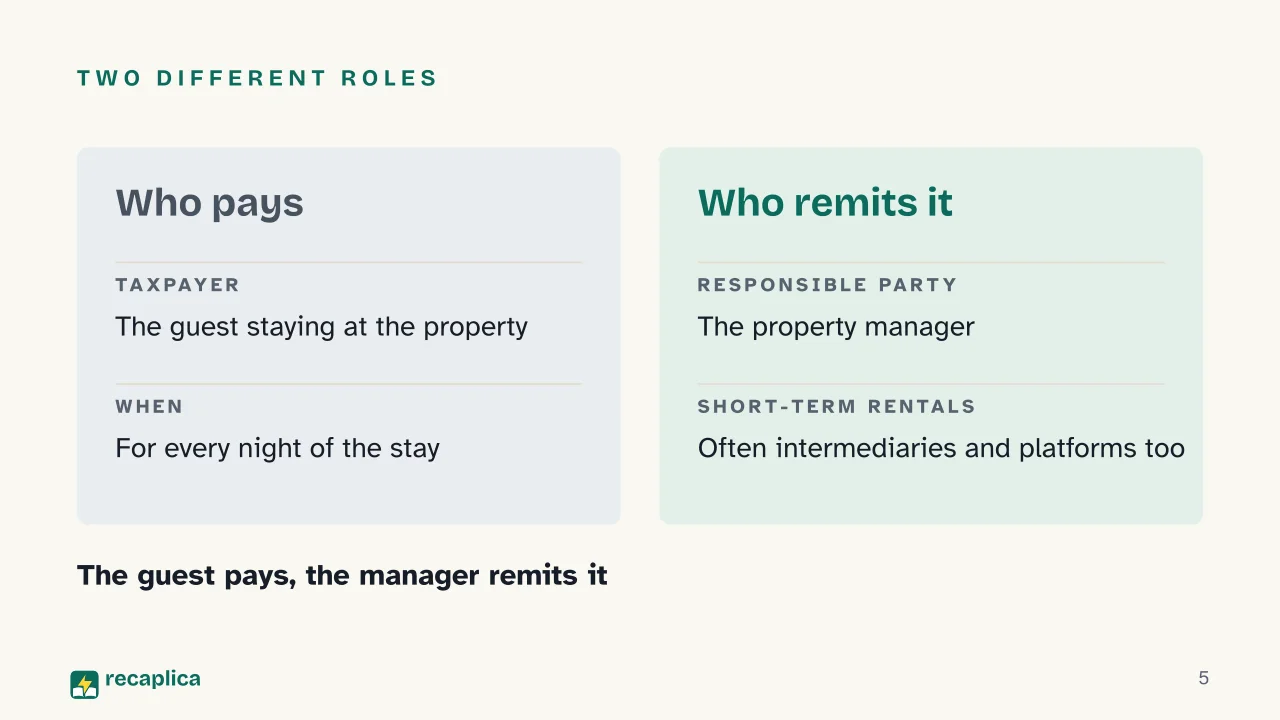
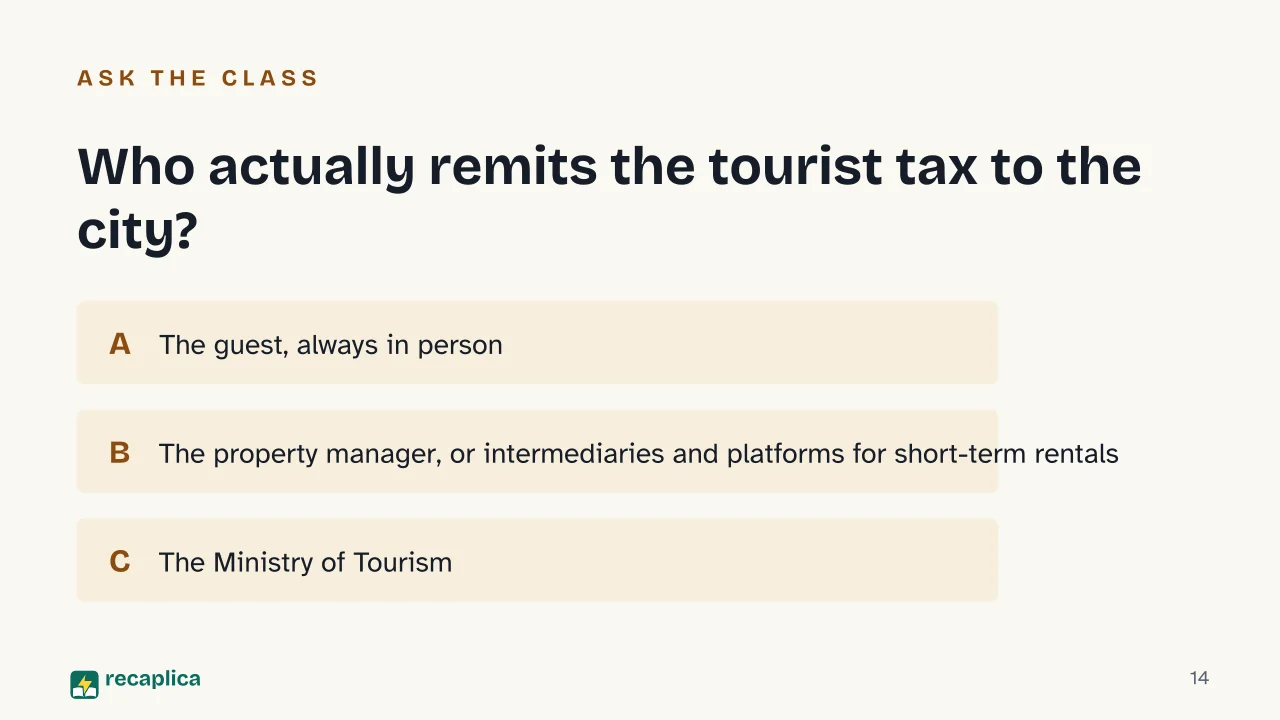
The guest staying at the property pays it; the property manager remits it to the city, and for short-term rentals online platforms or intermediaries often do too.
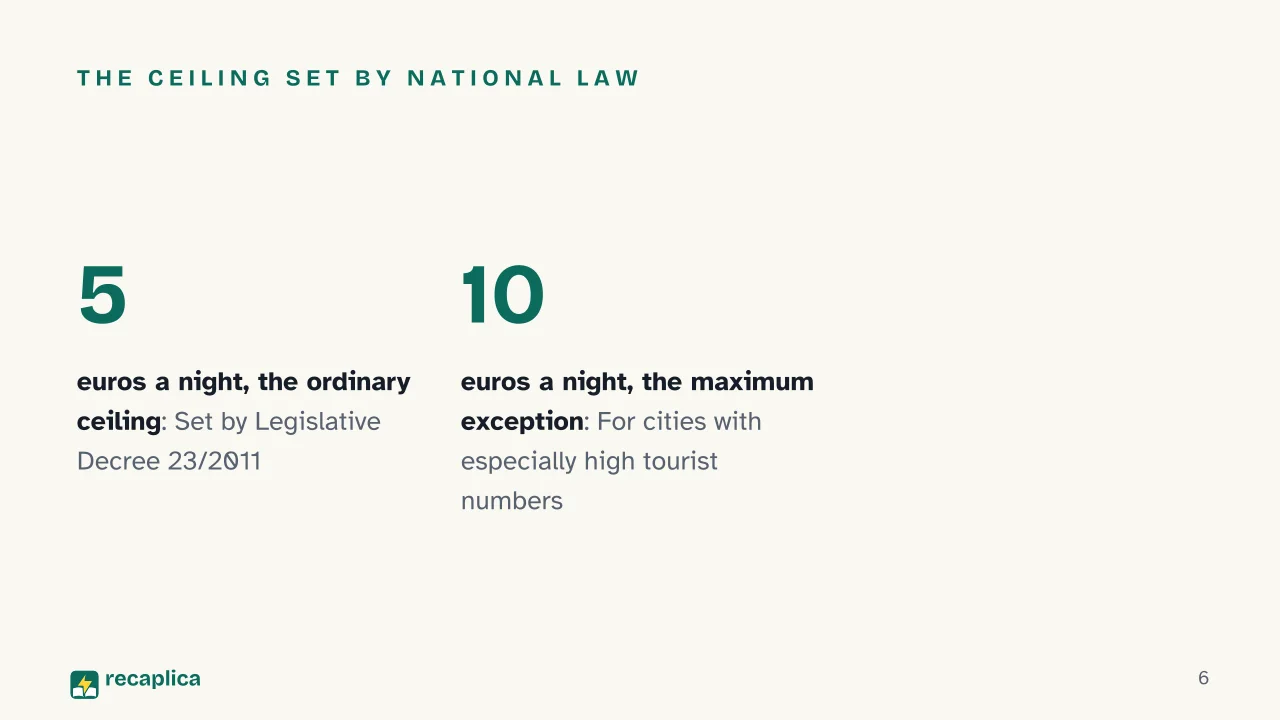
The ordinary ceiling set by national law is 5 euros a night, which can rise to 10 euros in municipalities with especially high tourist numbers.
It applies to holiday homes, B&Bs and short-term rentals too, not only hotels: it depends on each city's own rules.
Major events such as the 2025 Jubilee in Rome and the 2026 Milan-Cortina Winter Olympics can raise it temporarily by decree.
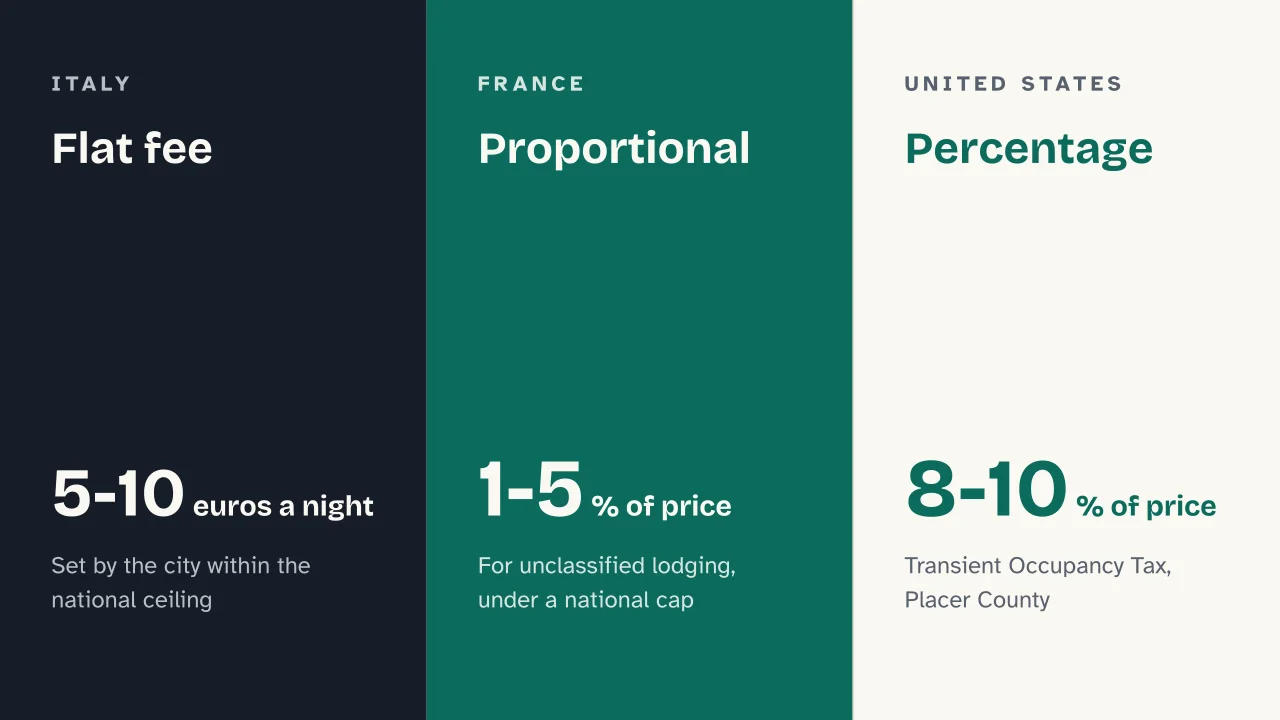
Abroad the model changes: in France it can be proportional to the room price, while in the United States it is almost always a percentage.
Key figures
5 EUR Ordinary maximum per night set by Italian national law (Legislative Decree 23/2011), which can rise to 10 euros in municipalities with especially high tourist numbers. It is a legal ceiling, not the amount every city actually charges. Source: Italian Ministry of Economy and Finance, Department of Finance
8-10% Transient Occupancy Tax rate applied in 2026 on the room price in Placer County, California: a percentage model, unlike Italy's fixed per-night amount. Source: Placer County, California
10 EUR Venice's 2026 day-tripper access fee for anyone who pays within the four days before entering the city without staying overnight (5 EUR for those who pay earlier). It is a different charge from the tourist tax: guests who stay overnight are exempt from it. Source: City of Venice
Deep Dive
Imposta di soggiorno is the technical name Italian law uses; tourist tax is how most English speakers would search for and describe the same idea. Some cities use a third name: Rome, for instance, calls it a contributo di soggiorno. It isn’t an automatic charge across the whole country: according to Italy’s Ministry of Economy and Finance, only provincial capitals, unions of municipalities, and towns listed as tourist destinations or cities of art can introduce it. A small mountain town without that status simply cannot apply it.
Who Pays and Who Remits the Tax
The trigger for the charge is simple: it applies to anyone staying at an accommodation within a municipality that has introduced it. The person who pays is the guest. The person who actually remits the amount to the city, though, is someone else: the property manager, who collects it from guests and hands it over to the local authority on a regular schedule.
In Rome that structure widens further. The trigger for the contributo di soggiorno covers not just hotels and other accommodation types, but also “other real estate rented out for short-term tourist stays,” and the parties responsible for remitting it include, besides property managers, real-estate intermediaries and the operators of booking platforms involved in the rental payment.
In practice: a family books four nights at a B&B in Milan in 2026. The price shown while booking is only the room rate: the tourist tax, calculated per person and per night according to the property’s tier, gets added and collected directly by the manager, who then remits it to the city.
How Much It Costs
National law sets a ceiling, not a single price. Legislative Decree 23/2011 fixes an ordinary maximum of 5 euros per night, which can rise to 10 euros in municipalities with especially high tourist numbers. These are maximums allowed by the rule: within that ceiling, each city sets its own rate, and can set it lower too.
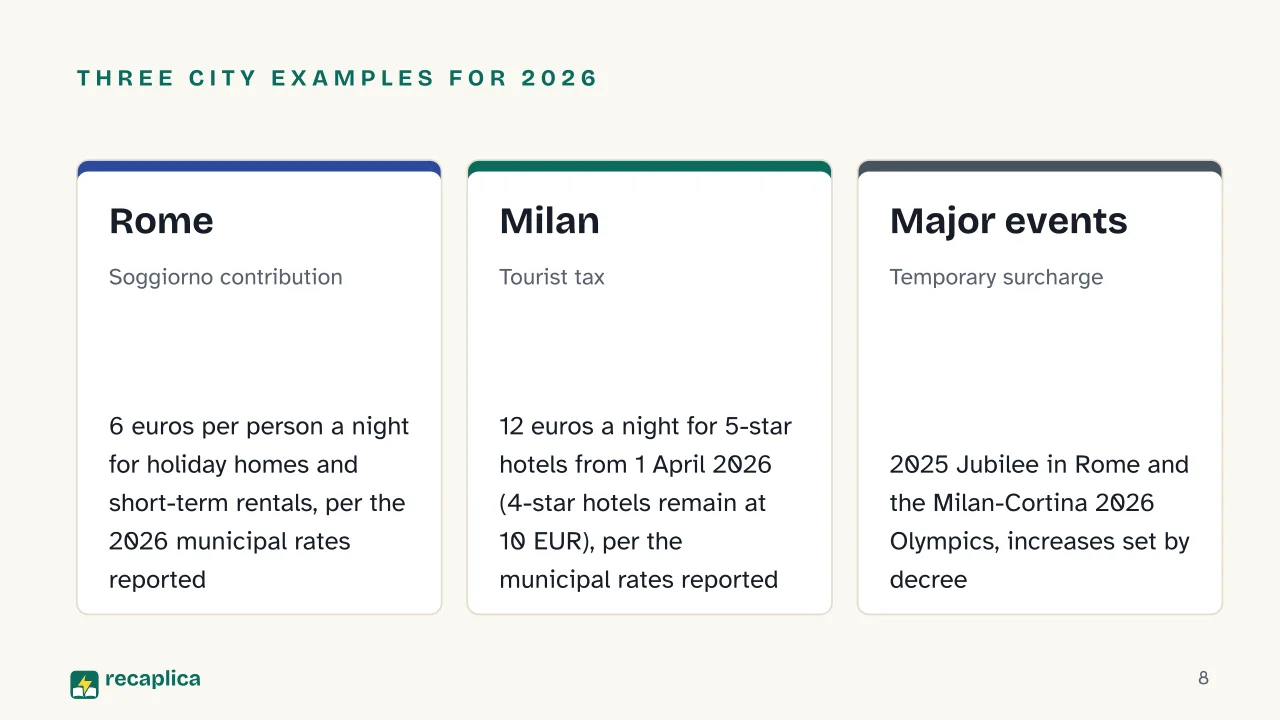
Rome and Milan show just how much municipal rates can differ. The following 2026 figures come from research summaries citing the respective municipal resolutions, not the full text of the documents, and should be treated as indicative.
Scope
Amount (per person/night)
Note
National ordinary ceiling
up to 5 EUR
legal maximum, not what every city charges
National ceiling, exception
up to 10 EUR
legal maximum for cities with heavier tourist flows
Rome, holiday homes and short-term rentals
6.00 EUR
2026 municipal rate, reported via a secondary source
Milan, 5-star hotels
12.00 EUR
municipal rate from 1 April 2026, reported via a secondary source (4-star hotels remain at 10 EUR)
Milan also has a specific reason for its 2026 increase: Decree-Law 156/2025 allows municipalities in Lombardy and Veneto within 30 kilometers of Winter Olympics venues to add a surcharge of up to 5 euros, and Milan chose the maximum margin. A later resolution, in force from 1 April 2026, added a further 2 euros specifically for 5-star hotels, bringing them to 12 euros, while 4-star hotels remain at 10 euros. In Rome, similarly, the charge rose temporarily for the 2025 Jubilee.
Short-Term Rentals, Airbnb and Booking
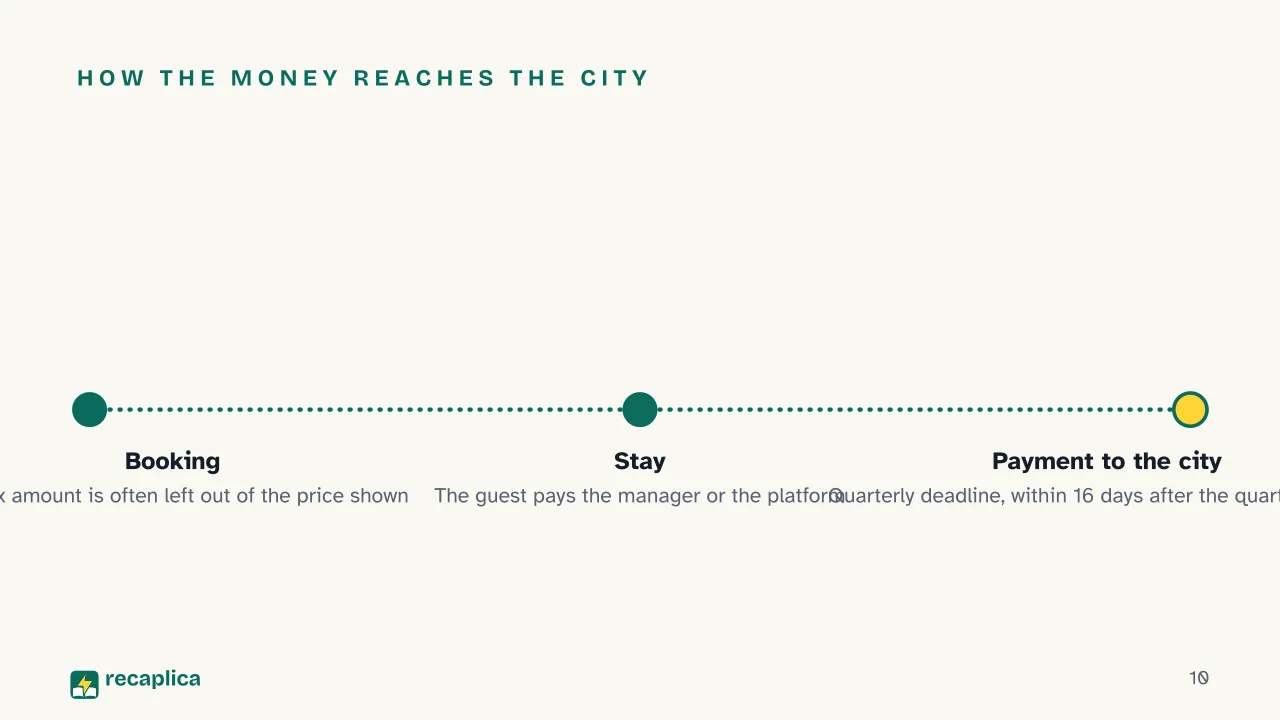
Where a municipality has introduced the charge, the general rule is that it applies to holiday homes, short-term rentals and B&Bs too, not only hotels. The difference from a traditional hotel lies in who remits the amount: in Rome, besides the individual host, real-estate intermediaries and booking-platform operators are also responsible for remitting it. The manager collects the amount from guests and pays it to the city on a fixed schedule: in Rome, for instance, within the sixteenth day after the end of each quarter.
In France the system is even more centralized for platforms: since 2024, tourist-booking platforms can file a single nationwide declaration instead of a separate one for every municipality where they operate.
Common Exemptions
Italian municipal rules often exempt several categories, though the exact list varies from city to city: residents registered with the municipality, children under a certain age (the threshold varies by rule, often between 12 and 14), employees of accommodation businesses, and people with disabilities who are not self-sufficient along with their companions. These aren’t exemptions imposed uniformly by national law: they’re choices each municipality makes on its own.
Major Events, When The Amount Rises
A little-known detail is that the tourist tax can rise temporarily by decree during events with an exceptional tourist inflow. In 2025, for the Jubilee, and in 2026, for the Milan-Cortina Winter Olympics, the rules allowed specific surcharge margins: for the Olympics, up to 5 euros more for municipalities in Lombardy and Veneto within 30 kilometers of competition venues. These are increases tied to a specific event and time window, not a permanent change to the rate.
The International Comparison
Outside Italy, the way this charge is calculated changes quite a bit.
Country
Model
Example
Italy
Flat fee per night, set by the city within a national ceiling
5-10 EUR ceiling, Rome and Milan with their own rates
France
Flat fee for classified categories; percentage of price (1-5%) for unclassified lodging, with a national cap of 15.93 EUR in 2026
Paris, 4-star furnished tourist rental at 4.40 EUR a night
Spain (Balearic Islands)
Regional charge, not municipal, also covering cruise ships calling at port
Impost sobre estades turístiques, filed only online
United States
Percentage of the room price (Transient Occupancy Tax), varying by county or city
Placer County, California, 8% or 10% depending on the zone
The simplest difference to remember is this: in Italy guests almost always pay a flat amount per night depending on the property’s tier, while in the United States the Transient Occupancy Tax is a percentage of the room price, closer to a small local consumption tax than a fixed figure. France sits in between, mixing flat fees and percentages depending on how the lodging is classified.
Slide deck
Slides ready to download and make your own in PowerPoint or Google Slides, with speaker notes. Pick the Flash cut or the Full one.
✓ Reality They are two separate charges with different triggers: the access fee is paid by anyone entering the city for the day without staying overnight, while the tourist tax applies to anyone who sleeps at least one night in an accommodation. Anyone staying overnight is simply outside the access fee's scope.
✗ Myth Short-term rentals and Airbnb don't pay a tourist tax.
✓ Reality Where a municipality has introduced the charge, it applies to holiday homes, short-term rentals and B&Bs too, not only hotels. In Rome the rule explicitly covers properties rented out for short tourist stays, and the duty to remit the charge extends to intermediaries and platforms as well.
✗ Myth The tourist tax is the same amount everywhere in Italy.
✓ Reality Each municipality sets its own rate within the ceiling fixed by national law (5 euros, which can rise to 10), so Rome and Milan charge different amounts from each other and by type of property; some municipalities, moreover, don't apply it at all because they aren't among those allowed to or have chosen not to introduce it.
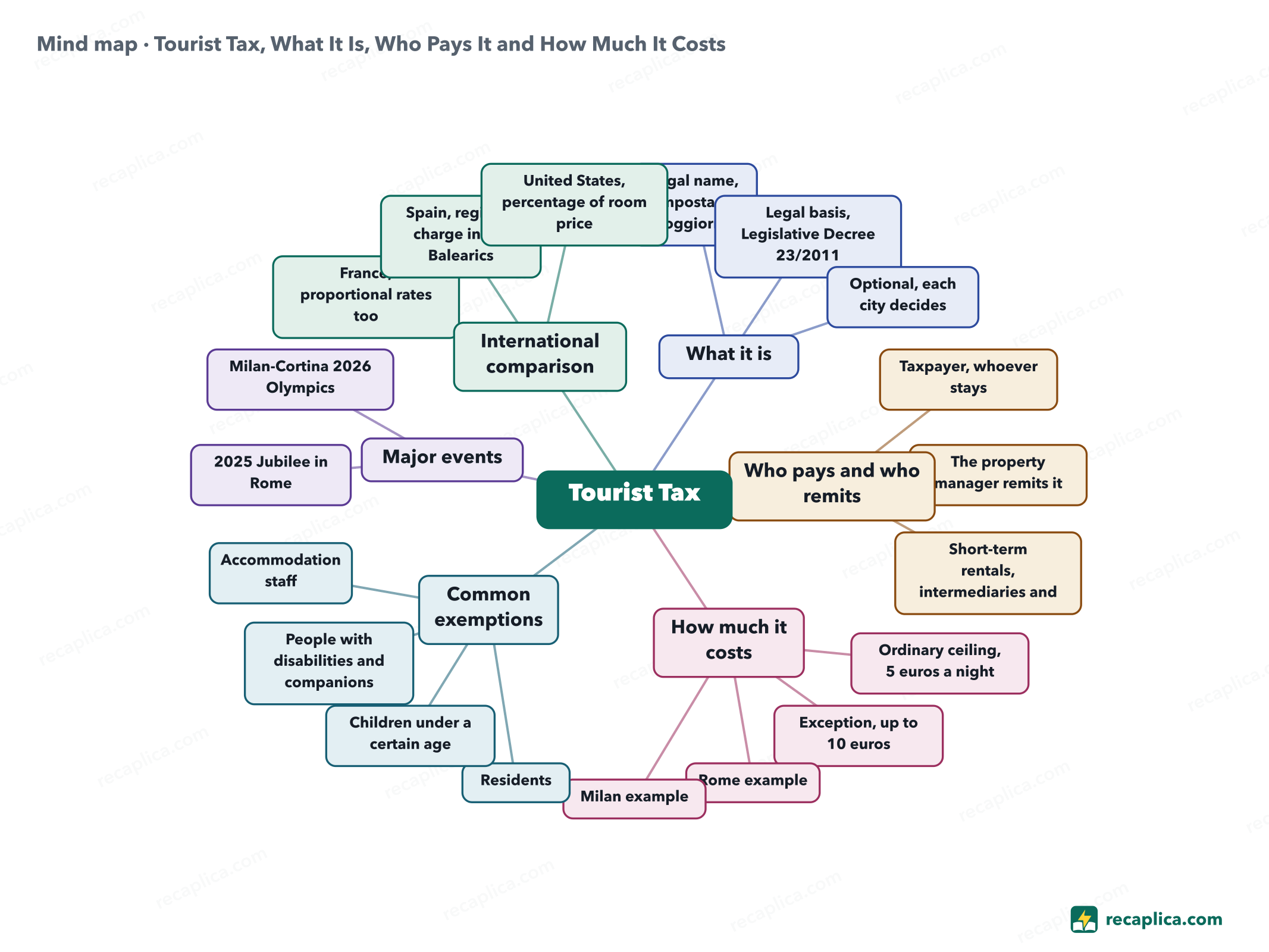
Mind map
Drag the background to move around and the nodes to reposition them; use − and + to collapse and expand branches.
Short-term rentals, intermediaries and platforms too
How much it costs
Ordinary ceiling, 5 euros a night
Exception, up to 10 euros
Rome example
Milan example
Common exemptions
Residents
Children under a certain age
People with disabilities and companions
Accommodation staff
Major events
2025 Jubilee in Rome
Milan-Cortina 2026 Olympics
International comparison
France, proportional rates too
Spain, regional charge in the Balearics
United States, percentage of room price
Quiz: test yourself
Answer the questions to check what you have learned: you get instant feedback and a short explanation.
Grade0/100/5
Answers: 1-B · 2-B · 3-B · 4-B · 5-B
Flashcards
Tap the card to flip it and check whether you remember the answer, then move to the next one.
1 / 8
Explain it in your own words
The ultimate test: if you can explain it in simple words, you've truly understood it. Write your explanation, then compare it with the Recap.
Your explanation is saved only on this device.
A tourist tax, called imposta di soggiorno by law in Italy, is a charge that Italian municipalities can choose to apply to anyone staying overnight in an accommodation on their territory. It isn't automatic: only provincial capitals, unions of municipalities, and towns officially listed as tourist destinations or cities of art can introduce it. The guest is the one who pays, but the property manager is the one who remits it to the city, and for short-term rentals online platforms often share that duty too. National law sets an ordinary ceiling of 5 euros a night, which some municipalities can raise to 10 euros, and events such as the 2025 Jubilee or the 2026 Milan-Cortina Winter Olympics can push it higher still, for a limited period.
Frequently asked questions
What is a tourist tax?
It is a municipal charge that guests pay for each night spent in an accommodation. In Italy its legal name is imposta di soggiorno; some cities, such as Rome, call it a contributo di soggiorno instead. Not every Italian municipality applies it: only provincial capitals, unions of municipalities, and towns listed as tourist destinations or cities of art can.
Do you pay a tourist tax on Airbnb and short-term rentals?
Yes, where the municipality has introduced it, the charge applies to holiday homes, B&Bs and short-term rentals too, not only hotels. In Rome, for instance, real-estate intermediaries and platform operators involved in the rental payment are also responsible for remitting it, not just the individual host.
For how many nights do you pay a tourist tax?
It depends on each city's own rules. Some set a maximum number of consecutive nights at the same property after which the charge no longer applies: in Rome, according to the 2026 rates published, that limit is 10 nights.
Can you ask for a receipt for the tourist tax?
The property manager is the one who collects the amount from guests and remits it to the city, so they are the right person to ask for a payment receipt at check-in or check-out.
Is there a difference between a tourist tax and an occupancy tax?
Legally, no: they describe the same kind of charge, just under different names depending on the country or authority. In Italy the technical term is imposta di soggiorno, tourist tax is the everyday term most people search for, and in the United States the same idea goes by transient occupancy tax.
Every Recap goes through an independent review before publication.
Statistics, only if you say so
To learn which Recaps help most we would use Google Analytics, with aggregate, anonymous data. It starts only with your OK, and you can change your mind anytime. Privacy policy