|
recaplica
Regime Forfettario: Italy's Flat-Rate Tax Scheme Explained | ||||||||||||||||||
| © 2026 Recaplica · recaplica.com — All rights reserved | ||||||||||||||||||
Regime Forfettario: Italy's Flat-Rate Tax Scheme ExplainedWhat to print Page numbers appear when printing with default margins. SlidesChoose a cut Flash10 slidesThe essential thread, to present in classFull16 slidesEvery chapter and the deeper detailBoth come with speaker notes. In 30 seconds quick readRegime forfettario is Italy's flat-rate tax scheme for people who open a partita IVA (the Italian VAT number) as sole traders: craftspeople, shopkeepers and freelance professionals with modest revenue. It's open to anyone with annual revenue up to €85,000 who also meets a set of other conditions, and it replaces ordinary income tax with a single substitute tax of 15%, cut to 5% for the first five years for people starting a genuinely new activity. There's no VAT to charge or reclaim and no periodic VAT filings, which cuts down paperwork a lot compared with the ordinary regime. It isn't a shortcut open to everyone, though: specific exclusions rule it out for people with certain business stakes or employment income above a threshold. Key Points
Key figures
Deep DiveRegime forfettario started out as a flat-rate tax scheme for individuals running a business, craft or profession in Italy. It changes how tax gets calculated, built for people with modest revenue who’d rather skip the more complex bookkeeping of the ordinary regime. Who can join the regime forfettario: the requirementsAccording to Agenzia delle Entrate, Italy’s tax authority, entry is open to those who earned revenue or received payments, prorated for partial years, not exceeding €85,000: that’s the threshold in force since 2023, introduced by the 2023 budget law (L. 197/2022). Someone opening a new partita IVA can choose the flat-rate scheme from day one, provided they fall under this limit and don’t trigger any of the exclusions listed further down. There’s a lesser-known condition too: anyone who earned employment income above a certain threshold in the previous year is shut out of the scheme. That threshold used to be €30,000, then was raised to €35,000 for 2025 and 2026. Someone working part-time who opens a partita IVA as a side activity needs to check this figure too, not just the revenue from the new activity. The revenue limit: €85,000 a yearWhen the regime forfettario launched, in 2015, the threshold was €65,000; it was raised several times since, up to the €85,000 in force since 2023. Staying under that annual ceiling is a condition for remaining in the scheme. The exclusionsStaying under the revenue limit isn’t enough on its own. Among others, the regime forfettario shuts out: people using special VAT regimes or flat-rate income-determination regimes; non-residents, unless they earn at least 75% of their total income in Italy; those who mainly or exclusively sell buildings, building land or new vehicles; those who work mainly for an employer they had a working relationship with in the previous two years, unless they’re completing a mandatory training period; and those who simultaneously hold a stake in a partnership, professional association or family business, or control a limited company whose activity overlaps with their individual one.
How the tax works: the rate and the profitability coefficientPeople on the regime forfettario don’t pay ordinary income tax, surtaxes or the other taxes normally due, but a single substitute tax instead. The standard rate is 15%, applied not to total revenue but to taxable income worked out by applying a profitability coefficient to revenue — a coefficient that differs by business activity code and is set out in a table attached to the law that created the scheme. For the first five years of activity the rate drops to 5%, provided the taxpayer hasn’t carried out a comparable artistic, professional or business activity in the previous three years, and the new activity isn’t simply a continuation of work already done in another form.
The VAT exemption and other simplificationsPeople on the regime forfettario don’t charge VAT to their clients on invoices and can’t reclaim the VAT paid on purchases. They’re also exempt from periodic VAT payments and filings and from the annual VAT return. In most cases they don’t even have to follow the rules on mandatory electronic invoicing, though anyone who chooses to invoice exclusively electronically anyway gets an extra perk: the deadline for tax assessment notices shrinks by a year, to four years instead of the ordinary five. On the whole, people on the flat-rate scheme also aren’t subject to withholding tax on the revenue or payments they receive, with the exception of employment and similar income. Regime forfettario versus the ordinary regime: the differencesThe most visible difference between the two regimes shows up on an invoice.
Someone working in the labor market as a self-employed professional, without an employer, often weighs up this table before even deciding how to open a partita IVA: the regime forfettario cuts down on paperwork, but it isn’t the most convenient choice for someone with a lot of deductible costs, because the flat-rate calculation doesn’t itemize those costs one by one. INPS contributions for craftspeople and shopkeepersAnyone enrolled in the relevant INPS social security schemes for craftspeople and shopkeepers who also joins the regime forfettario can apply for a 35% cut in the contributions owed, both on income up to the minimum threshold and on any income above it. The break, set out in Article 1, paragraph 111 of L. 208/2015, isn’t automatic: it has to be requested explicitly, and it’s calculated on the flat-rate income already determined for tax purposes, not on gross revenue. Slide deckSlides ready to download and make your own in PowerPoint or Google Slides, with speaker notes. Pick the Flash cut or the Full one.     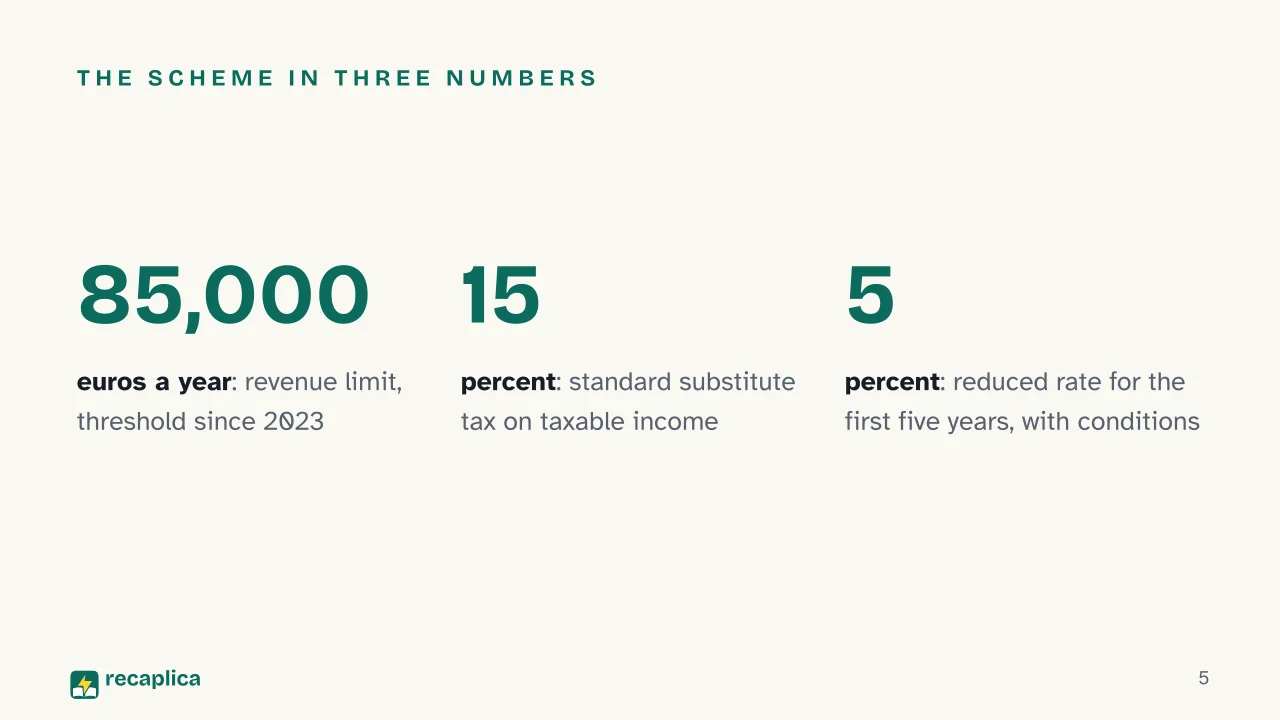  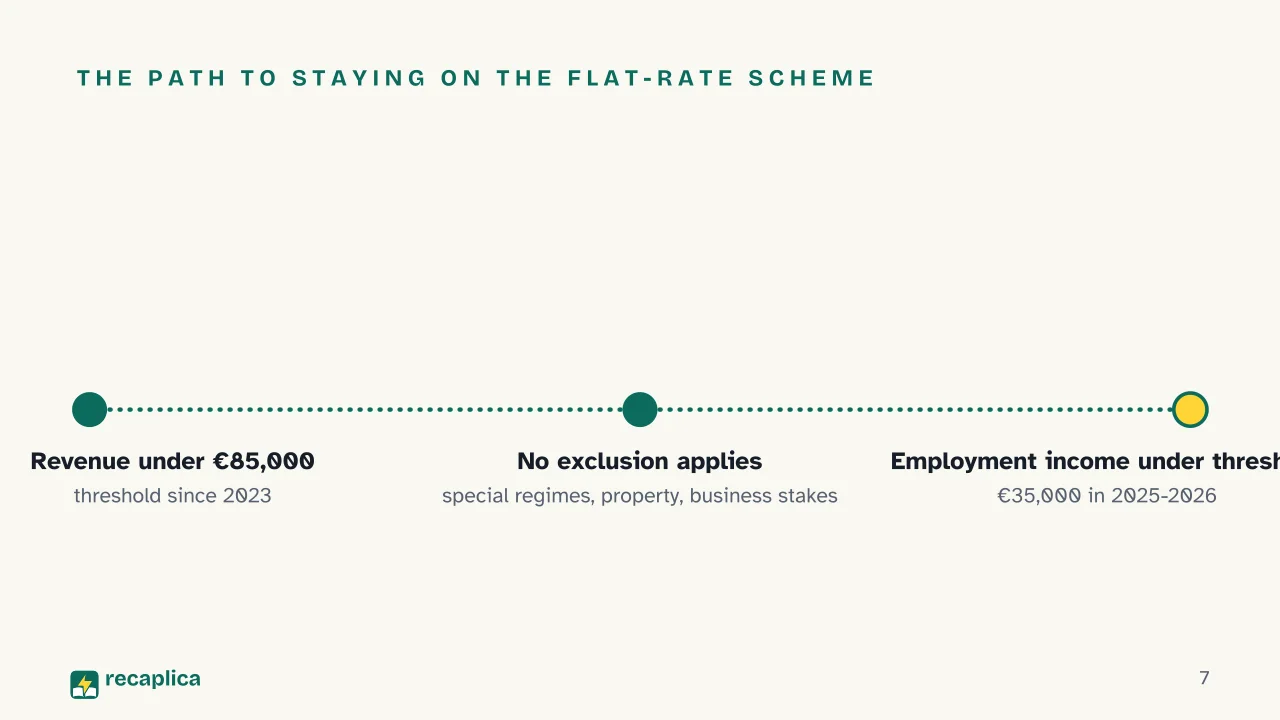 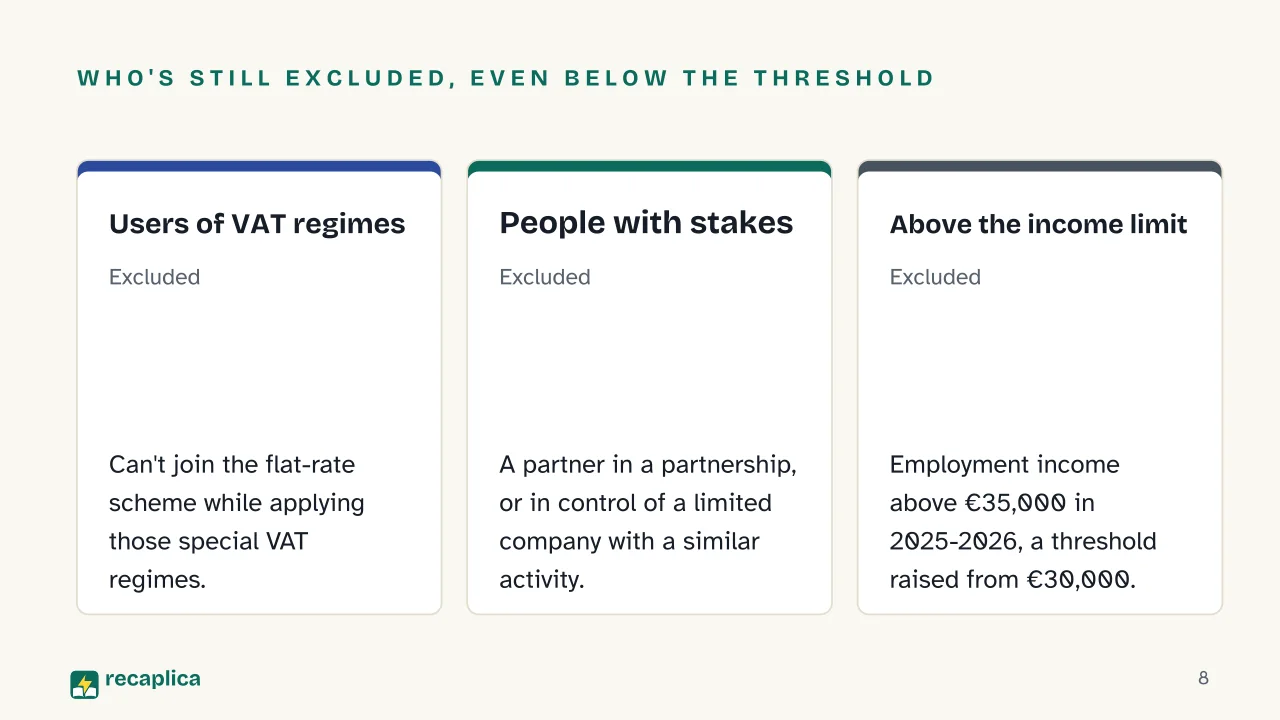  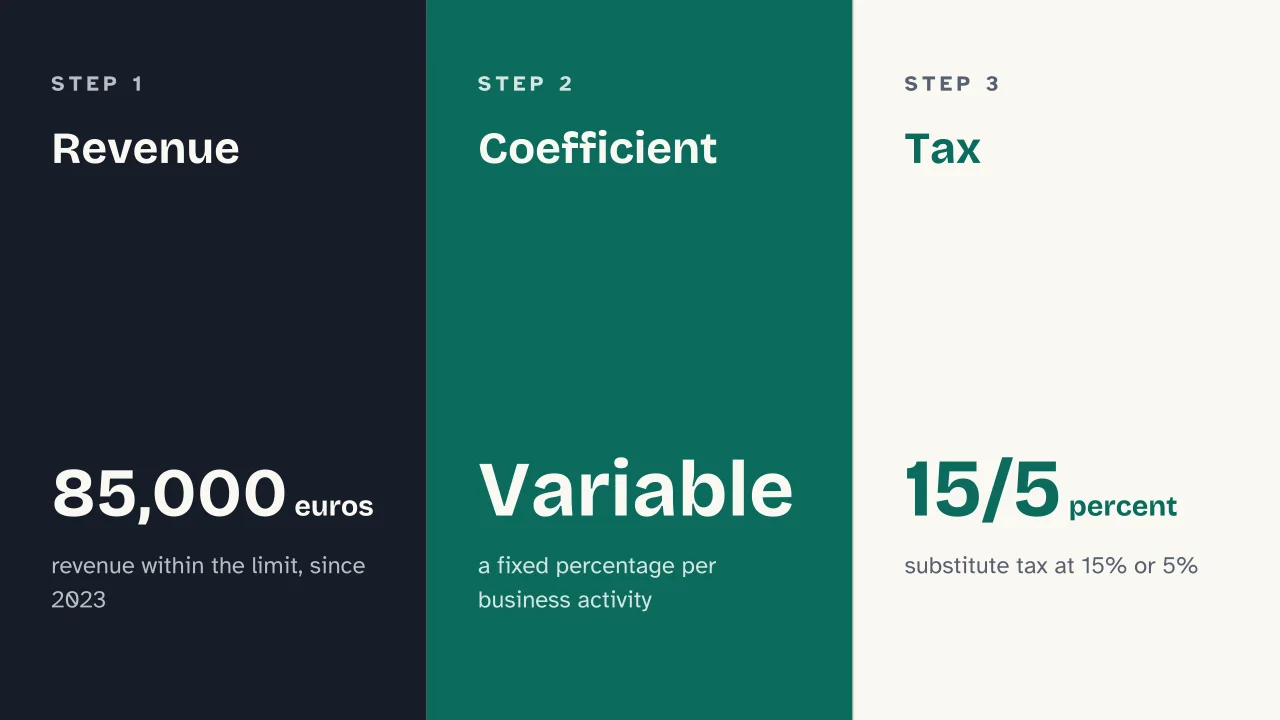  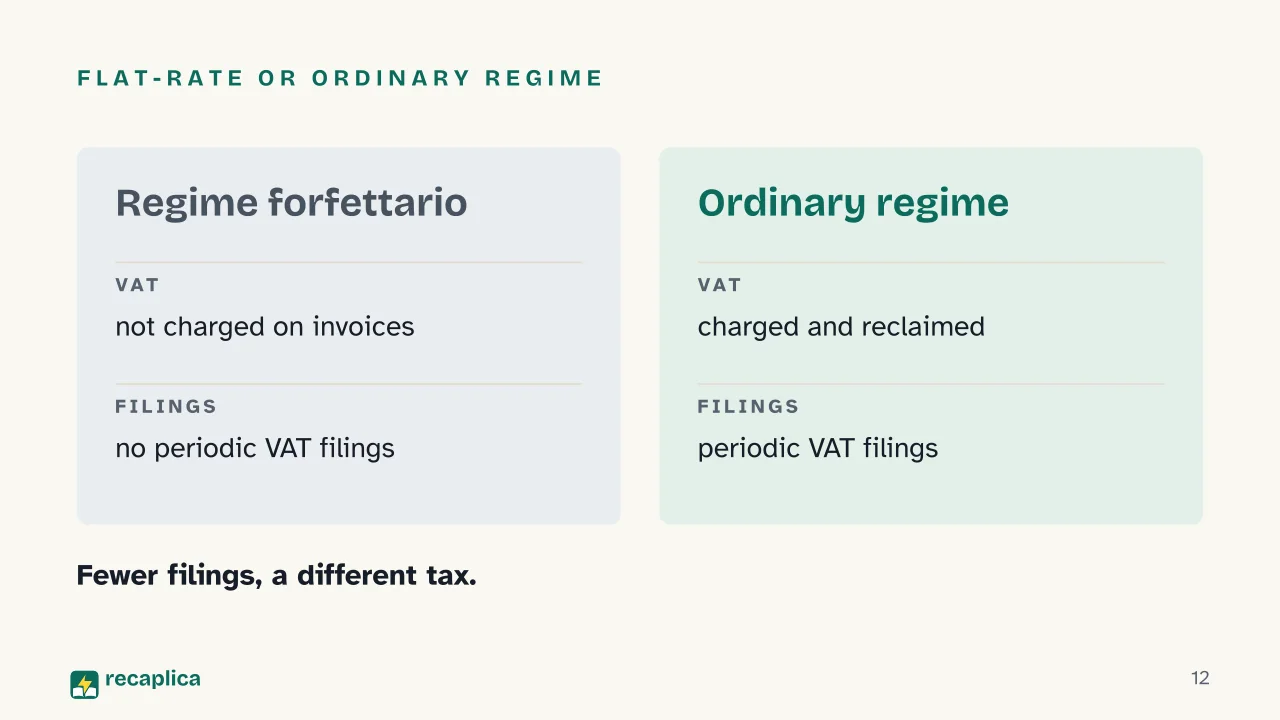 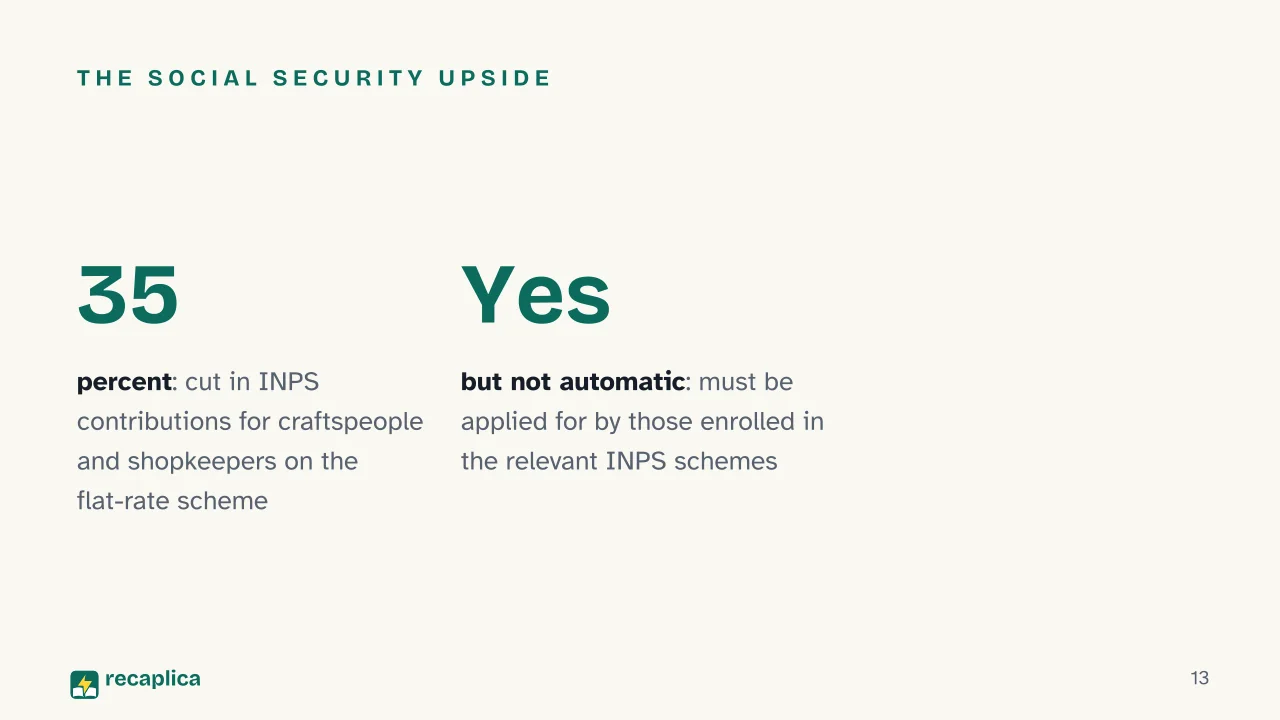 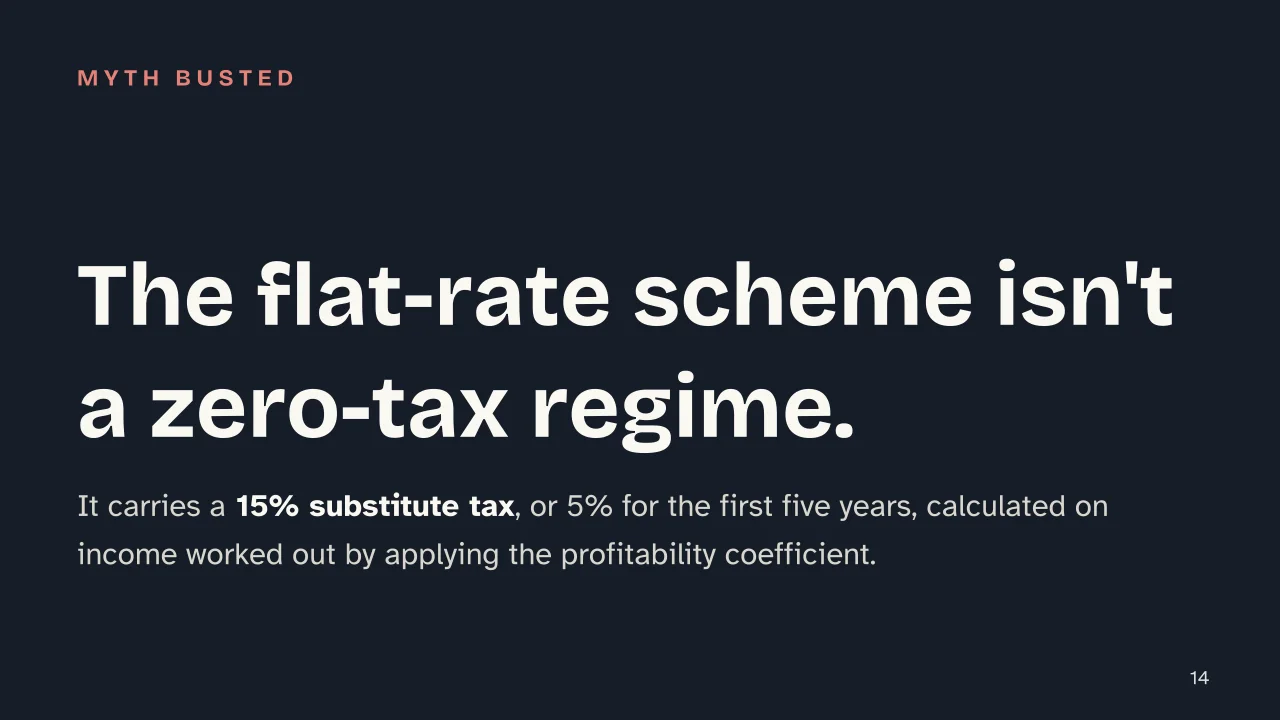 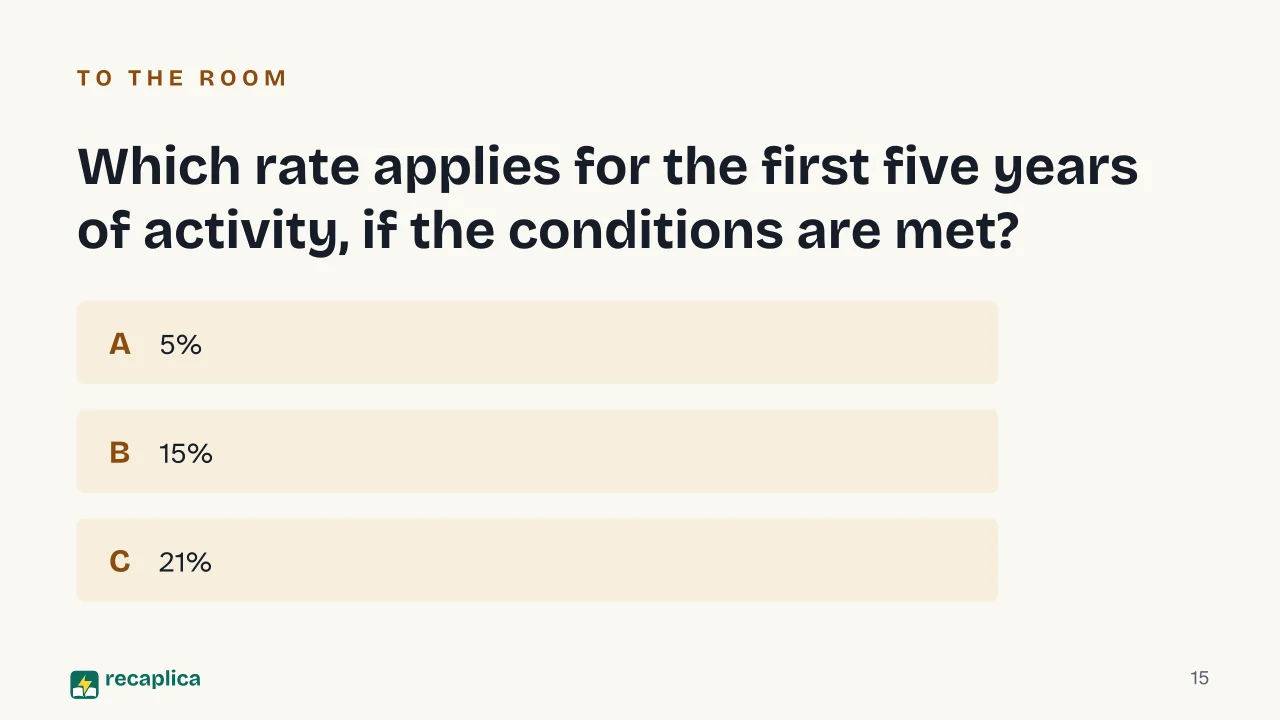  Common myths
Mind mapDrag the background to move around and the nodes to reposition them; use − and + to collapse and expand branches. 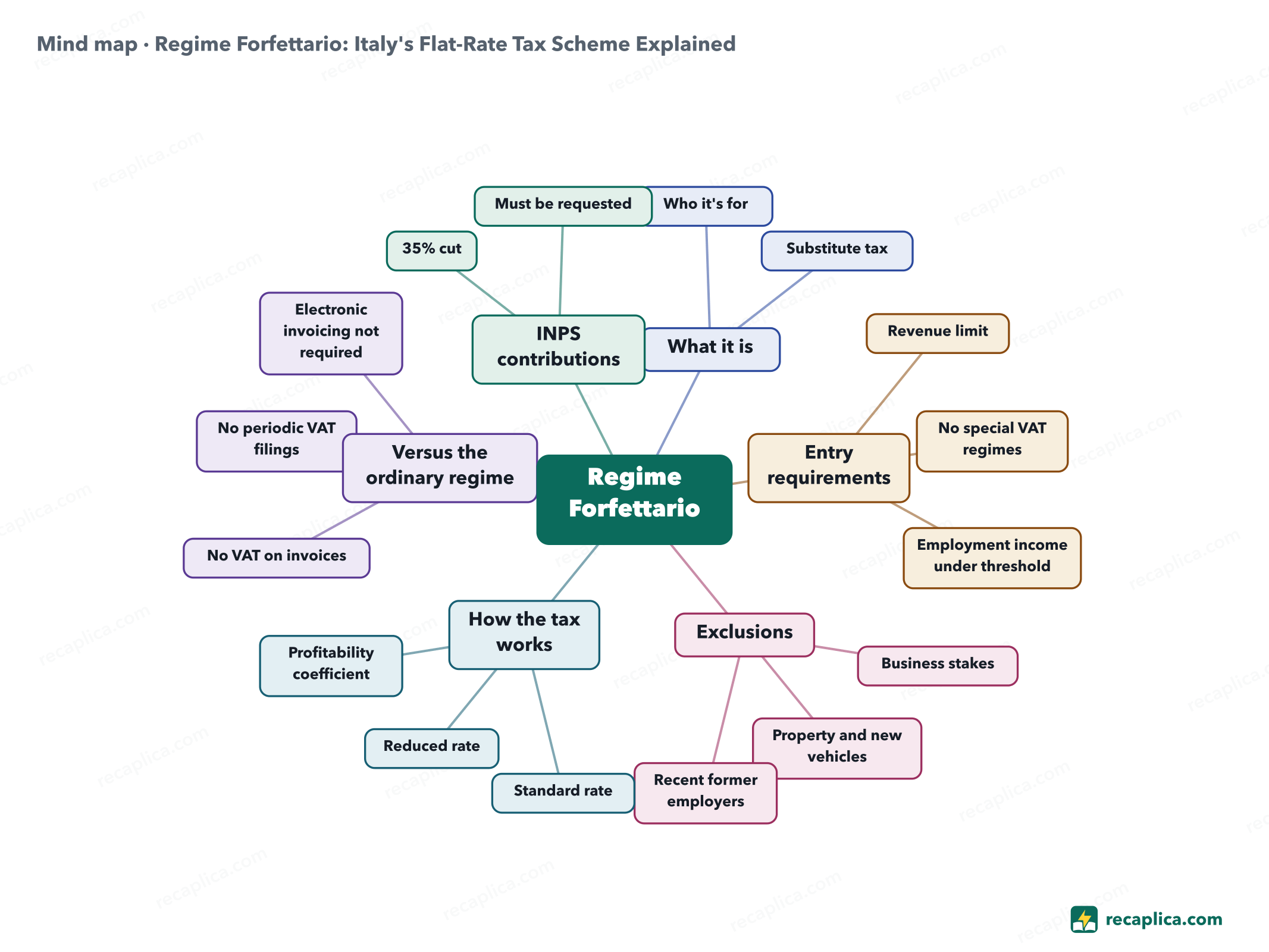
Quiz: test yourselfAnswer the questions to check what you have learned: you get instant feedback and a short explanation. Grade 0/10 0/5
FlashcardsTap the card to flip it and check whether you remember the answer, then move to the next one. 1 / 7 Explain it in your own wordsThe ultimate test: if you can explain it in simple words, you've truly understood it. Write your explanation, then compare it with the Recap. Your explanation is saved only on this device.
Frequently asked questionsWhat are the requirements for the regime forfettario?You need to be an individual with revenue up to €85,000 a year, not use special VAT regimes, not have employment income above the threshold (€35,000 for 2025-2026), and not fall under the other exclusions, such as stakes in partnerships or connected limited companies. What is the revenue limit of the regime forfettario?€85,000 in revenue a year, prorated for partial years: it's the threshold in force since 2023 under Italy's 2023 budget law (L. 197/2022). Go above that figure and you move to the ordinary tax regime. Does the regime forfettario come with a VAT exemption?Yes: people on the scheme don't charge VAT to clients on invoices, can't reclaim VAT on purchases, and are exempt from periodic VAT filings, payments and the annual VAT return. How does the regime forfettario differ from Italy's ordinary tax regime?Under the flat-rate scheme there's no VAT on invoices, no periodic VAT filings and generally no requirement for electronic invoicing; you pay a single substitute tax (15% or 5%) on income worked out by applying a profitability coefficient to revenue, instead of ordinary taxes calculated on actual deductible costs. Does the regime forfettario also cut INPS social security contributions?Not automatically for everyone: craftspeople and shopkeepers enrolled in the relevant INPS social security schemes can apply for a 35% cut in the contributions they owe (Article 1, paragraph 111, L. 208/2015). Every Recap goes through an independent review before publication. |