Skip to content
recaplica

    One moment: security check

    Cloudflare wants to make sure you're not a robot. Tick the box below and your search will continue on its own.

    IT
    recaplica Gender Role Socialisation: How Family, School and Media Teach It
    © 2026 Recaplica · recaplica.com — All rights reserved
    Home › Civics

    Gender Role Socialisation: How Family, School and Media Teach It

    By Recaplica Newsroom · Updated on October 6, 2026

    What to print

    Page numbers appear when printing with default margins.

    Slides

    Choose a cut

    Flash10 slidesThe essential thread, to present in classFull15 slidesEvery chapter and the deeper detail

    Both come with speaker notes.

    Telegram channel
    recaplica Clear in 30 seconds, yours in 10 minutes.
    In 30 seconds Key points Figures Deep dive Slides Myths Mind map Quiz Flashcards FAQ

    In 30 seconds quick read

    A gender role is what a society expects from a woman's or a man's behaviour and appearance: an idea that is distinct both from sex, the biological fact about a person, and from gender identity, how a person experiences their own gender internally. Sociology points to family, school, peer group and mass media as the four main channels through which these expectations pass from one generation to the next. Inside the family, the cited studies describe parents praising children more when they pick toys considered typical for their sex, with fathers generally less flexible than mothers about that line. At school, one study recorded teachers paying more attention and giving more encouragement to male students. Children's media counts too: an analysis of the ten highest-grossing US children's films found nine male leads out of ten, and a 2026 study of Chinese picture books found female characters more often shown doing housework and male characters more often shown outdoors.

    Key Points

    • Sociology treats sex, gender, gender identity and gender role as four separate layers: one biological, the other three social or personal.
    • Sociology names four main agents of gender socialisation: family, school, peer group and mass media.
    • Inside the family, the cited studies describe boys more often receiving toys such as vehicles and sports gear, and girls dolls and kitchen sets, with fathers generally less willing than mothers to bend that line.
    • At school, one study recorded teachers giving boys more praise and more turns to speak than girls.
    • In children's media, the cited analyses find recurring patterns: more male leads in the highest-grossing US children's films, more female characters in domestic roles in the Chinese picture books analysed.
    • Children of fathers more involved in day-to-day caregiving show, according to the cited source, less tendency to read the world through gender stereotypes.

    Key figures

    • 9 out of 10 Among the ten highest-grossing G-rated children's films released in the United States between 1991 and 2013, nine characters out of ten were male. Source: Smith, 2008, cited in OpenStax, Introduction to Sociology 3e
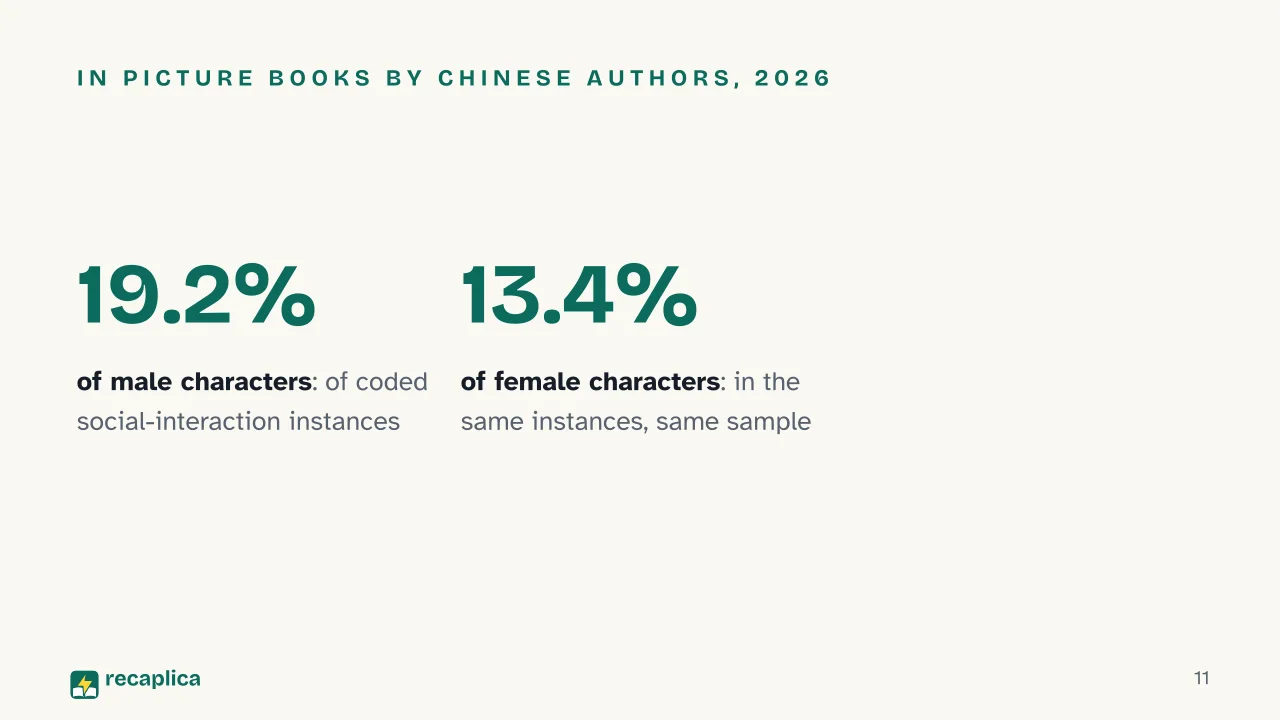
    • 19.2% versus 13.4% In 2026, in a sample of 148 Chinese children's picture books, male characters accounted for 19.2% of the coded social-interaction instances in books by Chinese authors, against 13.4% for female characters. Source: Zhou, Guo, Liu, Sun and Zhang, 2026, Behavioral Sciences (MDPI)

    Deep Dive

    What Gender Roles Are

    Sociology is careful to separate terms that everyday language often blurs together. Sex is a biological fact: the reproductive system and secondary traits such as height or muscle mass. Gender, by contrast, is a social category: the set of behaviours, personal traits and positions a society assigns to being a woman or a man. Gender identity is the internal, personal sense a person has of their own gender. Gender role, finally, is the set of social expectations about how men and women should look and behave — a concept distinct from both sex and gender identity.

    According to sociology textbooks, learning a gender role starts right from birth. Gender socialisation, in that sense, is one specific chapter inside a wider topic, how a person enters the rules of their own society: the channels stay the same — home, classroom, friends, screen — what changes is the object being watched, the expectations tied to gender.

    The Family

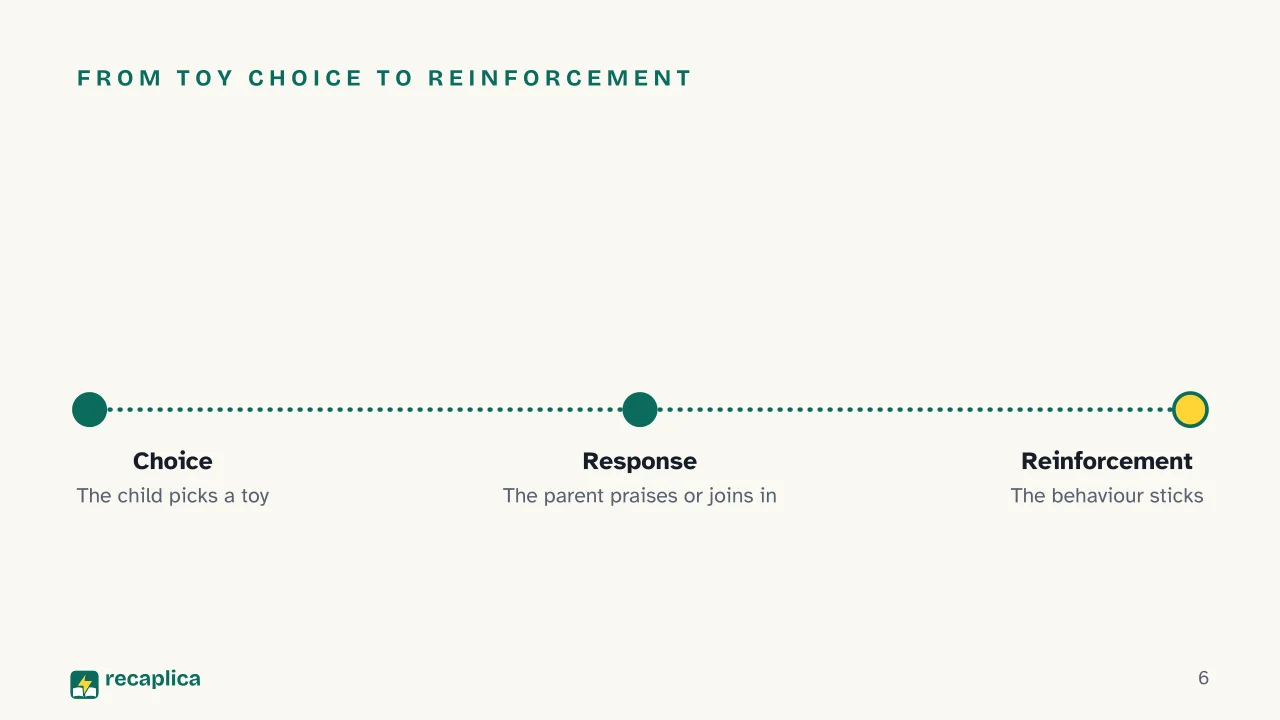
    The first agent, according to the textbooks, is the family. A frequently cited study, by Caldera, Huston and O’Brien (1998), found that children choose toys seen as “fitting their own gender” more often even when toys associated with the other gender are also available: the authors link that choice to how parents respond, with praise, involvement and physical closeness, to behaviour that matches gender expectations.

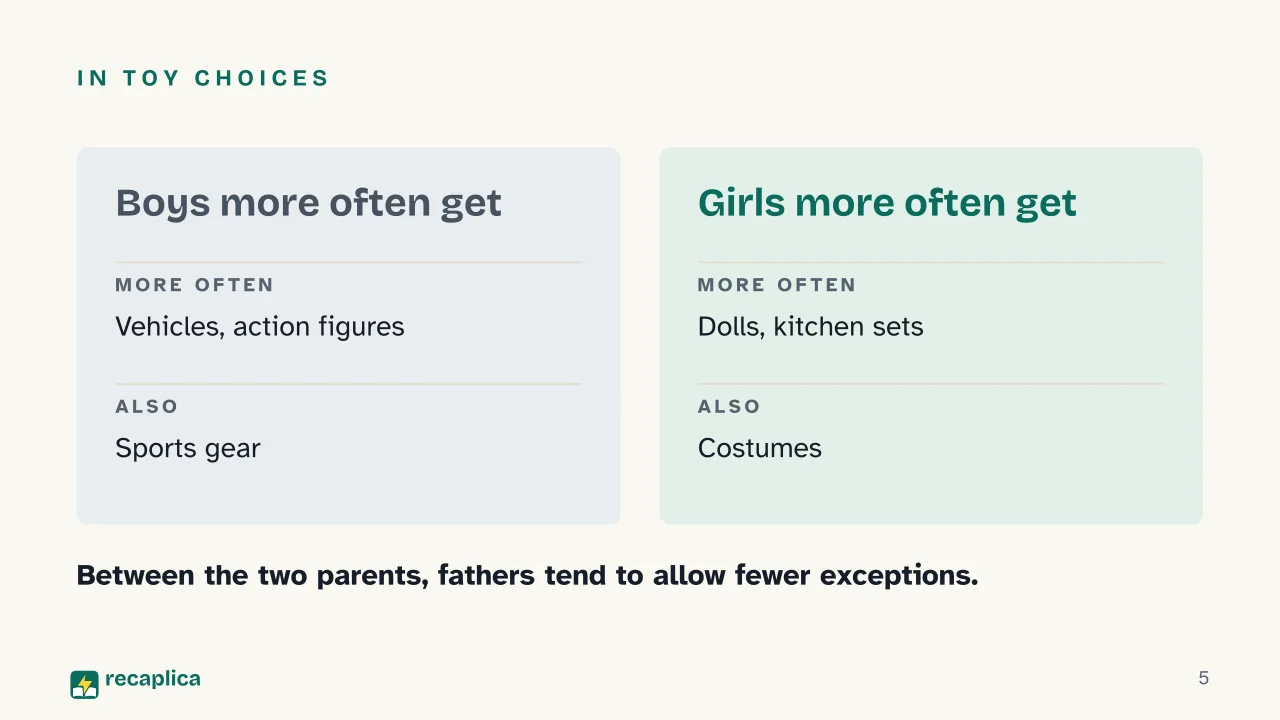
    Practical example: according to the cited source, parents tend to give boys vehicles, action figures and sports gear more often, and girls dolls, kitchen sets and costumes more often — a distinction that covers both the toy chosen and how actively parents encourage it.

    WhoObserved behaviour
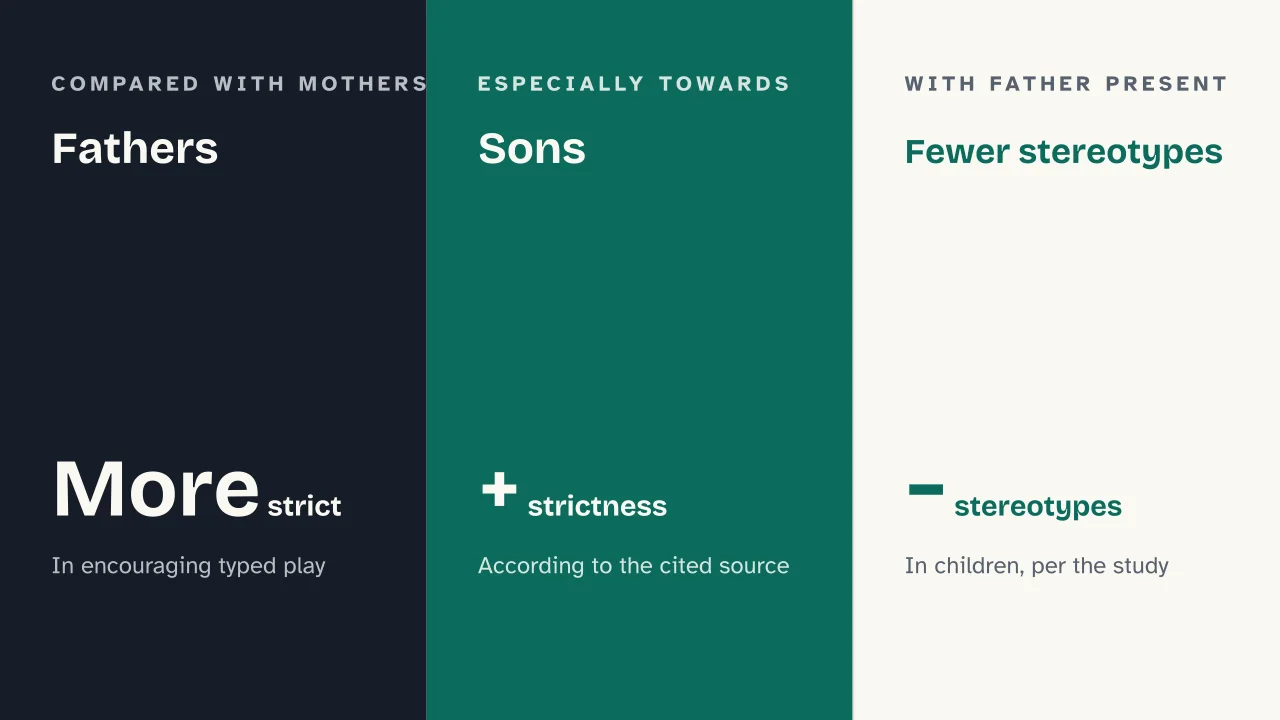
    FathersOn average stricter than mothers about encouraging typed play, especially with sons
    MothersOn average less strict than fathers on the same point
    Fathers involved in childcareLinked, according to the source, to children less prone to gender stereotyping

    The same source also flags a change over time: in recent decades, adults have grown more likely to hold egalitarian views on gender, with more variation among today’s parents than in the past. One detail specific to the US context, cited by the OpenStax textbook, adds a nuance: according to a 2004 study by Staples and Boulin Johnson, Black families in the United States are more likely than White American families to raise children with an egalitarian model of family roles — a finding tied to that specific context.

    School and Peers

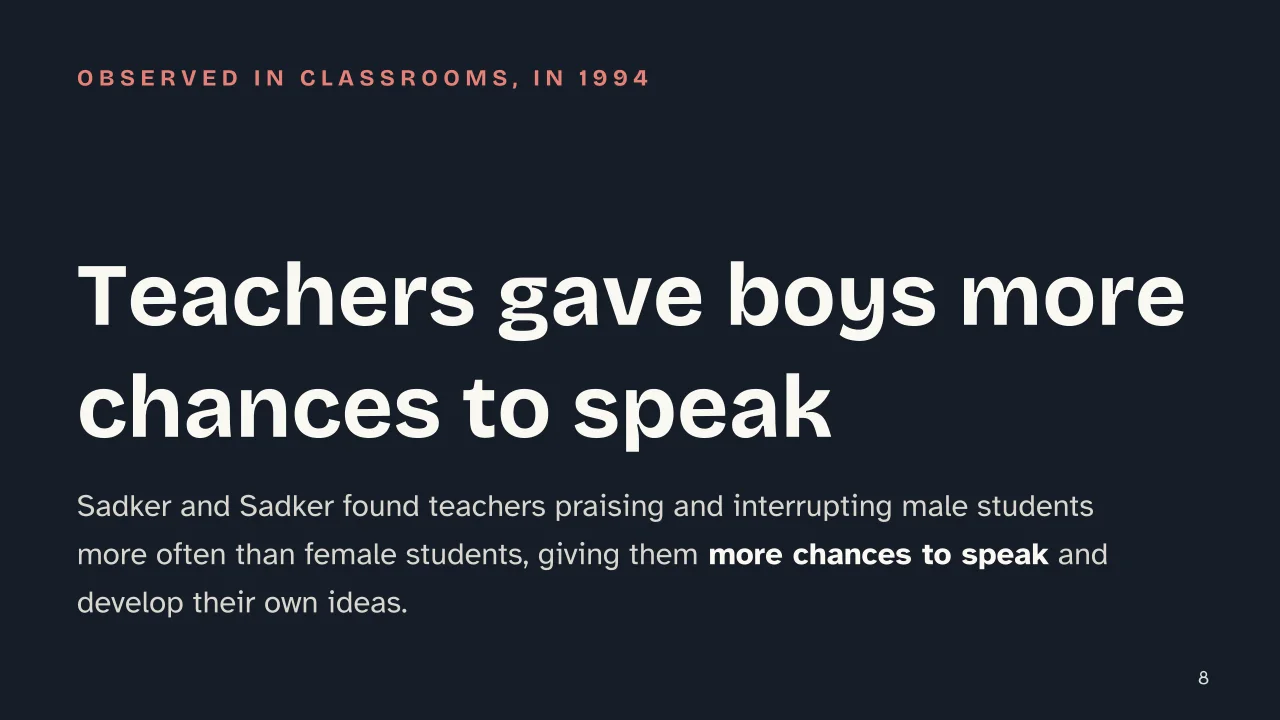
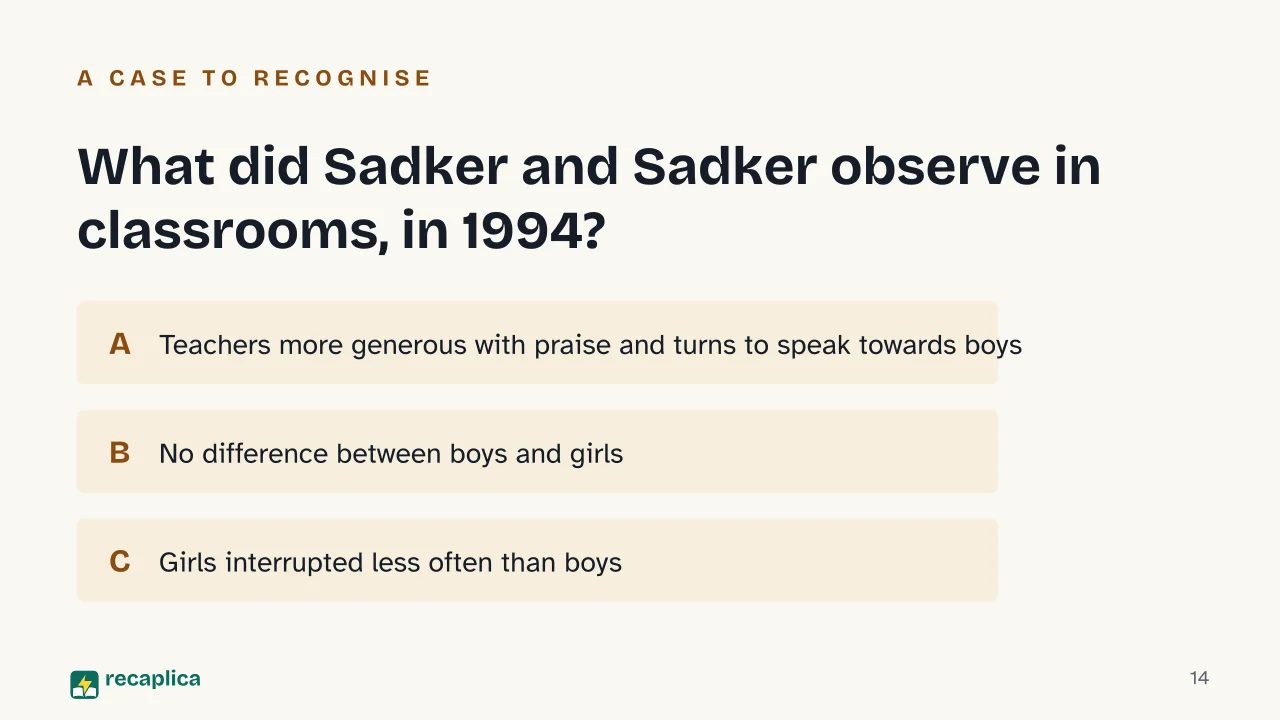
    At school, a 1994 study by Sadker and Sadker observed similar dynamics: boys got far more praise from teachers than girls did, were interrupted less often, and had more room to develop their own ideas. The textbook adds a general observation: girls are usually given more latitude to step outside the prescribed gender role than boys are.

    The peer group is the third of the four agents sociology textbooks list for gender socialisation; the studies gathered here mostly concern family, school and media.

    The Media

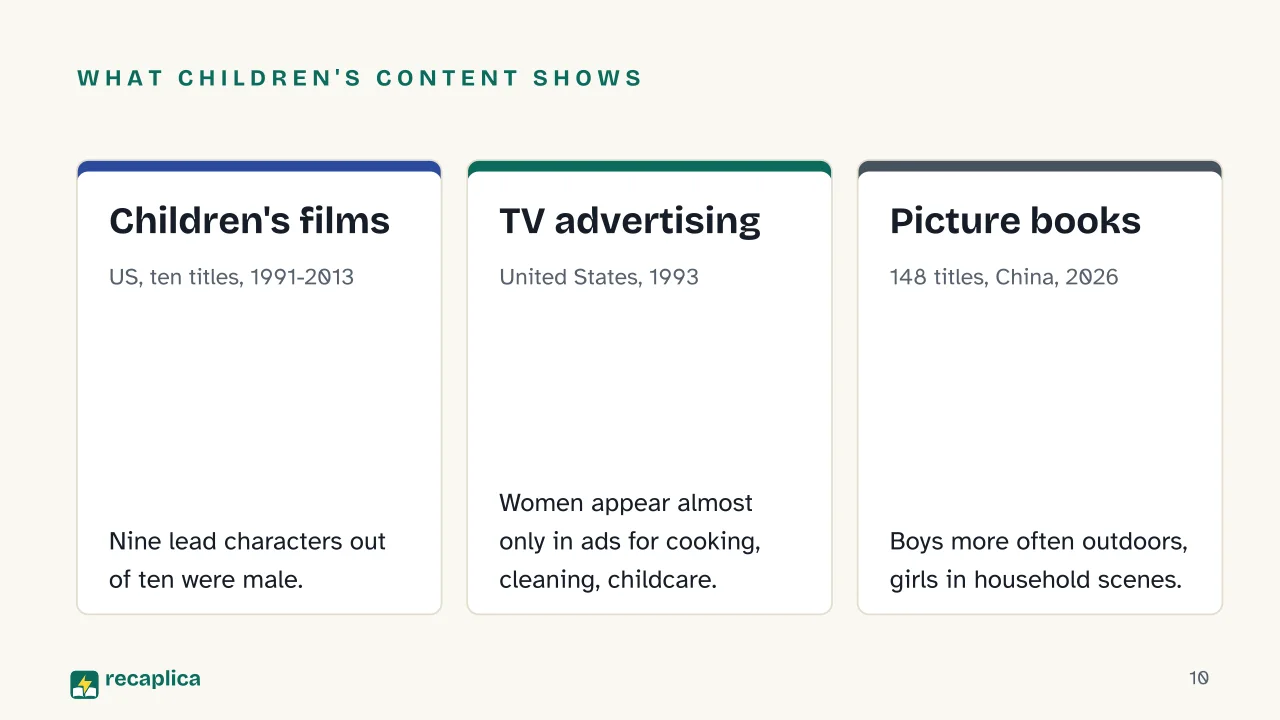
    Content aimed at children shows recurring gender patterns. Smith reviewed, in 2008, ten G-rated children’s films that topped the US box office between 1991 and 2013: in that group, out of ten characters counted, nine were male. Davis, in 1993, found that women appear almost exclusively in television advertising for cooking, cleaning or childcare products.

    A more recent line of research looks at children’s picture books. Zhou, Guo, Liu, Sun and Zhang analysed, in 2026, 148 books drawn from Chinese Ministry of Education reading lists, children’s literature awards and an early-reading catalogue: research carried out on children’s books in China, not generalisable to other countries. In that sample, male figures more often appear alone on the cover and in outdoor scenes; female figures appear more often doing housework, in both categories of books analysed (by Chinese and non-Chinese authors). In titles by Chinese authors, male characters cover 19.2% of the coded social-interaction instances against 13.4% for female characters; in titles by non-Chinese authors the gap narrows, 17.0% against 16.0% in favour of female characters. The research also cites earlier studies, carried out between 1972 and 2024 in different cultural contexts, documenting the overrepresentation of male characters in titles, in the lead role and in the illustrations of children’s books.

    Readers who want to judge for themselves how representative sources like these are, before generalising from them, can start with the criteria set out in media literacy.

    One Mechanism Inside a Larger Process

    The same pattern traced in this Recap — family, school, peers, media — is the one sociology uses to describe socialisation in general, applied here to a single aspect: gender. The Recap on social status and role shows how, more broadly, a social status gives rise to a recognised role without needing a written contract: a gender role is one specific case of that, tied to the gender a person is perceived as rather than to a position they have earned.

    Slide deck

    Slides ready to download and make your own in PowerPoint or Google Slides, with speaker notes. Pick the Flash cut or the Full one.
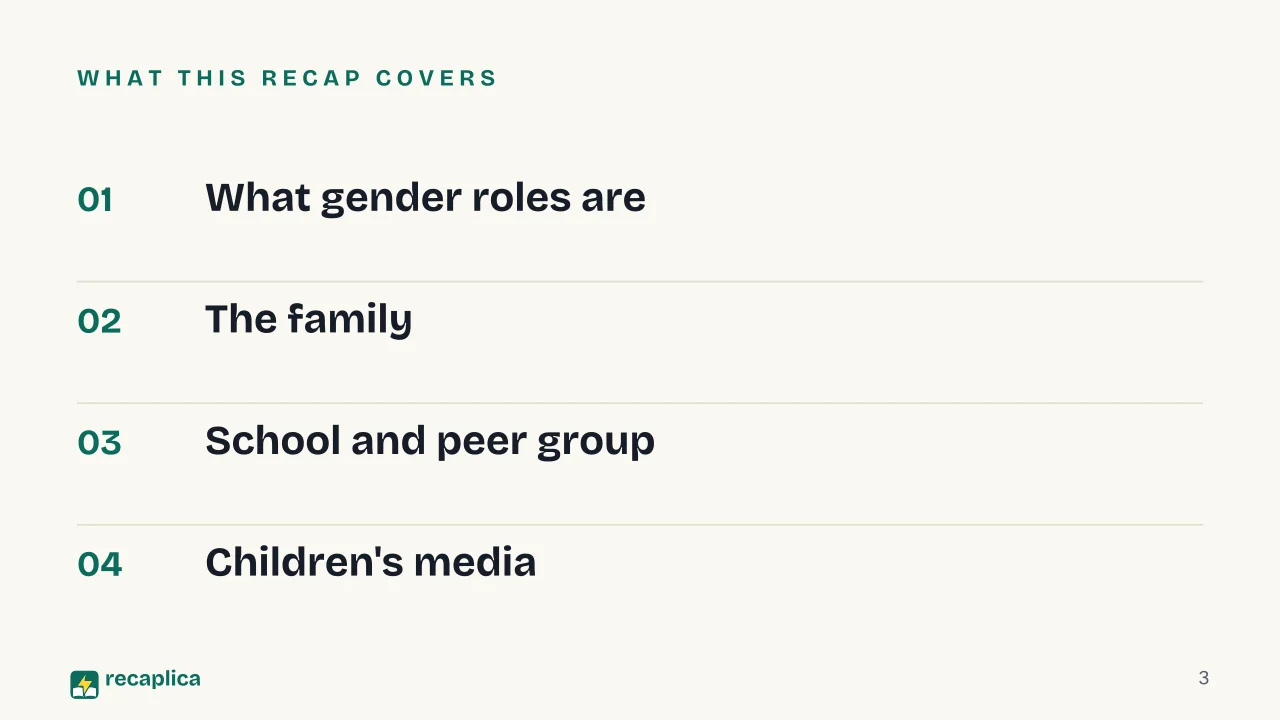
    Slide 1 of the presentation on Gender Role Socialisation: Gender RolesSlide 2 of the presentation on Gender Role Socialisation: Where do inherited gender roles actually come from?Slide 3 of the presentation on Gender Role Socialisation: What this Recap coversSlide 4 of the presentation on Gender Role Socialisation: Chapter 01: The FamilySlide 5 of the presentation on Gender Role Socialisation: In toy choicesSlide 6 of the presentation on Gender Role Socialisation: From toy choice to reinforcementSlide 7 of the presentation on Gender Role Socialisation: Chapter 02: School and Peer GroupSlide 8 of the presentation on Gender Role Socialisation: Teachers gave boys more chances to speakSlide 9 of the presentation on Gender Role Socialisation: Chapter 03: Children's MediaSlide 10 of the presentation on Gender Role Socialisation: What children's content shows: Children's films, TV advertising, Picture booksSlide 11 of the presentation on Gender Role Socialisation: In picture books by Chinese authors, 2026Slide 12 of the presentation on Gender Role Socialisation: Chapter 04: Fathers' InvolvementSlide 13 of the presentation on Gender Role Socialisation: Fathers · Sons · Fewer stereotypesSlide 14 of the presentation on Gender Role Socialisation: What did Sadker and Sadker observe in classrooms, in 1994?Slide 15 of the presentation on Gender Role Socialisation: Now, time to review
    Flash10 slidesThe essential thread, to present in classFull15 slidesEvery chapter and the deeper detail

    Common myths

    • ✗ Myth Gender roles are innate, not learned.

      ✓ Reality Sociology frames them as social expectations, not a biological trait: the cited studies show parents already responding differently to a toddler's first toy choices, with more praise and physical closeness when those choices match the child's assigned gender.

    • ✗ Myth Children's media simply reflects reality, without shaping a gender image.

      ✓ Reality The cited analyses find the opposite, recurring patterns: among the ten highest-grossing US children's titles released between 1991 and 2013, the lead character was male in nine cases out of ten; in the Chinese sample of 148 picture books, male characters appear more often alone on the cover and outdoors, female characters more often doing household chores.

    • ✗ Myth Mothers are mainly the ones who pass gender roles on to children.

      ✓ Reality The cited source finds the opposite on one specific point: fathers are less willing than mothers to tolerate non-typed play, especially with sons; the same research also finds that a father more involved in daily caregiving is linked to children less prone to stereotyping.

    Mind map

    Drag the background to move around and the nodes to reposition them; use − and + to collapse and expand branches.
    Customize
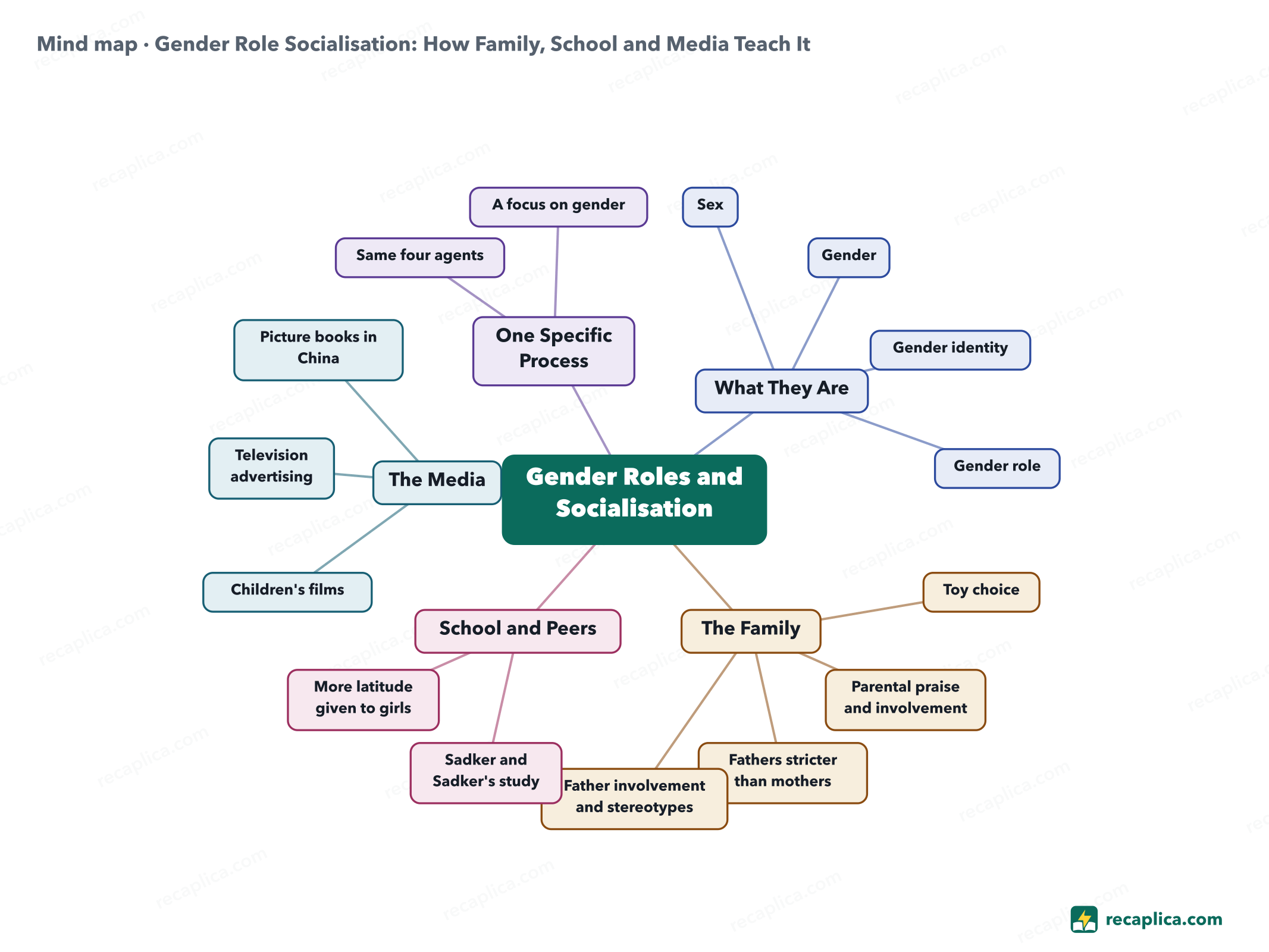
    Mind map: Gender Role Socialisation: How Family, School and Media Teach It
    • Gender Roles and Socialisation
      • What They Are social expectations about behaviour
        • Sex biological fact
        • Gender social category
        • Gender identity internal perception
        • Gender role expectations about behaviour
      • The Family toys, praise, role models
        • Toy choice
        • Parental praise and involvement
        • Fathers stricter than mothers
        • Father involvement and stereotypes
      • School and Peers different expectations in class
        • Sadker and Sadker's study
        • More latitude given to girls
      • The Media film, advertising, books
        • Children's films
        • Television advertising
        • Picture books in China
      • One Specific Process inside general socialisation
        • Same four agents
        • A focus on gender

    Quiz: test yourself

    Answer the questions to check what you have learned: you get instant feedback and a short explanation.

    Grade 0/10 0/5
    1 What is a gender role, in sociology?

    This is the textbook definition: expectations about appearance and behaviour tied to gender, not the biological fact of sex nor the internal perception of gender identity.

    2 What four main agents of gender socialisation does the textbook identify?

    These are the four contexts the textbook identifies as the main channels for passing on gender roles.

    3 According to the cited study, what did Sadker and Sadker observe in classrooms, in 1994?

    The study recorded teachers praising boys more often and giving them more turns to speak than their female classmates.

    4 True or false: according to the 2026 study of picture books in China, the results can be generalised to children's books in every country.

    False: the sample analysed is made up of 148 books selected in China (even if some authors were not Chinese), and the study itself does not extend its conclusions to other national contexts.

    5 What does the cited source associate with fathers being more involved in childcare?

    This is what the cited source observes: the more a father takes part in day-to-day caregiving, the less prone his children are to gender stereotyping.

    Answers: 1-A · 2-A · 3-B · 4-B · 5-A

    Flashcards

    Tap the card to flip it and check whether you remember the answer, then move to the next one.

    1 / 8

    Explain it in your own words

    The ultimate test: if you can explain it in simple words, you've truly understood it. Write your explanation, then compare it with the Recap.

    Your explanation is saved only on this device.

    A gender role is what a society expects from a woman's or a man's behaviour and appearance: an idea that is distinct both from sex, the biological fact about a person, and from gender identity, how a person experiences their own gender internally. Sociology points to family, school, peer group and mass media as the four main channels through which these expectations pass from one generation to the next. Inside the family, the cited studies describe parents praising children more when they pick toys considered typical for their sex, with fathers generally less flexible than mothers about that line. At school, one study recorded teachers paying more attention and giving more encouragement to male students. Children's media counts too: an analysis of the ten highest-grossing US children's films found nine male leads out of ten, and a 2026 study of Chinese picture books found female characters more often shown doing housework and male characters more often shown outdoors.

    Frequently asked questions

    What is the difference between sex, gender and gender role?

    Sex is a biological fact (the reproductive system, traits such as height or muscle mass); gender is a social category, the set of behaviours and positions a society assigns to women and men; gender role, specifically, is the set of social expectations about how people should look and behave.

    How are gender roles learned?

    Through socialisation: textbooks place its start in the earliest years of life, and the process runs through four contexts — family, school, peer group and mass media — each with its own mechanisms documented by the cited studies.

    Do parents really treat sons and daughters differently?

    The cited studies describe a recurring difference: boys more often receive vehicles, action figures and sports gear, girls dolls, kitchen sets and costumes, with more generous praise when the play matches the child's expected gender.

    Do children's media show different gender roles?

    The cited analyses find recurring patterns in content aimed at children: among the highest-grossing films released in the United States between 1991 and 2013 (ten titles examined), male leads outnumbered female ones nine to one; in a sample of 148 picture books collected in China, female figures appear more often in domestic settings, male figures more often outdoors.

    Is gender socialisation the same thing as socialisation in general?

    No: it is a specific angle on a broader process, a person's entry into the rules of their own society. Here the focus narrows to gender, while running through the same everyday contexts: family, school, friendships, content seen on screen.

    Sources

    • OpenStax, Introduction to Sociology 3e, §12.1 Sex, Gender, Identity, and Expression
    • OpenStax, Introduction to Sociology 3e, §12.2 Gender and Gender Inequality
    • Encyclopedia on Early Childhood Development — Parents' Socialization of Gender in Children
    • Zhou, Guo, Liu, Sun and Zhang (2026), Gender Roles in Chinese Children's Picture Books: A Descriptive Content Analysis, Behavioral Sciences (MDPI)

    Every Recap goes through an independent review before publication.

    Every evening, the day's new Recaps on our Telegram channel. Join the channel →

    Keep learning

    • Civics What Is Pi Day? Why It Falls on March 14 Pi Day is a yearly observance on March 14, chosen because the US date format writes that day as 3/14, matching pi's first digits. Larry Shaw, a physicist at San Francisco's Exploratorium, came up with it in 1988 during a staff retreat at the museum. What started as a small party among coworkers grew into a public celebration with a parade, pie, and a 2009 resolution from the US Congress. Today it's mostly marked in schools and science museums, with digit-memorization contests and discounts at pizza and dessert shops. Read the Recap →
    • Civics Mass Media: What They Are Mass society is a type of society where ordinary people carry real weight in political and social life, but at a cost: more conformity, less individual autonomy, greater exposure to manipulation. The Treccani encyclopedia places its rise between the late 19th and early 20th century, when population growth, urbanization, mass schooling, wider voting rights and industrial organization converge. Mass media, radio and film first, then satellites and the internet, make it possible on a scale never seen before. The Frankfurt School and Ortega y Gasset turned it into an object of criticism, from two different angles: a culture industry that standardizes, and a mass man who blends into the average. Read the Recap →
    • Civics Secularization: Definition, Theories, and How It Shapes Society Secularization is the process through which religious institutions, practices, and beliefs lose social weight, as a society leans more on reason and science, according to EBSCO Research Starters. It shows up on three different levels: institutions, a country's shared culture, and the religious choices each person makes. Max Weber described it as the disenchantment of the world, the modern rationalization that pushed religion and metaphysics outside the boundaries of legitimate knowledge; Émile Durkheim linked it, in 1912, to the split between the sacred and the profane. Pew Research Center data from 2024 show how unevenly the process plays out: in India, Israel, Nigeria, and Thailand, 95% or more of adults still belong to the religion they grew up in, while in South Korea half of adults have left theirs behind. Read the Recap →

    recaplica

    Clear in 30 seconds, yours in 10 minutes.

    Recaps Mind maps Request a Recap Telegram channel Mind map maker Our method About Privacy & cookies Legal notes & terms of use

    © 2026 Recaplica · A project by Curi S.r.l. — VAT IT05472000750

    Statistics, only if you say so

    To learn which Recaps help most we would use Google Analytics, with aggregate, anonymous data. It starts only with your OK, and you can change your mind anytime. Privacy policy