Skip to content
recaplica

    One moment: security check

    Cloudflare wants to make sure you're not a robot. Tick the box below and your search will continue on its own.

    IT
    recaplica Elements, Compounds and Mixtures: Classification of Matter, with Examples
    © 2026 Recaplica · recaplica.com — All rights reserved
    Home › Science

    Elements, Compounds and Mixtures: Classification of Matter, with Examples

    By Recaplica Newsroom · Updated on October 21, 2026

    What to print

    Page numbers appear when printing with default margins.

    Slides

    Choose a cut

    Flash10 slidesThe essential thread, to present in classFull14 slidesEvery chapter and the deeper detail

    Both come with speaker notes.

    Telegram channel
    recaplica Clear in 30 seconds, yours in 10 minutes.
    In 30 seconds Key points Deep dive Slides Myths Mind map Quiz Flashcards FAQ

    In 30 seconds quick read

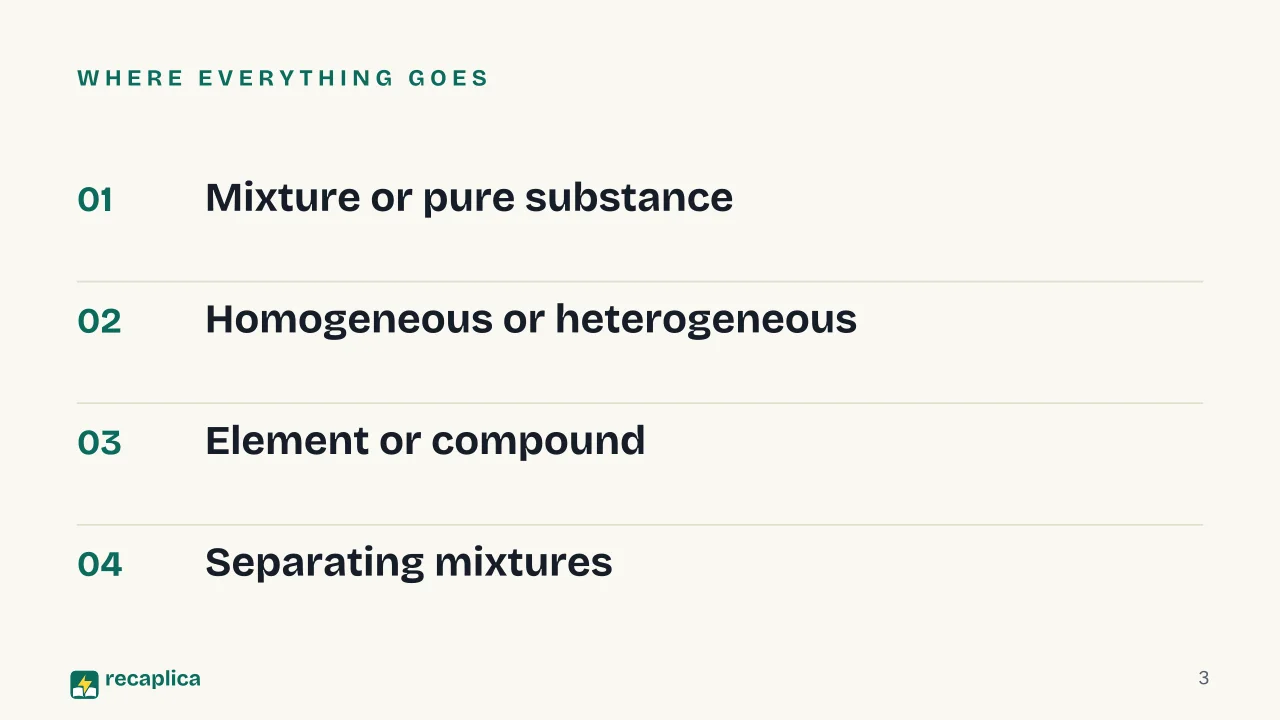
    To classify a sample of matter, look first at its composition. If the composition is always the same, the sample is a pure substance; if it can change from one sample to another, it is a mixture. A mixture is homogeneous when it has one phase and uniform composition, and heterogeneous when it has two or more phases. Pure substances are either elements, which cannot be broken down into chemically simpler substances, or compounds, which contain more than one element and can be broken down. Mixtures are separated by physical methods such as filtration, evaporation and distillation.

    Key Points

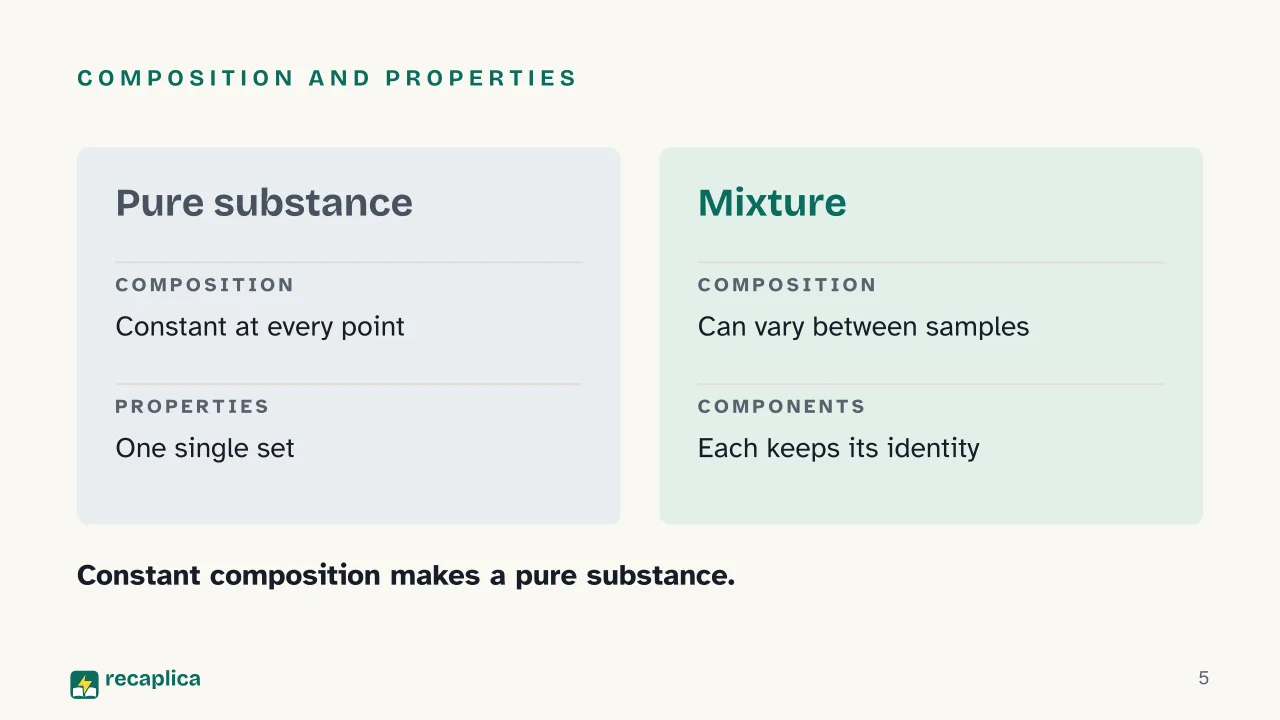
    • A pure substance has constant composition and a single set of properties throughout the sample. A mixture is made of two or more substances, and its composition can vary.
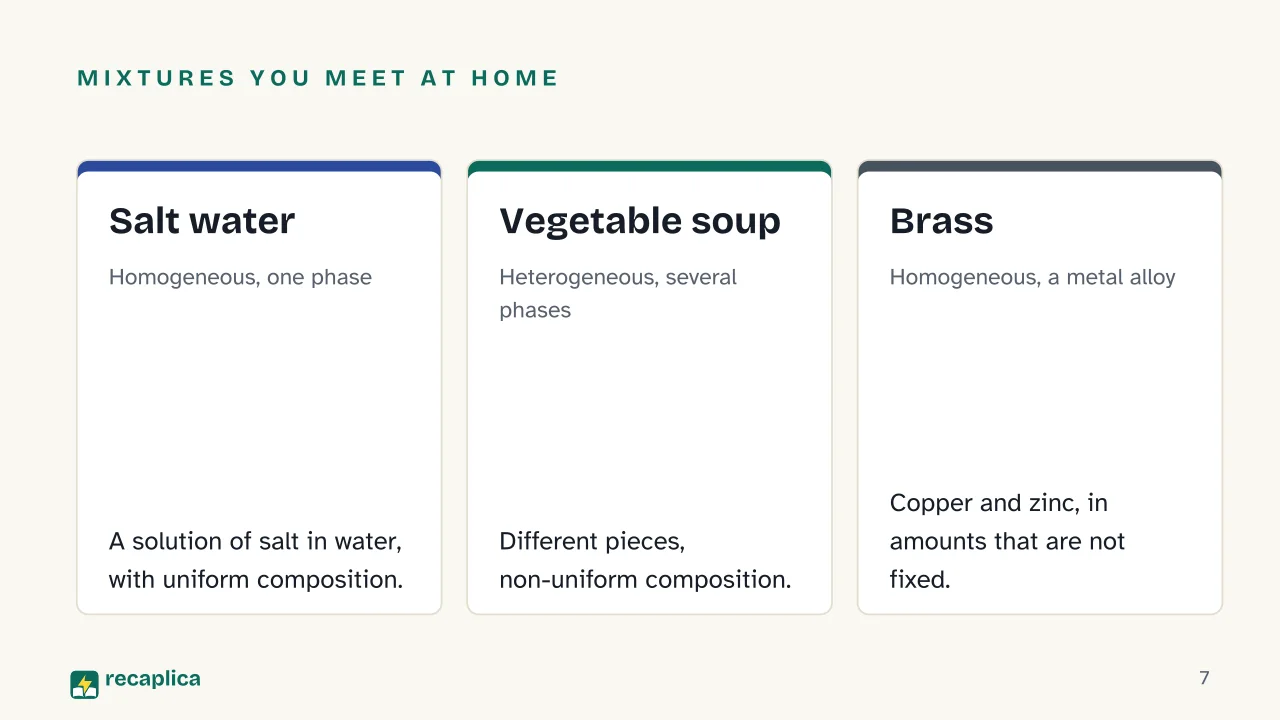
    • A homogeneous mixture has uniform composition and one phase, like any solution. A heterogeneous mixture has non-uniform composition and two or more phases, like vegetable soup.
    • Elements and compounds are both pure substances. An element cannot be split into chemically simpler components; a compound contains more than one element.
    • Water always holds 2 hydrogen atoms for every oxygen atom. In mixtures, the amounts of the components can vary.
    • Mixtures are separated with techniques based on physical changes: filtration, evaporation, distillation, chromatography, decantation and centrifugation.
    • Salt water, hydrogen peroxide solution and air are mixtures. Table salt and baking soda are compounds, so they are pure substances.

    Deep Dive

    Pure substances and mixtures: the first decision

    According to Chemistry LibreTexts, in the introductory chemistry course at the College of Marin, a pure substance keeps the same composition at every point of the sample, and its properties do not change either. Melting point, color and boiling point form a single set across the whole sample. A material made of two or more substances is a mixture.

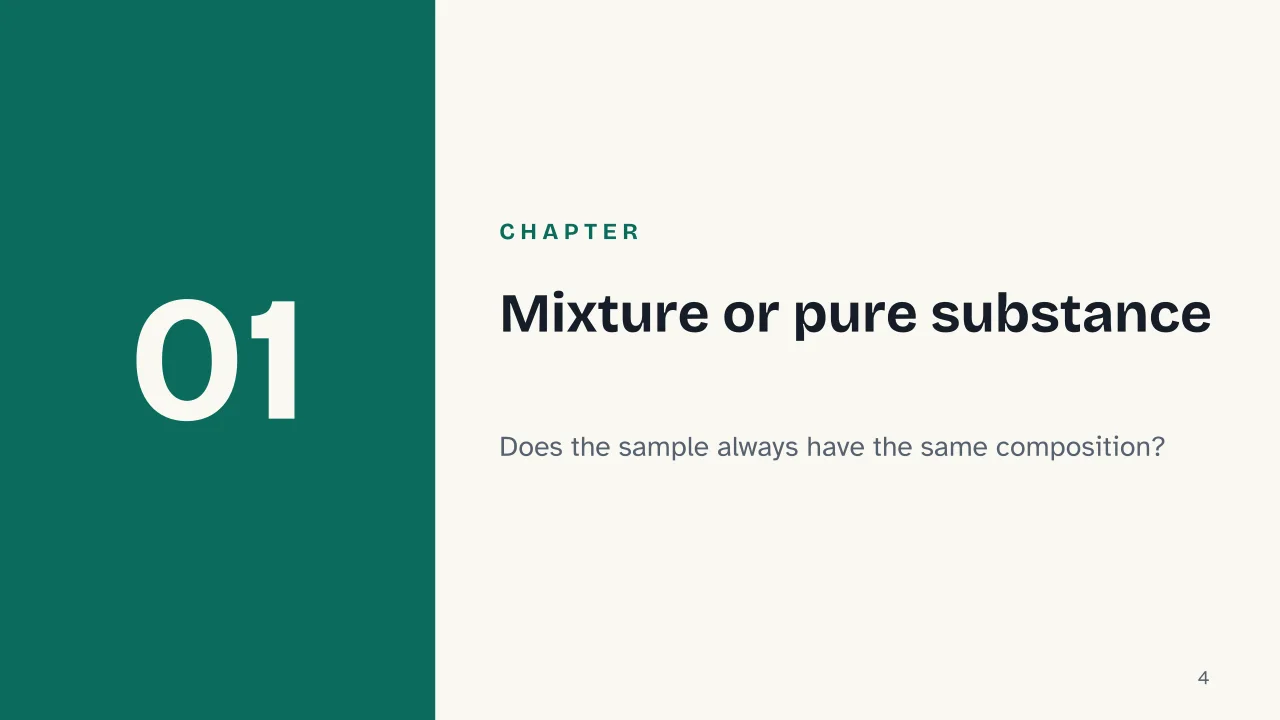
    That is where classification starts. Composition always identical: pure substance. Composition that varies from sample to sample: mixture.

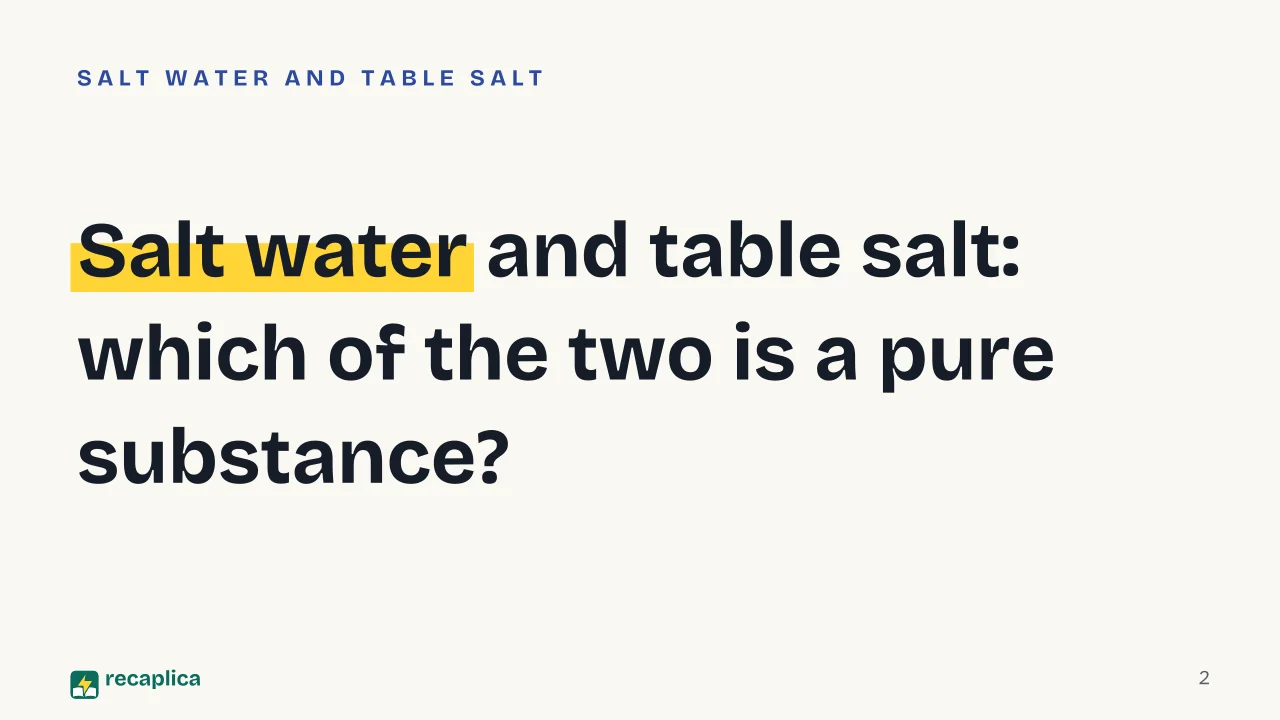
    Practical example: table salt (sodium chloride) is a pure substance, because its composition is uniform and definite. Salt water is not, because the amount of dissolved salt can vary from sample to sample.

    In a mixture each component keeps its own identity and properties, and the amounts of the components can vary, whereas a compound has a fixed, definite ratio. The melting point gives the difference away as well. As the Wikipedia entry on melting point reports, a pure substance melts over a narrower range than an impure sample of the same material or a mixture containing it. The more other components there are, the lower the melting temperature falls and the wider the range grows. Eutectics are the exception: mixtures that melt at a sharp, constant temperature, like a pure substance.

    Pure substanceMixture
    CompositionConstant at every point of the sampleCan vary from sample to sample
    PropertiesOne single setEach component keeps its own
    MeltingNarrow rangeWider range (except eutectics)
    ExampleTable saltSalt water

    Homogeneous and heterogeneous mixtures

    In a homogeneous mixture, the South Puget Sound Community College text explains, every sample has the same composition as any other. The most common case in chemistry is the solution, one substance completely dissolved in another, and all solutions are homogeneous mixtures. Alloys are too: the Wikipedia entry on mixtures describes them as solid solutions, homogeneous mixtures of metals. A homogeneous mixture has a single phase, like a pure substance.

    In a heterogeneous mixture the composition is not uniform and there are two or more phases. Soil and vegetable soup are examples. Oil and water form two separate layers. Orange juice with pulp holds solid bits and liquid, so it belongs among the heterogeneous mixtures.

    Practical example: salt in water is homogeneous, with uniform composition and one phase. Sand in water is heterogeneous, because the components remain clearly distinguishable. Stir in so much sugar that some of it stays undissolved on the bottom, and the sugar-water mixture becomes heterogeneous too.

    A homogeneous mixture and a pure substance both look uniform. Chemistry LibreTexts tells them apart by composition, which is always the same in a pure substance and variable in a mixture. The Mixture entry adds that the distinction depends on the scale of sampling: in practice, a mixture is homogeneous if the property you care about is the same whichever sample you take.

    Elements and compounds

    Elements and compounds are both pure substances. An element resists being broken down into chemically simpler components; Treccani describes it as a simple substance whose atoms all share the same atomic number, and unlike compounds it does not break down further in ordinary chemical reactions. A compound contains more than one element, and for that very reason it can be broken down into simpler components. Water, for example, is a compound of hydrogen and oxygen.

    About 118 elements are known, according to Chemistry LibreTexts, which does not give a year for the figure. For elements 113, 115, 117 and 118, IUPAC published two reports in 2016 validating their discovery, and on 28 November 2016 it announced the approved names and symbols. How the elements are ordered and read is the subject of the periodic table. In the eighteenth century, Treccani recalls, people stopped thinking in terms of the four pre-Socratic elements and began identifying elements by experiment: Lavoisier identified thirty-three, Treccani says.

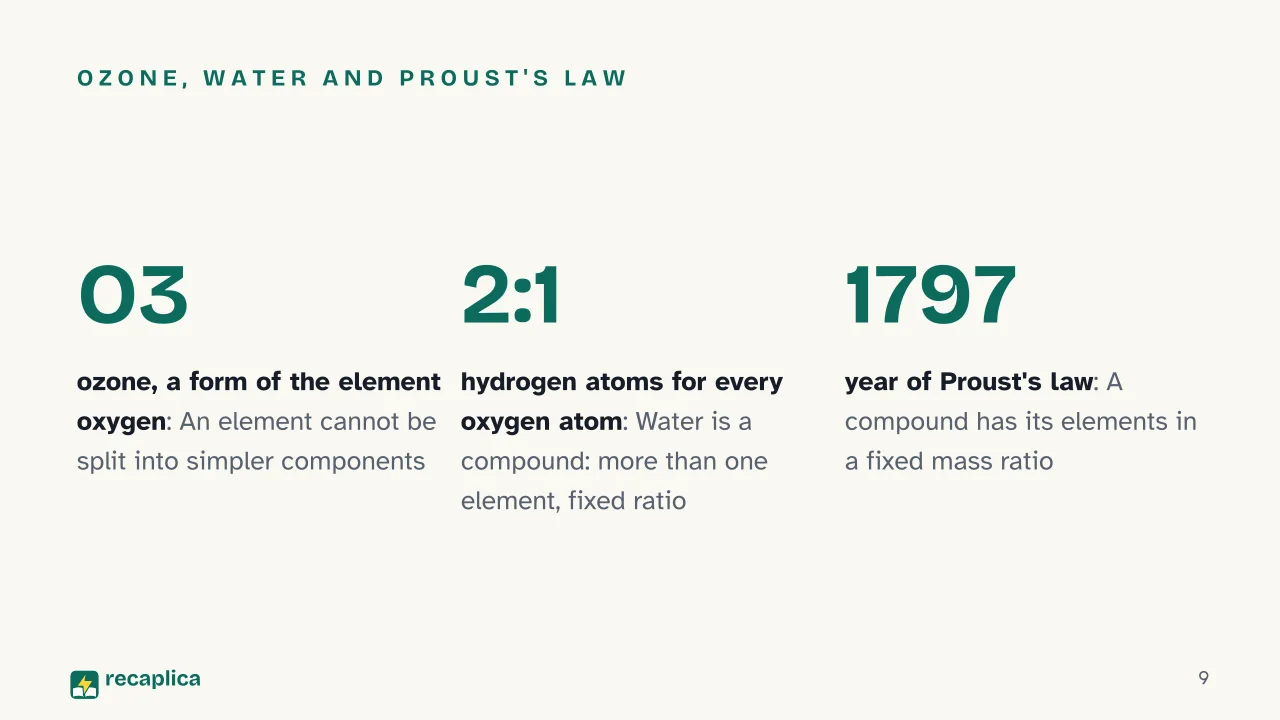
    The same element can show up in more than one form, called allotropes. According to LibreTexts, oxygen has two common allotropes, O2 (the one in air) and O3 (ozone), which has three atoms bonded instead of two. Carbon has many: diamond is transparent and the hardest natural material known, graphite is black, opaque and soft enough to leave a mark on paper. Diamond barely conducts electricity, and graphite is an excellent conductor.

    The chemical and physical properties of a compound may look nothing like those of its elements. Combine sodium, a soft metal with a shine, and chlorine, a green gas that smells sharp, and the result is sodium chloride, a white crystalline solid. Water forms when hydrogen and oxygen join chemically in a fixed ratio, 2 atoms of hydrogen to 1 of oxygen.

    The law of definite proportions, formulated by Joseph Proust in 1797, says that a compound contains its elements in a fixed mass ratio, whatever its origin or method of preparation. In a sample of pure water, oxygen makes up about 8/9 of the mass and hydrogen 1/9. At the end of the eighteenth century the concept of a compound was not yet well defined and the law was new: Claude Louis Berthollet argued that elements could combine in any proportion, and the law was disputed.

    MaterialTypeReason
    Oxygen (O2), ozone (O3)ElementA single element, in two forms
    Diamond, graphiteElementTwo forms of carbon
    WaterCompoundHydrogen and oxygen, 2 to 1
    Sodium chlorideCompoundSodium and chlorine combined
    Sodium bicarbonate (NaHCO3)CompoundA pure substance, not a mixture
    Salt waterHomogeneous mixtureThe salt can vary
    BrassHomogeneous mixtureAlloy of copper and zinc
    Vegetable soupHeterogeneous mixtureNon-uniform composition

    Sea water, hydrogen peroxide, air and baking soda

    Sea water is a solution of salts in water: water is a compound, but what comes out of the sea also contains salt in varying amounts, so it is not a pure substance.

    According to PubChem, hydrogen peroxide as sold is an aqueous solution of the compound, a strong oxidizer used as a bleach and a local antiseptic. It comes in different concentrations, such as the 3% one, and it is a homogeneous mixture of a compound in water. Pure hydrogen peroxide is unstable and breaks down quickly into oxygen and water.

    Baking soda, by contrast, is a compound of sodium and bicarbonate ions with the formula NaHCO3: a pure substance, a white crystalline powder. According to PubChem, heated above 50 °C it begins to give off carbon dioxide, water and sodium carbonate.

    Air is a gaseous mixture. According to NOAA (page updated July 2024), dry air is 78.084% nitrogen, 20.946% oxygen, 0.934% argon and 0.042% carbon dioxide by volume. Water vapor is almost always present, up to about 4% of the total volume.

    How mixtures are separated

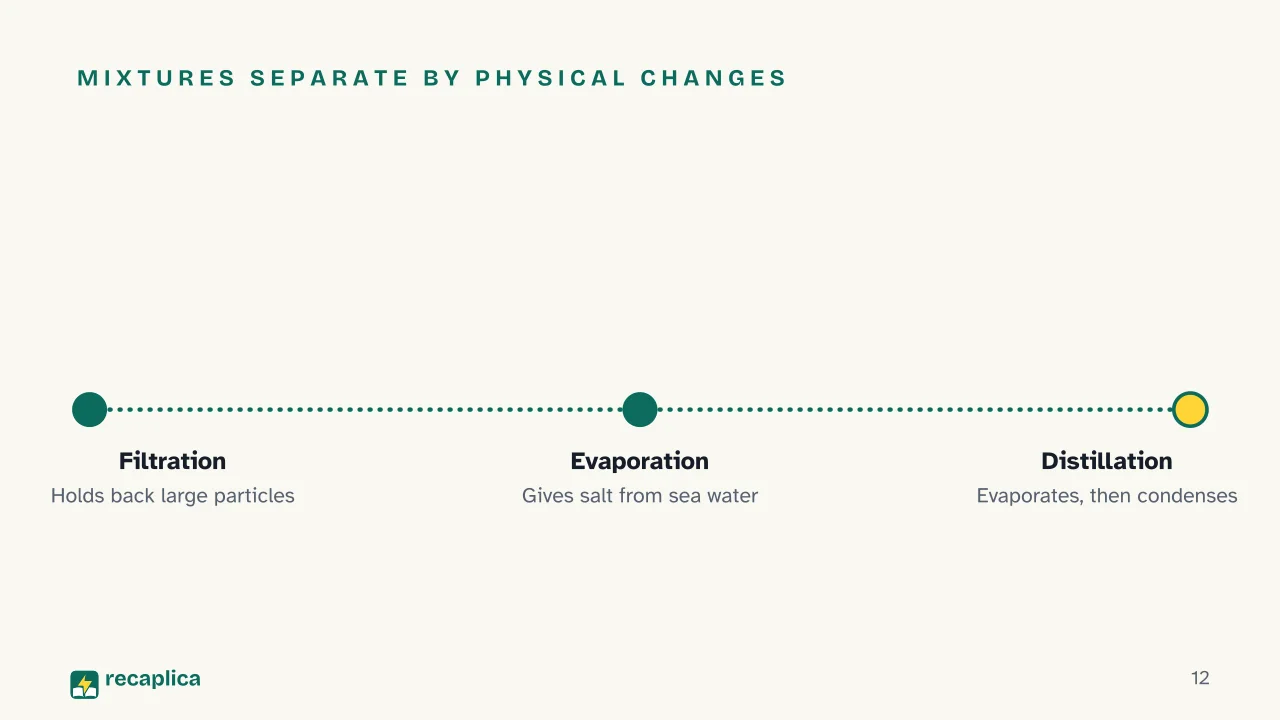
    Separating a mixture takes only techniques that rely on physical changes, and the pure substances it is made of always come back. According to the Mixture entry, the mechanical methods are distillation, chromatography, filtration, gravity separation and centrifugation.

    • Filtration: holds back particles large enough to be caught by a porous material. Soil suspended in water can be filtered with a coffee filter, and tea is separated from the leaves the same way.
    • Evaporation: separates a dissolved solid from a liquid. This is how table salt is obtained from sea water, and in salt pans the heat comes from the sun.
    • Simple distillation: once the mixture is heated, the more volatile component becomes vapor first, at the lower temperature. The vapor, cooled in a condenser, turns back into liquid and is collected as the distillate.
    • Chromatography: the components of the mixture cross a medium and advance at different speeds. Thin-layer chromatography separates the colored compounds of a spinach leaf.
    • Decantation: the top layer is poured away and the denser liquid or the solid stays at the bottom; the property exploited is density. It works for immiscible liquids or for a solid in suspension.
    • Centrifugation: it uses centrifugal force: the denser components move outward, and the separation depends on the size, shape and density of the particles and on the viscosity of the medium.

    A compound, by contrast, is broken down by a chemical reaction, as baking soda is when heated above 50 °C.

    Slide deck

    Slides ready to download and make your own in PowerPoint or Google Slides, with speaker notes. Pick the Flash cut or the Full one.
    Slide 1 of the presentation on Elements, Compounds and Mixtures: Elements, compounds and mixturesSlide 2 of the presentation on Elements, Compounds and Mixtures: Salt water and table salt: which of the two is a pure substance?Slide 3 of the presentation on Elements, Compounds and Mixtures: Where everything goesSlide 4 of the presentation on Elements, Compounds and Mixtures: Chapter 01: Mixture or pure substanceSlide 5 of the presentation on Elements, Compounds and Mixtures: Composition and propertiesSlide 6 of the presentation on Elements, Compounds and Mixtures: Chapter 02: Homogeneous or heterogeneousSlide 7 of the presentation on Elements, Compounds and Mixtures: Mixtures you meet at home: Salt water, Vegetable soup, BrassSlide 8 of the presentation on Elements, Compounds and Mixtures: Chapter 03: Element or compoundSlide 9 of the presentation on Elements, Compounds and Mixtures: Ozone, water and Proust's lawSlide 10 of the presentation on Elements, Compounds and Mixtures: A compound is not a mixture of elements.Slide 11 of the presentation on Elements, Compounds and Mixtures: Chapter 04: Separating mixturesSlide 12 of the presentation on Elements, Compounds and Mixtures: Mixtures separate by physical changesSlide 13 of the presentation on Elements, Compounds and Mixtures: How is brass, an alloy of copper and zinc, classified?Slide 14 of the presentation on Elements, Compounds and Mixtures: For a calm review
    Flash10 slidesThe essential thread, to present in classFull14 slidesEvery chapter and the deeper detail

    Common myths

    • ✗ Myth Salt water is a single substance, because it looks uniform.

      ✓ Reality It behaves like one substance, but it contains salt and water, and the amount of salt changes from sample to sample. A pure substance always has the same composition, so salt water is a homogeneous mixture, a solution. A uniform look only tells you there is one phase.

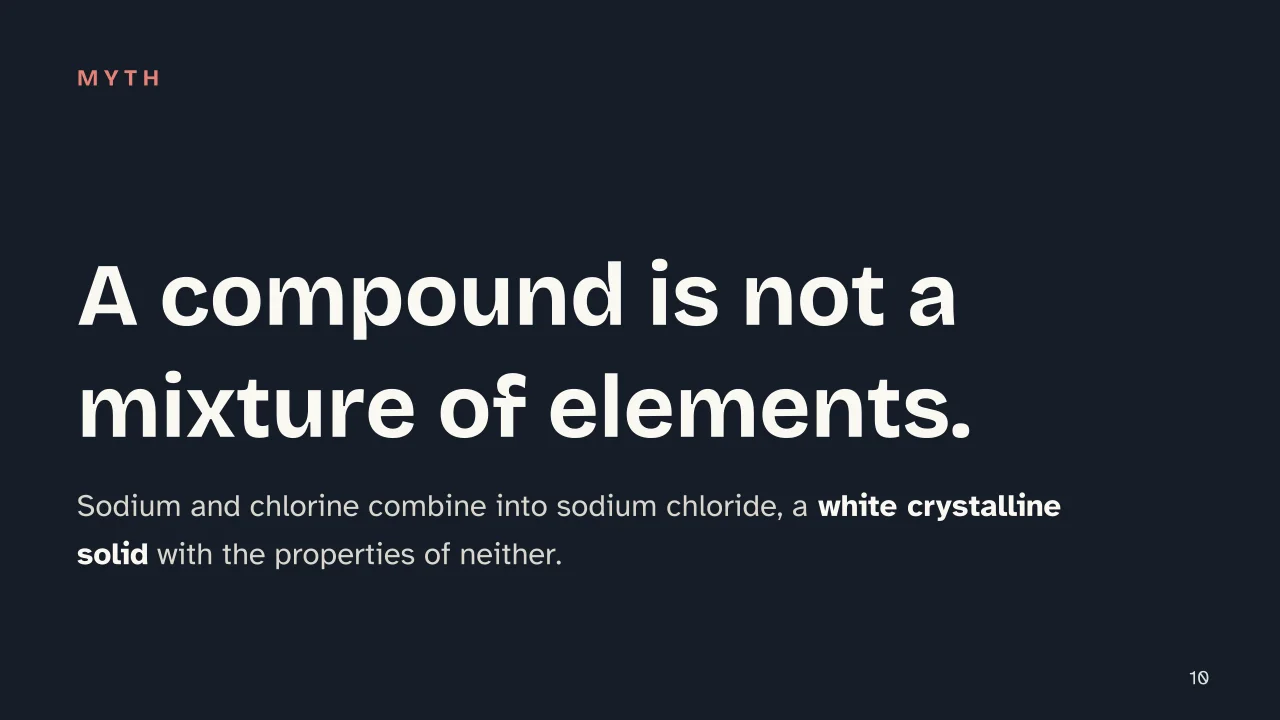
    • ✗ Myth A compound is just a mixture of elements.

      ✓ Reality In water, hydrogen and oxygen have combined chemically in a fixed ratio. Sodium chloride forms from the metal sodium and the gas chlorine, yet it is a white crystalline solid with properties unlike either element. In a mixture, no bond forms between the atoms of the components.

    • ✗ Myth Brass is made of two metals, so it is a compound.

      ✓ Reality Brass is a copper-zinc alloy, and the amounts of the two metals can change: usually about two thirds is copper and one third zinc. A compound, by contrast, has a fixed, definite ratio. In common single-phase brass, atoms of one metal can take the places of the other's in the same crystal lattice: it is a solid solution and counts as a homogeneous mixture.

    Mind map

    Drag the background to move around and the nodes to reposition them; use − and + to collapse and expand branches.
    Customize
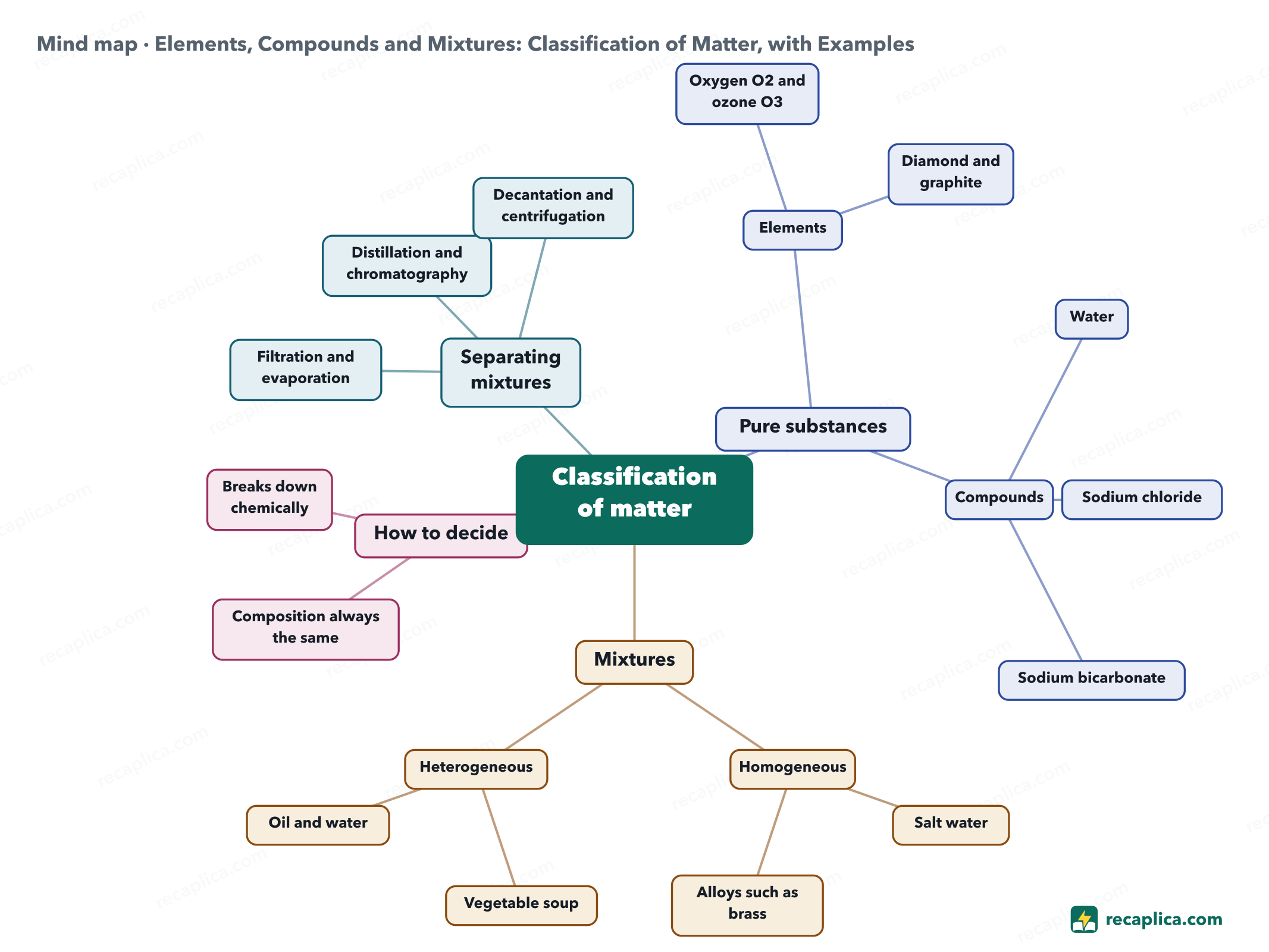
    Mind map: Elements, Compounds and Mixtures: Classification of Matter, with Examples
    • Classification of matter
      • Pure substances Constant composition, one set of properties
        • Elements Cannot be broken into simpler substances
          • Oxygen O2 and ozone O3
          • Diamond and graphite
        • Compounds More than one element, fixed ratio
          • Water
          • Sodium chloride
          • Sodium bicarbonate
      • Mixtures Two or more substances, variable composition
        • Homogeneous One phase
          • Salt water
          • Alloys such as brass
        • Heterogeneous Two or more phases
          • Vegetable soup
          • Oil and water
      • How to decide
        • Composition always the same Yes, pure substance. No, mixture
        • Breaks down chemically Yes, compound. No, element
      • Separating mixtures With physical changes
        • Filtration and evaporation
        • Distillation and chromatography
        • Decantation and centrifugation

    Quiz: test yourself

    Answer the questions to check what you have learned: you get instant feedback and a short explanation.

    Grade 0/10 0/5
    1 A sample has the same composition at every point, but the amount of salt in it changes from one sample to another. How is it classified?

    A composition that varies between samples rules out a pure substance. There is a single phase and the composition is uniform within the sample, so this is a solution, which is a homogeneous mixture.

    2 Which of these is made of a single element?

    Ozone (O3) and the oxygen in air (O2) are two forms of the same element, called allotropes. Water, sodium chloride and baking soda contain more than one element, so they are compounds.

    3 How do you get table salt from sea water?

    Evaporation separates a dissolved solid from a liquid, and in salt pans the heat comes from the sun. Filtration only holds back particles that are large enough, and dissolved salt passes straight through the filter.

    4 What happens when hydrogen and oxygen form water?

    Water is a compound: two hydrogen atoms for every oxygen atom, always in that ratio. A compound can have chemical and physical properties that differ from those of the elements that form it.

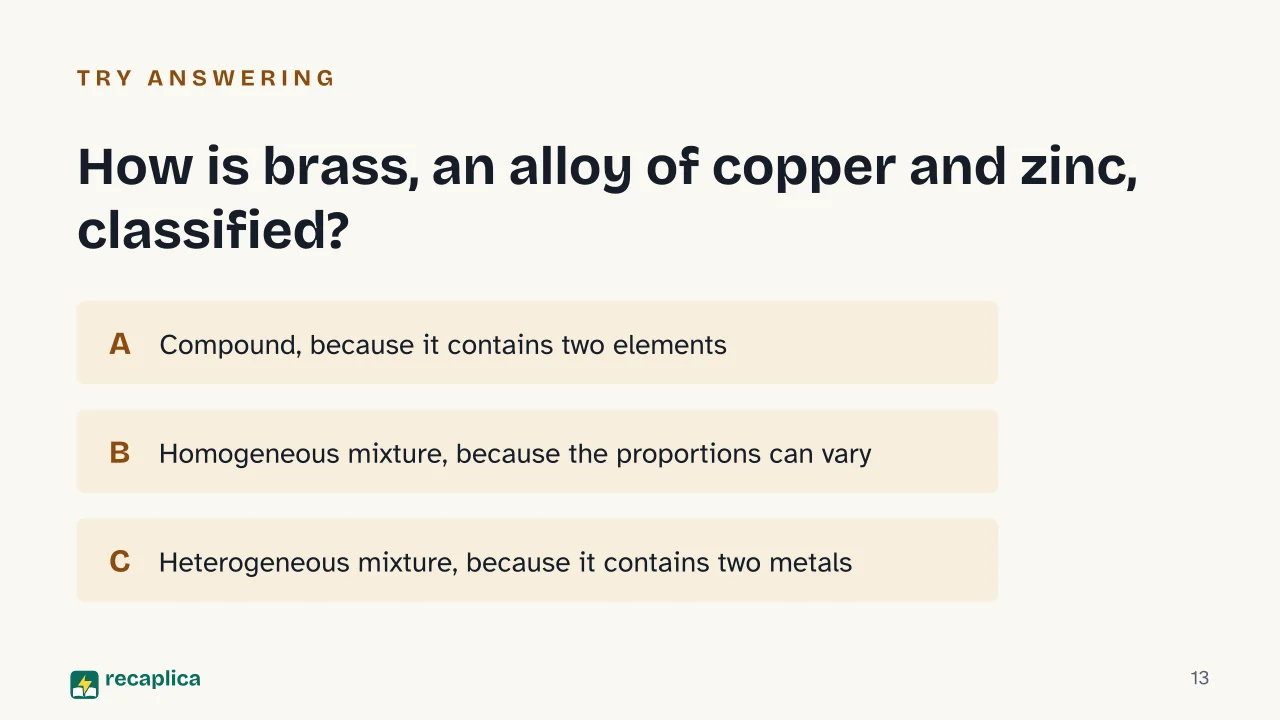
    5 How is brass, an alloy of copper and zinc, classified?

    Alloys are solid solutions, which means homogeneous mixtures of metals. In common single-phase brass, atoms of the two metals can replace each other in the same crystal structure, and the proportions are not fixed as they are in a compound.

    Answers: 1-B · 2-A · 3-C · 4-D · 5-B

    Flashcards

    Tap the card to flip it and check whether you remember the answer, then move to the next one.

    1 / 7

    Explain it in your own words

    The ultimate test: if you can explain it in simple words, you've truly understood it. Write your explanation, then compare it with the Recap.

    Your explanation is saved only on this device.

    To classify a sample of matter, look first at its composition. If the composition is always the same, the sample is a pure substance; if it can change from one sample to another, it is a mixture. A mixture is homogeneous when it has one phase and uniform composition, and heterogeneous when it has two or more phases. Pure substances are either elements, which cannot be broken down into chemically simpler substances, or compounds, which contain more than one element and can be broken down. Mixtures are separated by physical methods such as filtration, evaporation and distillation.

    Frequently asked questions

    Is sea water a pure substance?

    No. Water is a compound of hydrogen and oxygen, but sea water also contains dissolved salt, in an amount that can vary. It is a solution, so it is a homogeneous mixture. Evaporating the water leaves table salt, which is how salt pans work.

    Is hydrogen peroxide a pure substance?

    No. The product sold as hydrogen peroxide is an aqueous solution of the compound, used as a bleach and a local antiseptic. Solutions come in different concentrations, such as 3%, and that variable concentration makes it a homogeneous mixture. Pure hydrogen peroxide is an unstable compound that breaks down into oxygen and water.

    Is baking soda a pure substance?

    Yes. Sodium bicarbonate is a compound made of sodium and bicarbonate ions, with the formula NaHCO3, and it appears as a white crystalline powder. According to PubChem, above 50 °C it starts to decompose into carbon dioxide, water and sodium carbonate.

    How do you tell a homogeneous mixture from a pure substance?

    You cannot by eye, because both have a single phase. What counts is composition: a pure substance always has the same one, while that of a homogeneous mixture changes with the amounts of the components. The melting point helps too: a pure substance melts over a narrower range.

    How many chemical elements are there?

    According to Chemistry LibreTexts, about 118 elements are known; the page does not give a year. In 2016 IUPAC validated the discovery of elements 113, 115, 117 and 118, and on 28 November 2016 it announced their names and symbols.

    Sources

    • Chemistry LibreTexts, 3.4 Classifying Matter According to Its Composition
    • Chemistry LibreTexts, 1.3 Classification of Matter (South Puget Sound Community College)
    • Chemistry LibreTexts, 4.7 Separating Mixtures through Physical Changes
    • Chemistry LibreTexts, Allotropes
    • Chemistry LibreTexts, 14.4 Allotropes of Carbon
    • IUPAC, Periodic Table of Elements
    • Treccani, Elemento chimico
    • NOAA JetStream, The Atmosphere
    • PubChem (NIH/NLM), Sodium bicarbonate
    • PubChem (NIH/NLM), Hydrogen peroxide
    • Wikipedia, Mixture
    • Wikipedia, Melting point
    • Wikipedia, Law of definite proportions
    • Wikipedia, Brass
    • Wikipedia, Decantation
    • Wikipedia, Centrifugation

    Every Recap goes through an independent review before publication.

    Every evening, the day's new Recaps on our Telegram channel. Join the channel →

    Keep learning

    • Science Balancing Redox Reactions: Half-Reaction and Oxidation Number Methods A redox reaction is balanced when every element has the same number of atoms on both sides and the total charge is the same too. There are two routes. With the half-reaction method you write oxidation and reduction separately, add water, H⁺ and electrons, and then add the two halves together. With the oxidation number method you look at how much each element's number rises and falls, and pick coefficients that make the total rise equal the total fall. In basic solution you start as in acid, and at the end the H⁺ ions are turned into water with OH⁻. Read the Recap →
    • Science Brønsted-Lowry theory: definition of acids, bases and conjugate pairs In 1923 Johannes Brønsted and Thomas Lowry, working independently, defined an acid as a species that gives away a proton and a base as a species that takes one in. An acid-base reaction is therefore a transfer of a proton, and every transfer produces two conjugate pairs. Water can act as either an acid or a base, and ammonia is a base even though its formula has no OH-. The theory generalizes Arrhenius's, which holds only for water solutions. Read the Recap →
    • Science Chemical Equilibrium: Definition, the Constant K and the Reaction Quotient Q A reversible reaction can run in either direction, and in a closed system it reaches a point where the amounts of reactants and products stop changing. At that point the forward and reverse reactions keep going at the same rate. The equilibrium constant K depends on temperature. Comparing the reaction quotient Q with K shows which way the reaction is heading. An ICE table handles the calculations. Read the Recap →

    recaplica

    Clear in 30 seconds, yours in 10 minutes.

    Recaps Mind maps Request a Recap Telegram channel Mind map maker Our method About Privacy & cookies Legal notes & terms of use

    © 2026 Recaplica · A project by Curi S.r.l. — VAT IT05472000750

    Statistics, only if you say so

    To learn which Recaps help most we would use Google Analytics, with aggregate, anonymous data. It starts only with your OK, and you can change your mind anytime. Privacy policy