Skip to content
recaplica

    One moment: security check

    Cloudflare wants to make sure you're not a robot. Tick the box below and your search will continue on its own.

    IT
    recaplica Reaction rate: what it is and what affects it
    © 2026 Recaplica · recaplica.com — All rights reserved
    Home › Science

    Reaction rate: what it is and what affects it

    By Recaplica Newsroom · Updated on October 24, 2026

    What to print

    Page numbers appear when printing with default margins.

    Slides

    Choose a cut

    Flash10 slidesThe essential thread, to present in classFull17 slidesEvery chapter and the deeper detail

    Both come with speaker notes.

    Telegram channel
    recaplica Clear in 30 seconds, yours in 10 minutes.
    In 30 seconds Key points Deep dive Slides Myths Mind map Quiz Flashcards FAQ

    In 30 seconds quick read

    Reaction rate tells you how fast the concentration of a substance changes as it reacts or forms. It depends on concentration, temperature, the surface of solids and the presence of a catalyst, and collision theory accounts for each of these effects. The rate law links the rate to the concentrations, its exponents are the reaction orders, and the orders come from experiments.

    Key Points

    • Reaction rate is how quickly a substance is used up or formed. It is measured in mol/(L·s) and is always positive.
    • A reaction has a single rate, even when reactants and products change at different speeds, because each change is scaled by the coefficient of its substance.
    • Concentration, temperature, the surface of solids and a catalyst all change the rate. Collision theory, a model, explains this through effective collisions and activation energy.
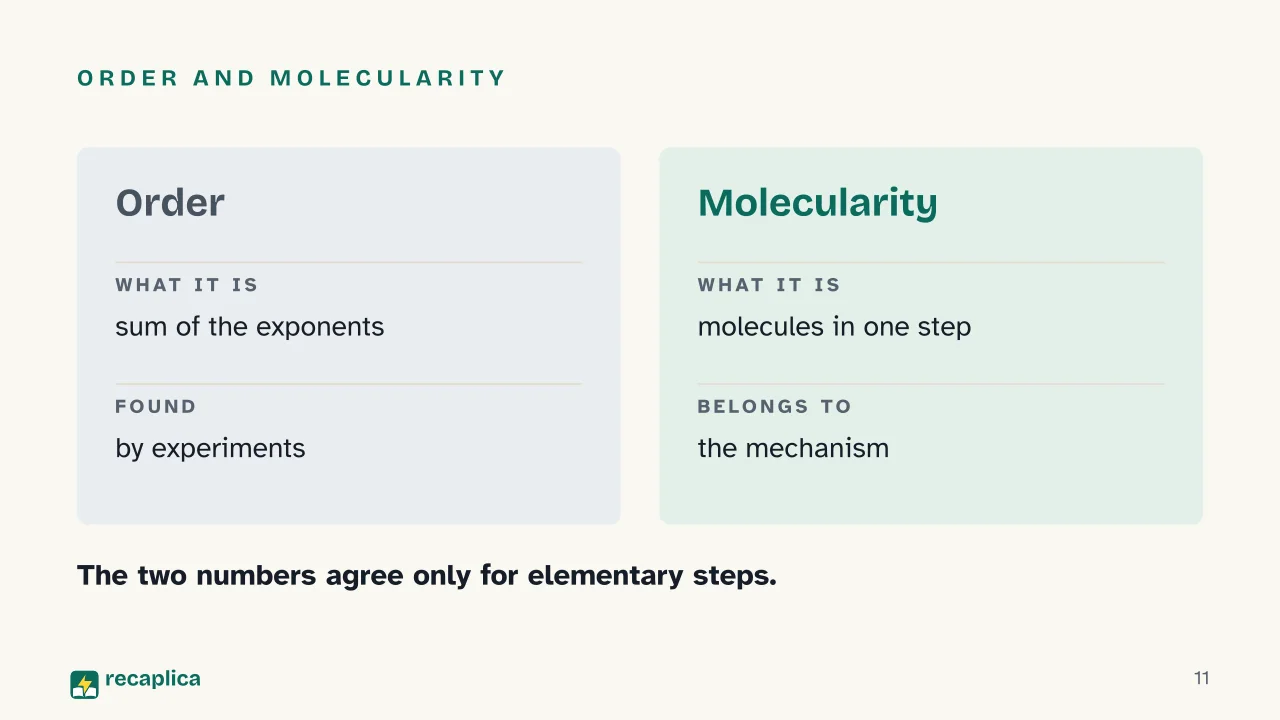
    • The order of a reaction is the sum of the exponents in the rate law, and it is found by experiment.
    • In first-order kinetics the half-life does not depend on the starting concentration and equals about 0.693 divided by k.

    Deep Dive

    What reaction rate is

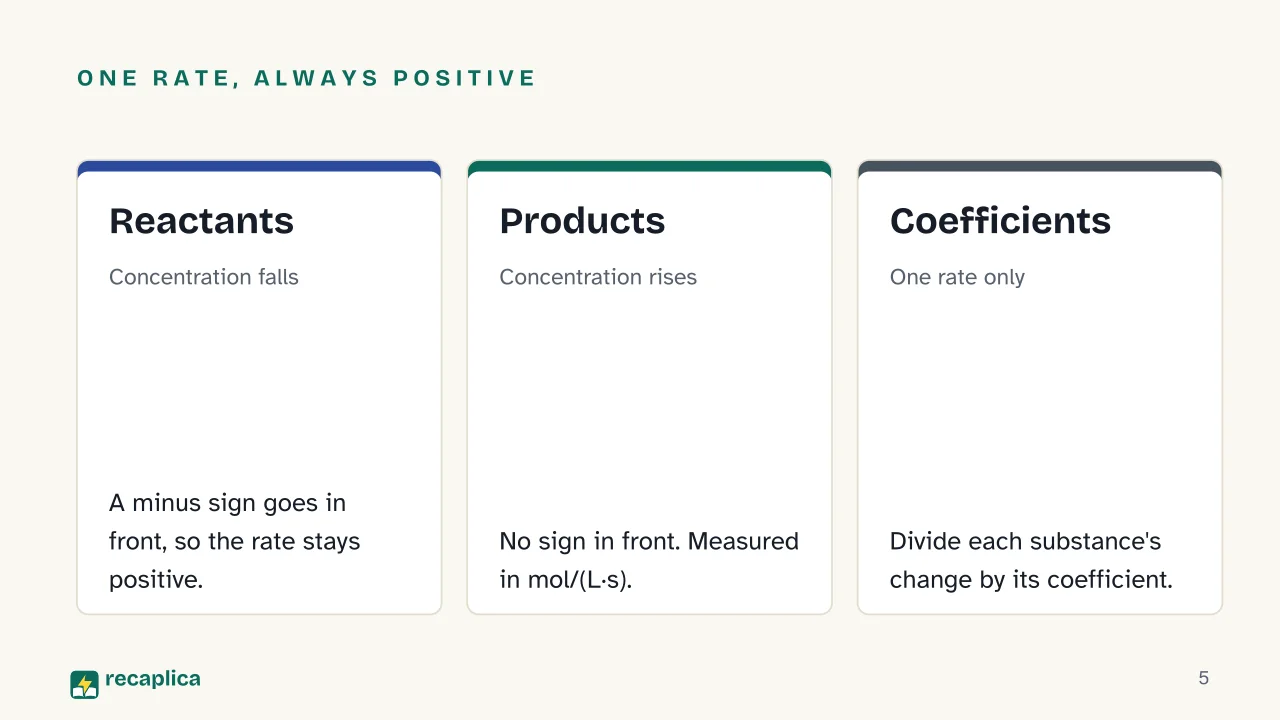
    According to LibreTexts, the rate of a reaction is how quickly it proceeds, and it is read from the concentration of a substance changing over time. You can follow the reactants disappearing, in which case a minus sign goes in front because their concentration falls, or the products appearing. The balanced equation ties the two together, and either works. The rate itself is always positive and is expressed in mol/(L·s).

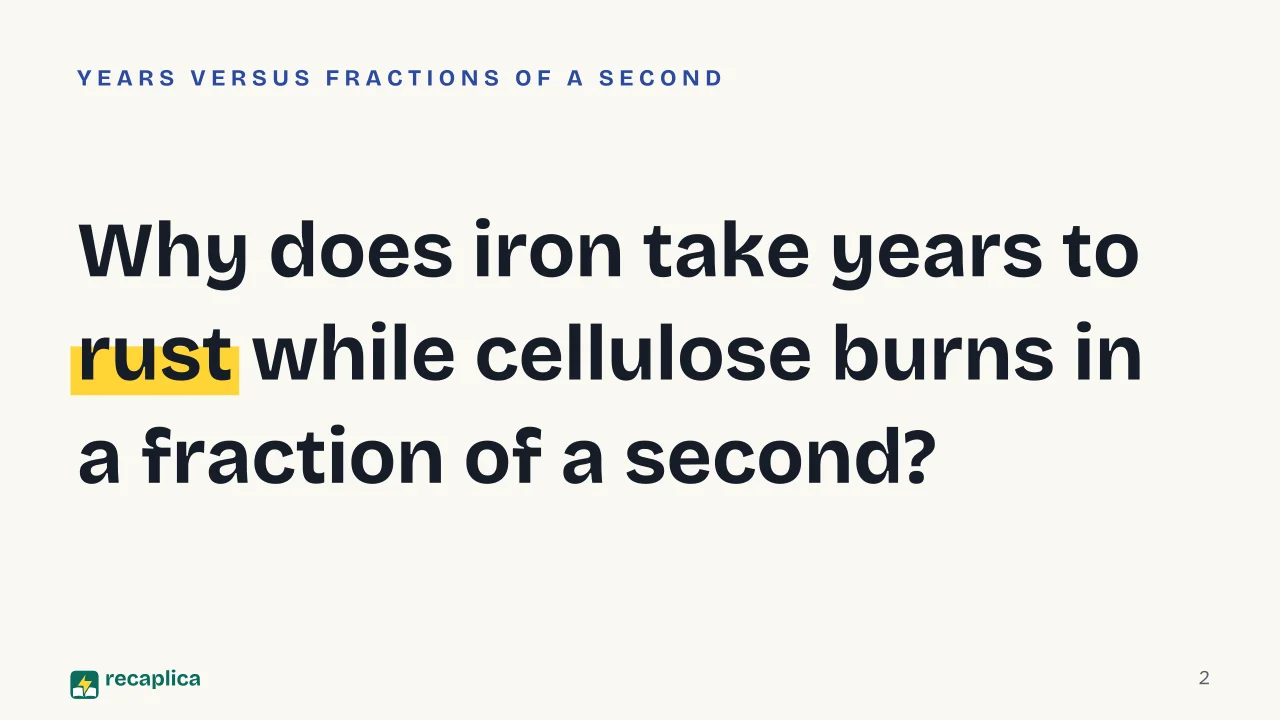
    Practical example: Wikipedia points out how widely rates vary. Iron can take many years to rust in the atmosphere, while cellulose burns in a fire in a fraction of a second.

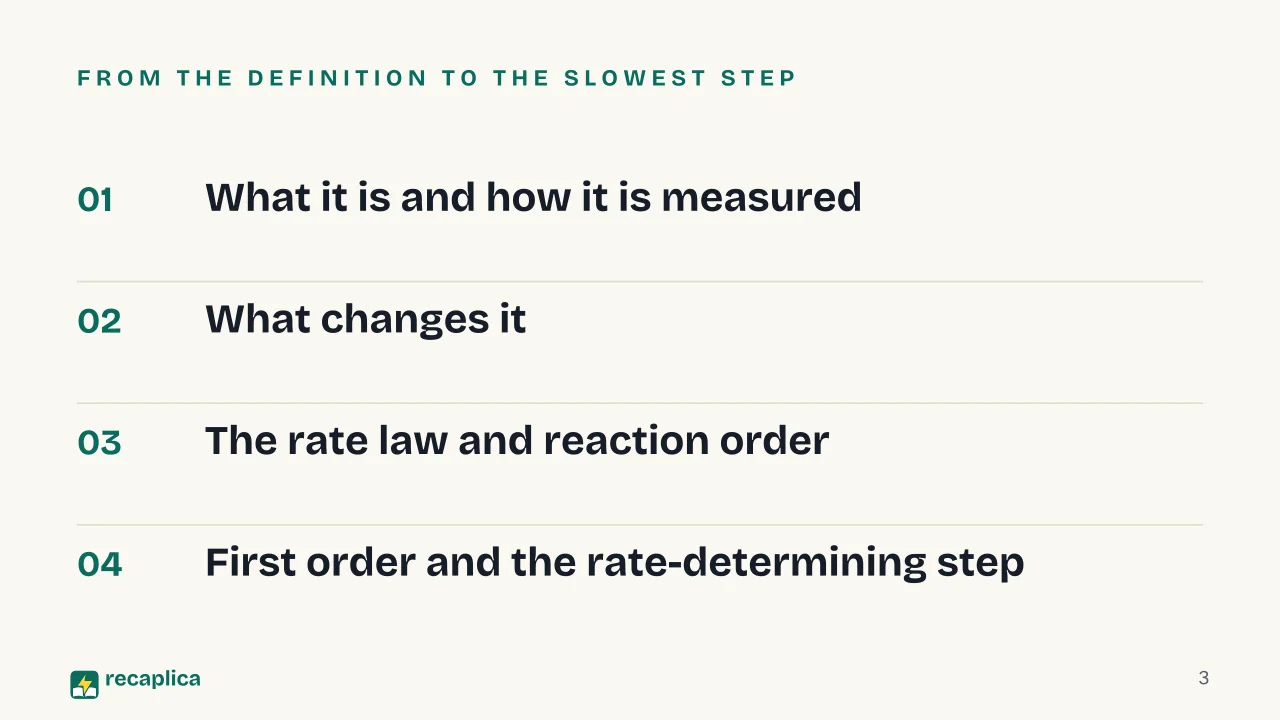
    In most reactions the rate falls as the reactants are consumed. The study of these speeds is called chemical kinetics, the part of physical chemistry that teaches how to measure and predict rates and how to use the data to propose mechanisms. The topic has a second half, chemical equilibrium, which has its own Recap.

    One rate for each reaction

    The substances involved can change concentration at different speeds. The reaction rate is still a single number: each change is divided by its own stoichiometric coefficient, so the result does not depend on which substance is used to measure it. The definition holds for one reaction in a closed system at constant volume.

    Practical example: if B has coefficient 3 and A has coefficient 1, B is used up three times as fast as A. The reaction rate is still one.

    How it is measured

    The rate is worked out from concentrations measured at different times. Small samples can be withdrawn and analysed, for example by titration. A spectrophotometer can give the concentration from the light absorbed, following Beer’s law. For reactions that produce gas it is enough to measure the volume released at different times and link it to the change in concentration.

    Factors affecting the rate of reaction

    For LibreTexts, the catalyst and the solvent matter, and so do the temperature and the concentration, besides the physical state and degree of subdivision of the reactants. Wikipedia lengthens the list with stirring and pressure. It also adds electromagnetic radiation and isotopes, plus the diffusion limit.

    Collision theory

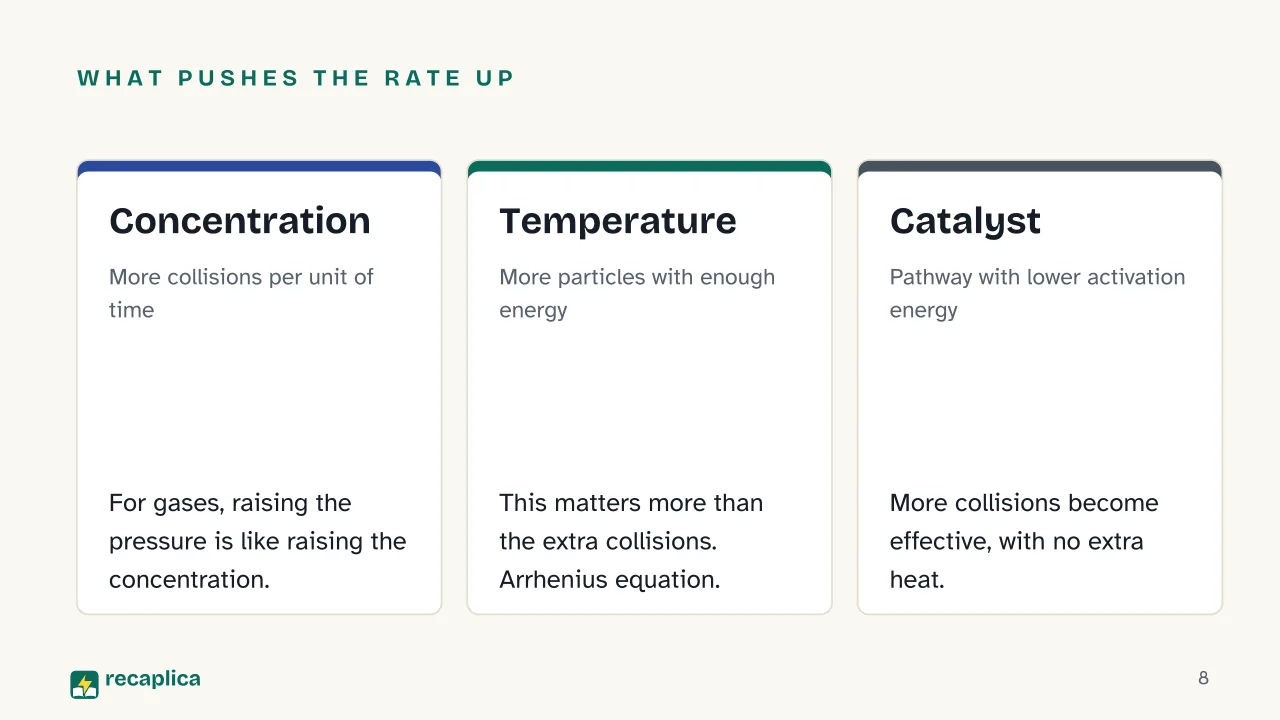
    Collision theory, a model, accounts for these effects. Particles must collide for a reaction to happen, and only some collisions lead to one: they need the right orientation and, at the moment of impact, enough energy to break the bonds already present and form new ones. That minimum energy is the activation energy. More reactant means more frequent collisions, and the rate rises. For gases, raising the pressure amounts to raising the concentration.

    Temperature, surface and catalyst

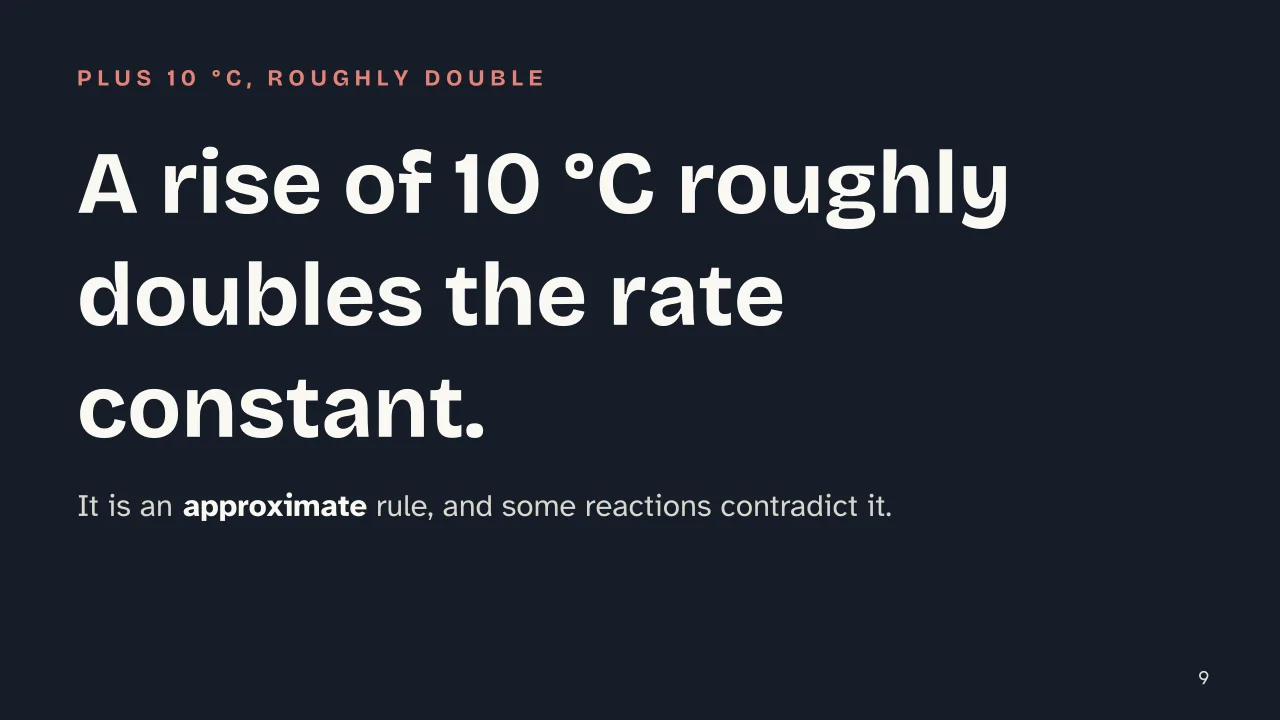
    Temperature speeds things up mainly because more of the colliding particles have the activation energy they need; the higher number of collisions counts for less. The Arrhenius equation describes the effect. Wikipedia reports an empirical rule: +10 °C roughly doubles the rate constant, with a ratio between the constants, Q10, usually around 2. This is an approximate rule and no law. There are exceptions: some reactions have a rate independent of temperature, others slow down on heating, and barrierless reactions (for example some radical reactions) tend to do the latter.

    In reactions that take place on a surface, the rate grows with the exposed area, since more particles of the solid can be reached by the reactant molecules.

    For reactions that follow the Arrhenius law, a catalyst lowers the activation energy by offering a different pathway. More collisions then become effective, the reaction speeds up in the forward and reverse directions, and there is no need to raise the temperature.

    Practical example: LibreTexts mentions iodide speeding up the decomposition of hydrogen peroxide without any heating.

    The rate law and the rate constant

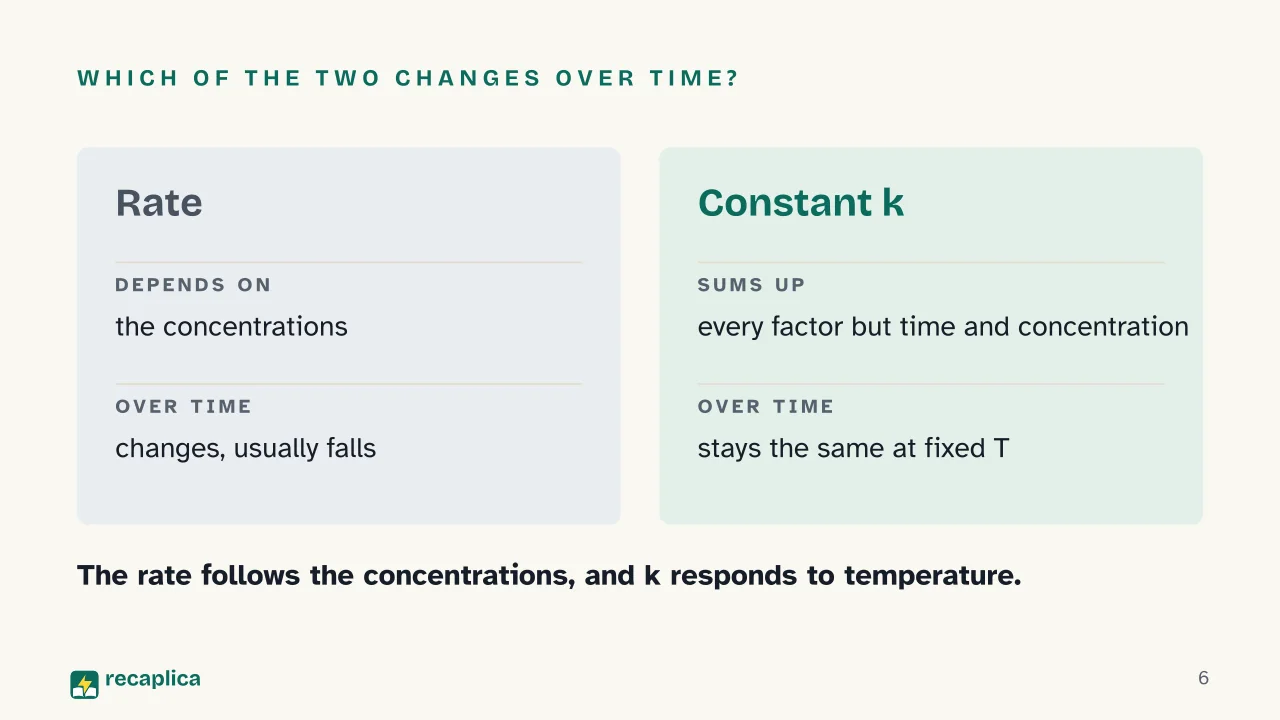
    The rate law is the expression that relates the rate to the concentrations; each exponent is a reaction order, and the constant k collects the rest. According to Wikipedia the “constant” is not really constant: it holds every factor that affects the rate, temperature included, except concentration and time. With temperature fixed, k does not change but the rate does. The units of k depend on the order; in first order they are 1/time.

    Order of a chemical reaction

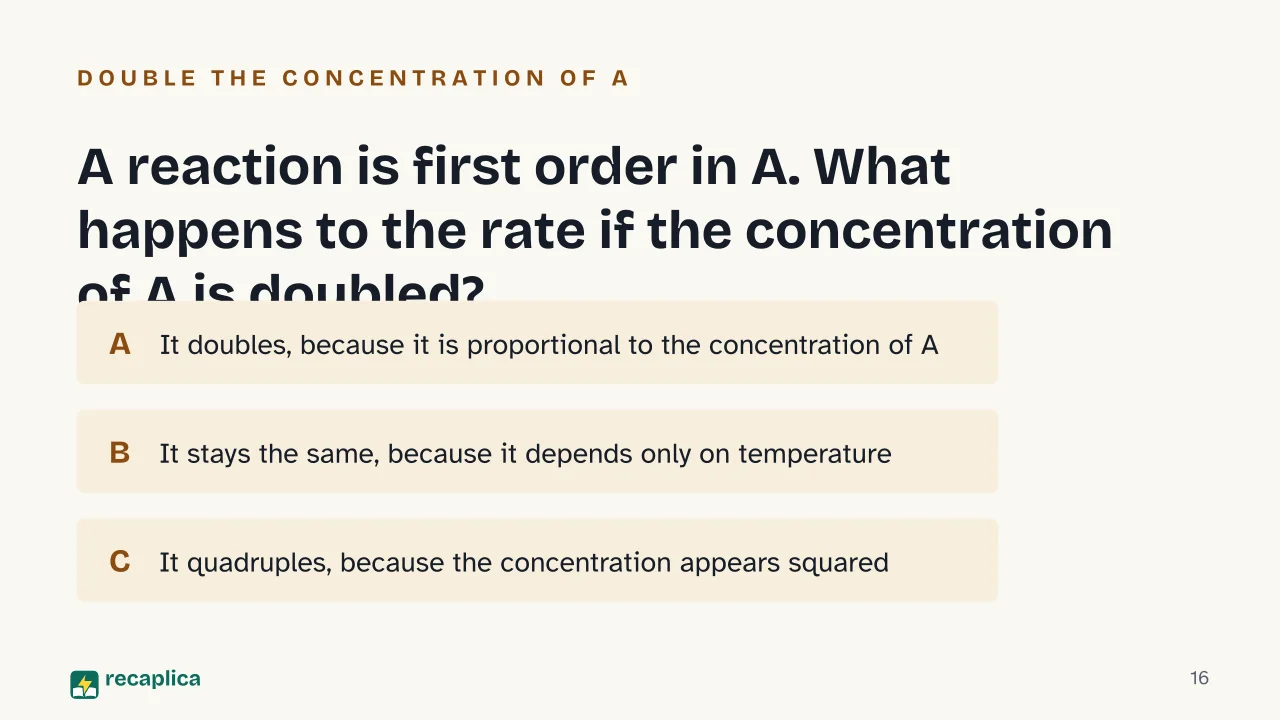
    The overall reaction order is the sum of the exponents with which the concentrations appear in the rate law. Each reactant can have its own partial order: in the LibreTexts textbook example, orders of 1, 2 and 0 give an overall order of 3. Zero order in a reactant means the rate does not depend on it. With order 1, doubling the concentration doubles the rate.

    Only for single-step reactions do the exponents match the stoichiometric coefficients. With several steps they may not, so the order has to be found by experiment, for example with the method of initial rates, which compares runs started at different concentrations.

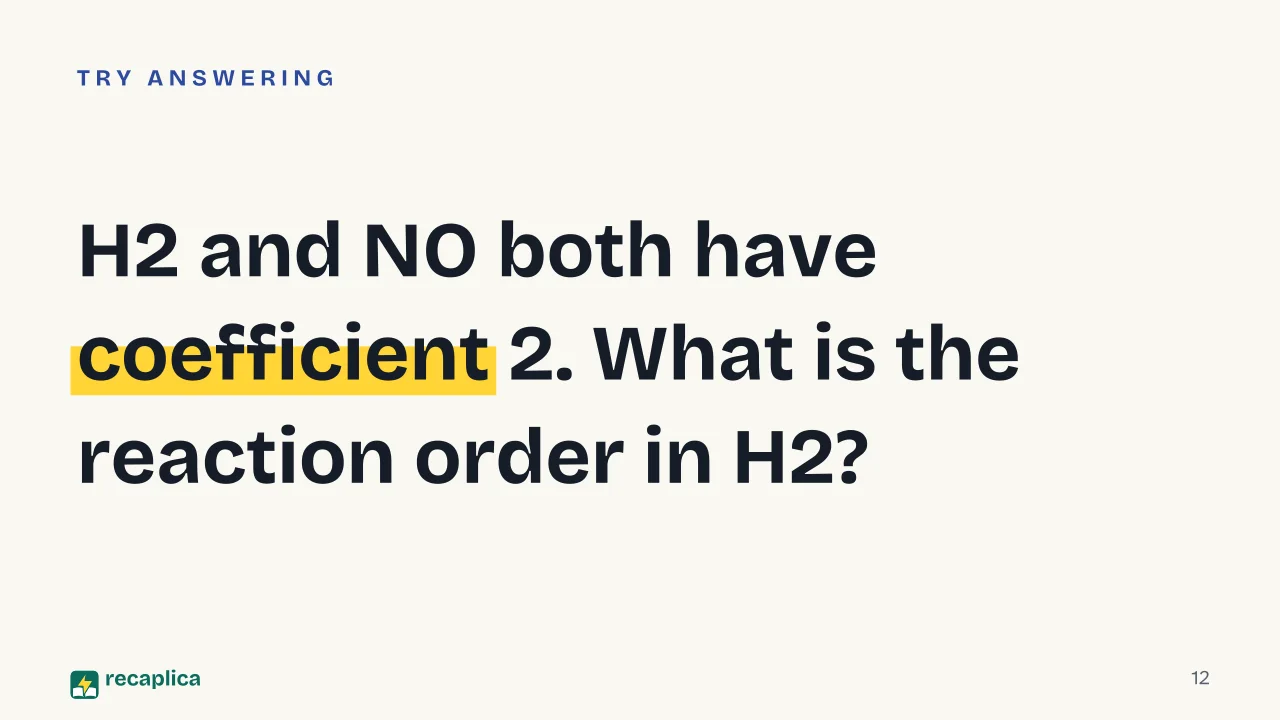
    Practical example: in the reaction between H2 and NO the coefficients are both 2, but the measured order is 1 in H2 and 2 in NO.

    Molecularity, the number of molecules taking part in an elementary step, equals the order only for elementary steps.

    Order is an experimental quantity, whereas molecularity belongs to the mechanism. A step with three molecules would be third order but slow, since simultaneous three-body collisions are rare.

    First order kinetics

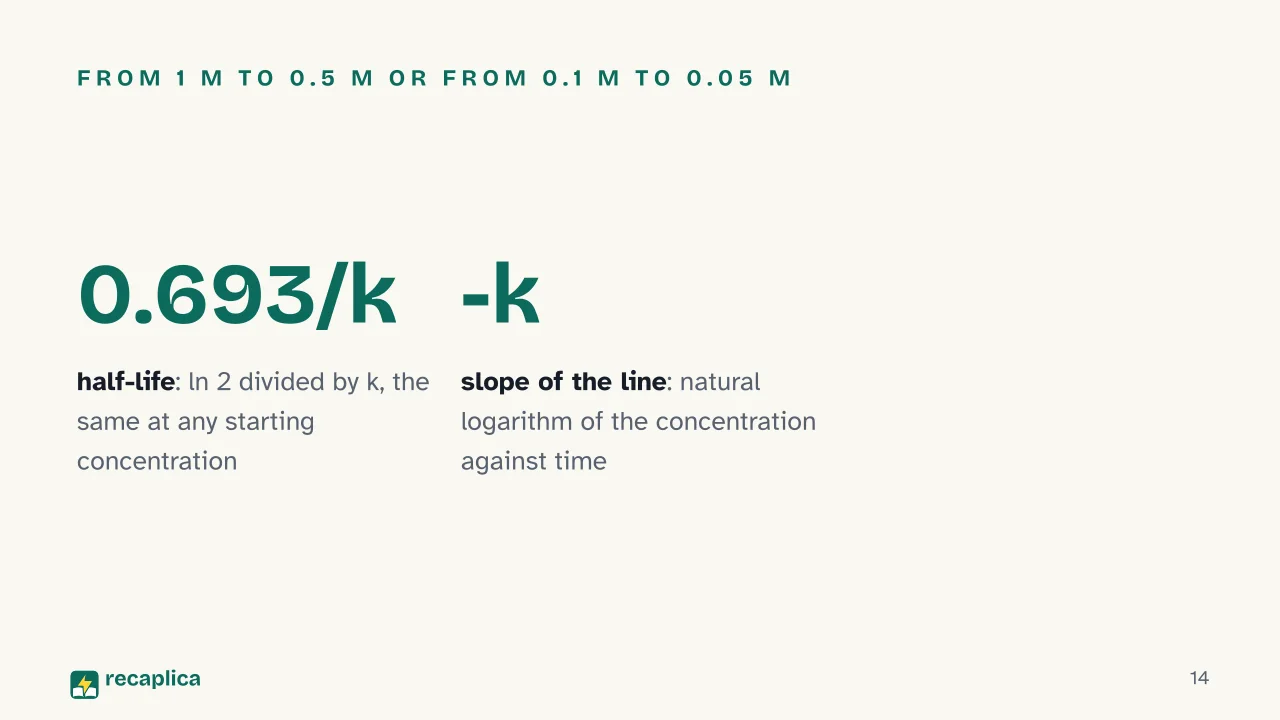
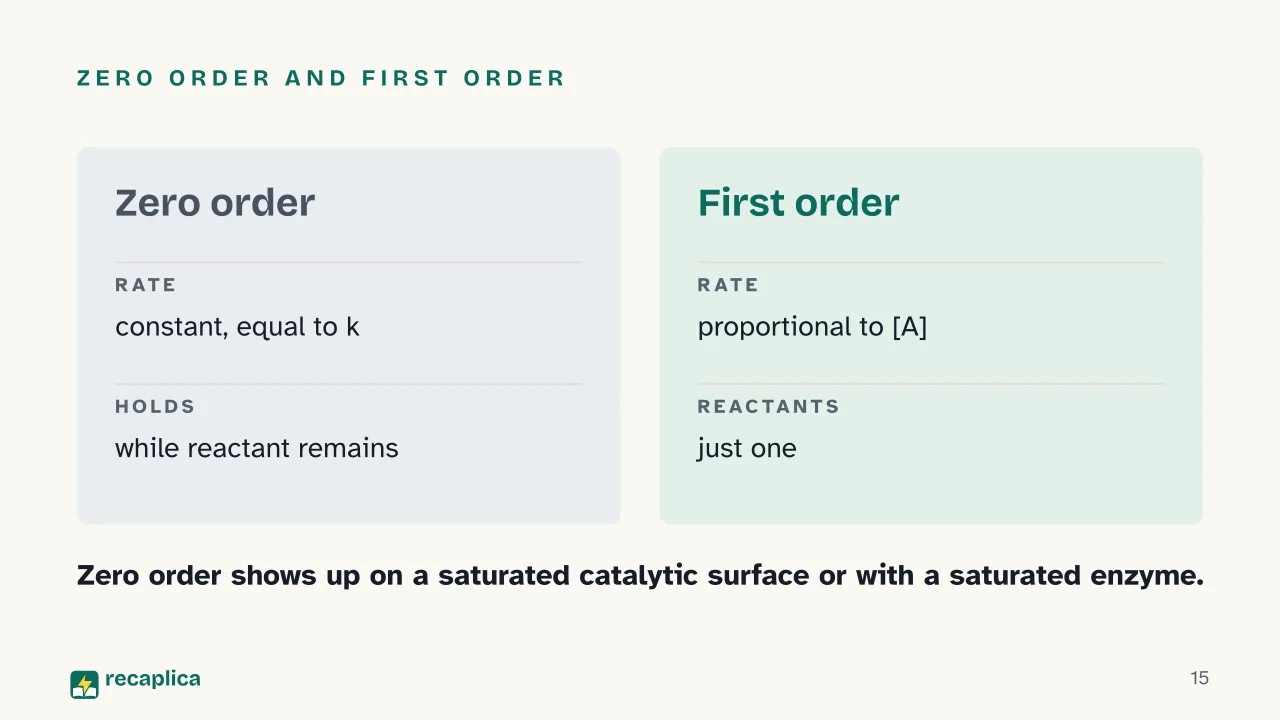
    In a first-order reaction the rate grows in proportion to the concentration of a single reactant. To check it, plot the natural logarithm of the concentration against time: a straight line with a negative slope equal to -k points to first order.

    LibreTexts presents a half-life that stays the same even when the starting concentration changes as the distinctive trait of first order. It equals ln 2 divided by k, about 0.693/k.

    Practical example: halving the concentration from 1 M to 0.5 M takes the same time as halving it from 0.1 M to 0.05 M.

    Zero order kinetics

    In a zero-order reaction the rate stays constant as the concentration changes and equals k. This holds only while reactant remains: without reactant the process cannot continue. It often appears when the reaction happens on a catalytic surface that becomes saturated. Wikipedia writes that when the substrate is far more abundant than the enzyme, the enzyme becomes saturated and many enzyme reactions are then zero order. One case is the oxidation of ethanol to acetaldehyde by liver alcohol dehydrogenase.

    The rate-determining step

    When a mechanism has several steps, it is usually the slowest elementary step that governs the overall rate, often only approximately. A reaction has a rate-determining step only when one of its steps is much slower than all the rest. Supposing that one exists makes the rate law much easier to work out. To tell which candidate is right, one works out the law each would imply and compares it with the measured one.

    Practical example: in NO2 + CO → NO + CO2 the observed rate is second order in NO2 and zero order in CO. It follows that CO enters a faster step, after the slow one.

    Slide deck

    Slides ready to download and make your own in PowerPoint or Google Slides, with speaker notes. Pick the Flash cut or the Full one.
    Slide 1 of the presentation on Reaction rate: Reaction rateSlide 2 of the presentation on Reaction rate: Why does iron take years to rust while cellulose burns in a fraction of a second?Slide 3 of the presentation on Reaction rate: From the definition to the slowest stepSlide 4 of the presentation on Reaction rate: Chapter 01: What it is and how it is measuredSlide 5 of the presentation on Reaction rate: One rate, always positive: Reactants, Products, CoefficientsSlide 6 of the presentation on Reaction rate: Which of the two changes over time?Slide 7 of the presentation on Reaction rate: Chapter 02: What changes itSlide 8 of the presentation on Reaction rate: What pushes the rate up: Concentration, Temperature, CatalystSlide 9 of the presentation on Reaction rate: A rise of 10 °C roughly doubles the rate constant.Slide 10 of the presentation on Reaction rate: Chapter 03: The rate law and orderSlide 11 of the presentation on Reaction rate: Order and molecularitySlide 12 of the presentation on Reaction rate: H2 and NO both have coefficient 2. What is the reaction order in H2?Slide 13 of the presentation on Reaction rate: Chapter 04: First order and the slow stepSlide 14 of the presentation on Reaction rate: From 1 M to 0.5 M or from 0.1 M to 0.05 MSlide 15 of the presentation on Reaction rate: Zero order and first orderSlide 16 of the presentation on Reaction rate: A reaction is first order in A. What happens to the rate if the concentration of A is doubled?Slide 17 of the presentation on Reaction rate: For revision
    Flash10 slidesThe essential thread, to present in classFull17 slidesEvery chapter and the deeper detail

    Common myths

    • ✗ Myth The exponents in the rate law are the coefficients of the balanced equation.

      ✓ Reality They match only when the reaction happens in a single step. In the reaction between H2 and NO both coefficients are 2, yet the measured order is 1 in H2 and 2 in NO, because the order depends on the mechanism.

    • ✗ Myth Every 10 °C increase doubles the rate, always.

      ✓ Reality Doubling the rate constant for every 10 °C is an empirical rule that Wikipedia describes as approximate: the ratio of the constants 10 °C apart is usually around 2. Some reactions have a rate that does not depend on temperature or that drops when it rises.

    • ✗ Myth The rate constant k is truly constant.

      ✓ Reality It sums up every factor that affects the rate except time and concentration, temperature included. At a fixed temperature it stays the same, while the rate keeps changing as the reaction proceeds and the reactants are used up.

    Mind map

    Drag the background to move around and the nodes to reposition them; use − and + to collapse and expand branches.
    Customize
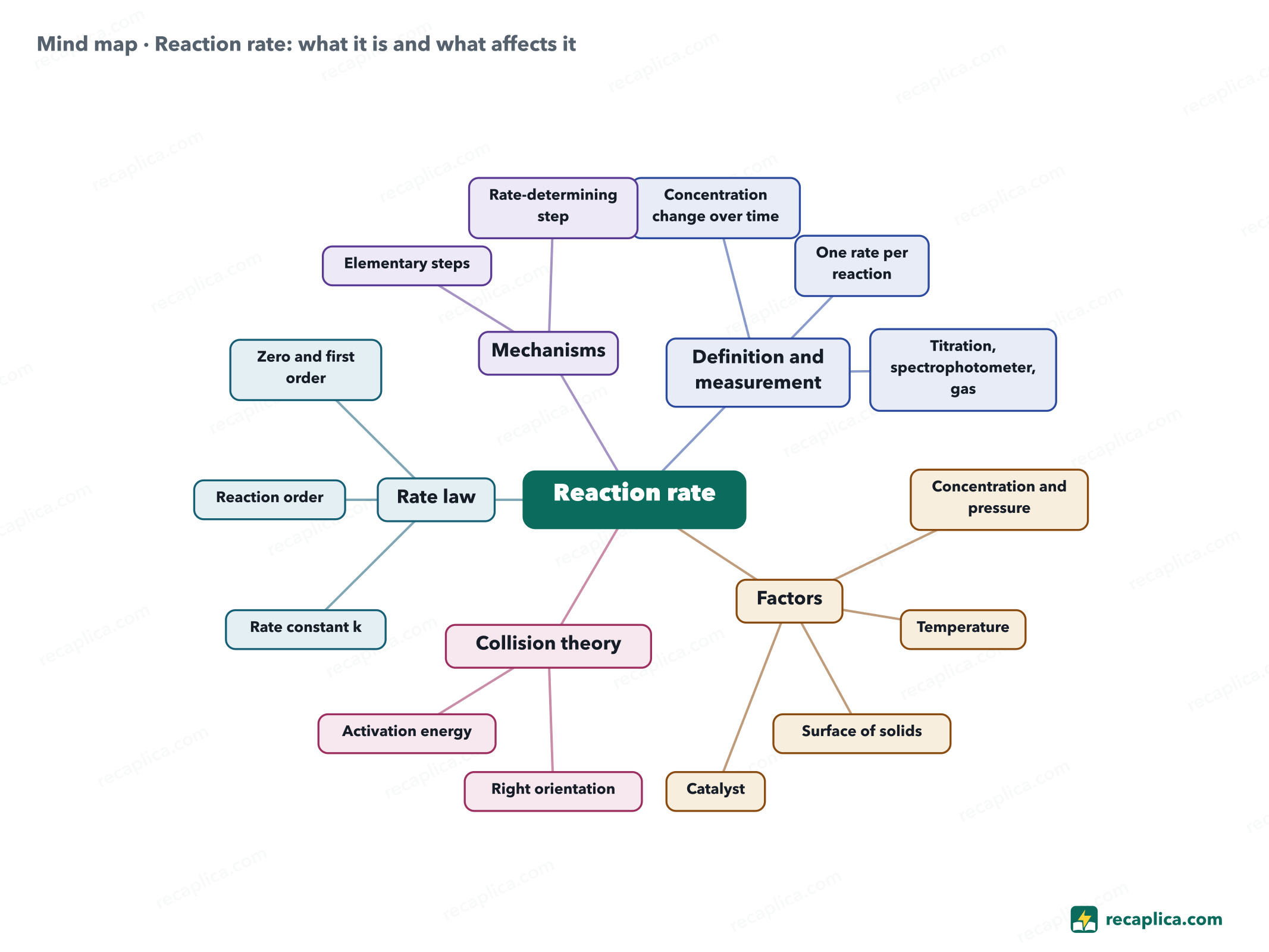
    Mind map: Reaction rate: what it is and what affects it
    • Reaction rate
      • Definition and measurement
        • Concentration change over time
        • One rate per reaction
        • Titration, spectrophotometer, gas
      • Factors
        • Concentration and pressure
        • Temperature
        • Surface of solids
        • Catalyst
      • Collision theory
        • Right orientation
        • Activation energy
      • Rate law
        • Rate constant k
        • Reaction order Found by experiment
        • Zero and first order
      • Mechanisms
        • Elementary steps
        • Rate-determining step

    Quiz: test yourself

    Answer the questions to check what you have learned: you get instant feedback and a short explanation.

    Grade 0/10 0/5
    1 A reaction is first order in reactant A. What happens to the rate if the concentration of A is doubled?

    In first order the rate is proportional to the concentration of a single reactant, so doubling the concentration doubles the rate.

    2 How is the order of a reaction with several steps established?

    With several steps the exponents do not match the coefficients. The method of initial rates compares runs that start from different concentrations and reads the order off the results.

    3 In a first-order reaction, how long does it take for the concentration to halve from 1 M to 0.5 M, compared with going from 0.1 M to 0.05 M?

    The first-order half-life is ln 2 divided by k, about 0.693 divided by k, and it does not contain the starting concentration, so both halvings take the same time.

    4 Why does a catalyst make a reaction faster?

    With a lower activation energy more collisions are effective, and the reaction speeds up in both the forward and reverse direction without any heating.

    5 Why does a minus sign appear in front of the rate calculated from the reactants?

    The rate is always positive. The minus sign offsets the fact that the concentration of a reactant decreases.

    Answers: 1-A · 2-B · 3-C · 4-D · 5-B

    Flashcards

    Tap the card to flip it and check whether you remember the answer, then move to the next one.

    1 / 7

    Explain it in your own words

    The ultimate test: if you can explain it in simple words, you've truly understood it. Write your explanation, then compare it with the Recap.

    Your explanation is saved only on this device.

    Reaction rate tells you how fast the concentration of a substance changes as it reacts or forms. It depends on concentration, temperature, the surface of solids and the presence of a catalyst, and collision theory accounts for each of these effects. The rate law links the rate to the concentrations, its exponents are the reaction orders, and the orders come from experiments.

    Frequently asked questions

    What is the formula for the rate of reaction?

    In words, it is the change in concentration of a substance over time, divided by its stoichiometric coefficient. A minus sign goes in front for a reactant and none for a product, so the result is positive and is measured in mol/(L·s). An expression containing the concentrations needs the rate law, which comes from experiments.

    What is the order of a chemical reaction?

    It is the sum of the exponents of the concentrations in the rate law. Each reactant has a partial order: with orders 1, 2 and 0 the overall order is 3, as in the LibreTexts textbook example. It is found by experiment.

    How do you recognize first order kinetics?

    Graph ln of the concentration over time. If the points fall on a straight line with a negative slope equal to -k, the reaction is first order. Another sign is a half-life that stays the same whatever the starting concentration.

    What is the difference between the reaction rate and the rate constant?

    The rate changes over time, because it depends on the concentrations. The constant k stays the same at a fixed temperature. Its units change with the order: in first order they are the inverse of a time.

    What is zero order kinetics?

    It is the case where the rate does not depend on the concentration of the reactant. The rate stays constant and equals k, as long as there is reactant left. It happens, for example, on a saturated catalytic surface or in many enzyme reactions with plenty of substrate.

    Sources

    • LibreTexts, The Rate of a Chemical Reaction
    • LibreTexts, Measuring Reaction Rates
    • LibreTexts, Reaction Order
    • LibreTexts, First-Order Reactions
    • LibreTexts, Zero-Order Reactions
    • LibreTexts, Rate Determining Step
    • LibreTexts, Ea and Catalysts
    • Wikipedia, Reaction rate
    • Wikipedia, Rate equation
    • Wikipedia, Collision theory
    • Wikipedia, Rate-determining step

    Every Recap goes through an independent review before publication.

    Every evening, the day's new Recaps on our Telegram channel. Join the channel →

    Keep learning

    • Science Balancing Redox Reactions: Half-Reaction and Oxidation Number Methods A redox reaction is balanced when every element has the same number of atoms on both sides and the total charge is the same too. There are two routes. With the half-reaction method you write oxidation and reduction separately, add water, H⁺ and electrons, and then add the two halves together. With the oxidation number method you look at how much each element's number rises and falls, and pick coefficients that make the total rise equal the total fall. In basic solution you start as in acid, and at the end the H⁺ ions are turned into water with OH⁻. Read the Recap →
    • Science Brønsted-Lowry theory: definition of acids, bases and conjugate pairs In 1923 Johannes Brønsted and Thomas Lowry, working independently, defined an acid as a species that gives away a proton and a base as a species that takes one in. An acid-base reaction is therefore a transfer of a proton, and every transfer produces two conjugate pairs. Water can act as either an acid or a base, and ammonia is a base even though its formula has no OH-. The theory generalizes Arrhenius's, which holds only for water solutions. Read the Recap →
    • Science Chemical Equilibrium: Definition, the Constant K and the Reaction Quotient Q A reversible reaction can run in either direction, and in a closed system it reaches a point where the amounts of reactants and products stop changing. At that point the forward and reverse reactions keep going at the same rate. The equilibrium constant K depends on temperature. Comparing the reaction quotient Q with K shows which way the reaction is heading. An ICE table handles the calculations. Read the Recap →

    recaplica

    Clear in 30 seconds, yours in 10 minutes.

    Recaps Mind maps Request a Recap Telegram channel Mind map maker Our method About Privacy & cookies Legal notes & terms of use

    © 2026 Recaplica · A project by Curi S.r.l. — VAT IT05472000750

    Statistics, only if you say so

    To learn which Recaps help most we would use Google Analytics, with aggregate, anonymous data. It starts only with your OK, and you can change your mind anytime. Privacy policy