Skip to content
recaplica

    One moment: security check

    Cloudflare wants to make sure you're not a robot. Tick the box below and your search will continue on its own.

    IT
    recaplica What Is Poetic Realism? Germany's 19th-Century Literary Movement
    © 2026 Recaplica · recaplica.com — All rights reserved
    Home › Literature

    What Is Poetic Realism? Germany's 19th-Century Literary Movement

    By Recaplica Newsroom · Updated on October 6, 2026

    What to print

    Page numbers appear when printing with default margins.

    Slides

    Choose a cut

    Flash10 slidesThe essential thread, to present in classFull15 slidesEvery chapter and the deeper detail

    Both come with speaker notes.

    Telegram channel
    recaplica Clear in 30 seconds, yours in 10 minutes.
    In 30 seconds Key points Figures Deep dive Slides Myths Mind map Quiz Flashcards FAQ

    In 30 seconds quick read

    Poetic Realism, known in German as "Poetischer Realismus," is a literary movement that took shape in Germany around the mid-19th century. It tells the lives of ordinary people through careful, objective observation, but it doesn't stop at holding up a mirror: it reworks reality with its own stylistic devices, something scholars call poetic transfiguration. One critical source places the era between 1848 and 1890, after the failed revolution of 1848/49. Its leading authors include Otto Ludwig, Theodor Fontane and Gottfried Keller.

    Key Points

    • Poetic Realism observes the trades, habits and social conventions of its time with care, giving voice to ordinary people rather than to grand events.
    • The term "Poetischer Realismus" is credited to Otto Ludwig, who is said to have coined it while describing a balance between idealistic and naturalistic art.
    • Reality isn't merely mirrored: Poetic Realism reshapes it through its own style, poetic transfiguration, which sets it apart from French and Russian Realism.
    • One critical source places the era between 1848 and 1890, against the backdrop of the Vormärz and the failed revolution of 1848/49.
    • Theodor Fontane and Gottfried Keller are among its leading authors, with different approaches: Fontane in novels of manners, Keller in the psychological depth of his characters.
    • Naturalism, the era that follows, drops these stylistic devices, and one source calls it "far more radical."

    Key figures

    • 1848-1890 Time span of German Realism as a literary era, according to a German critical source. Source: inhaltsangabe.de
    • 1895 Publication year of «Effi Briest», the novel by Theodor Fontane (1819-1898) ranked among the best known of Poetic Realism. Source: schullv.de

    Deep Dive

    In the second half of the 19th century, as everyday life across Europe shifted under the push of industrialization, German literature found its own way of telling the story of society: not the bare mirror of fact, but a reality observed with care and, at the same time, worked through style. The movement that grew out of this is Poetic Realism.

    From the Vormärz to a failed revolution

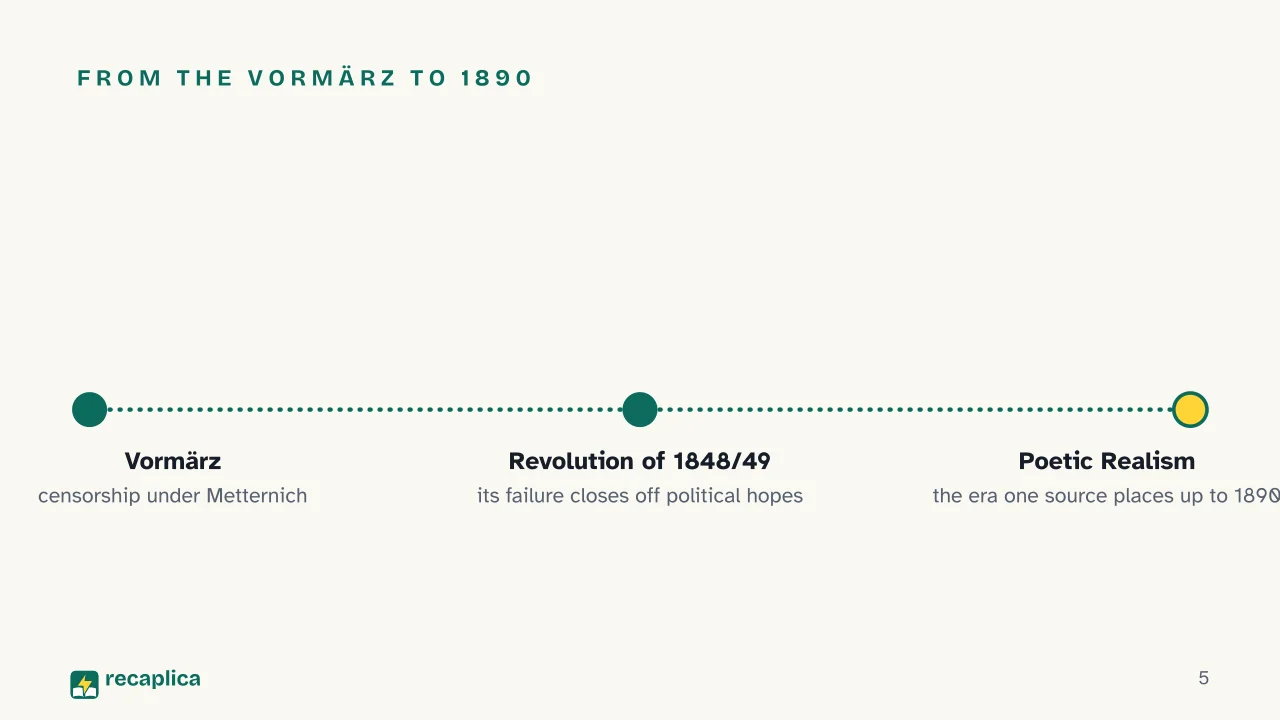
    At the start of the 19th century, the German Confederation, under Austrian chancellor Metternich, enforced a repressive policy that sharply limited literary activity through bans and censorship: the period is known as the Vormärz, “before March.” The March Revolution of 1848/49 loosened those restrictions for a while. It didn’t last: once the revolution definitively failed, the hopes for political participation that had come with it faded too.

    It was in that climate of disappointment that “Poetischer Realismus,” Poetic Realism, took shape in German-speaking lands.

    Before this era, an earlier generation of German writers had already broken with classicist conventions. The Sturm und Drang movement had anticipated, decades earlier, the idea that literature could give voice to a more authentic feeling; Poetic Realism inherits that drive and turns it toward the observation of society, with the attention those earlier writers had reserved for the individual.

    Poetic transfiguration: what sets German Realism apart

    The term “Poetischer Realismus” is credited, with some caution, to Otto Ludwig: one source says he is “said” to have coined it. Ludwig defined “artistic realism” as a balance between a subjectively idealistic art and an objectively naturalistic one. He belonged to a transitional phase from Romanticism to realism, and sought a harmonious ideal of human existence over its plain chronicle.

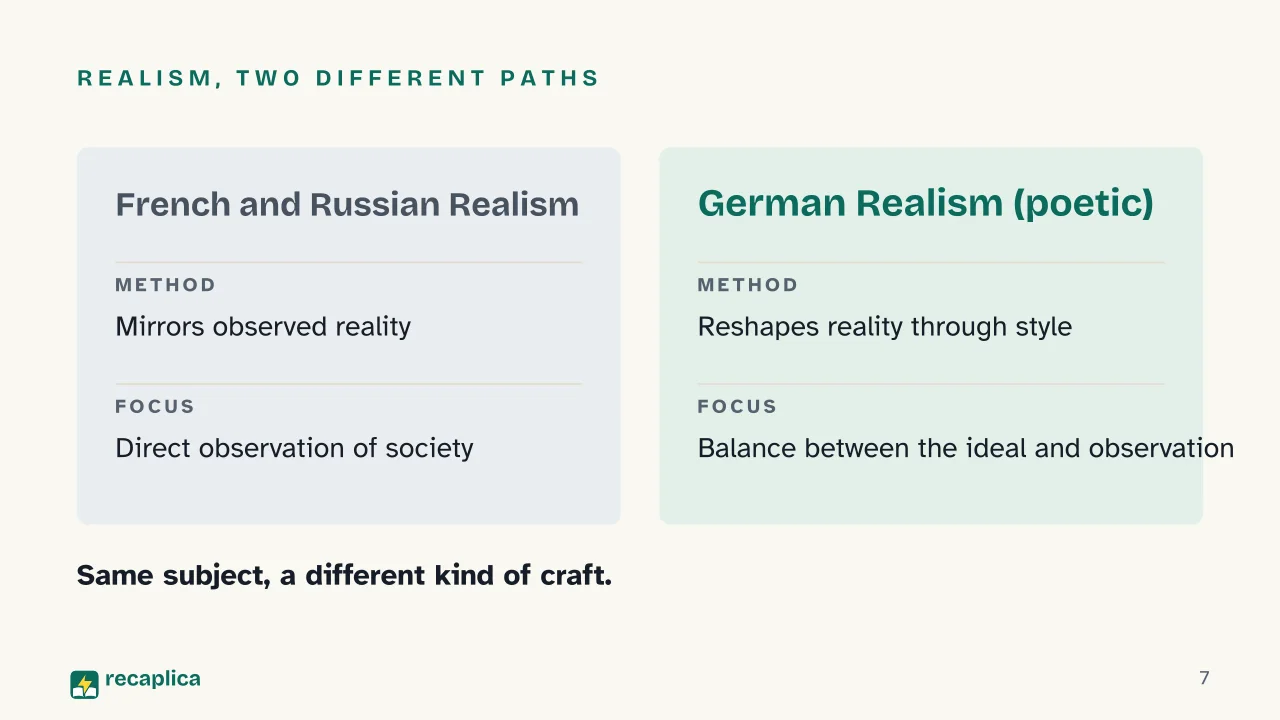
    Out of this idea comes the trait that most separates German Realism from the French or Russian kind: reality isn’t simply mirrored, it is artistically reworked. Even realistic works carry stylistic devices and ornamental touches; critics call this work “poetic transfiguration.” Realism as a literary era covers mainly French, German, English, Russian and American literature, and the German strand is one national variation among others, with this distinct flavor of its own.

    AspectFrench and Russian RealismGerman Realism (poetic)
    Relationship with realitymirrors it through direct observationreworks it through stylistic devices
    Theoretical referencesocial observation, critical commentarybalance between the ideal and the naturalistic (Otto Ludwig)
    Later legacycontinues toward European NaturalismGerman Naturalism drops that style

    Practical example: picture a novel set in a small German town in the mid-19th century. The author describes social habits, trades and marriage conventions with precision: so far, objective observation. But the scenes are built with a deliberate narrative design, carefully weighed dialogue, a rhythm that is nothing like raw chronicle. That balance between what is observed and how it is told is the poetic transfiguration Otto Ludwig had in mind.

    The authors: Otto Ludwig, Theodor Fontane, Gottfried Keller

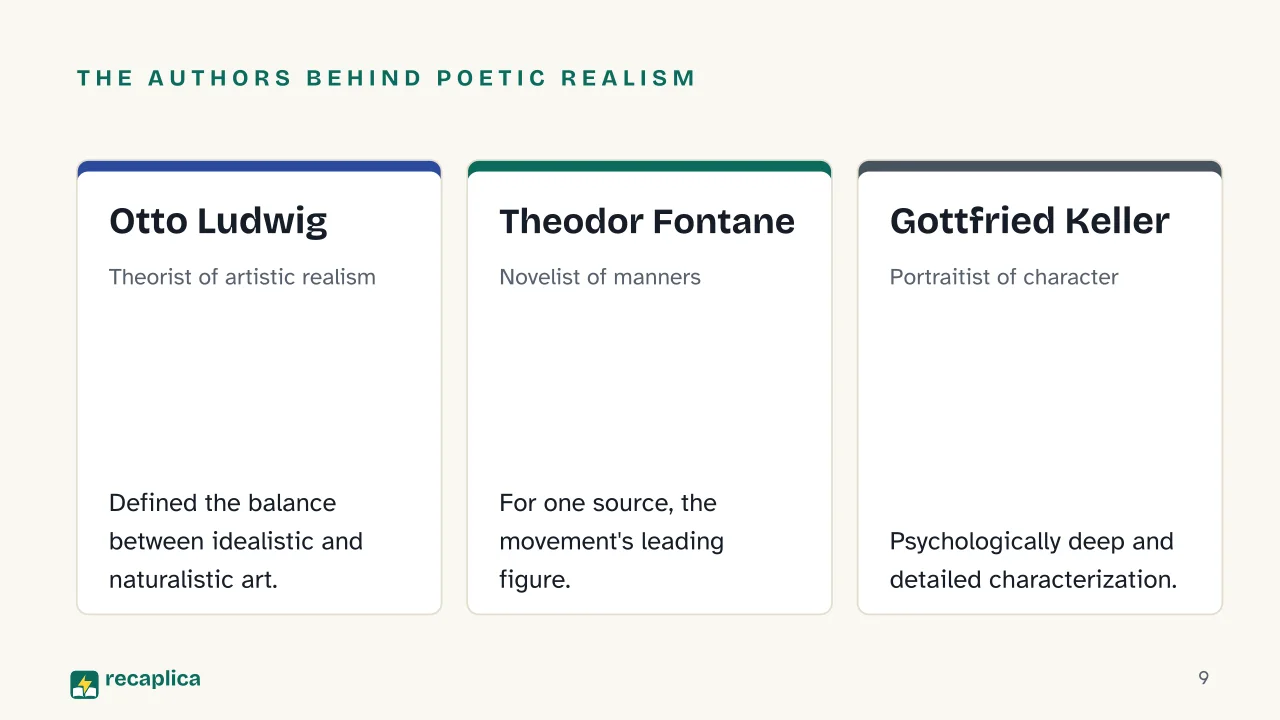
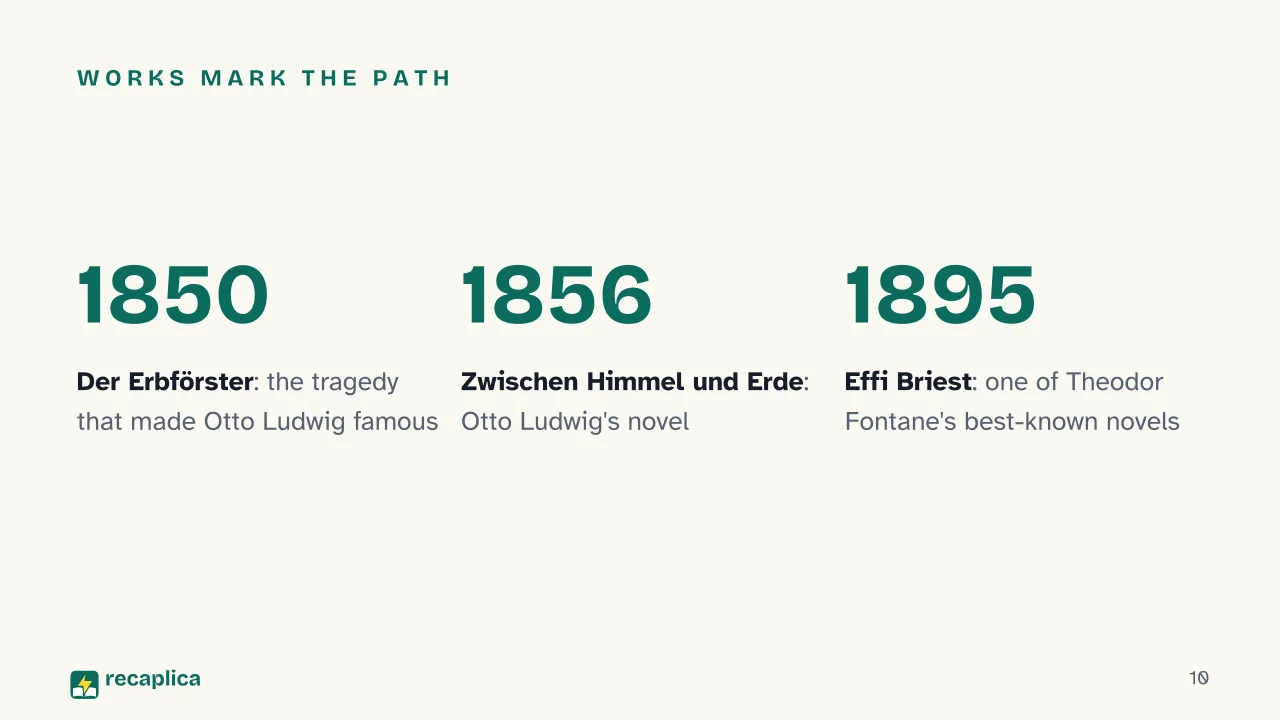
    Otto Ludwig was not only a theorist. In 1850, the five-act tragedy “Der Erbförster” (The Hereditary Forester) made him famous; in 1856 he published the novel “Zwischen Himmel und Erde” (Between Heaven and Earth); in 1871 came his main critical work, “Shakespeare Studien.”

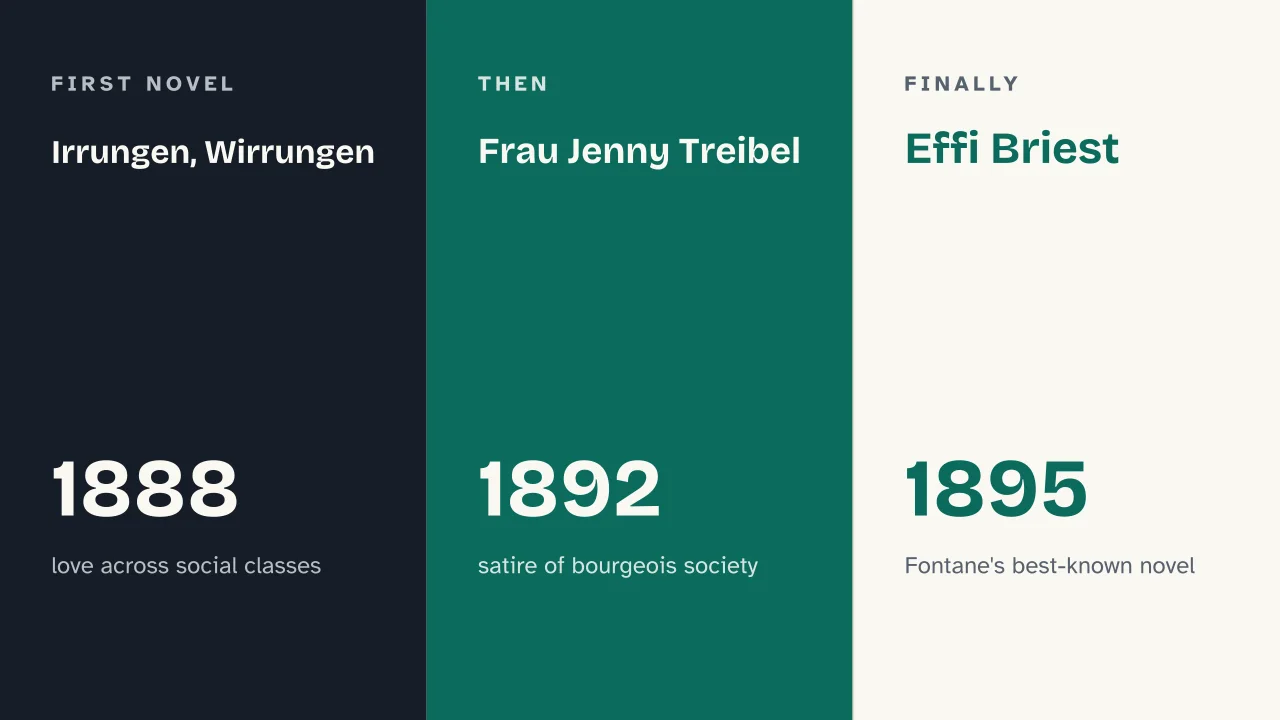
    Theodor Fontane (1819-1898) is named by one source as the movement’s leading figure. He wrote “Irrungen, Wirrungen” in 1888, “Frau Jenny Treibel” in 1892 and “Effi Briest” in 1895: novels of manners that observe the bourgeois and aristocratic society of his time. Gottfried Keller, for his part, is associated with a psychologically deep and detailed characterization of his figures: where Fontane looks at the social fabric, Keller digs into the individual.

    Where Poetic Realism ends: the border with Naturalism

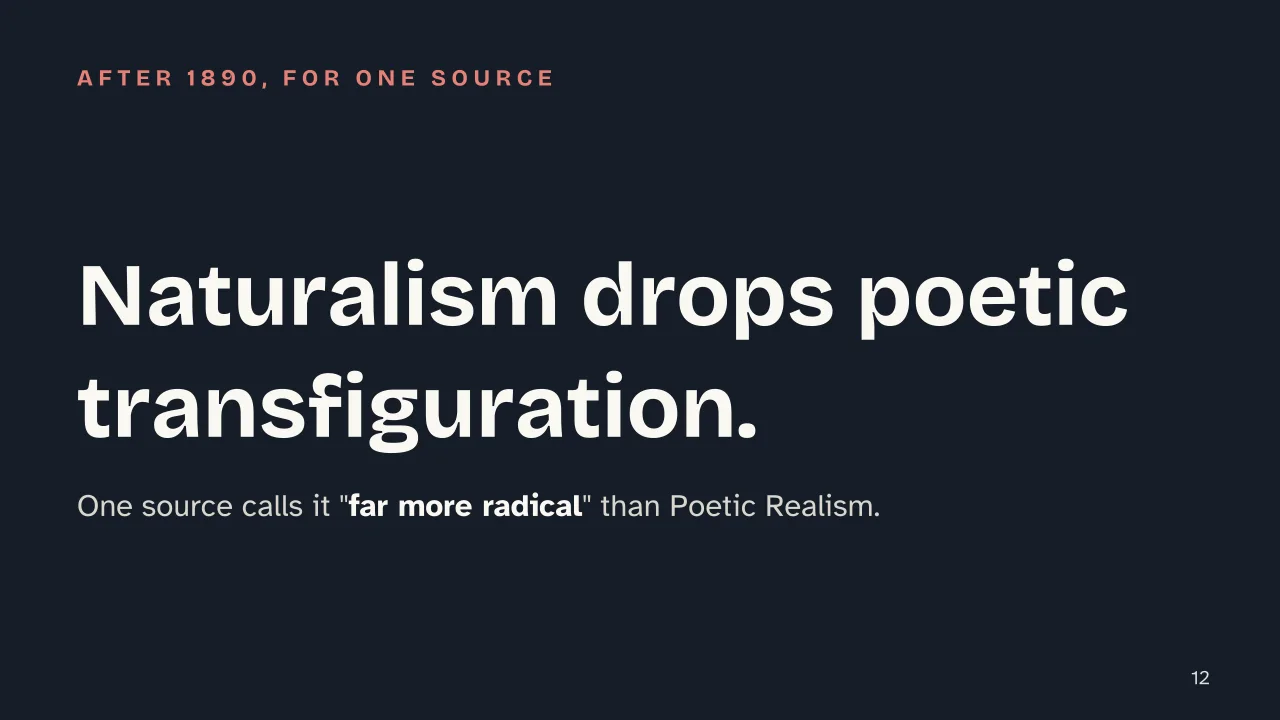
    A German critical source, inhaltsangabe.de, places Realism as a literary era between 1848 and 1890. Beyond that threshold comes Naturalism, described by one source as “far more radical”: the stylistic devices of poetic transfiguration, the ornamental elements that had marked Poetic Realism, are no longer used.

    The distinction is also useful for placing the movement among other European literary currents of the same period. In Italy, for instance, Giovanni Verga pursued a project in some ways close to French Naturalism with Verismo: the difference from German poetic transfiguration lies precisely in how much room is left to style over direct observation. Looking further back in the history of European literature, Neoclassicism had also placed form at the center, with precise rules of composition: German Poetic Realism inherits that attention to form and applies it to a new subject, 19th-century social life, far from ancient models.

    The term “Realismus” comes from the Latin “res,” thing, object, reality: an etymology that captures the movement’s program well, the attention paid to the observed thing, and, alongside it, the work German literature chose to do on that thing, reshaping it in poetic form.

    Slide deck

    Slides ready to download and make your own in PowerPoint or Google Slides, with speaker notes. Pick the Flash cut or the Full one.
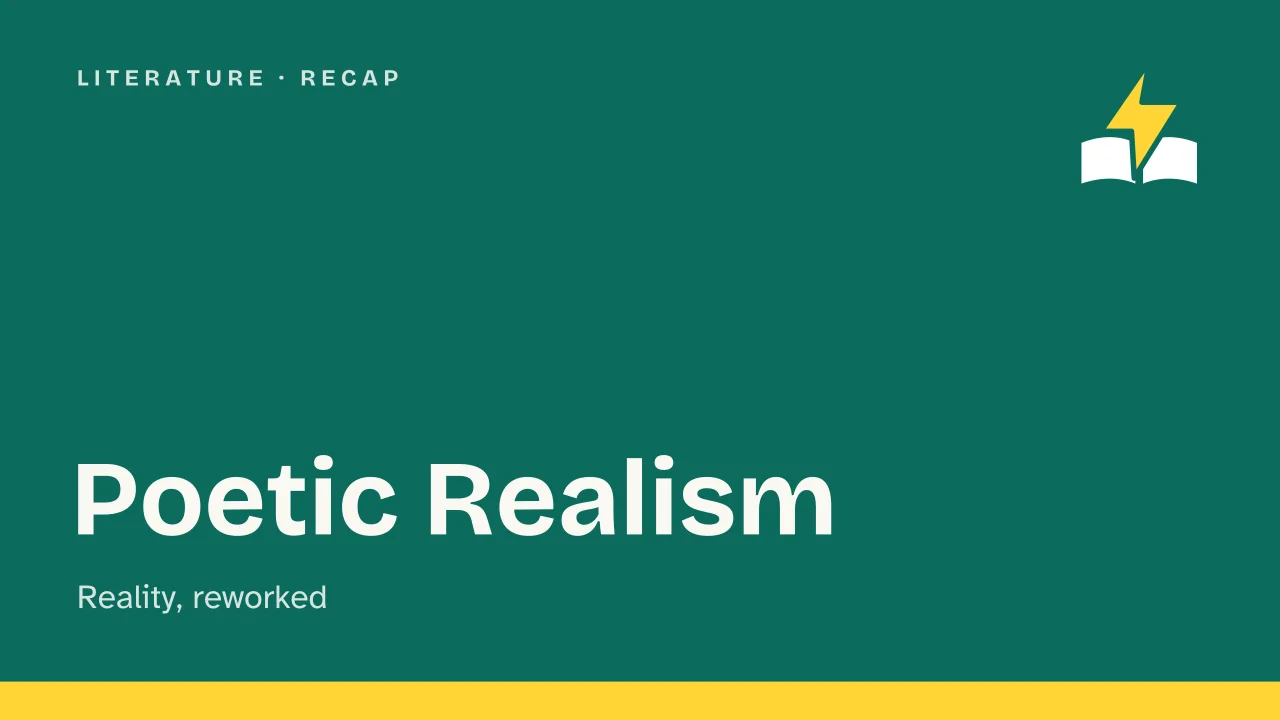
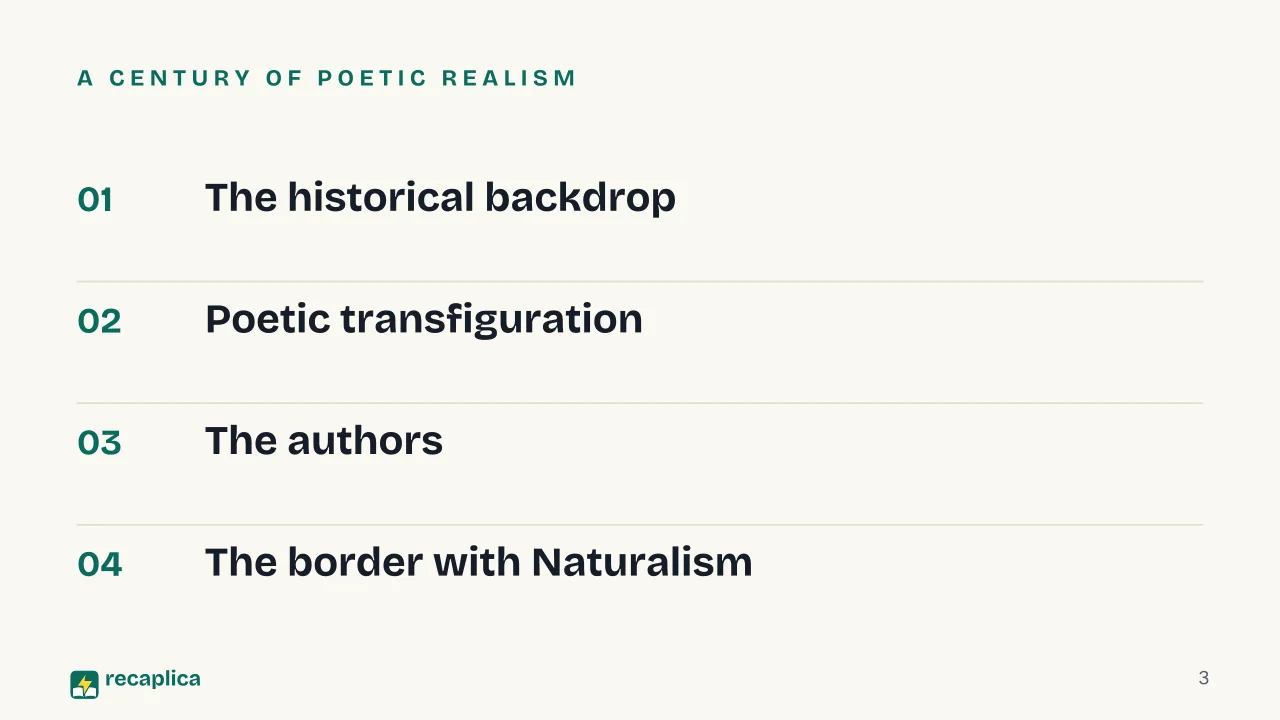
    Slide 1 of the presentation on What Is Poetic Realism? Germany's 19th-Century Literary Movement: Poetic RealismSlide 2 of the presentation on What Is Poetic Realism? Germany's 19th-Century Literary Movement: Can a story observe reality and reshape it at the same time?Slide 3 of the presentation on What Is Poetic Realism? Germany's 19th-Century Literary Movement: A century of Poetic RealismSlide 4 of the presentation on What Is Poetic Realism? Germany's 19th-Century Literary Movement: Chapter 01: The historical backdropSlide 5 of the presentation on What Is Poetic Realism? Germany's 19th-Century Literary Movement: From the Vormärz to 1890Slide 6 of the presentation on What Is Poetic Realism? Germany's 19th-Century Literary Movement: Chapter 02: Poetic transfigurationSlide 7 of the presentation on What Is Poetic Realism? Germany's 19th-Century Literary Movement: Realism, two different pathsSlide 8 of the presentation on What Is Poetic Realism? Germany's 19th-Century Literary Movement: Chapter 03: The authorsSlide 9 of the presentation on What Is Poetic Realism? Germany's 19th-Century Literary Movement: The authors behind Poetic Realism: Otto Ludwig, Theodor Fontane, Gottfried KellerSlide 10 of the presentation on What Is Poetic Realism? Germany's 19th-Century Literary Movement: Works mark the pathSlide 11 of the presentation on What Is Poetic Realism? Germany's 19th-Century Literary Movement: Chapter 04: The border with NaturalismSlide 12 of the presentation on What Is Poetic Realism? Germany's 19th-Century Literary Movement: Naturalism drops poetic transfiguration.Slide 13 of the presentation on What Is Poetic Realism? Germany's 19th-Century Literary Movement: Irrungen, Wirrungen · Frau Jenny Treibel · Effi BriestSlide 14 of the presentation on What Is Poetic Realism? Germany's 19th-Century Literary Movement: Which historical and political event forms the backdrop to Poetic Realism?Slide 15 of the presentation on What Is Poetic Realism? Germany's 19th-Century Literary Movement: Now, time to review
    Flash10 slidesThe essential thread, to present in classFull15 slidesEvery chapter and the deeper detail

    Common myths

    • ✗ Myth Poetic Realism mirrors reality without any artistic reworking.

      ✓ Reality A recognizable style runs through the telling: detailed descriptions, careful language choices, a deliberate narrative rhythm. Scholars call this work poetic transfiguration, the trait that separates Poetic Realism from the French and Russian kind.

    • ✗ Myth Poetic Realism and Naturalism are just two names for the same movement.

      ✓ Reality They are two distinct eras. Poetic Realism reworks reality through its own style; the Naturalism that follows drops that style, and one source calls it "far more radical" in observing facts.

    • ✗ Myth Otto Ludwig certainly coined the term "Poetischer Realismus."

      ✓ Reality One source points to him as the likely author of the term, but with caution: he is "said" to have coined it, which is not a fact documented beyond doubt.

    Mind map

    Drag the background to move around and the nodes to reposition them; use − and + to collapse and expand branches.
    Customize
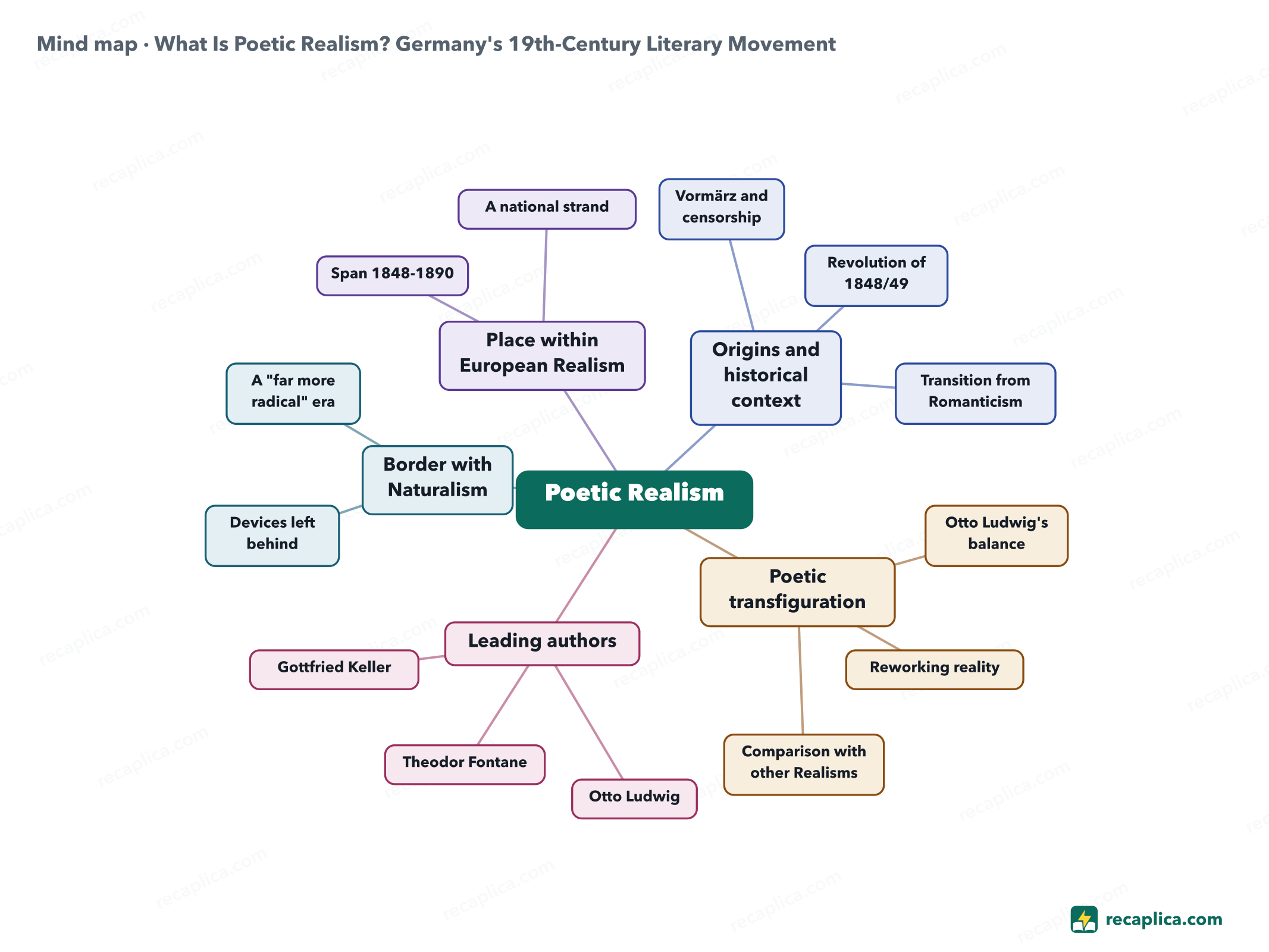
    Mind map: What Is Poetic Realism? Germany's 19th-Century Literary Movement
    • Poetic Realism
      • Origins and historical context
        • Vormärz and censorship repressive policy of the German Confederation led by Metternich
        • Revolution of 1848/49 its failure extinguished hopes for political participation
        • Transition from Romanticism Otto Ludwig worked during a transitional phase toward realism
      • Poetic transfiguration
        • Otto Ludwig's balance subjectively idealistic art and objectively naturalistic art
        • Reworking reality stylistic devices and ornamental elements
        • Comparison with other Realisms distinct from French and Russian Realism
      • Leading authors
        • Otto Ludwig Der Erbförster, 1850, Zwischen Himmel und Erde, 1856
        • Theodor Fontane 1819-1898, novels of manners such as Effi Briest
        • Gottfried Keller characters with psychological depth
      • Border with Naturalism
        • Devices left behind the style of poetic transfiguration does not carry on
        • A "far more radical" era definition from a critical source
      • Place within European Realism
        • Span 1848-1890 according to a German critical source
        • A national strand Realism also covers French, English, Russian and American literature

    Quiz: test yourself

    Answer the questions to check what you have learned: you get instant feedback and a short explanation.

    Grade 0/10 0/5
    1 What does "poetic transfiguration" mean in Poetic Realism?

    Poetic transfiguration is the balance between observing reality and reworking it artistically: reality gets told, but it also gets worked through stylistic devices and ornamental touches.

    2 Who is credited, with some caution, with coining the term "Poetischer Realismus"?

    According to one source, the term is credited to Otto Ludwig: his idea of "artistic realism" joined observation of society with narrative invention, the fact and the form that tells it.

    3 According to a German critical source, what time span does the Realism era cover in Germany?

    inhaltsangabe.de places the era of German Realism between 1848, the year of the revolution, and 1890, on the threshold of Naturalism.

    4 Which historical and political event forms the backdrop to the birth of Poetic Realism?

    With the definitive failure of the 1848/49 revolution, the hopes for political participation born after the Vormärz years of censorship faded away: that is the historical backdrop of the movement.

    5 True or false: Naturalism, the era following Poetic Realism, keeps the same stylistic devices of poetic transfiguration.

    One source describes Naturalism as "far more radical": the elaborate style of poetic transfiguration gives way, in that era, to a more direct relationship with reality.

    Answers: 1-B · 2-A · 3-B · 4-A · 5-B

    Flashcards

    Tap the card to flip it and check whether you remember the answer, then move to the next one.

    1 / 8

    Explain it in your own words

    The ultimate test: if you can explain it in simple words, you've truly understood it. Write your explanation, then compare it with the Recap.

    Your explanation is saved only on this device.

    Poetic Realism, known in German as "Poetischer Realismus," is a literary movement that took shape in Germany around the mid-19th century. It tells the lives of ordinary people through careful, objective observation, but it doesn't stop at holding up a mirror: it reworks reality with its own stylistic devices, something scholars call poetic transfiguration. One critical source places the era between 1848 and 1890, after the failed revolution of 1848/49. Its leading authors include Otto Ludwig, Theodor Fontane and Gottfried Keller.

    Frequently asked questions

    What is Poetic Realism (Poetischer Realismus)?

    A German literary movement that took hold in the mid-19th century. It puts ordinary people at the center, their trades and habits, told with care and without ideological filters. Some critics also call it "Poetischer Realismus," because the observed reality also gets reworked with its own stylistic devices.

    Who coined the term "Poetischer Realismus"?

    One source points to Otto Ludwig as the likely author of the term, used with caution because he is "said" to have coined it: he spoke of an "artistic realism" able to hold together the ideal and observation.

    What time period does Poetic Realism cover?

    A German critical source (inhaltsangabe.de) places the era between 1848, the year of the failed revolution, and 1890, on the threshold of Naturalism.

    What is the difference between Poetic Realism and Naturalism?

    Poetic Realism reshapes reality through its own style, poetic transfiguration. Naturalism comes after and drops that style: one source calls it "far more radical" in its approach to reality.

    Who are the leading authors of Poetic Realism?

    Otto Ludwig, theorist of "artistic realism" and author of the tragedy "Der Erbförster" (1850); Theodor Fontane (1819-1898), author of novels of manners such as "Effi Briest"; Gottfried Keller, known for the psychological depth of his characters.

    Sources

    • EBSCO Research Starters, «Otto Ludwig»
    • Vaia, «German Narrative Realism»
    • inhaltsangabe.de, «Realismus (1848–1890)»
    • schullv.de, «Realismus»

    Every Recap goes through an independent review before publication.

    Every evening, the day's new Recaps on our Telegram channel. Join the channel →

    Keep learning

    • Literature Best Dark Romance Books: A List for Every Subgenre A selection of dark romance books sorted by subgenre, for readers who already know what the genre is and just want a place to start. Dark mafia romance books cover forced marriages and warring crime families, as in Ruthless People and Killing Sarai. Dark fantasy romance books and paranormal romance move the same pull between desire and threat into worlds with gods, vampires and power struggles. Dark academia romance sets it among visions and fairy tales, while spicy dark romance books and stalker romance push the premise to the edge of real obsession. Read the Recap →
    • Literature Best Stephen King Books: 10 Novels and the Case for Each One Stephen King has written novels across several genres, from Carrie in 1974 to The Institute in 2019, and Wikipedia credits his books with more than 400 million copies sold overall. This list lines up ten titles that come up often in recommendations, with a reason for each pick, from horror staples like It and The Shining to novels that step outside the genre, such as 11/22/63 and The Green Mile. Every book comes with its publication year, its publisher and, where one exists, the award it won or was nominated for. There's no single agreed ranking: Hans-Åke Lilja, interviewed by Five Books as someone who has followed King's career for over 40 years, leaves well-known titles such as Carrie and The Shining out of his own personal picks. Read the Recap →
    • Literature Horror Story Ideas: Everyday Details, Old Fears and a Twist That Lands Writing a horror story often starts with a blank page more uncomfortable than the story itself. This Recap collects starting situations, recurring fears and ways to build a twist, with concrete examples to work from. It doesn't cover the techniques that build tension on the page — those live in the parent Recap on how to write a horror story. The sturdiest ideas tend to start with an everyday detail that stops behaving the way it should, or an old fear dressed in a setting readers recognize. Read the Recap →

    recaplica

    Clear in 30 seconds, yours in 10 minutes.

    Recaps Mind maps Request a Recap Telegram channel Mind map maker Our method About Privacy & cookies Legal notes & terms of use

    © 2026 Recaplica · A project by Curi S.r.l. — VAT IT05472000750

    Statistics, only if you say so

    To learn which Recaps help most we would use Google Analytics, with aggregate, anonymous data. It starts only with your OK, and you can change your mind anytime. Privacy policy