|
recaplica
English Level Test: What B1, B2 and C1 Mean, and Which Exams Prove Them | ||||||||||||||||||
| © 2026 Recaplica · recaplica.com — All rights reserved | ||||||||||||||||||
English Level Test: What B1, B2 and C1 Mean, and Which Exams Prove ThemWhat to print Page numbers appear when printing with default margins. SlidesChoose a cut Flash10 slidesThe essential thread, to present in classFull14 slidesEvery chapter and the deeper detailBoth come with speaker notes. In 30 seconds quick readB1, B2 and C1 are three of the six levels the CEFR uses to describe competence in a foreign language — English, in this case. Each level is defined by what a person can actually do, not by a school grade: understand a conversation, read a text, hold a conversation with a native speaker. An exam like Cambridge English, IELTS or TOEFL exists to prove that level to schools, universities or employers, with a score that translates onto the CEFR scale. The three exams use different scoring systems, though, and the match with B1, B2 and C1 is not always a fixed number. Key Points
Key figures
Deep DiveThe Common European Framework of Reference for Languages, the CEFR, describes six levels of language competence. B1, B2 and C1 are the three in the middle, the ones schools, universities and employers ask for most often in English: they mark the shift from getting by to working in English without too much strain. For the full CEFR framework, from A1 to C2, there is a companion Recap; this one zooms in on the three levels that have the most dedicated English certifications. What the B1 English level meansAccording to the CEFR table published by Europass, at B1 a person can follow the gist of plain, everyday speech about familiar matters — work, school, leisure. You don’t need every word, just enough of the thread when the vocabulary isn’t specialised. At the same level, a person can link sentences simply enough to describe experiences, wishes and ambitions, and briefly explain a plan or a reason.
What the B2 English level meansAt B2, comprehension climbs a step: according to Europass, a person at this level follows extended speech and lectures, tracking even complex arguments as long as the topic stays reasonably familiar. On the speaking side, the same source describes interaction with native speakers as “quite possible” with a fair degree of fluency and spontaneity — a cautious phrase, not a promise of effortless conversation. Preparing for B2 usually means tackling longer, less guided texts than at B1: a solid study method grounded in cognitive science helps absorb that jump, since the load of vocabulary and grammar grows fast between one level and the next. What the C1 English level meansAt C1, comprehension reaches extended speech even when it isn’t clearly structured and the logical links stay only implicit, says Europass. Spoken production is fluent and spontaneous, with a precise qualifier in the original wording — “without much obvious searching”, a softer claim than an absolute never searching for words. On the reading side, C1 covers long and complex texts, both factual and literary, picking up on differences in style between writers. The Cambridge English examsCambridge English describes the CEFR as an international standard on a six-level scale, from A1 to C2, and builds its own exams to map onto exactly that scale: according to Cambridge English, this lets employers and schools compare a Cambridge score against other exams in their own country. The exam names point to the level they target: B1 Preliminary, B2 First, C1 Advanced. The score is read on the Cambridge English Scale, a single scale shared across all Cambridge exams.
An exam’s top band does not stay inside the level named in its title: it certifies the level above. A candidate who sits B2 First and scores Grade A doesn’t walk away with a reinforced B2, but with a C1. IELTS: the band scaleIELTS measures competence on a continuous 9-band scale, a different system from the CEFR’s fixed steps. According to IELTS, the minimum threshold for C1 falls between bands 6.5 and 7: with 6.5, many candidates reach C1 while others stay just below it, a boundary the source itself calls blurred. Higher up, a score of 8.5 or above is recognised as C2, while an 8 is still described as “borderline” between the two top levels. For this reason IELTS prefers to talk about guidance rather than fixed equivalence: a band score points toward a CEFR level, but the conversion stays an estimate rather than an exact number. TOEFL iBT: the new scale since 2026The TOEFL iBT is ETS’s most widely used exam for academic English. Since January 2026 it has run on a new 1-to-6 scoring scale for each of the four skills — reading, listening, speaking, writing — replacing the older, wider-ranging point scale. On this scale, according to ETS, B1 corresponds to scores of 3-3.5, B2 to 4-4.5 and C1 to 5-5.5, each skill scored separately.
How to choose an English level testAnyone who needs to prove an English level for a university place, a competitive exam or a job usually doesn’t have to pick the test from scratch: most institutions already state which certification they accept and what minimum score they ask for. Someone who still needs to find their bearings can start from what the goal actually requires: a candidate aiming at university entrance exams with an English component often needs a Cambridge B2 or an academic IELTS, while a school transfer to another European country more often calls for a certification recognised locally, with preparation time to plan around the arrival date. The three certifications share one trait: none of them promises a level for life. Cambridge English, IELTS and TOEFL iBT capture a competence at the moment of the test, and regular practice remains the only way to keep it from fading in the years that follow. Slide deckSlides ready to download and make your own in PowerPoint or Google Slides, with speaker notes. Pick the Flash cut or the Full one.     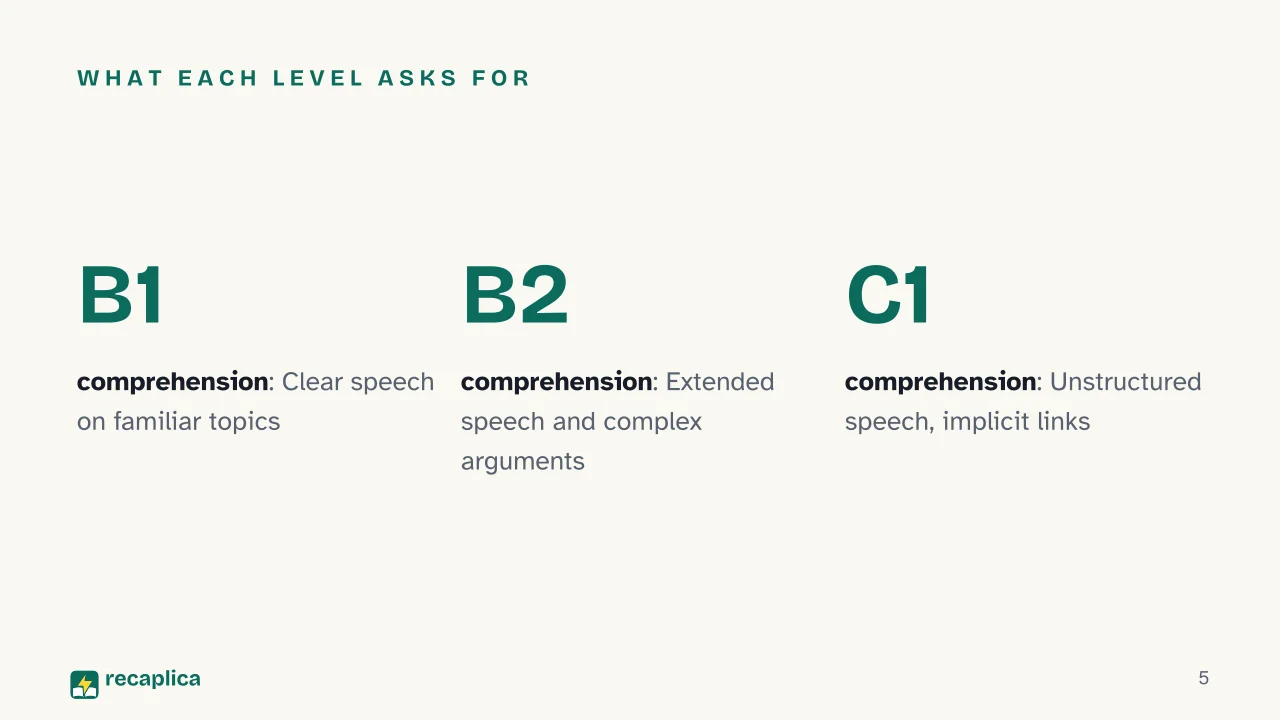 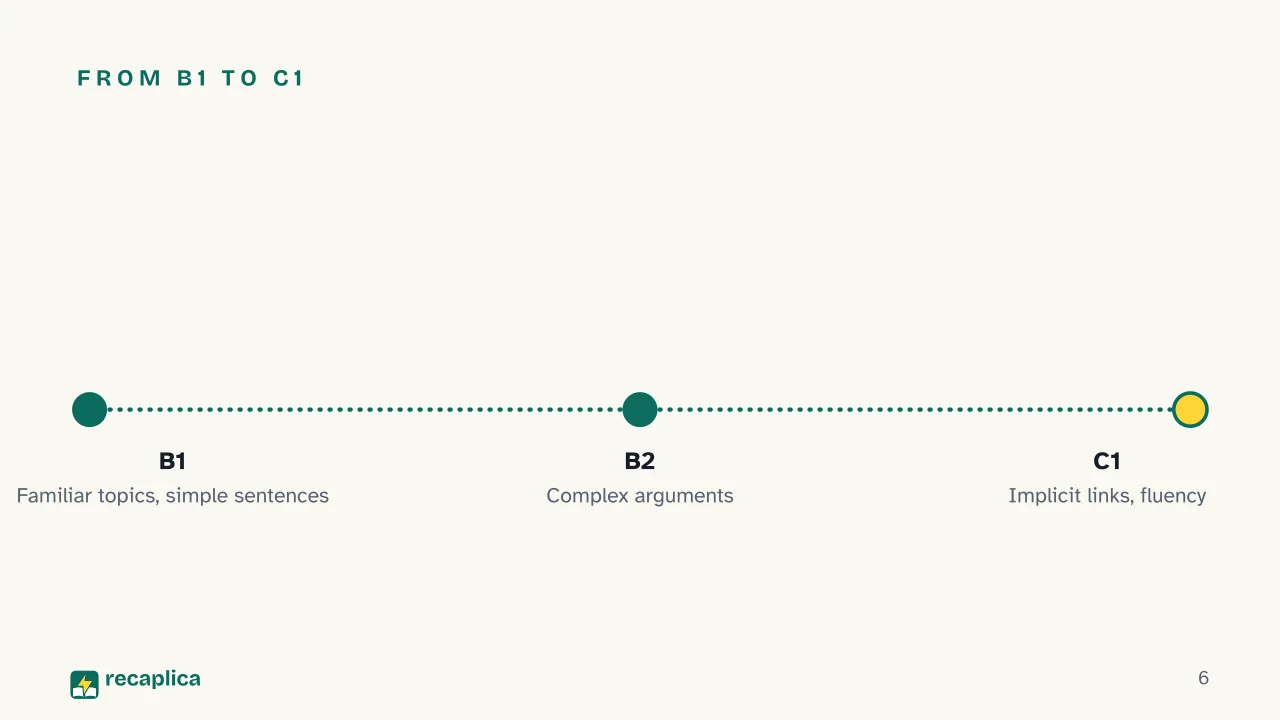  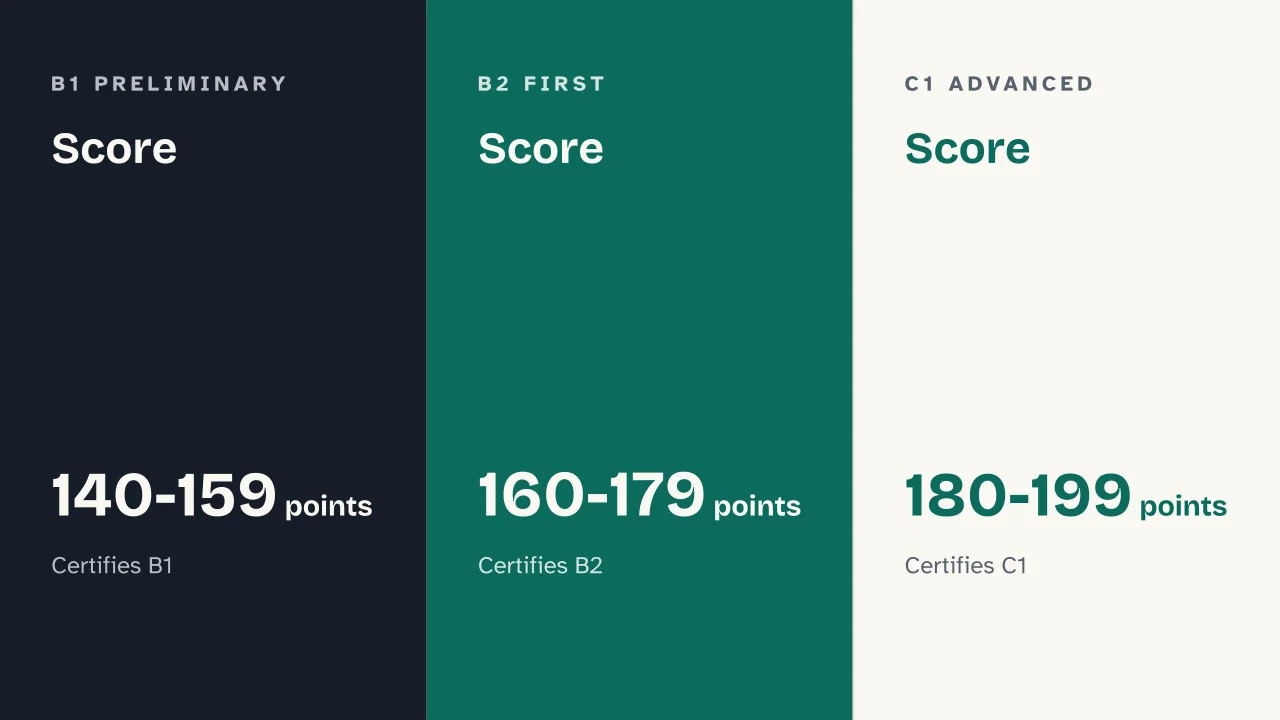 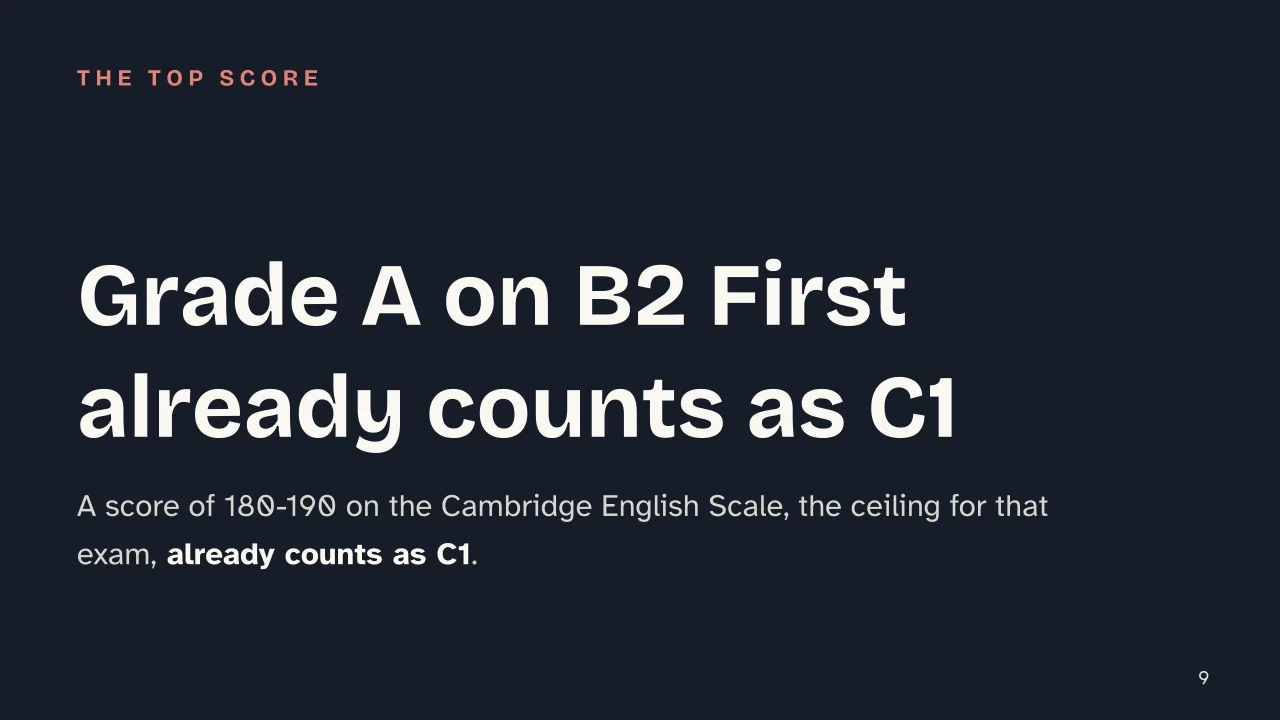  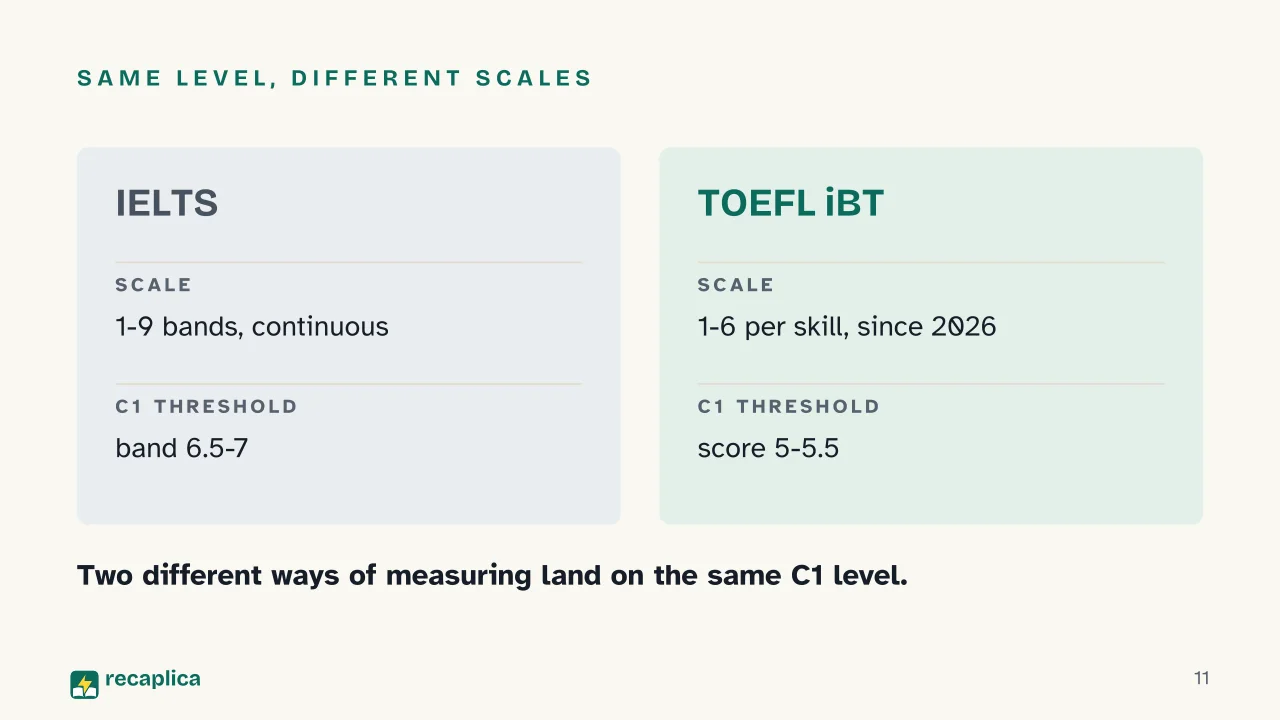    Common myths
Mind mapDrag the background to move around and the nodes to reposition them; use − and + to collapse and expand branches. 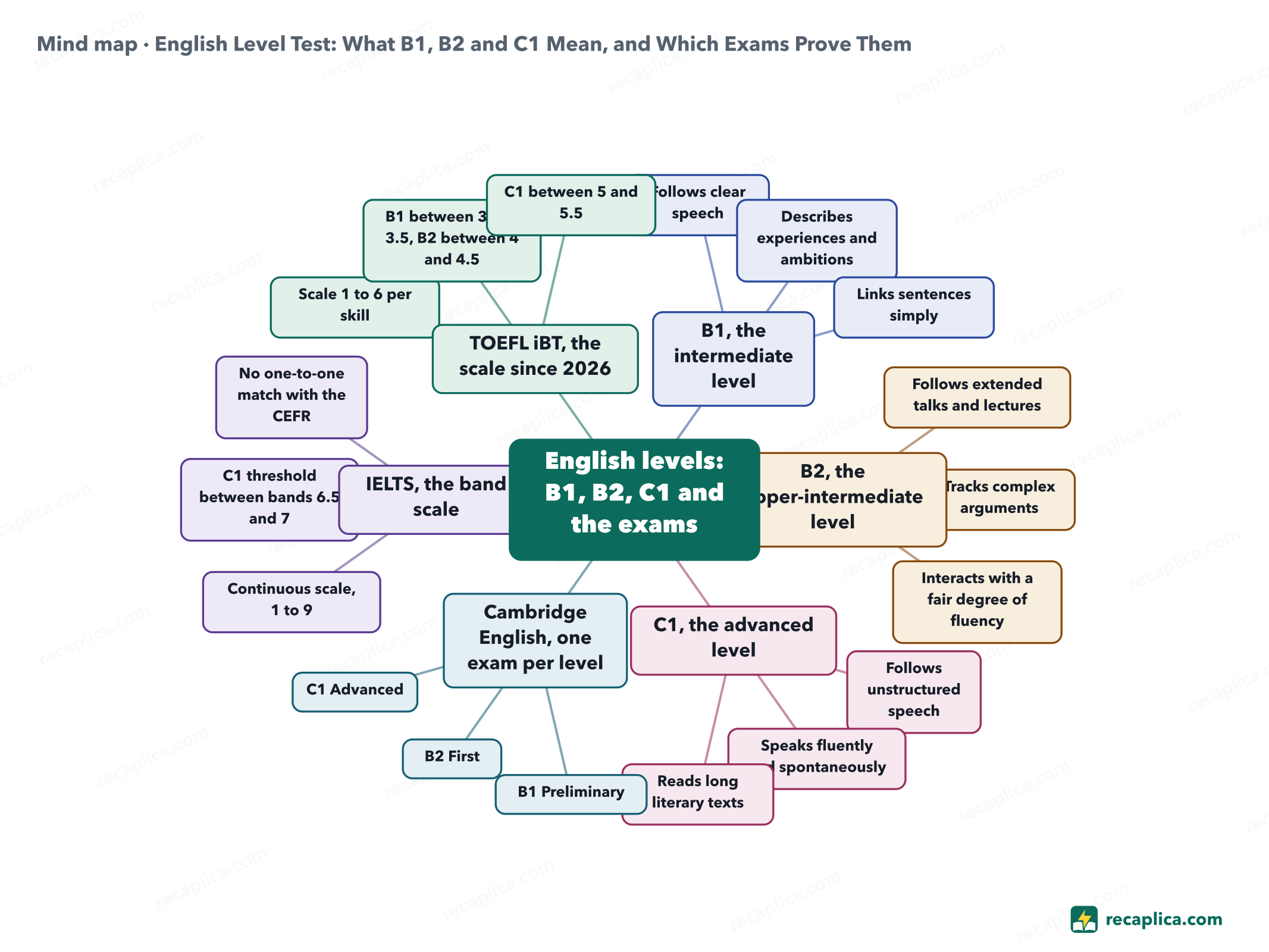
Quiz: test yourselfAnswer the questions to check what you have learned: you get instant feedback and a short explanation. Grade 0/10 0/5
FlashcardsTap the card to flip it and check whether you remember the answer, then move to the next one. 1 / 7 Explain it in your own wordsThe ultimate test: if you can explain it in simple words, you've truly understood it. Write your explanation, then compare it with the Recap. Your explanation is saved only on this device.
Frequently asked questionsWhich certification proves a B1 English level?Cambridge English B1 Preliminary is built specifically for B1, with a score of 140-159 on the Cambridge English Scale. IELTS and TOEFL iBT cover B1 too, each on its own scale: on the TOEFL iBT, since January 2026, B1 sits at a score of 3-3.5 per skill. How does an english level test recognised by schools and employers work?The most widely recognised English level tests are the Cambridge English exams, IELTS and TOEFL iBT: they assess reading, listening, writing and speaking, and return a score that maps onto a CEFR level, from B1 to C1 and beyond. What is the difference between a b1 english test and a b2 english level test?A B1 test, such as Cambridge English B1 Preliminary, checks whether you can follow clear speech on familiar topics and describe experiences in simple sentences. A B2 test, such as B2 First, raises the bar to extended speech and even complex arguments, still on familiar subjects. Which certification proves a c1 english level?Cambridge English C1 Advanced is the exam built for C1 (score 180-199 on the Cambridge English Scale). On IELTS the C1 threshold falls between bands 6.5 and 7; on the TOEFL iBT, since January 2026, a score of 5-5.5 in a single skill counts as C1 for that skill. What does having a B2 English level mean in practice?It means following extended speech and lectures even when the argument is complex, as long as the topic is reasonably familiar, and holding a conversation with a native speaker with a fair degree of fluency and spontaneity. Every Recap goes through an independent review before publication. |