Skip to content
recaplica

    One moment: security check

    Cloudflare wants to make sure you're not a robot. Tick the box below and your search will continue on its own.

    IT
    recaplica CEFR Levels Explained: What A1 to C2 Mean
    © 2026 Recaplica · recaplica.com — All rights reserved
    Home › Literature

    CEFR Levels Explained: What A1 to C2 Mean

    By Recaplica Newsroom · Updated on October 7, 2026

    What to print

    Page numbers appear when printing with default margins.

    Slides

    Choose a cut

    Flash10 slidesThe essential thread, to present in classFull15 slidesEvery chapter and the deeper detail

    Both come with speaker notes.

    Telegram channel
    recaplica Clear in 30 seconds, yours in 10 minutes.
    In 30 seconds Key points Figures Deep dive Slides Myths Mind map Quiz Flashcards FAQ

    In 30 seconds quick read

    The CEFR, the Common European Framework of Reference for Languages, is a six-level scale that runs from A1 to C2 and shows how far someone has come with a foreign language. The levels sit inside three wider bands, A, B and C, each split into two steps that mark a jump in independence. The framework does not hand out one overall score: it covers five separate language skills, from listening to writing. Its main job is letting people compare certificates issued for different languages on the same scale, while the quality of any single exam is checked separately, by bodies such as ALTE.

    Key Points

    • The CEFR is a shared six-level scale, from A1 to C2, used across Europe to describe how well someone uses a language.
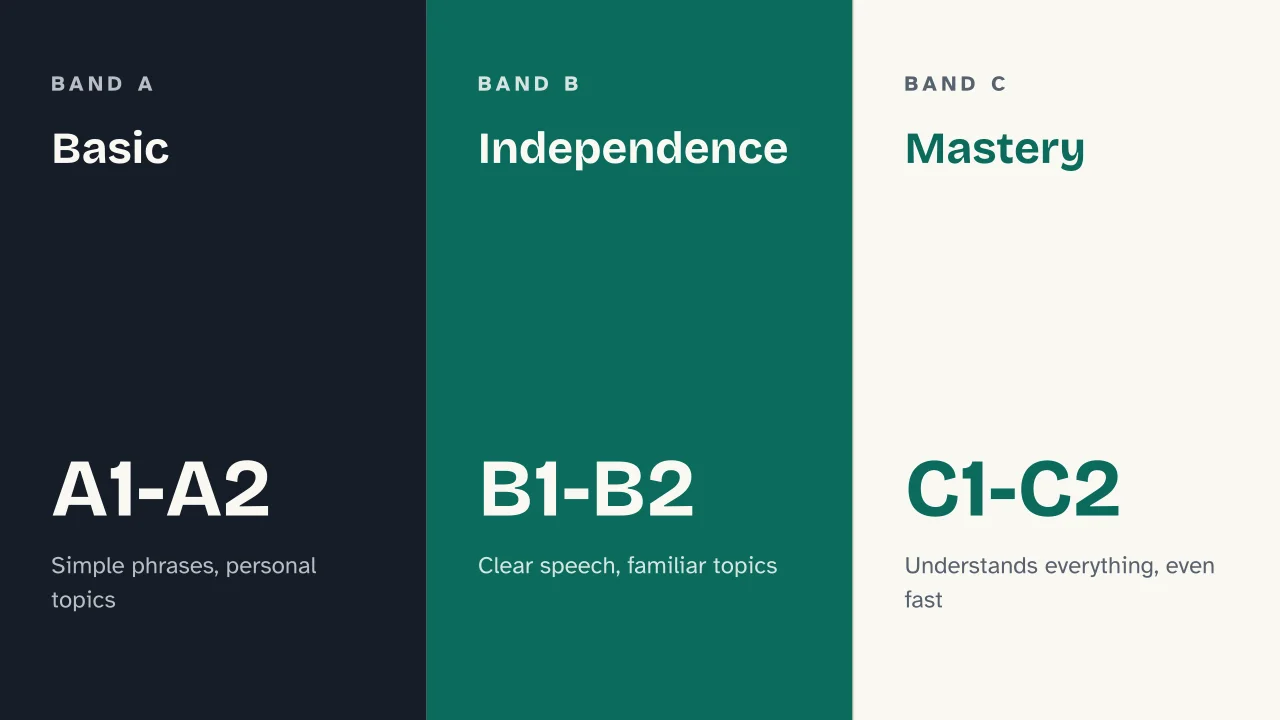
    • The levels sit in three bands: A for the basics, B for independence, C for mastery, each split into two steps.
    • The framework scores five separate language skills, listening being just one of them, each at its own level.
    • A certificate in one language can be compared with a certificate in another because both sit on the same scale.
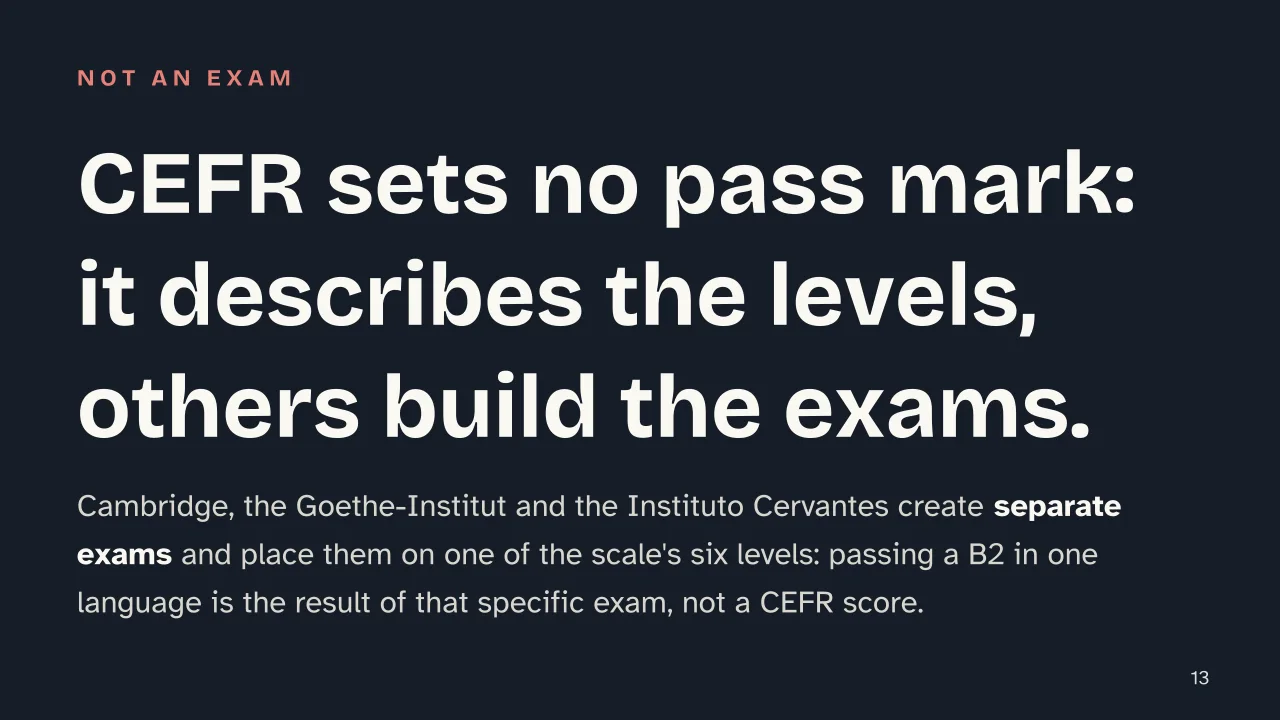
    • Every certifying body, such as Cambridge or the Goethe-Institut, designs its own exam and places it on one of the CEFR's levels.
    • Associations such as ALTE check the quality of member exams against shared standards.

    Key figures

    • A1-C2 CEFR measures language competence on a six-level scale, from A1 to C2 Source: Cambridge English, page accessed in 2026
    • 35 in 2026, full member organizations of ALTE, the European association of language testers, represent 26 European languages among them Source: ALTE, page accessed in 2026

    Deep Dive

    What the CEFR Is

    The CEFR, the Common European Framework of Reference for Languages, is an international standard that describes how well a person can use a foreign or second language. According to Cambridge English, the framework runs on a six-point scale, from A1, the level for beginners, to C2, full command of the language. Cambridge English points readers to the Council of Europe’s website for its origin; the scale itself stays identical whatever language a learner is studying.

    The same scale applies to English, German, Mandarin or Arabic: a B1 in French and an A2 in Japanese mean the same thing anywhere in Europe.

    Six Levels, Three Bands

    The six levels sit inside three wider bands: A for the basics, B for independence, C for mastery. Each band then splits into two steps, the first less developed than the second: A1 and A2, B1 and B2, C1 and C2.

    LevelBandIn listening, a person can…
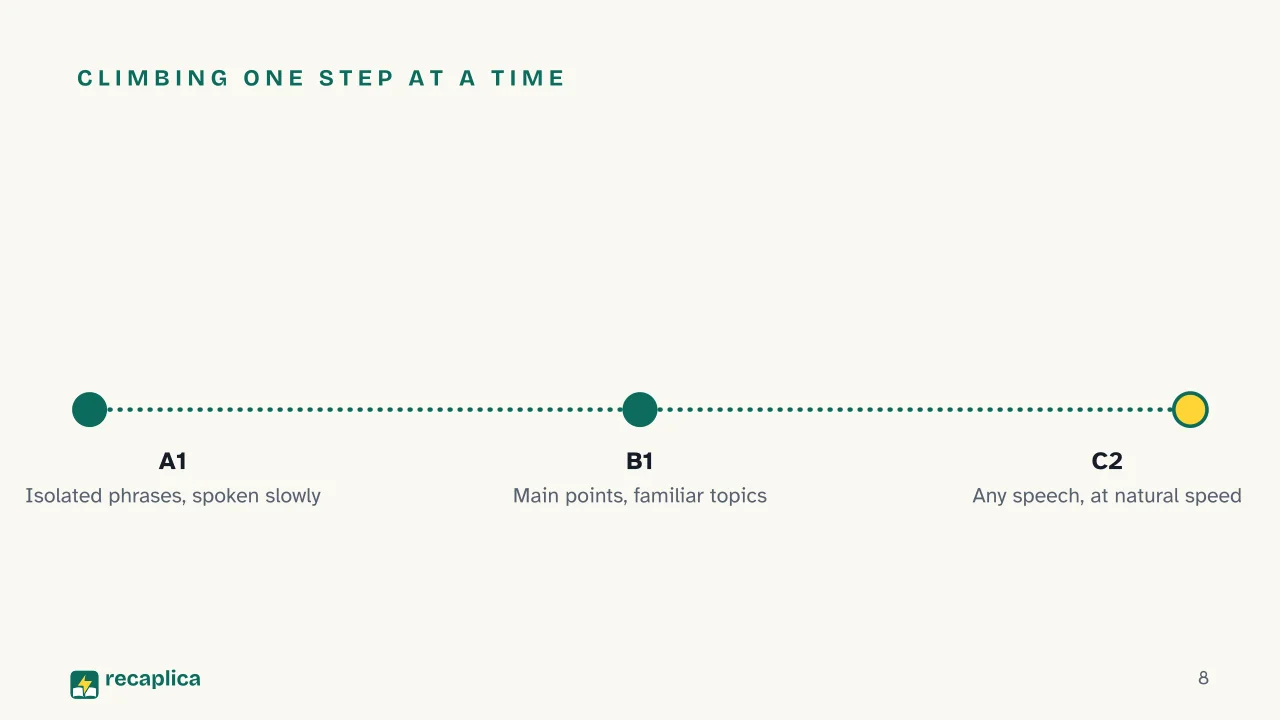
    A1Basicrecognize very simple words and phrases, spoken slowly and clearly
    A2Basicunderstand frequent phrases and expressions about matters that concern them directly
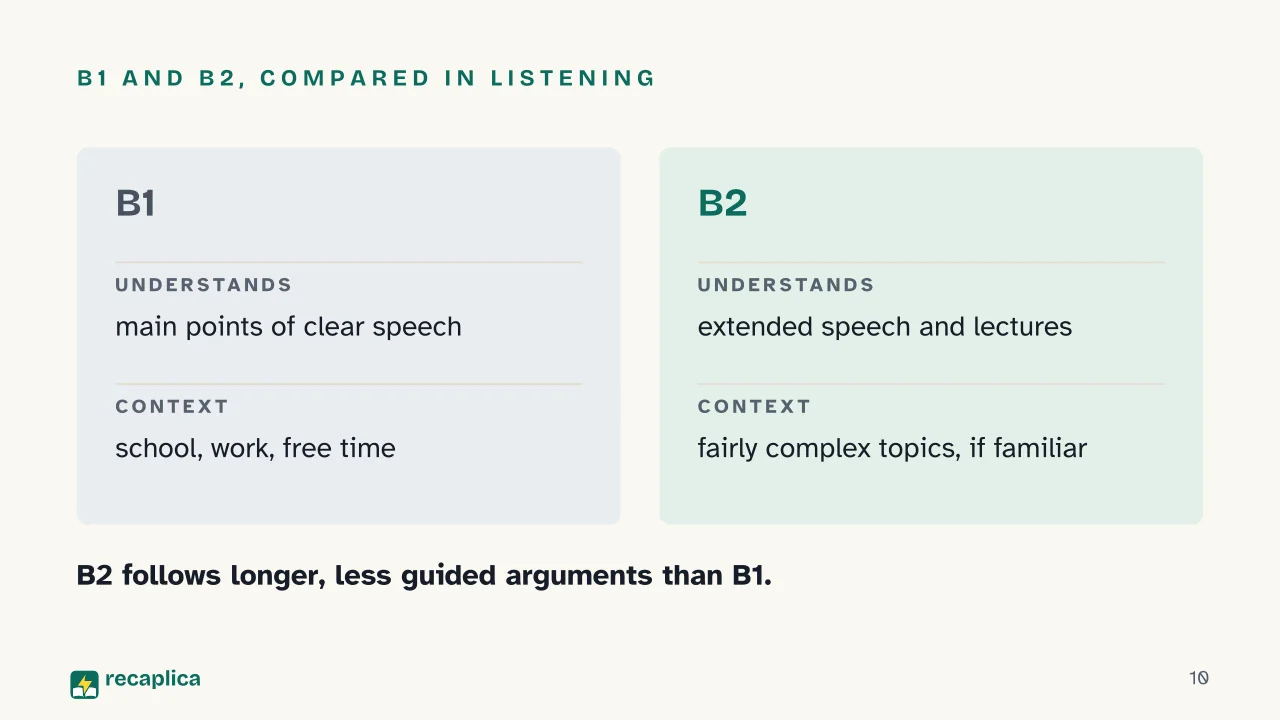
    B1Independencefollow the main points of clear speech on familiar topics, such as school or work
    B2Independencefollow extended speech and fairly complex arguments, on fairly familiar topics
    C1Masteryfollow extended speech even when it is not explicitly signaled
    C2Masteryunderstand any spoken language, even at natural speed

    These descriptors, drawn by Europass from the official CEFR text, cover only one of the skills the framework assesses, listening, used here as the example: the CEFR also looks at reading, speaking and writing, following the same six-step logic, though this Recap’s sources did not verify descriptors for those three, so they are not listed one by one here.

    Practical example: someone who follows a podcast in standard English and grasps the general sense, even while missing a few details, sits roughly at B1 in listening; someone who follows a conversation between native speakers with barely any effort to concentrate is already beyond that, closer to C1 or C2.

    A Common Yardstick for Certificates

    According to Cambridge English, having a shared scale makes it easy for teachers and students to compare the level of different language certificates; the same scale also lets employers and schools read a foreign diploma against their own grading system, with no translation needed. A B2 in English and a B2 in Spanish promise, on paper, the same independence, even though the exams that award them remain different from one another. English certificates, from the simplest level to the most advanced, have a detail worth exploring on their own; what matters here is the general principle, since it holds just as well for German, French or any other language being certified.

    Who Checks Exam Quality

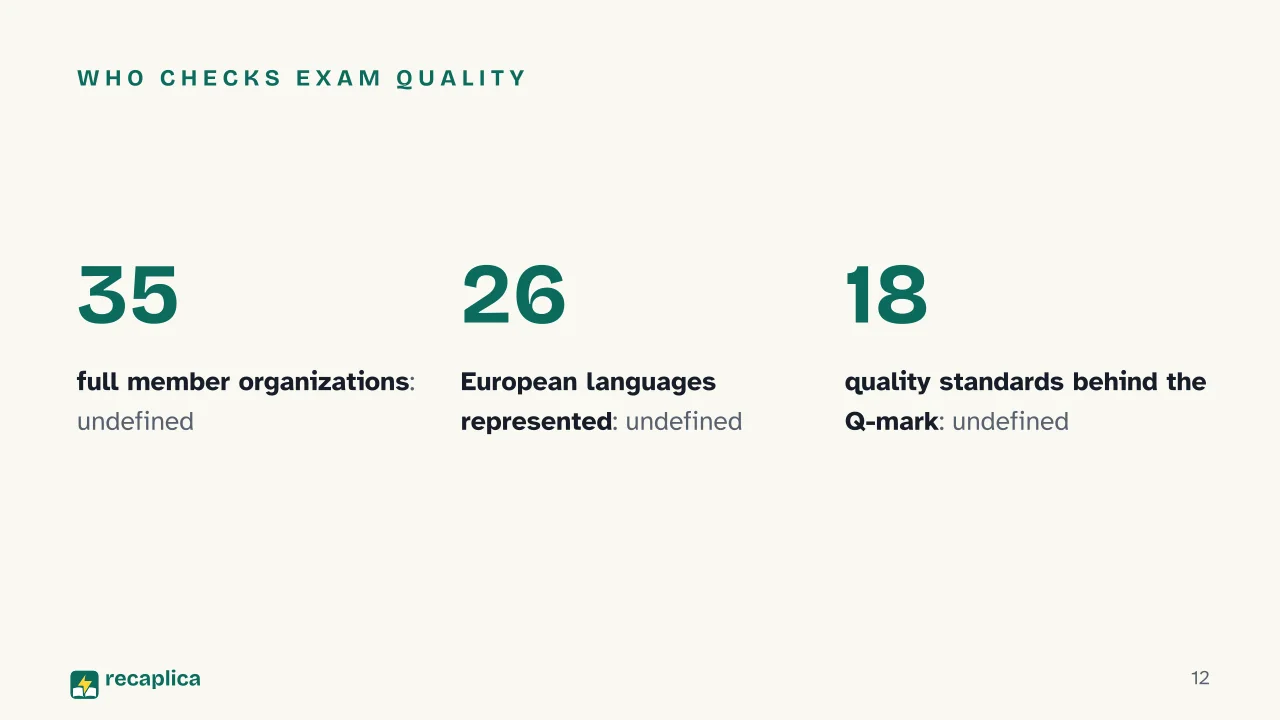
    Exams that measure these levels are run by certifying bodies, each with its own test. According to ALTE, the European association of language testers set up in 1989 by Cambridge together with Spain’s Universidad de Salamanca, in 2026 it counted 35 organizations as full members, representing 26 European languages between them, plus more than 120 associate members.

    ALTE has set 18 quality standards covering every stage of building an exam, from writing the questions to marking them. The Q-mark certifies that a test meets all of them, after an audit. Not every exam that cites the CEFR carries this mark: a stated level and an audited exam remain two separate guarantees.

    Anyone still working out how to organize study time to climb a level can start from an effective study method, useful well beyond languages, to tackle each of the CEFR’s six steps with more structure.

    Slide deck

    Slides ready to download and make your own in PowerPoint or Google Slides, with speaker notes. Pick the Flash cut or the Full one.
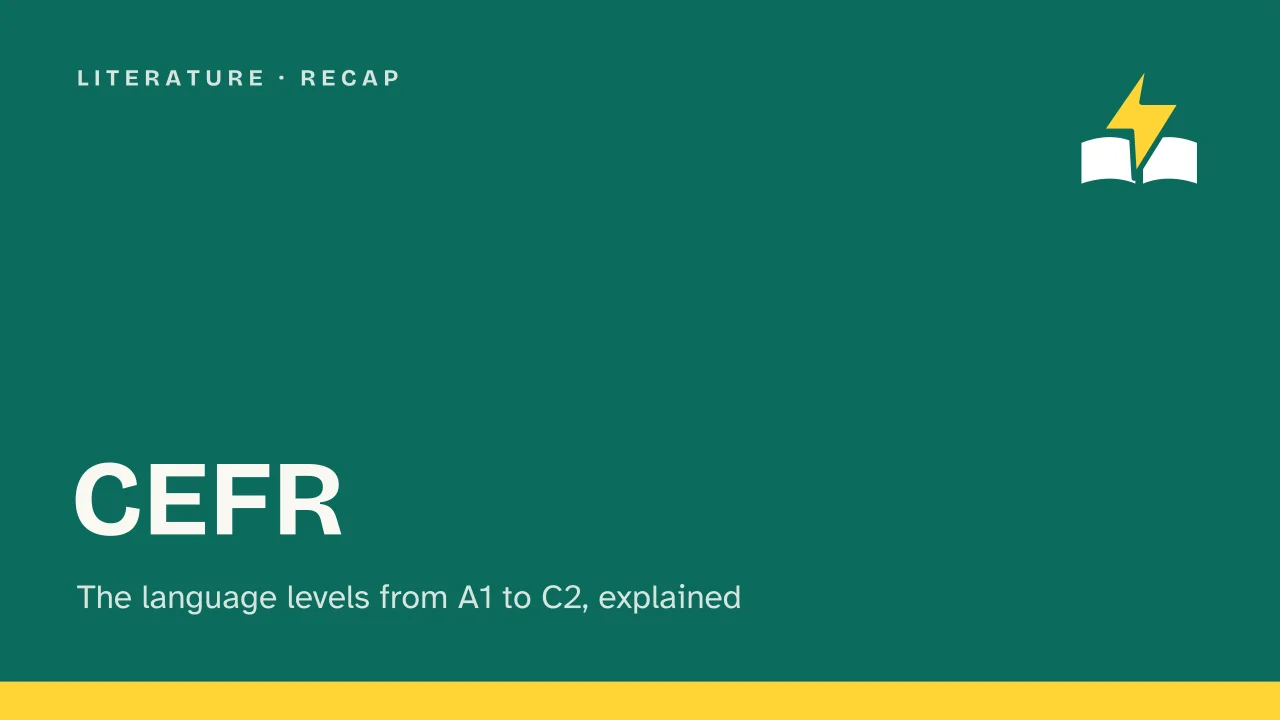
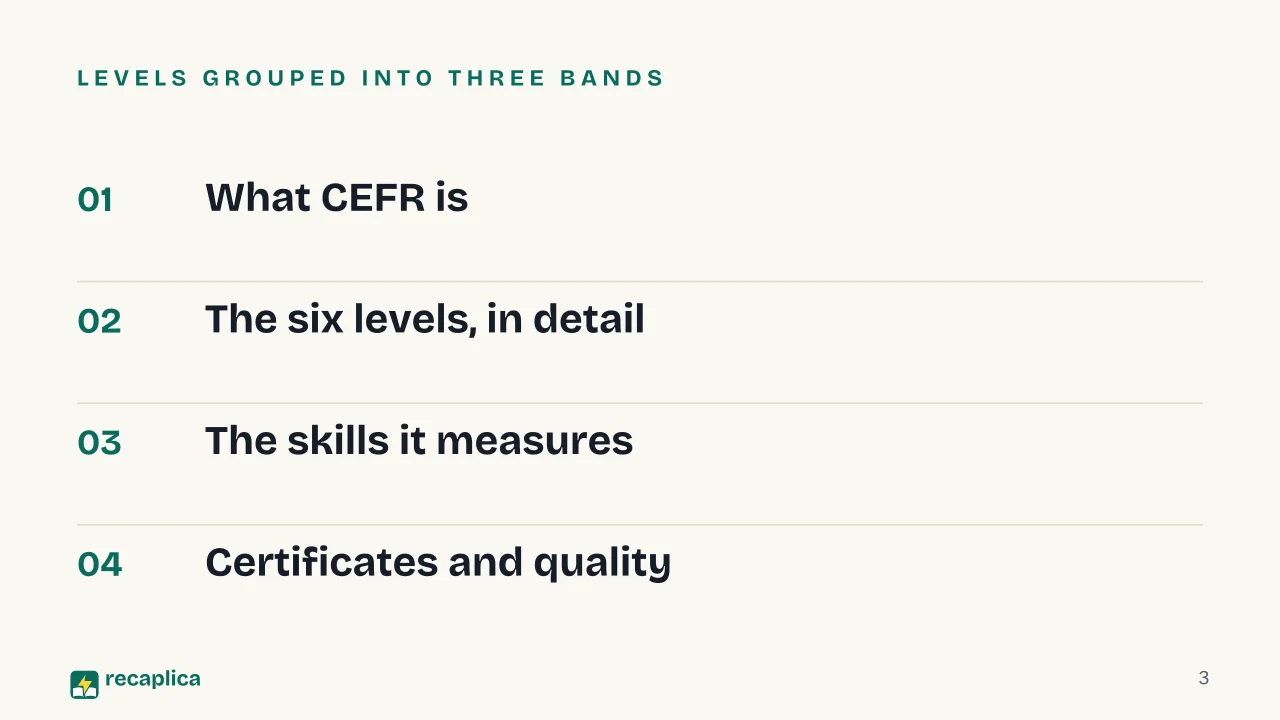
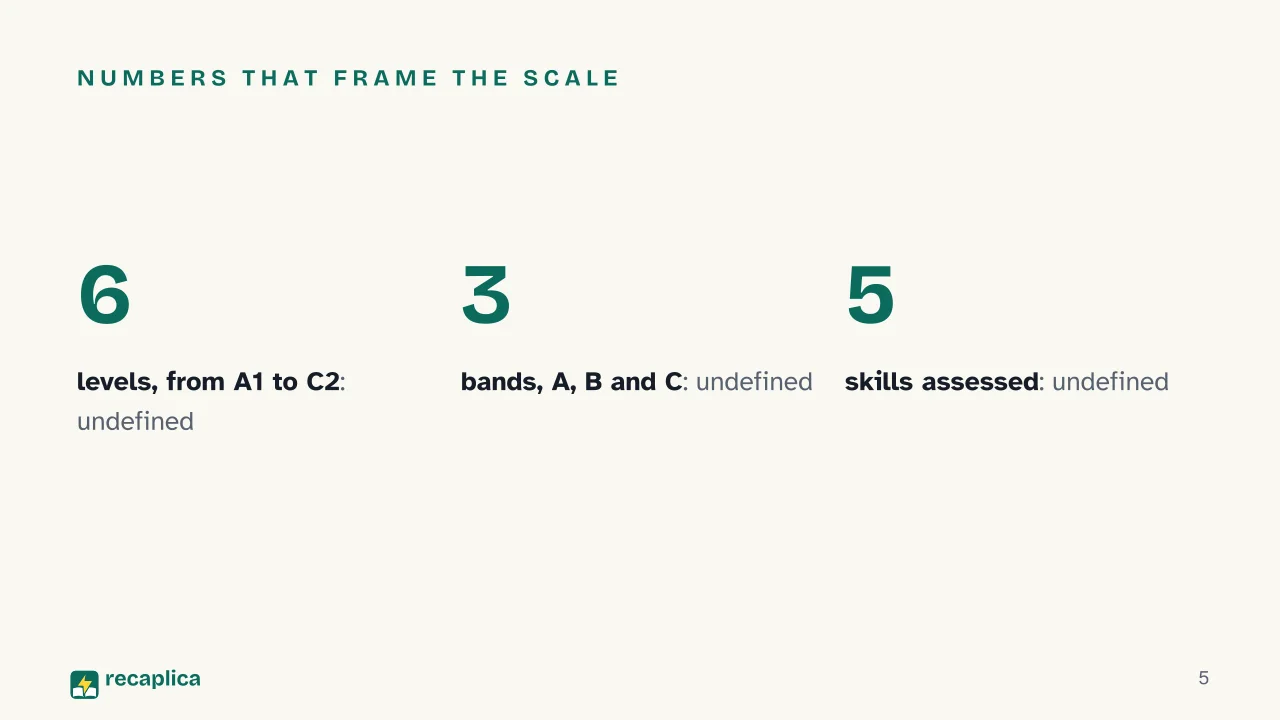
    Slide 1 of the presentation on CEFR Levels Explained: CEFRSlide 2 of the presentation on CEFR Levels Explained: How well do you speak a language, measured with the same yardstick across Europe?Slide 3 of the presentation on CEFR Levels Explained: Levels grouped into three bandsSlide 4 of the presentation on CEFR Levels Explained: Chapter 01: What CEFR isSlide 5 of the presentation on CEFR Levels Explained: Numbers that frame the scaleSlide 6 of the presentation on CEFR Levels Explained: Basic · Independence · MasterySlide 7 of the presentation on CEFR Levels Explained: Chapter 02: The six levels, in detailSlide 8 of the presentation on CEFR Levels Explained: Climbing one step at a timeSlide 9 of the presentation on CEFR Levels Explained: Chapter 03: The skills it measuresSlide 10 of the presentation on CEFR Levels Explained: B1 and B2, compared in listeningSlide 11 of the presentation on CEFR Levels Explained: Chapter 04: Certificates and qualitySlide 12 of the presentation on CEFR Levels Explained: Who checks exam qualitySlide 13 of the presentation on CEFR Levels Explained: CEFR sets no pass mark: it describes the levels, others build the exams.Slide 14 of the presentation on CEFR Levels Explained: How many language skills does the CEFR assess?Slide 15 of the presentation on CEFR Levels Explained: Now, the recap
    Flash10 slidesThe essential thread, to present in classFull15 slidesEvery chapter and the deeper detail

    Common myths

    • ✗ Myth The CEFR is an exam you pass or fail.

      ✓ Reality The CEFR is not a test, only a reference scale. Exams such as those from Cambridge, the Goethe-Institut or the Instituto Cervantes remain separate tests, built by different bodies, which are then placed on one of the six levels.

    • ✗ Myth The CEFR measures one single overall skill in a language.

      ✓ Reality The framework assesses five distinct language skills, listening among them: a person can sit at a higher level in listening than in writing, in the very same language.

    • ✗ Myth Any exam that claims a CEFR level has the same rigor as any other.

      ✓ Reality Stating a level is not proof of quality on its own. According to ALTE, only exams that pass an audit against its 18 quality standards earn the Q-mark.

    Mind map

    Drag the background to move around and the nodes to reposition them; use − and + to collapse and expand branches.
    Customize
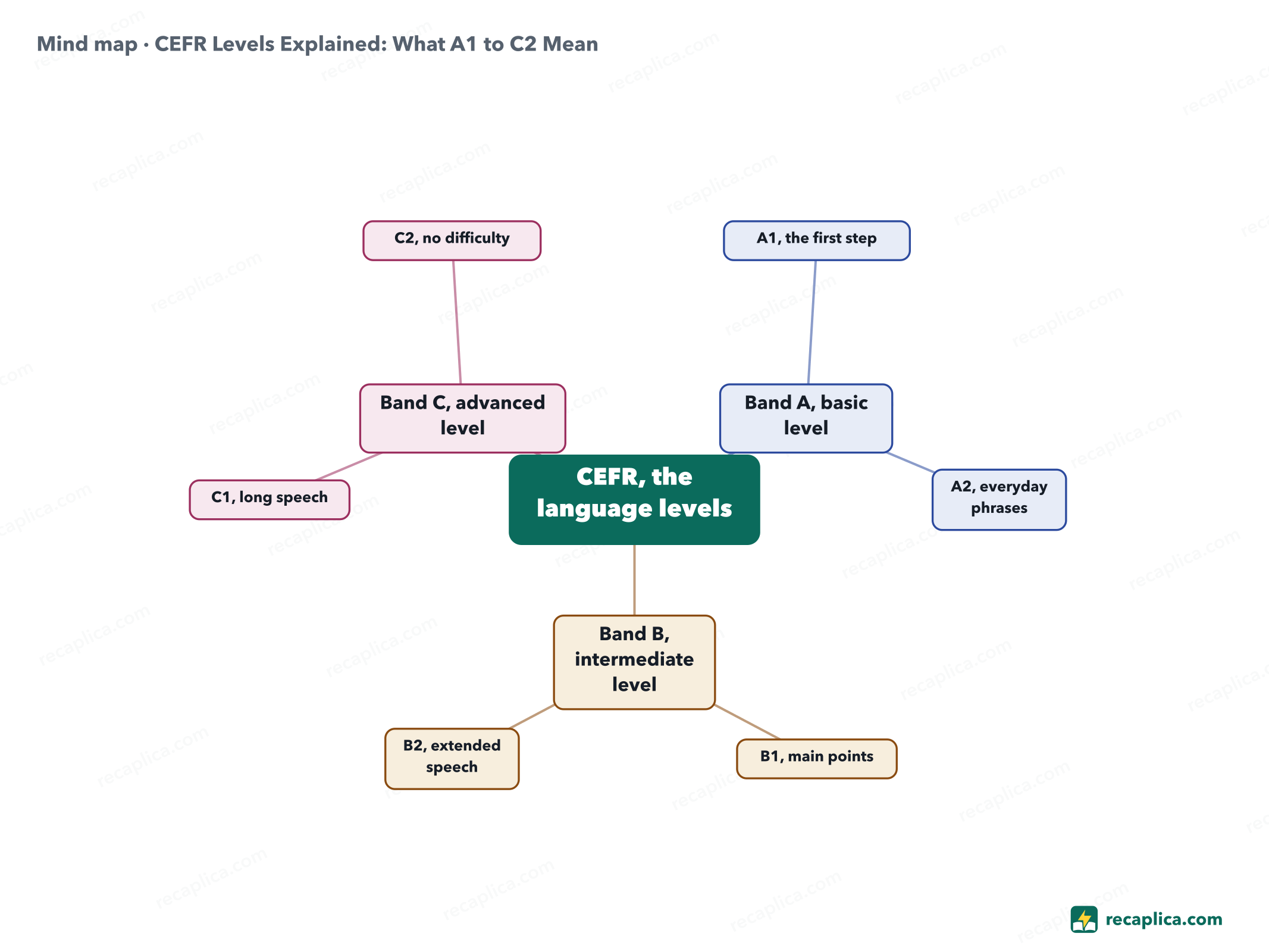
    Mind map: CEFR Levels Explained: What A1 to C2 Mean
    • CEFR, the language levels
      • Band A, basic level Essential communication, simple phrases
        • A1, the first step Recognizes very simple words and phrases, spoken slowly
        • A2, everyday phrases Understands frequent expressions about personal topics
      • Band B, intermediate level Growing independence in using the language
        • B1, main points Follows clear speech on familiar topics, school or work
        • B2, extended speech Follows fairly complex arguments, if the topic is familiar
      • Band C, advanced level Full command of the language
        • C1, long speech Follows a long speech even when links are not explicit
        • C2, no difficulty Understands any spoken language, even at natural speed

    Quiz: test yourself

    Answer the questions to check what you have learned: you get instant feedback and a short explanation.

    Grade 0/10 0/5
    1 How many levels does the CEFR scale have?

    The CEFR describes language competence with six levels, grouped into bands A, B and C.

    2 True or false: the CEFR is an exam you pass or fail.

    False: the CEFR is a reference scale. Exams that certify a level are built by separate bodies, such as Cambridge or the Goethe-Institut.

    3 How many language skills does the CEFR assess?

    The framework assesses five distinct language skills, one of them listening, each with its own path through the six levels.

    4 According to the official descriptors, a B2 listener can...

    B2 follows extended speech and lectures on fairly familiar subjects; understanding any speech at natural speed is instead the C2 target.

    5 What does ALTE's Q-mark indicate?

    The Q-mark certifies the quality of an exam's process, not the language level of whoever takes it.

    Answers: 1-A · 2-B · 3-B · 4-B · 5-B

    Flashcards

    Tap the card to flip it and check whether you remember the answer, then move to the next one.

    1 / 8

    Explain it in your own words

    The ultimate test: if you can explain it in simple words, you've truly understood it. Write your explanation, then compare it with the Recap.

    Your explanation is saved only on this device.

    The CEFR, the Common European Framework of Reference for Languages, is a six-level scale that runs from A1 to C2 and shows how far someone has come with a foreign language. The levels sit inside three wider bands, A, B and C, each split into two steps that mark a jump in independence. The framework does not hand out one overall score: it covers five separate language skills, from listening to writing. Its main job is letting people compare certificates issued for different languages on the same scale, while the quality of any single exam is checked separately, by bodies such as ALTE.

    Frequently asked questions

    What does CEFR stand for?

    CEFR stands for Common European Framework of Reference for Languages (bodies that use it point to the Council of Europe for its origin): it describes language competence on a six-level scale, from A1 to C2.

    What is the difference between A2 and B1?

    In listening, A2 understands frequent phrases and expressions about topics that directly concern the person; B1 goes further and follows the main points of clear speech on familiar topics met at school, at work or in free time.

    Does the CEFR apply to English certificates too?

    Yes: English certificates, like those for other languages, sit on one of the CEFR's six levels, so they can be compared with exams in other languages. Which certificates prove each level, with the score thresholds for Cambridge English, IELTS and TOEFL, is covered in [a Recap of its own](/en/literature/english-level-test-certifications/).

    What is the highest CEFR level?

    It is C2, the step at the top of the advanced band: whoever reaches it has no difficulty understanding any spoken language, even at natural speed.

    Who created the CEFR?

    Bodies that use the CEFR, such as Cambridge English, point to the Council of Europe for its origin: the framework is tied to that organization, though here the focus is on how it works, not its institutional history.

    Sources

    • Common European Framework of Reference for Language Skills | Europass
    • CEFR levels and criteria | Cambridge English
    • About ALTE | Association of Language Testers in Europe

    Every Recap goes through an independent review before publication.

    Every evening, the day's new Recaps on our Telegram channel. Join the channel →

    Keep learning

    • Literature Best Dark Romance Books: A List for Every Subgenre A selection of dark romance books sorted by subgenre, for readers who already know what the genre is and just want a place to start. Dark mafia romance books cover forced marriages and warring crime families, as in Ruthless People and Killing Sarai. Dark fantasy romance books and paranormal romance move the same pull between desire and threat into worlds with gods, vampires and power struggles. Dark academia romance sets it among visions and fairy tales, while spicy dark romance books and stalker romance push the premise to the edge of real obsession. Read the Recap →
    • Literature Best Stephen King Books: 10 Novels and the Case for Each One Stephen King has written novels across several genres, from Carrie in 1974 to The Institute in 2019, and Wikipedia credits his books with more than 400 million copies sold overall. This list lines up ten titles that come up often in recommendations, with a reason for each pick, from horror staples like It and The Shining to novels that step outside the genre, such as 11/22/63 and The Green Mile. Every book comes with its publication year, its publisher and, where one exists, the award it won or was nominated for. There's no single agreed ranking: Hans-Åke Lilja, interviewed by Five Books as someone who has followed King's career for over 40 years, leaves well-known titles such as Carrie and The Shining out of his own personal picks. Read the Recap →
    • Literature Horror Story Ideas: Everyday Details, Old Fears and a Twist That Lands Writing a horror story often starts with a blank page more uncomfortable than the story itself. This Recap collects starting situations, recurring fears and ways to build a twist, with concrete examples to work from. It doesn't cover the techniques that build tension on the page — those live in the parent Recap on how to write a horror story. The sturdiest ideas tend to start with an everyday detail that stops behaving the way it should, or an old fear dressed in a setting readers recognize. Read the Recap →

    recaplica

    Clear in 30 seconds, yours in 10 minutes.

    Recaps Mind maps Request a Recap Telegram channel Mind map maker Our method About Privacy & cookies Legal notes & terms of use

    © 2026 Recaplica · A project by Curi S.r.l. — VAT IT05472000750

    Statistics, only if you say so

    To learn which Recaps help most we would use Google Analytics, with aggregate, anonymous data. It starts only with your OK, and you can change your mind anytime. Privacy policy