Skip to content
recaplica

    One moment: security check

    Cloudflare wants to make sure you're not a robot. Tick the box below and your search will continue on its own.

    IT
    recaplica 9/11: What Happened on September 11, 2001, and What Changed After
    © 2026 Recaplica · recaplica.com — All rights reserved
    Home › History

    9/11: What Happened on September 11, 2001, and What Changed After

    By Recaplica Newsroom · Updated on September 7, 2026

    What to print

    Page numbers appear when printing with default margins.

    Slides

    Choose a cut

    Flash10 slidesThe essential thread, to present in classFull18 slidesEvery chapter and the deeper detail

    Both come with speaker notes.

    Telegram channel
    recaplica Clear in 30 seconds, yours in 10 minutes.
    In 30 seconds Key points Figures Deep dive Slides Myths Mind map Quiz Flashcards FAQ

    In 30 seconds quick read

    On September 11, 2001, nineteen men tied to the Islamist group al-Qaeda hijacked four passenger jets in the United States. Two planes hit the Twin Towers of the World Trade Center in New York, which collapsed within an hour and 42 minutes of the first impact; a third struck the Pentagon, just outside Washington; the fourth crashed in a Pennsylvania field after passengers tried to retake the cockpit. In total, 2,977 people died, most of them in New York. Within hours the United States closed its entire national airspace for the first time in its history, and over the following months and years the country changed its laws, its security apparatus and its foreign policy, from the war in Afghanistan to the PATRIOT Act.

    Key Points

    • Four passenger jets were hijacked on the morning of September 11, 2001 by nineteen al-Qaeda operatives: American Airlines 11 and United Airlines 175 struck the two towers of the World Trade Center, American Airlines 77 hit the Pentagon, and United Airlines 93 crashed in a field near Shanksville, Pennsylvania, after passengers fought back.
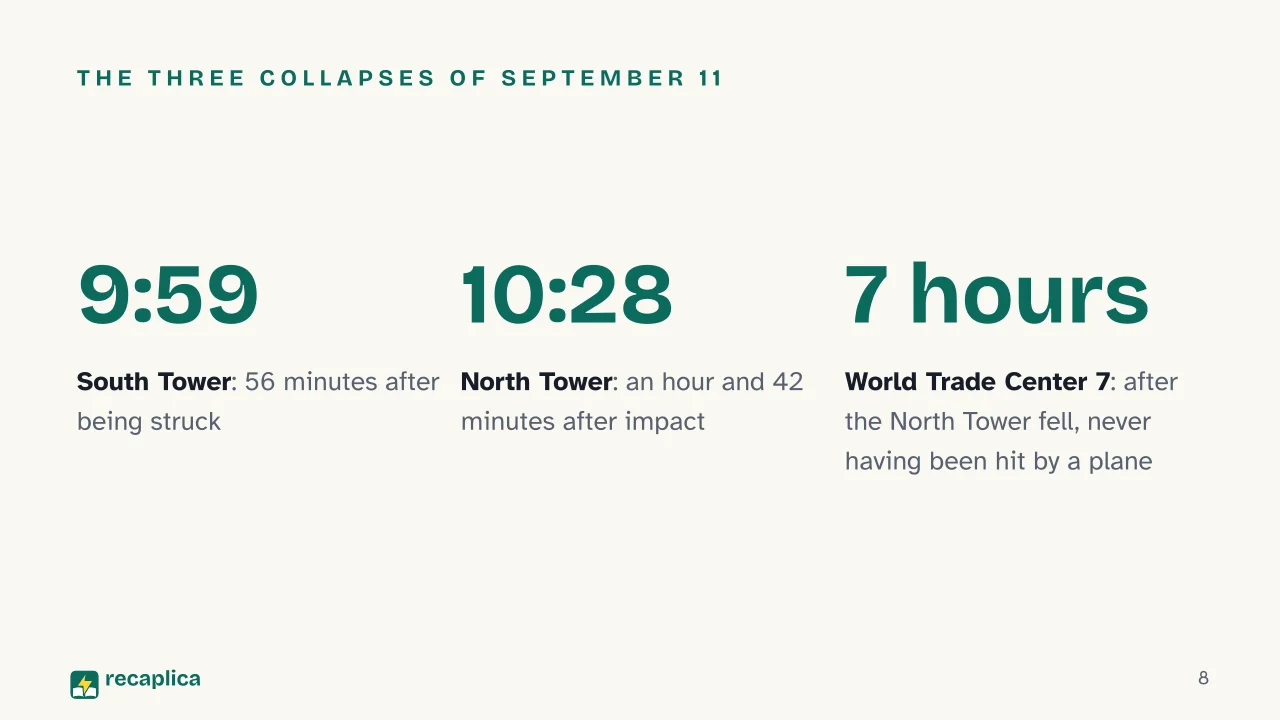
    • The South Tower fell at 9:59 a.m., 56 minutes after being hit; the North Tower at 10:28 a.m., an hour and 42 minutes after impact. Seven hours later, at 5:20:52 p.m., World Trade Center 7 also collapsed, despite never having been struck by a plane — it burned from debris thrown off by the North Tower's fall.
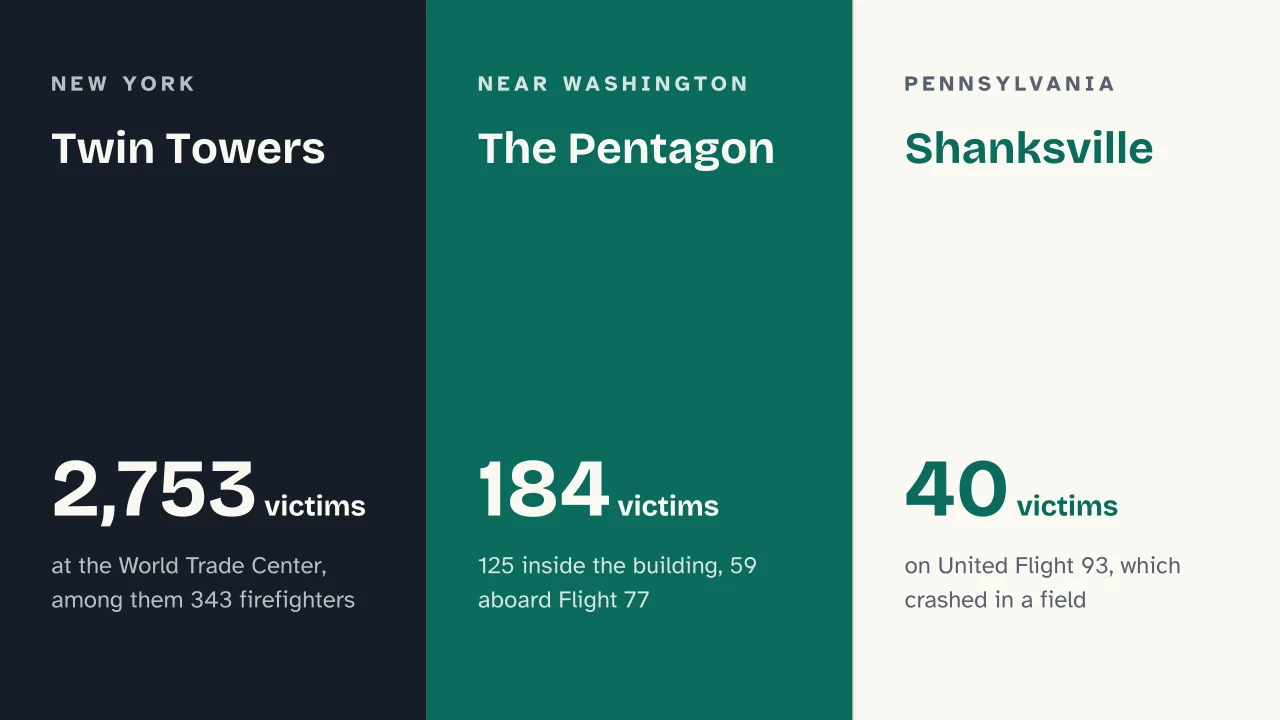
    • The death toll was 2,977, from 90 countries: 2,753 in New York, 184 at the Pentagon, 40 on United 93; among the World Trade Center victims were 343 firefighters.
    • At 9:45 a.m. the FAA grounded the entire United States airspace, the first time that had ever happened in the country's history; commercial flights resumed gradually two days later, on September 13, 2001.
    • In the years that followed, the United States launched the war in Afghanistan (from October 7, 2001), passed the PATRIOT Act (October 26, 2001) and created the Department of Homeland Security (November 25, 2002); Osama bin Laden, identified by investigators as the attacks' mastermind, was killed on May 2, 2011.
    • The bipartisan 9/11 Commission's report, released on July 22, 2004, attributed the attacks to a combination of failures — of imagination, policy, capabilities and management — across the security agencies, not to any single cause.

    Key figures

    • 2,977 the total number of victims of the attacks, from 90 different countries Source: National September 11 Memorial & Museum
    • 19 the al-Qaeda hijackers aboard the four planes, fifteen of them Saudi nationals, two from the United Arab Emirates, one from Egypt and one from Lebanon Source: 9/11 Commission, Staff Statement No. 1
    • 7 hours the time between the collapse of the North Tower and that of World Trade Center 7, which was never hit by a plane but burned from the debris Source: NIST, technical investigation of WTC 7

    Deep Dive

    A September morning

    At 8:46 a.m. on Tuesday, September 11, 2001, New York time, a passenger jet struck the North Tower of the World Trade Center. It was the start of a sequence of attacks planned by the Islamist group al-Qaeda: within a little over an hour, four hijacked airliners were turned into weapons against targets in the United States. Nineteen hijackers were aboard the four planes in all: fifteen Saudi nationals, two from the United Arab Emirates, one from Egypt, Mohamed Atta, and one from Lebanon, Ziad Jarrah. Atta led the operatives on the ground; the operation’s tactical planner was Khalid Sheikh Mohammed; investigators later identified Osama bin Laden, al-Qaeda’s leader, as the mastermind.

    The four flights

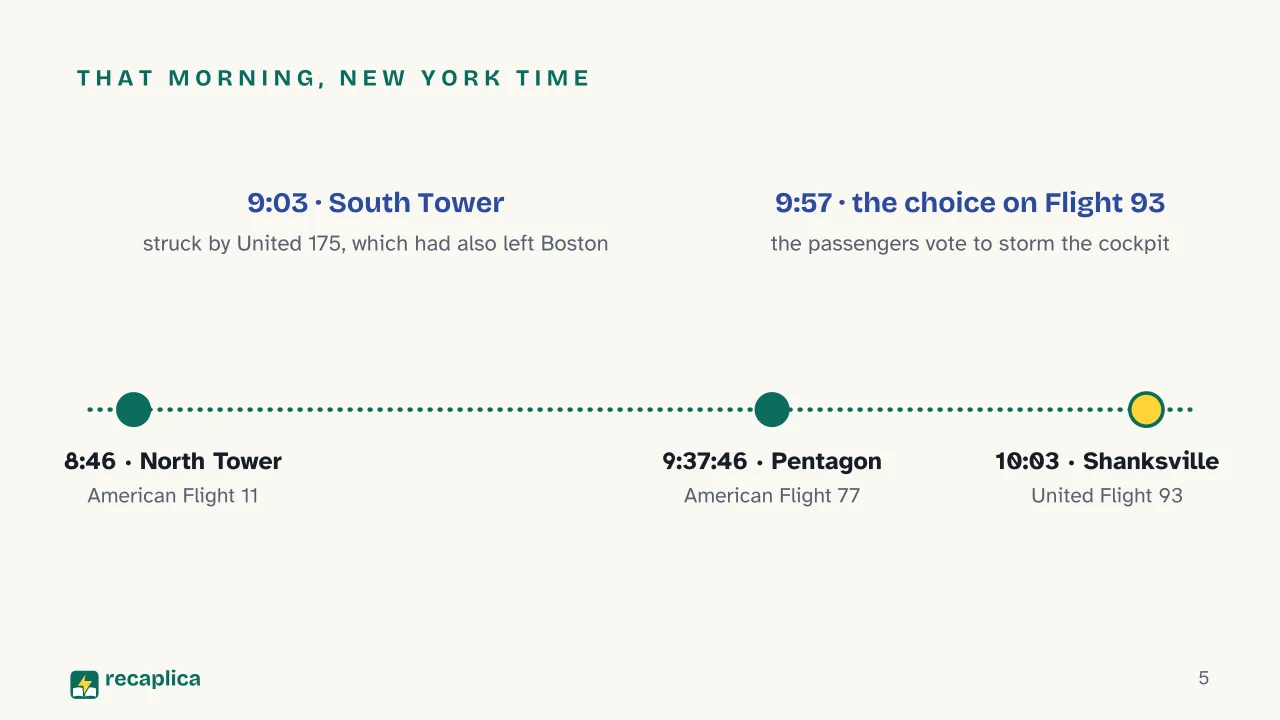
    American Airlines 11, a Boeing bound from Boston to Los Angeles, took off at 7:59 a.m. with 92 people aboard, crew and passengers combined. At 8:14 a.m. came its last routine radio contact; sixteen seconds later air traffic control asked the plane to climb and got no response. At 8:19 a.m. a flight attendant alerted the airline that a hijacking was under way. About half an hour after takeoff, at 8:46 a.m., the plane struck the North Tower of the World Trade Center between floors 93 and 99.

    United Airlines 175, a near-twin of the previous flight in route and scheduled departure time, also left Boston at 8:14 a.m. with 65 people aboard. It was hijacked around 8:42 a.m. and struck the South Tower, between floors 77 and 85, at 9:03 a.m.

    American Airlines 77 took off at 8:20 a.m. from Washington Dulles bound for Los Angeles, with 64 people aboard. Its last routine radio contact came at 8:51 a.m.; between 8:51 and 8:54 a.m., as the plane flew over eastern Kentucky, the hijackers took control. Hani Hanjour, the only one of the five hijackers with a pilot’s license, flew it toward Washington. At 9:37:46 a.m. the plane struck the Pentagon at roughly 530 miles per hour, cutting through three of the building’s five concentric rings and destroying the load-bearing capacity of about 30 columns on the first floor.

    United Airlines 93 left Newark at 8:42 a.m., about 45 minutes late because of air traffic, bound for San Francisco: 44 people aboard, four of them hijackers. Using the seatback phones and their own cellphones, some passengers learned what had happened on the other three flights. At 9:57 a.m. they voted to try to storm the cockpit. On a call with a telephone operator, passenger Todd Beamer was heard saying, “Are you ready. Okay. Let’s roll.” Facing the passengers’ attempt to break through the cockpit door, the hijackers deliberately put the plane into a dive, and it crashed in a field near Shanksville, Pennsylvania, at 10:03 a.m., at roughly 580 miles per hour. There were no survivors.

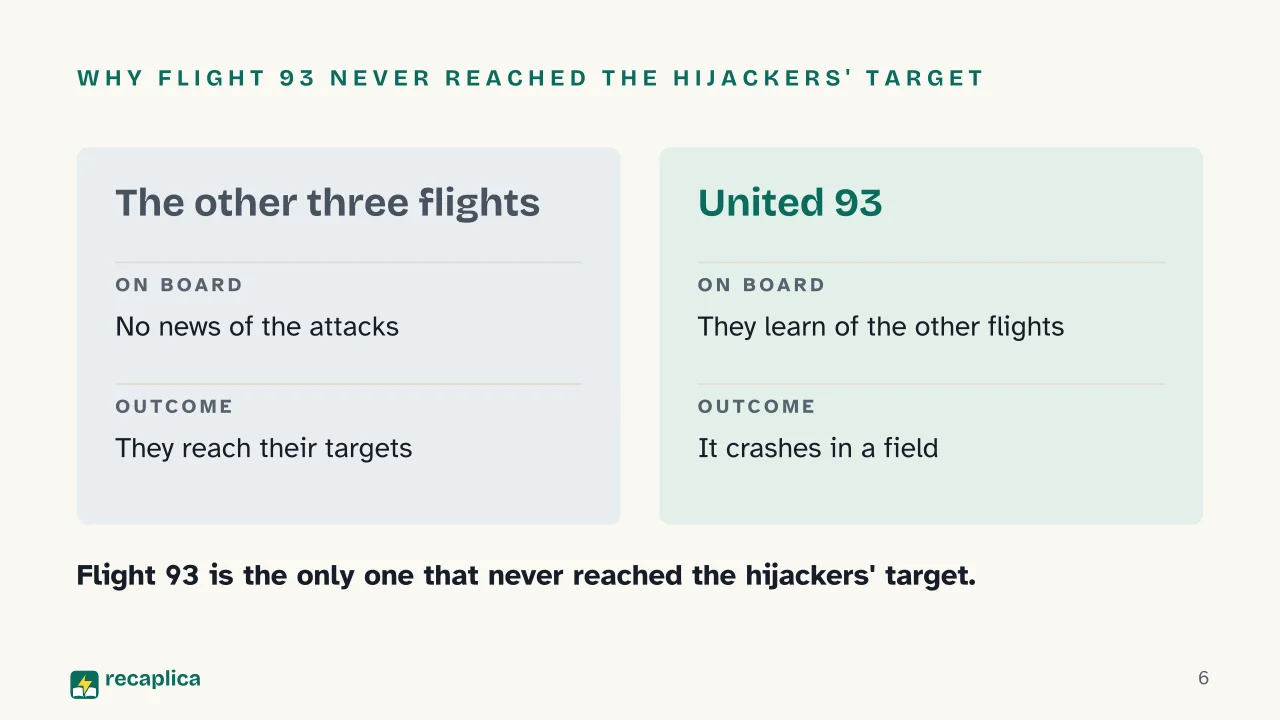
    Practical example: Flight 93 is the only one of the four that never reached the target the hijackers had planned. Among the factors that set it apart was its late departure: by the time its passengers found out, over the phone, what had happened to the other three planes, they had enough time and information to decide to fight back. On the other three flights, hijacked before news of the attacks had spread, that chance never existed.

    Later investigations, including the ones built on flight recordings recovered in the following months, made it possible to reconstruct the sequence of each of the four flights in precise detail; for more on how the instruments behind these reconstructions work, even after a plane is destroyed, see the article on the flight data recorder.

    The collapse of the Twin Towers and World Trade Center 7

    The South Tower fell at 9:59 a.m., 56 minutes after being struck. The North Tower, hit first, fell at 10:28 a.m., an hour and 42 minutes after impact. According to the technical investigation by NIST, the U.S. federal agency that led the official study of the collapse, the plane impacts severed structural support columns and stripped fireproofing insulation off the steel beams; fires on multiple floors, fed not only by jet fuel but also by office furniture and materials, reached temperatures of roughly 1,000°C. At that temperature steel’s strength drops to about 10% of its value at room temperature: the steel does not need to melt, and indeed NIST confirms that it did not, since its melting point is around 1,500°C.

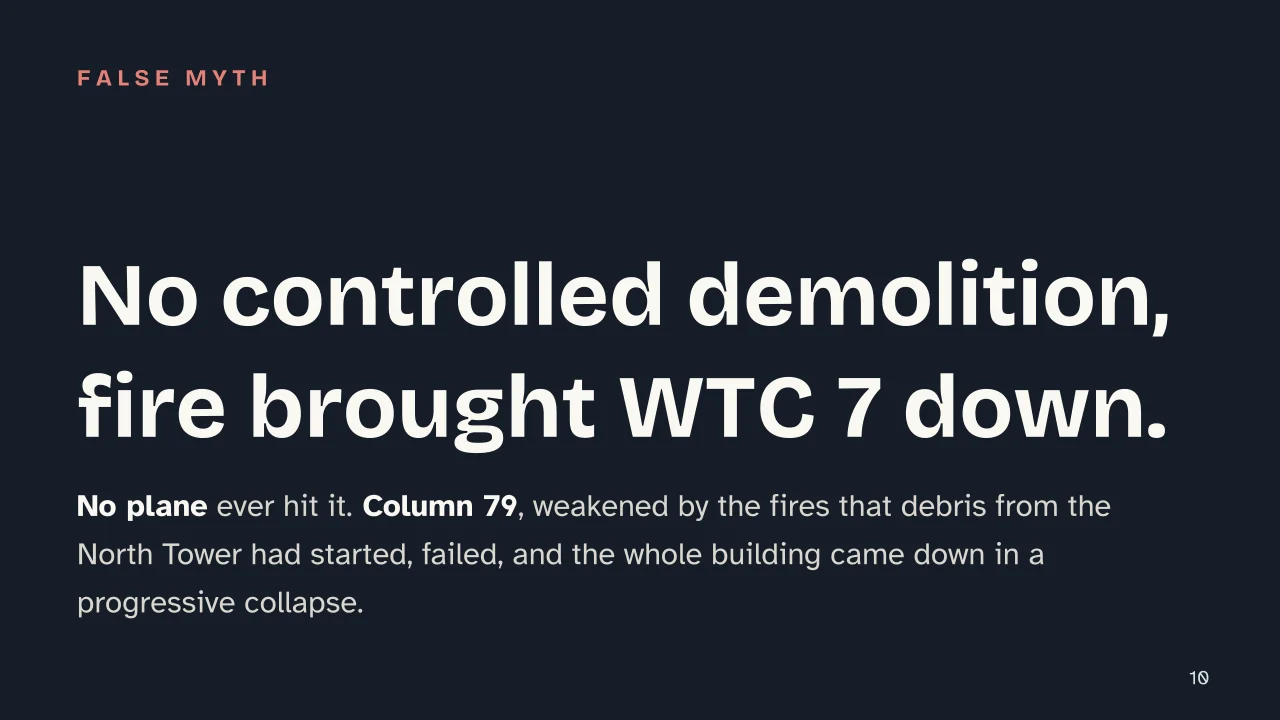
    At 5:20:52 p.m. that same day, World Trade Center 7 also collapsed — a 47-story building that had never been hit by any plane. Debris from the North Tower’s collapse had started uncontrolled fires on at least ten of its floors, while the sprinkler system in the affected area was not working. The heat weakened a critical support column, Column 79, until it failed: as the NIST report summarizes, “heating of floor beams and girders caused a critical support column to fail, initiating a fire-induced progressive collapse.” The building’s north face came down in roughly 5.4 seconds, about 40% slower than a free fall. It is the first known case worldwide of a tall building collapsing entirely because of fire, with no direct structural impact.

    The victims, the response, the health effects

    The total death toll from the attacks is 2,977, from 90 different countries: 2,753 in New York, 184 at the Pentagon, 40 on United Flight 93. At the Pentagon, 125 people died inside the building and 59 were aboard Flight 77; the section of the building that was hit collapsed about 30 minutes after impact, around 10:15 a.m.; the Pentagon’s own fire station responded immediately, and firefighters from Reagan National Airport and the Arlington County Fire Department arrived within minutes, helping save lives. In New York, 343 of the World Trade Center victims were firefighters; the remaining 2,410 were people who had been inside or around the buildings, including police officers.

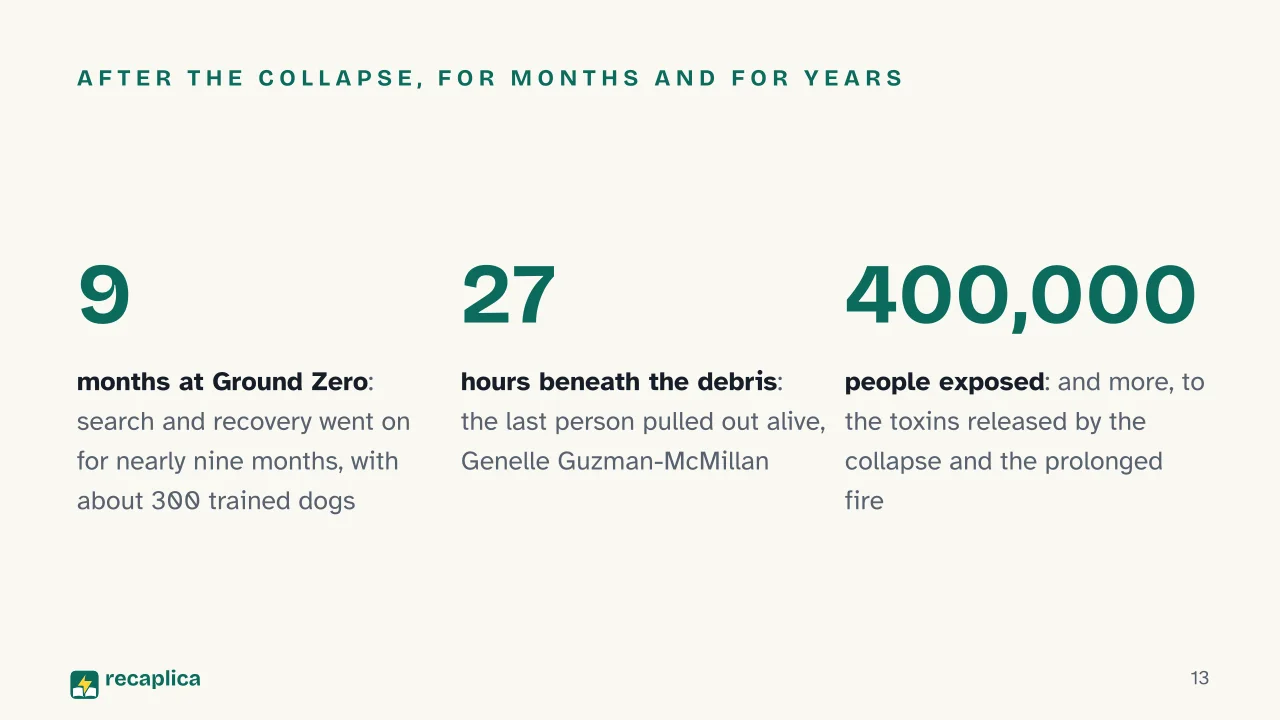
    In the days and months that followed, tens of thousands of people came to Ground Zero to help with the search and recovery effort, a job that went on for nearly nine months; about 300 trained dogs took part in the search. The last person pulled out alive from the rubble, Genelle Guzman-McMillan, who worked on the 64th floor of the North Tower, was rescued after 27 hours trapped beneath the debris.

    The health effects lasted well beyond the day of the attacks: more than 400,000 people were exposed to the toxins released by the towers’ collapse and the prolonged fire, and according to the most recent figures reviewed in 2026, tens of thousands live with chronic respiratory illness, mental health conditions and more than 100 different types of cancer linked to that exposure; Congress funded treatment and compensation through the James Zadroga 9/11 Health and Compensation Act of 2010. More than two decades on, according to the most recent figures reviewed in 2026 from the New York City Office of Chief Medical Examiner, about 40% of World Trade Center victims — roughly 1,099 people — remained unidentified; identification continues using increasingly advanced forensic genetics.

    Airspace closed for the first time in history

    At 9:06 a.m. the FAA, the U.S. federal civil aviation agency, grounded all traffic not yet airborne that was bound for New York airspace. At 9:45 a.m. came the more drastic decision: the complete shutdown of United States airspace, the first time that had ever happened in the country’s history, with a matching measure coordinated in Canada. Within a few hours every commercial and private flight already in the air was brought down. Airports resumed operations gradually two days later, on September 13, 2001, under far tighter security checks than before.

    The political aftermath and the official investigation

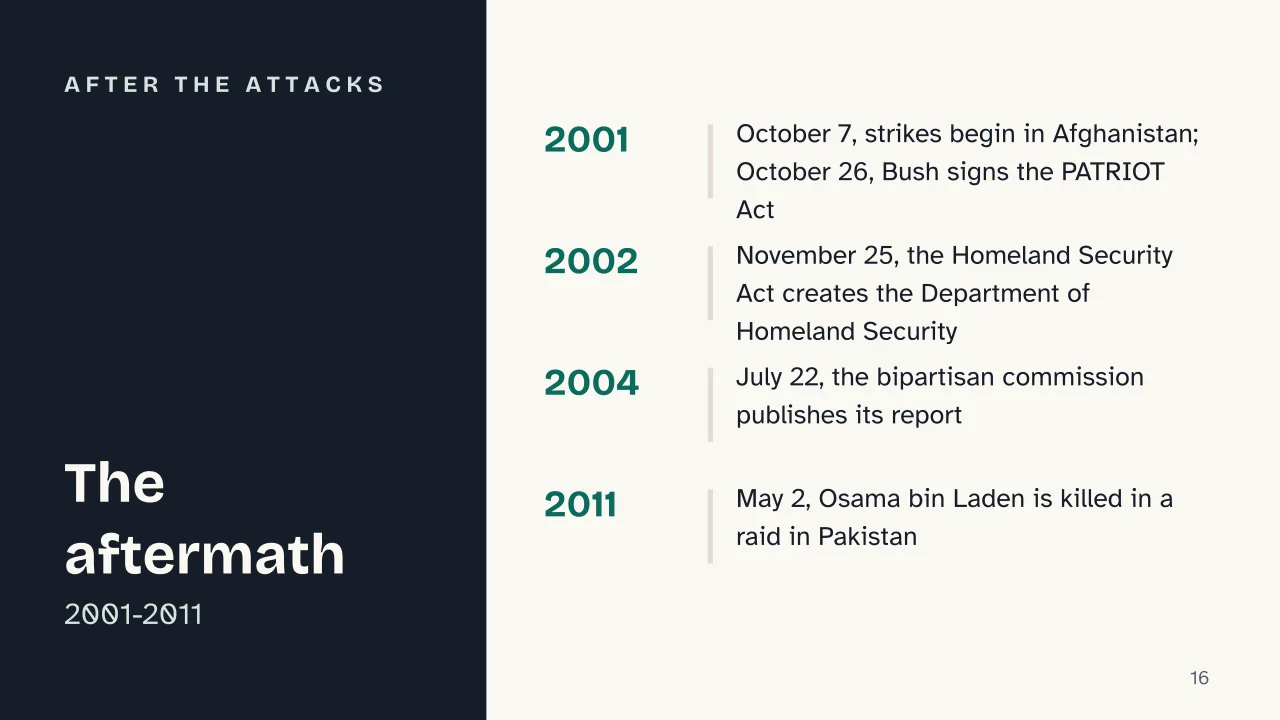
    On September 20, 2001, President George W. Bush addressed Congress and declared war “on a radical network of terrorists and every government that supports them.” On October 7, 2001, U.S. military strikes began in Afghanistan, opening what would come to be called the war on terror. On October 26, 2001, Bush signed the USA PATRIOT Act, which expanded the government’s information-gathering powers and its ability to detain and deport immigrants suspected of terrorism. On November 25, 2002, the Homeland Security Act created the Department of Homeland Security: the largest reorganization of the U.S. federal government since the 1940s. On May 2, 2011, President Barack Obama announced the killing of Osama bin Laden in a raid by U.S. special forces in Abbottabad, Pakistan.

    On July 22, 2004, the bipartisan commission set up by Congress, after more than 1,200 interviews across ten countries and a review of more than 2.5 million pages of documents, published its report: 585 pages, thirteen chapters. The Commission’s conclusion did not point to a single cause, but to a combination of failures across U.S. intelligence and security agencies: “a failure of imagination, policy, capabilities, and management.” Among the problems it identified: intelligence shortcomings, unsuccessful diplomatic efforts from 1997 to 2001, a lack of military options against the emerging terrorist threat, porous controls at the border and at airport security, and difficulty tracking terrorist financing. The Commission’s recommendations led, among other things, to the creation of the Director of National Intelligence and the National Counterterrorism Center.

    Anyone wanting to trace the international backdrop the United States had lived through in the preceding decades can look to the Cold War, the confrontation that for more than forty years had shaped American foreign policy and security services before 2001; for the last precedent of a federal reorganization on this scale, the reference point is the Second World War.

    Slide deck

    Slides ready to download and make your own in PowerPoint or Google Slides, with speaker notes. Pick the Flash cut or the Full one.

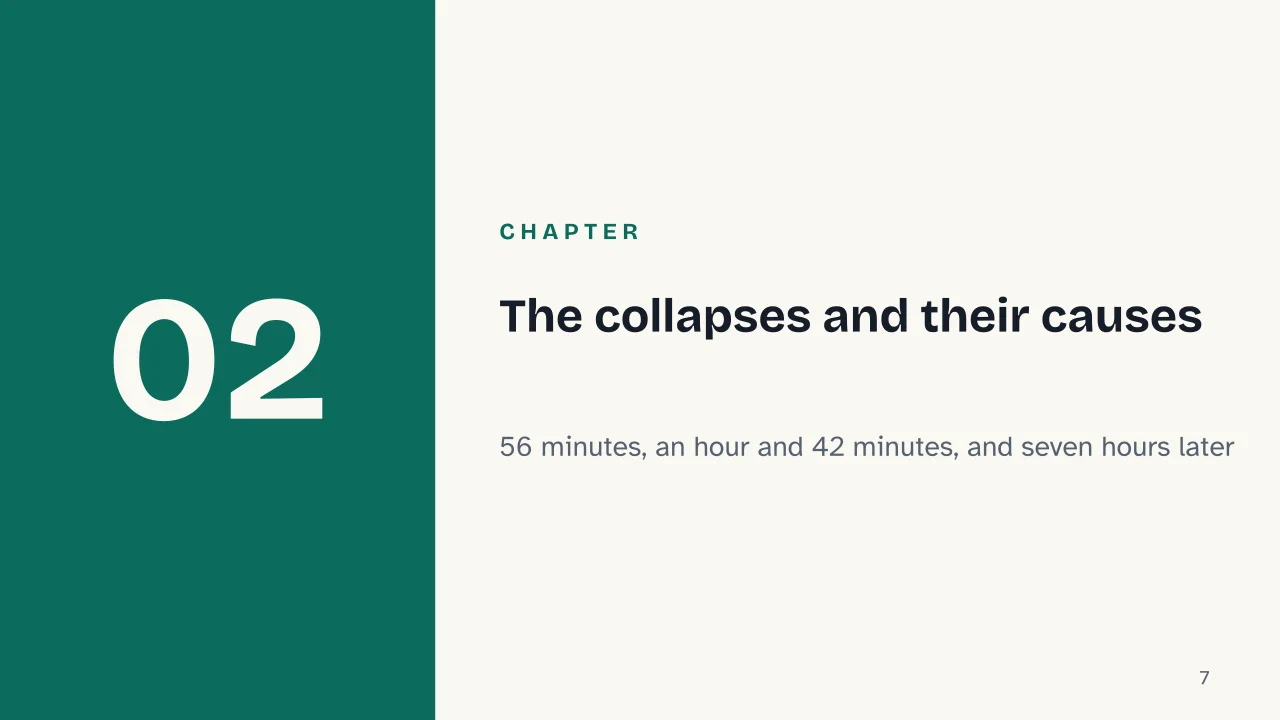
    Slide 1 of the presentation on 9/11: September 11, 2001Slide 2 of the presentation on 9/11: What happened in a little over an hour that morning?Slide 3 of the presentation on 9/11: What we will coverSlide 4 of the presentation on 9/11: Chapter 01: The four flightsSlide 5 of the presentation on 9/11: That morning, New York timeSlide 6 of the presentation on 9/11: Why Flight 93 never reached the hijackers' targetSlide 7 of the presentation on 9/11: Chapter 02: The collapses and their causesSlide 8 of the presentation on 9/11: The three collapses of September 11Slide 9 of the presentation on 9/11: Why did the steel fail without melting?Slide 10 of the presentation on 9/11: No controlled demolition, fire brought WTC 7 down.Slide 11 of the presentation on 9/11: Chapter 03: The victims and the responseSlide 12 of the presentation on 9/11: Twin Towers · The Pentagon · ShanksvilleSlide 13 of the presentation on 9/11: After the collapse, for months and for yearsSlide 14 of the presentation on 9/11: Chapter 04: What changed afterwardsSlide 15 of the presentation on 9/11: How long was United States airspace closed?Slide 16 of the presentation on 9/11: After the attacksSlide 17 of the presentation on 9/11: What did the Homeland Security Act of November 25, 2002, create?Slide 18 of the presentation on 9/11: And now, the review
    Flash10 slidesThe essential thread, to present in classFull18 slidesEvery chapter and the deeper detail

    Common myths

    • ✗ Myth World Trade Center 7, a building never hit by any plane, collapsed because of a controlled demolition planned in advance.

      ✓ Reality According to NIST's official technical investigation, the collapse of WTC 7 was caused by fires ignited by debris from the North Tower's fall, which weakened a critical support column (Column 79) until it failed and triggered the progressive collapse of the entire building, about 7 hours later. It is the first documented case worldwide of a skyscraper collapsing entirely because of fire. NIST rules out a controlled demolition: explosive charges powerful enough to sever the columns would have produced a sound of 130-140 decibels, audible half a mile away, which no witness ever reported; the collapse also began in a way consistent with the progression of the fire, not with a simultaneous detonation.

    • ✗ Myth Steel cannot melt from a fire fed by jet fuel, so the Twin Towers could not have collapsed because of fire.

      ✓ Reality It is true that jet fuel does not reach the melting point of steel, around 1,500°C, and NIST confirms that the steel in the Twin Towers did not melt. But steel does not need to melt to fail structurally: at around 1,000°C, a temperature the fires reached on multiple floors — fed not just by jet fuel but by furniture and office materials — steel's strength drops to about 10% of its value at room temperature. Combined with the direct structural damage from the plane impacts, that was enough to cause the progressive collapse that was observed.

    Mind map

    Drag the background to move around and the nodes to reposition them; use − and + to collapse and expand branches.
    Customize
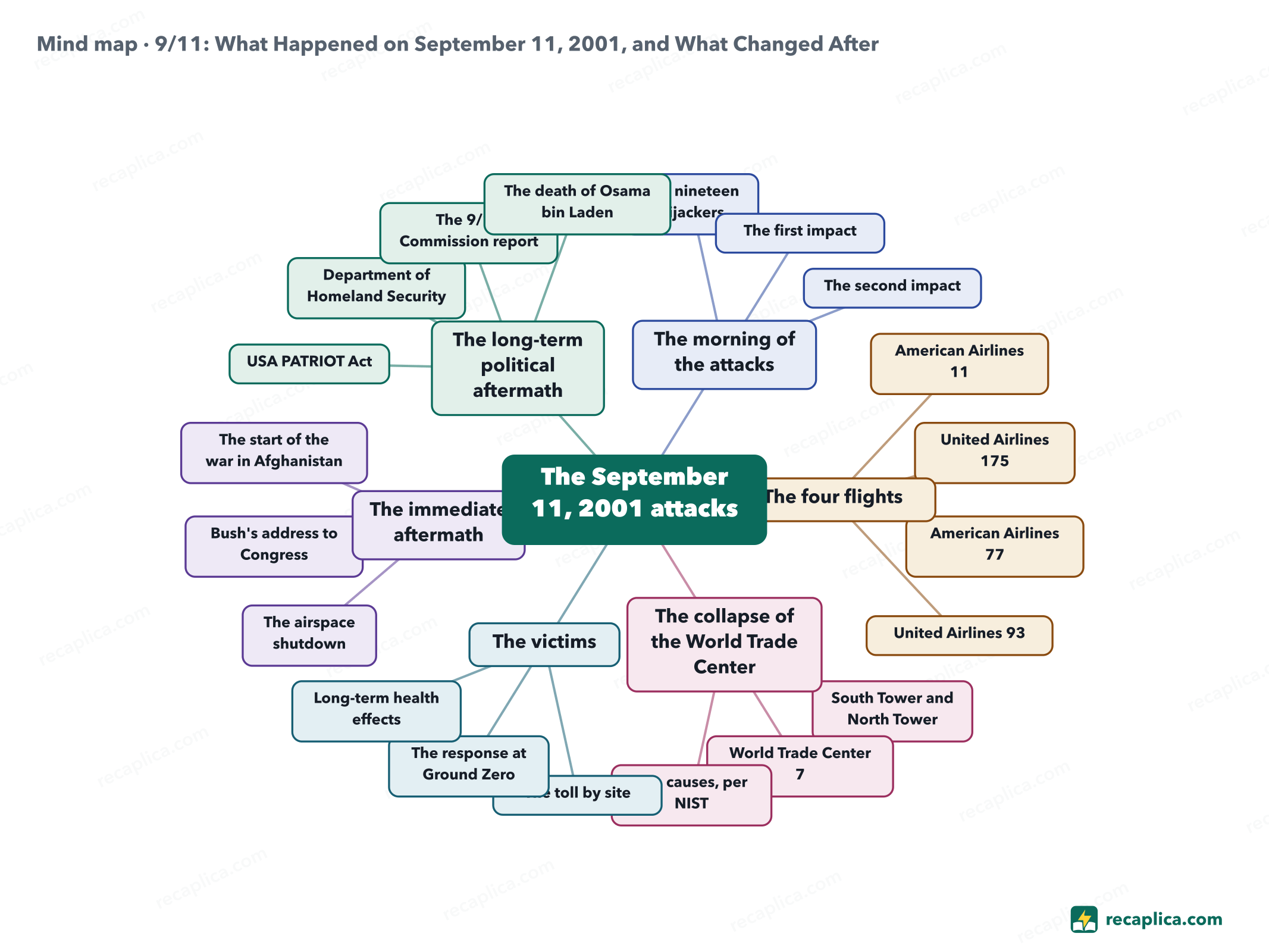
    Mind map: 9/11: What Happened on September 11, 2001, and What Changed After
    • The September 11, 2001 attacks
      • The morning of the attacks
        • The nineteen hijackers al-Qaeda, fifteen Saudis, two Emiratis, one Egyptian, one Lebanese
        • The first impact American Airlines 11 hits the North Tower, 8:46 a.m.
        • The second impact United Airlines 175 hits the South Tower, 9:03 a.m.
      • The four flights
        • American Airlines 11 Boston, North Tower of the World Trade Center
        • United Airlines 175 Boston, South Tower of the World Trade Center
        • American Airlines 77 Washington Dulles, the Pentagon
        • United Airlines 93 Newark, a field near Shanksville, Pennsylvania
      • The collapse of the World Trade Center
        • South Tower and North Tower 9:59 and 10:28 a.m., impact damage plus fire
        • World Trade Center 7 5:20:52 p.m., fire with no direct impact
        • The causes, per NIST steel weakened, not melted, until it failed
      • The victims
        • The toll by site 2,753 in New York, 184 at the Pentagon, 40 on Flight 93
        • The response at Ground Zero nearly nine months of search and recovery
        • Long-term health effects illnesses tied to toxins inhaled during the collapse
      • The immediate aftermath
        • The airspace shutdown 9:45 a.m., the first time in U.S. history
        • Bush's address to Congress September 20, 2001
        • The start of the war in Afghanistan October 7, 2001
      • The long-term political aftermath
        • USA PATRIOT Act October 26, 2001
        • Department of Homeland Security November 25, 2002
        • The 9/11 Commission report July 22, 2004
        • The death of Osama bin Laden May 2, 2011

    Quiz: test yourself

    Answer the questions to check what you have learned: you get instant feedback and a short explanation.

    Grade 0/10 0/5
    1 How many passenger jets were hijacked on September 11, 2001?

    Four planes were hijacked: American Airlines 11 and United Airlines 175, both departing from Boston, struck the two towers of the World Trade Center; American Airlines 77, departing from Washington Dulles, hit the Pentagon; United Airlines 93, departing from Newark, crashed in a field near Shanksville, Pennsylvania.

    2 At what time did American Airlines Flight 11 strike the North Tower of the World Trade Center?

    The plane had taken off from Boston at 7:59 a.m.; it hit the North Tower, between floors 93 and 99, at 8:46 a.m. The South Tower was struck at 9:03 a.m. by United Flight 175, and the Pentagon was hit at 9:37:46 a.m. by American Flight 77.

    3 What did the passengers of United Airlines Flight 93 do after learning, by phone, about the other attacks?

    At 9:57 a.m. the passengers, informed by phone calls of what had happened on the other three flights, voted to try to retake the aircraft. One of them, Todd Beamer, was heard on a call with a telephone operator saying, "Are you ready. Okay. Let's roll." Facing the passengers' attempt to break through the cockpit door, the hijackers deliberately put the plane into a dive, and it crashed in a field at 10:03 a.m. There were no survivors.

    4 Why did World Trade Center 7, a building never struck by any plane, collapse?

    According to the official NIST investigation, debris from the North Tower's collapse started uncontrolled fires on multiple floors of WTC 7, while the sprinkler system in the affected area was not working; the heat weakened Column 79 until it failed, triggering the progressive collapse of the entire 47-story building about 7 hours later. It is the first known case worldwide of a skyscraper collapsing entirely because of fire.

    5 What did the Homeland Security Act of November 25, 2002, create?

    The Homeland Security Act created the Department of Homeland Security, described as the largest reorganization of the U.S. federal government since the 1940s. The 9/11 Commission, which published its report in July 2004, was a separate body, set up by Congress to investigate the causes of the attacks.

    Answers: 1-C · 2-B · 3-B · 4-B · 5-B

    Flashcards

    Tap the card to flip it and check whether you remember the answer, then move to the next one.

    1 / 8

    Explain it in your own words

    The ultimate test: if you can explain it in simple words, you've truly understood it. Write your explanation, then compare it with the Recap.

    Your explanation is saved only on this device.

    On September 11, 2001, nineteen men tied to the Islamist group al-Qaeda hijacked four passenger jets in the United States. Two planes hit the Twin Towers of the World Trade Center in New York, which collapsed within an hour and 42 minutes of the first impact; a third struck the Pentagon, just outside Washington; the fourth crashed in a Pennsylvania field after passengers tried to retake the cockpit. In total, 2,977 people died, most of them in New York. Within hours the United States closed its entire national airspace for the first time in its history, and over the following months and years the country changed its laws, its security apparatus and its foreign policy, from the war in Afghanistan to the PATRIOT Act.

    Frequently asked questions

    How many people died on September 11, 2001?

    2,977 people, according to the most recent figures from the National September 11 Memorial & Museum: 2,753 at the World Trade Center in New York, 184 at the Pentagon and 40 on United Flight 93. The victims came from 90 different countries; among them were 343 New York City firefighters.

    Why did World Trade Center 7 collapse, if it was never hit by a plane?

    According to the official NIST investigation, debris from the North Tower's collapse started uncontrolled fires on multiple floors of WTC 7, while the sprinkler system in the affected area was not working; the heat weakened a critical support column, Column 79, until it failed and the entire building came down in a progressive collapse, about 7 hours after the North Tower fell. It is the first known case worldwide of a skyscraper collapsing entirely because of fire, with no direct structural impact.

    What changed in the United States after September 11, 2001?

    In the weeks and years that followed, the United States launched the war in Afghanistan (from October 7, 2001), passed the USA PATRIOT Act (October 26, 2001), which expanded the government's information-gathering powers, and created the Department of Homeland Security with the Homeland Security Act of November 25, 2002, the broadest reorganization of the federal government since the 1940s. Osama bin Laden, identified by investigators as the attacks' mastermind, was killed on May 2, 2011.

    Who was responsible for the September 11 attacks?

    Nineteen hijackers tied to the Islamist group al-Qaeda: fifteen Saudi nationals, two from the United Arab Emirates, one from Egypt (Mohamed Atta, the operative who led the group on the ground) and one from Lebanon (Ziad Jarrah). The operation's tactical planner was Khalid Sheikh Mohammed; investigators identified Osama bin Laden, al-Qaeda's leader, as the mastermind — he was killed on May 2, 2011, in a U.S. raid in Pakistan.

    What does the 9/11 Commission Report say?

    Published on July 22, 2004, after more than 1,200 interviews across 10 countries and a review of more than 2.5 million pages of documents, the report of the bipartisan commission set up by Congress concludes that the attacks were made possible by a combination of failures — of imagination, policy, capabilities and management — across U.S. intelligence and security agencies, not by any single cause.

    Sources

    • National September 11 Memorial & Museum — 9/11 FAQs
    • National September 11 Memorial & Museum — Module 6, Repercussions of 9/11
    • NIST — FAQ on the World Trade Center Towers (WTC 1 and WTC 2) investigation
    • NIST — FAQ on the World Trade Center 7 investigation
    • Pentagon Memorial Fund — 9/11 at the Pentagon
    • The 9/11 Commission Report
    • Britannica — September 11 attacks
    • FAA — closure of U.S. airspace, September 11, 2001

    Every Recap goes through an independent review before publication.

    Every evening, the day's new Recaps on our Telegram channel. Join the channel →

    Keep learning

    • History Martin Luther and the Protestant Reformation: A Summary Martin Luther was a German Augustinian monk who, according to tradition, nailed 95 theses against the sale of indulgences to the door of the Castle Church in Wittenberg in 1517. The act opened a religious process that lasted decades, later known as the Protestant Reformation, which led to Luther's excommunication and to a new Christian doctrine that took hold mainly in Germany and in the Scandinavian and Baltic countries. The clash with Emperor Charles V only ended in 1555 with the Peace of Augsburg, which split the territory of the Empire between Catholics and Lutherans. Read the Recap →
    • History Capetian Dynasty: Who Were the Kings Who Built Medieval France The Capetian dynasty ruled France from 987 to 1328, starting when an assembly of nobles elected Hugh Capet king. At first his real power covered a tiny territory, roughly 1,000 square kilometers between Paris and Orléans: the rest of the kingdom belonged to powerful feudal lords. Over the next two centuries the Capetian kings grew the Crown's holdings through alliances, marriages and war, culminating in Philip II Augustus's victory at Bouvines in 1214. Louis IX brought the dynasty to its religious and institutional peak, while Philip IV the Fair clashed openly with the papacy. When the direct line died out in 1328, the throne passed to the Valois, a branch of the same family. Read the Recap →
    • History Italian City-State: What It Was, How It Began, and How It Changed The Italian city-state was the form of self-government with which, starting in the late 11th century, many cities in northern and central Italy ran their own affairs, pulling free of direct control by bishops and feudal lords. It began as a government of consuls elected by an assembly of heads of household, then shifted to a foreign official called the podestà, and from the mid-13th century saw the institutions of the popolo take shape alongside it, organized by guild and led by the captain of the people. Through the 13th and 14th centuries, conflict between leading families and the popolo wore this balance down and opened the way to city lordships, the signorie. Venice followed a different path from the start, with an elected doge and its own system of councils. Read the Recap →

    recaplica

    Clear in 30 seconds, yours in 10 minutes.

    Recaps Mind maps Request a Recap Telegram channel Mind map maker Our method About Privacy & cookies Legal notes & terms of use

    © 2026 Recaplica · A project by Curi S.r.l. — VAT IT05472000750

    Statistics, only if you say so

    To learn which Recaps help most we would use Google Analytics, with aggregate, anonymous data. It starts only with your OK, and you can change your mind anytime. Privacy policy