|
recaplica
Erasmus of Rotterdam: Life, Thought, and Ideas on Education |
| © 2026 Recaplica · recaplica.com — All rights reserved |
Erasmus of Rotterdam: Life, Thought, and Ideas on EducationWhat to print Page numbers appear when printing with default margins. SlidesChoose a cut Flash10 slidesThe essential thread, to present in classFull15 slidesEvery chapter and the deeper detailBoth come with speaker notes. In 30 seconds quick readErasmus of Rotterdam was born in the Low Countries, in 1466 or 1469 depending on the source, and died in Basel in 1536. The Brethren of the Common Life educated him, and he entered an Augustinian monastery while still young, but his name became tied above all to humanism and to reading classical texts in their original language. He held that education mattered more than innate nature, and built works such as De pueris instituendis and De ratione studii on that very idea. He was a close friend of Thomas More and met John Colet during his stays in England, while his best-known work, The Praise of Folly, stands apart as a chapter of its own in his output. Key Points
Key figures
Deep DiveAccording to the Stanford Encyclopedia of Philosophy, Erasmus of Rotterdam was born in 1469 and died in 1536. Encyclopedia.com, however, dates his birth to 27 October 1466; the Treccani encyclopedia states the uncertainty outright, giving 1466 or 1469 as the two possibilities. The sources agree instead on his death, in Basel, on 12 July 1536 according to Encyclopedia.com. The name Erasmus was born with was not the one he became famous under. According to the Treccani encyclopedia, he was called Geert Geertsz, later latinized as Desiderius Erasmus, following the humanist fashion of the time for turning one’s own name into Latin. Erasmus’s childhood and education moved through several stages. According to Encyclopedia.com he was taught first at Gouda and then, from 1475, by the Brethren of the Common Life, staying at Deventer for eight years; the Stanford Encyclopedia of Philosophy describes the school at Deventer as progressive for its time. Orphaned in 1483, according to the Stanford Encyclopedia of Philosophy he was placed under guardians, and it was they who arranged his schooling with the Brethren of the Common Life. A few years later, at age 12 according to the Treccani encyclopedia, he entered the Augustinian monastery of Emmaus, also called Steyn, in the Low Countries: there, over five years, he gained an early grounding in the classics. The Internet Encyclopedia of Philosophy records that Erasmus took his monastic vows in 1486. He was ordained a priest in 1492 by Hendrik van Bergen, bishop of Cambrai, according to the Treccani encyclopedia. Already during his lifetime, according to the Stanford Encyclopedia of Philosophy, Erasmus’s name became synonymous with humanism. At the center of his pedagogical thought lay a precise claim: Erasmus held that education outweighed innate nature, given the strength of human will. The amount and method of one’s training mattered more than the disposition one was born with. This conviction runs through his views on the aims and methods of education, set out in De pueris instituendis, published in 1529. In De ratione studii, from 1511, he discussed the program of study instead — which texts to read, in what order, by what method.
Erasmus’s pedagogical method ties into a broader principle of his humanism: Ad fontes, the return to texts in their original language. Erasmus wanted the Greek and Latin classics, and the sacred texts, read in the language in which they had first been written. The same principle led Erasmus to edit the first printed edition of the Greek New Testament: Encyclopedia.com describes him, in fact, as a humanist, a scholar of classical and patristic literature, and the first editor of the Greek New Testament. For Erasmus, classical culture and Christian faith were not two separate paths. According to the Internet Encyclopedia of Philosophy, he held, in Latin, that being a philosopher amounted to being a Christian: a formula that sums up his Christian humanism. Philosophy, for him, was not a discipline reserved to universities, but a moral duty for every believer. The Treccani encyclopedia describes this stance as the pursuit of an alliance between classical learning (eruditio) and religious devotion (pietas) — the synthesis at the heart of his thought. Erasmus’s personal relationships spanned several European countries. During a stay in England, between 1499 and 1500 according to the Treccani encyclopedia, he met Thomas More, future Lord Chancellor of England, and John Colet, founder of St Paul’s School in London. His collaboration with More continued over time: the two worked together on a translation of selected dialogues of Lucian, and after further travel between France and the Low Countries, Erasmus returned to England as More’s guest. Encyclopedia.com adds that, through the friends he met during that 1499 stay, Erasmus came into closer contact with the legacy of the Italian Renaissance — the same movement that, in Italy, had already produced, in the previous century, the works of the Florentine Renaissance. Erasmus’s best-known work remains The Praise of Folly, written in 1509: the Treccani encyclopedia describes it as a biting satire of theological and scholastic conceit and of the immorality of the clergy of the time, while the Stanford Encyclopedia of Philosophy notes that it has stayed in print without interruption since. Its specific content — the themes, the characters, why it works as satire — is the subject of another Recap, dedicated solely to that book. In the years after Martin Luther’s break with Rome, Erasmus held to a distinct position. According to the Treccani encyclopedia, he could not bring himself to endorse the harsh Pauline outlook of Martin Luther: a sign of his critical distance from the reformer, without this producing an open break between the two. In 1535, according to the Treccani encyclopedia’s chronology, Erasmus turned down the nomination to cardinal. Slide deckSlides ready to download and make your own in PowerPoint or Google Slides, with speaker notes. Pick the Flash cut or the Full one.     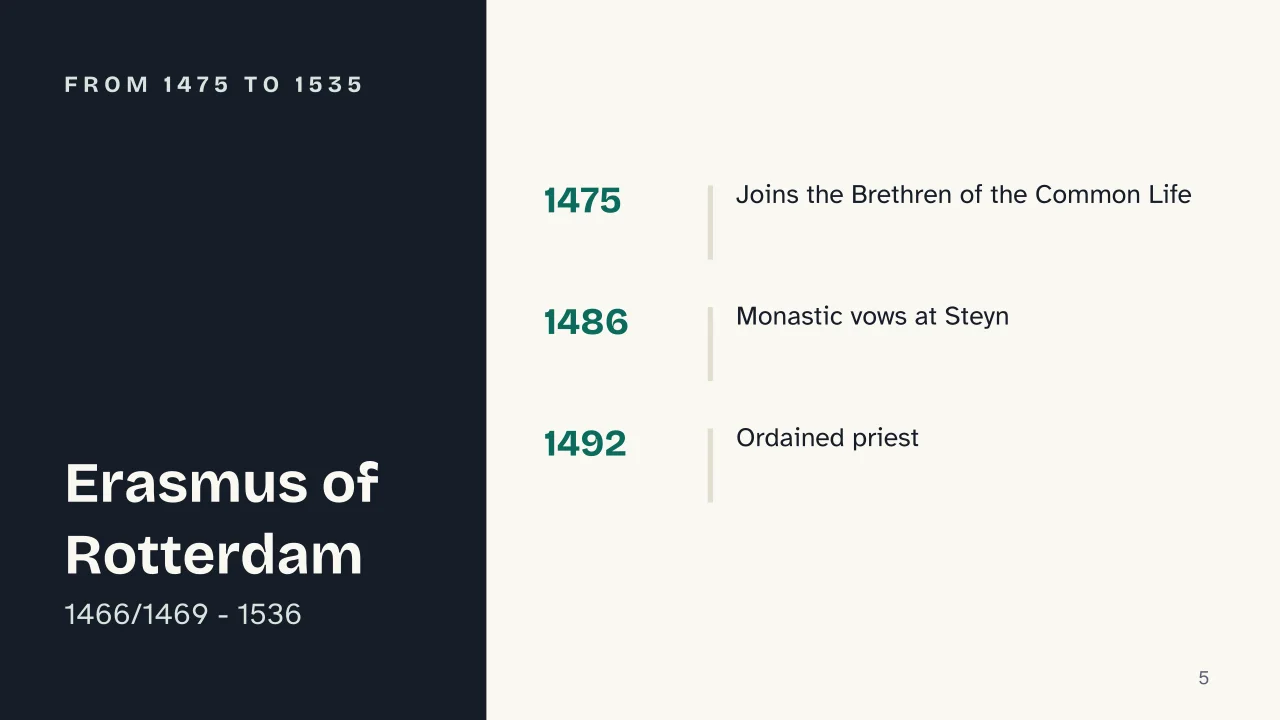  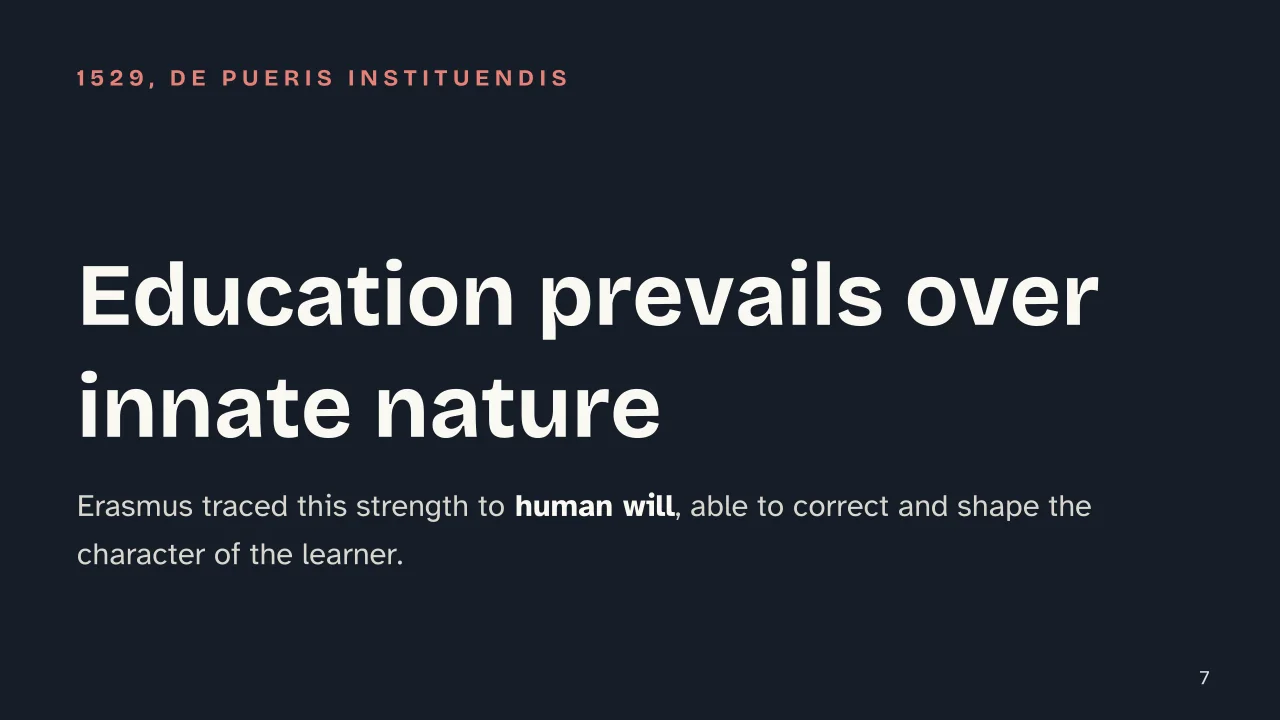 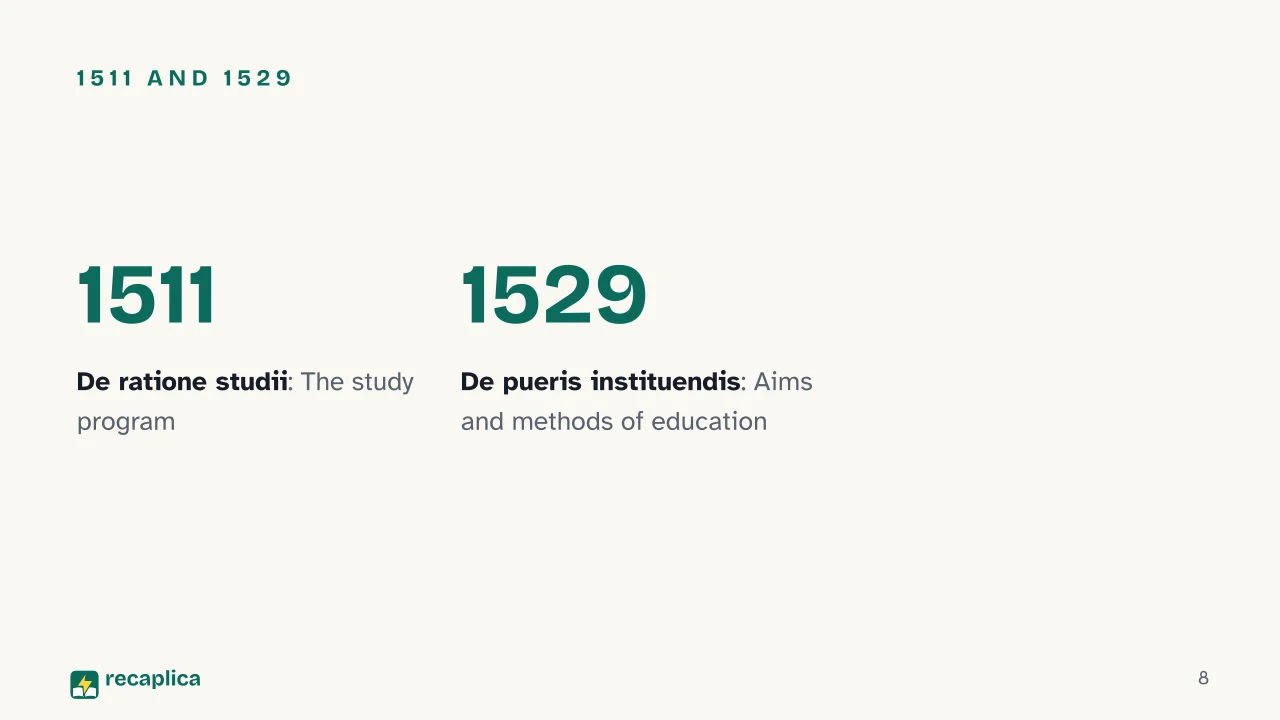  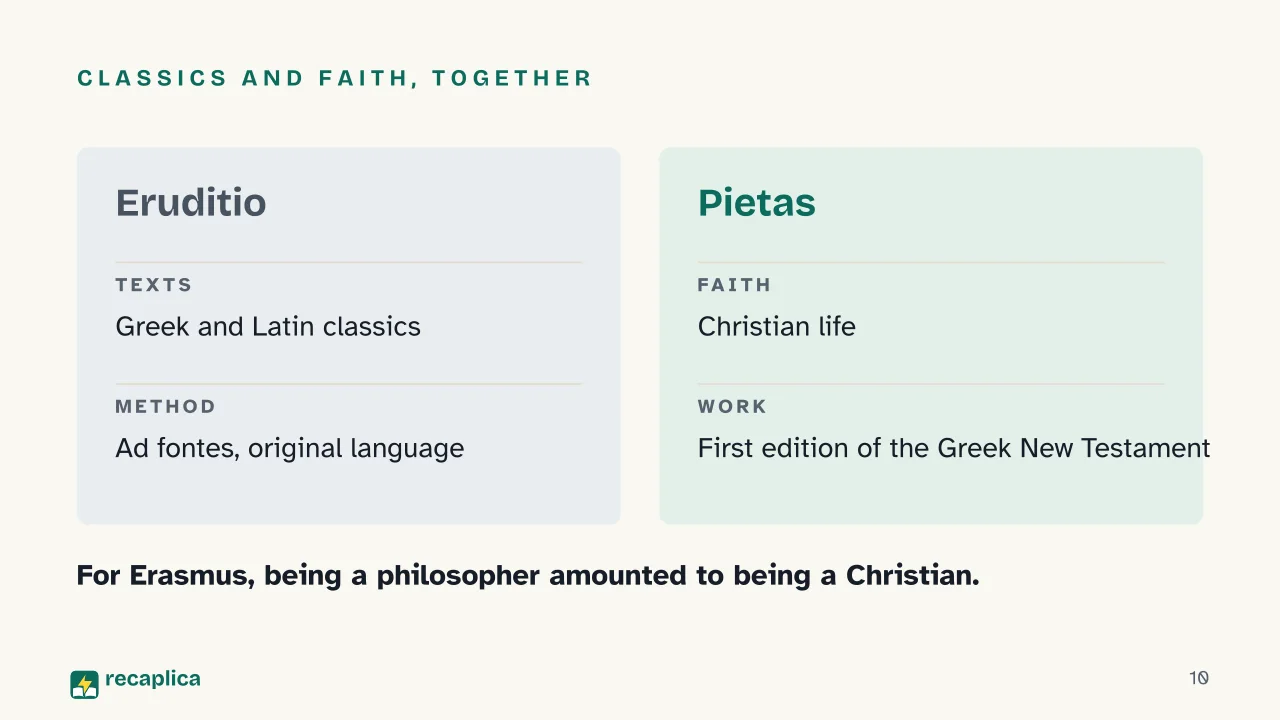  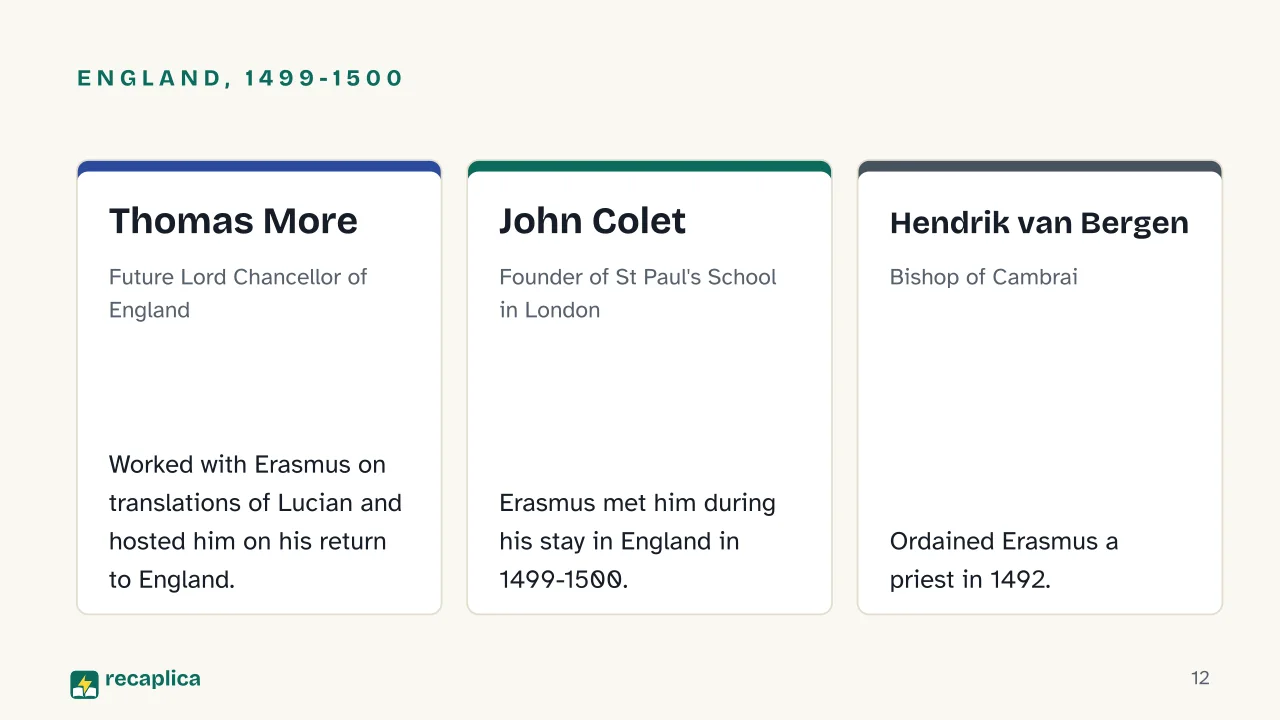 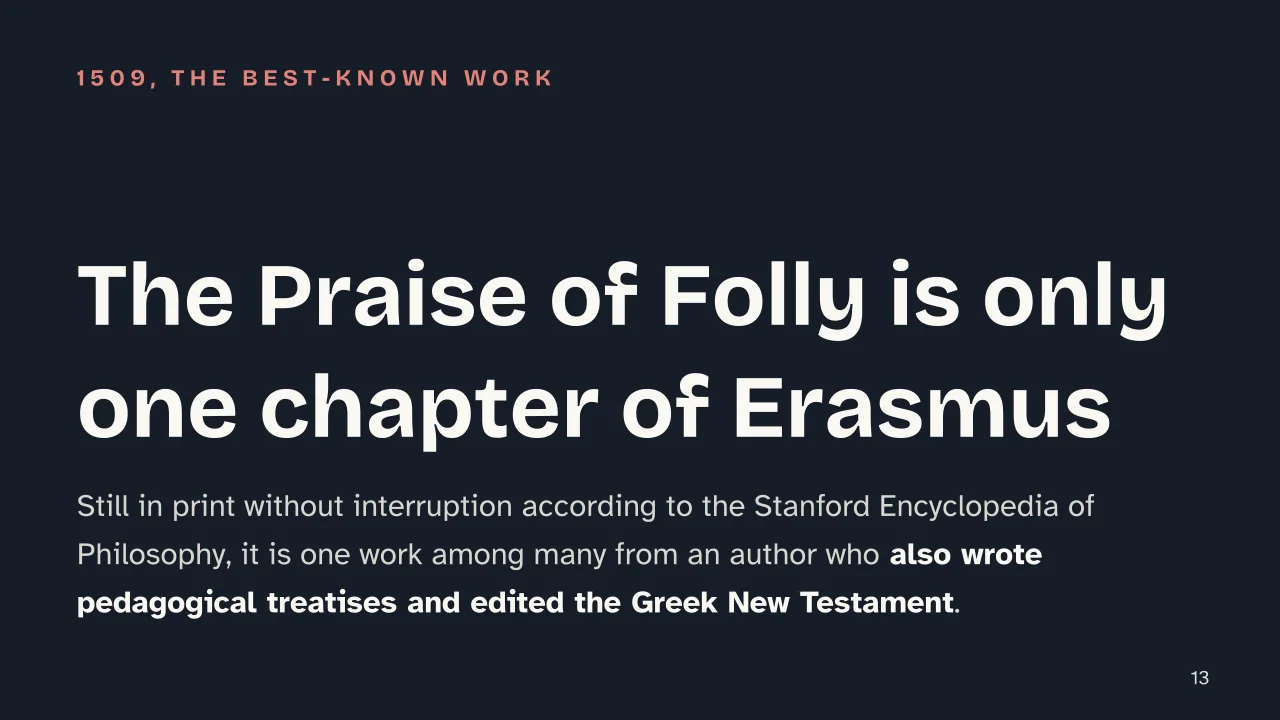 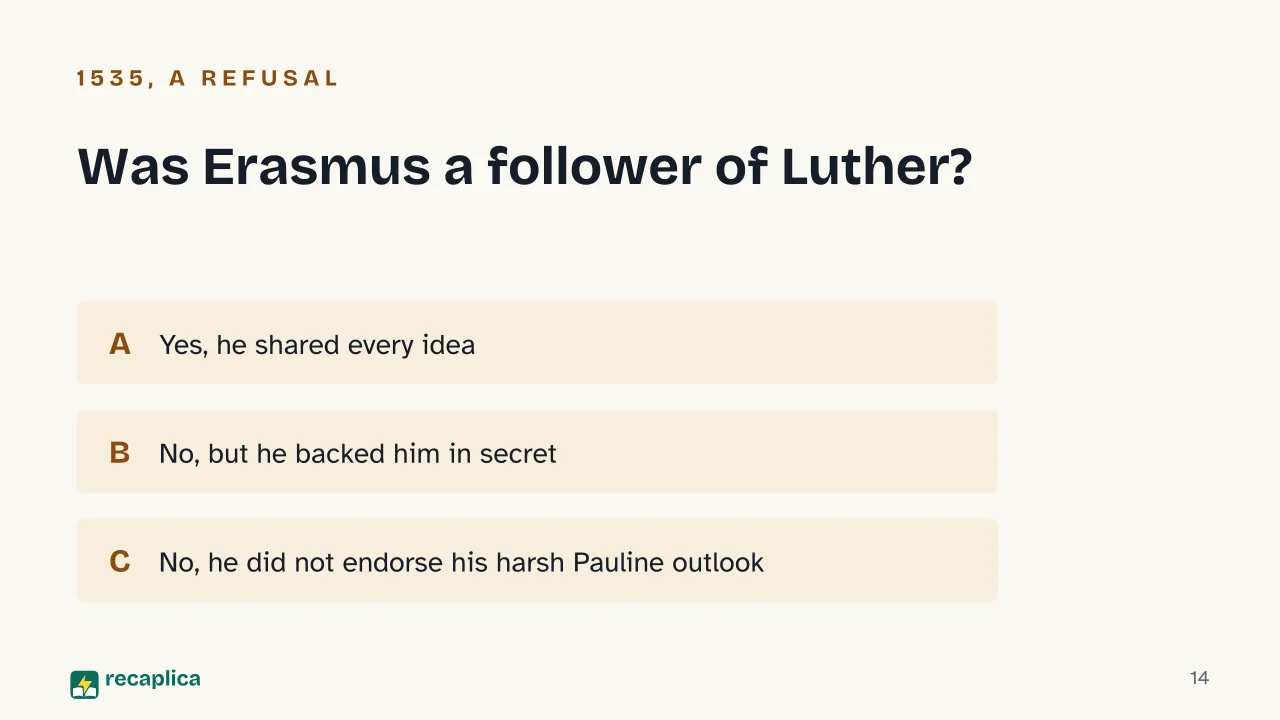  Common myths
Mind mapDrag the background to move around and the nodes to reposition them; use − and + to collapse and expand branches. 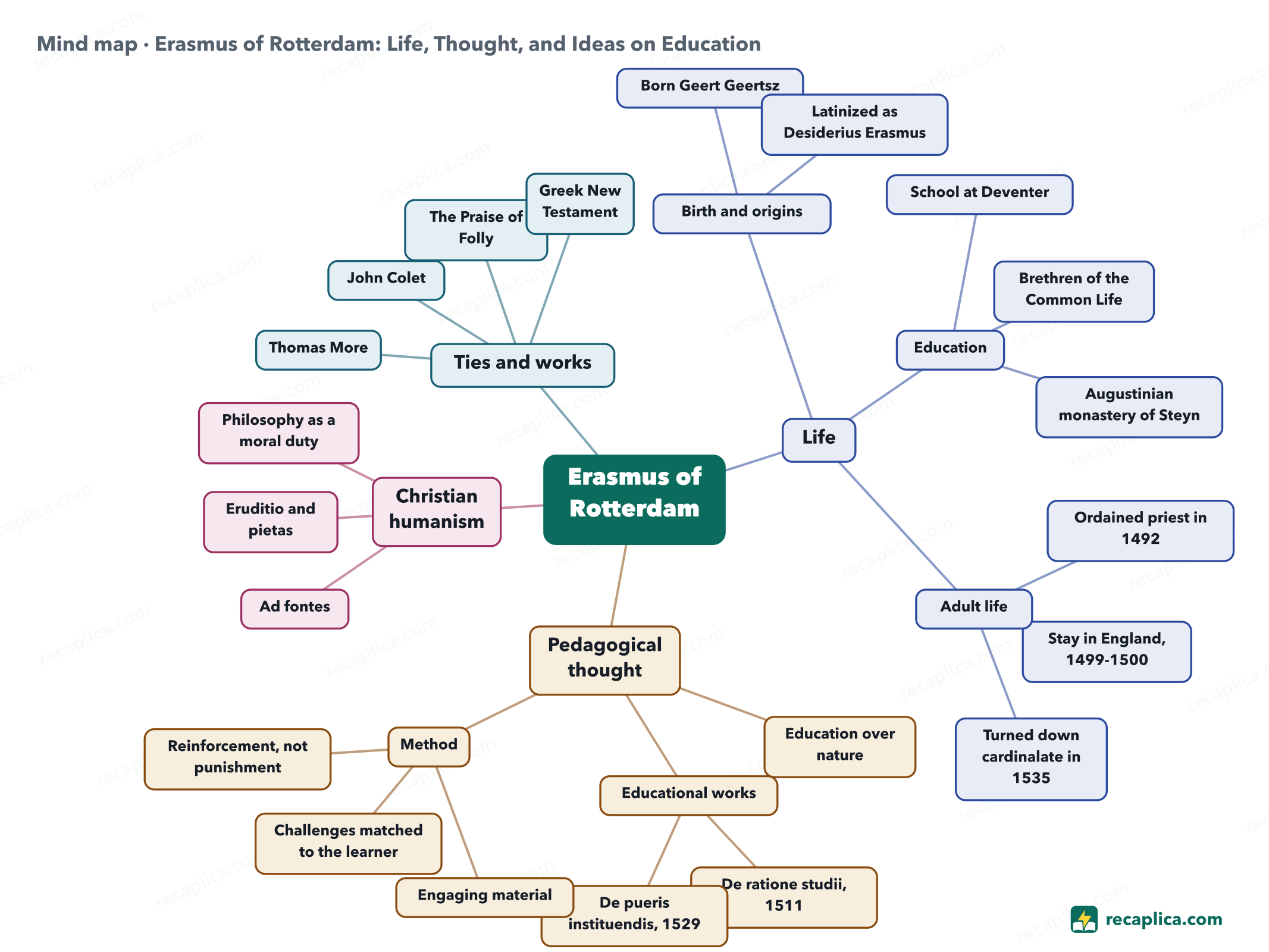
Quiz: test yourselfAnswer the questions to check what you have learned: you get instant feedback and a short explanation. Grade 0/10 0/5
FlashcardsTap the card to flip it and check whether you remember the answer, then move to the next one. 1 / 8 Explain it in your own wordsThe ultimate test: if you can explain it in simple words, you've truly understood it. Write your explanation, then compare it with the Recap. Your explanation is saved only on this device.
Frequently asked questionsWho was Erasmus of Rotterdam?Erasmus of Rotterdam was a humanist from the Low Countries, born in 1466 or 1469 and died in Basel in 1536. He studied classical and patristic literature, edited the first printed edition of the Greek New Testament, and wrote works of pedagogy and satire, including The Praise of Folly. Why is Erasmus considered a Christian humanist?Because he held together two planes usually kept apart, the study of Greek and Latin classics and Christian faith: according to the Internet Encyclopedia of Philosophy, in his eyes a true philosopher could only be a devout Christian. What did Erasmus think about education?For Erasmus, a learner's will mattered more than innate disposition: he recommended engaging material, challenges matched to the student's level, and positive reinforcement, never punishment. Was Erasmus a follower of Martin Luther?No. According to the Treccani encyclopedia, Erasmus could not bring himself to endorse Luther's harsh Pauline outlook, even though he had long criticized the abuses of the clergy of his time. What is The Praise of Folly?It is Erasmus's best-known work, a biting satire published in 1509. Its specific content is covered in a dedicated Recap. Every Recap goes through an independent review before publication. |