Skip to content
recaplica

    One moment: security check

    Cloudflare wants to make sure you're not a robot. Tick the box below and your search will continue on its own.

    IT
    recaplica Comenius: Who He Was and Why He Shaped Modern Pedagogy
    © 2026 Recaplica · recaplica.com — All rights reserved
    Home › History

    Comenius: Who He Was and Why He Shaped Modern Pedagogy

    By Recaplica Newsroom · Updated on October 19, 2026

    What to print

    Page numbers appear when printing with default margins.

    Slides

    Choose a cut

    Flash10 slidesThe essential thread, to present in classFull14 slidesEvery chapter and the deeper detail

    Both come with speaker notes.

    Telegram channel
    recaplica Clear in 30 seconds, yours in 10 minutes.
    In 30 seconds Key points Figures Deep dive Slides Myths Mind map Quiz Flashcards FAQ

    In 30 seconds quick read

    Comenius was a 17th-century Bohemian educator, bishop of the Unity of the Brethren, and author of two works that shaped the history of schooling: the Great Didactic, his theoretical program, and the Orbis Sensualium Pictus, the book that put it into practice. He argued for education open to everyone, rich and poor, boys and girls, organized by stages matched to the learner's age. In the Orbis Pictus, published in 1658, he paired words and pictures for the first time in a book designed to teach children. He spent much of his life in exile, through religious wars and family losses, and it was in those conditions that he worked out his method. He is counted among the fathers of modern pedagogy, alongside other thinkers of his time.

    Key Points

    • Comenius (1592-1670) was bishop of the Unity of the Brethren and an educator, remembered among the fathers of modern pedagogy.
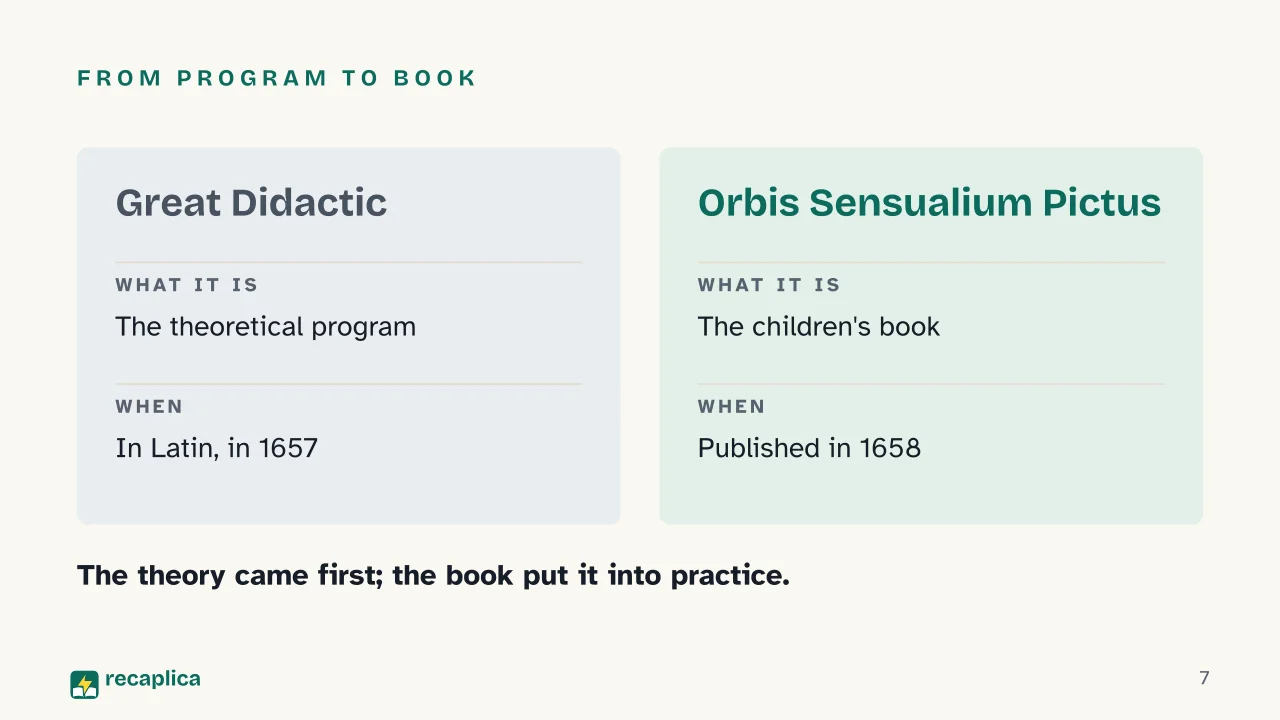
    • In the Great Didactic, published in Latin in 1657 according to Encyclopedia.com, he laid out a program of free, universal schooling for girls and boys alike, across every social class.
    • The Orbis Sensualium Pictus, released in 1658, was the first school book to teach languages through pictures.
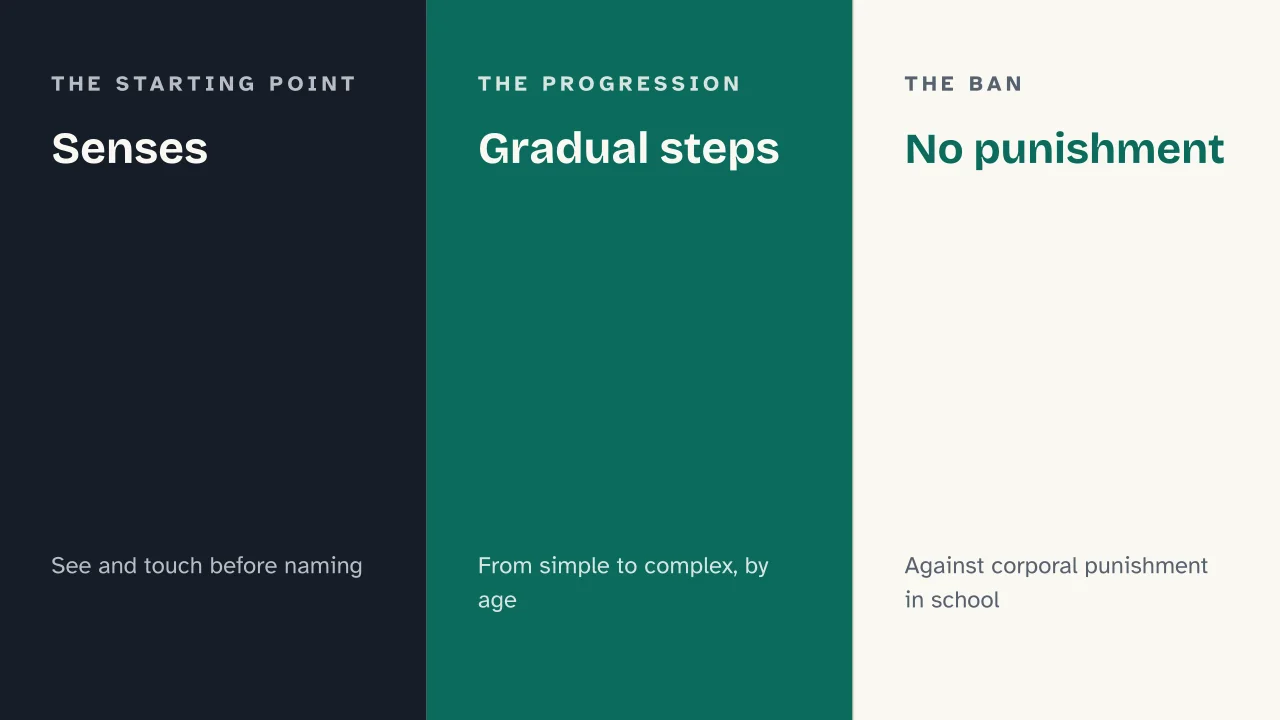
    • For Comenius, learning had to move from simple to complex according to the learner's age, always starting from the senses.
    • Comenius opposed corporal punishment, which he believed smothered children's natural desire to learn.
    • Comenius spent much of his life in exile, through the Thirty Years' War and the destruction of the Polish town of Leszno in 1656.

    Key figures

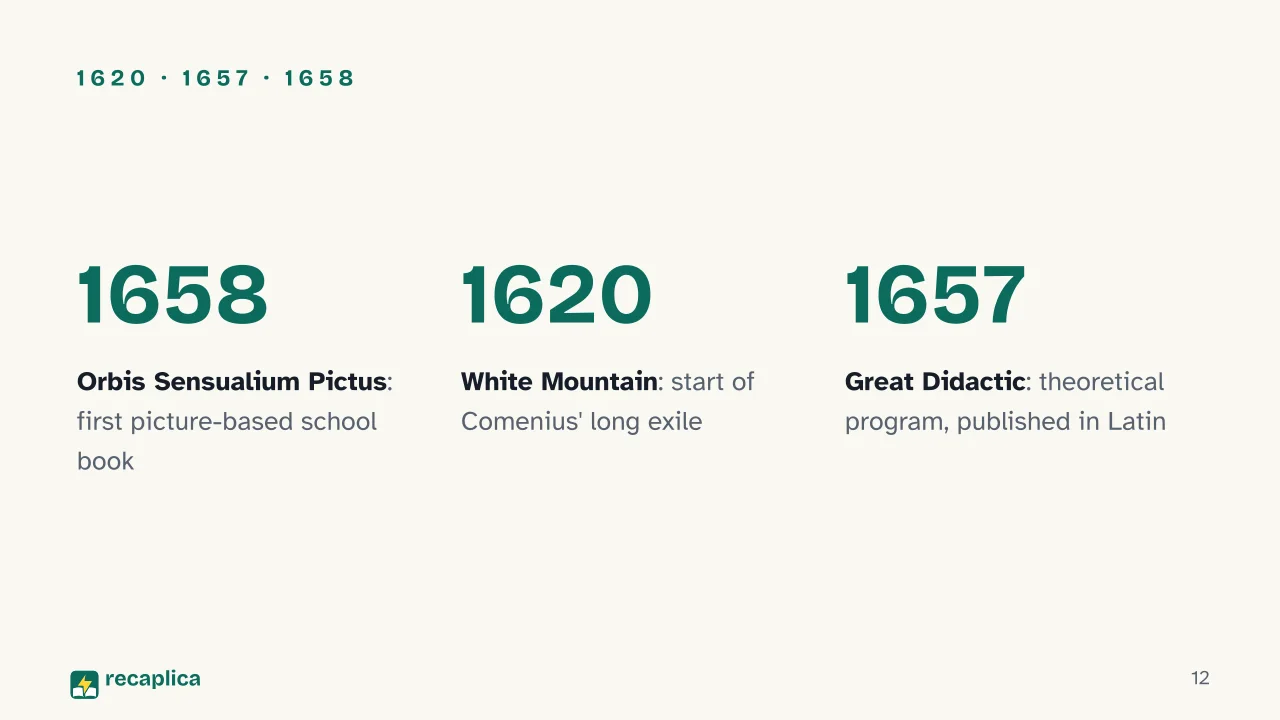
    • 1658 Year the Orbis Sensualium Pictus was published, the first school book built on the union of words and pictures. Source: Encyclopedia.com / Complete Dictionary of Scientific Biography
    • 1620 Year of the Battle of White Mountain, the turning point that opened a long exile for Comenius and the Unity of the Brethren. Source: New World Encyclopedia
    • 1657 Year of the first Latin edition of the Great Didactic, inside the collection Opera Didactica Omnia (a Moravian University page gives 1649, a date not confirmed anywhere else). Source: Encyclopedia.com / Complete Dictionary of Scientific Biography

    Deep Dive

    Who Was Comenius

    John Amos Comenius (in Latin Johannes Amos Comenius, born Jan Amos Komenský) was born on 28 March 1592; the exact place is uncertain, though the New World Encyclopedia names Nivnice, in Moravia, as the likely spot. He died on 15 November 1670 in Amsterdam, far from home.

    A Life Shaped by Exile

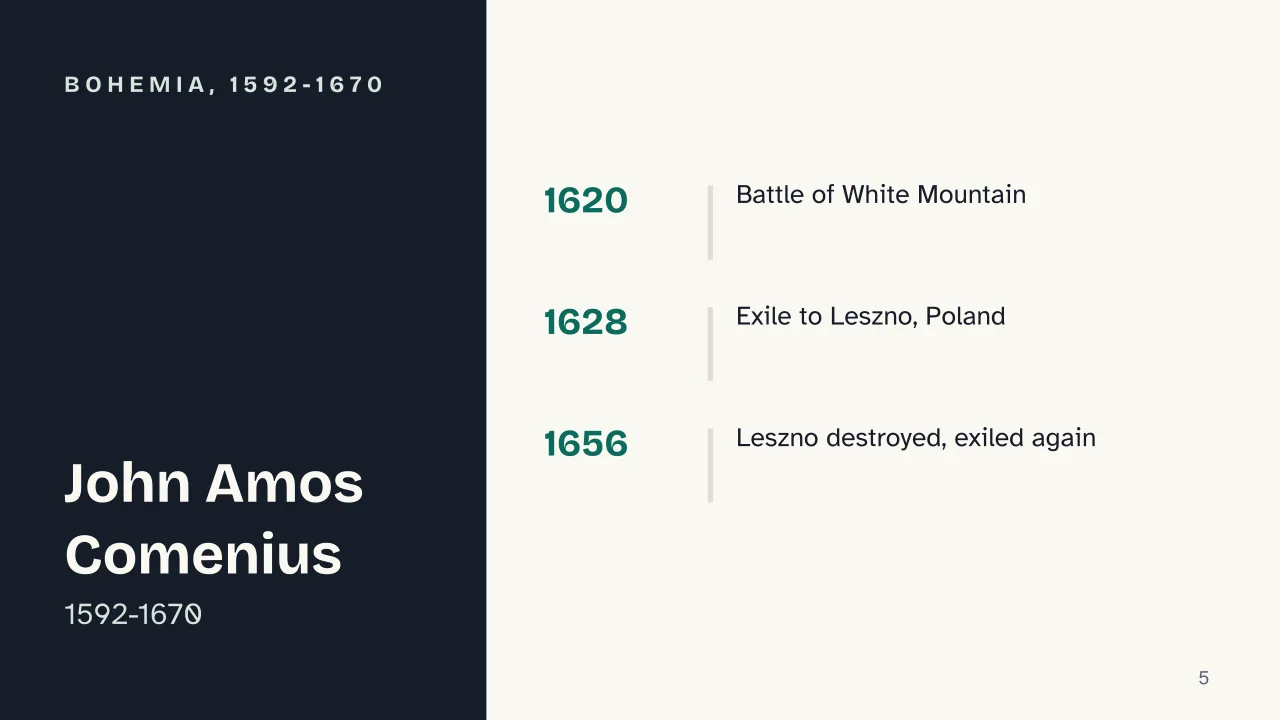
    Comenius belonged to the Unity of the Brethren, a Protestant religious community of which he later became bishop, and his biography is bound up with the religious wars of 17th-century Europe. The Battle of White Mountain, in November 1620, was, according to the New World Encyclopedia, a decisive turning point in his life and in the history of the Bohemian Reformation; in 1628 the Brethren were forced to leave Bohemia under persecution, and Comenius settled in Leszno, in Poland. He stayed there for years, until Polish troops destroyed the town in 1656: Comenius lost every book and manuscript he owned and was pushed into exile once again. Personal losses piled on top of the material ones — according to Moravian University, his first wife and two children died living as refugees.

    None of this stopped his work. Comenius wrote his major books during those very years of exile, moving between Poland and the Netherlands.

    Two Works, Two Different Roles

    In the Great Didactic, Comenius laid out the general theoretical program of his pedagogy. Encyclopedia.com, drawing on the Complete Dictionary of Scientific Biography, dates the work — written in Czech — to its Latin publication in 1657, inside the collection Opera Didactica Omnia: that date is the one backed by academic historiography, even though a Moravian University page gives 1649, a date not confirmed anywhere else. This is where Comenius called for free, universal, compulsory schooling for both sexes and every social class, never a proposal meant only for the wealthy or for elites.

    The Orbis Sensualium Pictus is its practical counterpart: the hands-on application of that theoretical program. Published in 1658 with text in Latin and German, it was the first school book built to teach children by setting pictures next to words. Earlier Latin manuals had relied on memorizing long lists of vocabulary; the Orbis Pictus added a step those manuals skipped: look first, repeat second. Comenius held that joining words with pictures taught more than either could alone, a belief rooted in a broader idea — that all knowledge starts with the senses.

    Practical example: in the Orbis Pictus, instead of asking a child to memorize a list of Latin names for farm animals, the page showed a drawing of each animal next to its name in Latin and German.

    The Principles of a New Method

    Beyond the picture-based method, Comenius applied other criteria that are pedagogical in a strict sense. School programs had to move from the simplest to the most complex topics according to the learner’s age, covering only what already belonged to the child’s experience; in that spirit he published the Janua Linguarum Reserata in 1631, a language-learning manual that, Encyclopedia.com notes, earned him fame across Europe by 1633.

    Comenius also pushed back against a widespread belief of his era, the idea that human beings are born naturally wicked, a belief often paired with the practice of instilling goodness and knowledge through corporal punishment. He argued against it openly. Moravian University reports that he criticized the schools of his time for smothering, through exactly that punishment, the natural desire for knowledge and goodness children are born with.

    One of the Fathers of Modern Pedagogy

    Encyclopedia.com calls Comenius “often” the father of modern pedagogy, yet teaching methods do not trace back to one author alone: Comenius was among the pioneers who, in the 17th century, theorized universal education and the picture-based method, alongside other thinkers of his time. That idea, learning that starts from the senses and concrete experience, finds an echo in pedagogical constructivism. Encyclopedia.com adds that pedagogy remains the most lasting — perhaps the only truly lasting — contribution Comenius left to knowledge.

    Slide deck

    Slides ready to download and make your own in PowerPoint or Google Slides, with speaker notes. Pick the Flash cut or the Full one.

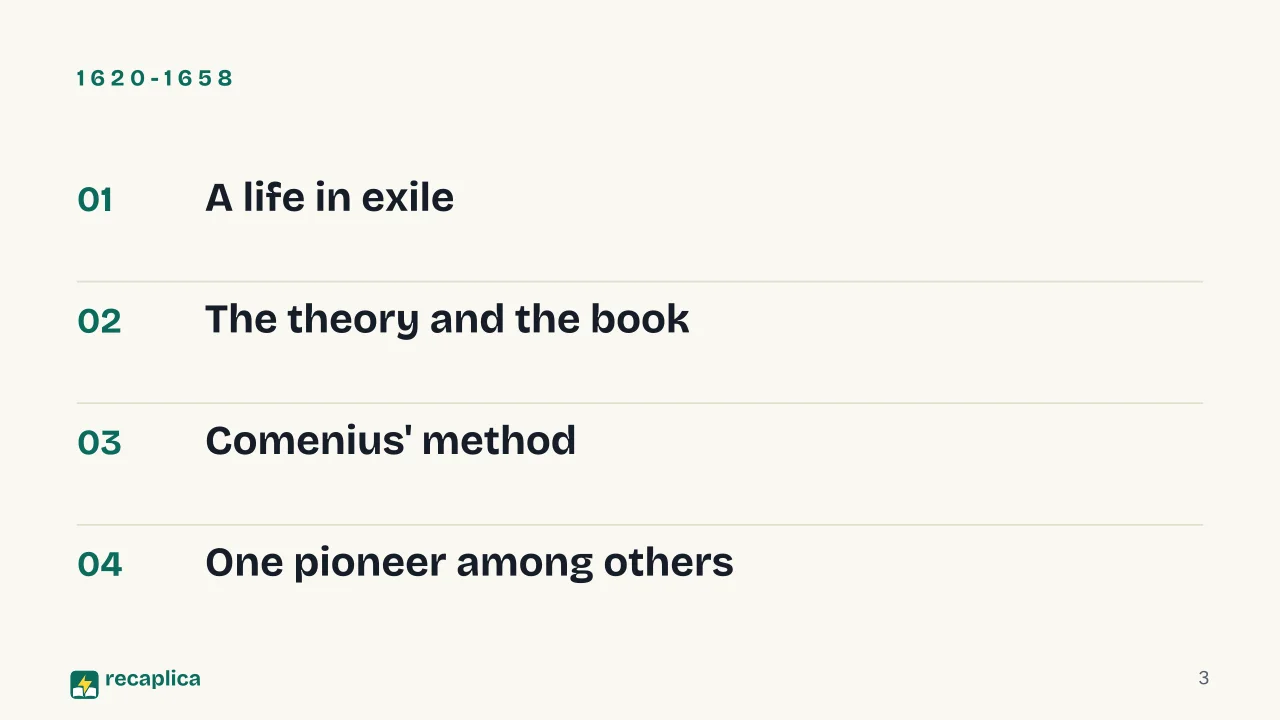
    Slide 1 of the presentation on Comenius: ComeniusSlide 2 of the presentation on Comenius: Why did a picture book teach children Latin?Slide 3 of the presentation on Comenius: 1620-1658Slide 4 of the presentation on Comenius: Chapter 01: A life in exileSlide 5 of the presentation on Comenius: Bohemia, 1592-1670Slide 6 of the presentation on Comenius: Chapter 02: The theory and the bookSlide 7 of the presentation on Comenius: From program to bookSlide 8 of the presentation on Comenius: Chapter 03: Comenius' methodSlide 9 of the presentation on Comenius: Senses · Gradual steps · No punishmentSlide 10 of the presentation on Comenius: The Orbis Pictus was not the first illustrated book in historySlide 11 of the presentation on Comenius: Chapter 04: One pioneer among othersSlide 12 of the presentation on Comenius: 1620 · 1657 · 1658Slide 13 of the presentation on Comenius: Why is Comenius considered one of the fathers of modern pedagogy, rather than the only one?Slide 14 of the presentation on Comenius: Comenius, 1592-1670
    Flash10 slidesThe essential thread, to present in classFull14 slidesEvery chapter and the deeper detail

    Common myths

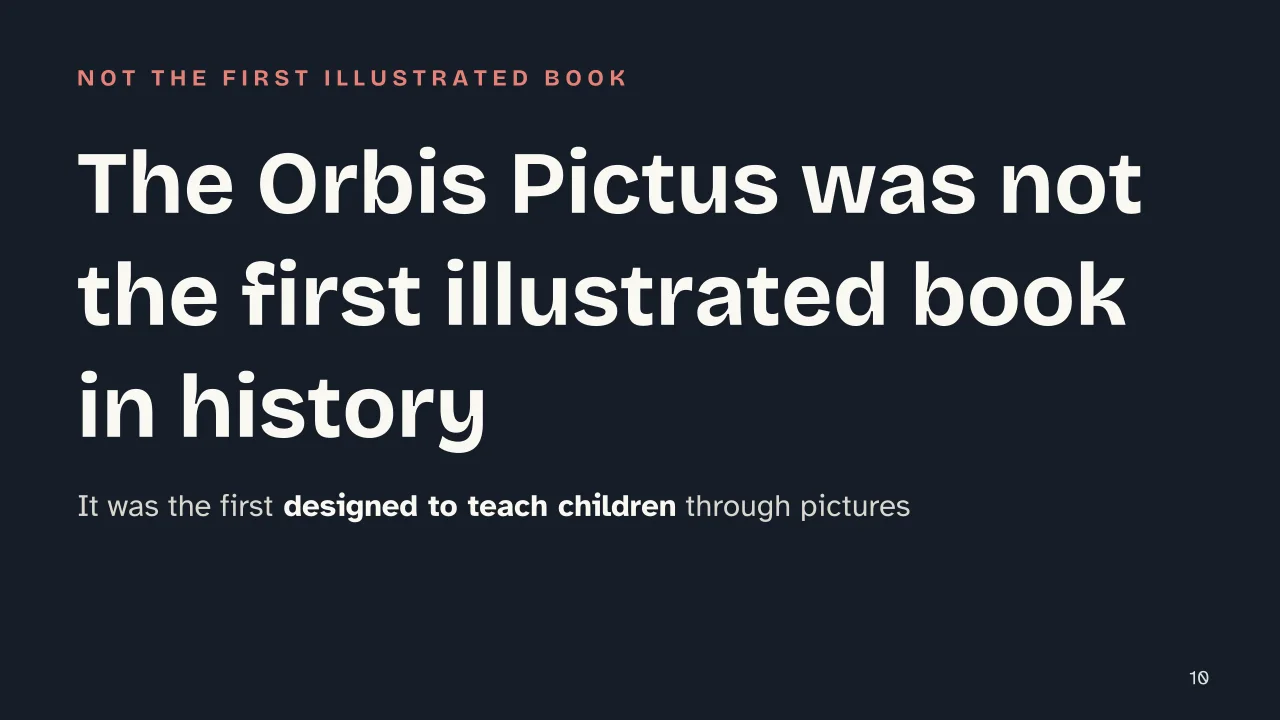
    • ✗ Myth Many believe Comenius' Orbis Pictus was the first illustrated book in history.

      ✓ Reality It was the first illustrated book designed to teach children through pictures, not the first illustrated book ever, since illustrated books for adults already existed before him: his novelty was the systematic use of pictures to teach languages.

    • ✗ Myth Many believe Comenius invented, on his own, the idea of educating everyone, rich and poor, boys and girls.

      ✓ Reality That principle was already taking shape within the religious culture of the Unity of the Brethren, whose bishop he was: his originality lies in turning it into a coherent teaching program in the Great Didactic.

    • ✗ Myth Many picture Comenius as a scholar who worked in peace in his native Moravia.

      ✓ Reality He spent most of his life in exile, through the Thirty Years' War, the destruction of Leszno in 1656, and the deaths of his first wife and two children as a refugee: his thinking took shape in exactly those conditions.

    Mind map

    Drag the background to move around and the nodes to reposition them; use − and + to collapse and expand branches.
    Customize
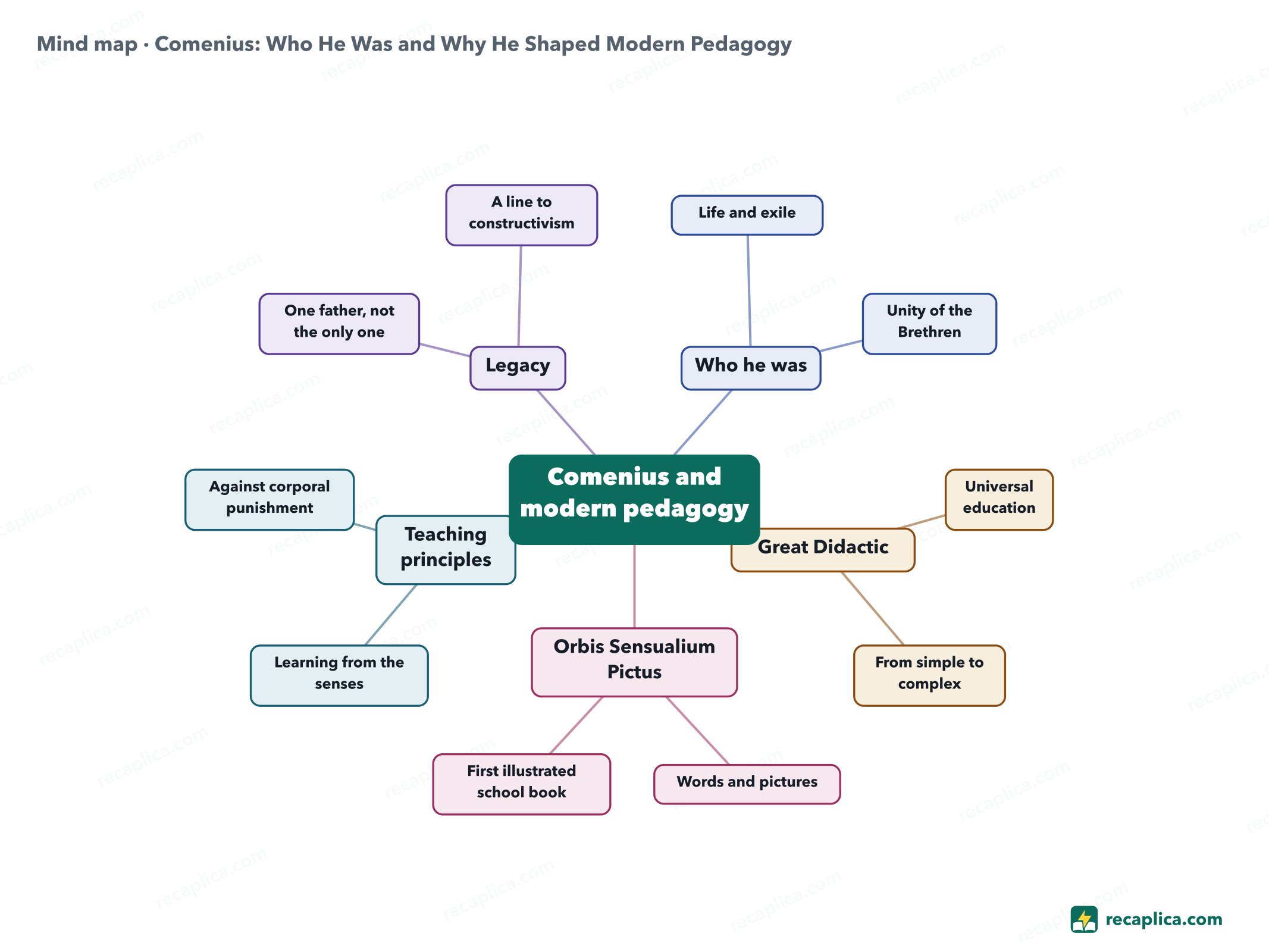
    Mind map: Comenius: Who He Was and Why He Shaped Modern Pedagogy
    • Comenius and modern pedagogy
      • Who he was
        • Life and exile
        • Unity of the Brethren
      • Great Didactic
        • Universal education
        • From simple to complex
      • Orbis Sensualium Pictus
        • Words and pictures
        • First illustrated school book
      • Teaching principles
        • Learning from the senses
        • Against corporal punishment
      • Legacy
        • One father, not the only one
        • A line to constructivism

    Quiz: test yourself

    Answer the questions to check what you have learned: you get instant feedback and a short explanation.

    Grade 0/10 0/5
    1 What is the main difference between the Great Didactic and Comenius' Orbis Sensualium Pictus?

    The Great Didactic set out Comenius' general teaching program; the Orbis Sensualium Pictus, published in 1658, was the school book that applied that program by teaching through pictures.

    2 True or false: Comenius argued that education should be reserved for children of wealthy families.

    Comenius called for free, universal education open to both sexes and all social classes: the statement describes the opposite of his proposal.

    3 In which city did Comenius live in exile after being forced to leave Bohemia in 1628?

    After the persecution of the Unity of the Brethren, Comenius moved to Leszno, in Poland, a town destroyed by Polish troops in 1656, which forced him into exile again.

    4 What principle underpinned the method of the Orbis Sensualium Pictus?

    For Comenius, all knowledge begins with the senses, and pairing words with pictures worked better than either on its own: a principle he applied, for the first time, in a school book.

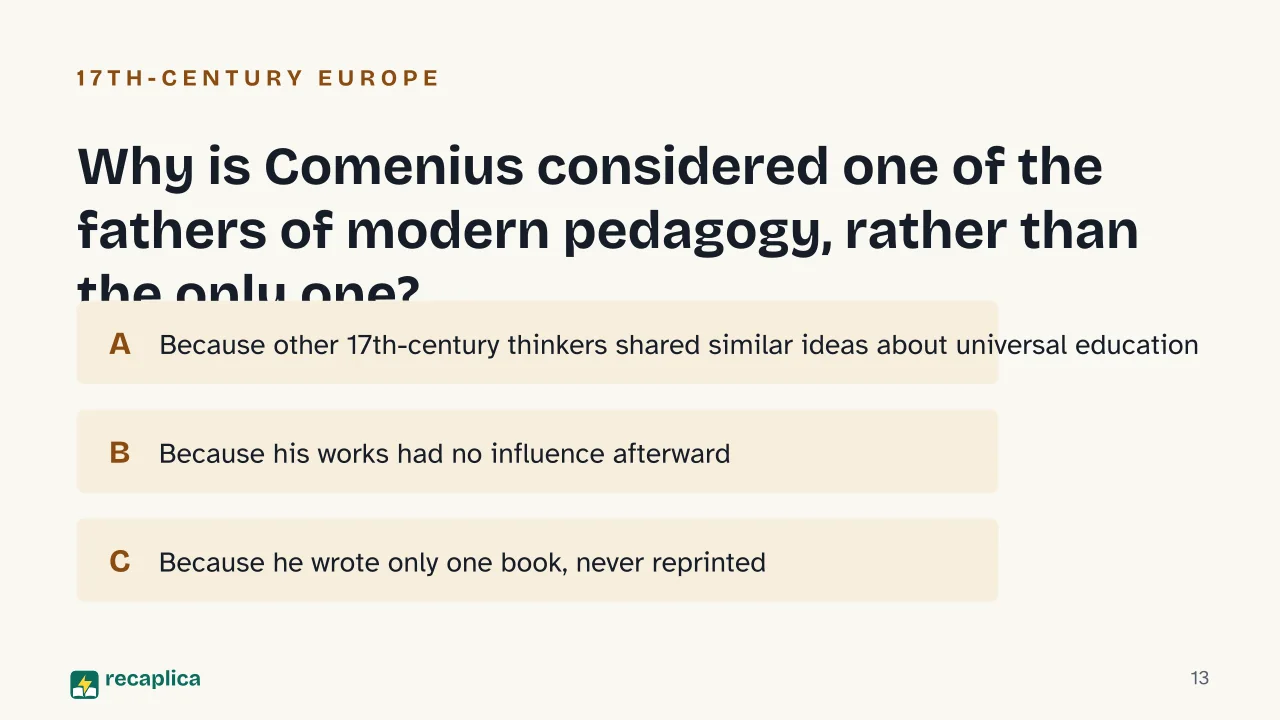
    5 Why is Comenius considered one of the fathers of modern pedagogy, rather than the only one?

    Comenius was among the pioneers who theorized universal education and the picture-based method in the 17th century, sharing that ground with other thinkers of his time.

    Answers: 1-A · 2-B · 3-A · 4-A · 5-A

    Flashcards

    Tap the card to flip it and check whether you remember the answer, then move to the next one.

    1 / 8

    Explain it in your own words

    The ultimate test: if you can explain it in simple words, you've truly understood it. Write your explanation, then compare it with the Recap.

    Your explanation is saved only on this device.

    Comenius was a 17th-century Bohemian educator, bishop of the Unity of the Brethren, and author of two works that shaped the history of schooling: the Great Didactic, his theoretical program, and the Orbis Sensualium Pictus, the book that put it into practice. He argued for education open to everyone, rich and poor, boys and girls, organized by stages matched to the learner's age. In the Orbis Pictus, published in 1658, he paired words and pictures for the first time in a book designed to teach children. He spent much of his life in exile, through religious wars and family losses, and it was in those conditions that he worked out his method. He is counted among the fathers of modern pedagogy, alongside other thinkers of his time.

    Frequently asked questions

    Who was John Amos Comenius?

    He was a Bohemian educator who lived from 1592 to 1670, bishop of the Unity of the Brethren and author of the Great Didactic and the Orbis Sensualium Pictus, two works at the root of modern pedagogy.

    What is the difference between the Great Didactic and the Orbis Pictus?

    The Great Didactic is Comenius' theoretical program, published in Latin in 1657; the Orbis Sensualium Pictus, from 1658, is the school book that put that program into practice by teaching with pictures.

    Is Comenius really the father of modern pedagogy?

    He is often called that, but he shared with other 17th-century thinkers the idea of education open to everyone and the picture-based method.

    Why is Comenius linked to the Orbis Pictus and not only the Great Didactic?

    Because the Orbis Pictus, published in 1658, was the first school book to put into practice his principle that pairing words with pictures helps learning more than either one alone.

    Did Comenius write his works during a calm period of his life?

    Quite the opposite: he wrote them during his years in exile, after the destruction of the Polish town of Leszno in 1656 and the loss of all his books and manuscripts.

    Sources

    • New World Encyclopedia — Comenius
    • Moravian University — John Amos Comenius, Father of Modern Education
    • Encyclopedia.com — John Amos Comenius (Complete Dictionary of Scientific Biography)

    Every Recap goes through an independent review before publication.

    Every evening, the day's new Recaps on our Telegram channel. Join the channel →

    Keep learning

    • History Ancient Greek Art: The Periods, Statues and Temples From Kouroi to the Hellenistic Age Greek art is usually split into four periods, from Geometric to Hellenistic, with the Severe style as the bridge between the two in the middle. Statues begin as the stiff kouroi of the sixth century BC, turn into the moving bodies of the Classical age and end as the theatrical groups of the Hellenistic world. Temples such as the Parthenon give sculpture its places: pediments, friezes and metopes. The dates are a teaching convention, because the changes were never sharp. Read the Recap →
    • History What Is Kinship? Types of Family, Descent and Residence Across Cultures In anthropology, kinship is the set of ties that a culture recognises as family: ties of blood, ties created by marriage and, in some cases, ties with neither, such as adoption. Families exist in every society, but in very different forms: nuclear, extended, joint, with several wives or several husbands. Cultures also differ in the line through which descent is counted, in where a couple goes to live and in the names given to relatives. A couple with young children is therefore one form among many. Read the Recap →
    • History Geocentric vs heliocentric model: from Ptolemy to Galileo In Ptolemy's system the Earth sat at the center of the cosmos, and the movements of the planets were explained by combining circles. Copernicus moved the Earth, which also called Aristotle's physics into question. Tycho Brahe, the greatest observer before the telescope, found none of the parallax that the Copernican model implied, and he proposed a compromise. Kepler's ellipses came in 1609 and Galileo's telescope discoveries in 1610, followed by Galileo's condemnation in 1633. Read the Recap →

    recaplica

    Clear in 30 seconds, yours in 10 minutes.

    Recaps Mind maps Request a Recap Telegram channel Mind map maker Our method About Privacy & cookies Legal notes & terms of use

    © 2026 Recaplica · A project by Curi S.r.l. — VAT IT05472000750

    Statistics, only if you say so

    To learn which Recaps help most we would use Google Analytics, with aggregate, anonymous data. It starts only with your OK, and you can change your mind anytime. Privacy policy